Technology (IJRASET)
Prototype Development of a
Smartphone-Controlled Robotic Vehicle with Pick- Place
Capability
Dheeraj Sharma
Electronics and communication department
Gian Jyoti Institute Of Engineering And Technology, Shambhukalan, Banur, Distt. Patiala, Punjab, India
Abstract— The work in this paper is directed towards the development of a robotic vehicle with arm and gripper, whose movements can be controlled by giving commands through android based Smartphone over Bluetooth wireless protocol. The Smartphone has been equipped with a suitable android application which can send up to Thirteen different codes wirelessly that can be decoded at the Bluetooth receiver end with the help of microcontroller based circuitry. The controller circuitry can then activate the various motors as per the code through suitable circuitry as long as the particular code is being received. The vehicle can move clockwise, anti-clockwise, forward and in reverse fashion. The arm has an elbow movement and the gripper has holding and releasing action.
Keywords— Bluetooth wireless protocol, Robotic vehicle, arm and gripper, Android application
I. INTRODUCTION
Now a day’s Smartphone’s based on android OS are becoming quite popular because of a wide variety of applications available for this particular OS. In this paper one of these applications known as “BLUECONTROL” has been utilized. With help of this application the user can send unique and discrete codes via Bluetooth communication protocol. Each code is decoded at the Bluetooth receiver end with the help of microcontroller 89C51 based circuit. The controller then generates outputs resulting in a particular movement such as movement of vehicle in forward and reverse direction, movement of elbow and gripper etc by activating suitable motors depending on what code is being received. The movement happens only for that amount of time for which a particular code is received successfully. Pick and place can be designed in various ways as in [1], [2] and [5]. Also android based Bluetooth technology implementation can be done using standard applications (e.g. [3], [4], [8] and [10]).
II. PURPOSE
The purpose in this paper is to design prototype of a wirelessly controllable robotic vehicle which can also pick and place small objects. Such a robot can in future be used in Industries for picking and placing objects in hazardous conditions. The main objectives are:
To use android phone for giving commands to the robot for a particular movement to happen. Usage of Bluetooth technology
Pick and place operation of small light-weight objects.
III.MATERIALANDCOMPONENTSUSED
A. Microcontroller 89C51
AT89C51 is an 8-bit microcontroller and belongs to Atmel's 8051 family. ATMEL 89C51 has 4KB of Flash programmable and
erasable read only memory (PEROM) and 128 bytes of RAM. It can be erased and program to a maximum of 1000 times. In 40 pin
AT89C51, there are four ports designated as P1, P2, P3 and P0. All these ports are 8-bit bi-directional ports, i.e., they can be used as
HC-05 module is an easy to use Bluetooth SPP (Serial Port Protocol) module, designed for transparent wireless serial connection setup as in [7]. Serial port Bluetooth module is fully qualified Bluetooth V2.0+EDR (Enhanced Data Rate) 3Mbps Modulation with complete 2.4GHz radio transceiver and baseband.
Fig. 1. HC-05 Bluetooth Module
C. L293D Motor Driver IC
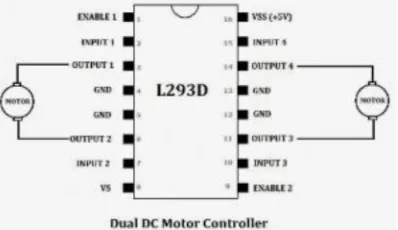
L293D is a typical Motor driver or Motor Driver IC which allows DC motor to drive on either direction. L293D is a 16-pin IC which can control a set of two DC motors simultaneously in any direction. It means that you can control two DC motor with a single L293D IC. It works on the concept of H-bridge. H-bridge is a circuit which allows the voltage to be flown in either direction. As you know voltage need to change its direction for being able to rotate the motor in clockwise or anticlockwise direction, Hence H-bridge IC are ideal for driving a DC motor.
Fig. 2. L293D Motor Driver IC
D. DC Motors
This helps in moving various parts of the robot. The 5 V dc motor has two terminals. By changing the polarity of the supplied voltage at these terminals, one can change the direction of rotation of the motor. Two such motors have been used in the vehicle which helps in its forward, reverse, clockwise and anti clockwise movements. One more motor has been used for providing the elbow movement.
E. 5V Servo Motor
[image:3.612.214.413.387.502.2]Technology (IJRASET)
Fig. 3. 5V DC Servo motor
One such motor has been used to provide the gripper holding and releasing movements.
F. 7805 Voltage Regulator
This provides regulated 5V dc for the control as well as the power circuit.
G. Blue Control V2.0 Application
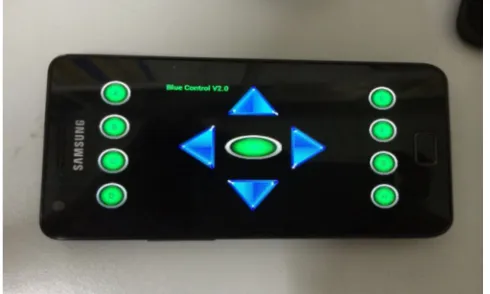
[image:4.612.191.436.326.473.2]This is an android application which has been installed in a Smartphone as in [6], [9]. It helps in operating the phone as a universal remote control for sending commands to the microcontroller over Bluetooth protocol.
Fig. 4. Bluetooth Remote Control Interface (Blue Control V2.0)
[image:4.612.188.436.499.696.2]interfaced to the microcontroller. These characters are detected by the microcontroller and for each particular character it enables particular outputs at the output ports. The outputs are then amplified with the help of motor driver ICs and finally lead to the movement of the motors.
For the servo motor, the microcontroller sends timed pulses so as to achieve a definite positional displacement of the motor which finally leads to a proportionate movement of the gripper.
V. CONTROLLOGIC
Microcontroller waits until it receives a character at the serial port.
After that it compares the received value with some preset reference values.
If value matches then a particular value reserved against the preset reference value is sent to the output port which activates dc motors accordingly.
In case of servo motor the timed delays of the pulses is changed depending upon whether the gripper has to holding or releasing. The loop is repeated by going back to step1 of the control logic.
VI.RESULTSANDDISCUSSION
After the mechanical and electronic fabrication, the robot has been tested for operation. Following results have been obtained:
The vehicle moves in forward direction when UP arrow button is pressed in the Smartphone application. When DOWN arrow is pressed the vehicle moves in the reverse direction.
Pressing of LEFT arrow button leads to the vehicle rotating clockwise.
Pressing of RIGHT arrow button leads to the vehicle moving in anticlockwise direction. On pressing “A” button the elbow moves upwards.
On pressing “B” button the elbow moves downwards. “C” button activation leads the gripper to open. “D” button activation leads the gripper to close.
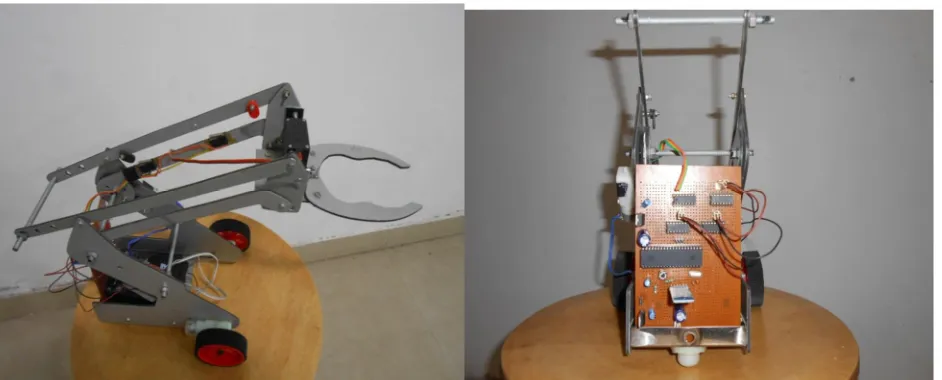
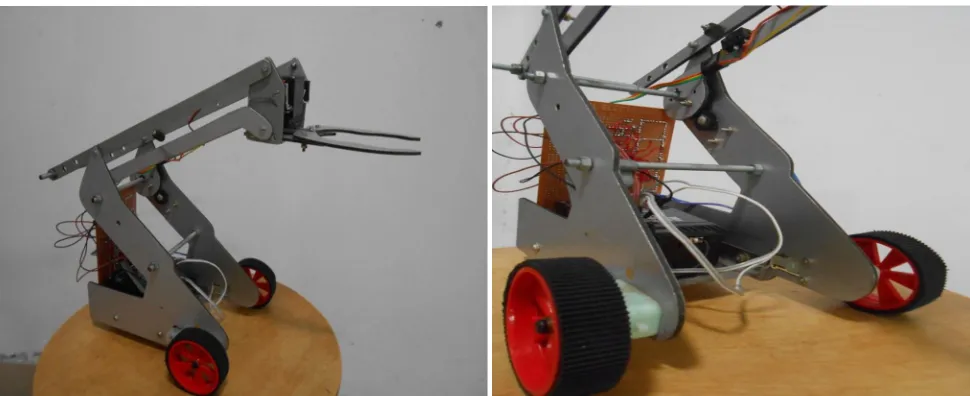
Various views of the robot have been shown in figure no. 6 to figure no.11. which give an idea of the mechanical structure as well as the electronic pcb used.
[image:5.612.81.552.514.704.2]Two limit switches have also been used which may not be visible in the images. These switches help in limiting the span of the elbow movement in order to protect the dc motor against sudden surge of high current when elbow reaches the maximum traversable distance and is unable to move further because of the mechanical limits. These switches cut off the dc supply to the motors when end limits of movement are reached.
Technology (IJRASET)
Fig. 8. Robot Image3 Fig. 9. Robot Image4
Fig. 10. Robot Image5 Fig. 11. Robot Image6
VII. CONCLUSION
A wirelessly controllable robotic vehicle with pick and place capability has been designed. Such a robot can be used in hazardous industrial environments where there is danger to the human workers and labour etc. Also, the bluetooth technology is free to use and thus provides a cheap way to control devices wirelessly. The robot can be equipped with a wireless camera in future for better remote accessebility.
REFERENCES
[1] Mir Sajjad Hussain Talpur, Murtaza Hussain Shaikh. Automation of Mobile Pick and Place Robotic System for Small Food Industry. IEEE Digital Library. 978-1-4577-1139: pp. 522-526, 2012.
[image:6.612.71.556.309.507.2]200-Measurement, Computer Communication and Control.Beijing. pp. 887-890, 2011.
[6] [6] Android Developers Guide. Android Architecture. URL: http://.android.com/about/versions/index.html. [7] HC-05 blue-tooth module , http://www.Lanwind.com/files/hc-06 en,pdf.
[8] Bluetooth based android phone/tablet controlled robot, http://www.robokits.co.in and http://www.robokitsworld.com [9] Smart phones android operated robot, http://www.sooxmatechnologies.com