BIROn - Birkbeck Institutional Research Online
Jackson, M. and Leslie, Esther (2017) Unreliable matriarchs. In: Cohen, M.
and Otomo, Y. (eds.) Making Milk: The Past, Present and Future of Our
Primary Food. London, UK: Bloomsbury. ISBN 9781350029965.
Downloaded from:
Usage Guidelines:
Please refer to usage guidelines at or alternatively
Unreliable Matriarchs
Melanie Jackson and Esther Leslie
ABSTRACT:
Milk’s fluidity and ostensible purity belie a complex array of industrial and regulatory
processes, and a thick web of social and cultural associations, and provokes a language for
emotion and thinking.From the milk of human breasts to industrialized cow’s milk, milk
combines with social operations and is invented anew, malleable under the pressures of law,
fashion, science and economy. Fantasies of milk’s powers recur, from the medieval lactating
Virgin Mary to the contemporary promise of raised I.Q. through formula or enhanced milk.
On account of its opaque properties and evocative associations, milk enjoys a particular
relationship to photographic representation. This relationship is extended through CGI
imaging, which finds novel ways to represent the drama inherent in milk, a play off between
self-forming agency and capture of a supply for siphoning into profitable ends. Milk acts as a
spectrometer that can reveal to us the defining characteristics of an epoch.
Introduction
Milk is an ur-substance, an originary substance (Cassirer 1994). It is the first substance to
enter the mouth, to touch the tongue, to fill the belly. It is the first fluid to be incorporated into
the body outside the womb. Pure white milk is an ideal-type or a norm and, as such, it is a
extruded. It is formless, but can take on any form. It takes on shapes, the shape of the vessel,
or the shapes pressed into it when in solid form. It is indexical.
Milk's uniform white color is achieved by separating all of its constituent molecules,
then recombining them in complex formations. If we disrupt milk’s turbid surface and explore
the practices and properties intrinsic to milk preparation — of separation, recombination and
homogeneity — we can mobilize milk as a ‘filter’ through which to explore more broadly
how relations between human and non-human entities, gender, representation, law,
technology and abstraction are set in motion. Milk helps us form our first words and catalyzes
a language of milk that is quickly adapted to a language of cogitation and communication,
forming a social and cultural matrix of metaphor: skim, condense, homogenize, express,
churn, curdle, culture, sour, combine, separate. Milk is polymorphic with an inclination for
promiscuous collaboration – whether it be with bacteria, with cartoon avatars, with
economics, pornography, racial politics or genetic re-calibration. Recombination emerges as a
methodological question too — combining different approaches, materials, histories,
disciplines, in order to ruminate on milk’s meanings. Milk thus acts as a spectrometer — an
apparatus that can reveal to us the defining characteristics of an epoch.
To perceive the shapes within milk, the ways in which it has been shaped over time, is
to give oneself up to its minglings, its combinations and recombinations with myth, social
norms, social fantasy, cultural and practices. It means to conceive its expressability, its
capacity to be images, to seep into language and be made metaphorical. It means to observe
its capacity to be extracted and abstracted, It necessitates thinking about the ways in which an
abstracted for capital, into data, into something limitlessly re-producable and separate from or
other to itself.
The Abrahamic religions overflow with milk’s sweetness, its nurturing power and
metaphysical transmissions (Maillet, this volume). In Gaston Bachelard’s (1942)
phenomenological account, water is a dream liquid, cleansing, pure, as fluid as the
imagination. But milk — opaque, catalytic, combinatory — flows in more directions. It seeps
into our social fabric and freezes into discernible forms. Its opacity makes of it a screen that
reflects back a cornucopia of meanings. Milk’s busy activity is associated both with restful
sleep and nightmare visions.
We can trace associations with cheese and nightmares to the early days of the moving
image. Winsor McCay's 1900’s cartoon strips and animations Dreams of the Rarebit Fiend is
a world of nightmares populated by fractious scenes of wish fulfillment, and distortions of
scale and perspective triggered by the night-time consumption of cheese, in what was the
early 20th century’s junk craze: the proto-pizza form of the Welsh Rarebit. Here to be found in the animations The Pet (1921) and The Flying House (1921) are apparitions of species-ism,
with an outsize and insatiable beast masquerading as a domestic pet growing to gargantuan
proportions, and a flying sequence where the house literally transcends capitalism's emerging
suburban grid, with its illusions of rationale and security betrayed by our inculcation into the
de-stabilizing debt-economy.
Milk is a complex liquid, lending itself to reformulation, regimentation, innovation —
the rules of the nanny and the boss, the technologist and the venture capitalist; to every kind
— think of the Greeks and Israelites as herders. Life, milk-sustained life, is linked to fate and
destiny. The land that flows with milk and honey was a specific reference to the homeland of
a herder people — Canaan was good land for dairy herds. This bountiful land became the
very model of a life sweet and fulfilled. Contemporary idiomatic language is replete with spilt
milk, milk sops, milk runs and milk routes, milk and water, running dry, milking it for all its
worth — all expressions of negativity, weakening and exploitation. They signal something of
our contemporary dis-ease with anything that evokes dependency, Dependency is an abject
state in an age dominated by a capital form that despises welfare, but thrives on precarity
(Bell 1997: 45-57). There is, then, a milky language that speaks to our emotions, our
socialization and our hopes. Can we extend this milky language to help us articulate what
milk means, how it produces and generates meaning?
Though milk is a primal substance, it is also a substance that is ever invented anew,
socially annexed, fraught. Milk has generated a busy activity of human and bovine
transformations. Historically, it formed the basis of thousands of products. The geographical
specificity of different articulations of cheese is notable. Different cows, different grass,
different bacteria, different air and soil and nutrients, different vessels and practices. Its
multiplicity is also evident in the variety of forms that it is shaped into in today’s modern,
industrialized dairy environment. In frozen, liquid and powder forms, it is the matter of
infinite innovation. It is dairy turned airy — in ice creams that swell up with nothingness
injected. It teams up commercially with a bestiary of cartoon avatars, and a dazzling spectrum
of synthetic colors. It is frozen into colorful crystals with personality, in a crowded frozen
treats market, whose products bear ever less tangible relations to milk. Concoctions of
partially reconstituted skimmed milk concentrate, sugar, vegetable oil, whey powder,
superheroes, cartoon villains, baroque architectonics and human body parts. For marketing
purposes the cow is often replaced by wily, smart-talking animals and apocryphal consumers
of milk – cats, rabbits, mice – leaving only a vestigial hint of its animality, a sign of the
interspecies promiscuity of milk.1 The ontology of donor species collapses as it re-forms into consumable biomass.
[Figure 1]
The Lick, Melanie Jackson, 2015. Courtesy the artist.
Milk’s capacities can also be signaled as weaknesses that can be overcome — for example
ultraheat treatment to prolong milk’s life. Lactose-free, omega-3-enhanced, full fat, low fat,
no fat. Its various forms are met by its invariant standardization. It is refined, homogenized,
monetized, mechanized and modernized. It is processed and recombined to extend its
functionality. The Mcflurry, Mr Whippy, Dairy Queen Blizzard, Cheese String, Dreaming
Cow, Laughing Cow, Skinny Cow, Crusha, Marvel: These dairy icons perform both health
and the abuse of health; an array of high calorie, high fat, low calorie, low fat, high sugar,
sugar-free, highly processed glimmer with techno-scientific, multi-color, hedonistic appeal.
manufacture — they are seemingly transgressive yet are utterly pervasive, hyper-normative
products. These products pitched at young people and children collaborate with a plethora of
high energy animated avatars and mascots in ecstatic reverie, weaning children from the
breast and the bottle, in a sugary addictive lure. The dairy products pitched at infants, or
rather their mothers, — in the form of formula milk — continue to proliferate in an ever
expanding market and are one of the few products on the market said to be immune to
economic cycles.
Cows’ milk is one of the most technologized liquids on the planet and appears in
recombination not only as food, but in fertilizers, airport de-icers, bottle labeling adhesives,
methane, ethanol, anti-wrinkle agents, shampoo, hand cream, floor leveling, leather finishing,
paper coating, concrete and cement. It appears as supplements and catalysts, emulsifiers and
surfactants. Milk re-enters the human body surreptitiously, as concentrates and isolates, in the
form of whey protein, to be incorporated into the muscle mass of male bodybuilders(Audic,
Chaufer and Daufin 2003).This technologized body of milk is at once a site of redemption
and annihilation.
Industrial Metaphysics
Separation is a capacity within milk (Selia dos Reis Coimbra and Teixeira 2016). Milk is
separated from cream, curds from whey. Separation is at work in the distancing or abstraction
of milk from the female mammal’s body by various means. Separation abounds in the milk
industry whereby calf is separated from the cow, and milk is extracted from animals for
human consumption. Separation more broadly occurs between nature and culture, commodity
object is separated from subject. Separation is also part of the process of individuation.
Separation is our situation. We separate from our caregivers, having passed through the nexus
that milk provides. Milk extracted or abstracted is a liquid representation of an annihilation of
nature over time. In producing cows’ milk for humans, there is no seasonal cycle related to
gestation. Through adapted breeding cycles, genetic and hormonal adjustments, there is
instead the endless time of ever increasing and ever adapted milk yields. This is the time of
the market, production and circulation. Production time is decoupled from the idea of limits
and insists that what is profitable is available at all times. (Hammer 2011: 46-48.) Milk flows
across the political body, its stream an emblem of progress and the perfectability of modern
times. Situating it as infinitely available, fresh, white, aseptic and central to the adult Western
diet became a driving quest of modernity, articulated in enough contexts to make of it a
narrative. The mass industrialization of milk was a mode of industrial metaphysics: an
abstraction from its associations with female human and non-human animal lactation, and a
transformation into an industrial staple. It is a fluid that flows through contemporary
distribution networks, and helped to bring them into being. How does the mechanization of
milk position the cow as source of the milk? As doubled form — a product of pastoral fantasy
and the bio-politically invaded. The source of milk, whether bovine or human, has to be
regulated, access to supply guaranteed, subject to regulation and laws (Cohen 2015). The
availability of milk exemplifies the mass operations that often invisibly, or in peripheral
vision, in the very corner of our eyes, guarantees the social reproduction of our existence.
Dairy is the industry that has pioneered the application of big data, assisting milk’s
accelerated abstractions into chemical components, economic actions, and bodily
manipulations. It has provided a model for other industries to generate their algorithmic
Milk is enmeshed industrially in various operations that shape it metaphorically and
abstract it from the producing body. But the producing body of the milk giver is no simple
entity. It is monstrous. It refuses. It takes on other shapes. For example, humans have engaged
and imagined other milk suppliers, which take on the shape of unusual caregivers. In myth, a
nanny goat was said to have nursed the baby Zeus and a she-wolf fed Romulus and Remus.
Between myth and rumor, Wild Peter, who appeared in North Germany in 1724, was covered
with thick hair, said to have grown as a result of him suckling from a bear — he imbibed with
the milk his nursing mother’s characteristics. (Douthwaite 2002: 22-25; Maillet, this volume)
Recent research into cockroach milk, which has been proposed as a protein-rich ‘superfood of
the future’, extends this relation (Banerjee 2016).
At various times in history, breastfeeding appears as an animal act, suitable only
for those who live amongst animals and are themselves more animal-like. Whereas in
the pre-modern period the animal aspects of breastfeeding were acknowledged such that
images of interspecies nutrition were available, the modern period introduces a series of
separations and divisions of class and status, and a philosophy of Humanism dependent
on hierarchies of beasts and humans, as well as within humankind, which render these
problematic (Fraisse 1994: 120-121). Why would a woman of status wish to turn herself
into a Milchkuh? The breasts of poor women were hired out to feed the children of
wealthier women in Europe. Wet nursing was considered acceptable occupations of
working class and non-white women — whose bodies were deemed closer to those of
animals (Schiebinger 1993). In eighteenth century Europe, breastfeeding was
unfashionable amongst the aristocracy and rising middle classes. Ladies believed it
would ruin their figures, spoil their health and interrupt the endless rounds of card
‘vestigial’ as were male nipples — organs transcending their original venal qualities
(Gould 1993; Cohen, this volume).2
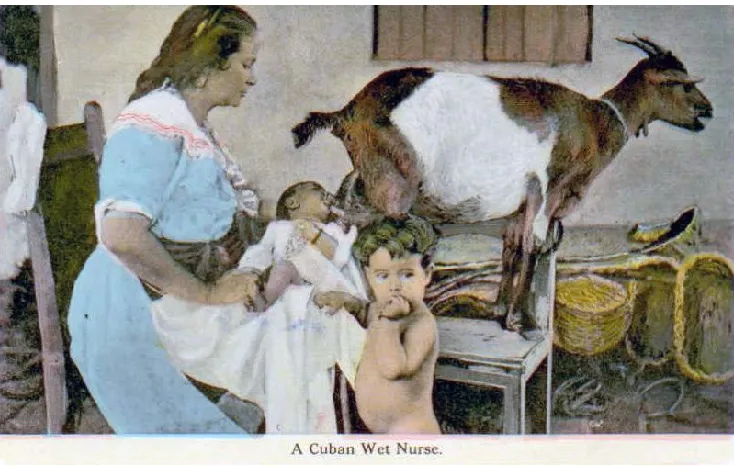
FIG 2
Curt Teich 1903, courtesy of The Wellcome Trust
There was not alwayssomeone to pay women to suckle babies who had been orphaned
and were brought up communally in philanthropic institutions such as the Foundling
Hospitals of the eighteenth century. Animals often sufficed to perform this role.
(Fauve-Chamoux 2000: 631) Abandoned syphilitic children, for example, suckled from
mercury-infused goats and other creatures (Fletcher 2011).Teats, not nipples, were for
their mouths. Today’s plastic bottles have teats rather than nipples too, linking these
artificial feeding mechanisms to what has now become an alien practice: cross-species
wet nursing (Maillet, this volume). The scarcity or supply of milk is a long-standing
issue and through its exigencies, breast milk is made moral, venal, and metaphorical.
[image:10.595.79.446.153.386.2]produce nourishment might signify the transcendent or the bestial. In either case there is
a separation off from the human.
The French draughtsman Honoré Daumier made several images of women
nursing. He entered a sketch for a state-sponsored competition in 1848, to define the
painted face of the Republic. His sketch is of a classically dressed woman in white
robes, seated indoors with children feeding from her exposed breasts. It is almost a
direct transposition of Delacroix’s Liberty at the Barricades, with the armed defenders of
the Republic depicted as (atypically older) suckling children. Liberty is now tethered to
a chair, flag rolled at her side. The image suggests that it is the duty of women to nurture
the citizens of the state. No longer bare breasted in the throes of revolutionary struggle,
they now have reproductive duties to the state. Captured in this abstraction of official art
as instruments of the state, milk-laden breasts become metaphorical. It is no coincidence
that in the new Republic actual women were no longer able to institute feeding networks
and informal networks of wet nursing became illegal.3 Over time, as the century passes on, issues of supply become crucial in the context of deprivation and displacement.
Instead of the state dispensing metaphorical milk in the shape of welfare to its citizens,
the state and private industry combine to control the supply of milk to those who are
becoming undernourished within the ravages of the industrial capitalist system. It is at
this point that animal milk – cow’s milk – comes to the fore, presenting a predictable
and constantly manageable flow that can subjected to technical analysis and
commodification. The whole body of the cow can be taken possession of and integrated
into the grid of supply and demand, circulation, quantification and standardization.
interposes, separating source and recipient, producer and consumer, it finds acceptable
form.
Formula milk is presented as a fix to problems of undernourishment and infant
mortality. First invented by Justus von Liebig in 1867(Brock 2002), ‘Liebig’s Soluble
Food for Babies’ was manufactured and sold in London by the Liebig’s Registered
Concentrated Milk Company. It was composed of cow’s milk, wheat, malt flour and
potassium bicarbonate. By 1883, there were 27 patented brands of infant food on the
market (Stein 2014: 162).The history of infant feeding was a triangulation between the
promises of technology, commercial pressure, and the promotion of biology (academic
knowledge of the body). By the following century, doctors recommended milk in this
form as superior, because of a devaluation of anything the (female) body could produce.
It is the only fluid created by the human body science presumed to have exceeded. It is
not until the 21st century that the full complexities of human milk are beginning to be
apprehended (Ballard and Morrow 2013).
A pertinent separation in relation to milk is that of the separation of mind from
body, and body mass and intelligence. This has been visualized in medieval stories
where breast milk provides sacred cognition out of a visceral and bestial source — the
visceral body denounced constantly as part of initiation into the sacred. The trope of
breast milk as something venal and transcendent is repeated in medieval mythologies
where St Bernard is sprayed with the virgin’s breast milk as an act of divine intervention
— the story is told variously as providing sustenance straight into his lips, to cure vision
in his infected eye, or to augment spiritual and cerebral insight and applied directly to
successor Henry of Clairvaux — who when summoned to suckle directly from the
virgin’s breasts was filled with mental clarity — with sacred words — whereby
cognition and godliness were dispensed in milk — Bernard called it the elixir of the
‘science divine.’ The cult of lactating Mary persists as a contemporary phenomenon.
The lactating Virgin can still be found in shopping centers across the Philippines and
[image:13.595.114.334.264.604.2]circulating internationally on eBay.4
FIG 3
SM Mall of Asia, Pasay City ,Mr. Marco Driz Dalma., 2011, courtesy of the photographer.
Technological processes for separation allows for the ubiquity of formula milk. Formula
milk is now couched in the language of the technically advanced upgrade, genetically
names resonant of growth and transcendence: ‘Optimal’, ‘Advantage’, ‘Humana’,
‘Platinum’ ‘Gold’. There are promises of great futures and social advantage. In Asian
markets the anglicized brand names reflect the market confidence, regulation and
corporate standardization alluded to by Western origination — combined with
aspirational technophiliac fantasy: ‘Smart baby’, ‘gene-plus’, ‘nu-gene’, ‘neo-baby’,
‘neo-kid’, all brand names of formula milks. In all there is an imperative of intelligence,
improvement — insinuated is a transfer of smartness from substance to baby brain. Just
like the smart phone, that is smarter than us and makes us smart, milk is smart —
technically augmented — and makes for smart babies. There are also breast pumps
“featuring new iQ Technology”; the pitch is: the pump’s memory chip makes it smart,
but the name also plays on claims that human milk, like fortified formula milks, raise
I.Q. scores.
Donna Haraway (1997: 22-72) has underlined the ways in which milk is
available for separation and recombination — as indicated in her lines on how “breast
milk is not nature to the culture of Nestlé’s formula. Both fluids are natural-technical
objects, embedded in matrices of practical culture and cultural practice.” (Haraway
1997: 58) All too often a polemical distinction is made between natural and artificial
forms. A humanist philosophy of science assumes that its inventiveness can exceed
anything that nature has produced, but at the same time, something called nature is
essentialized and rendered a source of specific value. What is key is that whatever is
devised does not exist in a vacuum, but is drawn into a matrix of valorization, which
overdetermines its expressions. But what the body produces ‘naturally’ cannot be
shrugged off. There is a constant need to refer back to it — because what is found out, in
subtle, responsive, biodynamic: an adaptable, multi-purposed liquid, which is emulated
and subject to optimizations (Ryan, this volume). Despite historical claims and efforts to
improve on the fluid, no such task has been accomplished.
Women are endowed with problematic messy bodies. According to Grosz (1994:
21), “women’s corporeality is inscribed as a mode of seepage.” Formula milk and
expressed milk extract, separate, and attempt to recombine that problematic fluid into
something more streamlined. Bodies become erased in the dynamic of technologically
realized reproduction and modes are sought of imagining breastfeeding and breast milk
that obliterate intimacy and bodily exchange. This is why it returns as again and again as
pornographica and as excessively visceral fantasy. We are strangely ambivalent about its
visibility as a source of nutrition and comfort for babies but as a seeping spurting image
for adult sexual consumption, in a return of the repressed, lactating breasts form their
market niche in the pornographic index: Preggo/Milky.
Breastfeeding is not just about the provision of milk. It is also not just about
intimate bonds. Like the act of reproduction lactation is the enactment of a splitting, of a
formation of self and part-self that is to become other. It disrupts the dominant motif of
the bounded body, of sovereign individuality. Milk is a bridge between bodies: an
emission from one and an incorporation into another. This can be evidenced in the
relatively recent proliferation of the brelfie, the breast feeding selfie — at once an image
of self and not the self — bodies joined in the transmission of milk. (Boon and Pentney
There is a social anxiety attached to this enactment of self-splitting. It is
mobilized to validate the social separation of the breastfeeding woman from the public
environment whether through shame, or through lack of paid maternity leave, which
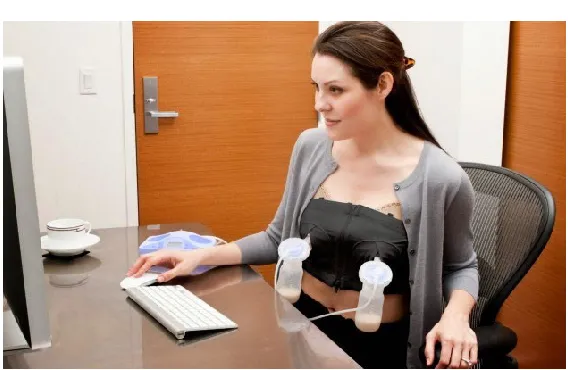
produces the need for the technological fix of the breast pump. Breast pumps are now
designed so that women can continue to be optimally productive — expected to work at
the computer whilst lactating, even whilst travelling or exercising. This socio-economic
and political context of infant feeding cannot be stressed enough (see also Smith, this
volume).
FIG 4
permission needed:
http://www.momtricks.com/breast-pumps/best-breast-pump-for-working-moms/
Milk of the Abysmal
Milk for babies has to be supplied. How this supply takes place has shifted historically,
but it has also long been imagined and played around with. Extracting milk supply from
[image:16.595.113.397.338.523.2]Indeed it is there in the origin myths that imagine the beginnings of time and space and
account thereby for the emergence of the starry Milky Way. This myth conveys a first
separation of milk from milk giver. The Gods want control of the supply, to wrest it
from the unreliable matriarchs. This is a battle over supply and it will recur in various
ways across time. According to the foundation myth in Ancient Greece, the Milky Way
was formed when the philandering Zeus held up his lover’s baby to his wife Hera’s
breast as she slept, hoping to suckle a little divine milk for his part-mortal son. Hera
awoke to find the usurper upon her and knocked it away. As she did so an arc of milky
droplets reached far into space. In Roman myth too the Milky Way forms from the milk
spilt from Opis’s breast in her attempt to save her newborn son Jupiter from being
devoured by his father Saturn, King of the Skies. She wrapped a rock in swaddling cloth
to try foil the hungry God, but when he forced her to nurse the decoy infant one last
time, her milk splattered into the heavens when her breast pressed against the rock’s
hard body. Jupiter is taken away and brought up by the Nymphs, suckling milk from the
goat Amalthea. In her own origin story the Egyptian deity Hathor makes her first
appearance as Ra, Goddess of destruction. She is intoxicated by annihilation, set on the
eradication of all human life. She is held sway, in nihilistic rapture, until she is tricked
into drinking wine instead of blood (Hyginus Gaeus Julius Astrominca II: 11-43).
In these origin myths, spilt milk evades the lips of the babies, hits the heavens,
makes a cosmos and is codified as milk of the abysmal, of death and destruction. What
could give life denies it too. They found their way into visual forms such as in the
painting of the Renaissance, where the epic squirt of breast milk reaching far into the
cosmos is rendered in splashes of oil paint, as in Tintoretto’s Origin of the Milky Way
this epoch that Galileo Galilei fixed the stars through a lens. The Ancient Greek
philosophers had thought that the Milky Way might be a vast collection of stars, too dim
to make out individually. But proof came when Galileo pointed his crude telescope at
the Milky Way in 1610, and was able to see that the Milky Way was made up of
countless stars.Through his lens the smooth splash of the Milky Way was revealed as a
cluster, as points — pixels of light (Maran and Marschall 2009: 127-8). As he pointed
his telescope upwards, others turned the same lens downwards and away from the
biggest things to look at the smallest things. They peered into what surrounded them,
inaugurating a scrutinizing glare into milk through the means of glass (Fletcher 2011:
106).
Milk communicates with the lens in pursuit of death and disease. Microscopes
stare into raw milk, watching and counting bacteria and somatic cells, and, in this act,
remind us that body fluids formed some of the earliest matter for the microscope. In
1646, Athanasius Kircher magnified the blood of fever patients and found much of
interest there (Kircher 1658; Fletcher 2011: 115-121). In 1658, in his Scrutinium Pestis,
he wrote of deadly microscopic ‘worms’ in the blood of plague victims — it is
impossible that he could have seen the bacillus, but rather, was probably viewing pus
cells or red blood cells. Leeuwenhoek, the lens grinder, saw much through the
microscope, including dental tartar, crystals of sodium urate that form in the tissues of
gout patients, dogs, pigs, molluscs, amphibians, fish and birds, even his own sperm. In
1683, he saw the lymphatic capillaries, containing ‘a white fluid, like milk’
(Leeuwenhoek 1952: 181).As Leeuwenhoek and the other seventeenth century pioneers
of microscopy looked into the body they found it teeming with other forms of life. For
For others it profoundly altered humanity’s position in the cosmos. The cosmos
was suddenly much larger and infinitely more complex, everywhere populated with life,
previously unseen. Humans become less central. This new tool to explore the invisibly
small made it visibly large. Over the eighteenth and nineteenth centuries, deciphering
which of these worms were good (sperm) and which ‘bad’ (bacteria) became a quest.
The molecularization of life discovered under the microscope was so unexpected and so
radical that, even in 1840s when higher magnification microscopy revealed ever more
detail, it still took decades to be universally accepted — and was still a novelty in 1903
when the Francis Martin Duncan program of films billed as The Unseen World screened
at the Alhambra Music hall in 1903. Cheese Mites was the smash of the show. The
image of the mites scuttling around on screen enlarged to the size of monsters created a
sensation in the audience. Spectators were at once fascinated and revolted by what they
saw.
Nowhere was bacteria pursued more aggressively than in milk — which nurtures
when drunk directly from the body and had a tendency to poison when removed from it
— the milky environment perfect as it is for nurturing all scales of life. The imperative
of ‘purifying’ milk — became a driving principle of the modern era.
Milk’s Machines
Milk met the camera as its perfect accessory. From the early days of photography, there
was an interest in photographing the liquid, making a record of its shapes and
fluid, caught as it splattered, spilt or gushed? Water lets light through and evades
visibility. Milk, opaque, even in tone, pale, outlined itself before the camera, filling out
its dribbled contours or leaping into its splashes or sprayed coronets and fronds. A.M.
Worthington (1908) observed and photographed for thirty years the collision of a milk
drop on a surface, making visible evidence for the science of fluid dynamics. These
observations were published in 1908 as A Study of Splashes. As the lenses got faster,
milk’s fluid action was captured in split-microsecond dramatic shots, such as those of
milk forming crowns, carried out again and again by Harold Edgerton. What was at
stake here was the gaining of knowledge for a more violent activity, for the milk drop
studies were providing information for ballistics research. Worthington, for one, was
awarded the Order of Companions of the Bath for his services to warfare, as the droplet
could be substituted by a bullet. Bullet trajectories, their flight behaviors and effects,
could be mimed in milk. That which is associated with the establishment of life in its
early days is re-routed for purposes of death. Such recordings reveal the extent to which
photography is a medium of death.
Milk’s fluid action was again captured in split micro-second stroboscopic shots
by Harold Edgerton from 1931 onwards. His images capture the sense of shock by
which they came into being, and his techniques were immediately adopted in the
promotion of commodities, becoming the standard of advertising photography (Hayes
2008). One of Edgerton’s milk-drop photographs, titled Coronet, was included in the
Museum of Modern Art’s first photography exhibition in 1937. That same year, he
began designing studio strobes for Gjon Mili, who became a well-known photographer
for Life magazine. At the request of Kodak, Edgerton set up a booth at the 1939 World’s
to take their own strobe pictures. In 1939, Edgerton also published Flash! Seeing the
Unseen by Ultra-High-Speed Photography, a collection of his photographs. It was an
instant bestseller. In 1940, MGM invited Edgerton to make a stroboscopic high-speed
motion picture with comedian Pete Smith. The ten-minute short, Quicker’n a Wink, won
an Oscar. However, ‘Papa Flash’ Edgerton did not consider himself a photographer, but
a scientist that enjoyed the cultural frisson of these frozen shots. Such dynamiting of
time into image was not only spectacular, and secured his celebrity status, but was
tethered in military research.
It happens that photographic film is radiosensitive, able to detect gamma, X-ray
and beta particles (Prasad 1995: 46). In 1946, Kodak customers began to complain about
foggy camera film (Miller 1986: 58-60, 157-158). Eastman Kodak established that farms
in Indiana had been exposed to fallout from the highly secret Trinity nuclear test in New
Mexico in 1945 and materials from the farms used in the cardboard packaging had
contaminated the films. Kodak kept silent. The detonations continued, in the Pacific and
in Nevada from 1951. Kodak knew because the company monitored radiation levels and
they caught a spike in snowfall that measured 25 times the norm some 1,600 miles away
from the test site. They complained to the authorities and an agreement was brokered
that the film industry would receive exclusive information in advance of any nuclear
testing, but no one else. Film-stock was protected. Livestock and lives were not. This
radiation entered the food supply. As the report from the National Cancer Institutes
phrases it: ‘As in the case of the weapons testing in Nevada, the dominant contribution
to dose from radioiodine is from I-131 transmitted from ground deposition on pasture
through the food chain in milk’ (Institute of Medicine 1999: 3). There was an
cancer, a disease that often manifests, incidentally, as what are called small, occult
tumors, through the ‘milk pathway’. This was known by 1953, but the tests did not stop
and the famers and public were not warned until the early 1960s, while film
manufacturers were provided with ‘maps and forecasts of potential contamination, as
well as expected fallout distributions which enabled them to purchase uncontaminated
materials and take other protective measures’ (Ortmeyer and Makhijani 1997).
Milk and photographic representation meet again in the digital age. The affinity
of the lens and turbid fluid is extended for the commercial screen where the desideratum
of digital real world simulation is the convincing reconstruction of fluid dynamics.
Computer generated imagery (CGI) renders fluid simulations which delight in liquid
rapture, from originary drips, splashes, swarms, swathes, streams, falls to spills of fluid,
floods, storms and waves of annihilation. Emulation of milk in CGI is reputedly the first
thing everyone learns to do.5 Milk acts again as a kind of primal, or primary, fluid. Spilt
milk becomes emblematic of both tragedy and of ecstasy. Captured by photographs or
rendered digitally, milk takes on a body. It solidifies into forms — forms that we know
are in a state of suspension — that will collapse and drown in a microsecond. This
solidification and collapse appears to be thematized in the representations themselves.
CGI extends the capacity of milk to adopt any form. It exploits its presence as liquid and
animate, while rendering it as solid and infinitely shapeshifting. Milk acts like unfired
clay in the digital world. The frozen coronet of Edgerton’s milk is donated an illusory
capacity for movement and plasticity, combining in its phantasms the liquid and the
crystal aspects of contemporary screens. Milk becomes anything, substituting for bullets,
semen, for the ejaculate and its splash, as advertising always knew, when it played with
milk-cum moustaches on young women’s faces.
Milk’s Geometry
Liquids and gases can flow. Solids keep their shape. Gases can be compressed. As liquid
milk can drip freely, but in our social practice milk is caught up, shaped, formed in to
standardized objects and directed along specific pathways. As milk flows it maps out a
geometrics of capitalist power. In “Analysis of a City Map” (1926), the social
commentator Siegfried Kracauer proposes two types of patterning, one encouraged, or
commanded, by those with social power, and one formed by the masses themselves.
Even in Edgerton’s freeze-framed photographs of milk coronets it is possible to see
something of its unruly, exuberant self-shaping. The milk that sprays into the skies of
pre- and early modern myths and paintings makes a heaven full of randomness. The
milk that is made orderly within modernity is no less mythic, but it is presented as
rationalized, a scientifically-permeated fluid. In ‘The Mass Ornament’ (1927), Kracauer
claims that capitalism ‘rationalizes nottoo much, but rather too little’ because it does not
encompass man (Kracauer: 81). Capitalism is trapped within new myths, and these are
irrational ones, for it cannot acknowledge its actual wellsprings, neither in the origins of
life giving, nor in the source of labor that produces value. Milk is something that is
rationalized, that is, becomes an emblem of rationality. One of the ways in which it does
this is through various types of shaping, modes of being shaped geometrically. Kracauer
explored these extensions of Euclidean geometry, of capitalism’s tendency to make
culture topological. He makes a distinction between abstractedness and abstraction.
welcome state. Abstraction can circumvent language, disrupt mimesis and identification.
It does not allow meaning to crystallize in familiar ways, for narrative to flow. It
becomes its own reality. It heralds new possibilities, imaginary states beyond
representation. Abstractedness on the other hand is politically reactionary, leading to the
consumption of ornamental patterning, operating under false rationalizations rather than
a more imaginatively and cognitively emancipatory reason.
The metaform of the ‘Milk Grid’ has been used specifically in relation to India’s
national network of milk provision, which was established in the 1970s and transformed
India from a ‘milk-deficient nation’ into the world’s largest milk producer by 1998
(Valenze 2011; Wiley, this volume). This program, also dubbed ‘the White Revolution’
and ‘Operation Flood’, was reanimated in 2015, as part of a project to stimulate liquid
milk trade across South Asia, in order to push out the imports of milk powders from
elsewhere. The grid is a powerful image for a network that goes from cow to kitchen and
covers an entire territory. It was modeled on the grid-like network of operations
pioneered by the now defunct Milk Marketing Board in the UK, that oversaw an
integrated structure, from mechanized milking sheds, to tankers, to railway distribution.
The motif of the cosmos returned with the seminal Plymouth to London railway line,
dubbed The Milky Way — all was incorporated in its network. The milk grid can be
extended from a motif of milk management in modernity enmeshed with ideas of
‘progress’ to the standardization of operations, from insemination, gestation, feeding, to
extraction purification, bottling and processing to the precision of the bottling plant, the
outputs of cubes or triangles of cheese, and so on. The grid produces geometric forms
and the more all is standardized, the sharper the angles, the more Platonically ideal the
clay to make sieves, and vessels) to wood and glass (churners and pats), to metal and
mechanical processes in the nineteenth and twentieth century, to robotics and digitized
operations of the twenty-first century. Robotic systems can now milk, clean and feed the
beasts, process and package the produce. In the contemporary optimized dairy operation
— there is no human contact between cow and human other than when milk enters the
mouth. There are geometries of milk that have emerged to ascertain quality at the level
of milk’s micro and macrostructure. In testing butter, for example, penetration and
compression tests deploy a range of geometries — cone, needle, cylinder, sphere and
plate. A cone enters the butter at a constant speed or with a constant load, to establish
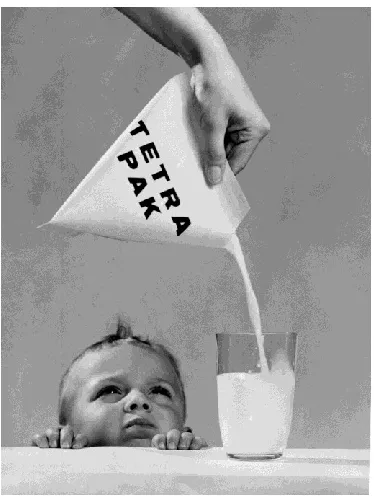
product hardness or firmness. Tetra Pak added an additional platonic geometry with its
white arrows of progress, from its white tetrahedral milk packs and their hexagonal
geodesic supermarket stacks (Kotler, 2010: 171). The Tetra Pak is generated from an
endless column of a stream of pure aseptic milk. The innovation that created their
success was based on the observation that a tube of milk can be poured endlessly and
bisected laterally to create this iconic pyramid form, never contacting air, hand or
FIG 5 1954
FIG 6 2016
Courtesy of Tetra Pak
permissions needed
Following on from their emergence in the 1950s, Tetra Pak’s Brancusi-like Platonic
pyramid cartons have now morphed from solid form into conceptual strategy and
economic principle. Tetra Pak currently sells 500 million packages a day. Its latest
corporate strategy is labeled ‘Deeper into the Pyramid.’ It works to insert itself into
developing economies via a prescient geometry. A minimalist modernity is now
conceptualized as an economic principle that will insert its white arrows into the
economic pyramid and try to use a new asset-stripped return, radically more pervasive
than that creamed off from an exclusive market. ‘A large proportion of Ali’s customers
earn between Euro 1.80 and Euro 7.20 a day, putting them firmly in the Deeper in the
Pyramid (DiP) consumer category that the Boston Consulting Group has identified as
Pyramid 2015: 3). Tetra Pak acknowledges that tapping into this market takes
adaptation. The question is how to make products that are ‘affordable, available and
attractive to consumers on limited incomes... without adding unsustainable costs.’ They
use alternatives to whole milk — such as whey or lactic acid and other low value milk
derivatives. Modifying, or tweaking the recipe can involve replacing a more expensive
ingredient with a cheaper one. Tetra Pak also work with governments to implement
regulations making it illegal to pasteurize milk at home, or to supply ‘loose’ milk.6
This new model has become the prevailing motif for Western economies which
seek the extraction of value from the base of the pyramid. Capital’s will to autonomy
finds material limits, and reciprocally, the material realm is shaped by the forces of
abstraction. As well as the packaging for the milk — the cow’s body first becomes a
process to be optimized — a language that pervades the industry, where ‘yield’ must be
increased by manipulating the cows’ feed, medication, living conditions, and genetics.
There is of course also a long history of destroying animals not deemed to be
economically viable as part of national animal improvement plans. The United States
Department of Agriculture now carries out an ‘animal improvement program’ through
genetic selection, rather than the culling programs of the early twentieth century (Curry
2013). Genetic animal ‘improvements’ are often tied into alliances of
scientific/government/corporate policy, and particularly target humans that are identified
as ‘under-capitalized’ and thus biopolitically ‘backward’, in what plays out as an
assertion of human genetic superiority. The language of optimization and improvement
permeates economics, the food industry, agriculture, and overseas development
programs. Humans that do not eat large amounts of meat and dairy are not considered
technologies, the narrative is an historical one. Milk’s whiteness is a transferable
characteristic. When Herbert Hoover made an address in 1923 on the milk industry at
the World’s Dairy Congress in 1923, he affirmed that ‘Upon this industry, more than
any other of the food industries, depends not alone the problem of public health, but
there depends upon it the very growth and virility of the white races” (Cohen 2016). The
whiteness of milk demands a white body capable of digesting it — or so think those who
attribute the development of European civilization around 11,000 years ago to the
lactose-tolerance of Northern Europeans (Curry 2013). Milk’s fortunes are entwined
with those of national health. William Prout (1834: 234), the London physician who
developed ideas of nutrients through his chemical analysis in the 1820s, alighted on
milk, ‘the only article actually furnished and intended by nature as food’, which he
decreed to be composed of the three necessary ingredients for healthy life, for milk
alone, and the mechanism by which milk is secreted, ‘were designed, and made what
they are, by the great Creator of the universe’: ‘In milk, therefore, we should expect to
find a model of what an alimentary substance ought to be — a kind of prototype, as it
were, of nutritious materials in general.’ Industry and the market came rapidly to deliver
this ever-so natural and simultaneously divine substance to the masses, in ever more
new and improved versions.
In contemporary agriculture the mining of vast datasets of bioinformatics are key
to determining which plants and animals will proliferate. Data analytics not only
facilitate complex abstracted financial exchange and market policy, but also transform
the matter we put into our mouths and incorporate into our own flesh. Drivers of
genomics and biotechnology present financialized imperatives as animal
transformations that are then acted out on bodies “[They] are fetishized by animal or
“meat” scientists and policy makers as the means by which to reinvent capitalism as a
new more efficient and environmentally benign project often under the banner of the
knowledge based bio-economy … The latter in its very enunciation pretends to portend
to ideas and not somehow also to material, bodily repercussions” (Twine 2013: 79).
Genetic manipulations materialize as abstracted chemical and biological events that take
place under the threshold of perception, yet are manifest as physical changes that are
incorporated within the systems of the donor and consuming bodies.
Big data has been implemented in dairy farming more than in any other industry,
and combined with the financialization of species and individual worth pioneered in the
field of animal science through quantitative analysis. Animals can be given a single
value figure — (NM$)2 or Lifetime Net Merit. In the case of (NM$)2, the number is
denominated in dollars because it is indexed as an estimate of how much a bull’s genetic
material will affect the potential revenue from a dairy cow. Fluid, fat, protein ratios of
the milk, and quality of the ensuing progeny are predicted by gene markers and heritable
traits and as well as pedigree records and market conditions. Body size, udder condition,
feet leg and body ratios, — cheese merit, fluid merit, daughter calving ease, productive
life, daughter pregnancy rate and stillbirth rate are all deduced through complex
calculations of big datasets. There is a air of rationality gone wild, cold logic mixed with
hi-jinx whimsy and mythopoesis: the bull who has been scientifically calculated as
having the highest net worth is named Badger-Bluff Fanny Freddie, and the third
Ensenada Taboo Planet-Et (Madrigal 2012).
operational rationalization and recombined for economic maximization through complex
algorithms and datasets. The work pioneered on the bodies of cows has now become
associated with high tech stock market trading, where great swathes of money flow
through speculative abstractions. The work pioneered on the bodies of cows has also
informed research that aims to subsume the body of the cow entirely: as scientists
attempt generate ‘real’ milk without the cow’s presence at all the in the new field of
‘cellular agriculture’. Based on the promise of taking milk cells as starter cells, but then
regenerating milk synthetically, headlines ecstatically assert ‘Animal lovers use biotech
to develop milk made by man instead of a cow’ — “From silk to milk: why growing
everything could be a 21st century game changer’ (Rodriguez 2016; Rooney 2016).
Synthetic biology fulfills a fantasy of growing anything at all; circumventing
politics and creating self-generating life that intends to bypass the messy issue of
sentience, or animal suffering. It also throws up the spectre of erasure, and the
eradication of animal bodies altogether. The nexus of nature and technology offers a
physical and imaginative emancipation of generative new materiality that defies
bounded perceptions of body/gender/species, but what seems to be a point of change is
also a continuity that can be perceived in the changing forms of milk over time. Milk is
a liquid latent with the power of annihilation as well as life giving, and its shapings are
driven by the attempt to wrestle control of supply.
Audic, Jean-Luc, Bernard Chaufer, and Georges Daufin. (2003), ‘Non-Food Applications of Milk Components and Dairy Co-Products: A Review’, Le Lait, 83 (6): 417-438.
Bachelard, Gaston. ([1942] 1999), Water and Dreams: An Essay on the Imagination of Matter, 3d edn, Texas: Dallas Institute of Humanities and Culture.
Banerjee, Sanchari, Nathan P. Coussens, François-Xavier Gallat, Nitish Sathyanarayanan, Jandhyam Srikanth, Koichiro J. Yagi, James S. S. Gray, Stephen S. Tobe, Barbara Stay, Leonard M. G. Chavasd, and Subramanian Ramaswamya. (2016), ‘Structure of a Heterogeneous, Glycosylated, Lipid-Bound, in Vivo-Grown Protein Crystal at Atomic Resolution from the Viviparous Cockroach Diploptera Punctata’,
IUCrJ, 3 (4): 282-293.
Ballard, Olivia and Ardythe L. Morrow. (2013), ‘Human Milk Composition: Nutrients and Bioactive Factors’, Pediatric Clinics of North America, 60 (1): 49-74.
Bell, David. (1997),‘Primitive Mind of State’, Pyschoanalytic Psychotherapy, 10: 45-57.
Boon, Sonja and Beth Pentney. (2015), ‘Virtual Lactivism: Breastfeeding Selfies and the Performance of Motherhood’, International Journal of Communication, 9: 1759-1774.
Brock, William H. (2002), Justus von Liebig: The Chemical Gatekeeper, Cambridge: Cambridge University Press.
Cassirer, Ernst. (1994), Das Erkenntnis problem in der Philosophie und Wissenschaft in der neueren Zeit, Darmstadt: Wissenschaftliche Buchgesellschaft.
Cohen, Mathilde. (2016), ‘Of Milk and the Constitution’, Harvard Journal of Law and Gender, 40: _.
Cohen, Mathilde. (2017), ‘Regulating Milk. Women and Cows in France and the United States’, American Journal of Comparative Law, 65: _.
Curry, Tim. (2013), ‘Archeology: The Milk Revolution’, Nature,500: 20–22.
Douthwaite, Julia. (2002), The Wild Girl, Natural Man, and the Monster: Dangerous Experiments in the Age of Enlightenment, Chicago: University of Chicago Press.
Fauve-Chamoux, Antoinette, (2000), ‘Breastmilk and Artificial Infant Feeding’, in Kenneth F. Kriemhild, Kiple, Ornelas, Conee (eds), The Cambridge World History of Food, 1, 626-635, Cambridge: Cambridge University Press.
Fraisse, Geneviève. (1994), Reason’s Muse: Sexual Difference and the Birth of Democracy, Chicago: University of Chicago Press.
Gould, Steven Jay. (1993), ‘Male Nipples and Clitoral Ripples’, Columbia: A Journal of Literature and Art, 20: 80-96.
Grosz, Elizabeth. (1994), Volatile Bodies, Towards a Corporeal Feminism, Bloomington: Indiana University Press.
Hammer, Espen. (2011), Philosophy and Temporality from Kant to Critical Theory, Cambridge: Cambridge University Press.
Haraway, Donna. (1997), ‘The Virtual Speculum in the New World Order’, Feminist Review, 55: 22-72.
Hayes, Kenneth. (2008), Milk and Melancholy, London: MIT Press.
Institute of Medicine (US) Committee on Thyroid Screening Related to I-131 Exposure; National Research Council (US) Committee on Exposure of the American People to I-131 from the Nevada Atomic Bomb Tests. Exposure of the American People to Iodine-131 from Nevada Nuclear-Bomb Tests: Review of the National Cancer Institute Report and Public Health Implications. Washington (DC): National Academies Press (US); 1999. 3, Health Risks of I-131 Exposure. Available online: http://www.ncbi.nlm.nih.gov/books/NBK100835/
Hyginus Gaeus Julius Astrominca II: 11-43
Kircher, Athanasius Scrutinium. (1658), Physico-medicum contagiosae Luis seu pestis, Rome: Vitale Mascardi.
Kotler, Philip and Waldemar Pfoertsch, Ingredient Branding: Making the Invisible
Visible, Springer Science & Business Media, 2010
Kracauer, Siegfried. ([1927] 1995), The Mass Ornament. Weimar Essays, Thomas Levin (ed), London: Harvard University Press.
Leeuwenhoek, Antoni. (1952), The Collected Letters of Antoni Van Leeuwenhoek, Volume 4,. Edited by Lodewijk C. Palm London: CRC Press.
Madrigal, Alex. (2012), ‘The Perfect Milk Machine: How Big Data Transformed the Dairy Industry’, The Atlantic Magazine. 1 May. Available online: http://www.theatlantic.com/technology/archive/2012/05/the-perfect-milk-machine-how-big-data-transformed-the-dairy-industry/256423/ (accessed 12 June 2016).
Maran, Stephen P, Marschall, Laurence A., (2009), Galileo's New Universe: The Revolution in Our Understanding of the Cosmos, Dallas: Benbella Books.
Miller, Richard L. (1986), Under the Cloud: The Decades of Nuclear Testing, Texas: Two Sixty Press.
Ortmeyer, Pat and Arjun Makhijani. (1997), ‘Worse Than We Knew’, The Bulletin of the Atomic Scientists, 53 (6): 46-50.
Prasad, Kedar N. (1995), Handbook of Radiobiology, 2d edn, Boca Raton: CRC Press.
Prout, William. (1834), Chemistry, Meteorology and the Function of Digestion: Considered with Reference to Natural Theology, London: William Pickering.
Rodriguez Fernandez, Clara. (2016), ‘This Startup is Producing Synthetic Milk the Tastes Like Your Usual Breakfast Dairy’, Labiotech.eu, 22 July. Available online: http://labiotech.eu/muufri-vegan-milk-synbio-startup/ (accessed 7 October 2016).
Rooney, Ben. (2016), ‘How Synthetic Biology Will Make More Money Than the Entire Computer Industry’, International Business Time, 7 July. http://www.ibtimes.co.uk/synthetic-biology-biggest-technological-revolution-we-will-ever-see-1569444 (accessed 7 October 2016).
Schiebinger, Londa. (1993), ‘Why Mammals Are Called Mammals: Gender Politics in Eighteenth-Century Natural History’, The American Historical Review, 98 (2): 382-411.
Selia dos Reis Coimbra, Jane and Jose A. Teixeira. (2016), Engineering Aspects of Milk and Dairy Products, Boca Raton: CRC Press.
Stein, Natalie. (2014), Public Health Nutrition, Burlington: Jones & Bartlett.
Twine, Richard. (2013), ‘Addressing the Animal-Industrial Complex’ in Raymond Corbey,Annette Lanjouw (eds.), The Politics of Species: Reshaping our Relationships with Other Animals, Cambridge: Cambridge University Press
‘
Valenze, Deborah. (2011), Milk: A Local and Global History, New Haven: Yale University Press.
Worthington, Arthur Mason. (1908), A Study of Splashes, London: Longmans, Green & Co.
1 Nestlé’s range of flavored milk drinks Nesquik are branded with ‘Quicky’ the Nesquik bunny and Chuck E. Cheese's chain of pizza restaurants are heralded by the cheese loving mouse.
aristocrats and men are not genetic ‘improvements’ on lactating women — milk is simply so fundamental that the organs for its transmission are a priori essential organs. 3 The Law for the Protection of Infants and in Particular of Nurslings was enacted by French National Assembly in 1874, known generically as the Roussel Law after principal sponsor Théophile Roussel.
4 See La Virgen de la Leche y Buen Parto, Facebook Group. Available online: https://www.facebook.com/LaVirgendelaLecheyBuenParto/photos (accessed 7 October 2016).
5 This is a popular truism, and can be found circulating on blogs and forums for CGI in education and training. See: http://helloyoucreatives.com/post/3307413119/cgi-milk-we-think-its-the-first-thing-everyone (accessed 7 October 2016).