IJPSR (2018), Volume 9, Issue 4 (Research Article)
Received on 07 July, 2017; received in revised form, 11 September, 2017; accepted, 14 September, 2017; published 01 April, 2018
STABILITY INDICATING UPLC METHOD DEVELOPMENT AND VALIDATION FOR THE DETERMINATION OF CRIZOTINIB IN PHARMACEUTICAL DOSAGE FORMS
Jahnavi Bandla*1 and S. Ganapaty 2
Department of Pharmaceutical Analysis and Quality Assurance 1, Faculty of Pharmacy, Vishnu Institute of Pharmaceutical Education and Research, Narsapur, Medak - 502313, Telangana, India.
Department of Pharmacognosy and Phytochemistry 2, GITAM Institute of Pharmacy GITAM University, Rushikonda, Visakhapatnam - 530045, Andhra Pradesh, India.
ABSTRACT: A stability indicating method was developed for the
estimation of Crizotinib in pharmaceutical dosage form by using Ultra Performance Liquid Chromatography (UPLC). The separation was done on isocratic mode with Hibra C18 (100 mm × 2.1 mm, 2 µ) column and 0.1% Ortho-phosphoric acid and acetonitrile (45:55% v/v) as mobile phase at a flow rate of 0.3 mL/min and at room temperature. The detection was done at a wavelength of 327 nm. A good linearity was observed in the concentration range of 37.5 µg/mL - 225 µg/mL, with a correlation coefficient of 0.999. The method was validated according to the ICH guidelines. The developed method was found to be accurate and precise, with % recovery 99.9% - 100.18% and % relative standard deviation 1.1. The drug was found to be stable at forced degradation conditions and the net degradation was found to be within the limits. The developed method can be used for the quality control of Crizotinib in pharmaceutical dosage form.
INTRODUCTION: Crizotinib Fig. 1, chemically designated as 3- [(1R)- 1- (2, 6-dichloro-3-fluoro-phenyl) ethoxy]- 5- (1- piperidin- 4- ylpyrazol-4-yl) pyridin-2-amine, is a white to pale yellow powder, slightly soluble in methanol, ethanol and water and has a pKa of 5.6 and 9.4. It is used in the treatment of lung cancer by acting as an oral receptor tyrosine kinase inhibitor 1. According to the literature survey, very few methods HPLC methods 2, 3, LC-MS/MS method 4, Spectrofluorimetry 5, UPLC-MS/MS method 6 and LC-ESI–MS/MS method 7 were developed.
QUICK RESPONSE CODE
DOI:
10.13040/IJPSR.0975-8232.9(4).1493-98
Article can be accessed online on: www.ijpsr.com DOI link: http://dx.doi.org/10.13040/IJPSR.0975-8232.9(4).1493-98
The proposed method aimed to develop and validate a stability indicating method for the estimation of Crizotinib in pharmaceutical dosage form by UPLC.
FIG. 1: CHEMICAL STRUCTURE OF CRIZOTINIB
MATERIAL AND METHODS:
Reagents and Chemicals: Crizotinib standard drug was supplied as gift sample by spectrum labs, Hyderabad (India).
Keywords:
Crizotinib, UPLC, Stability indicating method, Method development, Validation Correspondence to Author: Jahnavi Bandla
Assistant Professor,
Department of Pharmaceutical Analysis andQuality assurance, Vishnu Institute of Pharmaceutical Education and Research, Narsapur, Medak - 502313, Telangana, India.
(100 mm x 2.1 mm, 2 ) column maintained at room temperature, a solvents tray and UV detector was used for the estimation of Crizotinib in pharmaceutical dosage form. All the parameters of UPLC were controlled by Empower software. Other instruments used were electronic balance, digital pH meter and Ultrasonic bath sonicator. The mobile phase consisting of 0.1% Orthophosphoric acid and acetonitrile (45:55% v/v) was used on isocratic mode at a flow rate of 0.3mL/min. The detection wavelength used was 327 nm.
Preparation of Standard Solution and Sample Solution: Dissolve 15 mg of accurately weighed Crizotinib working standard in 10 mL volumetric flask with diluent (1500 µg/mL). Dilute 1 mL of above stock solution with diluent to 10 mL (150µg/mL). 20 Capsules (Crizalk) were weighed accurately and the average weight was calculated. The capsules were opened and fine powder was collected. Dissolve an amount equivalent to 15 mg of Crizotinib in 10 mL volumetric flask with diluent and sonicated for 30 min with intermediate shaking. The final volume was made up with diluent. The above solution was filtered and 1 mL of the solution was diluted with diluent in 10 mL volumetric flask.
Method Validation:
System Suitability: Inject standard solution into the chromatographic system and calculate the parameters such as % relative standard deviation (RSD), tailing factor and plate count.
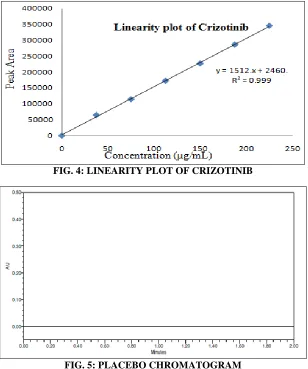
Linearity: Serial dilutions of standard Crizotinib in the range of 37.5 µg/mL and 225 µg/mL were prepared and injected into the UPLC. A linearity graph was plotted between concentration and peak areas.
Accuracy: The solutions were prepared in three different concentration levels of 50%, 100% and
determined by injecting the placebo solution and comparing with standard solution for the interference with Crizotinib peak.
Limit of Detection (LOD) and Limit of Quantitation (LOQ): LOD and LOQ are determined by standard deviation (SD) and slope of the calibration curve. The limiting values are calculated as per the following equations: LOD = (3.3 × SD) / Slope and LOQ = (10 × SD) / Slope.
Robustness: Robustness of the method was
determined by varying the optimum chromatographic
conditions such as mobile phase ratio (±10%), flow rate (±0.1 mL/min) and column oven temperature (±5 °C). The system suitability parameters were calculated and recorded.
Forced Degradation Studies: The drug solution was subjected to the various stress conditions such as acidic (2N Hydrochloric acid, 60 °C for 30 mins), basic (2N sodium hydroxide, 60 °C for 30 mins), oxidative (20% hydrogen peroxide, 60 °C for 30 mins), neutral (refluxing the drug in water for 6hrs at a temperature of 60 °C), photolytic (exposing the drug solution to UV light by keeping the beaker in UV Chamber for 7 days or 200 Watt hours/m2 in photo stability chamber) and thermal (drug solution was placed in an oven at 105 °C for 6 hours) conditions.
FIG. 2: UV SPECTRUM OF CRIZOTINIB
After considering the entire system suitability parameters mobile phase 0.1% OPA and acetonitrile (45:55% v/v) run in isocratic mode and flow rate 0.3 ml/min was selected. The retention
time of Crizotinib were found to be 0.86 min. The system suitability parameters are calculated from standard chromatogram Table 1 and Fig. 3.
TABLE 1: SYSTEM SUITABILITY AND VALIDATION PARAMETER RESULTS
Parameters Crizotinib
Specificity Specific, No interference
Precision (% RSD) 1.1
Accuracy (% recovery) 99.90% - 100.18%
Linearity range (µg/mL) 37.5 - 225
Correlation coefficient, r 0.9997
Limit of Detection (µg/mL) 0.35
Limit of Quantitation (µg/mL) 1.05
Ruggedness (% RSD) 0.6
Robustness Robust
Stability Stable
USP Plate count 3060
[image:3.612.114.482.316.653.2]USP tailing factor 1.7
FIG. 3: STANDARD CHROMATOGRAM OF CRIZOTINIB
For the estimation of linearity of method, concentrations ranging from 37.5 µg/mL to 225 µg/mL were prepared and a linearity graph Fig. 4
was plotted using concentration against peak area. The regression equation was found to be y = 1512.8x + 2460.1, with a correlation coefficient of
FIG. 4: LINEARITY PLOT OF CRIZOTINIB
FIG. 5: PLACEBO CHROMATOGRAM
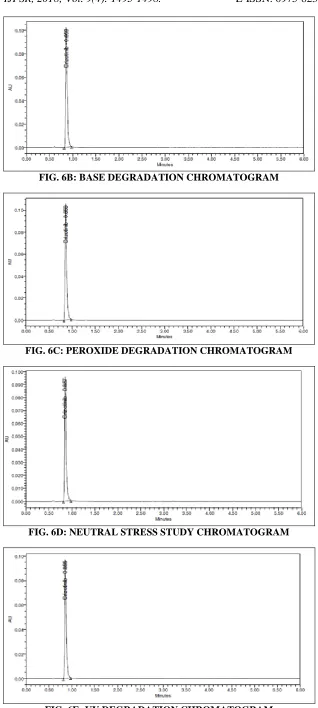
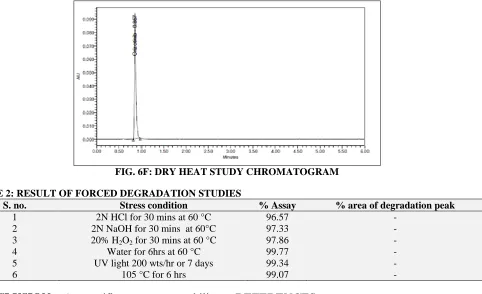
The stability of an analytical method was determined by forced degradation studies, in which the stability of the method was carried out by performing Acid stress study, Base stress study, Peroxide stress study, Water stress study, UV light
exposure study and Dry heat stress study. The net degradation was found to be within the limits. The results and chromatograms were summarized in
[image:4.612.146.467.562.734.2]Table 2 and Fig. 6.
FIG. 6B: BASE DEGRADATION CHROMATOGRAM
FIG. 6C: PEROXIDE DEGRADATION CHROMATOGRAM
[image:5.612.147.465.38.746.2]FIG. 6D: NEUTRAL STRESS STUDY CHROMATOGRAM
FIG. 6F: DRY HEAT STUDY CHROMATOGRAM
TABLE 2: RESULT OF FORCED DEGRADATION STUDIES
S. no. Stress condition % Assay % area of degradation peak
1 2N HCl for 30 mins at 60 °C 96.57 -
2 2N NaOH for 30 mins at 60°C 97.33 -
3 20% H2O2 for 30 mins at 60 °C 97.86 -
4 Water for 6hrs at 60 °C 99.77 -
5 UV light 200 wts/hr or 7 days 99.34 -
6 105 °C for 6 hrs 99.07 -
CONCLUSION: A specific, accurate stability indicating method was developed for the estimation of Crizotinib in pharmaceutical dosage form using UPLC. The method was validated by using various validation parameters and the method was found to be linear, precise, accurate, specific and robust. From the degradation studies conducted it is concluded that Crizotinib were more stable at more concentrations of acid, base, peroxide, thermal, UV and water stress study conditions. The run time was 2 min which enables rapid quantitation of many samples in routine and quality control analysis of capsule formulations.
AKNOWLEDGEMENT: The authors are thankful to the Pfizer Pharmaceuticals, Hyderabad for providing the Crizotinib as the gift samples. They are also thankful to the Spectrum labs, Hyderabad for providing required facilities to carry out this work.
CONFLICT OF INTEREST: Nil
REFERENCES:
1. Crizotinib: https://pubchem.ncbi.nlm.nih.gov/compound.
2. Jadhav PB and Vivek S: Development and Validation of
an RP-HPLC Method for Crizotinib. International Journal of Pharmacy and Pharmaceutical Research 2017; 9(2): 100-106.
3. Bontha VK, Emmadi S and Gandhe S: Estimation of
Crizotinib in Capsule Dosage Form by RP-HPLC. IOSR Journal of Pharmacy and Biological Sciences 2016; 11(6): 93-103.
4. Qiu F, Gu Y, Wang T, Gao Y, Li X and Gao X:
Quantification and pharmacokinetics of Crizotinib in rats by liquid chromatography-tandem mass spectrometry. Biomed Chromatography 2016; 30(6): 962-968.
5. Hany WD, Ahmed HB and Ibrahim AD: Enhanced
spectrofluorimetric determination of the multitargeted
tyrosine kinase inhibitor, crizotinib, in human plasma via
micelle-mediated approach. Tropical Journal of
Pharmaceutical Research 2016; 15(10): 2209-2217.
6. Wani TA, Iqbal M, Darwish IA., Khalil NY and Zargar S:
Development and validation of sensitive UPLC-MS/MS based method for the estimation of Crizotinib in human plasma. Digest Journal of Nanomaterials and Biostructures 2014; 9(2): 693-704.
7. Roberts MS, Turner DC, Broniscer A and Stewart CF:
Determination of Crizotinib in human and mouse plasma by liquid chromatography electrospray ionization–tandem
mass spectrometry (LC-ESI–MS/MS). Journal of
chromatography B 2014; 960: 151–157.
All © 2013 are reserved by International Journal of Pharmaceutical Sciences and Research. This Journal licensed under a Creative Commons Attribution-NonCommercial-ShareAlike 3.0 Unported License. This article can be downloaded to ANDROID OS based mobile. Scan QR Code using Code/Bar Scanner from your mobile. (Scanners are available on Google Playstore)
How to cite this article:
Bandla J and Ganapaty S: Stability indicating UPLC method development and validation for the determination of Crizotinib in