Wolf, M. and Sims, Julian and Yang, Huadong (2015) The effect of new
rhetors on HRM communication process. In: UNSPECIFIED (ed.) BAM 2015
Proceedings. British Academy of Management. ISBN 9780954960889.
Downloaded from:
Usage Guidelines:
Please refer to usage guidelines at or alternatively
WOLF / BAM conference 2015 1/15 The convergence of Information Technology and Human Resource Management (HRM) has long been recognised as a phenomenon posing new challenges in praxis and unveiling new research questions. This paper addresses specific challenges introduced into the HRM communication process by the emergence of Web 2.0 technologies. The potential of social media to support as well as to disrupt HRM activities has been recognised and addressed from a variety of viewpoints: e.g. use of social media in recruitment, selection and screening, information dissemination and engagement, employer branding, as well as employee voice, resistance and cyber deviancy. In this paper, HRM is theorised as a communication system between employer and employees. Social Media is introduced as an Information System which has the potential to change the rhetorical practises and so the HRM communication process. The concept of “social media use” is defined and linked to creation of dialogue. Empirical findings introduce new players into the HRM communication process, adding mutivocality, complexity and ambiguity. This paper discusses challenges for HRM strategy and praxis and suggests further research directions.
1
Introduction
There is a recognised need for more and more diverse research in Human Resource
Management (HR or HRM), using multiple sources of evidence and focusing on presence as well as implementation of HR practices (Guest, 2011). While HRM practices are changing slowly (Boudreau and Lawler III, 2014) the theory might have a chance to catch up with practice. New technologies are bringing new challenges and opportunities: social media being praised as “extremely important” by practitioners (Martin, 2013) speeds up changes in HRM praxis. New external systems replace the established internal systems for employee voice, presenting organisations with challenges to maintain control over communication media (Miles and Muuka, 2011, Kietzmann et al., 2011). Practitioners already recognise the
increasingly important role social media is playing in recruitment and attraction (Robb, 2014, p.65, Zielinski, 2013), however there is yet a research agenda to be developed for use of social media in other HRM areas such as recruiting and staffing activities (Brown and
Vaughn, 2011, Roth et al., 2013). These new challenges call for a variety of research methods including qualitative and quantitative research to generate a more complex and sophisticated theory (Guest, 2011).
Research on human resource management is lacking technology focus as is the research on
management in general.Orlikowski and Scott state that their analysis confirmed that ”over
95% of the articles published in top management research outlets do not take into account the role of technology in organizational life” (Orlikowski and Scott, 2008).Similarly many HR change studies in the past decade e.g. (Guest, 2002, Baird, 2002) have not considered technology as an influencing or mediating factor in HRM, despite the fact that technology has been seen as a phenomenon that introduces new challenges into HRM (Stanton and Coovert, 2004). Guest (2002) identified three core HRM models none of which considered the
required Information Technology (IT) or Information Systems (IS) infrastructure, IS adoption and or IS practices to support/disrupt the implementations of these models in practice. In a six-year case study of organization change from the view point of HRM practices the
technology to support the change and the adoption of such technologies was not considered at all (Baird, 2002). Collins and Clark (2003) focused on information availability to
WOLF / BAM conference 2015 2/15 maintaining social networks were central to emergence and re-affirmation of HRM practices, however the actual use of the IT and concrete features offered by the IT and utilised by users were not discussed. Introducing a technology-focus into this body of research would widen the field and provide an alternative viewpoint.
As information technology continues to play a vital part in organizations more
interdisciplinary research is needed (Eppler and Mengis, 2004, Roth et al., 2013, Orlikowski, 2001). The potential of social media to support as well as to disrupt HRM activities has been recognised and addressed from a variety of viewpoints: e.g. use of social media in
recruitment (Ollington et al., 2013, Boudreau and Lawler III, 2014), selection and screening (Stone et al., 2013), information dissemination and engagement (Hauptmann and Steger, 2013), employer branding (Edwards, 2010), as well as employee voice (Miles and Muuka, 2011, Panagiotopoulos, 2012), resistance (Richards, 2011) and cyber deviancy (Weatherbee, 2010). One of the under researched areas is the use of Social Media by organization for internal (i.e. employee-focused) communication (Leonardi et al., 2013).
This paper addresses the research gap in understanding what role social media use by
organisations and employees is playing in enabling, supporting and transforming HRM. This paper answers the calls for more sophisticated, process oriented research of HRM practices (Guest, 2011), more cross-disciplinary research (Orlikowski, 2001, Eppler and Mengis, 2004, Orlikowski and Scott, 2008), and more research in the emergent domain of social media (Leonardi et al., 2013, Roth et al., 2013) by extending and enhancing extant models of HRM and organisational rhetorical practices and providing new insights on social media use in organisations in the context of HR communications.
2
HRM as a communication system
The theory and research in the field of Human Resource Management has undergone significant developments in the past twenty years (Guest, 2011). The main research streams focused on establishing linkages between HRM strategy and organisational performance. Guest (2011) identifies three different directions from which these linkages were
investigated: one focusing on HRM practices, another applying the resource based view to HRM, and lastly a focus on implementation of a set of HRM practices. The common denominator of these approaches is the search for the source of a competitive advantage (Miles and Muuka, 2011, Guest, 2011, Barney, 1991, Wright et al., 2001). Guest (2002) identifies three key models which link HRM to improved organisational performance: High Performance Work System; High Commitment; and the Strategic Fit model. All of the
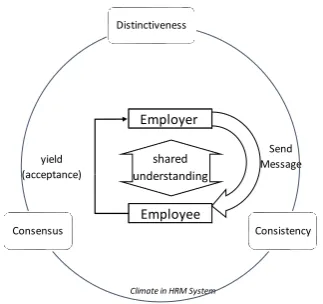
models identified by (Guest, 2002) view HRM as something organisations “have”: structures, policies, practices... An alternative view of HRM as a process, something organisations “do” rather than “have”, was introduced by Bowen and Ostroff (2004). In their model Bowen and Ostroff theorise HRM as a stream of communications between the employer and employees. Focusing on the top-down message delivery and understanding of this message, they
introduce a notion of a “system strength”. In essence, a system is strong when there is
WOLF / BAM conference 2015 3/15
Figure 1 Climate of HRM as communication system
Distinctiveness
A distinctive message stands out among other messages. Bowen and Ostroff (2004) argue that a message coming from higher hierarchy levels will be perceived as distinctive. Additional factors such as utilisation of the appropriate media to reach relevant audiences (Kaplan and Haenlein, 2010), perceived subject matter expertise of the sender (Fieseler et al., 2010), or strong emotional binding to the rhetor (Leonardi et al., 2013) have been identified
as contributing factors of increased distinctiveness of the message. Studies adopting the
communication lens show that businesses seek to utilise communication capabilities of new technologies to increase effectiveness (Billington and Billington, 2012) and provide a more distinctive message to target audiences.
Consistency
A (distinctive) message needs to be interpreted and understood by the audience. The message
can be reinforced if it is consistent. Consistency in this context implies consistency in space
and over time. Consistency over time refers to the messages employees receive at different times during their employee life cycle (e.g. attraction, appraisal, reward and promotion), and requires the same content to be presented to potential, current and former employees (Bowen and Ostroff, 2004). Spatial dimension of consistency refers to the hierarchical consistency, i.e. definition of goals and values by higher levels of management and communication and implementation of practices that underline these goals at the shop-floor-level, as well as horizontal consistency across complimentary HR practices (Boxall and Macky, 2009, Wright and McMahan, 1994). Consistent messages would carry the same content in all HR activities across different hierarchical levels of the organisation towards potential, current and former employees.
Consensus
Organisational performance increases, when employees’ understanding is consistent with
organisation’s understanding of expected outcomes (Sanders and Yang, 2015). Consensus is
a shared understanding of a message by a number of individuals or among groups (Edwards, 2010). The consensus is established at two levels – at inter-personal level among senders and recipients (Bowen and Ostroff, 2004) and at the process and structural level, through
integration of the message content into activities (e.g. perceived distributive fairness), and provision of feedback mechanisms (Kent and Taylor, 1998, Walton, 1985, Lawler, 1988).
Bi-Employer
yield (acceptance)
shared understanding
Employee
Climate in HRM System
Send Message Distinctiveness
WOLF / BAM conference 2015 4/15 directional communication and information exchange, including provisions for employee voice, are paramount for consensus building (Bowen and Ostroff, 2004, Miles and Muuka,
2011).
3
Web 2.0 and Social Media as Information System
The term Web 2.0 is used to describe technologies and platforms which are based on the philosophy of openness, sharing and collaboration (DesAutels, 2011, Kaplan and Haenlein, 2010) and on technological advances in web-, programming-, and computing-technologies which allow development and delivery of more interactive applications (DesAutels, 2011). Social media applications (including social networking sites, blogs, review sites, wikis, etc.) are applications built around Web 2.0 technologies. In contrast to other communication technologies, social media are characterised through a set of features, which (in combination) make it a unique phenomenon (Leonardi et al., 2013) distinctively different from previous computer mediated communication and collaboration technologies. The ability to perform different activities, namely communicate, manage and visualize relationships and create and edit content, in a single place combined with the fact that this information is stored and kept (semi-) publicly accessible over a long period of time is seen as a key feature of enterprise social media. There are other features of Social Media that make it different from traditional media (e.g. radio, print and TV broadcast), communication platforms (e.g. GSM, email or chat), offline social networks and communities (e.g. sports clubs, political parties etc.) and internet-based information services (e.g. Duden, Encyclopaedia Britannica, yell.com). Based on recent literature seven key differentiating factors of Social Media have been highlighted.
Availability – social media applications and services are commonly delivered through the World Wide Web (WWW) (Kaplan and Haenlein, 2010, Boyd and Ellison, 2008, Leonardi et al., 2013) and are accessible on a variety of devices such as mobile phones (e.g. SMS text messages to post and receive updates from twitter and Facebook), email, websites accessed through desktop and portable computers, desktop applications, mobile websites and smart-phone apps. Information can be sent and received via multiple independent channels such as GSM networks, mobile internet, public WiFi, private/institutional broadband connections etc. allowing access from virtually anywhere in the world, not excluding the ISS (Gaudin, 2010). Utilizing modern Information Technologies, most social media platforms and services are available across all time zones 24 hours a day, 7 days a week allowing any-time any-where access.
Accessibility – content created on Social Media is (semi-) public and accessible by other members of the wider network. Through integration of different network sites content can be effortlessly spread across multiple platforms potentially allowing even wider audiences to consume and enhance it. Persistence over time and accessibility by a broad scope of users enables “leaky-pipe” communication (Leonardi et al., 2013) whereby third party users for whom the content was not initially intended become aware of it and discover valuable information. Public dialogue and discussion can further benefit democratic decision-making and commitment towards goals (Hauptmann and Steger, 2013).
WOLF / BAM conference 2015 5/15 and no cost associated with creating and sharing content. Contrast that with for example cost of traditional printing of flyers and the cost of distribution of these fliers e.g. via mail.
Ease of Entry – anyone can join. There are no restrictions on who can join – sign up and tweet away, no recommendations or CV checks which are required when joining many traditional offline networks e.g. the BCS. Some social media might restrict the population consciously or subconsciously e.g. Facebook membership was consciously limited to Harvard-students at launch (Boyd and Ellison, 2008) or the Russian Social Networking Site “odnoklassniki.ru” was initially only available in Russian, (subconsciously?) limiting the population of potential members to Russian language speakers.
Speed of delivery and global reach – content is delivered to (intended) recipients
immediately. Online and offline social networks allow the content to spread further, e.g. when created, the “Youth Movement for Egyptian Opposition” group on Facebook in 2007 had 300 users who were invited via email. Within three days the awareness grew and the number of group members reached 3000 (Lim, 2012). The content is spread along the social graph and is crossing virtual platform borders, political and geographical boundaries and the boundaries between virtual and real worlds.
Association – The ability to articulate personal relationships is one of the key characteristics of a social media system. The content of messages delivered through implicitly trusted (or mistrusted) relationship networks tied in with the senders identity implicitly is attributed with similar level of trust as the sender(Hauptmann and Steger, 2013). For example a hotel critique posted by a Facebook-friend on TripAdvisor is more “trusted” than the description provided by hotel’s owner. Openness and transparency of the content and source of information contribute to trust (Fieseler et al., 2010).
Community Censorship – anyone can say anything. The users communicate whenever, wherever and about anything they want (Fieseler et al., 2010). The (corporate)
communication has been democratized (Kietzmann et al., 2011), traditional censors –
corporates (Kaplan and Haenlein, 2010) and governments (Lim, 2012) have little control over the content and information created about and or concerning them. Instead all community members take on the role of a censor/editor and punish inappropriate behaviour as well as encourage valuable contributions – censorship becomes more democratic empowering users. The owners of the social media platforms however, too have the power of censorship, and despite some claims user do not control (all) content or communication on social media (Stein, 2013).
The uniqueness of social media is further highlighted through users’ ability to create their own value-added applications by combining disjoined technologies into a new unique system which generates additional value for the user. For example the global positioning service (GPS) of a mobile phone can be used together with a “check in” (virtual publication of user’s current location) on Facebook to get Foursquare (a social networking site where users can leave short “tips” on locations, such as best dishes in a restaurant, or “must see” places in a city etc.) recommendations about restaurants in the vicinity. Following that, the user can then create their own content, by combining photo camera technology, Wi-Fi access, and Twitter (a microblogging site) application. Social Media, when understood as a set of interconnected
and (however loosely) integrated information technologies, is an Information System formed
WOLF / BAM conference 2015 6/15 paper Web 2.0 and social media are used interchangeably as one is the foundation of another, and the other is a tangible application of the first. The use of these technologies penetrates private and work life. The availability of social media platforms and applications and the ease of access to content creation tool has democratised corporate communications (Kietzmann et al., 2011) and provided employees with new mechanisms of voice beyond employer’s control (Miles and Muuka, 2011). This paper focuses on the application of social media within the context of an organisation and organisational rhetorical practices.
4
Rhetorical Practices
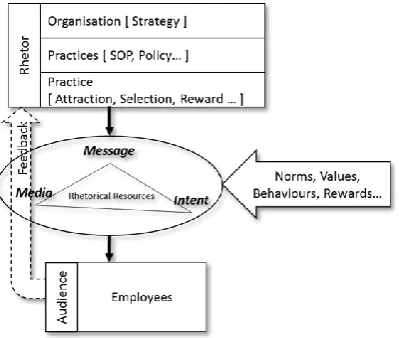
The HRM communication process is a multi-level, multi-facetted process of social interactions and communicative practices. Traditional models of organizational rhetorical practices assumed a one-to-one, one-way communication between the sender (rhetor) and the
recipient (audience) with limited feedback mechanisms (Huang et al., 2013). Error!
eference source not found. shows the HRM communication system in a traditional setting. The organisation’s strategy defines expected behaviours and norms, the practices available are limited through Legislation, Standard Operation Procedures, Policies, Regulations etc., and the actual praxis of communication is a one-way broadcast of organisational message
directed at the employees. The organisation accesses the rhetorical resources of Message –
what is being said, Intent – why is it being said, and Media – where is it being said (Huang et
[image:7.595.198.398.397.566.2]al., 2013). Notable is the organisation’s control over the content (intent and message) and the media (Nandan, 2005, Huang et al., 2013).
Figure 2 Internal Rhetorical Practices (adapted from Huang et al., 2013 to present HR as a rhetor)
WOLF / BAM conference 2015 7/15
5
Web 2.0 in HRM practice
Employees actively use social media to generate additional value for the organisations and for themselves as individuals. This happens for example when employees connect to professional talent and improve recruitment performance (Ollington et al., 2013), establish knowledge networks (Richards, 2011), find new employment opportunities (Janta and Ladkin, 2013), and build social networks which allow the employees to access social capital post-employment (Feuls et al., 2014). However, it is unclear how well organisations adapt their policies, practices and processes to deal with the challenges posed by these new technologies adequately (Boudreau and Lawler III, 2014). Arguably, there are several strategic approaches an organisation can tale when addressing the use of social media. One possibility is to increase control over rhetorical resources, employ prevention tactics, and introduce policies governing technology use and deviant behaviour (Weatherbee, 2010, Billington and Billington, 2012). The control of these (open and public) channels and the imposed limits on social media use are increasingly difficult (Miles and Muuka, 2011, Cascio, 2014). Ignoring these technologies, “changing slowly at best” (Boudreau and Lawler III, 2014, p. 242) is another option, which might lead to a number of negative outcomes ranging from losing voice (Kaplan and Haenlein, 2010), misinterpretations of organisational message by employees (Bowen and Ostroff, 2004), reduced employer attractiveness to potential recruits (Holt et al., 2012) , to major brand and public relations problems (Miles and Muuka, 2011). A third alternative is to seek ways of utilizing these technologies for
organisational rhetorical practices (Billington and Billington, 2012), through seeking engagement (Cascio, 2014, Hanna et al., 2011) and dialogue (Vidgen et al., 2013). This approach can pose challenges as well as add value. Challenges arise as the opportunities for misuse and the potential of distribution of unsanctioned and potentially damaging messages increases (Miles and Muuka, 2011, Weatherbee, 2010). A problem with conversations in apparently open groups (e.g. all employees of an organisation are still a limited and arguably homogeneous group of people) is the effect of “echo chambers” (Leonardi et al., 2013), whereby expressed opinions are repeated and re-enforced through repetition and paraphrasing of like-minded people. Such echo chambers have the potential to re-inforce a shared mis-interpretation of organisational message and so to make consensus harder to achieve. The value of employer’s engagement with employees can be generated through establishment of feedback mechanisms which support shared interpretations of HRM messages (Bowen and Ostroff, 2004), through engagement of employees in HR activities such as referral programs, attraction and employer branding (Mosley, 2007, Ollington et al., 2013), through
organisational learning via knowledge sharing and communities of practice (Richards, 2011), and through innovation and co-creation of products, services and culture (Juntunen et al., 2012, Edgeman and Eskildsen, 2012, Prahalad and Ramaswamy, 2004, Leonardi et al., 2013). One of the key elements of engagement activities is the establishment of a feedback process leading to a dialogue (Bowen and Ostroff, 2004, Vidgen et al., 2013, Cascio, 2014). A
WOLF / BAM conference 2015 8/15 resources, the power to speak is defined by access and the control over media, the power to define what is being said is linked to ability to define the message, and the power to prevent others from speaking is the control over rhetorical resources including control over media, censorship (control over message), and policy (control and regulation of discourse). The concept of “social media use” in the context of the framework introduced here is the
utilisation of social media functions to create a dialogue. This includes all activities aimed to utilise, combine, extend, and to make available communication features which allow a wider audience to access information, allow a wider audience to participate in content creation, and remove barriers which would exclude further groups of rhetors/audiences.
6
Empirical Findings
Two pilot studies conducted in large UK based organisations revealed, that HR departments engage with predominantly three identifiable distinct groups of rhetors: candidates,
employees, and alumni (Wolf et al., 2014). The aim of these studies was to investigate how organisation use social media, who are the target audiences of organisational rhetorical practices on social media, and what are the organisational strategies, policies and practices that drive and govern social media use in HRM communication process. The case studies were conducted in two large international UK-based companies from different industry sectors and with different approaches to employee engagement, management style and levels of social media use. Both studies revealed that social media applications are being used for information sharing, collection and conversations among candidates, employees and alumni, with and without organisational support and, in some cases, despite explicit lack of support.
Case Study Population
The first organisation is a UK based financial institution with over 100,000 employees worldwide and operations in over 50 countries. Other financial services firms, it is traditionally seen as a strongly regulated, rigid organisation with tall hierarchy structures ranging from associate, vice presidents, to presidents, directors and a number of high-ranking Executive Officers. At the time of the study the organisation was one of many financial institutions undergoing a global restructuring process. This involved a re-invention of the global brand and personnel changes at the same time. Many recruitment and employer branding activities were actively held back due to the lack of a (new common) brand and in fear of potential redundancies.
The other organisation is a UK based fast moving consumer goods enterprise with over 100,000 employees worldwide and operations in over 70 countries. This organisations
considers its employees as customers and values their engagement with the brand. Being very much marketing driven, many activities in HR are coordinated with public relations,
marketing and communication teams. Relatively flat hierarchies and employee-focused benefits such as flexible working hours contribute to the employer brand identity of a “family company”.
Case study data gathering
WOLF / BAM conference 2015 9/15 careers page were analysed in January 2014, reviewed in May 2014 and then again in
November 2014. Twitter channels for both organisations were evaluated during the
November 2014 review, to provide an additional data source and enrich the previous data set. The initial selection of websites analysed was driven by two approaches: (1) searches for “Company name jobs” and “… careers” on google and following any links from the corporate career site, and (2) any SNS mentioned during the interviews. Information from the websites evaluated and screenshots taken to preserve evidence. Analysis of the websites had two aims:
first, accessible features were recorded (allowed comments, free to join groups, allow wall
postings); then the actually used features were considered, i.e. did the users utilize any of the
available features and how? Another prominent source of external identity/image
communication is glassdoor.co.uk (Ladimedji, 2014). Anonymous reviews from current and
former employees as well as candidates supposedly provide a transparent image of the firm,
however, information on glassdoor.co.uk is anonymous, there are no feedback mechanisms and therefore, despite the fact that both organisations feature prominently and have received almost one thousand reviews each, the information from galssdoor.co.uk was not considered as part of this study due to the lack of transparency and low potential for dialogue.
The selection of the interviewees was not random: as HR employees both interviewees had an understanding of what the corporate message is in regards to employer brand and
engagement; Both interviewees are responsible for evaluating, selecting and implementing HR technologies (e.g. HRM software, applicant tracking systems, social media platforms); Both interviewees have a high exposure to attraction and selection activities of the
organisation; Being in middle management, the interviewees are close to the “shop floor level” to know what actual practices exist, yet required understanding and knowledge of higher level policies and strategies. Finally, the interviewees were internal employees, and not outsourced HR personnel, so that they too were subject to organisation’s messages in their capacity as employees.
The pilot studies further revealed, that dialogue took place among employees, between employees and alumni, as well as between candidates and alumni, the organisation being partially not aware of these conversations, and partially indifferent. Additionally, the studies showed that the organisations struggle to create dialogic engagement on social media with its
employees. These findings lead to extension of the extended model presented by (Huang et al., 2013). In addition to their recognition of added ambiguity, richness and blurred borders between consumption and production, new audiences and rhetors, with entirely different
rhetorical flows need to be introduced (
WOLF / BAM conference 2015 10/15
Figure 3 - Rhetorical Practices via Social Media (extension of Huang et al., 2013 adapted to incorporate new rhetors and audiences)
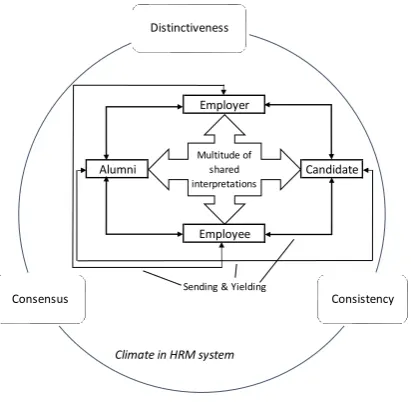
This extension has a direct impact on the HRM communication process. The communication process is no longer a top-down message/feedback exchange between employer and
employee (Figure 1), it is further more a multi directional exchange between and across a number of rhetor/audience groups (Figure 4).
Figure 4 - New actors in HRM as communication system
The effects of social media use are multi-fold. First, the top-down approach of traditional HR communication is challenged and a more egalitarian access to rhetorical resources is possible. Second, additional rhetors (namely alumni and candidates) can join the conversation. Third, the roles of employer as rhetor and employee as audience are being reversed and
intermingled. Linking these effects to the three faces of power: who can speak, what can be said, and who cannot speak, it could be argued that the increased number of rhetors gives voice to more participants (who can speak), easier access to rhetorical resources allows new and wider groups to set the agenda (what can be said), the complexity of conversational flows limits the ability of any single group to exclude others from the conversation (who cannot speak), so that the overall effect is a step towards a greater power equilibrium and a more balanced dialogue. Because of a greater power balance organisations now face challenges in
Employer
Alumni Candidate
Employee
Multitude of shared interpretations
Sending & Yielding
Climate in HRM system
Distinctiveness
[image:11.595.196.402.359.560.2]WOLF / BAM conference 2015 11/15
providing a distinctive and consistent message, and establishing common shared
understanding among a greater number of participants. While the HRM communication process limits and informs the HRM communication practices, the (new, emergent and changing) practices constitute, maintain and change the process. Investigations of the effects of social media use in HRM need to recognise the duality of the HRM system and attend to the phenomenon at both – the process and the practice – levels.
7
Discussion and Conclusions
The pilot studies presented in this paper confirmed previous findings (Huang et al., 2013) and found complexity, multivocality, extended reach and richness introduces into HRM
communication process. In addition, the studies revealed new actors – the alumni and the future employees. These new rhetor/audience groups add complexity into the HRM
communication process and introduce ambiguity (Huang et al., 2013). This added complexity can impact and challenge the strength of the HRM system, by influencing its levels of
consensus, consistency, and distinctiveness. Establishment of a common understanding, as a
necessary condition for consensus, has been made more difficult as more actors are involved.
The consistency of messages, traditionally maintained through top-down communication, is being jeopardises by bottom-up and cross communication and uncensored and unsanctioned
messaging (Miles and Muuka, 2011). The distinctiveness of messages, even when coming
from a distinctively legitimate and authorative sender (Bowen and Ostroff, 2004), is being challenged by messages coming from not organisationally endorsed, yet credible, trusted and thus distinctive sources (Vidgen et al., 2013).
Conclusions
The presented framework provides a theoretical lens to analyse the impact of social media use by different actor groups on HR process. The framework defines what is the “use” of social media Previous studies focused on employer/employee communications as
disconnected entities at different stages of employer/employee relationship: for example recruiter/candidate communications (Ollington et al., 2013, Stone et al., 2013),
employer/potential candidate attraction (Edwards, 2010, Boudreau and Lawler III, 2014), employer/employee engagement and negotiations (Bowen and Ostroff, 2004, Miles and Muuka, 2011, Hauptmann and Steger, 2013) etc. In contrast to previous models, the
framework allows HRM process to be understood as a continuous process of communications between the employer and its current, former and future employees, and other stakeholder groups such as unions, shareholders, politicians etc. The concept of “social media use” is defined as application of Web 2.0 technologies to create dialogue. This definition allows assessment of the “quality” of social media use – how do activities on social media contribute to dialogue. Finally, the framework links activities of diverse participant groups to the
strength of HRM communication system (Bowen and Ostroff, 2004), which allows the assessment of the effectiveness of these activities and their impact of these activities on system’s strength.
WOLF / BAM conference 2015 12/15 introduce new audiences and new rhetors, and increase ambiguity – it is yet to be formally understood, how organisations deal with the added complexity and ambiguity. How
organisations adapt their strategies in terms of engagement, directional-communication, and dialogue with potential, current and future employees, and other groups to address these challenges and make use of the opportunities. Future research can take several direction and employ a variety of methods to investigate questions such as: “what are firms’ strategic considerations when using social media?”, “what are antecedents and consequences of social media use?”, “what are the actual practices / combinations of practices that lead to
engagement?” etc. Acknowledging, that organisations have (almost) equal access to Web 2.0
technologies and social media one of the questions to ask is how some firms are able to create
engagement while others do not. The Research Based View (RBV) of the firm (Wright et al., 2001, Bowman and Ambrosini, 2003, Rouse and Daellenbach, 1999, Barney, 1991) could
provide a lens and guide for qualitative research in organisations to uncover firm internal
specific and idiosyncratic resources that lead to better engagement.
8
References
Baird, M. 2002. Changes, dangers, choice and voice: Understanding what high commitment
management means for employees and unions. Journal of Industrial Relations, 44,
359-375.
Barney, J. 1991. Firm Resources and Sustained Competitive Advantage. Journal of
Management, 17, 99-121.
Billington, M. G. & Billington, P. J. 2012. Social Media Tools for Leaders and Managers.
Journal of Leadership, Accountability and Ethics, 9, 11-19.
Boudreau, J. & Lawler Iii, E. E. 2014. Stubborn traditionalism in HRM: Causes and
consequences. Human Resource Management Review, 24, 232-244.
Bowen, D. E. & Ostroff, C. 2004. Understanding HRM–Firm Performance Linkages: The
Role of the “Strength” of the HRM System. Academy of Management Review, 29,
203-221.
Bowman, C. & Ambrosini, V. 2003. How the Resource‐based and the Dynamic Capability
Views of the Firm Inform Corporate‐level Strategy. British Journal of Management,
14, 289-303.
Boxall, P. & Macky, K. 2009. Research and theory on high‐performance work systems:
progressing the high‐involvement stream. Human Resource Management Journal, 19,
3-23.
Boyd, D. M. & Ellison, N. B. 2008. Social Network Sites: Definition, History, and
Scholarship. Journal of Computer-Mediated Communication, 13, 210-230.
Brown, V. R. & Vaughn, E. D. 2011. The Writing on the (Facebook) Wall: The Use of Social
Networking Sites in Hiring Decisions. Journal of Business and Psychology, 26, 219–
225.
Cascio, W. F. 2014. Leveraging employer branding, performance management and human
resource development to enhance employee retention. Human Resource Development
International, 17, 121-128.
Collins, C. J. & Clark, K. D. 2003. Strategic Human Resource Practices, Top Management Team Social Networks, and Firm Performance: The Role of Human Resource
Practices in Creating Organizational Competitive Advantage. The Academy of
WOLF / BAM conference 2015 13/15 Desautels, P. 2011. UGIS: Understanding the nature of user-generated information systems.
Business Horizons, 54, 185-192.
Edgeman, R. & Eskildsen, J. 2012. The C4 model of people-centered innovation: culture,
consciousness, and customer-centric co-creation. Journal of Innovation and Best
Business Practice, 2012, 14.
Edwards, M. R. 2010. An integrative review of employer branding and OB theory. Personnel
Review, 39, 5-23.
Eppler, M. J. & Mengis, J. 2004. The Concept of Information Overload: A Review of Literature from Organization Science, Accounting, Marketing, MIS, and Related
Disciplines. The Information Society, 20, 325–344.
Facebook 2011. Facebook. Facebook.
Feuls, M., Fieseler, C. & Suphan, A. 2014. A social net? Internet and social media use during
unemployment. Work, Employment & Society, 28, 551-570.
Fieseler, C., Hoffmann, C. P. & Meckel, M. 2010. CSR 2.0 - Die Kommuniation von
Nachhaltigkeit in Sozialen Medien. Marketing Review St. Gallen, 22-26.
Gaudin, S. 2010. NASA: Astronauts start Twittering from space station. Computerworld.
Guest, D. E. 2002. Human Resource Management, Corporate Performance and Employee
Wellbeing: Building the Worker into HRM. The Journal of Industrial Relations, 44,
335-358.
Guest, D. E. 2011. Human resource management and performance: still searching for some
answers. Human Resource Management Journal, 21, 3-13.
Hanna, R., Rohm, A. & Crittenden, V. L. 2011. We’re all connected: The power of the social
media ecosystem. Business Horizons, 54, 265—273.
Hauptmann, S. & Steger, T. 2013. “A brave new (digital) world”? Effects of In-house Social
Media on HRM. Zeitschrift für Personalforschung, 27, 26-46.
Holt, S., Marques, J. & Way, D. 2012. Bracing for the Millennial Workforce: Looking for
Ways to Inspire Generation Y. Journal of Leadership, Accountability and Ethics, 9,
81-93.
Huang, J., Baptista, J. & Galliers, R. D. 2013. Reconceptualizing rhetorical practices in
organizations: The impact of social media on internal communications. Information
and Management, 50, 112-124.
Janta, H. & Ladkin, A. 2013. In search of employment: online technologies and Polish
migrants. New Technology, Work and Employment, 28, 241-253.
Juntunen, M., Juntunen, J. & Autere, V. 2012. Recruits/' Corporate Brand Co-creation
Experiences of the Finnish Military Forces. Corp Reputation Rev, 15, 88-104.
Kaplan, A. M. & Haenlein, M. 2010. Users of the world, unite! The challenges and
opportunities of Social Media. Business Horizons, 53, 59—68.
Kent, M. L. & Taylor, M. 1998. Building Dialogic Relationships Through the World Wide
Web. Public Relations Review, 24, 321-334.
Kietzmann, J. H., Hermkens, K., Mccarthy, I. P. & Silvestre, B. S. 2011. Social media? Get
serious! Understanding the functional building blocks of social media. Business
Horizons, 54, 241-251.
Ladimedji, K. 2014. Should Employers Fear Glassdoor Reviews? [Online]. Available:
https://www.recruiter.com/i/should-employers-fear-glassdoor-reviews/ [Accessed 2014/11/12 2014].
Lawler, E. E., Iii 1988. Choosing An Involvement Strategy. The Academy of Management
Executive, 2, 197-204.
Leeper, R. V. 1996. Moral objectivity, Jurgen Habermas's discourse ethics, and public
WOLF / BAM conference 2015 14/15 Leonardi, P. M., Huysman, M. & Steinfeld, C. 2013. Enterprise Social Media: Definition,
History, and Prospects for the Study of Social Technologies in Organizations. Journal
of Computer-Mediated Communication, 19, 1-19.
Lim, M. 2012. Clicks, Cabs, and Coffee Houses: Social Media and Oppositional Movements
in Egypt,2004–2011. Journal of Communication, 62, 231-248.
Lukes, S. 1974. Power: A radical view, London Macmillan.
Martin, R. 2013. Ricky Martin Column: The importance of social media to a recruitment
business. Business intelligence for recruitment and resourcing professionals.
Miles, S. J. & Muuka, G. N. 2011. Employee choice of voice: a new workplace dynamic.
Journal of Applied Business Research (JABR), 27, 91-104.
Mosley, R. W. 2007. Customer Experience, Organisational Culture and the Employer Brand.
Journal of Brand Management, 15, 123-134.
Nandan, S. 2005. An Exploration of the Brand Identity-Brand Image Linkage: A
Communications Perspective. Journal of Brand Management, 04, 264-278.
Ollington, N., Gibb, J. & Harcourt, M. 2013. Online social networks: an emergent recruiter
tool for attracting and screening. Personnel Review, 42, 248-265.
Orlikowski, W. J. 2001. Technology and Institutions: What can research on Information
technology and Research on Organizations learn from each other? MIS Quarterly, 25,
145-165.
Orlikowski, W. J. & Scott, S. V. 2008. Sociomateriality:Challenging the Separation of
Technology, Work and Organization. The Academy of Management Annals, 2,
433-474.
Panagiotopoulos, P. 2012. Towards unions 2.0: rethinking the audience of social media
engagement. New Technology, Work and Employment, 27, 178-192.
Prahalad, C. K. & Ramaswamy, V. 2004. Co‐creation experiences: The next practice in value
creation. Journal of interactive marketing, 18, 5-14.
Richards, J. 2011. What has the internet ever done for employees? A review, map and
research agenda. Employee Relations, 34, 22-43.
Robb, D. 2014. Cultivating Connections. HR Magazine, 59, 65-66.
Roth, P. L., Bobko, P., Van Iddekinge, C. H. & Thatcher, J. B. 2013. Social Media in
Employee-Selection-Related Decisions: A Research Agenda for Uncharted Territory.
Journal of Management.
Rouse, M. J. & Daellenbach, U. S. 1999. Rethinking research methods for the resource‐based
perspective: isolating sources of sustainable competitive advantage. Strategic
management journal, 20, 487-494.
Sanders, K. & Yang, H. 2015. The HRM Process Approach: The Influence of Employees’
Attribution to Explain the HRM‐Performance Relationship. Human Resource
Management.
Stanton, J. M. & Coovert, M. D. 2004. Guest editors' note: Turbulent waters: The intersection
of information technology and human resources. Human Resource Management, 43,
121-125.
Stein, L. 2013. Policy and Participation on Social Media: The Cases of YouTube, Facebook,
and Wikipedia. Communication, Culture & Critique, 6, 353-371.
Stone, D. L., Lukaszewski, K. M., Stone-Romero, E. F. & Johnson, T. L. 2013. Factors
affecting the effectiveness and acceptance of electronic selection systems. Human
Resource Management Review, 23, 50-70.
Vidgen, R., Sims, J. M. & Powell, P. 2013. Do CEO bloggers build community? Journal of
Communication Management, 17, 364-385.
Walton, R. E. 1985. From control to commitment in the workplace. Harvard Business
WOLF / BAM conference 2015 15/15 Weatherbee, T. G. 2010. Counterproductive use of technology at work: Information &
communications technologies and cyberdeviancy. Human Resource Management
Review, 20, 35-44.
Wolf, M., Sims, J. & Yang, H. The role of Social Media in Human Resource Management.
In: BROOKS, L., WAINWRIGHT, D. & DAVID, W., eds. Annual Conference of the
UK Academy of Information Systems, Oxford, 2014, 2014. UKAIS.
Wright, P. M., Dunford, B. B. & Snell, S. A. 2001. Human resources and the resource based
view of the firm. Journal of Management, 27, 701-721.
Wright, P. M. & Mcmahan, G. C., Mcwilliams, Abagail 1994. Human resources and
sustained competitive. International Journal of Human Resource Management, 5,
301-326.