BIROn - Birkbeck Institutional Research Online
Jarzabkowski, P. and Chalkias, Konstantinos and Clarke, D. and Iyahen, E.
and Stadtmueller, D. and Zwick, A. (2019) Insurance for climate adaptation:
opportunities and limitations.
Global Commission on Adaptation, UN,
Rotterdam, the Netherlands and Washington, DC, U.S..
Downloaded from:
Usage Guidelines:
Please refer to usage guidelines at or alternatively
Prof Paula Jarzabkowski, Cass Business School, City, University of London & University of Queensland Dr Konstantinos Chalkias, Birkbeck, University of London
Dr Daniel Clarke, Centre for Disaster Protection
INSURANCE FOR
CLIMATE ADAPTATION:
ABOUT THIS PAPER
This paper is part of a series of background papers commissioned by the Global Commission on Adaptation to inform its 2019 flagship report. This paper reflects the views of the authors, and not necessarily those of the Global Commission on Adaptation.
Suggested Citation: Jarzabkowski, P., K. Chalkias, D. Clarke, E. Iyahen, D. Stadtmueller & A. Zwick. 2019. “Insurance for cli-mate adaptation: Opportunities and limitations.” Rotterdam and Washington, DC. Available online at www.gca.org.
ACKNOWLEDGEMENTS
The authors wish to thank the following colleagues for their helpful reviews on an earlier draft of this paper: Dr Jean-Claude Bidogeza (African Risk Capacity), Mr Vitumbiko Chinoko (CARE International), Ms Clare Harris (START Network), Mr Jan Kowalzig (Oxfam), Dr Nisha Krisnan (WRI/GCA), Ms Laura Scheske (GCA), Dr Simon Young (Former Facility Supervisor, CCRIF & Senior Advisor to ARC Ltd).
ABOUT THE GLOBAL COMMISSION ON
ADAPTATION
The Global Commission on Adaptation seeks to accelerate adaptation action and support by elevating the political visibility of adaptation and focusing on concrete solutions. It is convened by 19 countries and guided by more than 30 Commissioners, and co-managed by the Global Center on Adaptation and World Resources Institute.
ABOUT THE AUTHORS
Prof Paula Jarzabkowski: Cass Business School, City, University of London & University of Queensland
Dr Konstantinos Chalkias: Birkbeck, University of London [email protected]
Dr Daniel Clarke: Centre for Disaster Protection [email protected]
Ekhosuehi Iyahen: Insurance Development Forum [email protected]
Daniel Stadtmueller: IInsuResilience Global Partnershipm [email protected]
Dr Astrid Zwick: InsuResilience Global Partnership [email protected]
Executive Summary
Climate change jeopardizes socioeconomic stability, and sets back efforts at development. The increasing frequency and severity of climate-change-driven disasters threaten lives and livelihoods, food security, water supply, property secu-rity, and economic prosperity across the globe. Adaptation is vital to make society resilient to the impacts of climate change.
Adaptation means increasing our ability to recover from specific disasters; reducing vulnerability and promoting resil-ience (both physical and financial) to catastrophe. Insurance can be a key tool in both these aspects of adapting to climate change. First, it provides the flow of capital to support communities and infrastructure to recover from disas-ters. Without adequate insurance, the burden of paying for losses falls largely on individual citizens, governments or aid organizations, with significant impact upon already straining government budgets, and economic and social hardship for those affected. Countries with high insurance cover recover faster from disasters, and increasingly, governments are recognizing the role and benefits of insurance in transferring risk from disasters. Yet there is a large and even widen-ing ‘protection gap’ of underinsurance. Second, insurance contributes to the wider understandwiden-ing of climate-change risks, and helps promote measures that individuals and communities can use to improve their protection from cli-mate-change-driven disasters. For example, insurance expertise in risk evaluation helps to make the economic case for flood defences, or for changes to how and where buildings are constructed.
Using insurance is a step away from crisis towards risk management, and it strengthens socio-economic resilience under a changing climate. However, it is only one of the available disaster-risk financing mechanisms. It thus needs to be considered within a broader fiscal framework that also includes international assistance, catastrophe debt draw-downs, and other financial securities, disaster reserves and budgets. Furthermore, insurance and other disaster risk financing mechanisms are only part of the solution: they need to be integrated into other resilience and adaptation mea-sures as part of a comprehensive climate adaptation strategy. In this report, we make recommendations to maximize the benefits of insurance for climate adaptation:
Recommendation 1: Invest in open-source models that provide a long-term view of climate risk and link to insurance solutions.
Recommendation 2: Joined-up policy-making to put climate-risk models at the heart of national adaptation strategies.
Recommendation 3: Develop consistent climate adaptation regulation and standards across countries.
Recommendation 4: Foster insurance innovations that can respond to a changing climate risk landscape.
Recommendation 5: Strengthen dialogue between insurers and policy-makers around Build Back Better.
Recommendation 6: Converge insurance, humanitarian and development agendas.
Table of Contents
SECTION 1. INTRODUCTION 3
SECTION 2. THE INSURANCE VALUE CHAIN 4
2.1 Risk-transfer process 4
2.2 The three principles: Risk pooling, risk pricing and risk diversification 6
SECTION 3. INSURANCE PRODUCTS 8
3.1 Micro-, meso- & macro- levels of insurance 8
3.2 Indemnity products 9
3.3 Parametric or index-based products 9
3.3.1 Principles of parametric products 9
3.3.2 Disaster liquidity products 10
3.3.3 Summary: Pros and cons of parametric and index-based products 11
SECTION 4. GOVERNMENT INTERVENTION IN INSURANCE PROVISION 13
4.1 Addressing insurance supply failure 13
4.2 Mitigating unaffordable insurance 14
4.3 Protecting the financial viability of sovereigns or sub-sovereigns 15
4.4 Failures in government intervention 16
4.4.1 Commitment problems 16
4.4.2 Inequality in protection 17
SECTION 5. INSURANCE: A MECHANISM FOR ADAPTATION WITHIN A WIDER FISCAL FRAMEWORK 19
SECTION 6. INSURANCE FOR CLIMATE CHANGE ADAPTATION: THE OPPORTUNITIES 21
6.1 Identifying climatic risks 21
6.2 Signaling unsustainable development 22
6.3 Preparedness 24
6.4 Building Back Better: Resilient Reconstruction 25
SECTION 7. INSURANCE FOR CLIMATE CHANGE ADAPTATION: THE CHALLENGES 26
7.1 Increasing insurance penetration: Bridging the protection gap 26
7.2 Enhanced risk reduction 27
7.3 Balancing short-term insurance products with long-term adaptation measures 28
7.4 Financial and risk literacy 28
7.5 Insurance as a local solution to a global problem 29
SECTION 8. CONCLUSION 31
APPENDIX:CONTINGENCY PLANNING 33 GLOSSARY 35 ENDNOTES 37 TABLE OF FIGURES
Figure 1. The insurance value chain: Trading in catastrophic risk 4
Figure 2. Macro-level climate risk finance instruments 19
1. Introduction
Climate change is increasing the frequency and severity of extreme weather events, such as flood, hurricane and drought, and therefore jeopardizing sustainable devel-opment. Climate-change-driven disasters accounted for about 91% of the 7,255 major disasters between 1998 and 2017.1 These disasters pose risks not only pose
immedi-ate risk to life, but also damage food security, wimmedi-ater supply, human security, and economic growth over the longer term across the globe.2
Insurance, when put in place, provides financial resilience: it generates a flow of capital to support societies to recover from disasters. In the absence of adequate insurance, the burden of paying for losses falls largely on citizens, governments or aid organizations, with significant impact upon already straining government budgets, and economic and social hardship for those affected.3 When disasters
strike, insurance can provide financial protection to reduce setbacks to technological, economic and societal develop-ment: it is therefore a mechanism for securing a society’s developmental gains. However, insurance is only one of the available disaster-risk financing mechanisms. It needs to be considered within a broader fiscal framework that includes other financial securities, disaster reserves and budgets, catastrophe debt drawdowns, and international assistance.
For maximum effectiveness, insurance also needs to be incorporated into a long-term, comprehensive climate adaptation strategy. Climate adaptation requires both physical resilience – the minimising of vulnerability to haz-ard, and the provision of systems for response and recov-ery – and financial resilience to the risks which remain. Insurance can play a key role in both aspects of adaptation strategies. Insurance can help vulnerable countries to absorb residual financial risks that have not otherwise been mitigated; but through its expertise in risk assessment, it can also identify and incentivize effective physical resil-ience measures.
However, insurance itself needs to innovate and adapt, to better address the needs and challenges of climate adapta-tion. Insurance, particularly for property assets, is a relative-ly short-term product, renewing every 1-5 years, whereas climate adaptation necessitates long-term strategies integrating physical and financial protection. The
evolu-tion of insurance products, alongside their integraevolu-tion into wider risk-management frameworks, will best support the identification and reduction of climatic risks, and increase preparedness for, and resilience to climatic disasters.
Our aims in this report are 1) to describe and critically evaluate available insurance-based mechanisms, using examples that can be understood by a wide audience; and 2) to explain the key opportunities and challenges in using insurance mechanisms within wide-ranging strategies to increase resilience to climate change.
The report has the following structure.
Section 1 is this introduction to the report.
Section 2 outlines the principles of insurance and the risk-transfer value chain through which it operates.
Section 3 explains different types of insurance products and their various applications and beneficiaries.
Section 4 outlines the key reasons for, key mechanisms, and potential challenges of government intervention in insurance provision.
Section 5 briefly indicates how insurance fits within a wider fiscal framework to affect risk prevention, risk reduc-tion, preparedness, and recovery at macro-, meso- and micro-levels.
Section 6 introduces the opportunities of insurance mecha-nisms for climate adaptation, while Section 7 discusses its key challenges.
Section 8 makes key recommendations about how
insur-ance expertise can better address the growing threat of climate-change-driven disasters.
2. The insurance value chain
The purpose of insurance is to transfer a specified risk from one party, an insured, to another party in order to increase the insured party’s capability to withstand finan-cial loss. The potential for finanfinan-cial loss arising from cata-strophic events, such as a major flood or a tropical storm is transferred to insurers. These insurers are capitalized to absorb part or all of the financial impact of these catastro-phes, with their capital ultimately financed by the premiums they are paid for issuing insurance policies. In this section we will explain the risk-transfer process and the principles of insurance that underpin this process.
2.1 Risk-transfer process
Climate change exacerbates catastrophic risks that are a potential source of loss for citizens and businesses. For example, with the threat of tropical storm, a flood, or a forest fire, a citizen might be concerned about the risk of damage to their house, while a manufacturer might be concerned not only about the damage to their industrial plant, but also about the subsequent business interruption. Climate change is making more and more citizens and businesses vulnerable to such risks, so that a global
mac-ro-roadmap (such as the Paris Agreement) is required for action on adapting to climate change. Individually, citizens and businesses can also protect themselves from some of this potential loss by becoming insureds, meaning they transfer some of that risk through the risk-transfer value chain (see Figure 1).
[image:7.612.86.542.437.712.2]The insurer accepts the risk from insureds, charging them a premium for this service. Insurers are then responsible for the potential future financial losses according to the terms and conditions of the insurance policy. If a loss occurs, insurers will pay claims arising from the insurance policy. For example, individual citizens can buy an insur-ance policy to protect their house from flood. They can decide the level of cover, and how much risk to retain them-selves. For instance, if a citizen buys house insurance they can decide for which risks they will be covered (e.g. flood, fire), to what level of their house value they will buy cover, and what ‘excess’ or threshold they will pay themselves for damage before their insurance starts to pay. These differ-ent factors affect the price of their premium. More com-plete cover for multiple risks; full replacement value of the house; lower (or no) excess will each cost more, because
FIGURE 1 The insurance value chain: Trading in catastrophic risk
Insureds
Businesses InsurersPublic Private
market Reinsurers
Public Reinsurers
Financial Markets Private
Insurers Citizens
Governments
Insurance Reinsurance
Catastrophe Models
Capital flow in claims payment Capital flow in
claims payment
Premium payment for Risk transfer Premium payment
for Risk transfer
Premium payment for Risk transfer
Capital flow in claims payment Catastropic
more of the risk is transferred to the insurer. Based on such decisions, insured citizens pay an annual premium for their policy which is much lower than the actual cost of their house being rebuilt if a disaster strikes. Then if a flood damages their house, insurers will be liable for the covered loss and will issue payouts. Insurers calculate premiums, so that over time, the accumulated premiums from many insureds cover the probable losses of the unfortunate few. Insurers are typically private sector companies operating for a profit, but may in some political contexts be public-ly-owned or government legislated not-for-profit insurers developed to fill a particular social need, as we explain in section 4.
Reinsurers - Insurers make profit from trading risk through insurance policies. These policies, collectively, form their insurance portfolio. However, insurers must also protect themselves from having to pay too many claims simulta-neously after a catastrophic event, such as a series of hur-ricanes in the Gulf of Mexico that could strip their capital reserves. They therefore transfer risk to reinsurers in order to protect their capital reserves and ensure they will remain solvent to pay claims after a disaster. Essentially reinsur-ance is insurreinsur-ance for insurreinsur-ance companies. Each insurer creates a reinsurance program that transfers some of their risk to a panel of multiple reinsurers, each of whom covers a percentage of future potential losses. As in insurance risk transfer, reinsurers agree the conditions upon which to pay their share of that insurer’s claims, in return for which they receive a reinsurance premium. The capital which reinsurers need in order to pay claims comes from different actors: (1) private market reinsurers that accept insurance risk for a profit; (2) other capital market providers such as hedge funds, mutual funds, sovereign wealth funds, pen-sion funds, and institutional investors, also accepting risk for a profit; and (3) public sector or government-legislated reinsurers operating as not-for-profits to address a specific protection gap (see Section 4).
Apart from citizens and businesses, governments also transfer risk. Governments’ balance sheets and their public-ly-owned assets are also exposed to natural catastrophes. For example, a government might be concerned about the risk of tropical storm damage to infrastructure such as roads, electricity grids and hospitals. The government’s balance-sheet would be badly affected by having to use its own capital for reconstruction, if no insurance is in place. Governments typically have significant catastrophe risk
exposure compared to individual citizens or businesses. Lower-income countries especially – but not excepting wealthy countries with large government balance sheets – may therefore choose to transfer risk directly to the rein-surance industry (see Section 4.3): to both private market reinsurers and the wider capital markets.
Catastrophe models are used across the value chain for risk assessment and analysis, in order to facilitate risk transfer. Models allow insurers and reinsurers, corpora-tions, governments and other public agencies to evaluate and manage their exposure to catastrophic risk, including pricing any risk they will transfer. Catastrophe models con-sist of three parts:
1) Hazard is about the probabilities of occurrence and severity of any particular potential disaster, such as a tropical storm or flood, at a given location, within a spec-ified time period.
2) Exposure refers to the inventory of elements to be insured, such as property values by location; taking note of specific characteristics such as building materials, typical uses, age, and replacement cost.
3) Vulnerability assesses the level of damage which would be expected at different levels of intensity of a hazard. For example, when a storm surge hits an area with weak building regulations and few flood mitigation measures, it is more vulnerable to loss compared to an area that has strong flood control infrastructure and strong build-ing regulations. Vulnerability assessment may include secondary impacts such as business interruption.
Risk = Hazard × Exposure × Vulnerability
Importantly, models are regularly recalibrated based on recent events. Modelling is therefore at the front line in the evaluation of climate-related risks, because any likelihood that severity may increase, or that occurrence may be more frequent, will lead to increased losses, and hence require higher premiums. In particular, society’s need to under-stand climate change impacts can be at least partially met by using such models to ‘run’ different possible future climate scenarios. In this way society can explore risk, and estimate the financial (and human) value of adaptation. For (re)insurance companies this exploration of future scenarios will reveal both commercial opportunities, and challenges to the design and uptake of insurance products (see Section 6.1 and 7.1).
The expertise required to develop models is usually expen-sive. Models may be proprietary, with licenses issued by developers to industry parties for a fee. Or they may be owned in-house by industry parties as part of their own intellectual capital. Recently, development organizations have supported the generation and sharing of open-source models for evaluating risk and making decisions on risk transfer.4
Brokers are an important reservoir of expertise in risk. Their key role is as market intermediaries, facilitating risk transfer from insureds to insurers (or from insurers to reinsurers). They do not themselves provide the capital or hold the risk, but they are often involved in a wide range of industry activities, from analysis to pricing, from claims to capital provision. As a result, their knowledge base con-nects diverse risks, models, insurance actors, government and inter-governmental bodies, and insurance products from around the world; and they promote transparency and competition within risk trading. All this expertise may improve joined-up thinking on climate change adaptation.
2.2 The three principles: Risk pooling,
risk pricing and risk diversification
The risk-transfer value chain works to accumulate premi-ums across all insureds, so that the few affected insureds can receive a payout to support their recovery. Three princi-ples ensure that, in the event of disaster, each party within the value chain has sufficient capital reserves to pay the leveraged claims upon them.
Risk pooling means that many insureds are needed to help spread the insurers’ financial risks of payouts from
expen-sive claims more evenly. In particular, insurers hold a pool of risk, from across a large enough population, that their combined premiums can provide sufficient capital reserves for insurers to cover the risk of large payments to a few of them in any given year. Pooling is not simply about econo-mies of scale, but is based on a long history of cross-subsi-dization. Insurance can be provided to all in the pool, even though statistically, some insureds face higher risk. For example, people with houses next to a river face higher risk of flood. Nonetheless, with a large enough pool of insureds, the overall effect of the likelier or greater losses to these insureds is distributed across the pool.
Risk pricing: Despite the cross-subsidization effects of risk pooling noted above, there has always been an effort to ensure that those at higher risk also pay more for their insurance. Growing improvements in modelling (see Section 2.1) have made it possible to identify more accu-rately specific properties or insureds most likely to trigger a claims payment, and to charge higher premiums for them. This is known as risk-reflexive pricing and is now a key component of offering insurance policies.5
Risk diversification is a technique used by (re)insurers to spread loss exposures. A (re)insurer needs a wide range of risks spread across a wide geographical area, diverse enough to minimize correlation between those risks. A diversified portfolio may include different types of potential hazards, such as flood, earthquake and fire; for different assets from homes, to crops, to commercial businesses; and all of these may be located in different regions with dif-ferent exposure to any of these hazards. For example, a (re) insurer may diversify across earthquake in California, and hurricane in Florida, and this may be further diversified with flood in Europe and wildfire in Australia to minimize the possibility of having to pay multiple claims simultaneously. (Re)insurers with highly-diversified portfolios can achieve better capital optimization than those that are highly concentrated on a specific risk in a specific location – that is, the same amount of capital in reserve is capable of underwriting more risk if the risk is diverse. Diversification enables (re)insurers to demonstrate better solvency to regulators without having to transfer more risk away, which would come at a cost to their profitability that would be passed on to consumers through higher premiums.6
3. Insurance products
Insurance is one financial instrument, comprising a range of products which operate in different ways. This section explains different types of insurance products and their usefulness in different contexts.
The following four considerations affect the choice of insurance product(s):
1. The position of the risk across a spectrum from low-fre-quency-but-high-severity events, such as a one-hun-dred-year flood that can devastate a society, to events of high-frequency but low-severity, such as low-impact floods during rainy seasons.
2. Any strategies in place to cover different stages of post-disaster risk management, from early action, to disaster relief, to recovery support, and reconstruction. 3. The speed of financial relief needed for each of these
post-disaster stages, from immediate response to later reconstruction.
4. The parts of society and the economy that the product is intended to support, ranging from particularly-vul-nerable citizens, to individuals and small businesses, to the commercial sector, to government assets and infrastructure.7
Individual products may support different aspects of these four considerations.8
3.1 Micro-, meso- & macro- levels of
insurance
Insurance products can operate at micro-, meso- and mac-ro- levels, which we now briefly explain.
Micro-insurance is the direct insurance of individual or small-business policyholders. Increasingly, however, micro-insurance has come to mean the development of micro-products to insure the most vulnerable individu-als in low-income countries; a parallel with the concept of micro-finance. Micro-insurance has grown over the last decades in developing countries.9 An example is
R4, a partnership between the World Food Programme and Oxfam, which aims to increase the resilience of the livelihoods of people most vulnerable to weather-related risks. This program provides subsidized micro-insurance products which are linked to the specific risks faced by
these individuals, the poorest farmers, enabling them to access crop insurance R4 takes an innovative approach to risk management by integrating risk-transfer (through insurance) with risk reduction. Farmers and their families in some of the lowest income countries are mobilized to take risk reduction action such as the rehabilitation of low-lying lands for rain-fed rice cultivation, the construction of dikes and stone barriers, the construction of dams and the cre-ation of vegetable gardens, in return for insurance cover.10
Yet micro-insurance continues to have a relatively modest global reach relative to its potential11 indicating problems
in both the development of suitably tailored products and distribution channels, and, particularly issues of affordabili-ty for the most vulnerable.
Meso-insurance refers to those situations in which the insured is not an individual, but rather an aggregation of individuals under a collective body. For example, the insured might be an organization that supports a collective of farmers within an area. This meso-level organization buys an insurance product designed to cover the collective of individuals; the individuals themselves are indirect bene-ficiaries of financial protection. They will receive payments from the meso-level organization, based on any claims paid to the organization through insurance. Such products are often taken out on behalf of vulnerable individuals who do not have adequate protection – or indeed, any protection – through direct personal insurance, as per the example of the Kenya livestock insurance program in Section 3.3.1.
3.2 Indemnity products
Most of our understanding of insurance products is based on the principles of indemnification for loss against an actual physical asset. Assets such as a house, factory, commercial building, or power plant may be owned by a private individual or company, while other assets such as roads, hospitals or educational facilities can be publicly owned. The key to indemnified insurance products is that the asset has a known value for reconstruction; it is made of particular types of materials, in a specific location. This means the asset in question can be allocated an insured value, against it which can be indemnified. The price of the insurance product will be based on the cost of repairing the property and the likelihood of partial or full loss. High-value assets in very exposed areas, such as expensive infrastruc-ture or high-value commercial buildings in coastal areas prone to both wind and storm surge, will be charged a higher premium than assets of lower physical value, not in an area at high risk of an extreme weather event. The insur-ance contract is based on indemnification of the specific assets, and hence, actual losses to those assets are the trigger for payment.
Actual loss trigger: In order for payment to be released on these products, an independent loss adjustor is appointed to inspect the damage after the event. The loss adjustor will usually be an expert in the specific type of damage or loss and its valuation, working for an independent com-pany that therefore has no conflicts of interest with either the insured or the insurance company. They assess the damage and the cost to repair or reconstruct, after which a claim is paid by the insurance company to the owner of the asset. This claim may potentially be for the total of the insured value in the case of a full loss, according to the terms of the insurance contract. The trigger for payment is thus tied to the actual loss experienced by the asset owner, in respect of the identified event for which they were insured.
The key features of indemnification insurance products in terms of the four considerations above are:
1) Indemnity products are common for low-severity, high-frequency events, such as household, small busi-ness and commercial cover against a range of potential losses that may not affect society but are still critical to the financial stability of those policyholders. If risk
is reinsured, indemnity products can also provide for low-frequency, high-severity, catastrophic events. 2) Indemnity products are particularly suited to the expensive reconstruction phase of post-disaster management.
3) Due to the process of loss adjustment that accom-panies claims, indemnity products are not suited to immediate disaster response. They are much more appropriate to the medium-and longer-term responses of rebuilding physical assets.
4) Insurance policies will pay out against insured value, which may not include any additional premium pay-ments to build to a higher standard after loss. Hence, payments for reconstruction will not necessarily lead to the rebuilding of more resilient assets. Nonetheless, where insurance is linked to government regulations about rebuilding and enhanced construction codes it may be possible to increase the future resilience of the assets in question (see Example 3, Section 6.2). Such linkage indicates some of the opportunities for insur-ance in climate adaptation (see Section 6.4). However, rebuilding and construction codes arise from govern-ment legislation, and are not typically something over which the insurance company has control or jurisdic-tion (see Example 4, page 25 and Secjurisdic-tion 7.2). One of our recommendations is therefore a stronger dialogue between insurance companies and legislators (see Section 8) about how insurance can financially support improved standards for reconstruction, in order to better future proof assets for climate adaptation.
3.3 Parametric or index-based
products
products, which were initially developed as catastrophe bonds to supplement reinsurance capital for the insurance industry, have become particularly important for respond-ing to catastrophic events in low-income countries where insurance penetration is low. Indeed, they have been at the forefront of much industry innovation in providing disaster response for these countries. Such products comprise the following components:
Trigger: The insurance cover can be triggered when pre-de-fined event parameters are met or exceeded, measured by an objective model-based index of catastrophic events. For example, the event can be a tropical cyclone, where the parameters are the wind speed at particular pre-determined locations: or a flood, as measured by a rainfall volume and frequency over defined periods in a particular geographic location. Weather-related events are very common para-metric triggers.
There are many other possible index triggers such as mar-ket indices, crop yield, power outage and more. For exam-ple, an area yield trigger is typical for agricultural products. For this trigger, an index is calculated based on the typical aggregate yield of a crop across an area, and its historic experience of yield losses during a specified peril, such as drought. On the basis of this index, the product will trigger according to the average loss experienced by the crop across the area, rather than being calculated on a farm-by-farm basis. These products can work at the meso-level of insurance to provide aggregate cover. Examples include government-legislated or government-backed agricultural insurance pools supporting a collective of farmers within a certain area.
Index triggers can also operate at the micro-level to sup-port vulnerable individuals in low-income economies, by triggering particular types of payout that help to allay disas-ter for these individuals. For example, in Kenya an index-based livestock insurance product was developed, with a trigger for payout when pasture levels begin to decrease because of drought. The trigger is based on a satellite measures of the color of the ground as a proxy for dryness that will affect the amount of livestock feed available. The aim of the trigger is that the payout should be made while the pasture is decreasing, in order to provide livestock own-ers with money to purchase feed for their animals.12 This
scheme suffered from insufficient demand during its initial pilot phase,13 until the Kenyan government subsidized
farm-ers’ premiums to encourage participation in the scheme. Since then, the scheme has been sufficiently successful in providing payouts to 275 nomadic cattle farmers, that it is now being scaled up.14
Payout: a pre-agreed payout is issued if the parametric or index trigger is reached or exceeded, regardless of the actual physical loss sustained. If the wind speed or rainfall volume occurs within the pre-specified location, or the area yield, or industry loss is reached, as determined by an objective third party and specified in the contract, this triggers the payment.
While indemnified insurance payouts are calculated based on the losses incurred in relation to the insured value of a specified asset, there is no single way of calculating the payout on an index-linked product. Rather, the pay-outs are calculated according to the specific contractual basis of the product, which can be tailored to the specific demands for protection, making it a more flexible product than indemnity products. For example, payment can be triggered by modelled losses (that is, the losses projected
to occur for the particular severity of disaster experienced, as opposed to actual claims for losses), when they exceed specified thresholds. By contrast, as we note in Section 3.3.2 below, payouts on disaster liquidity products may be calculated to meet the modelled, projected costs of early action for the recovery phase after disaster. In yet other examples, such as the Kenyan livestock product, payment may be calculated based on a lump sum to provide feed for a specified number of animals per farmer in an affected region. Such payments typically have progressive trig-gers, enabling partial payments where lower levels of the presenting conditions are met. The payout could therefore be equal to or less, but not more than the agreed amount in the contract. Critically, the common feature of such prod-ucts is that payments can be issued much sooner, when the pre-agreed, modelled parameters or indices are met, rather than by the actual loss assessed after the disaster.
3.3.2 DISASTER LIQUIDITY PRODUCTS
indemnity products, once the parameters are met, the country can receive an almost immediate payment. This rapid injection of capital can then be used for immediate disaster relief, such as providing food, clean water, or shelter.
These products are therefore often termed disaster liquidity products. As disaster response is typically a government responsibility, these products usually operate at a mac-ro-level. For many sovereigns in low-income economies that struggle to meet disaster response costs through their own balance-sheets, these products have transformed their ability for rapid humanitarian relief. While reconstruction may come from international aid or other international development budgets, for these countries, immediate disaster relief is a priority that can be a viable and afford-able product for them to purchase, even though they may have had little history of insurance.
The timeliness and flexibility of parametric insurance prod-ucts have thus encouraged their innovative application to many hazards to which low-income countries are vulner-able. For example, payments triggered by drought can be used to support food security and protect the assets of the most vulnerable, as evidenced by the African Risk Capacity (ARC) (see Example 1).
These schemes are not without challenges. Such products are still under development, and can fall prey to errors and insufficient information in the parameters or indices that are being modelled. For example, in Malawi under a similar situation to Example 1, ARC’s payments were delayed because of modelled assumptions about the type of grain being used. These assumed greater resilience to drought than was actually experienced by Malawian farmers, who were using a different grain. Such different outcomes from the same scheme show the importance of continuously improving the models involved in developing products.
It is also important to assist those taking out products to examine what exactly they wish to protect, such as food security in the event of a climate-related disaster, as opposed to necessarily a climate-based rainfall index per se.16
3.3.3 SUMMARY: PROS AND CONS OF
PARAMETRIC AND INDEX-BASED PRODUCTS
Parametric and index-triggered products have valuable roles in addressing the four considerations of our opening paragraph, but they also raise some potential concerns.These products can be valuable for the following reasons:
•
They can address catastrophic risk, since the triggers and payouts can be linked to low-frequency, high-severi-ty events such as tropical storm, excess rainfall, drought and other non-climate related events like earthquakes.•
They can be used to support the most vulnerable: either as micro-insurance, albeit such `` are largely in their infancy; or, primarily, as meso-insurance, where they are designed as an aggregate product that can provide collective support for vulnerable individuals. For such individuals the development and purchase of a specific individual product would be neither viable for the insurer, nor affordable for insureds.•
They are timelier, issuing payouts quickly and deci-sively to reduce the immediate human and economic impact of the disaster. Since such products are often tied to modelled triggers rather than actual losses, loss adjustors do not need to assess the value of damage to assets which can be a lengthy process, particularly in the aftermath of a major disaster. Rather, the payment can be made within a matter of days to weeks, whichMauritania is impacted by drought on a frequent basis. It was among the first countries to purchase an insurance policy from ARC for an estimated pre-mium of $1,394,000 for a total cover of $9,000,000 for the agricultural season from July through November 2014. The product worked. After a very poor rainy season, Mauritania received a payout of approximately $6,326,000 in January 2015. With this rapid payment which gave them liquidity in the face of impending disaster, Mauritania had the necessary resources to alleviate a humanitarian crisis, providing 50,000 households with 50 kilo-grams of rice and 4 liters of oil each over 4 months (April – July 2015). The timeliness of the payout had a positive impact; it prevented migration, and protected livelihoods and assets, by avoiding the distressed sale of livestock.15
enables immediate action in response to climate-related events.
•
They have higher design and purpose flexibility than indemnity-based products, as they can be tailored to specific issues or scenarios from which an insured, such as a government or a farmers’ cooperative, desires protection. For example, payments can be linked to the provision of food security in the event of a climate-relat-ed disaster, rather than the reconstruction of assets.Due to the above four features, these products are a lead-ing component of innovative risk-financlead-ing strategies for disasters as diverse as weather-related events, agricultural risks, and pandemics. However, these products also pres-ent challenges:
•
Basis risk may occur, in which there is a difference between the payout triggered and the gravity of the disaster experienced by the insured. This may be both negative basis risk, in which the event severity is greater than that reflected in the modelled triggers, or positive basis risk, in which a payment is triggered despite the events being less severe than anticipated for that trig-ger.12 At least some of such risk will be counteracted asmodels improve, particularly where there is funding to absorb the lessons from losses and use these to update models and indices. However, because these products rely on models rather than actual loss, there will always be incomplete information, unknown unknowns, and no model can ever eliminate all error.
•
Insureds may lack the financial literacy to select a product that provides protection from the actual disas-ter that they perceive as threatening (see section 7.4). For example, food security is a specific threat, which may come from multiple different sources, only some of which will be triggered by a particular climate-related product. As products become more refined, and tailored to specific requirements, we can learn from them how to better specify the particular threat.•
From the perspective of climate adaptation, parametric insurance products may provide little incentive to reduce risk, because they are not tied to actual loss. In them-selves, these products do not encourage, for example, changing the natural or built environment to make it more resilient to disaster (see Section 7.2 on risk mitigation). Nonetheless, as we noted in Section 3.2 on4. Government intervention in insurance provision
While insurance is typically a private market mechanism, it operates within the legislative and regulatory framework of government. As underinsurance undermines the socioeco-nomic stability of society,17 inadequate access to insurance,
or failure in private market mechanisms can trigger gov-ernment intervention in insurance provision. This section considers such interventions, which can range from gov-ernments taking some risk upon their own balance sheet, to using developmental budget funds to subsidize some form of insurance provision for other countries, to introduc-ing schemes such as publicly-funded or publicly-managed (re)insurance pools that enable wider participation in the private insurance market.
These interventions increase access to insurance but can also distort the market, and potentially override the price signals that might incentivize adaptation. Hence, as climate change increases both the frequency and severity of disas-ter and also those areas that are vulnerable to disasdisas-ter, such interventions will be needed to be carefully designed to support insurance provision, whilst providing incentives for adaptation. We now briefly consider the reasons for different forms of government intervention in insurance provision, and their benefits and potential limitations.
4.1 Addressing insurance supply
failure
Extreme disasters can result in sudden large-scale disrup-tion, or even failure, of the supply of (re)insurance for a spe-cific risk. Disruption of supply occurs because of unexpect-ed large losses that jeopardize (re)insurers’ capital reserves and, in consequence, ability to pay claims. They therefore withdraw from providing cover to citizens and companies. Detrimental socio-economic effects follow: for instance, homeowners unable to get residential property insurance may then be unable to get a mortgage; businesses without insurance may struggle to get finance.
In such cases, governments may intervene to maintain the insurance provision that is critical for the socioeconomic stability of citizens and businesses. Typically, governments intervene to develop either:
•
a public sector scheme, with the capital reserves neces-sary to offer insurance products underpinned by a stateguarantee, as in the case of the Australian Reinsurance Pool Corporation (ARPC); or
•
a private sector but state-legislated scheme, such as the California Earthquake Authority (CEA), in which insurers can offer policies for the particular risks, but these poli-cies will be covered by the state-legislated body.5The schemes mentioned above, ARPC and CEA, aimed to ensure vital insurance provision temporarily to enable busi-nesses to continue to trade, and homeowners to protect their properties.
Governments will usually intervene to restore an existing insurance market where supply has been disrupted, in order to restore socioeconomic stability, but such deci-sions are neither clear cut nor universal across countries and markets. They are instead based on a range of finan-cial, market and political considerations. It is very rare for governments to provide this backstop where there has not been an insurance market to be disrupted, although there are some examples of governments intervening to create a new market for very severe risks of a non-climate nature, such as the Turkish Catastrophe Insurance Pool (TCIP) for earthquake.
However, if disruption in supply is long-term rather than temporary, this is usually a signal that a particular risk is becoming too volatile – meaning too likely to result in extremely high and unexpected losses – for the private market to cover above a specific threshold. These sig-nals of increased volatility are to be expected, and heed-ed, under climate change scenarios which predict more extreme flooding or stronger tropical storm within an area (see Section 6.1).18 Hence, while government intervention
to ensure continuity of supply is valuable to policyholders, long-term disruption may indicate that particular risks need new approaches to ensure adaptation to climate change (see Section 6.2).
covered by the private sector in the usual way. For example, one scenario might be that the risk of flooding increases due to climate change. As certain areas and policyholders become higher-risk, the insurance industry may remove risk from its own portfolios by simply not offering flood policies in such areas. A government might then intervene to provide a backstop for flooding that exceeds certain levels of loss; or it might step in to provide flood insurance itself, as occurred with the origins of the National Flood Insurance Program (NFIP) in the USA.
Furthermore, while government intervention ensures insurance continuity, it is important that such schemes do not simply remove the most volatile risk from the market, enabling trading in ‘the ‘easier’ or more profitable levels of risk, as this can distract public and private attention from the critical need for adaptation.
4.2 Mitigating unaffordable insurance
The combination of more frequent extreme weather events, high levels of urbanization in hazard-exposed areas, and increasingly sophisticated risk models able to pinpoint high-risk areas and even specific properties,19 has resulted
in a growing number of insureds in mature insurance mar-kets falling into the “high-risk” category. As insurers need to adhere to risk-reflexive pricing (see Section 2.2), insurance products may ‘price out’ potential policyholders at high risk. Climate change can exacerbate the protection gap, as more areas and policyholders are added to that high-risk group that is priced out of affordable insurance. This prob-lem has important social implications. In the aftermath of disasters, social inequality is widened between those who were covered, and those who were not. Under-insured parts of society in high-risk areas may never be able to recover financially, unless recovery is met from the public purse.
Risk pooling to address (high) risk-reflexive pricing effects. Governments may endeavor to solve this problem by estab-lishing schemes that make insurance products affordable to those in high-risk areas. In order to reduce the variation in risk-reflexive pricing, governments can artificially stimu-late the risk pooling principle of insurance (see Section 2.2). Specifically, they can legislate to spread the true cost of the highest-risk cover across the wider pool of insureds. This may involve a range of interventions such as mandatory insurance – as occurs with the Earthquake Commission (EQC) in New Zealand, where all citizens with an insurance policy must take out earthquake insurance with the EQC –
or a cross-subsidization of premiums, with all policyholders subsidizing the ‘at-risk’ policyholders – as with Flood Re in the UK, where all homeowners with an insurance policy pay a small levy that is then used to reduce the costs of flood insurance to those at most risk.
While mandatory insurance, or cross-subsidy maximize insurance provision across wider society, including the high-risk areas and properties, badly-designed government interventions can also disincentivize climate adaptation. Those at the highest risk of repeated loss are not incen-tivized to reduce their risk, or change risky behaviors (for example, through structural changes to their property to mitigate the effects of risk), since insurance provision is secured.
This is known as moral hazard, in which policyholders can engage in risky behavior knowing that other policyhold-ers, or the government, will incur the cost. For example, after repeated events in flood prone areas, leading to the rebuilding of highly exposed properties on more than one occasion, the National Flood Insurance Program (NFIP) in the USA has come under attack for precisely this issue, with the criticism that “it is subsidized floodplain develop-ment”.20 When the actual risk of living on a floodplain is
not reflected in the premium, then policyholders have little incentive to engage in risk mitigation strategies that would lower the cost of rebuilding. Thus, whilst such schemes may be considered to be ‘fair’ in the sense that they help those not served by private insurance markets to access insurance, by suppressing important pricing signals they can reduce the incentive for investments in adaptation, leading to higher overall economic costs of disasters in the medium term.
Hence, the design of such government schemes and pol-icy-making should consider moral hazard issues that can lead to unintended consequences. Government interven-tions for insurance provision should also align with acinterven-tions for disaster resilience and climate change adaptation, if they are to have a strong, lasting impact (see Section 6).
country. Compared to private insurers that are selective, this ensures they can smooth or subsidize risk-reflexive pricing in the highest exposed and so most expensive and potentially unaffordable areas.
While the Spanish and French examples, and other similar government interventions provide comprehensive cover for their citizens, and enable governments to control the pricing of that cover, they can also weaken the private sec-tor’s insurance provision. Insurance companies can end up relying on the government-led schemes to take the majority of risks. They then lose – or never develop – expertise in transferring that risk, and therefore lose appetite for such risks. This effect may be counteracted through risk sharing between the government scheme and the private sector. Private-sector insurers can be required to retain some of the risk, and purchase reinsurance for some of it from the government, while the government scheme also purchases some reinsurance in the private sector. This ensures that both the insurance and reinsurance markets hold some of the risk alongside the government, as has been designed into the Australian and UK terrorism insurance schemes, and the UK flood insurance scheme.
All of the above macro-insurance schemes involve some form of either government subsidisation, or government intervention to enable cross-subsidization of risk across the population. While these subsidies may be necessary to protect the most vulnerable (as, for example, with the R4 program noted in Section 3.1), it is important to ensure that the cost of subsidies is transparent and published publicly. In this way the true price of insurance (before subsidy) can be estimated, and the price signal can feed into informed public policy about adaptation investments. By contrast, opaque subsidization may lead to the problems of moral hazard, and diversion of attention from adaptation mea-sures as described above. Subsidization is of course only one of the possible approaches to make insurance more affordable for the most vulnerable and marginalized. Another approach is to design insurance products, such as those of R4, that support their participation. For instance, as women and men often control different crops and livestock or even have different financial capabilities and vulnerability related to the same risks, making insurance products more gender-sensitive in their design has been shown in pilot studies to alleviate some of those issues.10
4.3 Protecting the financial viability of
sovereigns or sub-sovereigns
While the insurance schemes described above are designed to protect private citizens and businesses, gov-ernments may also intervene to protect their own financial viability. Typically, governments own public sector assets, such as critical infrastructure, hospitals and schools. After disaster, they need to pay for losses and reconstruction of those assets, unless they have financial protection in place. In addition, some governments have state and federal emergency budgets for risk management and disaster response that they may also wish to protect to avoid fiscal shortfalls after disasters, and the consequent increases in debt levels. However, some do not have any financial protection, or any disaster management system or emer-gency fund in place to enable recovery from disasters, and instead rely entirely on international development and humanitarian aid. Increasingly, those development and aid agencies are themselves purchasing insurance to protect their own budgets in years when the demands from disas-ters are beyond the scope of the budget.
We now explain four schemes which protect the financial viability of sovereigns.
Reconstruction product. First, governments may buy a reconstruction product for their publicly-owned assets, particularly for critical infrastructure such as energy grids, hospitals, schools, and water supply systems. FONDEN in Mexico is a state fund for protection against national disas-ter. Part of the fund goes into buying cover in the global reinsurance market: the government pays the premiums in order to protect the disaster budget from particularly high demands, and to provide additional funds after a major disaster, to enable the budget to stretch further. When losses rise above a threshold specified in the reinsurance contract, the government can expect a payment to help with the costs of reconstruction. The cover FONDEN buys is based on modelling of the risk of loss to federally-owned infrastructure and assets, and the cost of reconstruction.21
indemni-fies all state-owned assets through the Victorian Managed Insurance Authority (VMIA). The VMIA then buys a reinsur-ance product in the global market, using risk transfer to fur-ther protect state capital reserves for reconstruction. Such schemes, when they are effective, can remove some of the financial burden of recovery and reconstruction post-disas-ter from government budgets to reinsurance markets.
Disaster liquidity product. Second, as noted in Section 3.3, sovereigns may buy a disaster liquidity product, in order to cover their immediate post-disaster capital require-ments, rather than the cost of reconstruction. Sovereigns in developing countries that have high exposure to natural catastrophe often begin experimentation with insurance purchase through disaster liquidity products. The insured is the state, not private citizens or businesses; and the state can often use the payout for any post-disaster require-ments, such as petrol for generators, payment of the civil service, or the relocation of citizens. These schemes can be highly effective in providing governments with timely post-disaster liquidity to respond quickly and decisively to reduce the human and economic cost of the disaster.22
Publicly-owned insurers. Third, some countries have set up publicly-owned insurance entities to implement catastro-phe insurance schemes. For example, the governments of France, Japan, New Zealand, Spain, Switzerland (German-speaking cantons). Turkey, the state of California, and the Republic of China (Taiwan), have all set up institutions that offer property catastrophe insurance to homeown-ers and businesses, and the governments of Canada, Cyprus, Greece, India, the Islamic Republic of Iran, and the Philippines have all established government-owned insur-ers to provide agricultural insurance.23,24 These schemes
typically offer insurance subsidized by government. In some countries, these schemes are perceived to have struck a reasonable balance, encouraging individuals to take some responsibility through paying part of the cost of insurance themselves, and thereby restricting the contingent liability of the government. Although it is often successful, if these schemes are not run on an actuarially sound basis they may end up having to be bailed out by the government after a disaster. Hence, the sound fiscal design of the scheme, particularly with regard to pricing risk and ensuring solvency of the government scheme, is critical.
Publicly-owned multi-sovereign schemes. Fourth, some countries, being too small and highly exposed to
weath-er-related disasters to buy affordable products on their own, form multi-sovereign risk pools to purchase insur-ance-based products together. For example, small island economies are often prone to major devastation from a single peril, such as tropical cyclone. These low-income countries are too small, too undiversified, and their budgets are too limited, to buy a product in the private market at an affordable premium. However, by collaborating, such coun-tries can use risk pooling and risk diversification, two of the principles of insurance, to generate combined power to buy cost-effective insurance products.
Innovative multi-sovereign pools have been developed to support the insurability of such countries. Specifically, governments, inter-governmental organizations such as the World Bank, and donor organizations have supported vulnerable countries to develop risk pools that cover an entire region. These multi-sovereign pools can also reduce transaction costs to countries from contracting with international reinsurance markets, and can promote peer learning – whilst an individual country may only be hit by a large disaster every ten years, they may see insurance working for a neighboring country and so increase their own awareness of the financial and practical value of (re) insurance. Examples include the Caribbean Catastrophe Risk Insurance Facility (CCRIF) which was a pioneer of this multi-sovereign approach, and which has made successful disaster liquidity payments on a range of perils over the 10+ years since its inception, most notably paying more than $61m during the 2017 year of hurricanes that affected the Caribbean. Other such multi-sovereign mechanisms include Africa Risk Capacity, and the Pacific Catastrophe Risk Insurance Company (PCRIC).
4.4 Failures in government
intervention
Proactive government interventions in private insurance markets can provide solutions to address insurance supply failures, subsidize the pricing of unaffordable insurance, and provide continuity of insurance to their citizens and society. However, reactive government intervention in disaster response is also prone to government failures that can exacerbate the gaps in protection, as we now explain.
4.4.1 COMMITMENT PROBLEMS
appeals, and well-intentioned actions. Yet well-intentioned responses by governments and the international commu-nity often fall short of their aims. The fundamental prob-lem is commitment,25 whereby after a disaster, farmers
and homeowners, subnational governments, and national governments are required to plead for help to benefactors and the international community, all of whom have retained discretion over how to allocate their budgets right up until those pleas for help. This ad hoc post-disaster fund-ing model does not work well. It is too slow; it leads to a fragmented and underfunded response; and it encourages underinvestment in risk reduction and preparedness, there-by increasing the socioeconomic costs of catastrophes. These shortcomings are further exacerbated as disasters become more frequent and severe due to climate change.
The commitment issue can be identified as three separate problems:26
1. Disaster relief may be prone to a moral hazard problem, and the classic `Samaritan’s dilemma’ in particular.27
Those at risk may deliberately under-protect themselves knowing that governments or donors will come to their rescue. This tendency is, of course, exacerbated where countries either lack the resources or the know-how to protect themselves adequately through insurance mechanisms (see Section 7.4 for recommendations on how to increase risk literacy).
2. Governments and the international community do not undertake the necessary steps before a disaster to avoid disaster-relief misallocation. Many people who should receive aid do not, and sometimes funds are diverted to those who suffered no losses at all. This problem stems from the fact that in the procedure of aid allocation it is difficult to monitor where exactly losses occurred, and to what extent. Accordingly, there is gen-eral mistrust towards claims for payouts made by recip-ients or the agency responsible for disaster relief. The mistrust in the probability of claims being valid results in the benefactor effectively giving less aid (see Section 7.1 and Appendix A for examples of accountability for payment)
3. Finally, disaster relief frequently arrives too late. Besides practical reasons for aid not being timely, governments and the international community may wait to see what others give before giving. This strategic delay may reflect a desire for a clearer idea of the burden sharing among disaster relief funders, before making
pay-ments7 (see section 3.3 for examples of rapid-payment disaster liquidity products).
Insurance schemes are one way that governments can plan ex-ante for climate-driven disasters, and reduce their dependence on donors. Specifically, independent disaster insurance institutions can (and in many places do) allow governments to break the typical disaster relief com-mitment problem. These institutions need to be able to commit to:25
1. A coordinated plan for post-disaster action agreed in advance
2. A fast, evidence-based decision-making process 3. Financing on standby to ensure that the plan can be
implemented.
These commitment devices can allow wider and deeper transparency of decision-making before and during crises, whilst also facilitating the participation of people in robust, inclusive planning processes.28
4.4.2 INEQUALITY IN PROTECTION
Through allocating resources, governments make implicit policy choices over whom to help with protection against what. Whilst this may be seen as a legitimate policy choice, this can leave large gaps in coverage, and can end up exacerbating inequalities.29 For example, poorer herders
in Mongolia tend to lose a higher proportion of their herds to the same adverse weather conditions compared with their wealthier neighbors, because they have less access to pasture, campsites, shelter, fodder, wells and veterinary services.30 However, they are also less likely to purchase
insurance from Mongolia’s subsidized, but voluntary, index-based livestock insurance program, where 80 percent of subsidies go to larger herders with more than 200 animals. So, in the event of a dzud, a harsh Mongolian winter, poorer herders are faced with both higher mortality and lower insurance coverage than wealthier herders.
Depending on its design, agricultural insurance can lead to those excluded from cover, such as landless laborers, going even further backwards after disaster.31 In the event
5. Insurance: A mechanism for adaptation within a wider
fiscal framework
In this section we position insurance within the wider fiscal framework, showing how governments can maximize the efficiency of insurance solutions by integrating them with other financial measures, and with a comprehensive climate adaptation plan.
Insurance is not a single solution to issues of climate adap-tation. Other financial instruments have roles to play, and governments should consider insurance as an important part of a suite of financial measures. An integrated financ-ing strategy can ‘mix and match’ from the available finan-cial instruments to generate more comprehensive cover across the spectrum of risk; more cost-effective cover; and more timely and practically effective cover.
Mixing financial instruments can also give governments the budget flexibility to meet two different objectives: to provide a rapid and effective response to disaster; and to protect the public finances from the enormous costs of disaster. Finally, the right mixture can help countries to reach the widest range of socio-economic levels in their society.32
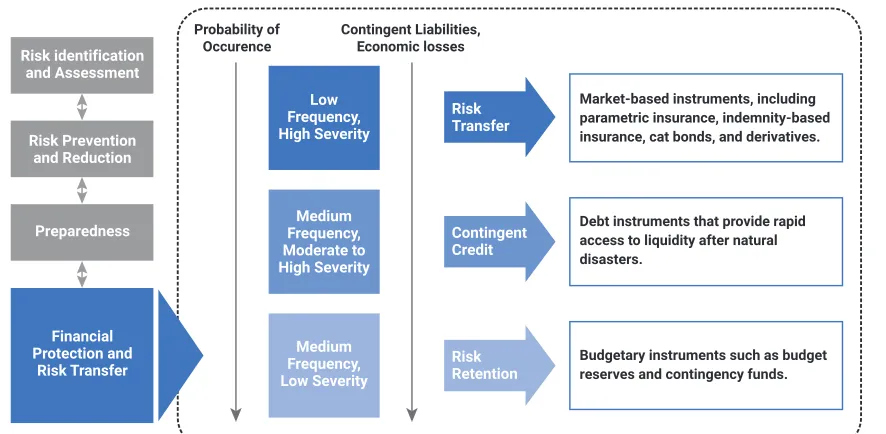
It is therefore important to understand how insurance ‘fits’ with other financial instruments, within an overall strategy
for climate adaptation. This is summarized at a macro-level in Figure 2.
The left-hand column of Figure 2 places insurance risk transfer in the context of climate adaptation. Risk identi-fication and assessment is a core expertise of insurance, and the necessary first step in considering physical resil-ience measures, such as risk reduction and preparedness. These measures reduce the residual risk which needs financial protection, and therefore reduce premiums and make insurance (or other financial instruments) more cost- effective. However, risk transfer can also support and incentivize action on physical resilience, such as the build-ing of flood defences, or the development of early-warnbuild-ing systems for drought (see Section 6).
[image:22.612.87.530.495.712.2]The key function of insurance is to provide financial pro-tection against risk. The central column of Figure 2 shows climate risks on a spectrum of frequency and severity. For example, in some regions, localized wildfires occur practi-cally every year, but the total losses may usually be relative-ly small. In other regions, a catastrophic tsunami may onrelative-ly occur once in a hundred years, but (as in Japan in 2011) kill thousands, and destroy or seriously damage more than a
FIGURE 2 Macro-level climate risk finance instruments32,33
Probability of
Occurence Contingent Liabilities, Economic losses
Risk identification and Assessment
Risk Prevention and Reduction
Preparedness
Financial Protection and
Risk Transfer
Risk Transfer
Risk Retention Contingent Credit Medium
Frequency, Moderate to High Severity
Low Frequency, High Severity
Medium Frequency, Low Severity
Market-based instruments, including parametric insurance, indemnity-based insurance, cat bonds, and derivatives.
Debt instruments that provide rapid access to liquidity after natural disasters.
million buildings. In Figure 2 the probability increases down the column, the severity increases upwards.
As we indicate in the right-hand column of Figure 2, a broad spectrum of financial instruments can help govern-ments address these different risk levels.33 Such a layered
approach to climate and disaster risks can help govern-ments identify which financing strategy might provide best use of capital. For instance, in the case of frequent but low-severity wildfires, a government might maintain a con-tingency fund year-on-year, thus retaining the risk. For the small probability of tsunami, various risk transfer products will probably be most cost-effective.
However, choice of financial instrument is not simply a matter of how severe the event will be: it also depends on the protection needs that the government wants to address. It might use parametric or index-based products to provide rapid, timely funding for disaster relief after a climate event, and indemnity-based insurance to fund reconstruction (see Section 3). The government’s finan-cial resilience is improved by using both. As illustrated in the Figure, insurance can be complemented by other risk financing instruments to address risks in lower layers.
The use of risk transfer products also feeds back into climate adaptation strategy. A government purchasing a disaster liquidity product knows that money will quickly be available in case of disaster, and can accordingly plan and budget its response systems much more specifical-ly. Countries may be drawn together into risk pools (see Section 2), such as African Risk Capacity (see Section 6) because risk pooling drives down the cost of insurance, and subsequently develop a joint expertise in early-warning systems.
On a micro-level, insurance provides direct financial pro-tection for lives and livelihoods affected by disaster. As explained in section 4.1, where private insurance markets fail to offer insurance cover affordable to large sectors of the population, government-led programs can act as insurers of last resort. These may seek to engage private insurers in various ways, include some provision of capital, or design of the products, or as distribution channels for payouts. They can also tie payouts to general policy on risk reduction, thereby reducing risk levels to a point where private insurance comes back to the market. Government can also develop policies and shape regulatory frameworks for sustainable meso-insurance products. For example, as
in the Kenya livestock programme (see section 3.3.1) they may pay for the development of micro-insurance products for poor farmers with very specific circumstances and needs. In such cases the development expenditure may not generate enough commercial return to be viable for a private insurer, but the private insurer can be a partner once the micro-insurance product is established. The govern-ment can also ensure that climate-risk preparedness and reduction behaviours are incentivized in line with its broad-er climate adaptation strategy.