N A N O E X P R E S S
Open Access
Trion X
+
in vertically coupled type II quantum
dots in threading magnetic field
Sindi Horta-Piñeres
1,2, Gene Elizabeth Escorcia-Salas
1, Ilia D Mikhailov
3and José Sierra-Ortega
1*Abstract
We analyze the energy spectrum of a positively charged exciton confined in a semiconductor heterostructure formed by two vertically coupled, axially symmetrical type II quantum dots located close to each other. The electron in the structure is mainly located inside the dots, while the holes generally move in the exterior region close to the symmetry axis. The solutions of the Schrödinger equation are obtained by a variational separation of variables in the adiabatic limit. Numerical results are shown for bonding and anti-bonding lowest-lying of the trion states corresponding to the different quantum dots morphologies, dimensions, separation between them,
thicknesses of the wetting layers, and the magnetic field strength.
Keywords:Quantum dots, Adiabatic approximation, Trion PACS:78.67.-n, 71.35.Pq, 73.21.La
Background
During the last few years, there has been much interest in the study of quantum dots (QDs), which are structures in which charge carriers are confined in all three dimensions. The quantum dots have opened the possibility to fabricate both artificial atoms and molecules with novel and fas-cinating optoelectronic properties which are not acces-sible in bulk semiconductor materials. Especially, the self-assembled QDs are considered to be very promising for possible applications, such as QD lasers, due to their large confinement energy and high optical quality. An attrac-tive route for nanostructuring semiconductor materials is offered by the self-assembled quantum dots (SAQDs) which are formed via the Stranski-Krastanow growth mode by depositing a material on a substrate with a dif-ferent lattice parameter [1-5]. The analogy with atoms can be strengthened by the capture of carriers with op-posite charges. In spite of the fact that SAQDs can pos-sess different morphologies such as disks, cones, rings, and lenses [1], they are, in general, thin layers and have, for the most part, a small height-to-base aspect ratio whose typical values vary between 0.029 and 0.067 [3]. The motion of the carriers in such structures is
quasi-two-dimensional but due to the tunneling of the carriers through finite height barrier along the crystal growth direction, they can escape outside of the layer, with a considerable probability. Besides, if the probabilities of the electron and the hole tunneling are different, the op-posite charge density in the central part inside the SAQD and the peripheral regions around SAQDs can be induced by a captured electron-hole pair. It is estab-lished that the quantum confinement of few particles systems, e.g., neutral and negatively charged donors (D0 and D−, respectively), excitons (X), trions (X−, X+) and biexcitons, enhances the binding energy allowing their observation even at the room temperature. The energy spectra of these systems governed by the interplay be-tween tunneling, confinement, and correlation effects have been studied by using different methods, such as variational [6], diagonalization [7-9], and finite elements [10]. Although these techniques give consistent results with the experimental data, they entail a tedious compu-tational work. Besides, the great majority of the analyzed models are two-dimensional, and they left to aside the effects related to the disk height. Recently, in order to calculate ground state energies of D0, D−, and X in the semiconductor heterostructures, it has been proposed as a simple variational procedure [11-13] related to fractal dimension scheme [14]. In this paper, we analyze the en-ergy spectrum of a positively charged exciton confined * Correspondence:[email protected]
1
Group of Investigation in Condensed Matter Theory, Universidad del Magdalena, Santa Marta AA 731, Colombia
Full list of author information is available at the end of the article
in a semiconductor heterostructure formed by two verti-cally coupled, axially symmetrical type II quantum dots located close to each other. The electron in the structure is mainly located inside the dots, while the holes gene-rally are placed in the exterior region close to the sym-metry axis. The solutions of the Schrödinger equation are obtained by a variational separation of variables in the adiabatic limit. Numerical results are shown for bon-ding and anti-bonbon-ding lowest-lying of the trion states corresponding to different quantum dots morphologies, dimensions, the separation between them, thicknesses of the wetting layers, and the magnetic field strength.
Methods
We assume that the adiabatic approximation can be used as a starting point for a qualitative analysis of the ground state energy of X+, taking into account that the effective hole mass in the In0.55Al0.45As material is essentially greater than the effective mass of the electron, and this circumstance is more relevant in conditions of strong con-finement. In this approximation the Hamiltonian of the X+ can be expressed in terms of the Hamiltonian of the D2+. To analyze the spectrum of the X+within framework of the adiabatic approximation, we first consider this com-plex under condition when the holes position vectorsrh1 andrh2are fixed, and this structure can be considered as a donor complex D2+. Beingreas the position vector of the electron and rh1, rh2 as the position vectors of the ions, the Hamiltonian for the donor D2+ground state in a struc-ture with the confinement potential Ve(re)due the struc-tural non-homogeneity and in the presence of the external magnetic fieldB applied along the symmetry axis can be written as:
HD2þðre;rh1;rh2Þ ¼H0eð Þ re 2=jrerh1j 2=jrerh2j;
H0ð Þ ¼ re ηe Δeþiγ∂∂ϑ eþ
γ2ρ2 e 4
þVeð Þre ð1Þ
The effective Bohr radiusa0¼ℏ2ε=μ e2 as the unit of length, the effective Rydberg Ry¼e2=2ε a
0¼ℏ2=2μ a02
as the energy unit, and γ¼eℏB=2μc Ry as the unit of the magnetic field strength have been used in Hamilton-ian (Equation 1), being me and mh the electron and the hole effective masses and μ¼memh= meþmh as the reduced mass. The following notations have been used: ηk¼mk=μand the cylindrical coordinatesrk=(ρk,ϑk,zk) labeled by k=h1,h2,e corresponding to the first hole, the second hole, and the electron, respectively. For the sake of simplicity, we consider a model of the QD with infinite-barrier confinement potential,Ve(ρe, ze) = 0, in-side the QD and to infinity otherwise, which restricts the electron only inside the QD, and for the holes located away from QDs,Vh(ρh, zh) = 0, outside the QD and to infinity inside them. The eigenfunctions φe(re) and eigenvaluesED2þðrh1;rh2Þof the Hamiltonian (Equation 1)
solutions of the wave equation
HD2þðre;rh1;rh2Þϕeð Þ ¼re ED2þðrh1;rh2Þϕeð Þre ð2Þ
[image:2.595.57.542.534.713.2]can be found by using the method described in the previ-ous paper [15]. The positively charged exciton X+ Hamil-tonian can be written in terms of the D2+ Hamiltonian (Equation 1) as follows:
HXþðre;rh1;rh2Þ ¼HD2þðre;rh1;rh2Þ þH0ð Þrh1
þH0ð Þ þrh2 2=jrh1rh2j;
H0ð Þ ¼ rk ηh Δkþiγ∂ϑ∂
kþ
γ2ρ2 k
4
þVhð Þrk ; k¼h1;h2:
ð3Þ
Following the adiabatic approximation standard pro-cedure, we seek the eigenfunction of the Hamiltonian (Equation 3) asΨXþðre;rh1;rh2Þ¼φeðre;rh1;rh2Þψðrh1;rh2Þ, whereψ(rh1,rh2) is the part of the wave function describ-ing a slow holes' motion which is a solution of the follow-ing wave equation:
ηhΔh1ψηhΔh2ψ
þ ED2þðrh1;rh2Þ þVhð Þ þrh1 Vhð Þ þrh2 2=jrh1rh2j
ψ¼EXþψ ð4Þ
Here,ED2þðrh1;rh2Þ, the energy of the fast electron
mo-tion as a funcmo-tion of the holes posimo-tions, presents poten-tial curves for the holes' slow motion.
Once the energies ED2þðrh1;rh2Þ for the different
elec-tron levels as functions of the holes positions are found, then the wave in Equation 4 can be solved approximately by using the method of symmetry structures [16] in which the problem in Equation 3 is reduced to the fol-lowing one-particle wave equation:
ηhΔhψþ ED2þðrh;rhÞ þVhð Þ þrh 1=j jrh
ψ¼ðEXþ=2Þψ:
ð5Þ
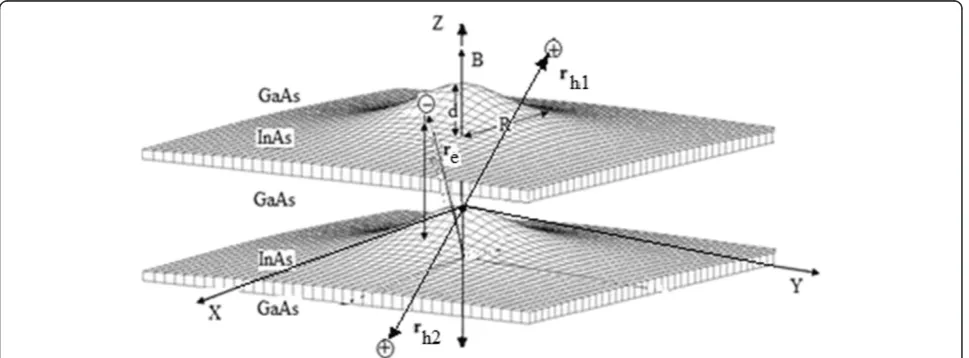
Schematically, the structure corresponding to Equation 5 is presented in Figure 1. The different sublevels of the X+ corresponding to the different energies of the hole motion in Z direction can be analyzed by solving the one-dimensional wave equation (Equation 5). In our calculations we use to aim the trigonometric sweep method [17].
Results and discussion
In Figure 2 we present the energies of some lower electron levels as functions of the distancezhbetween the hole and the adjacent semiconductor layer in the framework of the symmetrical structure model for the case when the height of the lens-shaped QD over the wetting layer of hw = 0.2a0* thickness is also equal to h = 0.2a0*, while the separation between layers isd= 0.6a0*.
0,5 1,0 1,5 2,0
10 15 20 25
(1,2,-)
(1,2,+) (1,1,-)
(1,1,+) (1,0,-)
Energy (Ry*)
z
h(a0
*)
(1,0,+)
h=0.2a
0
*, h
w=0.2a0
*, d=0.6a
0
[image:3.595.55.291.89.262.2]*,
Figure 2Potential curvesED
2þðd=2þzh;d=2zhÞfor the
electron confined in vertically coupled lens-shaped QDs.Solid lines represent energy levels of the Trion X+and dashed lines, Trion
X+. With separation,d,between layers and distance,Zh, between the
hole and the layer for zero-magnetic field case (γ= 0).
14 16 18 20 22
0,6 0,8 1,0 1,2
Density of states
Energy (Ry*)
trion electron
15 20 25
0,0 0,2 0,4 0,6 0,8 1,0 1,2 1,4
Density of states
Energy (Ry*) trion electron
[image:3.595.59.540.533.705.2]The corresponding potential curves are indicated by two-electron quantum numbers (ne, le) and by symbols (+) and (−) for the bonding and anti-bonding levels, re-spectively. It is seen that the electron energies corre-sponding to different levels initially descends as the
distance between holes and the layers Zh decreases,
while the electrostatic attraction between electron and holes is greater than the repulsion from the layer
pro-vided by the structural confinement. As Zh further
decreases, the repulsion from the layer provided by the increasing confinement becomes significant and the po-tential energy becomes to climb up sharply. Also, in Fig-ure 2 we show the holes' vibrational sublevels (dashed lines) with gaps significantly smaller than the corre-sponding values between electronic levels (solid lines). Similarly, the gaps between bonding and anti-bonding levels with the same quantum numbers, (ne, le), are lar-ger than the gaps between the two levels with the same parity and different quantum numbers. Additionally, one can see that energies corresponding to the bonding states are generally inferior, and there is only one
crossover between the lower anti-bonding potential
curve and the upper bonding one. The parameter Zh
tends to infinitize the energies of the potential curves approach asymptotically to electronic energy levels, while the dash lines in Figure 2 show energy levels (ground and excited) of the positively charged trion.
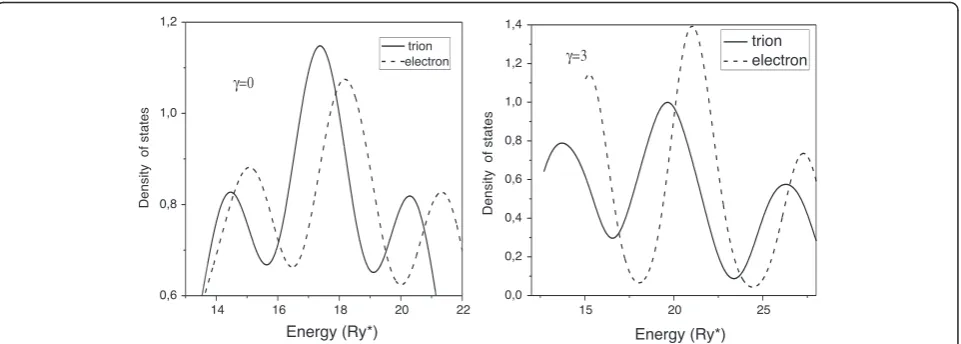
In Figure 3 we present the density of states (DOS) cor-responding to the electron (dash lines) and to the posi-tively charged trion (solid lines) for cases of the zero magnetic field (γ= 0) and (γ= 3). In both cases one can observe the presence of three separated peaks which we associate to the bonding, mixed, and anti-bonding states, respectively. The first peak is a superposition of the lines corresponding to the lower bonding states, the inter-mediate peak is related to a superposition of the upper bonding and the lower anti-bonding states, and the last peak is due to a superposition of the upper anti-bonding states.
When comparing the curves of DOS for the trion and electron, one can see that the additional attraction bet-ween the electron and holes in trion provides a displace-ment of all the peaks toward the region with lower energies. On the other hand, an external magnetic field enhances the difference between the curves of DOS for the electron and the trion due to the fact that the split-ting between energy levels with positive and negative an-gular momentum states for the trion is larger than for the electron. Therefore, it is seen in Figure 3 a more sig-nificant broadening of the peaks for the trion in the presence of the magnetic field (γ= 3). Also in Figure 3, one can observe a slight displacement of the peaks pro-vided by the magnetic field toward the region of higher energies due to the diamagnetic term γ2ρ2=4 in the Hamiltonian.
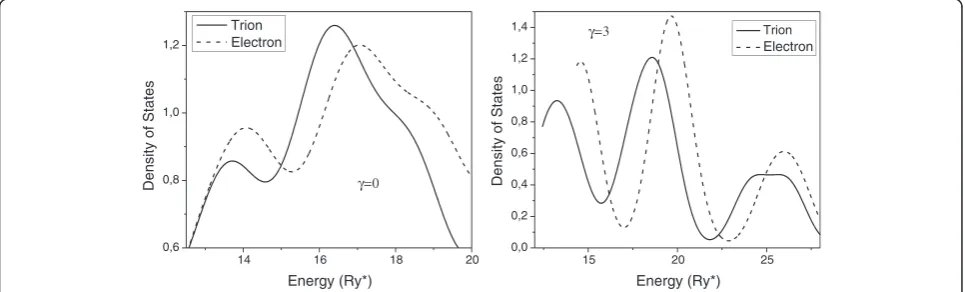
In Figures 4 and 5 we display the similar results for vertically coupled disk-shaped QDs. It is seen that the potential curves for the disks are analogous to those for the lens in Figure 2 with a single but very important dif-ference: the electron energies and gaps between them in
0,5 1,0 1,5 2,0
15 20
(1,0,-)
(1,1,-)
(1,0,-)
h=0.2a
0
*, h
w=0.2a0
*, d=0.6a
0
*,
(1,2,+)
(1,1,+)
(1,0,+)
Energy (Ry*)
z
h(a
[image:4.595.56.291.89.274.2]0
*)
Figure 4The same as in Figure 2 but for disk-shaped QDs.
14 16 18 20
0,6 0,8 1,0 1,2
Density of States
Energy (Ry*)
Trion Electron
15 20 25
0,0 0,2 0,4 0,6 0,8 1,0 1,2 1,4
Density of States
Energy (Ry*)
Trion Electron
[image:4.595.57.540.570.716.2]the lens and in Figure 4 are lower than the correspondent values in the lens in Figure 2. It is due to the fact that the in-plane confinement in lens is stronger than one in disk resulting in a weak resolution of the three peaks in the zero-magnetic field case (γ= 0) as it is seen in Figure 5, where the third peak is transformed in a right-side shoul-der at DOS curve.
However, as the magnetic field is sufficiently strong, the electron becomes more strongly confined within a region about the axis and the energy spectrum becomes analogous to one in lens. In consequence, the DOS in disk-shaped vertically coupled QDs for the magnetic field in Figure 5 (γ= 3) becomes similar to the lens-shaped QDs in Figure 3.
Conclusions
In short we propose a simple numerical procedure for calculating the energy spectrum of a positively charged exciton confined in a semiconductor heterostructure that are formed by two vertically coupled, axially sym-metrical type II quantum dots located close to each other. The electron in the structure is mainly located in-side the dots, while the holes generally are placed in the exterior region close to the symmetry axis. Our calcula-tion includes some important characteristic of the he-terostructure such as the possibility of the variation of the QD morphology. We found that the holes' vibra-tional sublevels with gaps significantly smaller than the corresponding values between the electronic levels and the gaps between bonding and anti-bonding levels with the same quantum numbers are larger than the gaps be-tween two levels with the same parity and different quantum numbers. Also we found that the splitting bet-ween energy levels with positive and negative angular momentum states for the trion is larger than for the electron, and the external magnetic field enhances the difference between curves of DOS for the electron and the trion.
Competing interests
The authors declare that they have no competing interests.
Authors’contributions
All authors contributed equally to this work. JSO created the analytic model with contributions from IM, SHP and GES performed numerical calculations and wrote the manuscript. All authors discussed the results and implications and commented on the manuscript at all stages. All authors read and approved the final manuscript.
Acknowledgments
This work was financed by the Universidad del Magdalena through the Vicerrectoría de Investigaciones (Código01).
Author details
1
Group of Investigation in Condensed Matter Theory, Universidad del Magdalena, Santa Marta AA 731, Colombia.2Universidad de Sucre, Sincelejo
AA 406, Colombia.3Universidad Industrial de Santander, Bucaramanga AA 678, Colombia.
Received: 16 July 2012 Accepted: 12 September 2012 Published: 26 September 2012
References
1. Jacak L, Hawrylak P, Wójs A:Quantum Dots. Berlin: Springer; 1997. 2. Leonard D, Pond K, Petroff PM:Critical layer thickness for self-assembled
InAs islands on GaAs.Phys Rev B1994,50:11687–11692.
3. Lorke A, Luyken RJ, Govorov AO, Kotthaus JP:Spectroscopy of nanoscopic semiconductor rings.Phys Rev Lett2000,84:2223–2226.
4. Granados D, García JM:In(Ga)As self-assembled quantum ring formation by molecular beam epitaxy.Appl Phys Lett2003,82:2401.
5. Raz T, Ritter D, Bahir G:Formation of InAs self-assembled quantum rings on InP.Appl Phys Lett2003,82:1706.
6. Szafran B, Stébé B, Adamowski J, Bednarek S:Excitonic trions in single and double quantum dots.Phys Rev B2002,66:165331.
7. Xie W, Chen C:Excitonic trion X−in GaAs quantum dots.Physica E2000,8:77. 8. Song J, Ulloa SE:Magnetic field effects on quantum ring excitons.Phys
Rev B2001,63:125302.
9. Wojs A, Hawrylak P:Negatively charged magnetoexcitons in quantum dots.Phys Rev B1995,51:10880–10885.
10. Janssen KL, Peeters FM, Schweigert VA:Magnetic-field dependence of the exciton energy in a quantum disk.Phys Rev B2001,63:20531.
11. Escorcia R, Robayo R, Mikhailov ID:Renormalized Schrödinger equation for excitons in graded quantum dot.Phys Stat Sol (B)2002,230:431. 12. Mikhailov ID, Betancur FJ, Escorcia R, Sierra-Ortega J:Off-center neutral and
negatively charged donor impurities in semiconductor heterostructures: fractal dimension method.Phys Stat Sol (B)2002,234:590.
13. Mikhailov ID, Betancur FJ, Escorcia R, Sierra-Ortega J:Shallow donors in semiconductor heterostructures: fractal dimension approach and the variational principle.Phys Rev B2003,67:115317.
14. He HF:Fractional dimensionality and fractional derivative spectra of interband optical transitions.Phys Rev B1990,42:11751.
15. Mikhailov ID, Betancur FJ, Marín J, Oliveira LE:Model structure for D-states in GaAs-(Ga, Al)As quantum wells.Phys Stat Sol (B)1998,210:605–608. 16. Singh J, Birkedal D, Lyssenko VG, Hvam JM:Binding energy of
two-dimensional biexcitons.Phys Rev B1996,53:15909–15913.
17. Betancur FJ, Mikhailov ID, Oliveira LE:Shallow donor states in GaAs-(Ga, Al) As quantum dots with different potential shapes.J Appl Phys D1998, 31:3391.
doi:10.1186/1556-276X-7-532
Cite this article as:Horta-Piñereset al.:Trion X+in vertically coupled
type II quantum dots in threading magnetic field.Nanoscale Research Letters20127:532.
Submit your manuscript to a
journal and benefi t from:
7Convenient online submission
7Rigorous peer review
7Immediate publication on acceptance
7Open access: articles freely available online
7High visibility within the fi eld
7Retaining the copyright to your article