Munich Personal RePEc Archive
Trustworthiness and economic
performance
Breuer, Janice Boucher and McDermott, John
University of South Carolina, University of South Carolina
March 2009
Trustworthiness and Economic Performance
Janice Boucher Breuer and John McDermott
∗August 16, 2010
Department of Economics, University of South Carolina, Columbia, SC 29208
Abstract
Trustworthiness is the foundation for trust, institutions, and per capita
output in society. Trustworthiness is primary – a society’s willingness to trust
and the quality of its institutions have their origins in the trustworthiness of
its citizens. Trustworthiness is therefore the basis for maximizing output in
economic exchange and in explaining differences in standards of living around
the world. We measure trustworthiness with a question from the World Values
Survey and estimate its effect using a sample of 60 countries. We find that
trustworthiness is important for output per capita and that any effect of trust
is likely to come from trustworthiness. Our results are robust to alternative
specifications.
(JEL codes: O10, O40, O43, Z1)
Surprisingly much of the literature on trust hardly mentions
trustworthi-ness, even though much of it is primarily about trustworthitrustworthi-ness, not trust.
Hardin (1992).
1
Introduction
Trustworthy behavior is an important determinant of economic outcomes. If people
are not trustworthy, a general lack of trust is inevitable, and exchange, specialization,
and production suffer. The effect of trust on economic performance has been studied
extensively and the results point consistently to a strong, positive correlation between
the two. Much less empirical work has been done on trustworthiness. One reason
for this may be the perception that there is no real difference between trust and
trustworthiness: you cannot have one without the other, this argument goes, so it
does not matter which is used as an explanatory variable. Another reason may be
the lack of an obvious measure for trustworthiness. We address these issues below
and test the primacy of trustworthiness on economic performance.
Our framework, which provides the structure for our empirical tests, contains four
elements: (1) the nature of trustworthiness; (2) the endogeneity of trust; (3) the
source of good institutions; and (4) the role of trust and trustworthiness in
generat-ing output. Trustworthy individuals are one of two types: intrinsically trustworthy
or conditionally trustworthy. Intrinsically trustworthy individuals always behave so,
regardless of incentives whereas the conditionally trustworthy behave honestly when
it is in their self-interest. We believe intrinsic trustworthiness comes from deep-seated
values that are related to culture while conditional trustworthiness comes from
insti-tutions. In either case, when there is more trustworthy behavior, individuals have
en-dogenous and can only exist in an environment of trustworthiness. The third element
asserts that the proportion of the intrinsically trustworthy is also the source of good
institutions in a country. Good institutions establish fair and efficient mechanisms
to punish cheating and encourage rational individuals to act in a trustworthy
man-ner. The higher the quality of the institutions, the greater the proportion of the
conditionally trustworthy. Finally, trust and trustworthiness are equally important
in generating output. Trust is necessary to initiate transactions and trustworthiness
is critical for the realization of production.
To date, the empirical literature in economics has focused on trust and its effect
on economic growth. In this literature, trusting behavior is said to generate
coop-eration, discourage diversion, and encourage civic engagement, which can enhance
output. Knack and Keefer (1997), Zak and Knack (2001), Tabellini (2008), Temple
and Johnson (1998), and Hall and Jones (1999) are all influential examples of this
literature.1
Many authors recognize that trustworthiness is important, yet there has been
virtually no cross-country empirical work that deals with it in a rigorous way. We
address this gap by introducing a measure of intrinsic trustworthiness and testing our
ideas. Like the usual measure for trust, our measure of trustworthiness comes from
the World Values Survey (2006). The measure is based on a question that elicits from
parents their subjective view of the importance of teaching children tolerance and
respect for others.
To preview our results, we find that using a sample of 60 countries, trustworthiness
consistently performs well in explaining per capita output. The inclusion of control
variables changes the magnitude, but not the significance of trustworthiness.
More-1
over, trustworthiness consistently outperforms trust in our regressions. At first, we
maintain the hypothesis that trustworthiness is exogenous. Later, we allow it to be
endogenous and use four different instruments to control for endogeneity. In almost
all of the cases, trustworthiness has a significant, first-order impact on per capita
income. We also show that intrinsic trustworthiness is important to the formation of
high quality institutions and trust.
The paper is organized as follows. The next section sets out our analytical
frame-work in more detail. This is not a rigorous theoretical model, but rather a guiding
structure to help understand the logic of the empirical tests. In Section 3, we describe
the data and the sample of countries that we use. Section 4 presents our econometric
specifications and results. Section 5 concludes.
2
Framework
2.1
Trustworthiness
We make an important distinction betweenintrinsic trustworthiness and conditional
trustworthiness. Intrinsic trustworthiness is unconditional; regardless of the costs of
behaving trustworthily, an individual who is intrinsically trustworthy, will always act
so. The existence of individuals who are intrinsically trustworthy has been assumed in
the game-theoretic work of Frank (1987), Harrington (1989), Huang and Wu (1994),
and Bohnet et al. (2001) in a similar context. Sen (1977) also assumes there are
individuals who are willing to take action that conflicts with self-interest (a type he
calls “committed”). In his study of rotating credit institutions in Peru, Karlan (2005)
conjectures that some of the respondents may have been innately trustworthy. In
contrast, conditional trustworthiness is trustworthy behavior that is conditional on
We define the fraction of people who behave trustworthily to be pT W:
pT W =rT W +vT W <1 (1)
where rT W is the fraction of people in the economy who are intrinsically trustworthy
and vT W is the fraction who are conditionally trustworthy.
In our view, economies are endowed with a level of intrinsic trustworthiness, but
conditional trustworthiness is generated by good institutions. Countries with good
legal and economic institutions prompt people to behave as if they were naturally
trustworthy. Institutions elicit honest behavior through threat of punishment or
so-cial pressure. Where institutions are good at suppressing cheating, they induce the
conditionally trustworthy to behave honestly.2
We express this relationship as follows:
vT W =V(I) (2)
where I stands for institutional quality.
2.2
Trust
In his book Trust, Fukuyama (1995) states that trust is “the expectation that arises
within a community of regular, honest, and cooperative behavior, based on commonly
shared norms, on the part of the members of that community.” Gambetta (1988)
defines trust as “a particular level of the subjective probability with which an agent
assesses that another agent or group of agents will perform a particular action.” Fehr
(2008) states that trust arises from beliefs about trustworthiness and preferences
2
toward risk.
For each of these, trust is equated with an expectation about behavior. More
im-portantly, these definitions point out that the trustworthiness of the party on the other
end of the transaction is critical. The trust that we observe is due to the existence
of trustworthy agents, whether intrinsic or induced by institutions. It is irrational to
trust others in an environment of dishonest agents. We write this relationship as:
pT =T(pT W) (3)
where pT is the proportion of individuals who trust and pT W is defined in (1). In
countries with more trustworthy behavior, trust itself is higher. In this environment,
trust ultimately depends on the expectation of being cheated, which in turn depends
on the fraction of the population that does not cheat.
2.3
Institutions
If everyone were intrinsically trustworthy, there would be no need for institutions.
No one would cheat and agents would soon learn to trust everyone. Unfortunately,
this is never the case. We assume good institutions come fundamentally from rT W,
the fraction of intrinsically trustworthy people in society. Our reasoning has two
elements. First, the intrinsically trustworthy fundamentally embrace a respect for
others in society. They value the security of property and rule of law as devices
to protect not only their own freedom, but that of others, too. Good institutions
may be seen as commitment mechanisms designed to ensure individual freedoms and
the protection of property rights over time. They increase the probability of catching
cheaters and increase the penalty if a cheater is caught. Second, the larger the share of
that establish institutions that effectively punish cheaters with high probability. Thus,
we hypothesize that institutional quality depends positively onrT W:
I =I(rT W) (4)
2.4
Production
We outline a simple story of exchange to illustrate how trust and trustworthiness
matter for aggregate output. First, we assume that individuals extend trust to others
to produce output. If they do not trust, no output is produced. Counterparties can
be two types – intrinsically trustworthy or conditionally trustworthy. Intrinsically
trustworthy types participate honestly in the production of output. The conditionally
trustworthy may behave dishonestly. When trust is met with trustworthy behavior,
maximum output - which we call ym - is produced. If not, output yl is produced
where yl =δym and 0< δ <1.
There areN individuals who meet others over the course of the year; in the limit,
assume each person encounters every other person. Under this scheme, there would
be M =N(N −1) meetings every year.3
Aggregate output,Y would then be:
Y =pTpT WM ym+pT (1−pT W)M yl (5)
As (5) shows, aggregate output depends on the proportions of people who trust (pT)
and can be trusted (pT W).
It is useful to write per capita output y= Y
N as follows:
3
y= 1 +δ(1−pT W) pT W
!
pTpT W ym(N −1) (6)
whereδ = yl
ym is the relative shortfall of output when people are not trustworthy. We
observe from (6) that living standards rise with both the fraction of people who are
trusting pT and the fraction who act honestly pT W.
The ideas in this section constitute a framework designed to highlight the
im-portance of trust and trustworthy behavior to standards of living. We now turn to
a discussion of the data that we use to test the importance of trustworthiness in
economic performance.
3
Data and Country Sample
Construction of our sample was guided by several considerations. First, we use the
question on trust from the World Values Survey (2006) that has been used frequently
in previous research.4
This question is A165 and is available in Wave 1 (1981), Wave
2 (1990), Wave 3 (1995), and Wave 4 (2000) of the survey. The question reads:
“Generally speaking, would you say that most people can be trusted, or
that you need to be very careful in dealing with people?”
1. Most people can be trusted
2. Can’t be too careful
The question has been used by many authors in a wide variety of disciplines.
4
We measure the fraction of those who trust in a country pT using affirmative
response rates (Answer 1) to the question. An affirmative answer seems to reflect, at
least in part, people’s confidence in not being cheated. There is no way to tell if people
are answering that “most people can be trusted” because they believe in the innate
goodness of others (i.e. the respondent views others as intrinsically trustworthy) or
because they have faith that institutions will discourage untrustworthy types from
cheating them (i.e. institutions have induced the respondent to be trusting).
To measure intrinsic trustworthiness rT W we use responses to question A035 from
the World Values Survey.5
Question A035 is part of a series of questions that asks
respondents to select up to five qualities that children can be encouraged to learn at
home. In Waves 3 and 4 of the World Values Survey, respondents were given a list
of ten qualities. These include good manners, independence, hard work, feelings of
responsibility, thrift, determination and perseverance, religious faith, unselfishness,
obedience, and tolerance and respect for others. The qualities listed across each wave
vary to some degree, but question A035 appears in all four waves.6
Each question
begins with:
“Here is a list of qualities that children can be encouraged to learn at
home. Which if any do you consider to be especially important? Please
choose up to five. CODE FIVE ONLY.”
Each question in the series is then followed by just one “quality”, e.g independence,
thrift, etc. Those who chose “tolerance and respect for others” we consider to be
5
We considered several other questions – a question on honesty (A031) and a question on lying (F127) used by Slemrod and Katusc´ak (2005). A031 was only asked in the 1981 survey and F127 only in the 1990 survey. We also considered questions that Knack and Keefer (1997) used to construct a measure of civic norms (which they mention may be associated with trustworthiness). We did not use these questions because they are situational and there may be a wide range of circumstances that respondents consider when answering.
6
intrinsically trustworthy. Individuals who value tolerance and respect for others are
more likely to be trustworthy. One cannot respect others and at the same time treat
them dishonestly. This question, we believe, elicits the true character of the parent,
not the child. Respondents who feel it important to teach their children tolerance
and respect for others, in our view, do so because they themselves possess these basic
qualities.
Because survey respondents are asked to select five questions from a list of 10
qualities, there is an opportunity cost to selecting any question. We think that this
cost elicits a true response. If, for example, the question were framed as the direct “do
you think it is important to teach your children tolerance and respect for a others?”
then people might respond “yes” even if they did not really value it. Unlike responses
to the trust question, we assume that our measure of trustworthiness does not include
a component that may be induced by institutions. Our maintained hypothesis is that
conditionally trustworthy types do not code “tolerance and respect for others” based
on the legal or social ramifications. In other words, we think that Question A035
measures rT W and not pT W.
For each country, we tabulate the percentage of total respondents who answered
“most people can be trusted” to question A165 and those who selected “tolerance and
respect for others” to question A035. These percentages correspond to pT and rT W.
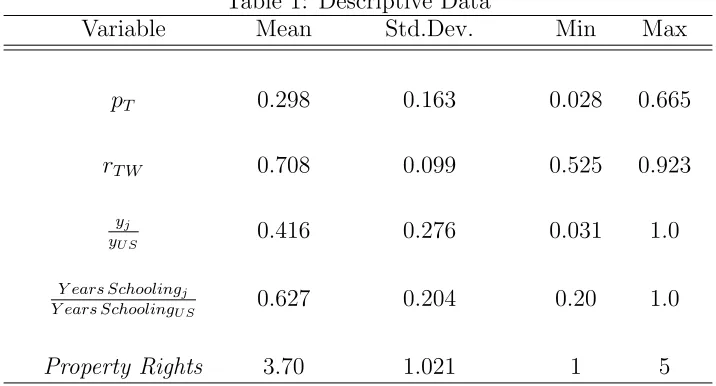
There is a fair amount of variation in our data. For example, pT and rT W are 36%
and 80% for the United States, but only 3% and 60% for Brazil. The first two lines
of Table 1 show that overall the fraction of people who are trusting is significantly
smaller than the number who are intrinsically trustworthy. These differences could
be due to differences in the quality of institutions or social preferences.7 7
Table 1: Descriptive Data
Variable Mean Std.Dev. Min Max
pT 0.298 0.163 0.028 0.665
rT W 0.708 0.099 0.525 0.923
yj
yU S 0.416 0.276 0.031 1.0
Y ears Schoolingj
Y ears SchoolingU S 0.627 0.204 0.20 1.0
Property Rights 3.70 1.021 1 5
In constructing our data set from the World Values Survey, we decided to exclude
Waves 1 and 2 from the analysis because these waves are heavily weighted with
Western European and advanced economies and provide substantially less variation.
Instead, we combined the countries from Waves 3 and 4 but eliminated duplicates;
we only used data from Wave 3 if there is no data from Wave 4 for that country.8
We also use data on GDP per capita (y) in purchasing power parity dollars from
the Penn World Table (v. 6.2); years of schooling in the population aged 25 or older
from Barro and Lee (2001) for human capital (H) which will be later used as a control
variable in estimating an equation for y; and the index of security of property rights
from the Heritage Foundation, as a proxy for institutions (I). A higher value implies
better institutions (we recoded property rights to make it conform to this rule).
The combined data yields a base set of observations for 60 countries. Country
coverage includes developed, developing, emerging, and transition economies.9
Table
8
As a robustness check, we ran all of our main results using the opposite rule: discarding the data for Wave 4 if there were duplicates. The results were virtually unchanged in terms of the significance of the key coefficients.
9
Mex-1 gives the basic descriptive statistics. We present the data fory, andYears Schooling
relative to the United States. Property Rights is based on a scale running from 1 to
5, with an average of 3.75.
4
Estimation
4.1
A Basic OLS Model
A log-linear model for output per capita that captures the basics of (6) may be
specified as:
lnyj =α0+α1lnpT,j +α2lnpT W,j +α3lnHj +µj (7)
where we include human capital Hj as a control variable to proxy for ym.
We cannot estimate the relationship in (7) however, because we do not have a
measure of trustworthy behavior pT W. We noted in (1) that pT W is equal to the sum
of the natively trustworthy rT W and the conditionally trustworthy vT W. Using (1)
and (2), we can replace pT W in (7) to get our first estimating equation:
lnyj =β0+β1lnpT,j +β2lnrT W,j +β3Ij +β4lnHj +ǫj (8)
Our initial strategy is to estimate Equation (8) with OLS. This is primarily a
benchmarking exercise, since it is likely that the regressors – with the possible
excep-tion of rT W – are correlated with the error ǫ in our cross section data set.
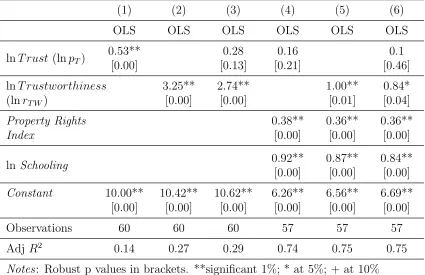
Table 2 presents the results from estimating variants of (8). The first two columns
show the results when the logs of pT and rT W are included one at a time, with no
other regressors. Both are quite significant while trustworthiness has a much larger
Table 2: Basic OLS
Dependent variable: lny
(1) (2) (3) (4) (5) (6)
OLS OLS OLS OLS OLS OLS
lnT rust(lnpT) 0.53**
[0.00] 0.28 [0.13] 0.16 [0.21] 0.1 [0.46]
lnT rustworthiness
(lnrT W)
3.25** [0.00] 2.74** [0.00] 1.00** [0.01] 0.84* [0.04] Property Rights Index 0.38** [0.00] 0.36** [0.00] 0.36** [0.00]
ln Schooling 0.92**
[0.00]
0.87** [0.00]
0.84** [0.00]
Constant 10.00** 10.42** 10.62** 6.26** 6.56** 6.69** [0.00] [0.00] [0.00] [0.00] [0.00] [0.00]
Observations 60 60 60 57 57 57
Adj R2
0.14 0.27 0.29 0.74 0.75 0.75
Notes: Robust p values in brackets. **significant 1%; * at 5%; + at 10%
coefficient than trust. The third column shows the results when we put the two
together. In this case, only trustworthiness is significant.
The last three columns add Property Rights for I and Years of Schooling for H,
but otherwise repeat the first three columns.10
Trustworthiness remains significant,
although the magnitude of its coefficient falls appreciably. Trust, on the other hand
is not significant in any specification. Property Rights and Schooling are also highly
significant and the highest adjusted R2
is 75%.
In sum, the results of Table 2 show a much stronger correlation between
trustwor-thiness and output per capita than between trust and output per capita.
10
4.2
A Reduced-form Model
Our main interest is in exploring the relationship between trustworthiness and output
per capita. However, equation (8) and the results in Table 2 may suffer from
endo-geneity bias. We are concerned that pT and I may be correlated with the error ǫ.
One way around the endogeneity problem is to estimate our system in reduced form.
We continue to maintain thatrT W is exogenous.
Consider institutions I. As emphasized by Acemoglu et al. (2001), rich countries
may prefer better institutions. Or, there may be a bias in the subjective construction
of the property rights index, such that evaluators see better institutions in richer
economies. Finally, measurement error may be particularly acute in studies like these.
Thus, I may be correlated with the error in (8).
Our measure of trust pT is also likely to be correlated with the error. As argued
earlier – see equation (3) – trustworthy behaviorpT W, whether intrinsicrT W or
condi-tionalvT W, determines trustpT. It does so because we believe that trust is impossible
without the expectation that the other party is likely to be trustworthy. Based on
(1), (2), and (3), we see that pT is correlated with institutions. Therefore, if I is
correlated with the error in (8), so will be pT.
Next, we assume that human capital depends onrT W. Glaeser et al. (2004) argue
that human capital H may be more deeply rooted and persistent than some of the
measures that are used to represent high quality governmental institutions. Since
intrinsically trustworthy types respect the rights and freedoms of others, it is natural
to hypothesize that they will also promote and expand educational opportunities. We
express this as:
H =H(rT W) (9)
both education and institutions (in their case, democracy) are determined by a third,
common variable. For us, that variable is intrinsic trustworthiness.
A reduced-form equation of our initial estimating equation (8) in whichydepends
only on intrinsic trustworthiness rT W can be obtained by using the four structural
relations (2), (3), (4) and (9), along with the identity (1). Accordingly, we estimate
the following reduced form:
lnyj =γ0+γ1lnrT W j +ϑj (10)
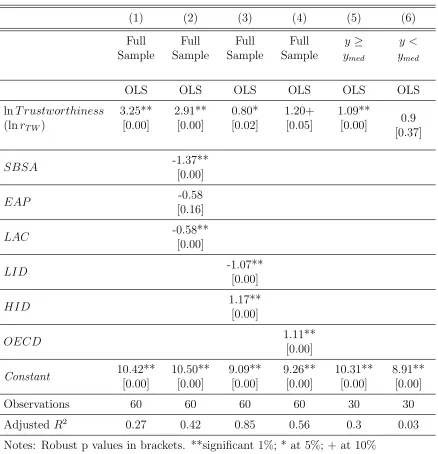
We estimate this equation using OLS. The results are shown in Table 3.
The first column repeats Column 2 of Table 2. The rest of the table adds regional
or income indicator variables to see if we are inadvertently picking up the influence
of a some third effect that is correlated with both y and rT W. The second column of
Table 3 adds indicator variables for Sub-Saharan Africa (SBSA), East Asia and the
Pacific, (EAP) and Latin America and Caribbean (LAC). Trustworthiness
contin-ues to be significant and the African and Latin American indicators are significantly
negative, but there is no explanatory power from theEAP indicator. Column 3 uses
indicators from the World Bank for low-income countries (LID) and high-income
countries (HID). Trustworthiness retains significance (although the magnitude falls)
and both of these indicators are significant with the expected signs. Column 4
re-peats the exercise with a single dummy for OECD countries. The results are similar:
trustworthiness is significant and so is the indicator. The adjusted R2
reaches 85%
for the third specification.
The last two columns divide the sample into countries with income above the
sam-ple median, and those with income below it. In the above-median group,
Table 3: Reduced-form OLS
Dependent variable: lny
(1) (2) (3) (4) (5) (6)
Full Sample Full Sample Full Sample Full Sample y≥ ymed y < ymed
OLS OLS OLS OLS OLS OLS
lnT rustworthiness
(lnrT W)
3.25** [0.00] 2.91** [0.00] 0.80* [0.02] 1.20+ [0.05] 1.09** [0.00] 0.9 [0.37] SBSA -1.37** [0.00] EAP -0.58 [0.16] LAC -0.58** [0.00] LID -1.07** [0.00] HID 1.17** [0.00] OECD 1.11** [0.00] Constant 10.42** [0.00] 10.50** [0.00] 9.09** [0.00] 9.26** [0.00] 10.31** [0.00] 8.91** [0.00]
Observations 60 60 60 60 30 30
Adjusted R2
0.27 0.42 0.85 0.56 0.3 0.03
is not significant for the below-median income group. The mean trustworthiness for
this group is only 66% as compared to 75% for the higher income group. As we
expect, trust is also lower on average (23% compared to 36%).11
4.3
Instrumental Variables
To this point we have maintained the hypothesis that our measure of intrinsic
trust-worthiness rT W is exogenous. Recall that rT W measures the proportion of the
pop-ulation of the country that identifies “tolerance and respect for others” in the World
Values Survey to be an important quality to teach their children. We claimed that
this proportion corresponds to a deep-seated character trait and does not depend on
income or institutions.
There are reasons, however, that some may be concerned about our exogeneity
assumption. First, it is possible that we are measuring intrinsic trustworthiness with
error. Second, since our measure of intrinsic trustworthiness is based on a survey, it
is possible that survey bias has occurred. Third, it may be possible that rT W and
y evolve together over time from the influence of common, unobserved variables. A
fourth possibility is that rT W is more dependent on currenty than we have assumed
– it is possible that rT W may be higher because y is higher. If any of these are true,
our measure of intrinsic trustworthiness rT W is correlated with the error ϑ in (10),
then the coefficient of interest γ1 is biased.
To correct for any potential endogeneity, we instrument for rT W. We consider
four different instruments: two past values of “Constraint on the Executive” (lags of
50 and 100 years) from the Polity IV database, which we label Constraint Exec50
and Constraint Exec100; the variable Latitude, which is the absolute value of the
11
country’s latitude measured as a fraction of 90 degrees; and M ortality, which is
the measure of potential European settler mortality from Acemoglu et al. (2001).
Constraint on the Executive has been used by Acemoglu and Johnson (2005) and
others as a measure of the quality of institutions.
We consider the first two to be measures of the quality of early institutions, which
we think are highly correlated with early intrinsic trustworthiness. It is likely that
the value of rT W in the past – not the present – is the key to institution formation.
Since we do not have data on historical values of rT W, we assume that today’s value
of rT W for which we do have data, is highly correlated with past values of I.
Latitude has been used by Hall and Jones (1999) and Glaeser et al. (2004) among
others to instrument for current institutions. Hall and Jones use it as a measure
of Western European influence on the set-up and subsequent development of social
infrastructure. The idea is that higher latitudes were both sparsely populated and
similar in climate to Western Europe itself, both of which encouraged settlement and
colonization by Europeans who brought their institutions with them.
We extend the argument to distinguish between types of settlers: we conjecture
that more trustworthy Europeans migrated to higher latitudes because the difficult
working conditions and the small size of settlements made life unattractive for
dis-honest agents. Small settlement size, for example, made detection of transgressions
easier. The lack of large-scale extractive industries – which were found mainly at low
latitudes – made it more difficult to find profitable opportunities to take advantage
of native peoples or other settlers.
Settler mortality was introduced by Acemoglu et al. (2001) as an instrument for
current institutions. The idea is similar: where settler mortality was low Europeans
were more likely to settle and construct good institutions.
is valid if all of our instruments workonly through current intrinsic trustworthiness.
We think this is a reasonable working hypothesis and, in any case, there is much
precedent for similar strategies in the recent literature.12
As a check, we also include
our instruments one at a time as exogenous regressors (and instruments) in some
specifications.
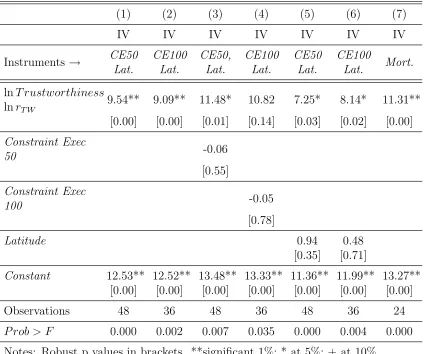
Table 4 presents the main results. The first column uses Constraint Exec50 and
Latitudeas instruments forrT W; the second usesConstraint Exec100 andLatitude.
The results are broadly similar: the log of rT W is highly significant in explaining
y; moreover, the magnitude of the point estimate is quite large. Columns (3) –
(6) include the instruments as regressors one at a time. Trustworthiness is
signif-icant at 5% or better in three of the four cases (and it is almost signifsignif-icant when
Constraint Exec100 is included). The included instruments are never significant.
The last column uses M ortality as the lone instrument for lnrT W. Again, we see
that trustworthiness is both highly significant and has a large impact on y.13
Living
standards as measured by y are strongly related to our measure of trustworthiness,
no matter which technique we use.
4.4
Structural Estimation
In this section we test to see if there is support for the structure as described by
equations (2), (3), (4), (9), along with (1). These equations show that our
mea-sures of institutions, human capital, and trust should all be determined by intrinsic
trustworthiness.
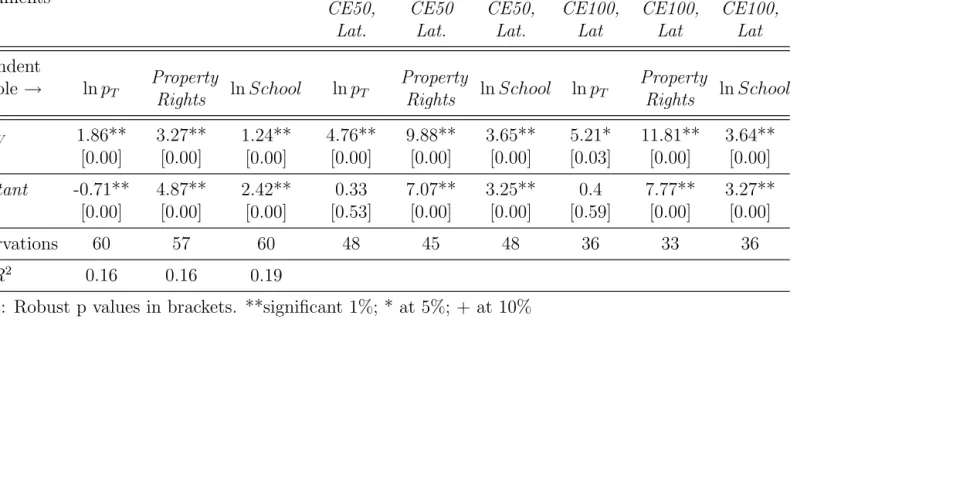
The first three columns of Table 5 run OLS regressions for trust, institutions, and
12
Most of the work on institutions and growth, including Acemoglu et al. (2001); Glaeser et al. (2004); Hall and Jones (1999); Hausmann et al. (2005), employ a similar assumption.
13
The first stages of the IV equations are reasonable. All are significant with one exception,
Latitude when the other instrument is Constraint Exec 100. The adj-R2sare not especially high,
Table 4: Instrumental Variables
Dependent variable: lny
(1) (2) (3) (4) (5) (6) (7)
IV IV IV IV IV IV IV
Instruments→ CE50
Lat.
CE100 Lat.
CE50, Lat.
CE100 Lat.
CE50 Lat.
CE100
Lat. Mort.
lnT rustworthiness
lnrT W 9.54** 9.09** 11.48* 10.82 7.25* 8.14* 11.31**
[0.00] [0.00] [0.01] [0.14] [0.03] [0.02] [0.00]
Constraint Exec
50 -0.06
[0.55]
Constraint Exec
100 -0.05
[0.78]
Latitude 0.94 0.48
[0.35] [0.71]
Constant 12.53** 12.52** 13.48** 13.33** 11.36** 11.99** 13.27** [0.00] [0.00] [0.00] [0.00] [0.00] [0.00] [0.00]
Observations 48 36 48 36 48 36 24
P rob > F 0.000 0.002 0.007 0.035 0.000 0.004 0.000
Table 5: Structural Equations
(1) (2) (3) (4) (5) (6) (7) (8) (9)
OLS OLS OLS IV IV IV IV IV IV
Instruments
→ CE50,
Lat.
CE50 Lat.
CE50, Lat.
CE100, Lat
CE100, Lat
CE100, Lat
Dependent
variable→ lnpT
Property
Rights lnSchool lnpT
Property
Rights lnSchool lnpT
Property
Rights lnSchool
lnrT W 1.86** 3.27** 1.24** 4.76** 9.88** 3.65** 5.21* 11.81** 3.64** [0.00] [0.00] [0.00] [0.00] [0.00] [0.00] [0.03] [0.00] [0.00]
Constant -0.71** 4.87** 2.42** 0.33 7.07** 3.25** 0.4 7.77** 3.27** [0.00] [0.00] [0.00] [0.53] [0.00] [0.00] [0.59] [0.00] [0.00]
Observations 60 57 60 48 45 48 36 33 36
Adj R2
0.16 0.16 0.19
Notes: Robust p values in brackets. **significant 1%; * at 5%; + at 10%
human capital on lnrT W. In all cases, trustworthiness is significant at the 1% level.
Since we cannot be sure that trustworthiness is exogenous, we also estimate each
specification using Constraint50 – or Constraint100 – and Latitude as instruments
for lnrT W. These results are shown in the last six columns of Table 5. The results
in Columns (4) - (9) confirm that trustworthiness is highly correlated with all three
structural variables. In each case, moreover, the coefficients rise substantially when
we go to IV estimation.
These results support our idea that trust depends on intrinsic trustworthiness.
They are also consistent with the idea that institutions and education are,
fundamen-tally, dependent upon the degree of trustworthiness in society.
5
Conclusion
In this paper we drew a distinction between two types of individuals: the intrinsically
trustworthy and the conditionally trustworthy. The former always honor contracts;
the latter do so only if it is in their self interest. In our view, the proportion of the
intrinsically trustworthy is the key to economic development, better institutions, and
higher per capita income. The greater the fraction of natively trustworthy people, the
greater the output produced and the greater the likelihood that institutions will be
established to encourage conditionally trustworthy individuals to behave in a
trust-worthy manner. As trusttrust-worthy behavior grows, so does trust, and output expands
further.
To test our hypotheses we used a new question from the World Values Survey
to measure intrinsic trustworthiness. This question elicits the respondent’s feeling
about the importance of a particular quality – “tolerance and respect for others” –
we found that it was highly significant in explaining per capita income in a wide
variety of specifications. In particular, it outperformed trust (measured by the usual
question from the World Values Survey) when the two were in the same regression.
In addition to treating intrinsic trustworthiness as exogenous, we instrumented for
it using lagged values of an institutional variable, latitude, and European settler
mortality. In all cases, it remained highly significant and its effect was large. We also
tested the structural building blocks of our framework, to see if trust, institutions,
and human capital were determined by intrinsic trustworthiness. We found support
for this idea too, whether we used ordinary least squares or instrumental variables.
The positive contribution of this paper is to point out the importance of
trust-worthiness in society. The formation of trust is clearly important, but it is secondary.
Trust emerges in an environment where there is trustworthy behavior. Whether
trust-worthiness is cultivated through institutions that discourage cheating or through the
promotion of innate or cultural traits, does not matter. Trustworthy behavior is
paramount. We leave as an open question the sources of intrinsic trustworthiness.
Institutions and human and physical capital are essential for economic development,
but the importance of trustworthiness in production and exchange cannot be
overem-phasized. We hope to encourage further theoretical and empirical research on this
topic.
References
Acemoglu, D. and Johnson, S. (2005). Unbundling
institu-tions. Journal of Political Economy, 113(5):949–995. available at
http://ideas.repec.org/a/ucp/jpolec/v113y2005i5p949-995.html.
colo-nial origins of comparative development: An empirical
investiga-tion. American Economic Review, 91(5):1369–1401. available at
http://ideas.repec.org/a/aea/aecrev/v91y2001i5p1369-1401.html.
Acemoglu, D., Johnson, S., Robinson, J. A., and Yared, P. (2005). From education
to democracy? American Economic Review, 95(2):44–49.
Axelrod, R. (1984). The Evolution of Cooperation. Basic Books.
Barro, R. J. and Lee, J.-W. (2001). International data on educational attainment:
Updates and implications. Oxford Economic Papers, 53(3):541–63. available at
http://ideas.repec.org/a/oup/oxecpp/v53y2001i3p541-63.html.
Berg, J., Dickhaut, J., and McCabe, K. (1995). Trust, reciprocity, and
so-cial history. Games and Economic Behavior, 10(1):122–142. available at
http://ideas.repec.org/a/eee/gamebe/v10y1995i1p122-142.html.
Beugelsdijk, S. (2006). A note on the theory and measurement of trust in explaining
differences in economic growth. Cambridge Journal of Economics, 30(3):371–387.
available at http://ideas.repec.org/a/oup/cambje/v30y2006i3p371-387.html.
Bohnet, I., Frey, B. S., and Huck, S. (2001). More order with less law: On contract
enforcement, trust, and crowding.American Political Science Review, 95:131 – 144.
Kennedy School of Government.
Coleman, J. S. (1988). Social capital and the creation of human capital.The American
Journal of Sociology, 94(1):95–120.
Ellison, G. (1994). Cooperation in the prisoner’s dilemma with anonymous
random matching. Review of Economic Studies, 61(3):567–88. available at
Fehr, E. (2008). On the economics and biology of trust. IZA Discussion Papers 3895,
Institute for the Study of Labor (IZA).
Frank, R. H. (1987). If homo economicus could choose his own utility function,
would he want one with a conscience? American Economic Review, 77(4):593–604.
available at http://ideas.repec.org/a/aea/aecrev/v77y1987i4p593-604.html.
Fukuyama, F. (1995). Trust: The Social Virtues and the Creation of Prosperity. Free
Press.
Gambetta, D. (1988). Can We Trust Trust? Basil Blackwell. Reprinted in electronic
edition from Department of Sociology, University of Oxford, chapter 13, pp.
213-237”.
Glaeser, E. L., Porta, R. L., de Silanes, F. L., and Shleifer, A. (2004). Do
insti-tutions cause growth? Journal of Economic Growth, 9(3):271–303. available at
http://ideas.repec.org/a/kap/jecgro/v9y2004i3p271-303.html.
Guiso, L., Sapienza, P., and Zingales, L. (2005). Cultural biases in economic
ex-change. CEPR Discussion Papers 4837, C.E.P.R. Discussion Papers. available at
http://ideas.repec.org/p/cpr/ceprdp/4837.html.
Hall, R. E. and Jones, C. I. (1999). Why do some countries produce so much more
output per worker than others? The Quarterly Journal of Economics, 114(1):83–
116. available at http://ideas.repec.org/a/tpr/qjecon/v114y1999i1p83-116.html.
Hardin, R. (1992). The street-level epistemology of trust. Analyse und Kritik, 14:S.
152 – 176.
Harrington, Joseph E, J. (1989). If homo economicus could choose his own utility
79(3):588–93. available at
http://ideas.repec.org/a/aea/aecrev/v79y1989i3p588-93.html.
Hausmann, R., Pritchett, L., and Rodrik, D. (2005). Growth accelerations. Journal
of Economic Growth, 10(4):303–329.
Heston, A., Summers, R., and Aten, B. (2006). Penn world table version 6.2.
Huang, P. H. and Wu, H.-M. (1994). More order without more law: A theory of social
norms and organizational cultures. Journal of Law, Economics, and Organization,
10(2):390–406.
Huck, S. (1998). Trust, treason, and trials: An example of how the evolution of
prefer-ences can be driven by legal institutions. Journal of Law, Economics and
Organiza-tion, 14(1):44–60. available at
http://ideas.repec.org/a/oup/jleorg/v14y1998i1p44-60.html.
Kandori, M. (1992). Social norms and community
enforce-ment. Review of Economic Studies, 59(1):63–80. available at
http://ideas.repec.org/a/bla/restud/v59y1992i1p63-80.html.
Karlan, D. S. (2005). Using experimental economics to measure social capital and
predict financial decisions. American Economic Review, 95(5):1688–1699.
Knack, S. and Keefer, P. (1997). Does social capital have an economic payoff? a
cross-country investigation. The Quarterly Journal of Economics, 112(4):1251–88.
available at http://ideas.repec.org/a/tpr/qjecon/v112y1997i4p1251-88.html.
La Porta, R., Lopez-de Silanes, F., Shleifer, A., and Vishny, R. W. (1997). Trust
in large organizations. American Economic Review, 87(2):333–38. available at
Miller, A. S. and Mitamura, T. (2003). Are surveys on trust trustworthy? Social
Psychology Quarterly, 66(1):62–70.
Putnam, R. (1993). Making Democracy Work: Civic Traditions in Modern Italy.
Princeton University Press.
Sen, A. K. (1977). Rational fools: A critique of the behavioral foundations of economic
theory. Philosophy and Public Affairs, 6(4):317–344.
Slemrod, J. and Katusc´ak, P. (2005). Do trust and trustworthiness pay off? Journal
of Human Resources, XL(3):621–646.
Tabellini, G. (2008). Culture and institutions: economic development in the regions
of europe. Forthcoming in the Journal of the European Economic Association.
Temple, J. and Johnson, P. A. (1998). Social capability and economic
growth. The Quarterly Journal of Economics, 113(3):965–990. available at
http://ideas.repec.org/a/tpr/qjecon/v113y1998i3p965-990.html.
World Values Survey (2006). European and world values survey four-wave integrated
data file.
Zak, P. J. and Knack, S. (2001). Trust and growth. Economic Journal, 111(470):295–