http://dx.doi.org/10.4236/cs.2016.78164
Fuzzy Based BEENISH Protocol for Wireless
Sensor Network
A. Devasena
1, B. Sowmya
21Anna University Chennai, Dhanalakshmi College of Engineering, Chennai, India 2Department of ECE, Dhanalakshmi College of Engineering, Chennai, India
Received 23 March 2016; accepted 30 March 2016; published 24 June 2016
Copyright © 2016 by authors and Scientific Research Publishing Inc.
This work is licensed under the Creative Commons Attribution International License (CC BY).
http://creativecommons.org/licenses/by/4.0/
Abstract
The main parameter to be considered in the wireless sensor network is the amount of energy that is available in each sensor node. The lifetime of the sensor node (SN) depends on it. As the SNs are deployed in remote locations, if the entire energy is consumed, it would be very difficult to replace or recharge the energy source immediately. Hence the energy consumed by each node is very im-portant. If individual SNs send information directly to the base station (BS), then the availability of energy in such SN decreases very fast. This will lead to reduction in the life time of the SN. Instead, the SNs can send the data to the cluster head (CH), then the CH consolidates the received data. The CH sends it to the BS periodically. In this way, utilizing CH for sending the information to the BS increases the lifetime of the SN. The cluster head selection is very crucial in such networks. This paper proposes a novel fuzzy based BEENSIH protocol for CH selection.
Keywords
Sensor Nodes, Cluster, Energy Level, Heterogeneous Sensor Network, Fuzzy Logic, BEENISH
1. Introduction
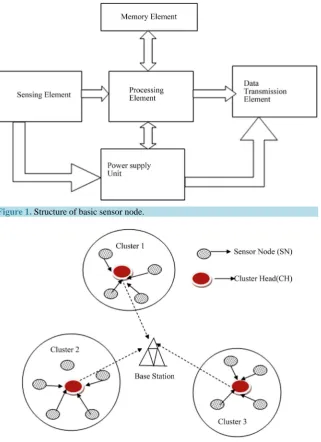
where the operation is being performed or very close to it. The sensor nodes are randomly deployed. Unique feature of the sensor network is the cooperative effort of sensor nodes. The SN protocols and algorithms must possess self-organizing capabilities [2]. Sensor nodes are fitted with an onboard processor. Instead of sending raw data to the nodes responsible for fusion, they use their processing abilities to locally carry out simple com-putations and transmit only the required and partially processed data. Sensor nodes are prone to failures. Sensor nodes mainly use a broadcast communication paradigm and they may not have global identification. The topol-ogy of the sensor networks changes very frequently [3]. The purpose of deploying sensor nodes is to monitor some important parameters in that area. SN consists of a sensing element for sensing, signal conditioning ele-ment for processing the sensed parameters, transmission eleele-ment for conveying the processed information either to CH or to the BS, and power supply unit for the operation of the sensor node.Figure 1 shows the structure of sensor node, Figure 2 shows the formation of clustering in a Wireless Sensor Network.
2. Heterogeneous Clustering Protocols
[image:2.595.156.478.268.711.2]There are many types of heterogeneous clustering protocols. They are as follows.
Figure 1. Structure of basic sensor node.
2.1. Stable Election Protocol
Performance of the clustering protocols can be analyzed with the help of the parameters like stability period, in-stability period, number of cluster heads per round, number of alive nodes per round. Stable and unstable region are available in any WSN. In the unstable region, if one node starts dying the remaining nodes present in the re-gion also started dying thereby the stability of the WSN has been disturbed. But in stable rere-gion, if one node starts dyeing, the remaining nodes present in the cluster continue to be alive, thereby the stability of the cluster continues. By implementing Stable Election Protocol (SEP), the stability of the cluster has been improved with the help of the parameters like excess energy faction that is available between normal and advanced nodes (α) and the portion of advanced nodes (m). In order to achieve the stability in the cluster, the energy consumed by the SNs has to be balanced [4]-[6].
Two types of nodes are available in SEP. They are normal nodes and advanced nodes. The energy level pre-sent in the advanced nodes is high when compared to the energy level prepre-sent in the normal nodes. The prob-ability of the selection of the CH depends on the amount of energy level present in the sensor node. Therefore for the advanced nodes the probability of becoming the CH is more when compared with normal nodes. SEP has been implemented for two level heterogeneous WSN, i.e. two levels of energy (high energy level, low energy level ) has been considered.
If the sensor nodes posses different energy levels (low energy, medium energy, high energy) then Distributed Energy Efficient Clustering (DEEC), Enhanced Distributed Energy Efficient clustering (EDEEC) protocols are used. For DEEC, EDEEC, the nodes have been identified as Normal nodes (low energy level), advanced nodes (medium energy level) and super energy nodes (high energy level).
2.2. Distributed Energy Efficient Clustering (DEEC) Protocol
The cluster head (CH) selection in DEEC utilizes the amount of energy level available in that node. For calcu-lating the energy level of the node, the initial energy level and residual energy level parameters have been con-sidered. In DEEC two types of nodes are available. They are normal nodes and advanced nodes. The advanced nodes possess higher energy level when compared to the normal nodes. Therefore the possibility of selection as CH is more for advanced nodes than normal nodes. After some rounds, the advanced nodes lose some of the re-sidual energy level. Due to this condition; the lifetime of the CH node is reduced very fast. This drawback has been overcome in Developed distributed energy efficient clustering (DDEEC) protocol [7] [8].
2.3. Developed Distributed Energy Efficient Clustering (DDEEC) Protocol
The nodes available in DDEEC are the same as in DEEC. In DDEEC, a threshold limit has been set for the node which is acting as a CH. After some rounds when the advanced node (which is acting as a cluster head) reaches the threshold limit (i.e. after the reduction in the amount of residual energy level) that CH node has been con-verted to normal node, then another advanced node has been acting as new CH. Thereby the early death of the advanced node (which acts as CH recently) has been prevented. Due to this threshold limit checking, all the ad-vanced nodes available in that sensor network will have the chance of operating as a CH [9].
2.5. Balanced Energy Efficient Network Integrated Super Heterogeneous Clustering
(BEENISH) Protocol
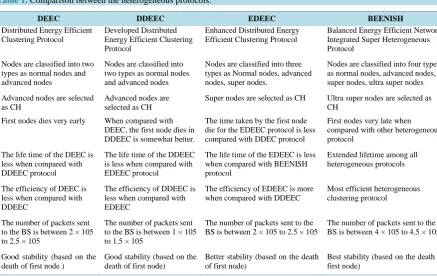
For four level of heterogeneity is being utilized in BEENISH protocol. Here, based on the energy level, the nodes have been classified as Normal nodes (low energy level), advanced nodes (medium energy level) super nodes (high energy level) and ultra super nodes (highest energy level) [12]. In general ultra super nodes have the highest chance for the selection of cluster head. The first node dies very late when compared to other protocols (DEEC, DDEEC, EDEEC). Due to this reason the lifetime of the BEENISH protocol has been extended. The ef-ficiency of this BEENISH protocol is highest when compared to DEEC, DDEEC, EDEEC protocols. The num-ber of packets sent to the base station is also high. Let us consider ri the number of rounds for a node (SN) to
become as cluster head. This is referred to a rotating epoch. The amount of energy consumed by the cluster head is more when compared to the other nodes that are available in that cluster. The CH selection in heterogeneous sensor network is different from the homogeneous sensor network based on the energy level; the ultra-super node has highest chance for the CH selection. Table 1 shows the comparison of these clustering protocols.
3. Existing Cluster Head Selection in BEENISH protocol
The nodes available in BEENISH protocol include normal nodes, advanced nodes, super nodes, and ultra super nodes. Ultra super node possesses highest energy level, while normal node possesses lowest energy level. The chance for the selection of the cluster head (CH) is very high for ultra super node. The average energy of each node has been determined with the help of the following equations
In BEENISH, average energy of rth round can be obtained as follows and as supposed in DEEC:
( )
1(
)
1
total
E E
N r
r = − R . (1)
R is showing total rounds from the start of network to the all nodes die and can be estimated as in DEEC and given as under:
total round
E E
E
[image:4.595.90.528.446.722.2]= .
(2)
Table 1. Comparison between the heterogeneous protocols.
DEEC DDEEC EDEEC BEENISH
Distributed Energy Efficient Clustering Protocol
Developed Distributed Energy Efficient Clustering Protocol
Enhanced Distributed Energy Efficient Clustering Protocol
Balanced Energy Efficient Network Integrated Super Heterogeneous Protocol
Nodes are classified into two types as normal nodes and advanced nodes
Nodes are classified into two types as normal nodes and advanced nodes
Nodes are classified into three types as Normal nodes, advanced nodes, super nodes.
Nodes are classified into four types as normal nodes, advanced nodes, super nodes, ultra super nodes
Advanced nodes are selected as CH
Advanced nodes are selected as CH
Super nodes are selected as CH Ultra super nodes are selected as CH
First nodes dies very early When compared with DEEC, the first node dies in DDEEC is somewhat better.
The time taken by the first node die for the EDEEC protocol is less compared with DDEC protocol
First nodes very late when compared with other heterogeneous protocol
The life time of the DEEC is less when compared with DDEEC protocol
The life time of the DDEEC is less when compared with EDEEC protocol
The life time of the EDEEC is less when compared with BEENISH protocol
Extended lifetime among all heterogeneous protocols
The efficiency of DEEC is less when compared with DDEEC
The efficiency of DDEEC is less when compared with EDEEC
The efficiency of EDEEC is more when compared with DDEEC
Most efficient heterogeneous clustering protocol
The number of packets sent to the BS is between 2 × 10⁵ to 2.5 × 10⁵
The number of packets sent to the BS is between 1 × 10⁵ to 1.5 × 10⁵
The number of packets sent to the BS is between 2 × 10⁵ to 2.5 × 10⁵
The number of packets sent to the BS is between 4 × 10⁵ to 4.5 × 10⁵
Good stability (based on the death of first node )
Good stability (based on the death of first node)
Better stability (based on the death of first node)
Eround is the energy dissipated in a network during single round.
To achieve the optimal number of CH at start of each round, node sidecides whether to become a CH or not
based on probability threshold calculated by expression in the following equation,
( )
if 1 1
0, 0, w
i i i i i p s G p rmod T s p ∈ − =
(3)
where G is the set of nodes eligible to become CH. If a node si has not been CH in the most recent ni then it
be-longs to set G. Random number between 0 and 1 is selected by nodes belonging to set G. If the number is less than threshold T(si), the node siwill be CH for that current round.
Threshold is calculated for CH selection of normal, advanced, super and ultra-super nodes by putting above values in equation below:
( )
if 1 1
0, 0, w
i i i i i p s G p rmod T s p ∈ − =
.
(4)
4. Proposed Cluster Head Selection in BEENISH Protocol Using Fuzzy Logic
4.1. Fuzzy Logic Based Cluster Head Determination
Fuzzy sets had been published by Lotfi A. Zadah of university of California in the year 1965. These fuzzy sets formed the basis for fuzzy logic. With the help of fuzzy logic, it is easy to implement real time scenario. This can be done by utilizing less expensive microcontrollers. The purpose of fuzzification is to convert the input values into fuzzy values. The rule evaluation module calculates the input real values to the corresponding output fuzzy values. The defuzzification module converts the output real values into appropriate output values [13].
Before implementing the fuzzy logic, the following assumptions are to be made. 1) The cluster head election should be done by the base station (BS).
2) The base station should be in static condition. BS should not move from one location to another. 3) The location of the nodes has to be conveyed to the BS.
4) The channel used for propagating the information is in symmetric form.
5) The energy level of the nodes also has to be intimated to the BS. This can be done during the setup phase of the cluster formation.
6) The distance between the BS and the nodes should be large.
7) The nodes that are present in the WSN should be homogeneous in nature (i.e. nodes have identical charac-teristics).
The algorithm adapted in the FL scenario is similar to the centralized approach, i.e. decision has been taken by the base station alone. In order to implement this, the base station possesses more energy, power, as well as memory capacity when compared to the other nodes [14]. Figure 3 shows the Implementation of cluster head determination using Fuzzy Logic.
Figure 3. Implementation of cluster head determination using fuzzy logic.
Figure 4. Fuzzy logic designer—cluster head selection.
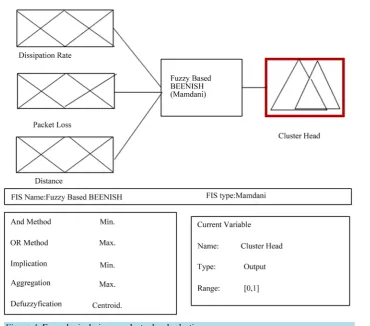
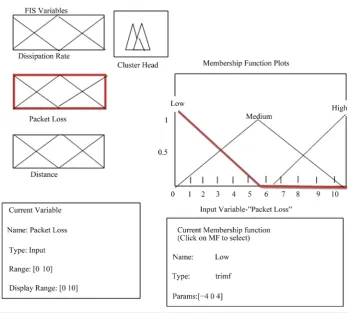
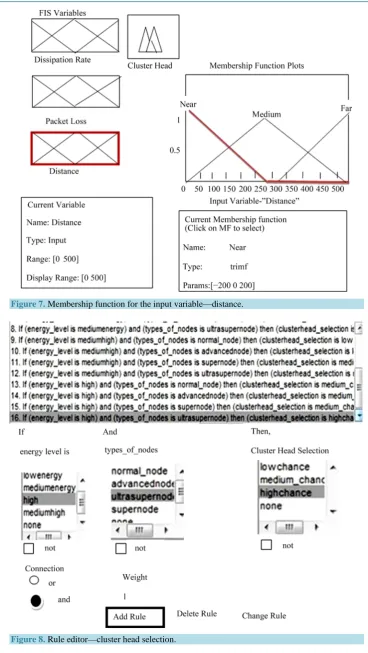
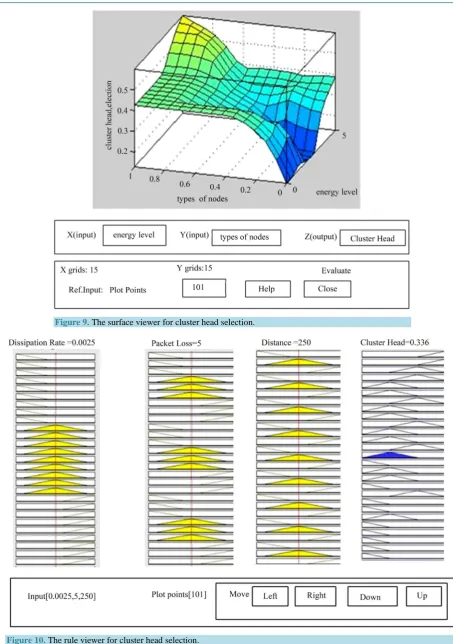
the nodes that are available in that cluster. For cluster head selection output variable, the fuzzy subsets like low, medium, high and highest are considered. To be a CH, the node should posses low energy dissipation rate, low number of packet losses, and distance from the base station should be near. Figure 4 shows the fuzzy logic de-signer for cluster head selection. Figure 5 shows the membership function for the input variable dissipation rate. Figure 6 shows the membership function for the input variable packet loss. Figure 7 shows the membership function for the input variable distance. Figure 8 shows the Rule editor for CH selection. Tables 2-4 show the Rule base for energy dissipation rate low, medium, high respectively
4.2. Proposed Algorithm for the Cluster Head Determination in BEENISH Protocol
Step 1: Check whether the node possess highest energy level. If yes, then go to step 5 or go to step 6.Figure 5. Membership function for the input variable-dissipation rate.
[image:7.595.138.487.396.709.2]Figure 7. Membership function for the input variable—distance.
Table 2. Rule base with energy dissipation rate—low.
Distance
Packet Loss
Energy Dissipation Rate—Low
Near Medium Far
Low HIGHEST HIGHEST HIGH
Medium HIGH MEDIUM MEDIUM
[image:9.595.139.490.86.372.2]High HIGH MEDIUM MEDIUM
Table 3. Rule base with energy dissipation rate—medium.
Distance
Packet Loss
Energy Dissipation Rate—Medium
Near Medium Far
Low HIGH MEDIUM MEDIUM
Medium HIGH HIGH LOW
High MEDIUM MEDIUM LOW
Table 4. Rule base with energy dissipation rate—high.
Distance
Packet Loss
Energy Dissipation Rate—High
Near Medium Far
Low HIGH HIGH LOW
Medium MEDIUM LOW LOW
High LOW LOW LOW
Step 3: Now check if the same node also possesses low energy dissipation rate. If yes, then go to step 5 or go to step 6.
Step 4: Now check if the same node also possesses nearer to the base station (distance between BS and SN should be near). If yes, then go to step 5 or go to step 6.
Step 5: Select the node which possesses highest energy level, low number of packet loss, low energy dissipa-tion rate, and nearer distance to the base stadissipa-tion as cluster head.
Step 6: Need not select the node which possesses low energy level, high number of packet loss, high energy dissipation rate, and far distance from the base station as cluster head. That node will not compete for cluster head selection.
Step 7: Now check the energy level of Cluster head (selected recently), then go to step 1.
5. Simulation and Results
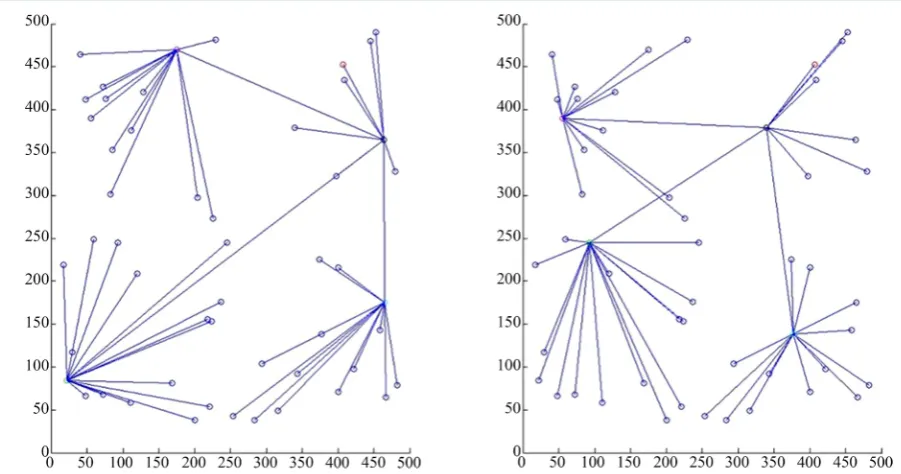
The Fuzzy based BEENISH protocol is simulated with the help of MATLAB and fuzzy logic and the corre-sponding results are shown below. Figure 9 shows the surface viewer for CH selection. Figure 10 shows the rule viewer for CH selection. Figure 11(a) shows the transmission between single sensor node and Base station in two hops for fuzzy based BEENISH protocol. Figure 11(b) shows the transmission between single sensor node and Base station in two hops for ordinary BEENISH protocol. Figure 12 shows the transmission between multiple sensor node and Base station in two hops for ordinary BEENISH protocol.
The comparison between ordinary BEENISH protocol and fuzzy based BEENISH protocol is shown in Table 5. The parameters to be chosen for comparison are, packets delivered and distance travelled. As already men-tioned, two hop communication has been chosen for transmission purpose. The packets delivered by the fuzzy based BEENISH protocol are comparatively higher than the ordinary BEENISH protocol for each and every transmission, and the distanced travelled is comparatively lower. As the distance travelled is less, then the path loss will be less.
6. Conclusion
Figure 9. The surface viewer for cluster head selection.
(a)
[image:11.595.117.497.78.691.2](b)
Figure 12. The transmission between multiple sensor node and Base station in two hops for fuzzy based BEENISH protocol and ordinary BEENISH protocol.
Table 5. Comparison of fuzzy based BEENISH protocol with ordinary BEENISH protocol for single transmission.
Round Ordinary BEENISH Protocol Fuzzy Based BEENISH Protocol
Packets Delivered Distance Travelled Packets Delivered Distance Travelled
Round 1 92.8459 425.2670 97.6769 371.1666
Round 2 84.1766 553.9332 89.7626 476.6217
Round 3 91.5762 551.0859 93.1606 516.0589
Round 4 93.3817 542.1898 98.1507 482.1286
Round 5 88.5360 755.1234 95.1497 536.4861
Round 6 84.2204 810.7682 93.2419 639.9198
Round 7 88.4544 614.4913 90.3646 483.6423
Round 8 89.1781 292.1283 94.2932 131.1708
Round 9 84.3798 287.5444 90.4835 184.4381
Round 10 92.8091 609.1781 93.5276 479.6700
this protocol, the energy level of the CH is maintained. If the energy level of the CH node decreases, then the node with another higher energy level is considered for cluster head. Thereby the energy consumed by the CH is maintained. The fuzzy based BEENISH protocol shows better performance when compared to the ordinary BEENISH protocol based on number of packets delivered to the base station. It also enhances fast transmission.
References
[1] Yick, J., Mukherjee, B. and Ghosal, D. (2008) Wireless Sensor Network Survey. Computer Networks, 52, 2292 -2330. http://dx.doi.org/10.1016/j.comnet.2008.04.002
[2] Akyildiz, I.F., Su, W., Sankarasubramaniam, Y. and Cayirci, E. (2002) Wireless Sensor Networks: A Survey. Com-puter Networks, 38, 393-422. http://dx.doi.org/10.1016/S1389-1286(01)00302-4
[3] Akyildiz, I.F., Su, W., Sankarasubramaniam, Y. and Cayirci, E. (2002) A survey on Wireless Sensor Networks. IEEE Communications Magazine, 40, 102-114. http://dx.doi.org/10.1109/MCOM.2002.1024422
[image:12.595.90.538.365.539.2][5] Smaragdakis, G. and Bestavros, I.M.A. SEP: A Stable Election Protocol for Clustered Heterogeneous Wireless Sensor Network.
[6] Kashaf, A., et al. (2012) TSEP: Threshold-Sensitive Stable Election Protocol for WSNs.
http://120.52.73.76/arxiv.org/pdf/1212.4092v1.pdf
[7] Elbhiri, B., et al. (2010) Developed Distributed Energy-Efficient Clustering (DDEEC) for Heterogeneous Wireless Sensor Networks.
[8] Khair, M.G., et al. (2011) Heterogeneous Clustering of Sensor Network. Procedia Computer Science, 5, 939-944. http://dx.doi.org/10.1016/j.procs.2011.07.132
[9] Mishra, B.K., Dhabariya, A.S. and Jain, A. (2014) Enhanced Distributed Energy Efficient Clustering (E-DEEC) Based on Particle Swarm Optimization. International Journal of Digital Application & Contemporary Research, 2, No. 6. [10] Javaid, N., Qureshi, T.N., Khan, A.H., Iqbal, A., Akhtar, E. and Ishfaq, M. (2013) EDDEEC: Enhanced Developed
Distributed Energy-Efficient Clustering for Heterogeneous Wireless Sensor Networks. Procedia Computer Science, 19, 914-919.
[11] Kumar, D., Aseri, T.C. and Patel, R.B. (2009) EEHC: Energy Efficient Heterogeneous Clustered Scheme for Wireless Sensor Networks. Computer Communications, 32, 662-667.
[12] Qureshi, T.N., Javaid, N., Khan, A.H., Iqbal, A., Akhtar, E. and Ishfaq, M. (2013) BEENISH: Balanced Energy Effi-cient Network Integrated Super Heterogeneous Protocol for Wireless Sensor Networks. Procedia Computer Science,
19, 920-925. http://dx.doi.org/10.1016/j.procs.2013.06.126
[13] Gupta, I., Riordan, D. and Sampalli, S. (2005) Cluster-Head Election Using Fuzzy Logic for Wireless Sensor Net-works.
[14] Tamene, M. and Rao, K.N. (2016) Fuzzy Based Distributed Cluster Formation and Route Construction in Wireless Sensor Networks. International Journal of Computer Applications, 140, No. 5.
[15] Gharghi, M., Parvinnia, E. and Khayami, R. (2013) Designing a Fuzzy Rule Base System to Head Cluster Election inWireless Sensor Networks. Indian Journal of Science and Technology, 6, No. 5.