http://dx.doi.org/10.4236/fns.2016.79077
Biochemical and Microbial Properties
of Palm Wine: Effect of Tapping
Length and Varietal Differences
Detto Karamoko
1, N’Dédé Théodore Deni
2, Jean-Luc Aboya Moroh
1,
Koffi Maïzan Jean-Paul Bouatenin
2, Koffi Marcellin Dje
21Laboratory of Food Microbiology and Biotechnology, Department of Biochemistry and Food Sciences, University Peleforo Gon Coulibaly of Korhogo, Korhogo, Cote d’Ivoire
2Laboratory of Biotechnology and Food Microbiology, Department of Food Sciences and Technology,
University Nangui Abrogoua of Abidjan, Abidjan, Cote d’Ivoire
Received 5 January 2016; accepted 22 July 2016; published 25 July 2016
Copyright © 2016 by authors and Scientific Research Publishing Inc.
This work is licensed under the Creative Commons Attribution International License (CC BY). http://creativecommons.org/licenses/by/4.0/
Abstract
The effects of variety and tapping length on several physical, biochemical, nutritional and micro-biological parameters (viscosity, pH, Total Titratable Acidity (TTA), fermenting microorganisms, contaminants) of palm wine extracted from two varieties of palm oil tree (Dura and Tenera) were studied. Each variety presented its own palm wine specific characteristics regarding the chosen parameters. Microbiological and biochemical contents of palm wine were determined during the tapping of Dura and Tenera felled oil palm trees for 4 weeks. Some differences in chemical compo-sitions between fresh palm wine samples of two palm trees varieties were observed. The exudates obtained during the first day of tapping of Dura palm wine were very sugary, less sour and did not contain substantial concentrations of alcohol but the highest loads of microorganisms were ob-served in Tenera palm wine. Throughout the tapping of palm wine, yeasts and lactic acid bacteria population changed with undoubtedly influence on the palm wine quality.
Keywords
Viscosity, Palm Wine, Fermentation, Palm Oil Trees
1. Introduction
guineensis), coconut palm (Cocus nucifera), date palm (Phoenix dactylifera), nipa palm (Nypa fruticans), kithul palm (Caryota urens), ron palm (Borassus aethiopum) and raffia palm (Raphia hookeri) [1] [2]. The unfer-mented sap is clear, sweet, colourless syrup containing about 10% - 12% (w/v) sugar, which is mainly sucrose
[3]. Upon fermentation by the natural microflora, the level of this sugar decreases as it is converted to alcohol and other products whereas the sap becomes milky white due to the increased microbial suspension resulting from the prolific growth of fermenting organisms [4]. It becomes a whitish, effervescent, alcoholic beverage consumed in very large quantities in West Africa, and known throughout the major parts of Africa under various names, such as “mimbo” in Cameroon, “nsafufuo” in Ghana, an “emu” in Nigeria and “bandji” in Côte d’Ivoire
[5] [6]. It is widely consumed in tropical regions where palms grow such as Asia, South America, Africa and
more particularly in Côte d’Ivoire amongst all socioeconomic groups. In such areas, the beverage plays an im-portant role in the culture of the people and most African countries have their own palm wine, including Côte d’Ivoire [6] [7]. It has been associated to life farmer, because being less expensive and produced in the farming surroundings [8]. Indeed the consumed volumes are in the same way order of size than those of modern beers. Because of the nutritional wealth of this non fermented sap, it is often proposed to infants whose mother cannot produce the necessary milk for the nursing [9] [10].
However, like many other traditional fermented foods in Africa, the production of palm wine is by the age-old method of chance inoculation and uncontrolled fermentation. Therefore, the usual variations in the quality and stability of the product are not unexpected. The sap of the palm tree is tapped and allowed to undergo spontane-ous fermentation, which promotes the proliferation of yeast species for the conversion of the sweet substrate into an alcoholic beverage containing important nutritional components, including amino acids, proteins, vitamins and sugars [11]. The process of tapping palm wine involves first felling or cutting down the tree, leaving the felled tree for a period of about 2 weeks for the sap to concentrate, followed by tapping for up to 8 weeks. Many problems associated with the different aspects of indigenous food fermentation processes including lack of good manufacturing procedure or hygiene code; lack of knowledge of nutritional and toxicological implication of the fermentation are important with particular reference to palm wine tapping and processing in that the quality is determined among others by the effectiveness of the tapping or fermentation process. Important works have been done in West Africa, especially in Ghana and Nigeria during the last 20 years on various aspects of palm wine including its production and composition [12] [13], but to our knowledge, variations in palm wine quality throughout tapping and oil palm tree varietal effect have not yet assessed particularly. In Côte d’Ivoire, palm wine is mainly obtained from palm oil tree Elaeis guineensis which involves many varieties. As palm wine has a significant role in customary practices in Africa, it is important that the microbiology and biochemistry of its tapping process are well understood. Thus, this study was carried out to investigate the microbiological and bi-ochemical changes which occur in palm wine during the tapping of two varieties of felled oil palm trees.
2. Materials and Methods
2.1. Materials and Sampling
Palm wine samples were obtained during the tapping of 20 palm trees (E. guineensis) of two varieties (Dura and
Tenera) at the University Nangui Abrogoua (Côte d’Ivoire) over a period of 5 months. Collection of palm wine during tapping was normally done twice a day by the tapper, but in this study samples were collected at three day intervals each morning of sampling day at 7:00 AM in stomacher bags from the beginning until the end of tapping. These samples were immediately transported to the laboratory for analyses, carried out in replicates.
2.2. Biochemical Analysis
2.2.1. Determination of pH and Total Titratable Acidity
The pH of palm wine samples was determined directly using a pH-meter (pH-meter P 107, CONSORT, Biob-lock, France) after calibration with standard buffers. Total titratable acidity was determined by titrating samples against 0.1 M NaOH using 1% phenolphthalein as indicator as described by [14] and expressed as percentage of lactic acid.
2.2.2. Determination of Total and Reducing Sugars
[15], while reducing sugars were quantified as previously described by Bernfeld [16]. Two independent mea-surements were made on each sample and results were expressed in g/L.
2.2.3. Ethanol Content
Ethanol content was determined by gas chromatographic analyses, carried out using a Shimadzu CG-14A gas chromatograph. Filtered samples (2 mL) were directly injected into the system. The temperature was set at 8˚C min−1. Injector and detector temperature were 200˚C and 250˚C, respectively. Helium at 2 kg∙cm−2 was used as a carrier gas and the external standard method was used for the quantitative determination of ethanol.
2.2.4. Viscosity
The Thermo Scientific HAAKE Falling Ball Viscometer type C was used to measure the viscosity of palm wine. It provides a very accurate way of measuring the viscosity of transparent Newtonian liquids and gases and meets the requirements of the German DIN 53015 as well as ISO 12058 standards. The time for rolling and sliding movements of a ball through the sample in an inclined cylindrical measuring tube is measured at 30˚C. The sample viscosity is correlated with the time needed by a ball to traverse a definite distance. By turning the mea-suring tube upside down again the return of the ball may also be used for an additional measurement. The test results were given as dynamic viscosity in the internationally standardized, absolute units of centi Poise (cP).
2.3. Enumeration of Microorganisms
The palm wine samples were shaken by hand in the stomacher bag and tenfold serial dilutions were prepared and spread-plated for determination of micro-organism counts. After dilutions, enumeration of total aerobic mesophile was carried out using plates of Plate Count Agar (PCA, Difco 0479-17-3; Difco Laboratories, Detroit, MI, USA) which were incubated at 30˚C for 2 days. Lactic acid bacteria (gram positive catalase negative rods, cocci and coccoids) were enumerated by pour plate on DeMan, Rogosa and Sharpe Agar (MRS, Merck 10660; Merck KGaA, Darmstadt, Germany) containing 10 mg/mL cycloheximide (ICN 100183 Biomedical Inc., Auro-ra, OH, USA) to suppress yeast growth after incubation at 30˚C for 3 days in an anaerobic jar with anaerocult A (Merck). Yeasts and moulds were enumerated on plates of Sabouraud Chloramphenicol agar (BIO-RAD, France) which were incubated at 30˚C for 3 - 5 days. Enumeration of total and faecal coliforms was carried out using plates of Violet Red Bile Lactose agar (VRBL, Merck 10660, Merck, Darmstadt, Germany) which were incu-bated for 24 h at 30˚C for total coliforms and 44˚C for faecal coliforms. Enterococci species were enumerated on plates of Bile Esculin Azide agar (AES Laboratoire, COMBOURG France) after incubation at 37˚C for 2 days.
2.4. Statistical Analysis
The data obtained were subjected to analysis of variance (Statistica, 99 Edition, Alabama, USA) and mean dif-ferences determined by Duncan’s multiple range tests. Significance of variations in the analyzed data was tested at 95% confidence limit.
3. Results and Discussion
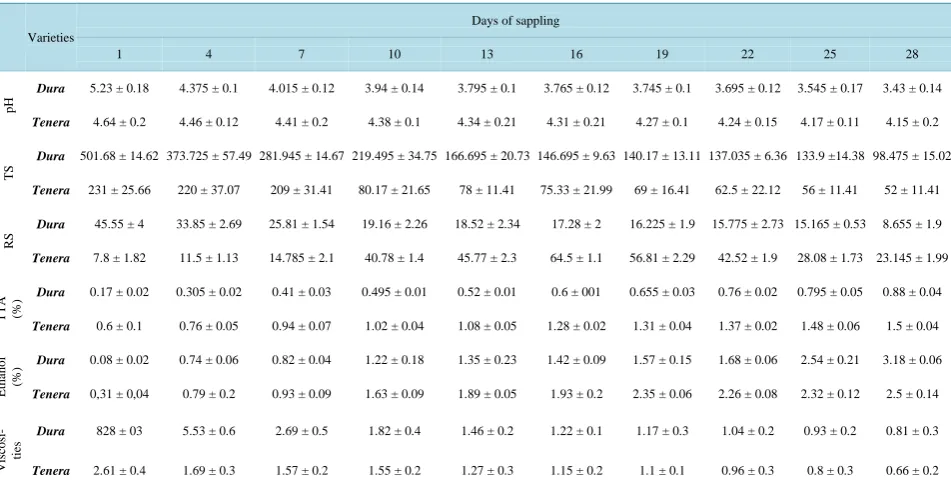
Table 1shows values of biochemical parameters obtained in palm wine every day during tapping of two
varie-ties of oil palm trees (Dura and Tenera). Most of the values decrease during tapping of oil palm tree. The initial pH, reducing sugars and ethanol contents were respectively 5.23 ± 0.18, 45.55 ± 4 g/L and 0.08% ± 0.02% in
Dura variety. These values are not similar to the mean values usually reported by other authors. Throughout the tapping, a subsequent drop of pH and sugars content associated with an increase of the titratable acidity and al-cohol rate were observed. During the collecting process, it is highly susceptible to spontaneous yeast-lactic fer-mentation of the sugary sap. This process is reported to be rapid under sunlight. Sources of fermenting microor-ganisms are tapping implements (knife and bamboo tube) and air. The weak rate of sugars observed in Tenera
Table 1. Biochemical parameters obtained in palm in every day during tapping of two varieties of palm oil trees.
Varieties
Days of sappling
1 4 7 10 13 16 19 22 25 28
pH
Dura 5.23 ± 0.18 4.375 ± 0.1 4.015 ± 0.12 3.94 ± 0.14 3.795 ± 0.1 3.765 ± 0.12 3.745 ± 0.1 3.695 ± 0.12 3.545 ± 0.17 3.43 ± 0.14
Tenera 4.64 ± 0.2 4.46 ± 0.12 4.41 ± 0.2 4.38 ± 0.1 4.34 ± 0.21 4.31 ± 0.21 4.27 ± 0.1 4.24 ± 0.15 4.17 ± 0.11 4.15 ± 0.2
TS
Dura 501.68 ± 14.62 373.725 ± 57.49 281.945 ± 14.67 219.495 ± 34.75 166.695 ± 20.73 146.695 ± 9.63 140.17 ± 13.11 137.035 ± 6.36 133.9 ±14.38 98.475 ± 15.02
Tenera 231 ± 25.66 220 ± 37.07 209 ± 31.41 80.17 ± 21.65 78 ± 11.41 75.33 ± 21.99 69 ± 16.41 62.5 ± 22.12 56 ± 11.41 52 ± 11.41
RS
Dura 45.55 ± 4 33.85 ± 2.69 25.81 ± 1.54 19.16 ± 2.26 18.52 ± 2.34 17.28 ± 2 16.225 ± 1.9 15.775 ± 2.73 15.165 ± 0.53 8.655 ± 1.9
Tenera 7.8 ± 1.82 11.5 ± 1.13 14.785 ± 2.1 40.78 ± 1.4 45.77 ± 2.3 64.5 ± 1.1 56.81 ± 2.29 42.52 ± 1.9 28.08 ± 1.73 23.145 ± 1.99
TTA (%)
Dura 0.17 ± 0.02 0.305 ± 0.02 0.41 ± 0.03 0.495 ± 0.01 0.52 ± 0.01 0.6 ± 001 0.655 ± 0.03 0.76 ± 0.02 0.795 ± 0.05 0.88 ± 0.04
Tenera 0.6 ± 0.1 0.76 ± 0.05 0.94 ± 0.07 1.02 ± 0.04 1.08 ± 0.05 1.28 ± 0.02 1.31 ± 0.04 1.37 ± 0.02 1.48 ± 0.06 1.5 ± 0.04
Ethanol (%)
Dura 0.08 ± 0.02 0.74 ± 0.06 0.82 ± 0.04 1.22 ± 0.18 1.35 ± 0.23 1.42 ± 0.09 1.57 ± 0.15 1.68 ± 0.06 2.54 ± 0.21 3.18 ± 0.06
Tenera 0,31 ± 0,04 0.79 ± 0.2 0.93 ± 0.09 1.63 ± 0.09 1.89 ± 0.05 1.93 ± 0.2 2.35 ± 0.06 2.26 ± 0.08 2.32 ± 0.12 2.5 ± 0.14
Viscos
i-ties
Dura 828 ± 03 5.53 ± 0.6 2.69 ± 0.5 1.82 ± 0.4 1.46 ± 0.2 1.22 ± 0.1 1.17 ± 0.3 1.04 ± 0.2 0.93 ± 0.2 0.81 ± 0.3
Tenera 2.61 ± 0.4 1.69 ± 0.3 1.57 ± 0.2 1.55 ± 0.2 1.27 ± 0.3 1.15 ± 0.2 1.1 ± 0.1 0.96 ± 0.3 0.8 ± 0.3 0.66 ± 0.2
TS: Total sugar; RS: Reducing sugar; TTA: total titratable acidity.
1 day. During tapping, a very high decrease was observed in Dura palm wine viscosity the first 13 days, corres-ponding to a period of active fermentation to rejoin palm wine of Tenera after which no significant variation was observed until the end of tapping (Figure 1). The results do not correspond with those obtained by Osuwa
[18] indicating that the decrease in viscosity occurs during the three (3) first days. The decrease in palm wine
viscosity was also reported by Osuwa [18] but also for other fermented beverages such as Boza [19].
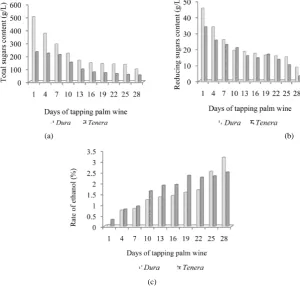
The chemical composition of fresh palm wines collected at every three sampling day intervals during tapping is showed in Figure 2and Figure 3. The sap obtained from Dura variety during the first day of tapping were very sugary, less sour and did not contain substantial concentrations of alcohol. The initial total soluble sugars content of fresh palm wine was 501.68 ± 26 g/L and do not correlate with the observed values of Odunfa [20]
and Olasupo [21] who reported fresh palm wine sugar content of 10% - 12%. Significant differences observed in sugar contents regarding varieties of palms but also due to microbial populations found in palm wines.
Figure 1. Changes in viscosities content during the tapping of different palm wine samples.
Figure 2. Changes in pH and total titratable acidity content during the tapping of different palm wine samples.
(a) (b)
(c)
Figure 3. Changes in the rate of ethanol, total and reducing sugars content during the tapping of different palm wine
[image:5.595.160.461.407.693.2]lactic acid), which then increase in total acidity and decrease in pH value. Normally, natural palm sap showed neutral pH approximately 7 as reported by Jiybunjerdkul [24] and Lasekan [25]. Hence, a high percentage of to-tal acidity and low pH indicates the initial fermentation step of palm sap, for example, during collecting time. In addition the results of pH, total titratable acid and organic acids confirmed the importance of lactic acid bacteria in the tapping of palm wine. In fact, lactic acid bacteria were considered to be responsible for the rapid acidifi-cation of the product as the acetic acid bacteria were not isolated in the palm wine samples on the first days of tapping. The results are similar to those obtained by Amoa-Awua [14]. The decrease in sugar content is a clear indication that a large portion of the sugars is fermented especially during the tapping in Dura oil palm tree. Moreover, the sugar level decreases rapidly as it is converted to alcohol and other products and the observed in-crease in acidity is indicative of the fact that production of acids in the tapping of sap occurred concurrently with alcohol production. Similar observations were reported by Obire [4] and Olasupo [21].
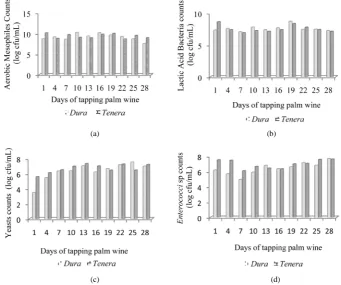
The sap of the palm tree has been shown to be a rich medium capable of supporting the growth of various types of micro-organisms, as high numbers of aerobic mesophiles, lactic acid bacteria, yeasts, Enterococci, co-liforms and sulphite reducing bacteria were found in palm wine during tapping. In discussing the population of the various microorganisms in palm wine, the following factor appears important. That to prevent insect and larvae infestation and also facilitate the oozing of the sap, the tapper cuts thin slices off the walls of the recep-tacle daily to expose a fresh layer. This physically removed the microbiota that had colonized the walls of the receptacle, thus reducing the microbial load in the chamber. In spite of all measures, the microorganism colo-nizes the palm wine. This could be explained by the results presented inFigure 4, which showed that these mi-cro-organisms in fresh palm wine might have originated from those that colonize those parts of the palm stalk of the male inflorescence, the leaf petiole, the felt (afabric-like outgrowth of the frond petiole used to cover the tapping hole), the cross strips and xylem stream which are covered with fluffy hairy outgrowths. Our results are similar to those obtained by Faparusi [26]. Some of them were also brought by the tapper, tapping materials and insects attracted by the sap sugar (Figure 5). Our results showed high loads of microorganisms already the first day in palm wines of both varieties (Dura and Tenera). Microbiological examination of Tenera palm wine sam-ples recorded aerobic mesophilic counts of 10.2 ± 0.1 log cfu/mL. Yeast counts was 5.6 ± 0.3 log cfu/mL, lactic
(a) (b)
[image:6.595.142.484.409.694.2](c) (d)
(a) (b)
[image:7.595.108.496.78.365.2](c)
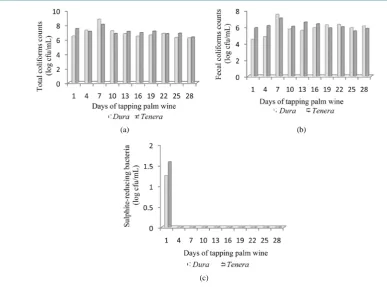
Figure 5. Mean values of the population of various micro-organisms in different samples of palm wine during the tapping.
(a) total; (b) Faecal coliforms; (c) Sulpfite reducing bacteria.
bacteria also produce low ethanol content and use pyruvate as the principal final hydrogen receptor.
A substantial part of coliforms and sulphite reducing bacteria were present in the different saps with the high-est loads in those collected in tenera palm wine when compared with corresponding values for dura palm wine (Figure 5). The presence of coliforms obtained in the palm wines could be explained itself by a human or ani-mal fecal contamination on the place of tapping and also by the presence of bugs attracted by sugars contained in palm wines. Our results agree with those of Tchiendji [28]. In addition the occurrence of coliforms and sul-phite reducing bacteria are indication of poor hygienic handling of the palm wine sampled. These microorgan-isms are contaminants from contaminated containers or from untreated water that is normally used in the dilu-tion of palm wine [3].
4. Conclusion
Palm wine is a beverage obtained from the fermentation of palm saps from palm tree (Elaeis guineensis) by in-digenous microbes. To conclude in this study, important microbial changes occurred in the various palm wine samples during tapping. The highest loads of microorganisms were observed in tenera palm wine at first day. Those undoubtedly have an effect on the biochemical and the safety of this beverage, and so far its nutritional value. The disappearance of all sulphite reducing counts was observed after 4 days of tapping palm wines. How- ever, the presence of coliforms obtained from this study is associated with the unhygienic handling of the beve-rage, as these bacterial isolates are known to have negative effects on the consumers’ health. The presence of an important population of lactic acid bacteria could have a benefic effect on consumer health and thus increasing the interest of this beverage. Therefore, further studies on their technological properties could help to elucidate the involvement of these micro-organisms in the food safety and the improvement of the consumer digestion; as palm wine is consumed with its wild micro-organisms generally without any toxicity has been observed.
References
[1] Dayo-Owoyemi, I., Boboye, B. and Akinyosoye, F.A. (2008) Organoleptic Analysis of Doughs Fermented with Yeasts from a Nigerian Palm Wine (Elaeis guineensis) and Certain Commercial Yeasts. The Open Microbiology Journal, 2, 115-120. http://dx.doi.org/10.2174/1874285800802010115
[2] Sambou, B., Goudiaby, A., Daouda, D., Ervik, F. and Camara, M.C. (2002) Palm Wine Harvesting by the Bassari Threatens Borassus aethiopum Populations in North-Western Guinea. Biodiversity and Conservation, 11, 1149-1161. http://dx.doi.org/10.1023/A:1016005025090
[3] Ogbulie, T.E., Ogbulie, J.N. and Njoku, H.O. (2007) Comparative Study on the Shelf Life Stability of Palm Wine from
Elaeis guineensis and Raphia hookeri Obtained from Okigwe, Nigeria. African Journal of Biotechnology, 6, 914-922. [4] Obire, O. (2005) Activity of Yeast Species in Palm Sap Obtained from Three Areas in Edo State, Nigeria. Journal of
Applied Science Environmental Management, 9, 25-30.
[5] Ezeronye, O.U. and Okerentugba, P.O. (2000) Genetic and Physiological Variants of Yeasts Selected from Palm Wine.
Mycopathologia, 152, 85-89. http://dx.doi.org/10.1023/A:1012323721012
[6] Karamoko, D., Djeni, N.T., N’Guessan, K.F., Bouatenin, K.M.J.-P. and Dje, K.M. (2012) The Biochemical and Mi-crobiological Quality of Palm Wine Samples Produced at Different Periods during Tapping and Changes Which Oc-cured during Their Storage. Food Control, 26, 504-511. http://dx.doi.org/10.1016/j.foodcont.2012.02.018
[7] Ukhun, M.E., Okolie, N.P. and Oyerinde, A.O. (2005) Some Mineral Profile of Fresh and Bottled Palm Wine, a Com-parative Study. African Journal of Biotechnology, 4, 829-832.
[8] Uzogara, S.G., Ezeokoli, N.F. and Uzogara, E.O. (1987) Tyramine Content of Some Nigerian Foods. Ecology of Food and Nutrition, 19, 257-264. http://dx.doi.org/10.1080/03670244.1987.9990969
[9] Ayernor, G.K.S. and Mathews, J.S. (1971) The Sap of the Palm Elaeis guineensis Jacq as Raw Material for Alcoholic Fermentation in Ghana. Tropical Science, 13, 71-83.
[10] Ezeagu, I.E. and Fafunso, M.A. (2003) Biochemical Constituents of Palm Wine. Ecology and Food Nutrition, 42, 213- 222. http://dx.doi.org/10.1080/03670240390226222
[11] Okafor, N. (1972) Palm Wine Yeasts from Parts of Nigeria. Journal of the Science of Food and Agriculture, 23, 1399- 1407. http://dx.doi.org/10.1002/jsfa.2740231203
[12] Uzochukwu, S.V.A., Balogh, E., Tucknot, O.G., Lewis, M.J. and Ngoddy, P.O. (1994) Volatiles Constituents of Palm Wine and Palm Sap. Journal of the Science of Food and Agriculture, 94, 405-411.
[13] Van Pee, W. and Swings, J.G. (1971) Chemical and Microbiological Studies on Congolese Palm Wines (Elaeis gui-neensis). East Africa Agriculture and Forest Journal, 36, 311-314.
[14] Amoa-Awua, W.K., Sampson, E. and Tano-Debrah, K. (2007) Growth of Yeasts, Lactic and Acetic Bacteria in Palm Wine during Tapping and Fermentation from Felled Oil Palm (Elaeis guineensis) in Ghana. Journal of Applied Micro-biology, 102, 599-606. http://dx.doi.org/10.1111/j.1365-2672.2006.03074.x
[15] Dubois, M., Gilles, K., Hamilton, J.K., Rebers, P.A. and Smith, F. (1956) Colometric Method for Determinations of Sugars and Related Substances. Analytic Chemistry, 280, 350-356. http://dx.doi.org/10.1021/ac60111a017
[16] Bernfeld, D. (1955) Amylases, Alpha and Beta. In: Colowick, S.P. and Kaplan, N.O., Eds., Methods in Enzymology, Academic Press Inc., New York, 149-154.
[17] Borse, B.B., Rao, J.L., Ramalakshmi, K. and Raghavan, B. (2007) Chemical Composition of Volatiles from Coconut Sap (Neera) and Effect of Processing.Food Chemistry, 101, 877-880.
http://dx.doi.org/10.1016/j.foodchem.2006.02.026
[18] Osuwa, J.C. and Mbamara, S.U. (2008) Viscosities of Palm Oil and Palm Wine as Quality Indicators.Journal of Food Technology, 6, 170-172.
[19] Gotcheva, V., Pandiella, S.S., Angelov, A., Roshkova, Z. and Webb, C. (2001) Monitoring the Fermentation of the Traditional Bulgarian Beverage Boza.International Journal of Food Science and Technology, 36, 129-134.
http://dx.doi.org/10.1046/j.1365-2621.2001.00429.x
[20] Odunfa, S.A. and Oyewole, O.B. (1997) African Fermented Foods. In: Wood, B.J.B., Ed., Microbiology of Fermented Foods, Springer, Boston, 713-752.
[21] Olasupo, N.A. and Obayori, O.S. (2003) Utilization of Palm Wine (Elaeis guineensis) for the Improved Production of Nigerian Indigenous Alcoholic Drink—Ogogoro.Journal of Food Processing and Preservation, 27, 365-372.
http://dx.doi.org/10.1111/j.1745-4549.2003.tb00523.x
[22] Lindsay, R.C. (1996) Flavors. In: Fennema, O.R., Ed., Food Chemistry, Marcel Dekker Inc., New York, 723-765.
[23] Phaichamnan, M., Posri, W. and Meenune, M. (2010) Quality Profile of Palm Sugar Concentrate Produced in Songkhla Province, Thailand.International Food Research Journal, 17, 425-432.
[24] Jitbunjerdkul, S. (1989) Effect of Antimicrobial Agents on the Quality of Palm Sugar Products. Songklanakarin Jour-nal of Science and Technology, 11, 161-165.
[25] Lasekan, O., Buettner, A. and Christlbaure, M. (2007) Investigation of Important Odorant of Palm Wine (Elaeis gui-neensis).Food Chemistry, 105, 15-23.http://dx.doi.org/10.1016/j.foodchem.2006.12.052
[26] Faparusi, S.I. (1973) Origin of Initial Microflora of Palm Wine from Oil Palm Trees (Elaeis guineensis).Journal of Applied Bacteriology, 36, 559-565.http://dx.doi.org/10.1111/j.1365-2672.1973.tb04142.x
[27] Nwachukwu, I.N., Ibekwe, V.I., Nwabueze, R.N. and Anyanwu, B.N. (2006) Characterisation of Palm Wine Yeast Isolates for Industrial Utilization. African Journal of Biotechnology, 5, 1725-1728.
[28] Tchiendji, C. (1985) Le vin de palme d’Elaeis guineensis.Ecole Supérieure Agronomique et des industries alimentaires. Université de Nancy, Nancy.