Munich Personal RePEc Archive
The effect of board size and composition
on bank efficiency
Agoraki, Maria-Eleni and Delis, Manthos D and Staikouras,
Panagiotis
8 October 2009
Online at
https://mpra.ub.uni-muenchen.de/18548/
The effect of board size and composition on bank efficiency
ABSTRACT
This paper analyzes the relationship between board structure, in terms of board size
and composition, and bank performance. Unlike previous studies, the present analysis
is carried out within a stochastic frontier framework. To this end, bank performance is
proxied by both cost and profit efficiency, measures that present considerable
advantages over simple accounting ratios. The empirical framework formed is applied
to a panel of large European banks operating during the period 2002-2006. We find
that board size negatively affects banks’ cost and profit efficiency, while the impact of
board composition on profit efficiency is non-linear. Finally, introducing risk-taking
(credit risk) as an interaction component of board size and composition does not affect
the robustness of the results.
JEL classification: G21; G34; C23; K23
Keywords: Corporate governance; Board size and composition; Bank cost and profit
efficiency; Stochastic frontier analysis
1. Introduction
Banks’ multifaceted and pivotal role in the economic system has attracted, not without
valid reasons, much regulatory attention in an effort to inspire sound corporate
governance standards and address the unique features of and risks faced by credit
institutions. The size and composition of the board of directors constitute of the most
essential corporate governance themes and have caught the attention of academics and
regulators alike. The latter, in particular, appear remarkably confident that smaller and
more outsider-dominated boards are critical drivers of better corporate management
and, thus, contribute positively to corporate performance. The present study innovates
in that the board structure (in terms of board size and composition)–performance
relationship in banking is examined within a stochastic frontier framework, while
performance is measured in terms of cost and profit efficiency of banks. This places
frontier methodologies (for reviews see Berger and Humphrey, 1997; Hughes and
Mester, 2008).
According to the generic definition offered by the Organization for Economic
Co-operation and Development, corporate governance involves a set of relationships
between corporate management, the board of directors, shareholders and other
stakeholders, while also providing the structure through which corporate objectives
are set, and the means of accomplishing those objectives and monitoring performance
are determined (OECD, 2004). Essentially, by establishing internal mechanisms
inciting corporate management to promote company’s interests and facilitating
effective monitoring, corporate governance systems enhance investors’ protection and
confidence, thus contributing to the proper functioning of the market economy and the
improvement of economic efficiency and growth (OECD, 2004; Basel Committee,
2006). Upgrading corporate board structure, in terms of both size and composition,
has been one of the core themes in all corporate governance initiatives undertaken by
international fora (e.g., EU Commission Communication, 2003; OECD, 2004; Basel
Committee, 2006).
Despite this renowned interest in the role of board size and composition, a full
review of the relevant literature concerning the impact of board structure on banks’
performance reveals that empirical findings are mixed. A common element of these
studies is that bank performance is proxied by simple accounting ratios that have been
proved limited measures of bank performance. Phrased differently, the empirical
studies on the board structure-bank performance relationship have not embraced the
large literature on the measurement of bank performance using stochastic frontier
methods. This seems odd because most bank performance studies have reached
consensus that frontier efficiency measures are superior for most regulatory and other
purposes to the standard financial ratios from accounting statements, which are
commonly employed by regulators, financial institution managers and industry
consultants to assess performance. The main reasoning is that frontier measures use
statistical techniques that remove the effects of differences in prices and other
exogenous market factors affecting the standard performance ratios and, therefore,
they are capable of characterizing the underlying production relationship (e.g., Fried,
Lovell and Schmidt, 1993; Bauer, Berger, Ferrier and Humphrey, 1998).
In the context of present analysis, the above consideration has at least three
performance within a frontier efficiency framework. First, financial ratios such as the
return on assets (ROA) and the return on equity (ROE) suffer from the well-known
conceptual shortcomings relating to the evaluation of inventories and depreciation
(Fisher and McGowan, 1983; Pi and Timme, 1993; Destefanis and Sena, 2007). To a
different extent among banks, these ratios under-represent a bank’s value because of
the so-called investment myopia problem (that is, when executives overextend the
useful life of their assets and delay needed new investments). If executives indulge in
myopic behavior, longer-term investment decreases and frontier efficiency is capable
of capturing this effect, since inventories and depreciation are accounted for in the
production relationship. Furthermore, corporate governance theory on separation
between management and ownership implies that executives may have incentives to
undertake projects yielding increased bargaining power, which may not be associated
with increased productivity or profitability (Shleifer and Vishny, 1997). Again this
behavior will be immediately reflected in the efficiency indicator, while measures of
performance like the Tobin’s Q may remain in higher levels in the short-run. Finally,
and as regards Tobin’s Q, if market efficiency deviates from the standards of the
Anglo-Saxon markets and/or many banks trade their equity in thin, secondary
markets, assessment of the market value of assets (needed to construct Q) is either
misleading or not readily available (Destefanis and Sena, 2007; Kapopoulos and
Lazaretou, 2007). The above arguments imply that a study of the relationship between
board structure and bank performance within a stochastic frontier framework is
worthwhile, as it may shed some light on the diverse character of the findings in the
relevant literature.
Two final distinguishing characteristics of this study are worth noting. First,
advances in stochastic frontier analysis (SFA), which is the method used in the
present paper, allow controlling for a number of bank-level and industry determinants
of bank efficiency. In particular, and given the fact that the choice on the size and
composition of bank boards may be made on the basis of better risk management, we
are very much interested to control for credit risk when evaluating the impact of board
size and composition on bank performance. In addition, we augment the usual
stochastic frontier methods to account for the possible endogeneity between bank
performance, board structure and risk, which is an issue of significant debate in the
The present study comprises five sections. The following section demarcates
the general framework of the debate by providing a concise theoretical basis of the
increased regulatory and academic interest on banks’ corporate governance systems,
while also reviewing the relevant literature concerning the relationship between board
structure (i.e., board size and composition) and bank performance. The third section
explains the empirical model and discusses the dataset used in the present study. The
study proceeds with the empirical results and relates them to the different strands of
the literature. Finally, the last section concludes the paper.
2. Corporate governance and banks: Setting the discussion in context
2.1. Rationalizing the regulatory emphasis upon banks’ corporate governance
The comparatively heavy regulation of the banking industry has conventionally been
attributed to the multifaceted and, by extension, sensitive role that banks perform in
the economic system as liquidity guarantors, originators of non-market finance,
information brokers between lenders and borrowers and payment system operators
(for an overview of the special functions performed by banks and the relevant literature
see inter alia Gorton and Winton, 2003 and references therein). Effectively, however, the
essential of banking, i.e., the transformation of short-term, payable-on-demand
deposits into illiquid, long-term loans, coupled with asymmetric information on the
quality of the inherently opaque bank assets and the application of the ‘first-come,
first-served’ rule permeating deposit withdrawals renders credit institutions
particularly susceptible to runs by their depositors. To make things worst, the failure
of an individual bank may spill-over to other banks, either via inter-bank linkages
with the ailing bank or because of panic provoking bank runs on other, non-distressed
banks, thus destabilizing the economic system as a whole (for an overview of the
theories and literature on bank runs and contagion risk see, inter alia, Calomiris, 2007 and
references therein).
Special, public safety-nets in the form of deposit insurance and liquidity
injection by the central bank in times of crises (lender-of-last-resort operation)
underlines the ‘special’ role of banks in the economy and manifests the weight that
regulators attach in maintaining public confidence in the smooth operation of the
banking system. On the other hand, however, public guarantees engender moral
hazard as they erode depositors’ incentives to monitor credit institutions, while, at the
character of banks appears to inspire a ‘regulatory cycle’: banks’ distinctive functions
call for equally special regulatory attention, which, however, stimulates unique moral
hazard risks necessitating, in turn, a new layer of regulation (Bhattacharya and
Thakor, 1993; Ceccheti, 1999). Internal corporate governance mechanisms (e.g.,
appointing non-executive, independent directors, introducing internal control systems,
establishing board committees, monitoring directors’ remuneration) present
themselves as one of the most popular devices to discipline corporate management
and curtail banks’ increased risk-taking appetite.2 Moreover, prudently run banks
produce positive externalities in the sense that they induce efficient corporate
governance of the firms with which they are associated either as creditors or, most
importantly, as shareholders (Barth, Caprio and Nolle, 2004).
Indeed, the Basel Committee (2006) has explicitly recognized that the
important financial intermediation role of banks, their sensitivity to failures stemming
from inefficient corporate management and the need to safeguard and align the (often
conflicting) interests of shareholders and other stakeholders, including supervisors,
governments and depositors, render banks’ corporate governance of great importance
to the financial system.3 Drawing from international experience, the Basel Committee
(2006) underlines, in particular, the key role of the board of directors and senior
management for the safety and soundness of banks, placing, inter alia, emphasis on
the board structure (including size) that “promotes efficiency and real strategic
discussion” as well as on the appointment of an adequate number of directors
“capable of exercising independent judgment of the views of management, political
interests or inappropriate outside interests”.
In a similar vein, John and Senbet (1998) corroborate the prominent position
that board structure and organization occupy in the corporate governance discussion,
concluding that the board of director’s effectiveness in monitoring corporate
management is fundamentally determined by its independence and size. Nevertheless,
as already noticed, notwithstanding the ‘popularity’ of the particular corporate
governance field, empirical research regarding the effect of board structure (i.e., board
size and composition) upon bank performance is not only comparatively scarce but,
2.2. Board size and bank performance
Simpson and Gleason (1999) elaborated upon a sample consisting of those banking
firms listed in the SNL Quarterly Bank Digest 1993 and found that the number of
board directors did not have a significant bearing on the probability of banks’
financial distress. Adams and Mehran (2005) examined the relation between board
size and firm performance using a sample of 35 large publicly-traded US bank
holding companies (BHCs) during 1959-1999. Contrary to the evidence for
non-financial firms, they concluded that banking firms with larger boards do not
under-perform their peers in terms of Tobin’s Q and that, as a result, constraints on board
size in the banking industry may be counter-productive. On the same line, Belkhir
(2006) studied a sample of 260 US bank and savings-and-loan holding companies for
2002, inferring that internal corporate governance mechanisms (i.e., manager and
block-holder ownership, proportion of outside directors, CEO-Chairman duality,
board size) are, to a considerable degree, endogenously determined and they exert a
non-significant impact upon banks’ performance.
Likewise, Zulkafli and Samad (2007) analyzed a sample of 107 listed banks in
the nine countries of Asian emerging markets (Malaysia, Thailand, Philippines,
Indonesia, Korea, Singapore, Hong Kong, Taiwan, India), also deducing that board
size is not significantly correlated with performance measures, such as the Tobin’s Q
and ROA. Finally, in their updated version of the 2005 research, Adams and Mehran
(2008) used a sample of 35 large publicly traded BHCs over the period 1959-1999
and concluded that board size does not have a negative effect on performance.
More recently, Andres and Vallelado (2008) examined information on the
characteristics of the boards of directors for 69 commercial banks operating in
Canada, US, UK, Spain, France and Italy over the period 1995-2005. After controlling
for the ownership structure, the weight of the banking industry, or differences in the
regulatory and institutional setting, they found that the inclusion of more directors is
positively associated with performance, which is measured by Tobin’s Q, ROA and
shareholder market return (SMR). However, they added that beyond a certain limit
(i.e., 19 directors) the coordination, control and decision-making problems
encountered by larger boards offset the benefits.
On the other hand and using a somewhat different approach, Sierra, Talmor
and Wallace (2006) constructed a board strength index on the basis of 76 bank
consisted of seven variables, including board size and independence under the
assumption that larger and more insider-dominated boards are associated with less
monitoring and higher CEO compensation and that, as such, denote weaker boards.
Their findings indicated that stronger boards (i.e., BHCs with a higher score on the
index) display higher performance measured in terms of ROA. The work of
Staikouras, Staikouras and Agoraki (2007) examined a sample of 58 out of the 100
largest, in terms of total assets, credit institutions operating in Europe for the period
between 2002 and 2004. Their analysis inferred that bank profitability – measured in
terms of ROA, ROE and Tobin’s Q – is negatively and significantly related to the size
of the Board of Directors. Finally, Pathan, Skully and Wickramanayake (2007) using
a dataset of the Thai commercial banks over the period 1999-2003, also obtained a
negative relation between board size and both ROE and ROA.
2.3. Board composition and bank performance
The same puzzling picture is attained when empirically assessing the relationship
between board composition and bank performance. A string of literature inferred that
the proportion of directors maintaining an employment relationship with the bank
(inside directors) and all other directors (outside directors) does not have a significant
impact upon bank performance as measured in terms of Tobin’s Q, ROA and ROE (Pi
and Timme, 1993; Adams and Mehran, 2005, 2008; Belkhir, 2006). Staikouras et al.
(2007) reached the same conclusion after examining the effect of the executive and
non-executive directors’ ratio upon bank performance. In the particular study,
“directors that are currently employed by the firm, retired employees of the firm,
related company officers or immediate family members of firm employees are
classified as executives”, while “[n]on-executive directors are members of the Board
who are not top executives, retired executives, former executives, relatives of the
CEO or the chairperson of the Board, or outside corporate lawyers employed by the
firm”. On the same line, Simpson and Gleason (1999) found that enhancing the
participation of inside directors (i.e., corporate officers also serving as board
directors) does not have a bearing on the banks’ probability to become financial
distressed, while Griffith, Fogelberg and Weeks (2002) also concluded that banks’
performance, measured in terms of market value added (MVA), economic value
added (EVA) and Tobin’s Q, is not significantly influenced by the number of inside
Finally, the more recent work of Andres and Vallelado (2008) found an inverted
U-shaped relation between the proportion of outsiders, defined as the number of
non-executive directors, and bank performance, suggesting that an optimum combination
of executive and non-executive directors would be more effective in securing value
for banks than excessively independent boards.
In contrast, Sierra et al. (2006), after denoting inside directors as the number
of executive directors and associating their presence with less board independence and
accountability, concluded that a positive correlation subsists between stronger boards
(i.e., BHCs with a higher value for a composite board index also comprising board
independence and accountability) and performance measured in terms of ROA. The
research of Busta (2007) examined a sample of 69 listed banks from France,
Germany, Italy, Spain and UK over the period 1996-2005 and a sample of 125 banks
operating in EU-15 and Switzerland during 2004. The results from the first sample
indicated that banks with a higher presence of non-executives (i.e., independent
directors) in their boards perform better in terms of the market-to-book value and
return on invested capital (ROIC) as far as the Continental Europe is concerned, while
the opposite holds for the UK; no significant correlation was detected in terms of
ROA. On the same line, Pathan et al. (2007) reached the conclusion that more board
independence, determined as the number of outside/non-executive directors
maintaining no material (employment or shareholding) relationship with the firm, is
associated with better performance of Thai banks, implying that independent directors
improve board accountability.
2.4. Bank efficiency and corporate governance: New paths for exploration
The empirical literature on bank efficiency and corporate governance parameters is
outstandingly meager and is completely absent (to the best of our knowledge) when
the broader measure of profit efficiency is considered. Pi and Timme (1993)
employed, for the first time, not only ROA but also cost efficiency (derived from a
stochastic frontier cost model) as a performance measure, arguing that cost efficiency
is negatively related to the combination of the Chairman and CEO roles and unrelated
both to institutional and large ownership, as well as to the proportion of outside and
inside board directors. Unfortunately, this early paper has not taken full benefit from
the relatively recent econometric advances on stochastic frontiers and in particular of
same issue, Tanna, Pasiouras and Nnadi (2008) used a sample of 18 banks operating
in the UK between 2001 and 2006 and a combination of data envelopment analysis
with Tobit regressions to estimate the technical, allocative and cost efficiency in the
first stage and then identify potential correlates of efficiency. They found some
evidence that board size is related to efficiency noticing, however, that this impact is
not robust across different samples and specifications, while, at the same time, they
concluded that a higher proportion of non-executive directors has a robustly positive
and significant impact on all measures of efficiency. However, this two-stage
approach applied in the study, is subject to severe consistency problems (see
Brissimis, Delis and Papanikolaou, 2008).
2.5. Endogeneity issues
A relatively more recent line of literature has been attempting to establish a relation
between board size and composition, on the one hand, and firm characteristics, on the
other hand, based upon the costs and benefits of the board’s monitoring and advising
roles (see e.g., Linck, Netter and Yang, 2008; Lehn, Patro and Zhao, 2008; Coles,
Daniel and Naveen, 2008). The main thrust of this literature is that each firm
structures the board in a way that promotes its own future value, thus offering a
plausible explanation for the future size and composition of the board (for a thorough
discussion, see also Bhagat and Jefferis, 2002). As a result, a causal relationship
between board variables and firm performance when the former are assessed as
exogenous should be approached with cautiousness. Given this potential endogeneity,
it would appear that modeling board composition in the fashion of most of the
previous literature may not be appropriate (see also Garay and Gonzalez, 2008).
Therefore, besides using a stochastic frontier approach to proxy bank performance, we
also opt for augmenting the estimation technique to account for the aforementioned
potential endogeneity.
3. Empirical specification and data
3.1. Methodology
To provide a comprehensive analysis of bank efficiency we estimate both cost and
profit efficiency, using the so-called stochastic frontier analysis (SFA). More
framework permits the simultaneous estimation of the profit or cost frontier with the
equations including the determinants of efficiency.
Cost efficiency is defined as the deviation of a bank’s actual cost from the
best-practice in the industry. Thus, the cost efficiency ratio measures the proportion of
cost or resources that are used efficiently by the bank. The general Battese and Coelli
model specifies a cost frontier with the following properties:
lnTCit = f W Y( it, it)+ +vit uit
)
(1)
where TCit denotes observed operating and financial cost for bank i at year t (in
logarithmic terms), Witis a vector of input prices and Yitis a vector of outputs of the
bank. The error term is distinguished in two components: vit corresponds to the
random fluctuations, is assumed to follow a symmetric normal distribution around the
frontier (vit ~iidN(0,σv2 ) and captures a phenomenon beyond the control of
management; uit, accounts for the bank’s inefficiency, which can be controlled by
management and is assumed to follow a truncated normal distribution of the form
2
~ ( , ) it it u
u N m σ . The SFA approach assumes that the inefficiency component of the
error term is positive; that is, higher bank inefficiency is associated with higher cost.
For the estimation of the cost function, we follow the literature (see e.g., Lensink,
Meesters and Naaborg, 2007) in using the following translog specification:
0
2
ln( ) ln ln 1/ 2 ln ln 1/ 2 ln ln
ln ln
it i it j jt im it mt jk jt kt
i j i m j k
ij it jt it it
i j
TC a a W Y a W W Y Y
W Y D T T v u
β β
δ λ κ κ
= + + + + +
′
+ + + + + +
∑
∑
∑∑
∑∑
∑∑
(2)The standard symmetry restrictions are imposed, i.e., aim=ami;βjk=βkj (see also Berger
and Mester, 1997). Note that in the above specification we include both country
dummy variables (D) and a time trend (T) in the estimation of the frontier. Since a
translog function is a second order approximation, a squared term of the trend is also
included.
Contrary to the concept of cost efficiency, profit efficiency captures both the
cost and revenue dimension of bank operation and therefore accounts for inefficiency
originating both in the input and output side (Berger, Hancock and Humphrey, 1993).
In other words, profit efficiency is a broader measure of bank performance that
particular level of input and output prices (Berger and Humprey, 1997). The profit
function of a bank takes the following general form:
( , )
it f W Yit it vit′ uit′
Π = + + (3)
where Πit is total profit of bank i in period t, and the error terms (inefficiency and
remainder disturbance) follow the same assumptions as above. Note that we employ
an alternative profit function in which each bank maximizes profits given output
quantities, rather than taking output prices as exogenous (Berger and Humphrey,
1997). In most cases the alternative profit function has provided qualitatively similar
results with a standard profit function; however, the alternative profit function can be
employed when output price data is missing (for further discussion on this issue, see
Berger and Humphrey, 1997; Berger and Mester, 1997 and references therein).
Similarly to the case of the cost function, we specify a translog profit function
of the following form:
0
2
ln( 1) ln ln 1/ 2 ln ln 1/ 2 ln ln
ln ln
it i it j jt im it mt jk jt kt
i j i m j k
ij it jt it it i j
a a W Y a W W Y Y
W Y D T T v u
θ β β
δ λ κ κ
Π + + = + + + + +
′
+ + + + + −
∑
∑
∑∑
∑∑
∑∑
(4)Notice that, consistent with the profit efficiency literature (see e.g., Berger and
Mester, 1997), we add a constant θ to the profits of all banks to avoid having
observations with negative net profits that would render estimation unfeasible.
In both the cost and profit efficiency models, the mean of the inefficiency term
m is modeled as a linear function of a set of explanatory variables:
it i it it
m =ξZ +w (5)
where is assumed to be truncated normally distributed, with zero mean and
variance
it
w
2
u
σ , ξ is a vector of coefficients to be estimated, and Z is a vector of
bank-specific and country-level factors that affect efficiency, including the proxies for the
governance variables. Finally, in the previous section, we observed a number of
reasons explaining that the endogeneity problem of the governance variables is quite
relevant and should be dealt with in our empirical framework. A simple way to come
around this issue is to follow the transformation of Bhargava (1991). In our empirical
model this transformation implies separating the Z-variables into a class of exogenous
variables and a class of endogenous variables. In other words, it is assumed that the
variables characterizing the board structure and all the other bank-level Z-variables
(given below) serve as exogenous variables. In this framework, a third equation is
estimated simultaneously with Eqs. (2 or 4) and (5), which involves regressing the
endogenous variable on the exogenous variables. In particular, this third equation
takes the form –Z2+ξ1Z1=w2, where Z2 and Z1 are the endogenous and exogenous
classes of variables, respectively. The emerging system can be estimated using full
information maximum likelihood, under the assumption of normal standard errors.4
For a proof of the consistency of this system estimator, see Bhargava (1991).
3.2. Data
Having defined the methodological approach to be followed, we focus on the
selection of variables. We construct a balanced sample of 57 large European
commercial banks operating in the EU-12 countries over the period 2002-2006. These
banks were amongst the 100 largest (in terms of book value of assets) banks during
the period examined.5 All data were manually collected from bank accounts and
annual reports. The availability of panel data permits us to check the response
processes over time and to identify how the changing characteristics of the board
affect bank efficiency.
The first problem encountered in evaluating bank efficiency is the definition
and measurement of bank output. The two most widely used approaches are the
‘production’ and the ‘intermediation’ approaches (for details, see Berger and
Humphrey, 1997). While we acknowledge that it would probably be best to employ
both approaches to identify whether the results are biased when using a different set
of outputs, transaction level data needed to employ the production approach is
typically unavailable on a bank-by-bank basis. Hence, our study opts for the
intermediation approach. Accordingly, we specify three outputs, namely, total loans,
total securities and off-balance sheet items; and three inputs, i.e., interest expenses,
personnel expenses and total other expenses. The three input prices are constructed by
dividing (i) interest expenses by total deposits and short-term funding, (ii) personnel
expenses by total assets6 and (iii) overheads by total fixed assets (a similar approach
has been adopted by many other studies, including, for example, Altunbas, Gardener,
Molyneux and Moore, 2001). In order to guarantee linear homogeneity we scale total
costs and inputs prices by the price of labor.
The elements Z of main interest in the present study are the measures of board
corporate governance literature (e.g., Yermack, 1996), we define board size as the
natural logarithm of the number of directors. However, as bank size exhibits a positive
correlation with board size, we also develop an alternative measure to check the
robustness of our results by dividing the board size variable by the natural logarithm
of total assets (see also Anderson, Mansi and Reeb, 2004). This allows us to avoid the
critique that large banks, which naturally face more complex organizational
structures, are in need of larger boards.
Turning our attention to the board composition measure, several caveats
should be placed in order. To begin with, as a proxy for board composition we use the
ratio of non-executive directors over the total number of directors.Definitions of who
qualifies as ‘executive’ and ‘non-executive’ director vary across legal systems.
Nevertheless, a common and generally acceptable denominator could be traced in the
EU Commission Recommendation 2005/162/EC, defining an ‘executive director’ as
any member of the administrative body (unitary board) who is engaged in the daily
management of the company, and a ‘non-executive director’ as any member of the
administrative body (unitary board) of a company other than an executive director.
The fundamental role of non-executive directors evolves around overseeing executive
and managing directors while also dealing with situations involving conflicts of
interests (OECD, 2004; EU Commission Recommendation, 2005/162/EC). With
respect to banks that adopt the ‘two-tier’ (or dual) board system, the assumption made
is that the directors that belong to the supervisory board (i.e., supervisory directors)
are non-executives. This is absolutely consistent both with the relevant definitions
offered by the EU Commission Recommendation 2005/162/EC, the OECD 2004
Corporate Governance Principles and the 2006 Basel Committee Corporate
Governance Principles using the two terms interchangeably and delineating
non-executive and supervisory directors’ tasks in an identical manner, as well as with the
relevant literature (e.g., Van Greuning and Brajovic-Bratanovic, 2003; Busta 2007).
Second, as already evidenced by the relevant literature review, empirical
research tends to approach the board composition measure from varying angles,
which, in turn, may add an element of confusion to the ensuing conclusions. More
specifically, while part of the literature differentiates between ‘insiders’ and
‘outsiders’ another part distinguishes between ‘executives’ and ‘non-executives’ and,
yet, a third portion attempts to separate ‘independent’ from ‘non-independent’
is crystal clear: our estimates are based upon the unambiguous dichotomization
between ‘executive’ and ‘non executive’ directors, as already defined in the previous
paragraph. Although it is generally considered that board independence is enhanced
by including non-executive directors (EU Commission Recommendation
2005/162/EC; Basel Committee, 2006) and that, as a result, the number of
non-executives could be used as a proxy for board independence, we take the position that
such an approximation is not absolutely robust. For, ‘independent directors’ are not
one and the same with but constitute a sub-group of non-executive directors, bearing
distinctive qualitative characteristics typically reflected into national corporate
governance principles in the form of ‘negative’ criteria (e.g., not be employed by the
company or its affiliates, not be closely related to the company or its management
through significant economic, family or other ties, not be representative of or having
close business ties with dominant shareholders, not be significant creditor or supplier
of the company, etc.).7 Understandably, the wide divergence of ‘independence
criteria’ across different jurisdictions in conjunction with the lack of available data on
the nomination of particular directors as independent does not allow accurate
estimation of the genuine degree of board independence; hence, we avoid using the
relevant term preferring, instead, the more pragmatic term ‘board composition’ (see
also Short, 1996; Sierra at al., 2006; Busta, 2007; Kang, Cheng and Gray, 2007).
We also use as Z bank-level controls for capitalization and credit risk, so as to
capture the potential interrelationship between board size and/or composition with
these basic bank characteristics. Capitalization is measured by the ratio of equity to
total assets and credit risk by the ratio loan loss provisions to total loans.8
Furthermore, note that we estimate a common frontier for all banking systems
in our sample, which enables us to compare the bank-level efficiency estimates across
countries. To make the global estimation feasible, we employ (as additional
Z-variables) country-specific controls, which include GDP per capita as a proxy for
differences in the level of economic development, banking market concentration as a
proxy for banking industry structure, the ratio of domestic credit to the private sector
as a percentage of GDP to control for differences in the development of the financial
sector and the nominal interest rate as a proxy for the differing monetary conditions
across countries. Data for the macroeconomic variables are collected from the World
Bank’s World Development Indicators. Concentration is measured by the
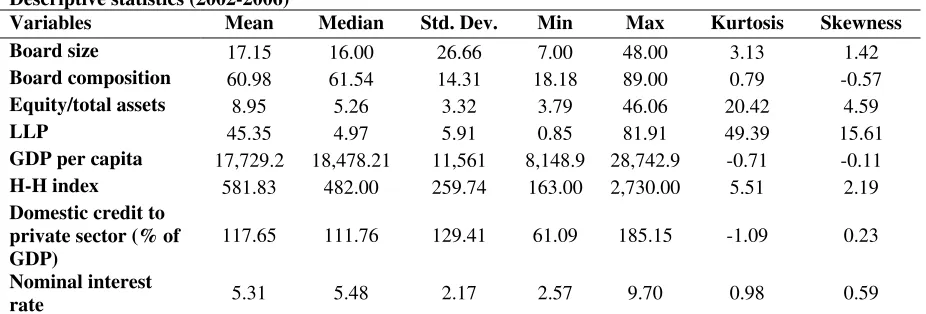
Table 1 provides descriptive statistics for all the potential correlates of bank
efficiency (Zs). As regards the main variables of interest, the board size variable
ranges between 7 and 48 directors and takes a mean value of 17.15. Board
composition in terms of non-executive directors’ participation in the board also varies
widely across banks (from a minimum of 18% to a maximum of 89%) and takes a
mean value of approximately 61%. The summary statistics are quantitatively similar
with those reported in previous studies of the banking sector (see e.g., Adams and
Mehran, 2003; Busta, 2007; Staikouras et al., 2007; Tanna et al., 2008).
(Please insert Table 1 about here)
4. Empirical results
A number of different versions of the models are estimated and the findings of the
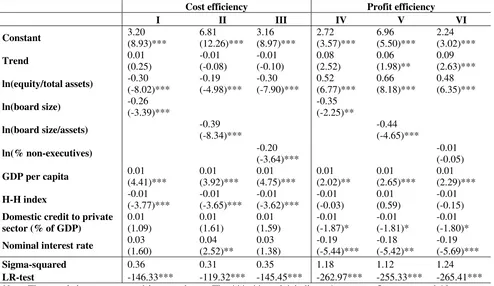
basic specifications are reported in Table 2. The estimated values for the cost and
profit efficiency are fairly reasonable. On average, cost efficiency obtains a mean
value of 89% and profit efficiency stands at 84%.9 Since board size and the
proportion of non-executive directors are highly correlated variables (the Pearson
correlation for the variables is as high as 88%), we avoid using them simultaneously
in the same estimated equations. We further explore two propositions concerning (i)
the possible non-linearity in the relationships in hand (see Table 3) and (ii) the
interrelationship between board structure and bank risk-taking (see Table 4). In what
follows, we discuss these results in turn.10
A first hint regarding the good fit of our equations is obtained from the
findings on the effect of control variables on cost and profit efficiency. In particular,
our results show that GDP per capita has a positive impact on cost and profit
efficiency in all cases, implying that an increase in GDP lowers total costs. This
appears intuitive considering that in more prosperous countries banks have better
access to new technologies (Lensink et al., 2007) or they can offer services of better
quality. Consistent with the literature suggesting a tradeoff between concentration and
efficiency (see e.g., Fries and Taci, 2005), the H-H index has a negative and
significant impact on cost efficiency; however this effect becomes insignificant when
profit efficiency is considered. Finally, the capital ratio is negatively and significantly
correlated with cost efficiency and positively correlated with profit efficiency. The
former result is expected considering that equity capital is an expensive source of
capital increases bank revenues and thus counterbalances the increased costs (see e.g.,
Berger, 1995; Brissimis, Delis and Tsionas, 2006).
Turning to the main focus of our study, our findings seem to be more
favorably inclined towards the strand of literature suggesting a negative correlation
between board size and performance (measured in terms of both cost and profit
efficiency). In fact, this negative impact is further strengthened when scaling board
size by bank size (see columns II, V of Table 2).11 A number of theoretical arguments
back up these findings. First, larger boards are usually associated with more intense
coordination, communication and process problems. In addition, free-rider problems
become more acute: larger boards not only entail less time for directors in expressing
their opinions within board meetings but also constrain directors’ incentives to acquire
information and monitor executive management, which essentially renders them more
easily controllable by the CEO (Lipton and Lorsch, 1992; Jensen, 1993; Yermack,
1996). Finally, considering that variability constitutes a significant dimension of
performance, larger boards are related with more compromises to reach consensus
and, by extension, with less direct and instant decision-making and more modest
corporate performance (Cheng, 2008).
The results reflecting a negative correlation between board composition and
cost efficiency (see column III, Table 2) and an insignificant relationship between
board composition and profit efficiency (column VI of Table 2) seem to contradict the
conventional wisdom favoring outsider-dominated boards. In fact, combining
evidence from the cost and profit efficiency equations and considering that the
element of revenue is missing from cost equations, it appears that the increased cost
associated with larger bodies of non-executives is counterbalanced by improved
revenue for banks with larger proportion of non-executive directors. In other words,
one may suspect that within the profit efficiency measure, decreased cost efficiency
and increased revenue efficiency owing to a larger share of non-executives yield the
non-significant result.
Another plausible explanation for the absence of a noteworthy association
between the proportion of non-executive directors and performance is offered by
Hermalin and Weisbach (1991) suggesting that it may well be the case that firms
optimally weigh their boards between insiders and outsiders, in which case it would
be difficult to trace a relationship between board composition and performance.12
below reporting an inverted U-shaped relationship between board composition and
profit efficiency.
(Please insert Table 2 about here)
In order to inquire into the robustness of the basic results presented in Table 2,
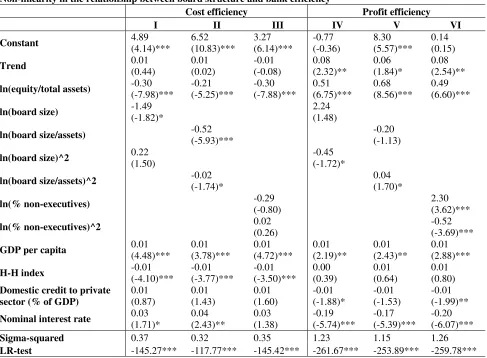
we estimate a number of alternative regressions. First, we include the square of board
size to examine the issue of non-linearity, yet no such a pattern is identified in either
the cost or profit efficiency equations (see columns I, II, IV and V of Table 3). In
contrast, and as regards profit efficiency, the share of non-executive directors has a
positive and significant impact, while the coefficient on its squared term is negative
and significant. Thus, profit efficiency and board composition appear to be related in
an inverted U-shaped way, which implies that an optimum mix of executives and
non-executives could better promote bank efficiency. This effect, combined with the
aforementioned finding on the improved revenue efficiency due to the increased
presence of non-executive directors, seems to underscore the case made by
supervisory authorities and international fora concerning the, rather neglected,
advising role of non-executive, independent directors.
In particular, those non-executive directors that have been nominated as
independent may have a positive bearing on the quality of corporate decision-making
and strategy by (a) bringing new perspectives from other businesses, (b)
constructively challenging and enriching company strategies and introducing
significant sources of management experience and expertise, and (c) advancing the
company’s reputation and assisting in the creation of business affiliations (OECD,
2004; Basel Committee, 2006; UK FRC Combined Code, 2008).13 Nevertheless, it
should always be born in mind that, in the presence of too many non-executive
directors, the arguments put forward by Lipton and Lorsch (1992), Jensen (1993),
Yermack (1996) and Cheng (2008) concerning oversized boards apply in full:
nomination of too many non-executives would essentially lead to cumbersome, slack
and more cost inefficient boards and, by extension, to reduced bank performance. This
observation elucidates our findings on the non-linear relationship between board
composition and profit efficiency.
(Please insert Table 3 about here)
A significant element in the determination of the optimal board structure in
banking concerns the risk-taking behavior of banks and in particular credit risk. More
performance is channeled through the better control of credit risk. To examine this
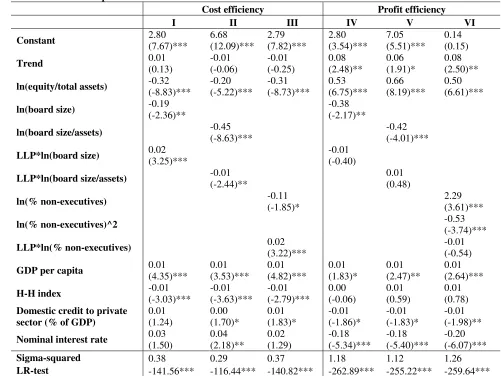
potential relationship, we add interaction terms of credit risk (measured by loan loss
provisions/total loans) with the board structure variables. The results, presented in
Table 4, indicate that large boards are associated with higher loan-loss provisions in
the cost efficiency equation (see column I), while this effect fades away when profit
efficiency is considered. Since the latter measure is a more comprehensive reflection
of bank performance, we conclude that larger board structures are not associated with
better bank performance through better management of credit risk.14 As regards board
composition, the results are qualitatively similar with those presented in Table 3, with
the non-monotonic relationship remaining robust in the profit efficiency equation
(column VI).15 It is worth mentioning that using the ratio of non-performing loans to
total loans does not alter any of these findings.
(Please insert Table 4 about here)
One final concern might be that these results are somehow an artifact of how
the frontier models were implemented in terms of the variables used to shape the
frontier. To address this issue we re-estimated the profit efficiency models (which we
view as the most informative) using: (i) the capital and risk variables only in the
translog specification (and not as determinants of efficiency), (ii) the macroeconomic
variables in the translog specification and (iii) the capital, risk and macroeconomic
variables in both the translog equation and as determinants of efficiency. These
choices for the modeling of bank efficiency are motivated from the fact that the
control variables may be thought to have some input characteristics. For example,
decisions on the level of risk-taking may be internal choices of bank management, the
capital base may be used to finance expensive projects, while macroeconomic factors,
if accurately predicted, can influence the production process itself. The results (not
reported here but available on request) suggest that only the model that includes all
control variables as both inputs and determinants of efficiency produces somewhat
different results, especially in connection to the impact of board size (i.e., it becomes
insignificant). However, this could simply be the effect of multicollinearity or the
violation of the assumption of independence in the structure of the error term. Bearing
these issues in mind, we conclude that robust evidence is reported insinuating a
negative relationship between board size and profit efficiency, as well as an inverted
U-shaped relationship between the proportion of non-executive directors and profit
5. Conclusions
Recent scandals in the financial sector have brought corporate governance at the
forefront of academic and supervisory attention. Banks’ versatile role in the economic
system has caught regulatory and supervisory interest around the world in an effort to
inspire high quality corporate governance standards. Board structure, in the sense of
board size and composition, and its impact on corporate performance constitutes an
indispensable and, at the same time, prevalent theme of the corporate governance
discussion.
Using a sample of large European banks over 2002-2006, our study innovates
in that bank performance is measured in terms of both cost and profit efficiency, while
the impact of board size and composition is modelled within a stochastic frontier
framework, thus offering a more lucid insight into the sources of efficient
performance in the banking industry. Our results strongly suggest that, indeed, smaller
boards are more efficient. On the other hand, the effect of appointing non-executive
(including independent) directors is not that straightforward. In particular, an
increased number of non-executive directors decreases cost efficiency, but apparently
increases revenue efficiency, thus rendering the overall impact on profit efficiency
questionable. To gain some deeper insights in these patterns we further examine the
potential non-linearity in the aforementioned relationships. We find that, while the
negative impact of board size is linear, increasing the number of non-executives is
negatively associated with banks’ profit efficiency beyond a certain point. Hence, our
study implies that the regulatory enthusiasm, at least as far as the impact of
outsider-dominated boards is concerned, is not a stated truth and, as a result, should be
approached with cautiousness. These results, backed up by corporate governance
theories on both financial and non-financial firms, are robust to controls for bank size,
risk and capital within a wide array of empirical specifications.
1
2
The term “internal corporate governance” is employed to distinguish from “external disciplinary devices”, including the market for corporate control. In the words of the Basel Committee on Banking Supervision (2006), (internal) corporate governance from a banking industry perspective involves “the manner in which the business and affairs of banks are governed by their boards of directors and senior management, which affects how they set corporate objectives; operate the bank’s business on a day-to-day basis; meet the obligation of accountability to their shareholders and take into account the interests of other recognised stakeholders; align corporate activities and behaviour with the expectation that banks will operate in a safe and sound manner, and in compliance with applicable laws and regulations; and protect the interests of depositors”.
3
Kose and Yiming (2003), Baxter (2003) and Adams and Mehran (2003) also stress that a distinctive corporate governance feature of banks arises from the need to align not only managers’ and equity holders’ interests, but also depositors’ interests and the public interest. On the same line, Macey and O’Hara (2003) argue that the special nature of banks’ corporate governance essentially entails that board directors should be held to a broader standard of care than other directors.
4
Luckily, normality is identified using a Jarque-Bera test. If normality was not identified a three-stage least squares estimator would have been the consistent method. For a thorough discussion on the estimation of panel data models with endogenous regressors, see Bhargava (1991).
5
Only large commercial banks are used so as to avoid potential criticism regarding differential technology structures between banks of different size or type.
6
It would have been preferable to use the number of employees, instead of total assets, to construct the price of labor. However, the number of employees is not available for many banks in our sample (for a similar implementation, see e.g. Lensink et al., 2007).
7
See OECD (2004). The EU Commission Recommendation 2005/162/EC states, in generic terms, that a director should be considered to be independent only if he is free of any business, family or other relationship, with the company, its controlling shareholder or the management of either, that creates a conflict of interest such as to impair his judgment. Annex II of the Commission Recommendation identifies a number of situations reflecting the relationships or circumstances usually recognized as likely to generate material conflict of interest (e.g., not be an executive director or employee of the company or associated company, not be or represent a controlling shareholder, not have, or have had within the last year, a significant business relationship with the company or an associated company, not be, or have been within the last three years, partner or employee of the present or former external auditor of the company or an associated company, etc.).
8
A better measure for credit risk is probably the ratio of non-performing loans to total loans. However, provisions are readily manageable by banks and thus represent an element of choice for the financial institutions. Nevertheless we inquire into the robustness of the results by also using non-performing loans.
9
Due to space considerations we do not report detailed efficiency results or results for the coefficients on inputs/outputs and interaction terms of Eqs. (2) and (4). However, these results are available on request.
10
For expositional brevity we report results on efficiency (not inefficiency). 11
This result remains unaffected in the rest of the equations presented in Tables 3 and 4 below. Therefore, it seems that the board size variables should be scaled by bank size, so as to avoid giving larger banks an unfair advantage. Most of the previous literature simply uses the logarithm of board members.
12
Adams and Mehran (2003) offer a different explanation: due to regulatory requirements emphasizing the safety and soundness of banks and taking into account that bank supervisors share examination results with the boards of directors and may also perform on-site visits to poorly performing banks, board directors are inclined to direct their advisory role towards maintaining the safety and soundness of the institution rather than value maximization.
13
On the advisory role of non-executive, independent directors see, inter alia, Daily and Schwenk (1996), Johnson, Daily and Ellstrand (1996), Lawler, Finegold, Benson and Conger (2002), Fich (2005). For the potential limitations of non-executive, independent directors’ advisory role see e.g., Adams and Mehran (2003), Song and Thakor (2006), Adams and Ferreira (2007).
14
Note that the level of the board size variable remains negative and statistical significant throughout. 15
References
Adams, R., and Ferreira, D. 2007. A theory of friendly boards. Journal of Finance, 62:
217-250.
Adams, R., and Mehran, H. April 2003. Is corporate governance different for bank holding
companies?. Federal Reserve Bank of NY Economic Policy Review, 123-142.
Adams, R., and Mehran, H. August 8, 2005. Corporate performance, board structure and its
determinants in the banking Industry. EFA 2005 Moscow Meetings. Available at SSRN:
http://ssrn.com/abstract=302593.
Adams, R., and Mehran, H. 2008. Corporate performance, board structure and their
determinants in the banking industry. Federal Reserve Bank of NY Staff Report No 330.
Altunbas, Y., Gardener, E.P.M., Molyneux, P., and Moore, B. 2001. Efficiency in European
banking. European Economic Review, 45: 1931-1955.
Anderson, R.C., Mansi, S.A., and Reeb, D.M. 2004. Board characteristics, accounting report
integrity, and the cost of debt. Journal of Accounting and Economics, 37: 315-342.
Andres, P., and Vallelado, E. 2008. Corporate governance in banking: the role of the board of
directors. Journal of Banking and Finance, 32: 2570-2580.
Barth, J., Caprio, G., and Nolle, D. 2004. Comparative international characteristics of
banking. Working Paper 01, Office of the Comptroller of the Currency Economic and
Policy Analysis.
Basel Committee on Banking Supervision. 2006. Enhancing Corporate Governance For
Banking Organisations.
Battese, G.E., and Coelli, T.J. 1995. A model for technical inefficiency effects in a stochastic
frontier production function for panel data. Empirical Economics, 20: 325–332.
Bauer, P.W., Berger, A.N., Ferrier, G.D., and Humphrey, D.B. 1998. Consistency conditions
for regulatory analysis of financial institutions: a comparison of frontier efficiency
methods. Journal of Economics and Business, 50: 85-114.
Baxter, T. 2003. Governing the financial or bank holding company: how legal infrastructure
can facilitate consolidated risk management. Federal Reserve Bank of NY Current Issues
in Economics and Finance, 9: 1-7.
Belkhir, M. 2006. Board structure, ownership structure, and firm performance: evidence
from banking. Working Paper 02, Laboratoire d’ Economie d’ Orléans.
Berger, A.N. 1995. The relationship between capital and earnings in banking. Journal of
Berger, A.N., Hancock, D., and Humphrey, D.B. 1993. Bank efficiency derived from the
profit function. Journal of Banking and Finance, 17: 317–347.
Berger, A.N., and Humphrey, D.B. 1997. Efficiency of financial institutions: international
survey and directions for future research. European Journal of Operational Research, 98:
175-212.
Berger, A.N., and Mester, L.J. 1997. Inside the black box: what explains differences in the
efficiencies of financial institutions?, Journal of Banking and Finance, 21: 895–947.
Bhagat, S., and Jefferis, R.H. 2002. The econometrics of corporate governance studies.
Cambridge: The MIT Press.
Bhargava, A. 1991. Identification and panel data models with endogenous regressors. The
Review of Economic Studies, 58: 129-140.
Bhattacharya, S., and Thakor, A. 1993. Contemporary banking theory. Journal of Financial
Intermediation, 3: 2-50.
Brissimis, S.N., Delis, M.D., and Papanikolaou, N.I. 2008. Exploring the nexus between
banking sector reform and performance: evidence from newly acceded EU countries.
Journal of Banking and Finance, 32: 2674-2683.
Brissimis, S.N., Delis, M.D., and Tsionas, E.G. 2006. Technical and allocative efficiency in
European banking. Working Paper 46, Bank of Greece.
Busta, I. 2007. Board effectiveness and the impact of the legal family in the European
banking industry. FMA European Conference, Barcelona–Spain. Available at:
www.fma.org/Barcelona/Papers/BustaFMA2007.pdf.
Calomiris, C. 2007. Bank failures in theory and history: the Great Depression and other
“contagious” events. Working Paper 13597, National Bureau of Economic Research.
Ceccheti, S. 1999. The future of financial intermediation and regulation: an overview.
Federal Reserve Bank of NY Current Issues in Economics and Finance, 5: 1-6.
Cheng, S. 2008. Board size and the variability of corporate performance. Journal of
Financial Economics, 87: 157-176.
Coles, J., Daniel, N., and Naveen, L. 2008. Boards: does one size fit all?. Journal of
Financial Economics, 87: 329-356.
Daily, C., and Schwenk, C. 1996. Chief executive officers, top management teams, and board
of directors: congruent or countervailing forces?, Journal of Management, 22: 185-208.
Demirgüç-Kunt, A., Kane, E., and Laeven, L. 2008. Determinants of deposit-insurance
Destefanis, S., and Sena, V. 2007. Patterns of corporate governance and technical efficiency
in Italian manufacturing. Managerial and Decision Economics, 28: 27-40.
European Central Bank . October 2007. EU Banking Structures.
European Union Commission Communication from the Commission to the Council and the
European Parliament, Modernising Company Law and Enhancing Corporate Governance
in the European Union - A Plan To Move Forward, COM(2003) 284 final.
European Union Commission Recommendation 2005/162/EC of 15 February 2005 on the
role of non-executive or supervisory directors of listed companies and on the committees
of the (supervisory) board [2005] L 52/51.
Fich, E. 2005. Are some outside directors better than others? Evidence from director
appointments by Fortune 1000 firms. Journal of Business, 78: 1943-1971.
Financial Reporting Council. June 2008. The Combined Code on Corporate Governance.
Fisher, F., and McGowan, J. 1983. On the misuse of accounting rates of return to infer
monopoly profits. American Economic Review, 73: 82–97.
Fried, H., Lovell, C.A.K., and Schmidt, S. 1993. The measurement of productive efficiency:
techniques and applications. NY: Oxford University Press.
Fries, S., and Taci, A. 2005. Cost efficiency of banks in transition: evidence from 289 banks
in 15 post-communist countries. Journal of Banking and Finance, 29: 55–81.
Garay, U., and Gonzalez, M. 2008. Corporate governance and firm value: The case of
Venezuela. Corporate Governance: An International Review, 16(3): 194-209.
Gorton, G., and Winton, A. 2003. Financial intermediation, in: Constantinides G. M., Harris
M., Stulz R. (Eds.), Handbook of the economics of finance. The Netherlands: Elsevier, pp
431-552.
Griffith, J., Fogelberg, L., and Weeks, H. 2002. CEO ownership, corporate control, and bank
performance. Journal of Economics and Finance, 26: 170-183.
Hermalin, B., and Weisbach, M. 1991. The effects of board composition and direct
incentives on firm performance. Financial Management, 20: 101-112.
Hoggarth, G., Jackson, P., and Nier, E. 2005. Banking crises and the design of safety nets.
Journal of Banking and Finance, 29: 143-159.
Hughes, J.P., and Mester L.J. 2008. Efficiency in banking: theory, practice, and evidence.
Working Paper 08-1, Research Department, Federal Reserve Bank of Philadelphia.
Jensen, M. 1993. The modern industrial revolution, exit, and the failure of internal control
John, K., and Senbet, L., 1998. Corporate governance and board effectiveness. Journal of
Banking and Finance, 22: 371-403.
Johnson, J., Daily, C., and Ellstrand, A. 1996. Board of directors: a review and research
agenda. Journal of Management, 22: 409-438.
Kang, H., Cheng, M., and Gray, S.J. 2007. Corporate governance and board composition:
diversity and independence of Australian boards. Corporate Governance: An
International Review, 15(2): 194-207.
Kapopoulos, P., and Lazaretou, S. 2007. Corporate ownership structure and firm
performance: evidence from Greek firms. Corporate Governance: An International
Review, 15(2): 144-158.
Kose, J., and Yiming, Q. April 2003. Incentive features in CEO compensation in the banking
industry. Federal Reserve Bank of NY Economic Policy Review, 109-121.
Lawler, E., Finegold, D., Benson, G., and Conger, J. 2002. Corporate boards: keys to
effectiveness. Organizational Dynamics, 30: 310-324.
Lehn, K., Patro, S., and Zhao, M. 2008. Determinants of the size and structure of corporate
boards: 1935-2000. Working Paper No 13, Center For Economic Institutions.
Lensink, R., Meesters, A., and Naaborg, I. 2007. Bank efficiency and foreign ownership: do
good institutions matter?. Journal of Banking and Finance, 32: 834-844.
Linck, J., Netter, J., and Yang, T. 2008. The determinants of board structure. Journal of
Financial Economics, 87: 308-328.
Lipton, M., and Lorsch, W. 1992. A modest proposal for improved corporate governance.
Business Lawyer, 48: 59-77.
Macey, J., and O’Hara, M. 2003. The corporate governance of banks. Federal Reserve Bank
of NY Economic Policy Review, April: 91-107.
Organisation for Economic Co-operation and Development. 2004. OECD Principles Of
Corporate Governance.
Pathan, S., Skully, M., and Wickramanayake, J. 2007. Board size, independence and
performance: an analysis of Thai banks. Asia-Pacific Financial Markets, 14: 211-227.
Pi, L., and Timme, S.G. 1993. Corporate control and bank efficiency. Journal of Banking and
Finance, 17: 515-530.
Shleifer, A., and Vishny, R. 1997. A survey of corporate governance. Journal of Finance, 52:
Short, H. 1996. Non-executive directors, corporate governance and the Cadbury report: a
review of the issues and evidence. Corporate Governance: An International Review,
4(2): 123-131.
Sierra, G., Talmor, E., and Wallace, J. 2006. An examination of multiple governance forces
within banking holding companies. Journal of Financial Services Research, 29: 105-123.
Simpson, W.G., and Gleason, A.E. 1999. Board structure, ownership, and financial distress
in banking firms. International Review of Economics and Finance, 8: 281-292.
Song, F., and Thakor, A. 2006. Information control, career concerns, and corporate
governance. Journal of Finance, 61: 1845-1896.
Staikouras, P., Staikouras, C., and Agoraki, M.E. 2007. The effect of board size and
composition on European bank performance. European Journal of Law and Economics,
23: 1-27.
Tanna, S., Pasiouras, F., Nnadi M. 2008. The effect of board size and composition on the
efficiency of UK banks. Coventry University Business School Applied Research Working
Paper Series. Available at: http://ssrn.com/abstract=1092252.
Van Greuning, H., and Brajovic-Bratanovic, S. 2003. Analyzing and managing banking risk:
a framework for assessing corporate governance and financial risk. Washington: The
World Bank.
VanHoose, D. 2007. Theories of bank behaviour under capital regulation. Journal of Banking
and Finance, 31: 3680-3697.
Yermack, D. 1996. Higher market valuation of companies with a small board of directors.
Journal of Financial Economics, 40: 185-211.
Zulkafli, A.H., and Samad, F.A. 2007. Corporate governance and performance of banking
firms: evidence from Asian emerging markets. Advances in Financial Economics, 12:
Table 1
Descriptive statistics (2002-2006)
Variables Mean Median Std. Dev. Min Max Kurtosis Skewness Board size 17.15 16.00 26.66 7.00 48.00 3.13 1.42
Board composition 60.98 61.54 14.31 18.18 89.00 0.79 -0.57
Equity/total assets 8.95 5.26 3.32 3.79 46.06 20.42 4.59
LLP 45.35 4.97 5.91 0.85 81.91 49.39 15.61
GDP per capita 17,729.2 18,478.21 11,561 8,148.9 28,742.9 -0.71 -0.11
H-H index 581.83 482.00 259.74 163.00 2,730.00 5.51 2.19
Domestic credit to private sector (% of GDP)
117.65 111.76 129.41 61.09 185.15 -1.09 0.23
Nominal interest
rate 5.31 5.48 2.17 2.57 9.70 0.98 0.59
Source: Annual reports of the credit institutions.
Table 2
The effect of board structure on bank efficiency
Cost efficiency Profit efficiency
I II III IV V VI
Constant 3.20
(8.93)*** 6.81 (12.26)*** 3.16 (8.97)*** 2.72 (3.57)*** 6.96 (5.50)*** 2.24 (3.02)***
Trend 0.01
(0.25) -0.01 (-0.08) -0.01 (-0.10) 0.08 (2.52) 0.06 (1.98)** 0.09 (2.63)***
ln(equity/total assets) -0.30
(-8.02)*** -0.19 (-4.98)*** -0.30 (-7.90)*** 0.52 (6.77)*** 0.66 (8.18)*** 0.48 (6.35)***
ln(board size) -0.26
(-3.39)***
-0.35
(-2.25)**
ln(board size/assets) -0.39
(-8.34)***
-0.44 (-4.65)***
ln(% non-executives) -0.20
(-3.64)***
-0.01 (-0.05)
GDP per capita 0.01
(4.41)*** 0.01 (3.92)*** 0.01 (4.75)*** 0.01 (2.02)** 0.01 (2.65)*** 0.01 (2.29)***
H-H index -0.01
(-3.77)*** -0.01 (-3.65)*** -0.01 (-3.62)*** -0.01 (-0.03) 0.01 (0.59) -0.01 (-0.15)
Domestic credit to private sector (% of GDP)
0.01 (1.09) 0.01 (1.61) 0.01 (1.59) -0.01 (-1.87)* -0.01 (-1.81)* -0.01 (-1.80)*
Nominal interest rate 0.03
(1.60) 0.04 (2.52)** 0.03 (1.38) -0.19 (-5.44)*** -0.18 (-5.42)** -0.19 (-5.69)***
Sigma-squared 0.36 0.31 0.35 1.18 1.12 1.24
Table 3
Non-linearity in the relationship between board structure and bank efficiency
Cost efficiency Profit efficiency
I II III IV V VI
Constant 4.89
(4.14)*** 6.52 (10.83)*** 3.27 (6.14)*** -0.77 (-0.36) 8.30 (5.57)*** 0.14 (0.15)
Trend 0.01
(0.44) 0.01 (0.02) -0.01 (-0.08) 0.08 (2.32)** 0.06 (1.84)* 0.08 (2.54)**
ln(equity/total assets) -0.30
(-7.98)*** -0.21 (-5.25)*** -0.30 (-7.88)*** 0.51 (6.75)*** 0.68 (8.56)*** 0.49 (6.60)***
ln(board size) -1.49
(-1.82)*
2.24
(1.48)
ln(board size/assets) -0.52
(-5.93)***
-0.20
(-1.13)
ln(board size)^2 0.22
(1.50)
-0.45
(-1.72)*
ln(board size/assets)^2 -0.02
(-1.74)*
0.04 (1.70)*
ln(% non-executives) -0.29
(-0.80)
2.30 (3.62)***
ln(% non-executives)^2 0.02
(0.26)
-0.52 (-3.69)***
GDP per capita 0.01
(4.48)*** 0.01 (3.78)*** 0.01 (4.72)*** 0.01 (2.19)** 0.01 (2.43)** 0.01 (2.88)***
H-H index -0.01
(-4.10)*** -0.01 (-3.77)*** -0.01 (-3.50)*** 0.00 (0.39) 0.01 (0.64) 0.01 (0.80)
Domestic credit to private sector (% of GDP)
0.01 (0.87) 0.01 (1.43) 0.01 (1.60) -0.01 (-1.88)* -0.01 (-1.53) -0.01 (-1.99)**
Nominal interest rate 0.03
(1.71)* 0.04 (2.43)** 0.03 (1.38) -0.19 (-5.74)*** -0.17 (-5.39)*** -0.20 (-6.07)***
Sigma-squared 0.37 0.32 0.35 1.23 1.15 1.26