Journal of Criminal Law and Criminology
Volume 86
Issue 1
Fall
Article 4
Fall 1995
Regulating Gun Markets
Philip J. Cook
Stephanie Molliconi
Thomas B. Cole
Follow this and additional works at:
https://scholarlycommons.law.northwestern.edu/jclc
Part of the
Criminal Law Commons
,
Criminology Commons
, and the
Criminology and Criminal
Justice Commons
This Symposium is brought to you for free and open access by Northwestern University School of Law Scholarly Commons. It has been accepted for inclusion in Journal of Criminal Law and Criminology by an authorized editor of Northwestern University School of Law Scholarly Commons.
Recommended Citation
Copyright 0 1995 by Northwestern University, School of Law Printed in U.S.A.
REGULATING GUN MARKETS*
PHILIP
J.
COOK, PH.D.
STEPHANIE MOLLICONI, M.P.H. THOMAS B. COLE, M.D., M.P.H.
I. INTRODUCTION
With the rapid increase since the mid-1980s in rates of homicide and other criminal violence, crime has emerged as the nation's lead-ing domestic problem. One tactic for mitigatlead-ing lethal violence is gun
control-government regulation of the production, exchange, and use of personal firearms. A number of proposals are currently being debated at the federal, state, and local levels. Recently, Congress en-acted the Brady Bill and adopted a partial ban on assault weapons, while the Bureau of Alcohol, Tobacco and Firearms (BATF) tough-ened sales procedures for gun dealers.' A central issue in debating these and other control measures is which types of regulation are likely to be most cost-effective in reducing gun violence.
This Article concerns the secondary gun market, one of the key issues in understanding the potential effectiveness of gun control measures. The primary objective of much of the gun control effort in the United States is to discourage certain categories of people, includ-ing felons and those under indictment, from obtaininclud-ing and possessinclud-ing guns, while preserving ready availability of guns for everyone else.2 To
* The research reported in this Article was sponsored by the Harry Frank Guggenheim
Foundation and Duke University. A number of people have been helpful to us and require special thanks. Joel Rosch of the SBI and Bill Bridgewater of the National Alliance of Stocking Gun Dealers Association both served as important guides in understanding gun control issues. A handful of other law enforcement officers from BATF and local police departments were also instructive guides. The local police and sheriff departments committed substantial efforts to filling out our questionnaires; we especially appreciate the efforts of Tom Moss and the Gamer Police Department. Most of all we appreciate the help of the ten students from CA Dillon School who agreed, with their parents, to be interviewed and then gave substantive answers to Stephanie's questions. We thank the Dillon School officials for their help in organizing these interviews.
1 See The Brady Handgun Violence Prevention Act, 18 U.S.C. §§ 921-22 (1994); The
Public Safety and Recreational Firearms Use Protection Act, Pub. L. No. 103-322, 108 Stat. 1807 (codified as amended in scattered sections of 42 U.S.C.); 27 C.F.R. § 178 (1995).
2 See Philip J. Cook & James Blose, State Programs for Screening Handgun Buyers, 455
COOK MOLIJCONI, & COLE
this end, federal law bans mail order shipments to everyone except licensed dealers and requires licensed dealers to screen customers for eligibility.8 However, dealers are not well-regulated and used guns can be readily purchased from other sources. Both of these issues
undercut the discrimination strategy for reducing gun violence. Our research is concerned with developing a better understanding of gun markets, particularly the secondary, largely unregulated markets that supply youths and criminals with a large percentage of their guns. We seek to identify promising tactics by which regulatory and law enforce-ment agencies may better enforce the prohibition on purchase and possession by proscribed groups.
This Article provides a summary of the existing literature on gun markets and presents a year-long data-collection effort to develop an empirical description of gun markets as they operate in the Triangle area of North Carolina.4 We arranged meetings with local law en-forcement officers, State Bureau of Investigation (SBI) personnel, BATF officers, and ten incarcerated delinquents to learn about local gun transactions.5 To collect data on gun theft in the area, we sur-veyed law enforcement agencies, and, when necessary, visited the agencies to pull data directly from the original crime reports. We at-tended a gun show and observed the guns offered for sale and the characteristics of the transactions that occurred. We also collected newspaper accounts from across the country to help piece together a picture of gun markets.
When we began, we expected that state and local law enforce-ment agencies and the local office of the BATF could provide us with information about illicit gun markets. However, we found that no
agency investigates and disrupts the local gun markets that supply youths and criminals with guns. Even a small effort in this area would be a useful beginning.
Section II of this Article provides background on gun ownership and gun use in crimes in the United States. Section III reviews the federal and state systems regulating the distribution of guns, pointing to major loopholes in these systems. Section IV details the distinction between the primary and secondary markets for firearms and dis-cusses the linkages between them. Federally licensed firearm dealers
3 18 U.S.C. § 922 (1994).
4 The Triangle area of North Carolina is comprised of Wake, Durham, and Orange Counties and includes the cities of Raleigh, Durham, and Chapel Hill. Total population:
699,066 in 1990. BUREAU OF THE CENSUS, U.S. DEP'T OF COMMERCE, 1990 CENSUS OF POPU-LATION AND HOUSING: POPUPOPU-LATION AND HOUSING UNIT COUNTrS-UNITED STATES 640
(1993).
5 The Appendix contains a summary of findings from our interviews with youth
of-fenders and is available from the authors.
are discussed in Section V, with examples of dealers who use their licenses to distribute guns illegally, together with an assessment of the prospects for improving the regulation of these dealers. Section VI focuses on theft as a source of guns for the illegal sector and on the redistribution of stolen guns; we also discuss possible interventions to reduce gun theft. Section VII details secondary firearm markets, where guns are bought and sold without the benefit of a licensed dealer or the paperwork that provides an official record of the transac-tion. Section VIII notes the extraordinary lack of intelligence data on the workings of the gun markets and suggests proposals for future research and regulation.
II. BACKGROUND: GUNs AND CRIME
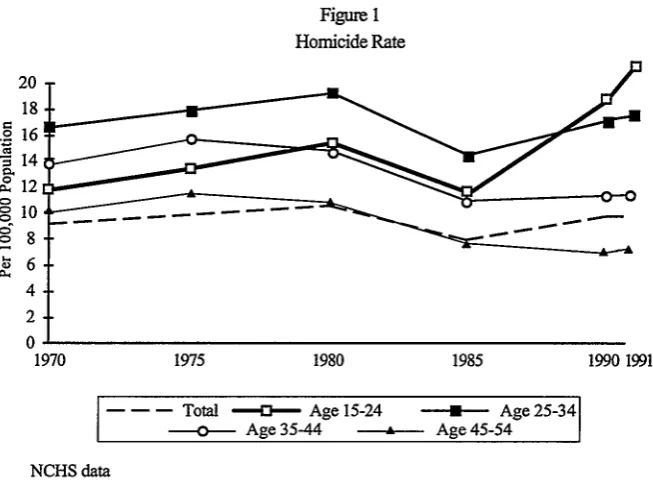
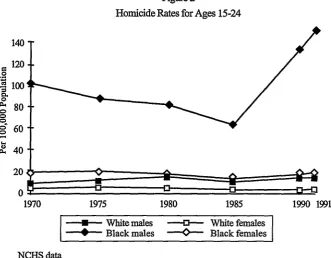
Violent crime emerged in the last few years as the most promi-nent domestic problem facing the nation. The homicide rate, which declined 23% between 1980 and 1985, climbed in 1991 almost to the 1980 level.6 What is remarkable about this recent surge of violence is the extent to which it has been concentrated in a rather narrow seg-ment of the population-youths in their teens and twenties, especially African-American, male youths.7 Figures 1 and 2 depict these trends. The already high homicide victimization rate for African-American males age fifteen to twenty-four doubled in six years. Meanwhile, both African-Americans and whites over age thirty-five have experienced a
continuing decline in homicide rates since 1980.8
Developing a comprehensive explanation for these puzzling trends is beyond the scope of this Article. But several additional facts clarify these trends. First, most victims are killed by people who have similar demographic characteristics; and the demographic trends in homicide-arrest rates are similar to trends in victimization.9 Second, guns are used in two-thirds of criminal homicides, and over 80% of male homicide victims aged fifteen to twenty-four die of gunshot wounds. During the past twenty years, firearm homicides accounted for virtually all the rapid increase in the homicide rate for young, Afri-can-American males, as shown in Figure 3.
Youths appear to have easy access to guns. Over half the respon-dents in one representative sample of sturespon-dents in grades seven
6 Our sources for these data are annual volumes reporting detailed statistics on
mor-tality: e.g., U.S. NAT'L CENTER FOR HEALTH STATISTICs; U.S. DEP'T OF HEALTH AND HuMAN
SERvicES; VITAL STATIsTICS OF THE UNITED STATES, MORTALTY, PART A (1980).
7 SeeJAMES ALAN Fox, CHILDREN ARE SLAIN BY THEIR PARENTS AND TEENAGERS BY THEIR PEERS 1-3 (1993).
8 Id.
COOK MOLLICONI, & COLE
Figure 1
Homicide Rate
20 18 .2 10 14 tn. 0 12
10
N8
CL 64 2
0
1970 1975 1980 1985 1990 1991
--- Total -E-- Age 15-24 - - Age 25-34
--o- Age 35-44 --- Age 45-54
NCHS data
through twelve said they could get a handgun if they wanted one, in-cluding 62% of the respondents who lived in central cities.'0 More remarkable is that 15% of these youths said they had carried a hand-gun on their person in the previous thirty days." While there are no comparable statistics from earlier years, these results indicate that guns are now as prevalent in the cities as they have been in rural areas. The difference is that the cities have much higher rates of criminal violence.
While the widespread availability of guns in urban areas is not a "root cause" of violent crime, it significantly adds to the deadliness of that violence.'2 Effective control over the distribution of guns would have little effect on the volume of assaults and robberies, but it would reduce the homicide rate.
Guns are extremely durable, and some of the guns used in crime have been in the possession of the shooter for years or even decades. Effective regulation of guns already in private hands seems a difficult task. But on the basis of available evidence, we conclude that most guns used in crime, especially by youths, are not those that have been
10 See Louis HARRIS, A SURVEY OF EXPERIENCES, PERCEPTIONS, AND APPREHENSIONS ABOUT GUNS AMONG YOUNG PEOPLE IN AMERICA (1993).
11 Id.
12 See PhilipJ. Cook, The Technology of Personal Volence, 14 CRIME &Jusr. 1, 47 (1991).
Figure 2
Homicide Rates for Ages 15-24
140
120
:5 100 0
S80-40
20
1970 1975 1980 1985 1990 1991
- --- White males -E--- White females
-4- Black males --- Black females
NCHS data
kept in the same dresser drawer for the last decade, but have been acquired relatively recently.'5 An effective transfer-regulating scheme that prevents guns from going to dangerous people would be nearly as successful as a much more intrusive scheme targeted at current gun owners.
Each new cohort of violent criminals must obtain guns some-where. Many delinquent youths are active in the gun market as both buyers and sellers, and they acquire guns by borrowing and stealing them.14 While we have no systematic data on the average lag between acquisition of a gun and its use in a crime, logic suggests that the lag cannot be longer than a few months for youthful offenders, and it may be only a few weeks.
13 For evidence that relatively new guns are used disproportionately in crime, see
Franklin E. Zimring, Street Crime and New Guns: Some Implications for Firearms Control, 4 J.
CRiM. JusT. 95 (1976). Several surveys of criminally active populations indicate that the typical pattern for those who use guns is to steal, buy, borrow, sell, and otherwise exchange
them frequently. See, e.g., JAMES D. WIGHr & PETER H. Rossi, ARMED AND CONSIDERED
DANGEROus: A SURVEY OF FELONS AND THEIR FIREARMS (1986);JOsEPH F. SHELEY &JAMES D.
WRIGHT, NATIONAL INSTITUTE oFJUsTICE, U.S. DEP'T OFJUsTICE, GuN AcQuISITION AND
POS-SESSION IN SELEcrEDJtVENiLE SAMPLES (1993).
14 Seejames D. Wright et al., Kids, Guns, and Killing Fields, Soc'rv, Nov.-Dec. 1992, at
COOK MOLL[CONJ, & COLE
Figure 3
Firearm Homicide Rate for Black Males Age 15-19 120
0100
S80
0
g60
40
20
0
11970 1975 1980 1985 1990
I - --- Firearms Homicides
--
Non-firearm HomicidesNCHS data
In trying to understand gun markets and how they relate to crimi-nal activity, it is useful to consider that guns have value in exchange as well as in use. For someone living a chaotic life without a regular address or source of income, a gun may serve as an important store of value that can be readily exchanged for other goods and services. A youth who purchases or steals a gun may hold on to it for a few weeks and then decide that he needs money-or drugs-more than a gun, at which point he will find a ready market among his peers. Alterna-tively, the gun may be stolen from him, or he may loan it to a friend and not replace it for a while. One interesting statistic from a survey of inner-city, male, high-school students indicates that over one quar-ter of respondents who had ever owned a gun (8% of the total) cur-rently did not own one.15
We interviewed ten boys with extensive records of criminal activ-ity.16 We asked about the number of guns they had prior to coming to the school. All had owned at least one, and seven had possessed more
15 Id.
16 Stephanie Molliconi conducted these interviews on three days in April 1994 at the
C.A. Dillon School in Burner, North Carolina. Due to a promise of confidentiality, no
names or titles will be cited. See the Appendix (available from the authors) for a more complete account of what the boys said.
than ten guns during their brief criminal careers. Even so, several admitted there were times when they had been without a gun. One interviewee said, "I didn't have guns for awhile because I was chilling out. I didn't want anything to do with guns. I sold some, then gave some away to friends." Another said, "I didn't have a gun once for three months because I lent my gun to my cousin to use." They com-mented on the value of a gun in trade. One indicated, "When [peo-ple] are short on money they have no choice but to sell."'7 Comments by Interviewee 9 helped remind us that these were still just kids: "I've had about twenty guns. I traded a .22 for a Super Nintendo and some other guns for a VGR and for my waterbed. I got other stuff for my room, like a phone with lights and a copy [fax] machine for a
twenty-gauge.' 8
Regulating gun transfers appears to be a promising method of keeping guns from the hands of youths and criminals or; at least, of limiting the time that they are armed. When guns are relatively scarce and expensive, youths may be slower to acquire a gun and quicker to sell it.
III. BACKGROUND: REGULATING GUN TRANsFERs
The government regulates the manufacture and distribution of guns to reduce gun violence and enacts and enforces these regula-tions under heavy influence from the traditional and arguably consti-tutional right to keep and bear arms for sport and self-defense. Therefore, rather than responding to the gun problem through a blanket prohibition or high taxes,19 federal and state governments have sought to limit misuse while preserving legitimate uses.20 A few types of guns are prohibited, while most are not.2' Relatively few peo-ple are prohibited from possession, such as felons or those under in-dictment, while most of us are entitled to possess guns.2 2 True, a handful of jurisdictions have gone further towards restricting owner-ship; for example, the District of Columbia bans possession of
hand-guns for almost everyone living in the city.2 3 However, at the federal
17 Interview 10 in Burner, North Carolina (April 1994).
18 Interview 9 in Burner, North Carolina (April 1994).
19 SeeThe National Firearms Act, 26 U.S.C. § 5801 (1995) (imposing a tax of $1,000 per year on importers and manufacturers for each place of business and $500 per year on dealers for each place of business).
20 See The Brady Handgun Violence Prevention Act, 18 U.S.C. § 922 (1994) (listing
unlawful acts with regard to the possession, purchase and sale of firearms).
21 § 922(b) (4)-(5) (prohibiting the sale of destructive devices, machine guns, short-bar-relled shotguns, and short-barshort-bar-relled rifles).
22 § 922(g)(1)-(8).
COOK MOLLICONI, & COLE
level and in most jurisdictions, the objective of gun regulation is to discriminate between different types of weapons and between differ-ent categories of people, i.e., to ban the most dangerous guns from commerce, and to ban possession by people whose past actions sug-gest they are especially dangerous.2 4
One objective of federal gun control law is to insulate states so that stringent regulations on firearms commerce adopted in some states will not be undercut by greater availability of guns in other states. The Gun Control Act of 1968 established the framework for the current system of controls on gun transfers.2 5 The Act limits all shipments of firearms, including mail order sales, to federally licensed dealers, who are required to obey applicable state and local ordi-nances.2 6 Restrictions on sales of guns to out-of-state residents also
exist.2 7
A number of states have adopted restrictions on commerce in firearms, especially handguns. As of 1993, a majority of states require that handgun buyers submit to a waiting period and a criminal record check before taking possession of a handgun.2 8 All but a few state transfer-control systems are permissive; most people are legally enti-tled to obtain a gun. In 1993, Congress adopted the Brady Bill, which requires that dealers in states that lack their own screening system for handgun purchasers enforce a five day waiting period between the purchase and transfer of a handgunYa The dealers must notify law enforcement officials shortly after receiving a purchase request so that they can run a background check on the buyer.3 0
North Carolina law requires that an individual purchasing a pistol obtain a permit from his county sheriff.3' Although the permit
proce-24 See Cook & Blose, suPra note 2, at 80-91; 18 U.S.C. § 922(g) (1994). 25 See 18 U.S.C. § 922.
26 Id.
27 The Gun Control Act of 1968, 18 U.S.C. §§ 921-930, prohibited licensed dealers
from selling long guns to in-state residents. However, the 1968 statute allowed dealers to sell long guns to residents of contiguous states if both states' regulations permitted. The McClure-Volkmer Amendments of 1986 eased the restrictions on out-of-state long gun sales by allowing dealers to sell long guns to out-of-state purchasers from any state,
neigh-boring or otherwise. 18 U.S.C. § 922(b) (3) (A) (1994). Such interstate transactions are now legal as long as each transaction complies with the regulations of both the buyer's state of residence and the state in which the sale occurs and the transferee meets with the dealer in person to accomplish the transaction. Id.
28 BuREAu OFJUSTICE STATISTICS, U.S. DEP'T OFJUSTICE, SOURCEBOOK OF CRIMINALJUS-TICE STATISTICS 1993, at 142 (Kathleen Maguire & Ann L. Pastore eds., 1994) (data
com-piled by the National Rifle Association of America, Institute for Legislative Action).
29 18 U.S.C. § 922(s)(1) (1994). 30 § 922(s) (1) (A) (i) (]I).
dures differ by county, all sheriffs have thirty days in which to review a pistol permit application.3 2 In accordance with federal law, a pistol permit cannot be issued to a felon, a fugitive from justice, a drug ad-dict, or an individual who has been confined to a mental institution by court order.3 3 However, in North Carolina an individual who has completed a felony sentence has all rights restored, including the right to own a firearm.3 4
The permit system in North Carolina is permissive rather than restrictive. North Carolina does not limit the number of permits sued to an individual. In the three-county Triangle area, officials is-sued 21,964 permits in 1992 and 1993-one for every twenty-three
adult residents.3 5 But for many of these handgun buyers, one was not enough.
We analyzed the list of permits issued in Wake County, North Carolina where the sheriff granted as many as five permits per applica-tion. We found that the average application in 1992 was for 2.2 per-mits. Furthermore, 104 individuals applied more than once. Eighteen individuals picked up ten or more permits during 1992. The maximum number of permits issued to one individual was twenty-five.3 6
place within or without the State any pistol or crossbow unless a license or permit therefor has first been obtained by the purchaser or receiver from the sheriff of the county in which that purchaser or receiver resides." N.C. GEN. STAT. § 14-402(a) (1994).
Any transfer of a handgun to an individual who has not obtained a permit is techni-cally illegal. However, the sheriff departments in the Triangle area consider this statute to apply primarily to purchases of pistols from FFLs [federal firearm licensees] and believe that permits are not required, but can be requested of the buyer by the seller in secondary transactions. Interviews with Triangle Area Sheriff Offices, in N.C., June 1994.
32 The law states that the sheriff "shall have fully satisfied himself by affidavits, oral evidence, or otherwise, as to the good moral character of the applicant therefor, and that such person, firm, or corporation desires the possession of the weapon mentioned for (i) the protection of the home, business, person, family or property, (ii) target shooting, (iii) collecting, or (iv) hunting... .Each applicant for any such license or permit shall be in-formed by said sheriff within 30 days of the date of such application whether such license or permit will be granted or denied...." N.C. GEN. STAT. § 14-404 (1994).
3 Id.
34 "North Carolina automatically restores the rights of citizenship to convicted felons upon their release from prison, parole, or probation. N.C. GEN. STAT. § 13-1 (1994). In-cluded in those restored rights is the right to own and possess firearms. The only excep-tion is created by the Felony Firearms Act, N.C. GEN. STAT. § 14-415.1 (1994), which prohibits felons from possessing handguns away from their residence or place of business for a period of five years from release from prison, parole, or probation, whichever is later." See Letter fromJohnny Binkley, Bureau of Alcohol, Tobacco and Firearms Agent in Winston-Salem, to Joel Rosch, Director of Research, N.C. State Bureau of Investigation
(Dec. 1993).
35 See Appendix C, available from the authors.
COOK MOLLICON, & COLE
The state and federal systems of regulation described above have important loopholes: dealers are not regulated effectively, and some of them do not play by the rules. Half of all transfers that do not involve dealers are for the most part unregulated even within the let-ter of the law. Any systematic effort to reduce the availability of guns to dangerous people must take into account all relevant gun markets.
IV. AN ANALYSIS OF PRIMARY AND SECONDARY MARKETS FOR GUNS
New guns are sold by dealers who have a federal firearms dealer's license. Once in the private domain, these guns change hands in a wide variety of transactions, many of which do not involve licensed dealers. The key distinction is not whether the transfers involve new or used guns, but whether sales are conducted by federal firearms licensees (FFLs) or by non-licensed individuals. We term the former as the primary market and the latter as the secondary market.3 7
For a buyer, purchasing a gun from a dealer offers the same ad-vantages as purchasing a motor vehicle from a dealer. The buyer can locate the dealer without difficulty. The dealer offers a wide variety as well as an implicit or explicit warranty of quality. On the other hand, a buyer purchasing a firearm from a dealer faces several disadvantages due to regulations of such transfers. First, the sale is traceable: the dealer is required to keep a record of the sale and provide that infor-mation to law enforcement agencies on request. Second, if the buyer is shopping for a handgun, then buying from a dealer means submit-ting to a criminal record check by local law enforcement, a process that in most states takes several days and requires a fee. Third, if the buyer is underage or otherwise not eligible to buy a gun, he will have to use false identification and lie. Of course, some FFLs are willing to ignore these regulations and sell a gun without requiring the usual paperwork.
The secondary market is diverse, similar to the secondary market
for motor vehicles. People who seek to sell a gun privately have to
advertise that fact to potential buyers. Most newspapers accept classi-fied ads for guns. Guns may also be advertised through a wide variety of newsletters and magazines oriented to gun owners and gun sports enthusiasts.38 Many transactions occur within families or among friends.39 Word-of-mouth advertising is apparently an effective means
any central office and do not act as a registration system.
37 This terminology is borrowed from the market for government securities; initially,
securities issued by the U.S. Treasury Department are sold exclusively by primary dealers. Once purchased from a primary dealer, securities are resold in a secondary market.
38 Examples of such publications include Shotgun News and American Rifleman. 39 See WRIGHT & Rossi, supra note 13, at 183; SHELEY & WRIGHT, supra note 13, at 6;
for finding a buyer on the street, and some people, often drug deal-ers, deal in guns frequently enough to become known in this regard.40 The gun show, where FFLs mingle with non-dealers who have one or two guns to sell, is an unique institution for bringing buyers and sell-ers together.
Secondary transactions are typically accomplished expeditiously, without any recordkeeping or fees. Yet buyers in the secondary mar-ket may find it time consuming to locate the kind of gun they want, and they may not be sure whether the seller is the legitimate owner of the gun or whether the gun works properly.
The available data do not provide a complete answer as to the size of the two markets. BATF provides estimates based on tax records of the number of new handguns, shotguns, and rifles sold in each year in the U.S. This estimate is calculated as the number manufactured plus the number imported minus the number exported. During the 1980s sales averaged 4.5 million units annually, including 2.1 million hand-guns and 2.4 million long hand-guns.4 1 Presumably, all of these new guns are sold retail by FFLs.
The volume of used gun sales and other transfers, most of which would be in the secondary market, is not known. An occasional sur-vey, which provides some information, asks respondents how and where they obtained their most recent firearm. For example, an April 1992 Los Angeles Times poll of Southern California adult residents found that 59% of gun owners reported obtaining their most recent gun from a store, while 18% purchased their gun from a friend or relative, 10% received it as a gift or inheritance, and 12% named an-other source or provided no information.42 A ballpark estimate is that half of the most recent acquisitions by these California gun own-ers were of guns already in private hands. Survey data for other years and broader samples are compatible both with this estimated fifty-fifty split between new and used guns, and with the sixty-forty split between the primary and secondary markets.4 3
Charles M. Callahan & Frederick P. Rivara, Urban High School Youth and Handguns: A
School-Based Survey, 267JAMA 3038, 3038-42 (1992).
40 Sheley and Wright report that 36% of the youthful inmates they interviewed had obtained their most recent handgun from a drug dealer. SHELEY & WRmI-, supra note 13,
at 6. For examples, see Don Terry, How Criminals Get Guns: In Short, All Too Easily, N.Y TiMs, March 11, 1992, at Al.
41 See Philip J. Cook, Notes on the Availability and Prevalence of Firearms, 9 AM. J.
PREVEN-Tr= MED. 33, 33-34 (1993).
42 David Freed, Fear of Violence From Guns Alters Many Lives, LA TIMEs, May 17, 1992 at
Al.
na-COOK MOLLICONI, & COLE
Based on an estimate of the fraction of guns in private hands that were acquired used, we can extrapolate, under certain assumptions,
an estimate of the number of used guns that change hands each year.44 Given the fifty-fifty split in acquisitions, our best estimate is that there are roughly as many transactions of used guns as there are sales of new guns.45
Youths and criminals tend to obtain their guns outside the regu-lated sector of licensed dealers. When asked in a recent survey how and where they got their last handgun, 43% of adult prisoners re-ported purchasing the gun.46 Of those who purchased their hand-guns, only one-third purchased them in the primary market, a gun store or pawnshop.4 7 About 15% of their most recent handguns were acquired in primary transactions. The pattern of acquisition of long guns, shotguns and rifles, was similar.
Youths are less likely than adult felons to obtain guns in the pri-mary market since federal law prohibits FFLs from selling handguns to those under twenty-one and prohibits the sale of long guns to those under eighteen. In a survey of delinquents and inner-city youths, only 7% of inmates and 11% of students who owned handguns had purchased the guns from a gun or pawn shop.48
A. LEGAL AND ILLEGAL TRANSACTIONS
The legality of any transaction depends on the status of the buyer, entitled or proscribed,49 the seller, licensed or unlicensed,50 the weapon itself, legal or illegal model, licit or stolen,5 1 and the
de-tional sample conducted by DMI, 36% of guns acquired by respondents were from private
sources. Id. The corresponding number for Southern California from the 1992 Los Ange-les Times poll is also 36%, leaving aside those who say they do not know or refuse to answer. Freed, supra note 42, at Al.
44 Suppose that half of the most recent guns obtained by gun owners were acquired used. That does not imply that half of all acquisitions are of used guns. It could be, for example, that people who tend to acquire used guns are much more active in the gun market than those who prefer to acquire new guns. Then, on an annual basis, transactions in used guns would be more than half the total. But there is no way of knowing whether those who tend to acquire used guns are more or less active than those who acquire new guns, and hence we proceed on the assumption that they are equally active.
45 See Cook, supra note 12, at 12.
46 SeeWRIGHT & Rossi, supra note 13, at 183. The rest reported stealing (32%),
borrow-ing (9%), tradborrow-ing (7%), or receivborrow-ing the gun as a gift (8%). Id. 47 WRIGHT & Rossi, supra note 13, at 185.
48 See SHELEV & WRIGHT, supra note 13, at 6.
49 18 U.S.C. § 922(g) (1994) (listing those who are prohibited from purchasing
firearms).
50 § 923 (detailing the licensing standards and rules for sellers, importers and
manufacturers).
tails of the transaction, paperwork completed or "under the counter."5 2 Table 1 presents examples of various transactions, classi-fied according to whether they create legal liability for the seller. Of course, any of the scenarios would be illegal if the gun were stolen or illegally modified and banned from commerce.53
B. LINKS BETWEEN MARKETS
This type of descriptive information is a useful start, but does not tell us how markets will respond to a change in regulation. The pri-mary and secondary markets are closely linked, like the analogous markets for motor vehicles or prescription drugs.
Markets are linked because many buyers move from one to the other, depending on relative prices and other terms of the transac-tion. Other things being equal, most buyers prefer to buy from a dealer so they have a broad array of choices and a warranty concern-ing the legal status and condition of the gun. To compete, secondary sellers have to offer lower prices, 4 both because guns sold in the sec-ondary market are used and of uncertain quality, and because shop-ping in the secondary market is inconvenient. While price differences between the two markets is not uniform for all types of guns, there is a close correspondence in the price structures of the primary and sec-ondary markets; guns that are relatively expensive in gun stores are also relatively expensive on the street.55 Further, when there is a gen-eral upward shift in the price of new guns and the demand for used guns increases, prices in the secondary market increase as well. In these respects, the market for used guns is similar to the markets for houses or used cars.
While buyers prefer the primary market, the secondary market will look increasingly attractive as the regulations governing the pri-mary market become more restrictive. If buying from dealers requires long waiting periods, costly permits, or other inconveniences, the
de-§ 922(j) (prohibiting the possession, concealment, storage, sale or disposal of any stolen weapon or ammunition).
52 18 U.S.C. § 923(g) (stipulating the procedures for the sale of firearms).
53 § 921-930.
54 New guns are typically sold for a small markup, 5-15%, over wholesale. Gun stores sell guns at approximately 15% over cost. Telephone Interview with Bill Bridgewater,
Ex-ecutive Director, National Alliance of Stocking Gun Dealers Association (Jan. 1994). Some of the larger chain retail stores are able to sell on a 3 to 5% margin. See Stuart Steers,
Making a Killing The Weapons Business in Colorado, 44 DENv. Bus. J., July 23, 1993, at 1A. Federally licensed dealers who sell at gun shows can sell guns for less than gun store deal-ers because their overhead is lower. Telephone Interviews with Ernie Driver, Special Agent, Bureau of Alcohol, Tobacco and Firearms (March 1994). At shows, guns will sell for around 10% over cost Interview with Bill Bridgewater, supra.
COOK, MOLLCONJ, & COLE
mand for guns in the secondary market will be stronger.
In cities such as New York and Boston, where the prevalence of gun ownership is low because legal transactions are subject to onerous regulations or are banned, prices in the secondary market are higher than in other east coast locales.5 6 The street prices of guns are actu-ally higher than prices in gun stores. As a result, dealers have long been able to make a profit by buying guns in Virginia or points south and running them northward to the street markets of northeastern cities.57 The high price of guns in the secondary market in New York and Boston is the direct result of the regulation of the primary market.58
A more complete analysis must consider the role of the scofflaw dealer. These are dealers who are willing to sell guns to youths and felons or to sell guns without requiring the usual paperwork; they find a ready market.5 9 From the perspective of the buyers, scofflaw FFLs combine the advantages of both the primary and secondary markets: they have the ability to choose any new gun in the catalog, but without the paperwork, delays, fees, and restrictions on who can buy. Prices in such transactions are generally much higher than in licit primary
sales.60
One conclusion from this analysis is that the regulatory structure
56 For example, a Davis 380 that will bring $250 on the streets of Charlotte or Raleigh,
will bring $400 on the streets of New York or Washington, D.C. Memorandum from Bill Bridgewater, Executive Director, National Alliance of Stocking Gun Dealers Association
(May 15, 1993). Similar differentials exist across the country. A .357-caliber magnum that sells for $250 in a Dallas gun shop will bring $700 on the streets of New York. See Richard Lacayo, Running Guns up the Interstate, TIME, Feb. 6, 1989, at 24. Ravens that went for $50 in Ohio sold on the streets of Philadelphia for $250. Tec-9s, $200 a piece in Ohio, were sold on the streets of Philadelphia for $500. See Michael Iskoff, Gun Dealer's Great Scam: US
Licenses Grow Popular with Criminals, WASH. POST, May 8, 1991, atAl. "On the streets of New
York, an illegal handgun often can be sold for more than $1000 in cash or drugs-a markup of five times or more over the price in Virginia," said Patrick Hynes, a BATE spe-cial agent. John F. Harris, Gunrunning Alleged in Indictment: Trail Said to Run From Va. to
NY., WASH. PoST, Jan. 6, 1993, at Dl. Joel Rosch, North Carolina SBI, provided us with the
following information on street prices in New York City:
Retail NYC Street Jennings .22 $ 55 $ 250 Raven .25 60 275 Davis .380 90 525 MAC 11 290 1,000
Tec 9 300 1,000
57 See Lacayo, supra note 56, at 24; Harris supra note 56, at D5; John Ellement, Many
Boston Guns Traced to State Sources, BOSTON GLOBE, March 23, 1993, at 17.
58 See Cook, supra note 41, at 35-6.
59 See generally, VIOLENCE POLICY CENTER, MORE GUN DEALERs THAN GAS STATIONS
(1992). For examples, see Michael Iskoff, supra note 56; Francis Hopkins, Gun Ring's Goods
Often at the Scenes of the Crimes, RALEIGH NEWS AND OBSERVER, July 19, 1993.
has large loopholes. But despite these loopholes, the regulations do
make a difference. Tougher restrictions in the primary market raise
prices in the secondary market. While such restrictions do not
en-tirely prevent youths and criminals from obtaining guns, higher prices
will deter some sales. Just as it is not necessary to plug every hole in
the dam to hold water, so it is not necessary to directly regulate each
transaction to reduce the availability of guns to dangerous people.
In what follows, we consider the prospects for regulating the
pri-mary sector more closely, and for restricting the secondary markets
more effectively. Improving FFL regulation, cracking down on gun
theft, and extending regulation to secondary markets would impede
the flow of guns to unauthorized persons.
V. STRENGTHENING FFL REGULATION
Strengthening the regulation of firearms dealers would curtail the flow of weapons into the hands of prohibited classes of individuals.
A. BACKGROUND
A federal firearms license (FEL) allows an individual to buy guns mail-order at wholesale prices without a background check or a wait-ing period.6 1 To obtain a three year FFL, an applicant must be at least twenty-one years of age and provide a Social Security number, pro-posed business name, location, and hours of operation.62 An appli-cant must state that he is not a felon, a fugitive, an illegal immigrant, or a substance abuser, and that he has never been committed to a mental institution or dishonorably discharged from the military. The fee for the most common FEL, Type 1, is $200 for the first three years and $90 for three-year renewals;6 3 before December 1993, the Type 1 license was only $10 per year.64 For an additional Special Occupancy Tax of $500 per year, the dealer may obtain a Class III license, which authorizes the dealer to sell fully automatic weapons, silencers, sawed-off rifles, shotguns, and other specialty weapons.65 According to a re-port by the Violence Policy Center, "[i]t is far easier to become a dealer in machine guns than to obtain a license to own a fully
auto-61 Id.
62 See id. atA1, A13; 18 U.S.C. § 923(d) (1)-(2) (1994). An applicant must also provide
the Secretary with a photo and fingerprints, 18 U.S.C. § 923(a), and must not be ineligible to purchase firearms as detailed in § 922(g), (n).
63 § 923(a) (3) (B). 64 Id.
COOK MOLLCONI, & COLE
matic weapon as an individual."6 6
BATF runs the applicant's name and Social Security number through the FBI's criminal records to screen out convicted felons.67 However, usually the system cannot determine whether a name and Social Security number on an application are false.68 Personal infor-mation on applicants, such as mental health and substance abuse records, is generally not available.69
In 1993, there were nearly 284,000 federally licensed firearms dealers in the United States.70 Few of these licensees met the legal requirement that they actually engage in the business of dealing fire-arms. Most licensed dealers are people who find it convenient to buy their own guns direct from a wholesaler.7' Gun magazines carry ads encouraging people to get their own license, offering "kits" to aid in the application process.72
1. Federal Regulation of Dealers
Until very recently, BATF has not had the resources nor the au-thority to effectively screen license applicants and regulate FFLs. The number of FFs increased 59% from 1980 to 1993 while the number of BATF inspectors declined 13% during the same period.73 As a re-sult, only 10% of applicants were interviewed by a BATF inspector before a license was issued; fewer than one in every 1,000 applications were denied licenses.74
The McClure-Volkmer amendments of 1986 weakened BATF's ability to regulate gun dealers. Under McClure-Volkmer, BATF can
66 See VIOLENCE POLICY CENTER, supra note 59, at 37.
67 Federal law prohibits several categories of persons from obtaining firearms, includ-ing convicted felons. 18 U.S.C. 922(g) (1)-(8). The Bureau of Alcohol, Tobacco and
Fire-arms' (BATF) investigation of applicants for licenses to sell firearms includes checking
federal and state governments' criminal records systems. Telephone interview with Les Stanford, BATF, (July 11, 1995).
68 Pierre Thomas, Hit-or-Miss Control of Firearms Sales; Enforcers Can't Keep Up With Dealers, WASH. POST, Nov. 29, 1992, at Al, Al0.
69 SeeJAMEs TIEN & THOMAS RICH, U.S. DEPT. OFJUSTICE, IDENTIFYING PERSONS, OTHER
THAN FELONS, INEUGIBLE TO PURCHASE FIREARMs: A FEASIBILTrrY STUDY (1990).
70 Of the 612 local dealers in the Triangle area, 577 (94%) hold a Type 1 basic retail
license, and 32 (5%) hold a Type 2 pawnshop license. There is one federally licensed firearms dealer for every 814 adults in the area, fewer than the national average.
71 See Freed, supra note 60, at Al, A12.
72 These kits contain information on how to fill out BATF's FEL application and ex-plain the laws relevant to firearms dealers. Some of these ads offer a "guarantee" that one's application will be accepted. See, e.g., ads by Mohawk of Boulder City, Nevada in
Shotgun News (stating that a "license [is] guaranteed or [a] full refund").
73 See Stuart Dabbs, How North Carolina Can Better Regulate Gun Dealers 10 (1994)
(unpublished M. thesis, Duke University); Jim Specht, Gun Control Bill Aimed at Weapons
Sellers, GANN=-r NEWS SERVICE, March 3, 1993, available in LEXIS, News Library, GNS File.
74 See VIOLENCE POUCY CENTER supra note 59, at 17.
make only one inspection of a dealer per year without a warrant.7 5 Further, due process protection was instituted that makes it difficult to deny or revoke a license.
In actuality, BATF's problem is more one of limited resources than limited authority. In 1990, only 2% of dealers, excluding machine gun dealers, were inspected (all machine gun dealers are inspected every year).76 Inspection tends to be concentrated on own-ers of gun stores rather than on individuals who deal guns from their homes.7 7 As a result, the relatively few dealers that BATF does inspect in any one year are likely to be inspected in subsequent years as well. Only 10% of Type 1 dealers have ever had a compliance inspection.78 When inspections do occur, violation of BATF regulations are
com-mon,79 yet FFLs are rarely revoked.80
2. In the Business
One of the most widespread violations of federal law is the re-quirement that FFLs be in the business of selling firearms. "Engaged in the business" is defined as:
a person who devotes time, attention and labor to dealing in firearms as a regular course of trade or business with the principal objective of liveli-hood and profit through the repetitive purchase and resale of firearms, but such term shall not include a person who makes occasional sales, exchanges or purchases of firearms for the enhancement of a personal collection or for a hobby, or who sells all or part of his personal collec-tion of firearms.8'
Evidence from our study and others indicates that the majority of FFLs are not really "in the business." We found that 40% of Triangle area dealers, that is the dealers in the Raleigh-Durham-Chapel Hill area, had not provided BATF with the name of their business, while another 38% provided business names and phone numbers that turned out to be home numbers. Among the few Type 1 dealers in the Triangle area who have businesses that can be found in the phone
75 18 U.S.C. 923(g) (1) (B) (1994).
76 VIOiENCE PoLIcY CENTER, supra note 59, at 44.
77 See VIOLENCE POLICY CENTER, supra note 59, at 47-48; "Remarks of Treasury Secretary Lloyd Bentsen at the Federal Law Enforcement Training CenterAwards Ceremony," DEPARTMENT OF TREASURY NEWS, Jan. 4, 1994.
78 FmFARS AND EXPLOsIVEs DIVISION, BuRAu OF ALCOHOL, TOBACCO, AND FIREARMs, OPERATION SNAPSHOT FINAL REPORT 8 (1993). Only 13% of Type 1 dealers and 50% of Type 2 dealers in the Triangle area have ever been inspected.
79 Ninety percent of the gun dealers inspected by BATF in 1990 were cited for viola-dons such as incomplete records of gun buyers and reductions in gun inventories unac-counted for in sales. See VIoLENCE POLICY CENTER, supra note 59, at 48.
80 In 1990, there were 235,684 Type 1 FFLs; that year BATF revoked just three licenses.
See VIOLENCE POLICY CENTER, supra note 59, at 56.
COOK MOLLICONI, & COLE
book (20%), many listed businesses have little to do with retail gun sales: among those listed were chiropractors, financial planners, and beauty supply shops. Just 4% of the dealers listed their businesses in the yellow pages under "Guns." These findings are consistent with the rest of the nation: 80% of dealers nationwide do not have storefront retail business selling firearms.8 2
3. State and Local Regulation of Dealers
Federal law requires that licensed dealers comply with state and local laws governing firearms commerce. Almost half the states do not regulate dealers. North Carolina is typical of those states that do regu-late; it requires all firearms dealers to obtain a state license to deal firearms, and to collect sales tax on the firearms they sell.83 In North Carolina the state firearm dealer license is a tax; it is managed by the Department of Revenue, and it is not used to screen or regulate indi-viduals who deal firearms in the state. In addition to the state license, some cities and counties in North Carolina levy their own licensing tax.84 Few dealers bother to obtain these local licenses.
Our comparison of BATF records and North Carolina Depart-ment of Revenue records found that as of 1993 only 26% of Type 1 dealers in the Triangle area had acquired the $50 state license; 69% of Type 2 dealers, pawn brokers, had paid for the license. Of the 370 FFLs in the Triangle cities of Raleigh-Durham-Chapel Hill, only forty-five had the required city licenses to deal firearms.8 5
It is worth noting that the Type 1 dealers who paid for the state license were not necessarily those who listed their businesses in the phone book. In fact, several major retail stores had not paid for the state license, including Walmart (six stores in the Triangle area had FFLs), K-mart (nine stores with FFLs), and Rose's (eight stores with FFLs). Some individuals who had not listed a business name with BATF had, in fact, obtained a state license.86
As of spring 1994, the Department of Revenue obtained a list of FFLs from BATF, and is matching this list manually with a list of state
82 See VIOLENCE POLICY CENTER, supra note 59, at 47.
83 The law requires that "[eivery person, firm, or corporation who is engaged in the business of selling or offering for sale firearms. . .shall obtain a license from the Secre-tary of Revenue... " N.C. GEN. STAT. § 105-80(a) (1992).
84 See Todd Richissin & John Schmid, Gun Dealers Skip State, Local Licenses, RALEIGH NEws AND OBSERVER, Feb. 4, 1994, at Al.
85 Id.
86 In addition, there were names on the county lists provided by the Department of Revenue that were not found on the county lists from BATE. In part this discrepancy could result from differences in how BAT and the Department of Revenue assigned dealers to counties.
license holders.8 7 FFLs who do not have the state license are sent a letter saying they must obtain a license or establish that they are not actually dealing firearms, in which case they must forfeit their FFL.88 In two years, the state expects to have a computer system capable of automatically comparing the lists.
The experience of other states is illuminating. Like North Caro-lina, Alabama issues state gun dealer licenses through the Department
of Revenue. There are no provisions for background checks, inspec-tions, or other enforcement.8 9 In 1993, the Alabama Department of Revenue obtained a list of Alabama FFLs from BATF and contacted FFIs who lacked a state license. Nine hundred FFLs claimed to have been ignorant of the state requirement and paid the license fees and penalties for up to the past three years. Over $250,000 was col-lected.90 Another 900 FFLs stated that they were not in fact firearms dealers for state tax purposes. They were asked to sign an affidavit that was sent to BATE. Their licenses will be canceled. About 200 people could not be found; their licenses will also be canceled.
New Jersey regulates gun dealers more strictly than any other state. Handgun dealers must submit to fingerprinting, a state and fed-eral criminal history check, and a review of any mental health records. In addition, licensees are inspected once a year by the state.9 1 Pre-sumably, as a result of this stringent process, NewJersey has the fewest FELs per capita. 2 About half of all its FF-s have a state handgun deal-ers license.
Maryland also has thorough licensing procedures for handgun dealers. Applicants for state licenses must submit fingerprints and a photograph. Criminal records, motor vehicle records, and some mental health records are checked.93 Zoning requirements must be met. Unlike New Jersey, Maryland makes no effort to determine which of the state's FFLs should have a handgun dealers license. The result is that Maryland has more gun dealers than states with similar laws.
New York City has one of the most stringent dealer licensing laws in the country. Applicants pay a fee, submit fingerprints, undergo a criminal background check, and must provide an extremely detailed description of their intended business. Dealing without a storefront is
87 See Dabbs, supra note 73, at 16. 88 See 60 Fed. Reg. 10782 (1995).
89 See ALA CODE § 40-12-2 (1994).
COOK, MOLLICONI, & COLE
forbidden. Applicants must also meet requirements for store security, including motion detectors.94
The New York Police Department has received a grant from the U.S. Department of Justice to implement these rules.95 When BATF receives an application for a license, a BATF inspector and NYPD of-ficer work together. If the applicant is ineligible for a state license-and almost all of them are-he is discouraged from applying for the federal license. The NYPD has not issued a single state license in over four years.96
B. PROSPECTS FOR MAKING A DIFFERENCE THROUGH IMPROVED
REGULATION
Improved FFL regulation shows promise for stemming the flow of guns to proscribed individuals. While there is no systematic data avail-able on the effect of scofflaw dealers, there is anecdotal information suggesting the variety of ways in which they have abused the system. Some federally licensed firearm dealers become known for their will-ingness to sell firearms with no questions asked.9 7 Others purposely seek out the proscribed sector of the gun market by selling in crime-ridden areas of cities9 8 or by selling directly to gangs or drug dealers. In the Triangle area, a Raleigh dealer became notorious as the source of a number of guns that later turned up in violent crimes.99 He and his ring of associates are estimated to have put 1,200 guns on the streets in a single year.10 0 He used his license to buy and sell guns off the books in exchange for crack or money, and he primarily served customers who could not legally purchase guns because they were convicted felons or juveniles.'0'
Jack Haynes, a FFL dealer in Erwin, Tennessee distributed over
94 See Dabbs, supra note 73, at 22.
95 SeeJustice Department Funds Joint BATF-NYPD Program to Improve Gun Dealers' Compliance
with Firearms Regulations June 2, 1993, available in LEXIS, Exec Library, USNWR File (US
NEWSwiRE).
96 See Dabbs, supra note 73, at 22.
97 See VIOLENCE POLICv CENTER, supra note 59, at 70. 98 As one newspaper reported:
[I]ncreasingly, officials say, federal gun licenses have become a hot commodity on the streets, abused by illicit gun runners, drug dealers and others looking for fast and easy access to heavy firepower. In some of the city's drug-infested neighborhoods, "you have five, six or eight licensed (gun) dealers on the same street," said Bernard La Forest, special agent in charge of the Detroit BATF office.
See Iskoff, supra note 56, at Al.
99 See Francis Hopkins & Steve Riley, Agents Smash Gun Ring RALEIGH NEWS AND
OB-SERVER, July 10, 1993, at Al.
100 Id. 101 Id.
15,000 guns a year on the east coast.1 0 2 He ordered large numbers of handguns, altered their serial numbers, and distributed them through contacts in North Carolina. 0 3 Many of Haynes' guns sold for double the retail price. According to the BATF agent in charge of the investi-gation, "drug gangs and other violent criminals prefer untraceable guns and are willing to pay a premium, especially for bulk quanti-ties."'04 Similar abuses of FFLs have been reported across the nation.0 5
A variation of selling directly to proscribed individuals is the "straw purchase" transaction. In a straw purchase, a qualified individ-ual purchases a gun for a proscribed individindivid-ual. Someone who know-ingly makes a straw purchase for a proscribed person commits a federal crime. It is the dealer's legal responsibility to take precautions against selling to a straw purchaser, but the dealer is not usually in a position to know that the transaction is illegitimate.
If effective regulation could make it more difficult for youths and criminals to buy guns from dealers, two notable consequences would result. First, one of the leaks in the regulatory system which helps to supply proscribed individuals would be plugged. Second, the total number of guns in circulation would decrease. In the secondary mar-ket, demand would increase as a first consequence and supply would fall as a second consequence. Basic economics predicts that prices would then rise, thus encouraging youths and others to economize on gun possession.
C. RECENT CHANGES AT BATF
In the past two years increasing public attention has focused on lax federal regulation of gun dealers. In August 1993, the Clinton administration instructed BATF to take its regulatory responsibilities more seriously, in particular to:
1) improve "the thoroughness and effectiveness of background checks in screening dealer license applicants";
2) make the " 'premises' requirement of the statute more meaningful by increasing field checks" and using "other procedures to verify compliance";
3) review sanctioning policies to determine the desirability of "adding the option of license suspension for certain violations";
4) expand the use of "cooperative agreements with State [sic] and local
102 U.S. BuRFAu OF ALCOHOL, TOBAcCO, AND IRFARms, Untitled Press Release Covering the
Jack Haynes Case, March 2, 1993 (on file at BATF).
103 Id.
104 Id.
COOK MOLLUCONI, COL[.
law enforcement agencies."106
BATF has begun to implement these changes. The new FFL ap-plication requires a full ten-fingerprint card and a photograph. BATF in North Carolina is advising applicants that they must first obtain state and local licenses. In addition, BATF is attempting to increase the number of application inspections; however, it does not have any additional money or staffing for this purpose.10 7 BATF is also con-ducting "preliminary" application inspections; these are telephone in-terviews verifying information about the applicant's business and compliance with state and local laws.'0 8 In conjunction with the li-cense fee increase of the Brady Law, these new procedures are already starting to have an effect on the number of FFL applications. In the first five months of 1994, the number of FFLs in North Carolina de-clined by 10%, probably the result of increasing fees at the federal level and increasing enforcement of state regulations.0 9
As the number of FFLs falls, the current capacity of BATF and the states to regulate dealer activities will become more equal to the task. North Carolina could supplement the meager regulatory efforts of BATF by transferring responsibility for state licensing from the De-partment of Revenue to an agency that has the capacity to review ap-plications and conduct regulatory investigations of licensees. Two reasonable options are the State Bureau of Investigation and Alcohol Law Enforcement.11 0
VI. CRACK DOWN ON THEFT
Theft is an important source of guns for youths and criminals."' To curtail this source would require owners to store their guns more carefully, and law enforcement agencies to give higher priority to
in-106 Memorandum from President Clinton on Gun Dealer Licensing to the Secretary of
the Treasury, 29 WEEKLY COMP. PREs. Doc. 1605-07 (Aug. 11, 1993).
107 See Dabbs, supra note 73, at 14.
108 U.S. Bureau of Alcohol, Tobacco, and Firearms, Firearms Fact Sheet Jan. 4, 1994.
109 See Chris O'Brien, N.C. Gun Dealers Decimated, RAPEIGH NEWS AND OBSERvER,June 10,
1994, at Al.
110 See Dabbs, supra note 73, at 40.
111 When asked where they obtained their most recent handgun, 32% of prisoners
re-ported stealing that gun; 23% stole their most recent long gun. A number of other respon-dents believed that their most recent gun was stolen property even though they themselves did not do the stealing. See WIGHT & Rossi, supra note 13, at 17, 182-84. In the survey of youths conducted by Sheley and Wright, more than half of the youth inmates had stolen a gun at least once in their lives and 8% of inner-city students had stolen a gun. See SHELEY & WIcHT, supra note 13, at 6. Of the young inmates who described themselves as gun deal-ers, the majority reported their most common sources as theft from homes or cars and acquisitions from drug addicts. Id at 7-8. Nearly one in ten had stolen guns in quantity from stores or off trucks during shipment. Id.
vestigating and prosecuting cases in which a gun was stolen. Under-cover work, which disrupts the stolen-gun market, may also be effective.
A. GUN OWNERSHIP AND GUN THEFT
The higher the rate of gun ownership among the general public, the more opportunity there is for proscribed individuals to acquire a gun through secondary transactions, including theft. Nationally, 49% of households have a firearm present, 12 a proportion that has re-mained constant for at least the last three decades. However, the per-centage of households that own a handgun has increased substantially."3 The prevalence of gun ownership differs widely from city to city and from region to region. The fraction of burglaries in which a gun is stolen is highly correlated with the prevalence of guns.114
The average number of guns owned by gun-owning households is about four and one-half," 5 so when a gun-owning household is suc-cessfully burglarized, several guns are likely to be included in the loot.
B. NUMBER OF GUNS STOLEN
The 150-200 million firearms in private hands, one-third of which are handguns, provide an enormous pool of potential weapons for the illicit market. While no precise estimates are available, it is safe to say that more than a half million guns are stolen each year. The FBI com-piles national data only on 'the value," 6 not the number, of stolen guns in its Uniform Crime Reporting (UCR) system. From the total value, it is possible to determine an estimate of the number of guns. The Police Foundation estimated that in 1991, between 300,000 to 600,000 guns were stolen, depending on what was assumed about the average value of a stolen gun. Data collected directly from law en-forcement agencies in the Triangle area suggest an average gun value
112 Rural people are far more likely than urban residents to own guns, including hand-guns. By region, gun ownership is highest in the Rocky Mountains, followed by the South-ern states, the Midwest, then the Pacific states. The lowest prevalence rates are found in the mid-Atlantic states and New England. See Philip Cook, The Effect of Gun Availability on
Robbery and Robbery Murder A Cross-Section Study of Fifty Cities, 3 POL'Y STtUD. REv. ANN. 743,
748, 752, 760-61 (1979). See also KI_ cK, supra note 43, at 39-40.
113 From 13% in 1959 to 32% in 1993. See Philip Cook & Mark Moore, Gun Control in CRIME AND PUBLIC Poucy 269 (James Wilson &Joan Petersilia eds., 1995).
114 See Mark Moore, Keeping Handguns ftom Criminal Offenders, 455 ANNAts AM. AcAr. POL & Soc. Sc. 92, 99-100 (1981).
115 See KLEcr, supra note 43, at 54.
COOK, MOLLCON-, & COLE
of $282.117 Applying this to the UCR total value of guns stolen throughout the nation in 1992 yields 458,475 gun thefts. Some of these were eventually recovered, but since they may have been used in crime prior to recovery, we do not exclude them from the count.
The total number of gun thefts in the U.S. can be calculated us-ing results from the government's National Criminal Victimization Survey (NCVS) of households. Based on the NCVS, the average an-nual number of incidents in which at least one firearm was stolen for the period 1987 to 1992 was 340,700.118 The NCVS does not record the number of firearms stolen in each incident. Our calculations for the Triangle area place this average at 1.5.119 If the Triangle area is representative in this respect, it implies a national total of 511,000 guns stolen in noncommercial thefts. Again, using the results from the Triangle area, we increased that number by 11% to take account of gun thefts from commercial locations. Our best estimate for the national total, then, is 567,000.
While the two estimates are based on independent sources of in-formation, they both imply close to a half million gun thefts.120 That appears to be a reliable "ballpark" estimate and suggests the impor-tance of this type of transaction. Since there are 4.5 million new guns sold each year, and a similar number of transactions involving used guns, we estimate that thefts are 5% or more of all transactions.
C. GUN THEFT IN THE TRIANGLE AREA
In order to better understand the importance of gun theft, we surveyed the eleven law enforcement agencies that collectively handle 90% of reported crime in the Triangle area.12 1 The results for juris-dictions that were able to give us relevant details are reported in Table 2. We concluded that at least 1,815 guns were stolen in the Triangle area in 1992-945 handguns and 870 long guns, valued, according to police records, atjust over $500,000. Of these, 28% of handguns were recovered, and 15% of long guns were recovered.
117 See infra part VI.C.
118 Michael Rand, Guns and Crime: Handgun Victimization, Firearm Self-Defense and Firearm Theft, UNnTD STATES DEPARTMENT OFJusrIcE, BuRt.Au OF JUSTICE STATISTICS (April 1994)
119 See Table 2. There were 1,035 instances in which a gun was stolen in a Triangle area burglary in 1992, and the total number of guns stolen in these instances was 1,585. Id.
120 Another source of data on gun thefts is the National Criminal Information Center
database on stolen guns. But it only includes reports of theft received from local law en-forcement agencies, which typically only report thefts involving guns for which they have complete information concerning make, model, and serial number.
121 See PHILIP J. COOK ET AL., TowARD MORE EmcrwE REGULATION OF GUN MARES (1994); Appendix A for details of data collection effort and data collection instrument, available from the authors.