Journal of Criminal Law and Criminology
Volume 103 | Issue 2
Article 3
Spring 2013
Leveraging Death
Sherod Thaxton
Follow this and additional works at:
https://scholarlycommons.law.northwestern.edu/jclc
Part of the
Criminal Law Commons
This Criminal Law is brought to you for free and open access by Northwestern University School of Law Scholarly Commons. It has been accepted for inclusion in Journal of Criminal Law and Criminology by an authorized editor of Northwestern University School of Law Scholarly Commons.
Recommended Citation
475
LEVERAGING DEATH
SHEROD THAXTON
*Empirical research addressing the use of the death penalty as leverage
in plea negotiations is virtually nonexistent. This is particularly surprising
given the fact that both plea bargaining and capital punishment have been
the focus of much scholarly attention. The U.S. Supreme Court has
explicitly approved guilty pleas induced out of fear of the death penalty, yet
the impact of the threat of the death penalty on the likelihood of parties
reaching a plea agreement is far from obvious. On the one hand,
prosecutors, defense attorneys, and defendants may have especially strong
incentives to plea bargain in death-eligible cases. On the other hand, many
of these advantages may be offset by forces pushing against compromise on
both sides of the aisle
precisely
because the death penalty is an option, so
the role the death penalty is playing in plea negotiations
in the aggregate
remains ambiguous. To date, the only empirical study to explore this issue
concluded that the threat of capital punishment does not impact the
likelihood of reaching a plea agreement. Unfortunately the study suffers
from several limitations that may have ultimately masked any true effect
that the death penalty has on plea-bargaining rates. This Article
reexamines this question using an originally constructed data set of recent
capital charging-and-sentencing decisions in Georgia (1993–2000) that is
able to avoid many of the shortcomings of the sparse prior research. The
results provide strong evidence that the threat of the death penalty has a
robust
causal effect
on the likelihood of a plea agreement—the threat of the
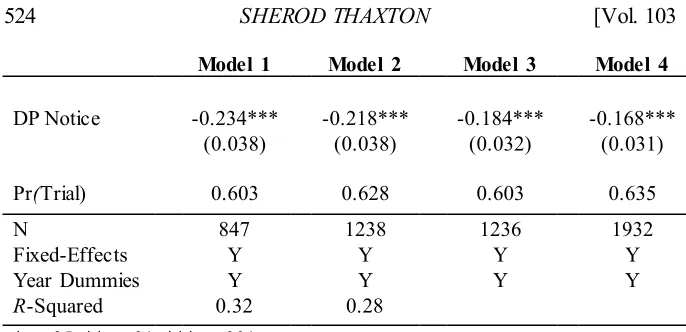
death penalty increases the probability of a plea agreement by
approximately 20 to 25 percentage points across various model
* Assistant Professor of Law, UCLA School of Law. Former Staff Attorney, Capital
476
[Vol. 103
specifications. Not only is this finding important in its own right by
illuminating capital defendants’ behavioral response to the death penalty, it
also has meaningful implications for other purported benefits of plea
bargaining in the capital context. The paper briefly considers one of the
most commonly identified benefits of plea bargaining—cost reduction—and
concludes that the death penalty fails to deter sufficient numbers of murder
defendants from opting for trial to offset the significant expense of a capital
case and subsequent appeals.
T
ABLE OFC
ONTENTSI
NTRODUCTION... 477
I.
P
LEAB
ARGAINING IN THES
HADOW OFD
EATH... 484
A.
Bargaining Incentives ... 484
B. Bargaining Disincentives ... 487
II.
P
RIORR
ESEARCH... 492
III.
G
EORGIA’
SD
EATHP
ENALTY... 498
A. History and Description of the Modern Statute ... 498
B. Life Without the Possibility of Parole ... 502
C. Capital Case Progression ... 503
IV.
D
ATA... 505
V.
E
MPIRICALS
TRATEGY... 507
A. Designation of Treatment and Control Groups ... 507
B. Statistical Model ... 513
C. Missing Data... 519
VI.
R
ESULTS... 521
A. Fixed-Effects logit specifications ... 521
B. Sensitivity Analyses ... 524
VII.
F
INANCIALI
MPLICATIONS ANDD
ISCUSSION... 540
I
NTRODUCTIONPlea bargaining
1is a crucial feature of our criminal justice system, as
approximately 95% of convictions that occur within a year of arrest are
obtained by a guilty plea.
2Despite its current centrality, however, “plea
bargaining did not occur with any frequency until well into the nineteenth
century,”
3and the Supreme Court did not specifically address its
constitutionality until long after it was common practice in the criminal
justice system.
4In
Brady v. United States
,
5the Court reasoned that plea
bargaining benefited both sides of the adversarial system and was “inherent
in the criminal law and its administration.”
6The following year, in
Santobello v. New York
,
7the Court defended the practice of plea
bargaining, calling it “an essential component of the administration of
justice”
8that was to be encouraged as long as it was properly administered
(i.e., as long as pleas were intelligent and voluntary). Several years later in
Bordenkircher v. Hayes
,
9the Court endorsed prosecutorial threats of stiffer
penalties when defendants refuse to accept a plea offer.
10In fact, since its
1Plea bargaining is “[a] negotiated agreement between a prosecutor and a criminal
defendant whereby the defendant pleads guilty to a lesser offense or to one of multiple charges in exchange for some concession by the prosecutor, usu. a more lenient sentence or a dismissal of the other charges.” BLACK’S LAW DICTIONARY 1270 (9th ed. 2009). Plea
bargaining may involve three areas of negotiation: charge bargaining (negotiation to plead guilty or no contest in exchange for the dismissal of some counts or reduction of the charge); sentence bargaining (negotiation to plead guilty or no contest in exchange for the prosecutor’s recommendation to the court for a lighter sentence); and fact bargaining (negotiation to stipulate to certain facts in exchange for an agreement not to introduce other facts into evidence). Id.
2SeeTHOMAS H.COHEN &TRACEY KYCKELHAHN,BUREAU OF JUSTICE STATISTICS,U.S.
DEP’T OF JUSTICE,FELONY DEFENDANTS IN LARGE URBAN COUNTIES,2006,at10 (2010); see
also Padilla v. Kentucky, 130 S. Ct. 1473, 1485 n.13 (2010) (recognizing that only 5% of federal and state felony prosecutions are resolved by trial).
3Albert W. Alschuler, Plea Bargaining and Its History, 79 COLUM.L.REV. 1, 5 (1979); see also id. at 19 (“It was only after the Civil War that cases of plea bargaining began to appear in American appellate court reports.”).
4See John H. Langbein, Torture and Plea Bargaining, 46 U.CHI.L.REV. 3, 9 (1978) (“If
you turn to the American Constitution in search of authority for plea bargaining, you will look in vain. Instead, you will find—in no less hallowed a place than the Bill of Rights—an opposite guarantee, a guarantee of trial.”).
5397 U.S. 742 (1970). 6Id. at 751.
7404 U.S. 257 (1971). 8Id. at 260.
9434 U.S. 357 (1978).
10 Id. at 363. Eight years before Bordenkircher, the Court ruled that the mere fact that a
478
[Vol. 103
formal endorsement of plea bargaining, the Court has been reluctant to
regulate plea bargains, recently noting that “[h]indsight and second guesses
are [] inappropriate . . . where a plea has been entered without a full
trial . . . .”
11Most judges support the system of plea bargaining because it allows
them to alleviate the need to schedule and hold a trial on what are typically
already overcrowded dockets.
12Prosecutors desire both the reduced
caseload and assurance of a conviction from plea bargaining. Plea
negotiations also allow prosecutors to strengthen their cases against
codefendants by offering certain defendants a plea arrangement in exchange
for testimony against one or more codefendants. This practice assures
prosecutors at least one conviction while also enhancing the chances of a
25, 31 (1970).
11 Premo v. Moore, 131 S. Ct. 733, 745 (2011). Notable exceptions include the Court’s
recent decisions in Missouri v. Frye, 132 S. Ct. 1399 (2012), Lafler v. Cooper, 132 S. Ct. 1376 (2012), and Padilla v. Kentucky, 130 S. Ct. 1473 (2010). In Padilla, the Court held that defense counsel’s incorrect advice to a client regarding the deportation risk associated with pleading guilty may violate the Sixth Amendment guarantee to effective assistance of counsel if it prejudices the client’s decision. 130 S. Ct. at 1478. The Court also rejected the argument that its ruling would ultimately open the “floodgates” of litigation by providing defendants with new causes of action. Id. at 1484–85. But see Derek Wikstrom, Note, “No Logical Stopping-Point”: The Consequences of Padilla v. Kentucky’s Inevitable Expansion, 106 NW. U.L.REV. 351, 374 (2012) (“Even if Padilla has an eventual logical
stopping-point, that point comes after extension to many other collateral consequences that are as serious as deportation.”).
In early 2012, the Court decided Cooper and Frye, extending Padilla’s logic to nondeportation cases and holding that a defendant’s Sixth Amendment right to effective assistance of counsel may be violated when (1) defense counsel fails to properly inform the defendant of a beneficial plea agreement offered by the prosecution (Frye), or (2) defense counsel incorrectly advises the defendant on the state of the law, leading the defendant to reject a beneficial plea agreement (Cooper). Frye, 132 S. Ct. 1399; Cooper, 132 S. Ct. 1376. The Court recognized that defense counsel’s duty to inform a client of formal plea offers may be subject to exceptions. Frye, 132. S. Ct. at 1408. It also pointed out that claims raised under “ineffective advice” must satisfy three conditions: (1) the ineffective advice was the “but for” cause of the plea not being accepted by the defendant, (2) the trial court would have ultimately accepted the terms of the bargain, and (3) the conviction or sentence would have been lesser than those imposed after trial. Cooper, 132 S. Ct. at 1385; see also Justin F. Marceau, Embracing a New Era of Ineffective Assistance of Counsel, 14 U.PA.J.CONST.L.
1161, 1191–92 (2012) (analyzing the Court’s recent plea-bargaining decisions). The impact of these decisions on plea bargaining is debatable, however. As one federal trial judge has explained, most of the problems that occur in the plea-bargaining process do not result from ineffective assistance of counsel, but rather prosecutorial overconfidence in the face of questionable evidence and sources. Jed S. Rakoff, Frye and Lafler: Bearers of Mixed Messages, 122 YALE L.J.ONLINE 25, 26 (2012).
12 Blackledge v. Allison, 431 U.S. 63, 71 (1977) (noting that plea bargaining permits
“[j]udges and prosecutors [to] conserve vital and scarce resources”). But see Jo Dixon, The Organizational Context of Criminal Sentencing, 100 AM. J. SOC. 1157, 1177 (1995)
subsequent conviction. Defendants are allowed to avoid a more serious
charge or sentence and, if represented by private counsel, avoid the cost of a
trial.
13So, on balance, the practice of plea bargaining is generally believed
to be superior to trials due to reduced costs, improvements in the speed and
efficiency of case processing, and increases in the certainty of
convictions.
14The practice is not without its detractors, however, as legal
academics and practitioners continue to debate its fairness and desirability.
Critics of the plea-bargaining system emphasize that it encourages
prosecutors to “overcharge” at the start of the case in an effort to coerce
defendants into accepting a plea, allows prosecutors to “cure” defects in
their cases by avoiding trial, and encourages defendants to plead guilty to
crimes that they did not commit.
15A defendant who agrees to a plea
bargain may also be required to relinquish certain constitutional and
statutory rights in exchange for a negotiated plea.
16Opponents of plea
bargaining also suggest that the practice allows defendants to avoid the
13 See, e.g., Frank H. Easterbrook, Criminal Procedure as a Market System, 12 J.LEGAL
STUD. 289, 297–98 (1983) (defending plea bargains as an element of a well-functioning
market system and cautioning that efforts to restrict actors’ discretion in criminal procedure will have negative consequences); Frank H. Easterbrook, Plea Bargaining as Compromise, 101 YALE L.J. 1969 (1992); William M. Landes, An Economic Analysis of the Courts, 14
J.L. & ECON. 61, 66–69 (1971) (describing factors influencing the likelihood of parties
reaching plea agreements); Robert E. Scott & William J. Stuntz, Plea Bargaining as Contract, 101 YALE L.J. 1909, 1918–34, 1967–68 (1992) (explaining the risks and
entitlements parties trade in plea bargaining).
14 See, e.g., GEORGE FISHER, PLEA BARGAINING’S TRIUMPH: A HISTORY OF PLEA
BARGAINING IN AMERICA 200–01 (2003) (discussing the growth of plea bargaining in
response to the operational goals of judges and prosecutors); Donald J. Newman, Pleading Guilty for Considerations: A Study of Bargain Justice, 46 J. CRIM. L. CRIMINOLOGY &
POLICE SCI.780,790 (1956) (describing plea bargaining “as a natural, expedient outgrowth
of deficiencies in the administration of our ‘trial-by-combat’ theory of justice”);Edward A. Ruttenburg, Plea Bargaining Analytically—The Nash Solution to the Landes Model, 7 AM.J.
CRIM.L. 323, 353 (1979) (“Plea bargaining should be accepted openly as a system which
can accomplish the goals of justice as completely as can a pure trial system, while at the same time releasing resources to serve society in other areas of life.”).
15 See Langbein, supra note 4, at 3 (discussing the parallels between the coerciveness of
current plea-bargaining practices and torture in medieval European courts); see also Oren Bar-Gill & Omri Ben-Shahar, The Prisoners’ (Plea Bargain) Dilemma, 1 J.LEGAL ANALYSIS
737, 769 (2009) (positing that plea bargaining may benefit individual defendants, but due to coordination problems, may not benefit defendants as a group); Oren Gazal-Ayal, Partial Ban on Plea Bargains, 27 CARDOZO L.REV. 2295, 2306 (2006) (arguing that prosecutors use
negotiated pleas in cases with weak—possibly inadmissible—evidence and when specific defenses might be established in court); Stephen J. Schulhofer, Plea Bargaining as Disaster, 101 YALE L.J. 1979, 1980–91 (1992) (describing structural flaws—e.g., innocence and
conflicts of interest—in the plea-bargaining system).
16 Stephanos Bibas, Regulating the Plea-Bargaining Market: From Caveat Emptor to Consumer Protection, 99 CALIF.L.REV. 1117, 1123 (2011) (discussing the rights defendants
480
[Vol. 103
appropriate punishment for their crimes (as established by state legislative
bodies) and that the practice heavily favors defendants with savvy lawyers,
irrespective of the defendants’ actual culpability.
17Also, claims of plea
bargaining as a “necessary” and “inevitable” component of our criminal
justice system have been challenged, as critics of plea bargaining point to
jurisdictions that have experimented with partial or complete bans on the
practice.
18The debate over the promises and pitfalls of plea bargaining is perhaps
most contentious in the context of the death penalty,
19yet scholars have
17 WELSH S.WHITE, THE DEATH PENALTY IN THE NINETIES:AN EXAMINATION OF THE
MODERN SYSTEM OF CAPITAL PUNISHMENT 56 (1991) [hereinafter WHITE,DEATH PENALTY]
(explaining that many prosecutors disfavor litigating pretrial motions, and defense attorneys who engage in intensive pretrial motion work are likely to obtain favorable plea bargains for their clients); Albert W. Alschuler, Plea Bargaining and the Death Penalty, 58 DEPAUL L.
REV. 671, 674 (2009) (suggesting that plea bargaining for a reduced punishment undermines
both the symbolic and instrumental purposes of punishment); Stephanos Bibas, Plea Bargaining Outside the Shadow of Trial, 117 HARV. L.REV. 2463, 2493 n.116 (2004)
(arguing that plea bargaining tends to favor repeat offenders).
18 See Michael L. Rubinstein & Teresa J. White, Alaska’s Ban on Plea Bargaining, 13
LAW &SOC’Y REV. 367, 367 (1979) (describing Alaska’s attempt to ban plea bargaining for
the vast majority of cases); Robert A. Weninger, The Abolition of Plea Bargaining: A Case Study of El Paso County, Texas, 35 UCLAL.REV. 265, 311–13 (1987) (explaining that
efforts to abolish plea bargaining have achieved mixed results). But several scholars have noted that the incentives to plea bargain are so strong for all the primary actors in the criminal justice system that they simply find alternative ways to achieve the same end even when the practice has been expressly prohibited. See, e.g., Joseph L. Hoffmann et al., Plea Bargaining in the Shadow of Death, 69 FORDHAM L.REV. 2313, 2390 (2001).
19 Seeinfra Part I. Compare, e.g., ROBERT M.BOHM,DEATHQUEST II:AN INTRODUCTION
TO THE THEORY AND PRACTICE OF CAPITAL PUNISHMENT IN THE UNITED STATES 207–08
(2003) (commenting that the availability and use of plea bargaining can contribute to arbitrariness and discrimination in the implementation of the death penalty), WHITE, supra
note 17, at 54 (conducting interviews with capital defense attorneys and concluding that “the likelihood of a plea bargain in a capital case will be dramatically affected by factors that have nothing to do with the nature of the crime or the strength of the evidence against the defendant”), Alschuler, supra note 17, at 674 (suggesting that plea bargaining “undermines the [death penalty’s] most common rationale . . . some crimes are so horrible that they simply require it”), and Daniel Givelber, The New Law of Murder,69 IND.L.J. 375, 410–11
(1994) (explaining that the existence of statutorily defined special circumstances for death eligibility strengthens the prosecutor’s bargaining position and facilitates arbitrariness), with WELSH S.WHITE, LITIGATING IN THE SHADOW OF DEATH 145–171(2006)[hereinafterWHITE,
LITIGATING IN THE SHADOW OF DEATH](explaining that plea bargaining is an important tool
for defense counsel to save their clients’ lives, but also recognizing how the practice leads to increased arbitrariness and potentially wrongful convictions), and Russell Stetler, Commentary on Counsel’s Duty to Seek and Negotiate a Disposition in Capital Cases (ABA Guideline 10.9.1), 31 HOFSTRA L. REV. 1157, 1157–58 (2003) (noting that, in 2003, the
conducted very little research on the relationship between the death penalty
and plea negotiations.
20Instead, they have focused the bulk of their
attention on the examination of the possible deterrent effect of the death
penalty on potential murderers.
21This Article offers an empirical
examination of the causal impact of the threat of the death penalty on the
likelihood of parties reaching a plea agreement. This type of inquiry is
particularly relevant because the effect of the death penalty on plea
bargaining is theoretically ambiguous. The threat of the death penalty may
induce defendants who may not have otherwise accepted a plea agreement
to plead to avoid the risk of possible execution, so the overall number of
cases proceeding to trial is reduced. An opposite effect is plausible as well:
armed with the threat of the “ultimate penalty,” prosecutors may be less
willing to offer capital defendants desirable plea bargains, if any bargain at
all, so the number of cases going to trial may increase.
22It is also possible
worked more diligently to obtain a negotiated plea).
20 See Ilyana Kuziemko, Does the Threat of the Death Penalty Affect Plea Bargaining in Murder Cases? Evidence from New York’s 1995 Reinstatement of Capital Punishment, 8 AM.L.&ECON.REV. 116, 141 (2006) (conducting the first study of the effect of the death
penalty on plea bargaining); see also Susan Ehrhard, Plea Bargaining and the Death Penalty: An Exploratory Study, 29 JUST.SYS.J. 313, 315 (2008) (noting that there has been
only one systematic examination of the impact of the death penalty on plea bargaining); Kent S. Scheidegger, The Death Penalty and Plea Bargaining to Life Sentences 1–2 (Criminal Justice Legal Found., Working Paper No. 09-01, 2009) (same); cf. ANDREW WELSH
-HUGGINS, NO WINNERS HERE TONIGHT:RACE,POLITICS, AND GEOGRAPHY IN ONE OF THE
COUNTRY’S BUSIEST DEATH PENALTY STATES 96–100 (2009) (discussing the high prevalence
of plea bargaining in capital cases in California, New York, Ohio, and at the federal level).
21 To be sure, social scientists—particularly those working in fields outside of
economics—have conducted empirical research on various aspects of the death penalty for more than 75 years, and over the past 30 years, socio-legal research has figured prominently into the debate over the appropriateness and effectiveness of capital punishment in the United States. See David C. Baldus, Keynote Address: The Death Penalty Dialogue Between Law and Social Science, 70 IND.L.J. 1033, 1041 (1995); Michael L. Radelet & Marian J.
Borg, The Changing Nature of Death Penalty Debates, 26 ANN.REV.SOC. 43, 43–44 (2000).
But no other issue related to the death penalty has received more systematic attention from legal and academic communities. William C. Bailey & Ruth D. Peterson, Murder, Capital Punishment, and Deterrence: A Review of the Literature, in THE DEATH PENALTY IN
AMERICA:CURRENT CONTROVERSIES 135, 135 (Hugo Adam Bedau ed., 1997).
22 See Kuziemko, supra note 20, at 117 (asserting that the death penalty may make
prosecutors more aggressive or recalcitrant, so they may be less willing to strike deals with defendants); see also WHITE, LITIGATING IN THE SHADOW OF DEATH, supra note 19, at 157–
58 (presenting the problem that some defendants prefer execution rather than life imprisonment); Ehrhard, supra note 20, at 318 (highlighting that many prosecutors only make “take it or leave it” offers of life without the possibility of parole in death-eligible cases); James S. Liebman, Opting for Real Death Penalty Reform, 63 OHIO ST.L.J. 315,
322–24 (2002) (showing that the availability of the death penalty can trump the usual pressure for prosecutors and defendants to reasonably compromise).
482
[Vol. 103
that the death penalty will have no impact on the likelihood that a defendant
accepts a plea bargain and will only impact the terms of the bargain.
23As
two scholars have recently noted, “opposing hypotheses about the effect of
the death penalty on prosecutorial discretion have never been rigorously
tested.”
24Examining the impact of capital punishment on plea bargaining is
important for several reasons. First, it helps inform our understanding of
how sentencing law influences plea bargaining. Given the centrality of
pleas for the disposition of criminal cases, studying how sentencing
structure impacts the incentives of prosecutors and defendants in plea
negotiations is important to our understanding of the criminal justice
system.
Second, the use of the death penalty as leverage in plea negotiations
raises important legal and ethical issues. Defendants are typically required
to waive important constitutional rights as a condition of the plea
agreement.
25Many of these rights are considered crucial to the accurate
determination of guilt and punishment at trial, so the absence of these
protections may undermine our confidence in that determination. This may
be of particular concern in the capital context because although defendants
who plead guilty avoid the risk of execution, they still receive very lengthy
payoffs from pursuing a capital case even when the defendant ultimately receives a sentence less than death or the capital sentence is reversed on appeal. See, e.g., WHITE,DEATH
PENALTY,supra note 17, at 55(arguing that capital defense lawyers routinely remark that
upcoming prosecutorial elections are the most important factor in predicting the likelihood of a plea bargain in a capital case, and savvy defense attorneys attempt to delay trial until after an election in order to increase the likelihood that a prosecutor will offer a plea); Jonathan E. Gradess & Andrew L. B. Davies, The Cost of the Death Penalty in America: Directions for Future Research, in THE FUTURE OF AMERICA’S DEATH PENALTY:AN AGENDA FOR THE NEXT
GENERATION OF CAPITAL PUNISHMENT RESEARCH 397, 409 (Charles S. Lanier et al. eds.,
2009) (“Prosecutors are often hawkish about the death penalty during election campaigns, increasing the probability that they will press for it in office and use it when available.”); Liebman, supra note 22, at 324–25 (arguing that trial error is virtually costless to prosecutors). But see Ronald F. Wright, How Prosecutor Elections Fail Us, 6 OHIO ST.J.
CRIM.L. 581, 606 (2009) (suggesting that campaigning prosecutors invoke the death penalty
infrequently). Alaska, Connecticut, Delaware, New Jersey, and Rhode Island are the only states that do not popularly elect their district attorneys. John A. Horowitz, Note, Prosecutorial Discretion and the Death Penalty: Creating a Committee to Decide Whether to Seek the Death Penalty, 65 FORDHAM L.REV. 2571, 2575 n.24 (1997).
23 Kuziemko, supra note 20, at 140. See generally George L. Priest & Benjamin Klein, The Selection of Disputes for Litigation, 13 J.LEGAL STUD. 1 (1984) (explaining why parties
fail to reach settlement agreements when such agreements are apparently mutually beneficial).
24 Gradess & Davies, supra note 22, at 409.
25 Hoffmann et al., supra note 18, at 2317–30 (discussing the U.S. Supreme Court’s
sentences—typically life imprisonment. The threat of the death penalty has
also induced innocent defendants to plead guilty (and even falsely implicate
others) to avoid execution.
26Finally, the study of the plea-negotiation process in the capital context
permits us to gain a better understanding of the financial and administrative
costs of capital punishment to states and the federal government. Capital
trials are extremely expensive and they rarely reduce prison costs because
of the infrequency of executions and the added expense associated with
housing inmates on death row.
27The threat of capital punishment may
result in substantial savings, however, if the threat of execution deters
sufficient numbers of individuals from pursuing trial.
Part I of the Article discusses many of the unique aspects of plea
bargaining in the capital context and how these factors cut both in favor and
against successful plea negotiations. Part II describes the limited empirical
research on the impact of the threat of the death penalty on plea bargaining
and how certain weaknesses of that particular work undermine our ability to
draw firm conclusions about the relationship between capital punishment
and plea bargaining. This section also explains how the limitations of this
prior research are avoided in the study conducted in this Article using an
originally constructed data set on capital charging-and-sentencing decisions
in Georgia. Part III briefly outlines Georgia’s modern capital punishment
and life without the possibility of parole (LWOP) statutes, Part IV describes
the data collected on Georgia’s capital charging-and-sentencing system that
are used to analyze the impact of the death penalty on plea negotiations, and
Part V discusses the empirical strategy employed to analyze the data. Part
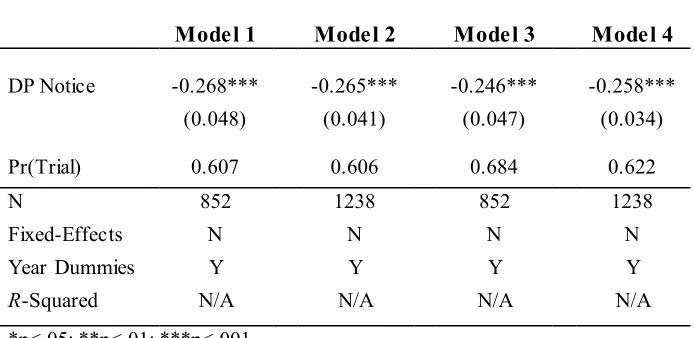
VI reports the results from various model specifications. According to
these findings, my conservative estimate is that the threat of the death
penalty increases the likelihood of reaching a plea agreement by
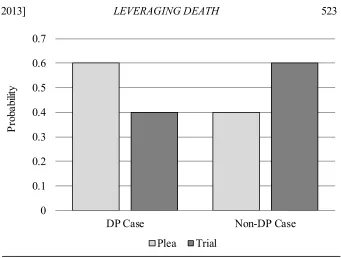
approximately 20 percentage points. In practical terms, the death penalty
increases the plea-bargaining rate from approximately 40% to 60%. In
other words, the threat of capital punishment deters roughly two out of
every ten death-noticed defendants from pursuing a trial. Part VII discusses
the implications of the findings for the administrative and financial costs of
26 See, e.g., Samuel R. Gross et al., Exonerations in the United States 1989 Through 2003, 95 J. CRIM. L. & CRIMINOLOGY 523, 544–46 (2005) (describing cases in which
innocent defendants pleaded guilty to murder, and even falsely implicated others, in order to avoid the death penalty); Paul Hammel, ‘Beatrice 6’ Cleared; ‘100 Percent Innocent,’ OMAHA WORLD-HERALD, Jan. 27, 2009, at B1 (discussing five exonerated convicted
murderers who falsely pleaded guilty after being threatened with the death penalty).
27 John K. Roman et al., Reassessing the Cost of the Death Penalty Using Quasi-Experimental Methods: Evidence from Maryland, 11 AM.L.&ECON.REV. 530, 551–53, 571
484
[Vol. 103
the death penalty. Based on the high costs associated with litigating a
single capital trial and the rather modest ability of the death penalty to deter
defendants from pursuing trial, capital punishment does not appear to be a
cost-justified bargaining chip.
I. P
LEAB
ARGAINING IN THES
HADOW OFD
EATHA.BARGAINING INCENTIVES
In addition to the perceived increase in plea-bargaining leverage
resulting from the severity of the punishment, prosecutors typically enjoy
huge advantages by merely seeking the death sentence. First, it enables the
government to empanel a “death-qualified” jury. The primary purpose of
“death qualification” during voir dire is to remove jurors who
unequivocally oppose the death penalty or, conversely, who believe that the
death sentence is required in every homicide case.
28Although the Supreme
Court has upheld the constitutionality of death-qualified juries in the face of
the claim that these juries placed defendants at an unfair risk of
conviction,
29available evidence strongly suggests that death-qualified juries
are much more likely to convict than non-death-qualified juries.
30The
death-qualification process also permits prosecutors to identify jurors with
mildly skeptical views of the death penalty (or the criminal justice system
in general) who may survive exclusion for cause, and subsequently exercise
their peremptory challenges to remove them from the jury.
3128 See, e.g., Wainwright v. Witt, 469 U.S. 412, 424 (1985) (explaining that the standard
for determining when the Court may exclude a prospective juror because of his views on capital punishment is whether “the juror’s views would ‘prevent or substantially impair the performance of his duties as a juror in accordance with his instructions and his oath’” (footnote omitted)).
29 Witherspoon v. Illinois, 391 U.S. 510, 517–18 (1968) (“We simply cannot
conclude . . . that the exclusion of jurors opposed to capital punishment results in an unrepresentative jury on the issue of guilt or substantially increases the risk of conviction.”).
30 See generally CRAIG HANEY, DEATH BY DESIGN:CAPITAL PUNISHMENT AS A SOCIAL
PSYCHOLOGICAL SYSTEM 118–21 (2005) (describing the conviction proneness of
death-qualified juries); William J. Bowers, The Capital Jury: Is It Tilted Toward Death?, 79 JUDICATURE 220, 222–23 (1996) (same); Robert Fitzgerald & Phoebe C. Ellsworth, Due
Process vs. Crime Control: Death Qualification and Jury Attitudes, 8 LAW &HUM.BEHAV.
31, 48 (1984) (same); Walter E. Oberer, Does Disqualification of Jurors for Scruples Against Capital Punishment Constitute Denial of Fair Trial on Issue of Guilt?, 39 TEX.L.
REV. 545 (1961) (same); Robert L. Young, Guilty Until Proven Innocent: Conviction
Orientation, Racial Attitudes, and Support for Capital Punishment, 25 DEVIANT BEHAV. 151,
155 (2004) (same).
31 James S. Liebman, The Overproduction of Death, 100 COLUM.L.REV. 2030, 2097
Second, seeking the death penalty substantially increases the defense’s
burden with very little increase, if any, in the government’s burden by
vastly expanding the defense attorney’s role and the requisite skill set and
financial resources.
32The overwhelming majority of criminal defense
attorneys, both in private practice and employed by the government, are
routine negotiators of deals that permit their clients to avoid trial.
Representation of a capitally charged client now possibly requires defense
counsel to become serious investigators of a horrific crime (or at least
coordinators of complex investigations), competent consumers (and
communicators) of mental health and forensic science, and experts on
complicated (and constantly evolving) specialized constitutional and
statutory law.
33Prosecutors are well aware that many highly skilled trial
lawyers will simply refuse to represent a capital defendant, and evidence
suggests that capital defendants represented by court-appointed counsel are
more likely to receive the death sentence and more likely to have their
appeals denied.
34According to one scholar:
Preliminary Screening of Prosecutorial Access to Death Qualified Juries: A Missing Constitutional Link, 62 IND.L.J. 295, 325 (1987) (arguing for prescreening of capital cases
for probable cause of the existence of “death-eligible” special circumstances prior to death qualification of a jury); Young, supra note 30, at 151 (explaining that death-qualified jurors are more likely to prefer convicting the innocent over acquitting the guilty).
32 Liebman, supra note 31, at 2097–98; Liebman, supra note 22, at 322; see also Stephen
B. Bright, Counsel for the Poor: The Death Sentence Not for the Worst Crime but for the Worst Lawyer, 103 YALE L.J.1835, 1844 (1994) (discussing interrelated reasons for the poor
quality of representation in capital cases).
33 Liebman, supra note 22, at 322–23; see also Bibas, supra note 16, at 1141 (“Good
defense lawyers must know, for example, whether a defendant’s small children, ill health, apology, cooperation, or restitution can lower his sentence.”); Richard G. Dudley, Jr. & Pamela Blume Leonard, Getting It Right: Life History Investigation as the Foundation for a Reliable Mental Health Assessment, 36 HOFSTRA L.REV. 963, 988 (2008) (emphasizing the
importance and accompanying complexity of thorough mental health investigation for mitigation in capital cases). See generally Stephen B. Bright, Death by Lottery—Procedural Bar of Constitutional Claims in Capital Cases Due to Inadequate Representation of Indigent Defendants, 92 W.VA.L.REV. 679 (1990); Stephen B. Bright, In Defense of Life: Enforcing
the Bill of Rights on Behalf of Poor, Minority and Disadvantaged Persons Facing the Death Penalty, 57 MO. L. REV. 849, 857–62 (1992) (providing examples of gross ineffective
assistance of defense counsel in capital cases).
34 See James C. Beck & Robert Shumsky, A Comparison of Retained and Appointed Counsel in Cases of Capital Murder, 21 LAW &HUM.BEHAV. 525, 538 (1997); see also
RAYMOND PATERNOSTER ET AL., THE DEATH PENALTY: AMERICA’S EXPERIENCE WITH
CAPITAL PUNISHMENT 237 (2008) (reporting that court-appointed lawyers representing
capitally charged clients in the most active death penalty jurisdictions were significantly more likely to have been professionally disciplined priorto the appointment); Jules Epstein, Death-Worthiness and Prosecutorial Discretion in Capital Case Charging, 19 TEMP.POL.&
CIV. RTS. L. REV. 389, 400–01 (2010) (suggesting a direct consequence of overly broad
486
[Vol. 103
“There are many small communities that do not have surgeons. But that does not mean that we allow chiropractors to do brain surgery in those communities.” We do, however, let “chiropractors” with law degrees perform the equivalent of brain surgery in capital cases and, predictably, the “patient” often dies.35
Third, prosecutors generally understand that defense attorneys will
adopt minimalist, risk-averse pretrial and litigation strategies and practices,
focusing primarily on penalty-phase investigation and preparation and on
preserving “credibility” at the penalty phase. Consequently, the risk of an
acquittal even in cases with genuine evidentiary problems regarding guilt is
particularly low.
36In fact, a national study of jurors who served on capital
trials revealed that jurors were more likely to vote for the death sentence
when defense counsel’s guilt-phase and penalty-phase presentations were
logically inconsistent.
37The Supreme Court has also recognized that
“[a]ttorneys representing capital defendants face daunting challenges in
developing trial strategies [for guilt and penalty phases]”
38and “must strive
at the guilt phase to avoid a counterproductive course.”
39Finally,
prosecutors recognize that judges at both the trial and appellate levels—
especially elected judges—are less likely to require capital trials to strictly
follow reliable procedure out of fear that prosecutors will publicly blame
judges for losses based on “legal technicalities.”
40taking into consideration the vast responsibilities associated with defending a capital defendant, the number of qualified attorneys in any jurisdiction dwindles to a handful or completely disappears); Ronald J. Tabak & J. Mark Lane, The Execution of Injustice: A Cost and Lack-of-Benefit Analysis of the Death Penalty, 23 LOY. L.A.L. REV.59, 70 (1989)
(reporting that 90% of inmates on death row could not afford private counsel).
35 Vivian Berger, The Chiropractor as Brain Surgeon: Defense Lawyering in Capital Cases, 18 N.Y.U.REV.L.&SOC.CHANGE 245, 254 (1990–1991) (citations omitted).
36 Ehrhard, supra note 20, at 318 (describing capital defense attorneys’ concerns about
compromised credibility at the penalty phase after aggressively pursuing an innocence defense).
37 Scott E. Sundby, The Capital Jury and Absolution: The Intersection of Trial Strategy, Remorse, and the Death Penalty, 83 CORNELL L.REV. 1557, 1589–91 (1998).
38 Florida v. Nixon, 543 U.S. 175, 191 (2004) (discussing the potential tensions between
guilt and penalty phase strategies).
39 Id.
40 See Stephen B. Bright & Patrick J. Keenan, Judges and the Politics of Death: Deciding Between the Bill of Rights and the Next Election in Capital Cases, 75 B.U.L.REV.
759, 834–35 (1995); Richard R. W. Brooks & Steven Raphael, Life Terms or Death Sentences: The Uneasy Relationship Between Judicial Elections and Capital Punishment, 92 J.CRIM.L.&CRIMINOLOGY 609, 638–39 (2002); Andrew Gelman et al., A Broken System:
The Persistent Patterns of Reversals of Death Sentences in the United States, 1 J.EMPIRICAL
LEGAL STUD. 209, 260 (2004); Liebman, supra note 31, at 2111–14; Ashley Rupp, Death
Penalty Prosecutorial Charging Decisions and County Budgetary Restrictions: Is the Death Penalty Arbitrarily Applied Based on County Funding?, 71 FORDHAM L.REV. 2735, 2736–
B.BARGAINING DISINCENTIVES
The aforementioned advantages that prosecutors enjoy in seeking the
death penalty would appear to increase the likelihood of a plea bargain;
however, these advantages may be offset by forces pushing against
compromise on both sides of the aisle. Both systematic and anecdotal
evidence suggests that plea negotiations are most likely to occur when (1)
both parties perceive a similar expected probability of conviction, (2) the
expected trial penalty is relatively small (i.e., low-severity offenses), (3) the
settlement discount offered by the government is substantial, (4) the
defendant’s risk aversion is high, (5) pretrial detention and court delays
substantially increase opportunity costs for defendants, and (6) the parties
(particularly the defendant) will directly incur the full costs of litigation.
41But many of these features may be missing or substantially weakened in the
majority of capital cases.
The central point of contention in a capital trial is not the expected
probability of conviction—approximately 90% of all murder trials result in
conviction;
42rather, it is the likelihood of a death sentence (or a sentence
greater than the statutory minimum) at the penalty phase,
43and perhaps
even the expected likelihood of ultimately being executed.
44Juries wield
enormous discretion in deciding whether to impose the death sentence,
which is inherently a subjective enterprise.
45Rigorous examinations of jury
41 See, e.g., Gazal-Ayal, supra note 15, at 2299 (explaining that prosecutors obtain guilty
pleas when they can offer substantial concessions); Landes, supra note 13, at 99 (presenting evidence that the likelihood of a plea agreement depends, inter alia, on the severity of the crime, differences in the expected probability of conviction, resources available to the parties, and parties’ risk aversion).
42 COHEN &KYCKELHAHN,supra note 2, at 11; THOMAS H.COHEN &BRIAN A.REAVES,
BUREAU OF JUSTICE STATISTICS, U.S. DEP’T OF JUSTICE, FELONY DEFENDANTS IN LARGE
URBAN COUNTIES, 2002,at 24 (2006); BRIAN A.REAVES,BUREAU OF JUSTICE STATISTICS,
U.S.DEP’T OF JUSTICE,FELONY DEFENDANTS IN LARGE URBAN COUNTIES,1994,at24 (1998).
43 FRANKLIN E.ZIMRING, THE CONTRADICTIONS OF AMERICAN CAPITAL PUNISHMENT 53–
55 (2003) (describing the penalty phase of a capital trial as a “status competition” between the defendant and the victim’s family); Jon Kyl et al., On the Wings of Their Angels: The Scott Campbell, Stephanie Roper, Wendy Preston, Louarna Gillis, and Nila Lynn Crime Victims’ Rights Act, 9 LEWIS & CLARK L. REV. 581, 607–08 (2005) (describing the
proliferation of victims’ rights legislation and victim-impact statements during the penalty phase of capital trials).
44 NANCY J.KING &JOSEPH L.HOFFMANN,HABEAS FOR THE TWENTY-FIRST CENTURY:
USES, ABUSES, AND THE FUTURE OF THE GREAT WRIT 147 (2011) (explaining that capital
cases are thirty-five times more likely to be granted relief upon federal habeas review than noncapital cases); James S. Liebman et al., Capital Attrition: Error Rates in Capital Cases, 1973–1995, 78 TEX.L.REV. 1839, 1850, 1852 (2000) (noting that 68% of death sentences
were overturned on appeal from 1973 to 1995 and 82% of those defendants ultimately avoided the death penalty at resentencing).
488
[Vol. 103
sentencing patterns are unable to identify any meaningful (i.e., legally
legitimate) defendant or crime characteristics that consistently distinguish
cases that receive the death penalty from cases that do not.
46This strongly
suggests that prosecutors and defendants in capital cases may significantly
differ in their assessments of the expected trial sentence. As a result,
prosecutors will only have imperfect information about a defendant’s
reservation price (i.e., the maximum plea sentence that the defendant would
accept to avoid a trial), and might inadvertently make a plea offer exceeding
that reservation price.
47While prosecutors may generally know the
probability that a case would result in a plea bargain, they cannot accurately
predict the actual result in specific cases.
48Nationally, only one-third of
capital trials result in a death sentence,
49so a capital defendant may require
a larger discount than what a prosecutor is willing to offer. This is
are only required to narrow death eligibility and not to channel jurors’ discretion at the penalty phase, and nonstatutory aggravating circumstances may be considered by the jury as well); accord Lee v. State, 365 S.E.2d 99, 105 (Ga. 1988), cert. denied, 488 U.S. 879 (1988); see also Nance v. State, 623 S.E.2d 470, 473 (Ga. 2005) (stating that there is no requirement under the Georgia capital statute that nonstatutory aggravating circumstances be proven beyond a reasonable doubt), cert. denied, 549 U.S. 868 (2006); Chelsea Creo Sharon, The “Most Deserving” of Death: The Narrowing Requirement and the Proliferation of Aggravating Factors in Capital Sentencing Statutes, 46 HARV.C.R.-C.L.L.REV. 223, 245
(2011) (describing the U.S. Supreme Court’s refusal to place greater restrictions on the factors juries may consider when deciding whether to impose the death sentence).
46 See Richard Berk et al., Statistical Difficulties in Determining the Role of Race in Capital Cases: A Re-Analysis of Data from the State of Maryland, 21 J.QUANTITATIVE
CRIMINOLOGY 365, 387 (2005) [hereinafter Berk et al., Statistical Difficulties] (“It is difficult
to imagine that a few covariates exist that if included as predictors would lead to clear and justified distinctions between defendants who are charged with a capital crime and defendants who are not; likewise for death sentences. . . . [I]f idiosyncrasies associated with the case, the defendant, or the adjudication process seem to determine a substantial part of the outcome, the adjudication process is suspect whether race is important or not.”); see also BARRY NAKELL &KENNETH A.HARDY,THE ARBITRARINESS OF THE DEATH PENALTY 120,
151 (1987) (noting that legally legitimate characteristics in capital cases only explain a small portion of the variation in charging-and-sentencing decisions); Richard A. Berk et al., Chance and the Death Penalty, 27 LAW &SOC’Y REV. 89, 107–09 (1993) [hereinafter Berk
et al., Chance and the Death Penalty] (same); William J. Bowers & Wanda D. Foglia, Still Singularly Agonizing: Law’s Failure to Purge Arbitrariness from Capital Sentencing, 39 CRIM.L.BULL. 51, 84 (2003) (demonstrating that constitutionally mandated requirements to
guide jury discretion and eliminate arbitrariness in sentencing are not working); Deon Brock et al., Arbitrariness in the Imposition of Death Sentences in Texas: An Analysis of Four Counties by Offense Seriousness, Race of Victim, and Race of Offender, 28 AM.J.CRIM.L.
43, 70 (2000) (reporting evidence of significant within-jurisdiction arbitrariness in the imposition of the death penalty after taking into account offense seriousness).
47 Bar-Gill & Ben-Shahar, supra note 15, at 757.
48 Bibas, supra note 17, at 2467; Gazal-Ayal, supra note 15, at 2321.
49 RICHARD C.DIETER,DEATH PENALTY INFO.CTR.,SMART ON CRIME:RECONSIDERING
important because prosecutors are concerned with more than just avoiding
trials. They also care about fairness and reputation, and this may lead
prosecutors to refuse to adjust plea offers in a manner that would avoid
trial, even when prosecutors accurately assess the defendant’s reservation
price.
50Pressure from victims’ family and the community may also factor
into the minimum plea a prosecutor is willing to offer.
51Statutory minima in capital cases—typically life with or without the
possibility of parole—also preclude prosecutors from offering substantial
concessions (at least in the minds of many defendants).
52Prosecutors are
also less willing to drop or reduce homicide charges because such actions
are politically costly, so they often feel bound to dedicate resources to
trying homicide cases even with evidentiary problems.
53Even plea offers
of a life sentence
with
the possibility of parole may not be considered a
meaningful concession relative to life
without
the possibility of parole in the
current climate in which determinate-sentencing and truth-in-sentencing
laws typically require inmates sentenced to life imprisonment to serve at
least twenty-five years, and parole boards are increasingly reluctant to
release inmates serving life sentences.
54As one scholar has explained, plea
50 WILLIAM J.STUNTZ,THE COLLAPSE OF AMERICAN CRIMINAL JUSTICE 258 (2011) (“A
prosecutor who becomes known as a pushover will be taken advantage of, not once but many times . . . once [a] threat [is] made, it ha[s] to be carried out.”); Josh Bowers, Punishing the Innocent, 156 U.PA.L.REV. 1117, 1152–53 (2008).
51 See, e.g., Kyl et al., supra note 43, at 621 (advocating increased victim and victim
family involvement in plea negotiations, including the ability to reopen a plea or sentence when the accused has pleaded to a reduced offense).
52 See, e.g., WHITE, LITIGATING IN THE SHADOW OF DEATH, supra note 19, at 158
(describing the “free me or fry me” attitude of many capital defendants); Robert L. Misner, Recasting Prosecutorial Discretion, 86 J. CRIM. L. & CRIMINOLOGY 717, 742 (1996)
(explaining how the prevalence of statutory minima has dramatically increased the importance of charge bargaining relative to sentence bargaining for serious offenses); see also Lucian E. Dervan, The Surprising Lessons from Plea Bargaining in the Shadow of Terror, 27 GA.ST.U.L.REV. 239, 245 (2011) (suggesting that the ability to offer substantial
sentence reductions is key to prosecutors’ success in the use of plea bargaining).
53 Gazal-Ayal, supra note 15, at 2306; Daniel C. Richman & William J. Stuntz, Al Capone’s Revenge: An Essay on the Political Economy of Pretextual Prosecution, 105 COLUM.L.REV. 583, 600–05 (2005) (arguing that state prosecutors are more often politically
obliged to prosecute a defendant for the offense she is suspected of committing, and thus cannot drop the case or offer a charge bargain).
54 MARC MAUER ET AL., THE SENTENCING PROJECT, THE MEANING OF “LIFE”:LONG
PRISON SENTENCES IN CONTEXT 12 (2004) (discussing the steady increase in time actually
490
[Vol. 103
bargaining draws “sustenance . . . from the
principles
of the indeterminate
sentence,”
55so statutory minima and de facto determinate sentences (via
extremely inactive parole boards) severely restrict the magnitude of a plea
discount.
Many capital defendants also suffer from substantial cognitive and
emotional deficits and biases, and consequently are more likely to be
risk-seeking (or risk-neutral at best) and less likely to accept favorable plea
bargains.
56As a result, defense counsel in capital cases must be particularly
skillful with potential mental health issues affecting their clients.
57In fact,
a recent study of federal habeas corpus actions discovered that client mental
health issues continue to provide a strong basis for relief.
58Capital
defendants are also more likely to be highly skeptical of their defense
attorneys during plea negotiations, especially in situations when the
defendant is a racial or ethnic minority and defense counsel is not.
59Pretrial detention, court delays, and litigation costs are much less of a
concern for capital defendants as well. Defendants charged with murder are
the least likely to be released pending trial (19%), have the highest bail
amounts (i.e., represent the largest percentage of defendants with bail
exceeding $50,000), and are decreasingly (over the past twenty years) likely
to be granted pretrial release.
60In many jurisdictions, defendants charged
with murder are “non-bondable” either through statute or practice (e.g.,
http://www.pap.state.ga.us/opencms/export/sites/default/press_releases/1998_press_releases/ news_0005.html (refuting popular misconception that “straight lifers” are released and reporting that twenty-one “straight lifers” died in prison while serving their sentences in the previous twelve months).
55 FISHER,supra note 14, at127.
56 See, e.g., WHITE, LITIGATING IN THE SHADOW OF DEATH, supra note 19, at 162
(explaining that capital defendants with mental health problems pose a significant obstacle in plea negotiations and often express a “free me or fry me” position to their defense counsel); Alschuler, supra note 17, at 674 (explaining that defendants are executed “for the crime of being [] optimist[s] . . . [the] inability to think 100 yards in front of [themselves]”); Bibas, supra note 17, at 2467 (highlighting that the combination of poor lawyering and irrational behavior can lead some defendants to reject bargains they should otherwise accept).
57 Liebman, supra note 22, at 322.
58 KING &HOFFMANN,supra note 44, at 151 (examining habeas corpus petitions after the
enactment of the Anti-Terrorism and Effective Death Penalty Act (AEDPA)).
59 See, e.g., WHITE, LITIGATING IN THE SHADOW OF DEATH, supra note 19, at156–57
(describing how defendants’ mistrust of defense counsel in capital cases is often compounded by racial or cultural differences); cf. Albert W. Alschuler, The Defense Attorney’s Role in Plea Bargaining, 84 YALE L.J.1179, 1180–82 (1975) (claiming that plea
bargaining is destructive to attorney–client relationships).
60 THOMAS H.COHEN &BRIAN A.REAVES, BUREAU OF JUSTICE STATISTICS,U.S.DEP’T
OF JUSTICE,PRETRIAL RELEASE OF FELONY DEFENDANTS IN STATE COURTS 3, 6 (2007); BRIAN
A. REAVES & JACOB PEREZ, BUREAU OF JUSTICE STATISTICS, U.S. DEP’T OF JUSTICE,
defendants lack the requisite financial resources to post bail),
61defense
counsel has a strategic incentive to delay trial absent any strong claims of
actual innocence,
62and the costs associated with defending a capital trial
make it virtually impossible for defendants to finance their own defense,
63so the state must almost invariably declare them indigent and appoint
counsel at the government’s expense.
64Local prosecutors also avoid the
burden of incurring the full cost of capital trials—particularly the
substantial costs of error correction at the appellate level.
65Finally, there are a variety of additional reasons why prosecutors and
defendants may not reach plea agreements in capital cases. The highly
publicized nature of capital cases, relative to noncapital cases, can increase
the reluctance of defendants to admit their participation in the crime in open
court.
66Complicating matters is the fact that many prosecutors and judges
(and even some capital statutes) do not permit defendants to enter Alford or
nolo contendere
pleas in capital murder cases, but do allow such pleas in
noncapital murder cases.
67Prosecutors may also seek the death penalty
61 COHEN &REAVES,supra note 60, at 3–6.
62 BARRY LATZER &JAMES N.G.CAUTHEN,JUSTICE DELAYED?TIME CONSUMPTION IN
CAPITAL APPEALS:AMULTISTATE STUDY 30 (2007) (remarking on the extraordinary amount
of time some defense attorneys take to file a notice of appeal in capital cases); Michael E. Tigar, Judges, Lawyers and the Penalty of Death, 23LOY.L.A.L.REV. 147, 148 (1989)
(discussing judges’ condemnation of defense counsel’s conduct in capital cases, including delay tactics).
63 See infra Part VII for a discussion of the specific costs associated with capital trials. 64 See, e.g., AM. BAR ASS’N,EVALUATING FAIRNESS AND ACCURACY IN STATE DEATH
PENALTY SYSTEMS: THE GEORGIA DEATH PENALTY ASSESSMENT REPORT 143 (2006),
available at http://www.americanbar.org/content/dam/aba/migrated/moratorium/assessment project/georgia/report.authcheckdam.pdf (noting that appointment of counsel is required for a defendant indicted for a capital felony if she can establish that she is indigent). To be declared indigent, a person must “lack[] sufficient income or other resources to employ a qualified lawyer to defend him or her without undue hardship on the individual or his or her dependants [sic].” Id. at 143 n.73 (citations omitted) (internal quotation marks omitted); cf. Alschuler, supra note 17, at 677 (discussing how defense counsel in capital cases often threaten or attempt to make the trial as expensive as possible in order to improve their bargaining positions).
65 Arthur L. Alarcón & Paula M. Mitchell, Executing the Will of the Voters?: A Roadmap to Mend or End the California Legislature’s Multi-Billion-Dollar Death Penalty Debacle, 44 LOY.L.A.L.REV. S41, S88 (2011) (reporting the significant costs associated with federal
habeas review of state death sentences in California); Liebman, supra note 22, at 325 (explaining that state and federal courts incur the financial burden of correcting trial mistakes); Misner, supra note 52, at 719–20 (arguing that our current system is seriously flawed because prosecutors are not required to take into account finite criminal justice resources when making charging-and-sentencing decisions).
66 WHITE, LITIGATING IN THE SHADOW OF DEATH, supra note 19, at157.
67 An Alford plea is similar to a plea of nolo contendere where a defendant pleads guilty
492
[Vol. 103
against a particular defendant in an attempt to extract information that may
have otherwise been impossible to obtain—e.g., the names of possible
accomplices and additional victims—by inducing the defendant’s
cooperation in exchange for a sentence reduction. If the defendant refuses
to cooperate, the prosecutor may be less likely to offer a favorable plea.
68Such cooperation may not be forthcoming in capital cases both because of
the high-profile nature of the cases and the severity of the potential
penalties for possible codefendants implicated by the defendants.
Due to the influence of these competing incentives on plea-bargaining
dynamics in the capital context, coupled with the lower likelihood of pleas
in murder cases in general, it is far from obvious what role capital
punishment is playing in plea negotiations in the aggregate. The empirical
analysis of the influence of the threat of the death penalty on parties’
propensity to reach a plea agreement assists in informing this debate.
69II. P
RIORR
ESEARCHTo date, only one study has attempted to systematically examine the
impact of the death penalty on plea bargaining.
70Professor Ilyana
(explaining that “[a]n individual accused of crime may voluntarily, knowingly, and understandingly consent to the imposition of a prison sentence even if he is unwilling or unable to admit his participation in the acts constituting the crime” and there is no “material difference between a plea that refuses to admit commission of the criminal act and a plea containing a protestation of innocence when . . . a defendant intelligently concludes that his interests require entry of a guilty plea and the record before the judge contains strong evidence of actual guilt”); see also Henderson v. Morgan, 426 U.S. 637, 644–45 (1976) (explaining the constitutional prerequisites for Alford pleas). Georgia’s capital statutes prohibit Alford pleas in capital cases. GA.CODE ANN. § 17-7-95(a) (West 2003).
68 See, e.g., David Garland, “Symbolic” and “Instrumental” Aspects of Capital Punishment, in THE FUTURE OF AMERICA’S DEATH PENALTY, supra note 22, at 421, 437.
69 The focus of the empirical analyses in this Article is whether a plea agreement was obtained, not the specific dynamics of the negotiations involved in obtaining a plea. In cases that were ultimately disposed by trial, the data used in these analyses cannot distinguish whether plea negotiations were attempted and, if so, why the negotiation failed. Nevertheless, it is reasonable to assume that in the vast majority of cases, defendants rejected the plea offer from the prosecutor because the offer was deemed unacceptable. Although no systematic research on this topic has been conducted, experts estimate between 50% and 75% of inmates on death row rejected plea offers that would have avoided the death sentence. WHITE, LITIGATING IN THE SHADOW OF DEATH, supra note 19, at 145–46;
Alschuler, supra note 17, at 671; Stetler, supra note 19, at 1157.
According to a recent empirical study of federal postconviction review of capital cases, 3% of defendants sentenced to death plead guilty at the conviction phase without obtaining a sentence bargain from the prosecutor. KING &HOFFMANN,supra note 44, at 147.
Some defendants may perceive additional benefits from accepting a plea apart from what the government is willing or able to offer, such as leniency from the judge or jury during sentencing. See Dervan, supra note 52, at 259.