Munich Personal RePEc Archive
Explaining intention to use the Islamic
credit card: an extension of the TRA
model
Hanudin, Amin
Labuan School of International Business and Finance, Universiti
Malaysia Sabah, IIUM Institute of Islamic Banking and Finance,
International Islamic University Malaysia
1 January 2012
Online at
https://mpra.ub.uni-muenchen.de/36957/
Labuan School of International Business and Finance, Universiti Malaysia Sabah IIUM Institute of Islamic Banking and Finance, International Islamic University Malaysia
! " – The Islamic credit card is a type of banking product offered by Islamic banks. Given the importance to the Islamic credit card to Islamic banks, the study is aimed at identifying the factors determining the Malaysian bank customers’ behavioral intention to use the Islamic credit card.
" # $ " %! !&!#'$ ! % – Drawing upon the Theory of Reasoned Action (the TRA model), this study proposes a modified model to examine the acceptance factors of attitude, subjective norm and perceived financial cost within the Islamic credit card context. The study used multiple regression model in order to examine the impacts of these explanatory variables on the intention to use the Islamic credit card. The model is tested using survey data from 257 respondents.
# – The results reveal that attitude, subjective norm and perceived financial cost significantly influence the Islamic credit card intention to use. Of these, attitude was first ranked factor explaining intention to use the Islamic credit card.
" " % & ! $ & ! – The research suffers from two limitations. The first limitation is related to the generalization of finding whilst the second limitation is related to the limited measures employed in the current work. Despite these limitations, this research is significantly contributed to the body of knowledge in the area of Islamic credit card, at least at exploratory level.
& & ! – Information gathered from the study will serve as a basis for more future works in the area of Islamic credit card. The theory developed in the current study’s model could also be generalized into other contexts of Islamic banking products and services. Practically, branch managers of Islamic banking institutions could of prime importance to extend the findings of the study for the better future planning of their Islamic credit card offerings.
# & '$( & " – Importantly, the study extends the applicability of the TRA model into Islamic credit card context. Few studies have conducted over the years under this context in Malaysia.
)"'*! Islamic credit card, personal finance, Islamic bank, Malaysia
+, ! !
By definition, a credit card is referred as the means of payment that involves the concept of buying first and paying later (Yee et al., 2007). On the same note, the Islamic credit card refers as the “buying first and paying later” using Shariah concepts, principles and values, and aimed at providing credit financing to clients of Islamic banks. Prior to the introduction of the Islamic creditt card, many questionable problems rose pertaining to potential issues such as the permissibility of the card, its legal impacts, acceptance and also the question of the high debt amongst graduates at the young age. This calls for the Islamic bank to come up with fine measures in order to tackle these issues effectively. The banks are thus of prime importance to provide the facilities of Islamic credit cards which meet their policies. This explains that only those who are affordable and possess greater net income are able to possess the Islamic credit card.
Despite these issues, the Islamic credit card is expected to strengthen the threatened Islamic identity for muslims in which it is prevented for those affordable muslims to continuously employed conventional credit card, which is totally prohibited by the religion of Islam. The Islamic credit card is fundamentally an essential mode of payments in muslim today’s society (Amin et al., 2007). It is one of the important pillars of consumerism. People own this money for various reasons such as to attain credit facility, cash advance, easy payment, charge card and prestige (Billah, 2003). Indeed, the credit card has symbolized the status of wealth of a person in order to make her/him special than others. Over the years, credit card industries are getting popular among the Malaysian societies (Mansor, 2005). The credit cards that circulated in Malaysia could be clustered into two categories, which are conventional and Islamic6based credit cards (Yee et al., 2007). Although in nature, these cards are the same, but they are differences in terms of principles, fees and operations. For instance, conventional credit card allows interest whilst Islamic credit card only allows fees in any client’s financial transactions.
As far as the discrepancy between conventional and Islamic credit cards is concerned, the need to differentiate is thus of considerable interest to carry out. Particularly, there are three generic differences which could be shared in this write6up. Firstly, Islamic credit card is free from compounding interest whilst conventional has. Secondly, Islamic credit card is of value to fix the profit margin for whole contract period whilst the profit margin for conventional credit card is not predetermined. Thirdly, Islamic credit card is guided by Shariah principles whilst conventional is not. In line with the third discrepancy, the doctrine of bay al Inah is recognized and used to validate the credit card transaction (Kazi, 2002). The bay al inah contract works based on two (2) separate agreements, notably Bay al Mutlak (cash sale) and bay bithaman ajil
Earlier researches have produced mixed findings pertaining to Islamic credit card adoption (Mansor and Che Mat, 2009; Mohd Dali et al., 2008; Choo et al, 2007). Viewed in detail, Mansor and Che Mat (2009) examined the use of Islamic credit card and found out that income was an influential predictor for the use of Islamic credit card among the existing users. Mohd Dali et al. (2008) on the other angle found out that shopping, bulk purchase, concept understanding were considered as the key factors determining one’s satisfactory on the Islamic credit card use. Choo et al. (2007) found out that the employment was the only one that found to have significant influence on probability of choosing Islamic6based credit card. These studies on average have produced mixed outcomes pertaining to the key antecedents which leading to the Islamic credit card adoption. It is of paramount importance to justify that the research on Islamic credit card adoption is still remained inconclusive and further job is required to contribute to the body of Islamic credit card knowledge.
Owing to the enormous benefits of Islamic credit cards for both parties, banks and customers, investigating the factors influencing the customers is particularly the main purpose of the study. Given the purpose, the study also proposes a model of factors from the TRA theory to meet the objective particularly.
-, " " "( "*
There is paucity of studies that have adequately addressed the effects of attitude, subjective norm and perceived financial cost on the Islamic credit card adoption context. Particularly in Malaysia, there have been studies in the literature about credit cards (Mansor and Che Mat, 2009; Mohd Dali et al., 2008; Choo et al, 2007). In these studies, Islamic credit card is addressed differently in terms of purpose, statistical analyses and findings. The following are the discussions of these studies:
Mansor and Che Mat (2009) investigated the impact of demographic factors on the Islamic credit card use. The study was conducted by involving a total of 305 respondents as a sample of study and frequency and chi6square analyse were used to analyse the data. The study reported that income was an influential predictor for the use of Islamic credit card among the existing users. Theoretically, consumers tend to increase their spending pattern when their income increases. It was reported that there were no statistical differences between males and females in the use of credit card. However when considered the variables pertaining to levels of education and income, there was a sign of certain degree of differences appeared to exist when observing the three levels of education and the four levels of income. The authors also noted that among those with lower and middle income were prone to use credit cards as it was able to provide safety and convenience features.
particularly varied when it is compared with the current research, in which the latter will employ one endogenous variable and several exogenous variables, which are not examined in a study by Mohd Dali et al. (2008). The current study is expected to add the literature on the Islamic credit card along with the presence of findings by Mansor and Che Mat (2009) and Mohd Dali et al. (2008).
Another interesting study by Choo et al. (2007), examined the consumer choice of Islamic6based credit card using a bivariate probit model. The study contributes to the literature in terms of model used and in terms of the model specific constructs. The study used a survey6questionnaire approach on the basis of convenience sampling, in order to meet the research objective. The study found out that the employment section was the only one that found to have significant influence on probability of choosing Islamic6based credit card. Not surprisingly, those from private sector of the opinion to have less preference on the Islamic credit card use. On the other hand, the authors noted that the government staffs had higher tendency to choose Islamic6based credit card, which is perhaps most of the government staffs were Islam. Interestingly, the study also noted that the perceived or actual frequent of using credit card online purchase was significantly related to the probability of choosing Islamic6based credit card. An increase in the frequency increases the probability of choosing and using the card. The card had a positive impact, in which this tells us that Islamic credit card is more secure, and cheaper (Choo et al., 2007).
The aforementioned studies have reported mixed results, which have raised a difficulty in understanding the Islamic credit card acceptance factors. These studies have employed different methods, measures and perspectives in order to meet their research’s objectives. To fill this gap, drawing upon the TRA model, this study postulates that attitude, subjective norm and perceived financial cost are significant determinants of Islamic credit card adoption.
., %"! " & / "*! 0
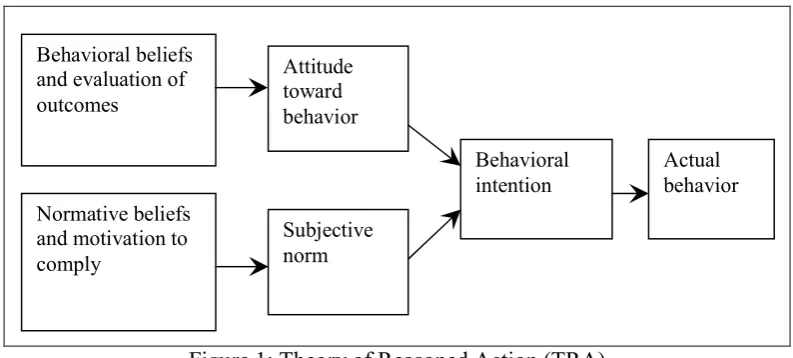
Various academic works have employed the TRA model into their model of studies. The reasons behind the wide empirical supports of the theory are particular because of three fundamental reasons. Firstly, the theory is well suited for the purpose of examining and predicting a particular behavior. As stated by Md6Taib et al. (2008), the fundamental constructs of the theory are essential in order to explain why people using musharakah mutanaqisah. Secondly, the theory has been praised for its flexibility to be applied into a different context of research. The TRA has been applied in online stock trading (Gopi and Ramayah; Ramayah et al., 2009), knowledge sharing (Ryu et al., 2003) and the marketing area. Thirdly, the TRA can be used to measure behavioral intention and actual of a particular situations, systems or even products. Previous researches have supported the importance of the TRA in predicting the behavioral intention and actual use (Ramayah et al, 2009). The present study used to measure behavioural intention to use Islamic credit card amongst Malaysian bank customers, thus using the TRA is of considerable relevant in the current study.
Figure 1: Theory of Reasoned Action (TRA) Source: Fishbein and Ajzen (1975)
The TRA was introduced by Fishbein and Ajzen (1975) in order to establish links between beliefs, attitudes, intentions and behaviors (Md6Taib et al., 2008). Recently, the theory has been applied in Islamic finance contexts. For instance, the study by Md6Taib et al. (2008) used TRA in order to examine bank customers’ perception over musharakah mutanaqisah home financing in the Malaysian context. Musharakah mutanaqisah is also known as “musharakah diminishing to ownership” where capital is not permanent and every repayment of capital by the bank customer will diminish the total capital ratio for the bank. This will increase the total capital ratio for the customer until the customer becomes the sole proprietor for the bought house (Abdul6 Rahman, 2007). On the same note, Amin et al. (2009) used TRA to examine undergraduate students’ acceptance of Islamic accounting.
The present study extends the theory to an Islamic credit card financing context. Two unique determinants of TRA, namely attitude and subjective norm are applied in the present study since previous studies indicated that acceptance of Islamic financing could be explained by the determinants of TRA (Amin et al., 2009; Md6Taib et al., 2008). As such, the determinants are included to help explain the reasons bank customers use Islamic credit card.
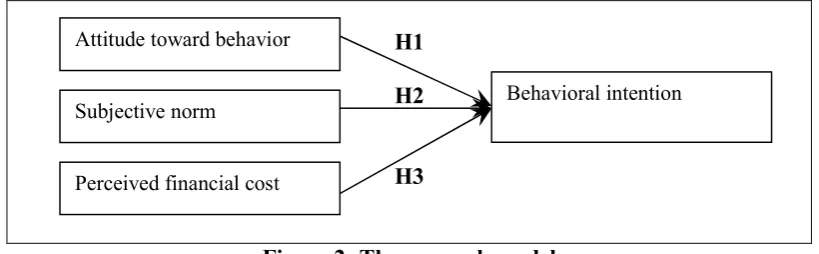
Further, the above model is modified to better explain the intention to use Islamic credit. Previously, the model has also been modified to better explain behavioral studies in the areas of management, psychology, and marketing. Md6Taib et al. (2008) and Ramayah and Mohd6Suki (2005) have modified the TRA and to reconcile the applicability of the TRA into a newly context of research. The model is modified by only including the behavioral intention, attitude and subjective norm, whilst other branches of the TRA are skipped. To measure the intention to use Islamic credit card by Malaysian bank customers, the current research is of value to add perceived financial cost into the research framework. Limited studies have been examined the importance of perceived financial cost. Two interesting studies namely Luarn and Lin (2005) and Mathieson et al. (2001) have found out that perceived financial cost was significant antecedent affecting behavioral intention. An interesting study by Ramayah et al. (2006) also provides a groundwork pertaining to the inclusion of perceived financial cost in explaining behavioral intention. Ramayah et al. (2006) found that price was not significantly related to the Internet banking acceptance. The result by Ramayah et al. (2006) is not in consonance to that of Luarn
Behavioral beliefs and evaluation of outcomes
Normative beliefs and motivation to comply
Attitude toward behavior
Subjective norm
Behavioral intention
and Lin (2005) and Mathieson et al. (2001). To overcome such debates, it is worth noting that further research for perceived financial cost is of considerable interest to be carried out. It is also anticipated the outcomes could also be generalized into the Islamic credit card context. The final model is presented below:
+
-.
# " - %" " " % ! "&
In line with the research model, the following hypotheses are of value to be tested:
H1: Attitude will have a positive effect on intention to use Islamic credit card (Ramayah et al., 2009)
H2: Subjective norm will have a positive effect on intention to use Islamic credit card (Ramayah et al., 2009)
H3: Perceived financial cost will have a negative effect on intention to use Islamic credit card (Luarn and Lin, 2005)
1, " %! !&!#'
Subjects
[image:7.595.93.503.173.300.2]The sample size of the study was 257 of Malaysians who were serving Islamic banking products and services at the time during the survey conducted. Non6probability sampling was applied owing to the fact that Bank and Financial Institutions Act (BAFIA) 1989 did not allow the disclosure of such information (Ramayah et al., 2006; Ramayah et al., 2003). In addition, commercial banks did not disclose such information since it has confidentiality value for the purpose of competitive advantage of any bank (Amin and Ramayah, 2010). The study results are rooted in bank customers’ intention to Islamic credit card intention to use which is derived from previous the TRA model (Amin and Ramayah, 2010). Out of these respondents, a total of 92 respondents were males while the remainder 165 respondents were females. Concerned with marital status, a total of 202 respondents were unmarried whilst the rest of 21.4 percent were married. With respect to ethnicity, most of the respondents were Malays with 129 (50.2 percent).
Table 1: Profile of respondents
Frequency Percentile
Gender
Male 92 35.8
Female 165 64.2
Marital status
Attitude toward behavior
Subjective norm Behavioral intention
Single 202 78.6
Married 55 21.4
Ethnicity
Malay 129 50.2
Bajau 25 9.7
Kadazandusun 28 10.9
Murut 15 5.4
Suluk 10 3.9
Other 51 19.8
Age
Less 20 11 4.3
20630 190 73.9
31640 30 11.7
More 40 26 10.1
Explained in more detail, Malay accounted the majority of respondents (50.2 percent) followed by others (19.8 percent), Kadazan6Dusun (10.9 percent), Bajau (9.7 percent), Murut (5.4 percent) and Suluk (3.9 percent). In terms of age, most of the respondents were aged 20630 years old (73.9 percent) as this group of age was considered appropriate for being Islamic credit card users in the future
Measurement
The questionnaire items were extracted from selected studies. Questionnaire items were adapted from prior studies which can be described as follows: attitude (Ramayah et al., 2008), subjective norm (Zainuddin et al., 2004), and behavioral intention (Md6Taib et al., 2008). The questionnaire items for added variable “perceived financial cost” are derived and adjusted from Luarn and Lin (2005). Here, adjustments were made in order to ensure all employed items were better reflecting Islamic credit card context. In the questionnaire, the respondents were required to rate their level of agreement with statements using five6point scales ranging from “strongly disagree” (1) to “strongly agree” (5). This scale has been used in previous survey related research (e.g. Pikkarainen et al., 2004).
Prior to the actual survey four6questionnaires were provided in order to facilitate a pilot study to be conducted among lecturers majoring Islamic finance and marketing. The pilot study is important in order to digest any problems relevant to the instrument used for the study. Fortunately, all respondents to the test commented that the questions were easily understood. Only formatting and some editing work were done to the questionnaire prior to the actual survey. A total of 300 questionnaires were printed.
2, " &
Factor analysis and cronbach alpha
identify the appropriate items for the analysis. Factor analysis is a data reduction technique that uses correlations between data variables. The underlying assumption of factor analysis is that a number of factors exist to explain the correlations or inter6relationships among observed variables (Chatfield and Collins, 1992). The study performed factor analysis using a Principal Component Analysis (PCA) alongside with Varimax with Kaiser Normalization rotation method until the eigenvalue of each factor was equal to 1 or more. According to Tabachnick and Fidell (1996), there are several methods of rotation used in a research6based study such as Quartimax, Direct Oblimin and Varimax rotation. Varimax rotation is most commonly used and it aims to maximize the variance of factor loadings by making a high loading higher and low ones lower for each factor.
Table 2: Factor analysis Factor loadings
Items 1 2 3
A2 .900
A3 .892
A1 .879
A4 .839
A5 .750
SN2 .851
SN1 .842
SN4 .842
SN3 .842
SN5 .793
P3 .902
P2 .898
P1 .863
P5 .822
P4 .714
Variance
explained 49.330 23.744 8.491
Eigenvalue 7.399 3.562 1.274
KMO 89.1%
Bartlett’s Test of Sphericity
X2=4672.27 df=105, p6value=.000
.969 .946 .894
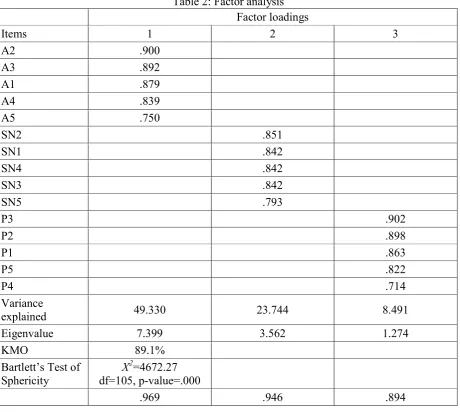
The results for reliability test are presented in Table 2. According to Black (1999) “reliability is an indication of consistency between two measures of the same thing”. To understand the relationship between the two groups of data, it is necessary to quantify the reliability of the data. The reliability of the factors need to be determined in order to support any measures of validity that may be employed (Nunnally, 1978). The employed items in this research were found to be reliable. All values ranged from .894 to .969. Explained in more detail, the results for the tested items were as follows: attitude .969 (5), subjective norm 0.946 (5), perceived financial cost .894 (5) and intention to use Islamic credit card is .946 (5). Thus, all items were deemed reliable (Ramayah et al., 2003).
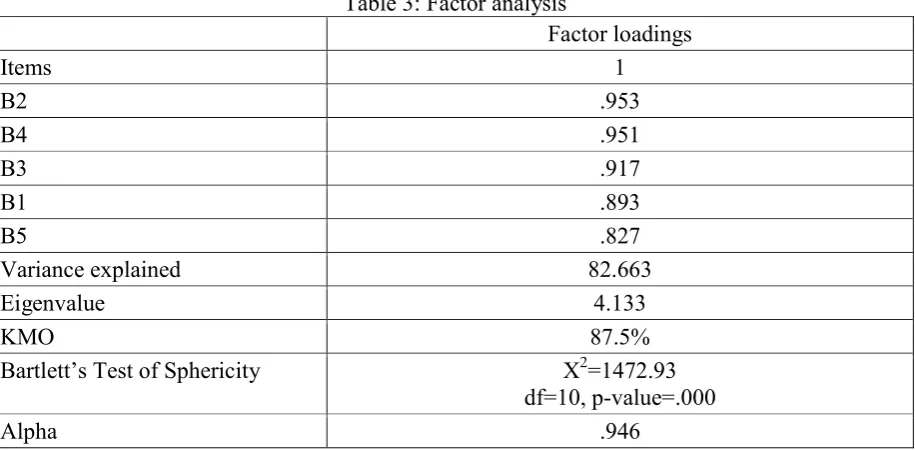
[image:10.595.70.528.353.578.2]Concerned with the Kaiser6Meyer6Olkin (KMO) measure, the combined items of the independent variables had a value of 0.891, indicating that the sampling adequacy was greater than 0.5 and therefore satisfactory. Barletts Test showed a χ² of 4672.27 with a significance level of 1 percent, where the total variance explained was 81.565 out of 3 components.KMO for the dependent variable, on the other angle, depicts a value of .875 which implied that the sampling was satisfactory. Barletts Test also found to be significant at 1 per cent significance level.
Table 3: Factor analysis
Factor loadings
Items 1
B2 .953
B4 .951
B3 .917
B1 .893
B5 .827
Variance explained 82.663
Eigenvalue 4.133
KMO 87.5%
Bartlett’s Test of Sphericity X2=1472.93 df=10, p6value=.000
Alpha .946
Hypotheses testing and discussion of results
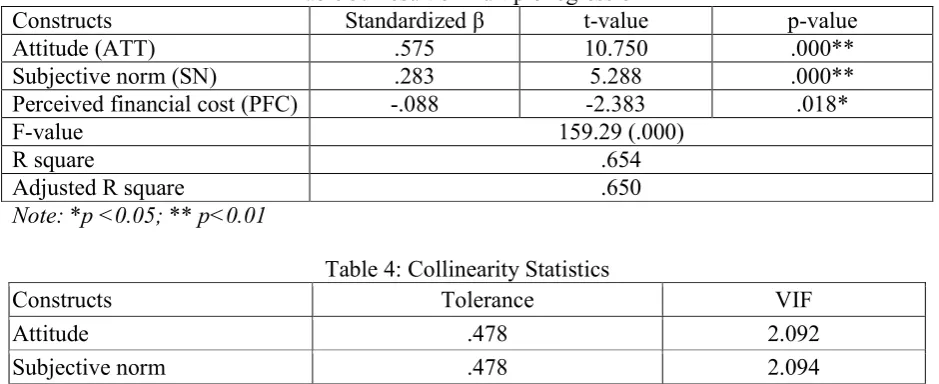
[image:11.595.64.534.385.577.2]In order to test the three proposed hypotheses, the authors employed a multiple regression. Table 3 presents the regression results of “attitude”, “subjective norm”, “perceived financial cost” and “intention to use Islamic credit card”. The R² was 0.654 indicating that 65.4% of the variation in intention to use Islamic credit card could be explained by the two named variables and the F6 value of 159.29 was significant at the 0.01 level. Attitude was positively related to intention to use Islamic credit card and so was subjective norm. On the other angle, perceived financial cost was negatively related to intention to use Islamic credit card. Consequently, H1, H2 and H3 were supported. These outcomes are consistent with previous studies (Md6Taib et al., 2008; Zainuddin et al., 2004 and Luarn and Lin, 2005). Thus, the more positive the attitude, the more likely that Islamic credit card is selected by the customers. Yet, the more positive the subjective norm, the more likely that Islamic credit card is selected by the customers. In sum, the results show the appropriateness of the fundamental elements of TRA in Islamic credit card context. It is confirmed that attitude and subjective norm had strong influence over the behavioral intention to use Islamic credit card. In addition, the study also showed that the greater the perceived financial cost, the likelihood that Islamic credit card is selected will be lower. This result corroborates with the findings of Luarn and Lin (2005), where the financial cost is of value to explaining the motivation of use for Islamic credit card.
Table 3: Result of multiple regression
Constructs Standardized β t6value p6value
Attitude (ATT) .575 10.750 .000**
Subjective norm (SN) .283 5.288 .000** Perceived financial cost (PFC) 6.088 62.383 .018*
F6value 159.29 (.000)
R square .654
Adjusted R square .650
Note: *p <0.05; ** p<0.01
Table 4: Collinearity Statistics
Constructs Tolerance VIF
Attitude .478 2.092
Subjective norm .478 2.094
Perceived financial cost .997 1.003
3, ! & ! 4 & & ! / " " " %
This research examined the intention to use Islamic credit card by exploring three possible key factors namely attitude, subjective norm and perceived financial cost. Drawing upon the TRA, the effects of the three key factors were uncovered, explaining that attitude, subjective norm and perceived financial cost were of prime importance to addressing the usage intentions. These results have managerial implications for bank managers and for researchers. As such, banks may opt to strengthen attitude and subjective norm roles. Pertaining to the attitude, the banks are expected to publishing cogent information for Islamic credit cards which could better market the Islamic credit cards to end users, thus impacting positive attitude, which in turn is leading to the reception. On subjective norm perspective, the bank are recommended to build up a database for existing users in which these users can be appointed as the agents for the bank in persuading new customers to apply for the Islamic credit cards. In return, financial incentives and fee waiver are of interest to be rewarded to the existing users who perform such task. In terms of financial cost, it is of importance to offer the services of Islamic credit cards at the discriminated cost associated with the level of usage rather than fixed it as normally conducted.
The research contributed to the literature from several aspects. Firstly, to the best of our knowledge this study is a pioneering effort in applying the TRA to the newly context of Islamic credit card, which has been available in Malaysia since 2000s. Secondly, the study adds perceived financial cost to the existing TRA in order to better justify the context of Islamic credit card acceptance.
The study however posed two main shortcomings. Firstly, our sample involved only a specific user group in a particular geography as the study was conducted in Eastern Malaysia whilst the sample from Western Malaysia was not studied. The findings may generalize to users in Eastern Malaysia but not in Western Malaysia. Secondly, the model of factors of the current research is limited to three exogenous variables which are in nature limit our possible research implications. For the sake of further studies, the first limitation can be overcome by calling other friends in Peninsula to re6investigate Islamic credit card usage, which in turn may offer generalization of findings to the users in Peninsula. Worth to mention, future researches may use a richer set of variables, including not only up to the three factors here but also including prior experience and personal factors, as predictors to provide better explanatory power for Islamic credit card adoption.
"/" " "
Abdul6Rahman, A R (2007), “Islamic microfinance: a missing component in Islamic banking”,
Kyoto Bull. of Islamic Area Studies, Vol. 1 No.2, pp. 38653.
Ajzen I. and Fishbein M (1980). Understanding Attitudes and Predicting Social Behaviour, Prentice Hall, New Jersey, NJ.
Billah, M M (2003). Islamic Credit Card in Practice, [Online] Available: http://islamicmortgages.org.uk/index.php?id=262.
Black, T R (1999). Doing Quantitative Research in the Social Sciences – An Integrated Approach to the Research Design: Measurement and Statistics, Sage Publications: London.
Chatfield C, Collins A J (1992). Introduction to Multivariate Analysis, Chapman and Hall: London.
Choo S Y, Lim H E, Sanusi N A (2007). The consumer choice of Islamic6based credit card: an analysis of bivariate probit model, In Sanusi, N.A., Harun, M. and Samsudin, S. (eds), Readings in Islamic economics and finance, Sintok, Universiti Utara Malaysia Press. Ekonomi dan Kewangan Islam 2005, Sintok: UUM.
Darwish A F (2003). Can a Credit Card ever be Halal? [Online] Available: http://www.baankerme.com/bme/2003/mar/islamic_banking.asp.
Fishbein M. and Ajzen I (1975). Belief, Attitude, Intention and Behavior: An Introduction to Theory and Research, Addison6Wesley, Reading, MA.
Gopi M, Ramayah T (2007). Applicability of theory of planned behavior in predicting intention to trade online: Some evidence from a developing country. Int. J. of Emerging Markets, 2(4):3486360.
Hair J F, Black W C, Babin B J, Anderson R E. and Latham R L (2006). Multivariate Data Analysis, 6th ed., Upper Saddle River, New Jersey: Prentice6Hall.
International Law Book Services (2002). Akta Bank Islam (IBA) 1983 (Akta 276), Percetakan Maziza Sdn Bhd, Kuala Lumpur.
International Law Book Services (2004). Banking and Financial Institution Act (BAFIA) 1989, Syarikat Percetakan Ihsan, Selangor.
Kazi, M. (2002). Malaysian Banks Launches first Islamic Credit Card in Asia, [Online]Available:http://www.islam6online.net/English/news/2002607/25/articles06.shtml.
Luarn, P. and Lin, H. H. (2005). “Toward an understanding of the behavioural intention to use mobile banking”, Computer in Human Behaviour, Vol. 21, pp. 8736891.
Mansor, N. (2005). Islamic credit card: Are demographic factors a good indicator? Prosiding Seminar Ekonomi dan Kewangan Islam 2005, Sintok: UUM.
Mathieson, K., Peacock, E. and Chin, W. W. (2001), “Extending the technology acceptance model: the influence of perceived user resources”, DATABASE for Advance in Information System, Vol.32 No.3, pp.866112.
Mohd6Dali, N. R. S., Abdul6Hamid, H., Shahimi, S. and Wahid, H. (2008), “Factors influencing the Islamic credit cards holders satisfaction”, The Business Review, Vol.11 No.2, pp.2986304.
Nunnally J C (1978). Psychometric Theory, McGraw6Hill: New York.
Pallant J (2005). SPSS Survival Manual: A Step by Step Guide to Data Analysis Using SPSS for Windows, ver. 12, Allen Unwin, Australia.
Pikkarainen, T., Pikkarainen, K., Karjaluoto, H., and Pahnila, S. (2004), “Consumer acceptance of online banking: an extension of the technology acceptance model”, Internet Research, Vol.14 No. 3, pp.2246235.
Ramayah, T., Md6Taib, F. and Ling, K. P. (2003), “Classifying users and non6users of Internet banking in northern Malaysia”, Journal of Internet Banking and Commerce, Vol. 11 No.2, pp.16 13.
Ramayah T, Jantan M, Noor M N M, Ling K P (2003). Receptiveness of internet banking by Malaysian consumers. Asian Academy of Manage. J. 8(2):1629.
Ramayah T, Mohd6Suki N M (2006). Intention to use mobile PC among MBA students: Implications for technology integration in the learning curriculum. UNITAR e6J. 1(2):1610.
Ramayah T, Mohd6Suki N M (2005).Intention to shop online amongst MBA students: Comparing theory of reasoned action (TRA) and the technology acceptance model (TAM), APMC Conference 2005, UNIMAS, Sarawak.
Shahwan S, Mohd Dali N R S, Salleh S (2008). Factors determining the ownership of Islamic credit card in Malaysia: An analytical study. Proceedings of the MFA Conference 2008, 5046513.
Tabachnick B G, Fidell L S (1996). Using Multivariate Statistics, 3rd ed.,Harper Collins Publisher: New York.
Md6Taib F M, Ramayah T, Razak D A (2008).Factor influencing intention to use diminishing partnership home financing. Int. J. of Islamic and Middle Eastern Finance and Manage. 1(3):2356 248.