A Systematic Approach for Congestion Control in
Wireless Ad hoc Network using Opnet
Parminder Kaur
M.tech CSE LLRIET,Moga
Ranjit Singh
Assistant Prof. of CSE dept. LLRIET,Moga
ABSTRACT
Transmission Control Protocol (TCP) is a reliable, end-to-end transport protocol, which is most widely used for data services and is very efficient for wired networks. However, experiments and research showed that TCP’s congestion control algorithm performs very poorly over Wireless Ad Hoc Networks with degraded throughputs and severe unfairness among flows.In this paper, a deep study has been conducted in order to study the factors that cause congestion in an ad hoc wireless network. Main focus in this report has been to simulate and study the effect of change in topology and number of users on network congestion. Apart from that, the effects of network congestion and the importance of its study have also been highlighted. Congestion is a critical factor, in determining the quality of network. It also determines the dependability and sustainability of a network. Deploying new network infrastructure to tackle congestion problem is not economically viable solution, hence it is important to understand the reasons behind such network operation conditions and then design suitable methods to overcome them. In this paper, various network behaviors’ have been simulated using OPNET Modeler 14.5 to study how node’s buffer space gives impact to the in-flight packets in ad hoc environment by also taking mobility and power consumption into consideration. With a controlled size of
users ( ) the network
condition has been simulated. Performance has been measure on several parameters such as throughput, number of packets dropped, and retransmission count and end number of users changed.
General Terms
Network Congestion,Network Parmeters.
Keyword
Ad hoc network,Power Consumption,Buffer size,Opnet
1.INTRODUCTION
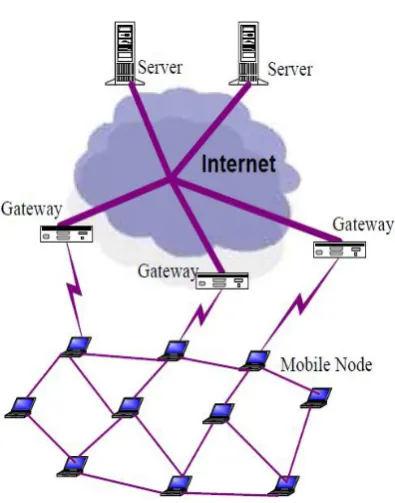
[image:1.595.337.535.215.467.2]Wireless Ad Hoc Networks are multi-hop wireless networks. A Wireless Ad Hoc Network consists of mobile platforms (e.g., a router with multiple hosts and wireless communication devices) here in simply referred to as “nodes” – which are free to move about arbitrarily [1]. Wireless Ad Hoc Networks can be easily deployed with or without the support of existing infrastructure. Figure 1 is an example Ad Hoc network which uses gateways as the connection between the wired and wireless parts, which is referred to as a Wireless Ad Hoc Access Networks.
Figure 1:An Example Wireless Ad Hoc Access Network.
1.1
Ad Hoc WLANs
networks, in particular, the optimal design, scalability, performance, and fundamental capabilities of these networks remain poorly understood, at least in comparison with their wireless network paradigms and a lot of “daylight” remains in this field of research. However, with enormous potentials for such networks, ad hoc networks primarily support data networks, but it has been envisioned recently to enter to home networks, wireless device networks, distributed control systems, and sensor networks etc. In the following subsections, the network architecture, routing and scalability of an ad hoc network are described.
1.2
Congestion Control
Congestion is an unwanted situation in networked systems, where the part of the network is being offered more traffic than its rated (desired) capacity. Congestion can be disastrous for a data transmission system as it manifests itself as depletion of resources that are critical to the operation of the system. These resources can be CPU, buffer space, bandwidth etc. Resource crunch will lead to lengthening of various queues for these resources. Due to finite length constraint, many packets may eventually get dropped, which, in turn, will deteriorate the response time of the system beyond permissible limits due to retransmission requests. “Congestion Control” refers to the mechanism of combating congestion, which makes sure the resources are used optimally and the system has maximum data throughput with the given conditions.The main objective of congestion control is to make sure the system is running at its rated capacity, even with the worst case overload situations. In certain systems, this is ensured by restricting certain nodes to transmit at the maximum capacity or to make use of certain resources monotonously. Doing this enables optimal usage of resources for all the nodes in the system with a measurable quality-of-service (QOS). In some systems, there are built-in mechanisms that does not allow congestion situation to take place and every node keeps track of system statistics and resources. This is often knows as “congestion prevention” or “Congestion Avoidance”.Congestion control is necessary for systems, whose nodes do not keep track of such statistics or do not keep resource information. In such systems, the nodes participate in the network, in which the topology changes very often and the network statistics also vary randomly. As such the control of congestion becomes an issue of the nodes that act as bridges. Ad hoc networks are examples of such scheme. In this thesis, the terms congestion control and congestion avoidance will be used synonymously with the ultimate aim to keep the total networked system free of congestion. Congestion control can either be rate-based control or buffer-based control depending on how the actual control is done. Most of the rate-based congestion control algorithms are applied during routing of data from node to node. In multi hop routing, thus, congestion takes place on every hop and is termed hop-by-hop congestion control. However, for single hop routing congestion is only an end-to-end issue and more of rate adjustment of the source rather than destination. A major open challenge for research still remains for congestion control of large ad hoc wireless networks, where single hop routing is virtually impossible [1].
2.OBJECTIVE
A network link is said to be congested when the offered load on the link reaches a value close to the capacity of the
link. In a similar manner, wireless network congestion can be defined as the state in which the transmission channel is close to being completely utilized. Due to popularity of wireless ad hoc network technology in the market it has become necessary to study and manage the effects of congestion in the wireless networks. The objective of our research is to study how node’s buffer space gives to the in-flight packets in ad-hoc environment by also taking the mobility and power consumption into consideration. This will also enable us to conduct a deeper study to understand network congestion in ad-hoc networks.In wireless networks, the congestion control protocols and methods are very different from the conventional wired networks. Specially, in the case of ad-hoc networks it is hard to control network congestion, as every node behaves like a router. The congestion will vary with different topologies, methods of network deployment, mobility, channel utilization and power consumption at node level. We will try to simulate various network environments with different number of users and then study the network on parameters like throughput, delay retransmission attempts, packets dropped etc.
2.1 Objectives include:
1. To simulate various network topologies of ad-hoc network and vary the number of users in various cases.
2. Study the effect of node’s buffer space on in flight packets of the network.
3. Vary the power consumption and topology of networks to study the effect of network congestion, and how they may or may not be an important contributor towards network congestion.
4. Represent the results on various standard parameters such as throughput,retransmission attempts , packets dropped etc.
5. Conduct a deep study to understand network congestion in ad-hoc networks.
3.LITERATURE REVIEW
network utility maximization problem. In recent years a number of papers have presented theoretical solutions to this problem that are based on combining differential-backlog scheduling algorithms with utility-based congestion control. However, this work typically does not address a number of issues such as how signaling should be performed and how the new algorithms interact with other wireless protocols.
In this paper we address such issues. In particular: • Firstly define a specific network utility maximization problem that we believe is appropriate for mobile adhoc networks.
• Describe a wireless Greedy Primal Dual (wGPD) algorithm for combined congestion control and scheduling that aims to solve this problem.
• Show how the wGPD algorithm and its associated signaling can be implemented in practice with minimal disruption to existing wireless protocols.
•Show via OPNET simulation that wGPD significantly outperforms standard protocols such as 802.11 operating in conjunction with TCP.
4.PROPOSED APPROACH
Start with defined a simple ad hoc network, the scalability of the network is determined by a formula where n is
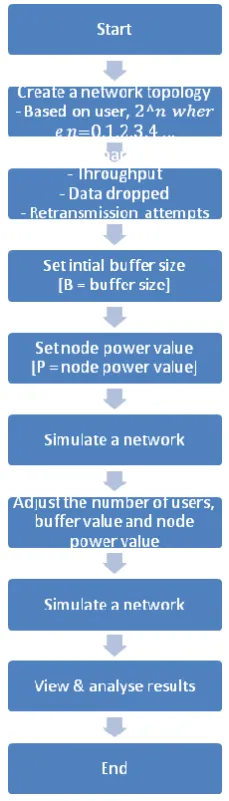
[image:3.595.383.498.72.474.2]given as 0, 1, 2, 3 and 4. For this study, mobility issue is our consideration. Therefore, all nodes are mobile nodes. Here, the heavy data streaming has been chosen in order to observe the packet behaviour correspond to the changes of buffer size and users in wireless environment.There are two scenarios created to represent Scenario 1 (B = 256 K, P = 0.005 watts) and scenario 2 (Large buffer B = 1024 K, P = 0.010). Several parameters will be observed and then analysed more detail later. This simulation will be run for 1hour.
Figure 2: The proposed steps.
4.1 Network Environment Setup
Figure 3: The proposed network
[image:4.595.328.544.131.371.2]4.2Network Environment configuration
used
Table 1:Wireless network configuration
WLAN Technology
IEEE 802.11b
Map used
Office
Dimensions of map
100 meters X 100
meters
Routing algorithm
AODV
Data Rate
11 Mbps
Transmit power
levels used
0.005/0.010
Packet Reception
Power Threshold
-67
Buffer Size
256 K/1024 K
5.RESULTS AND DISCUSSION
In this section, we will describe how the simulations were done and what all results were achieved during the simulations. The simulations were performed under two
main scenarios
:
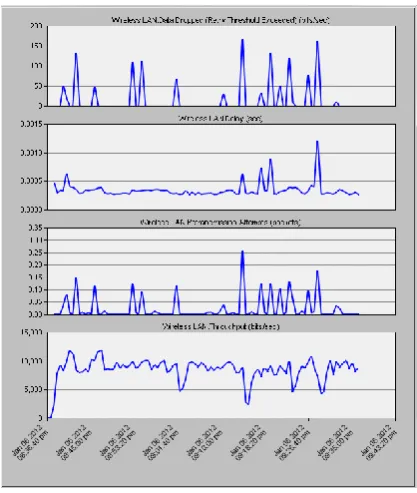
Case 1: With node buffer size of 256 K and transmission power of 0.005 watts Case 2: With node buffer size of 1024 K and transmission power of 0.010 watts.In both cases a random mobility was provided to the ad hoc network nodes. The result of both the simulation and their analysis has been discussed in the sub section of this section.The Sub-sections of this chapter are as followes:5.1 Simulation Case -1
In this case the buffer size B = was set to 256 K and transmission power set to 0.005 watts.
Figure 4: Simulation results in case of n = 2
[image:4.595.71.286.389.543.2] [image:4.595.327.536.414.661.2]Figure 6: Simulation results in case of n = 8
Figure 7: Simulation results in case of n = 16
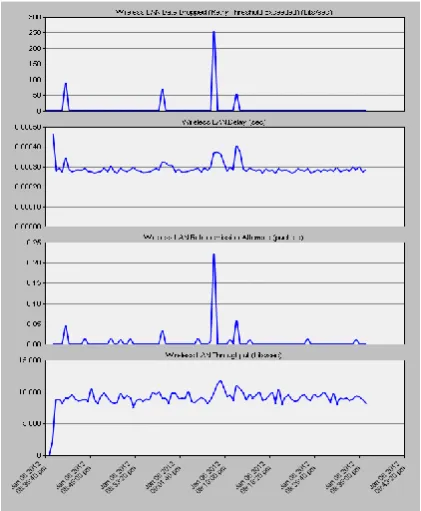
5.2 Simulation Case -2
[image:5.595.78.289.375.656.2]In this case the buffer size B = was set to 1024 K and transmission power set to 0.010 watts.
Figure 8: Simulation result of case 2 when n=2
[image:5.595.329.540.434.690.2]Figure 10: Simulation result of case 2 when n=8
Figure 11: Simulation result of case 2 when n=16
[image:6.595.328.573.93.335.2]5.3 Overall result of both the cases
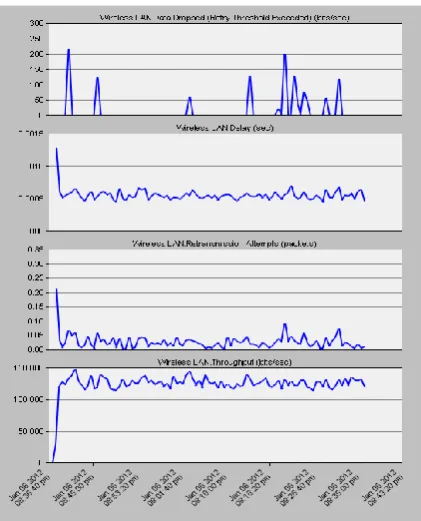
Figure 12 : Data dropped in both the cases
With increase in the node transmission power and buffer size the amount of packets dropped becomes less.
Figure 13 : Delay in both the cases
[image:6.595.328.574.401.648.2] [image:6.595.79.290.409.670.2]Figure 14 : Retransmission attempt in both the cases
In Case 2 the retransmission attempts were significantly lesser as compared to Case 1
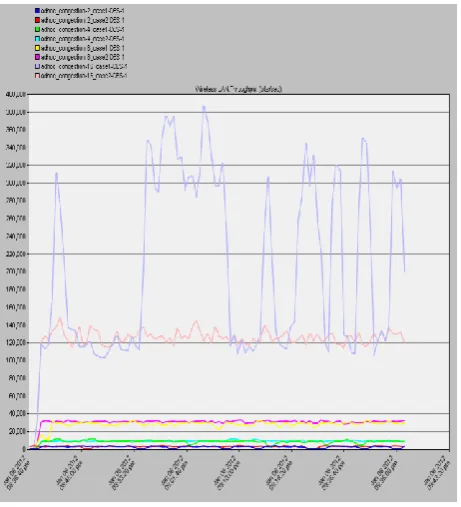
Figure 15 : Throughput in both the cases
Throughput in Case 1 is still higher as compared to that of Case 2.
6.CONCLUSION
The analysis of heavily congested wireless networks is crucial for the robust operation of such networks. To this
end, this report has presented an analysis of some IEEE 802.11b wireless ad-hoc networks specifically.In this paper investigated the effect of buffer size, mobility and node power level to the in flights packets congestion on network. Some methods of handling congestion is also discuss in this report, which can be employed for certain network status. With the help of certain simulation conducted using OPNET Modeler 14.5 it was determined as to how buffer size, mobility and node power can prove to be critical for ad hoc network performance. With a controlled size of users , the simulation result shows that the “larger node’s buffer size and power level” at even a random mobility will makes network performance degradation more critical compared to the “small node buffer size and power level”. This can be seen throughout several selected parameters which are: low throsughput, high number of packet dropped, high number of retransmission attempts and long. Therefore, it can be concluded the changes of node’s buffer space availability in ad hoc environment plays an important point in order to have better the network performance.A lot of issues and problems regarding wireless ad hoc network were discussed in this report, from their routing to control mechanisms all were discussed. However there are some ways by whish this study may be expanded further.
Effect of Antenna design – In this study we conducted all the simulations on standard IEEE WLAN mobile nodes, however it is yet to be evaluated as to how the antenna design affect the performance of an ad hoc network
Performance issues due to wireless losses – It is yet to be evaluated as to how the wireless losses may change the network performance with increase in its scale.
7.REFERENCES
[1] V. Anantharaman and R. Sivakumar, “TCP Performance over Mobile Ad Hoc Networks – a Quantitative Study”, Wireless Communication and Wireless Networks (WCMC), Special Issue on Wireless Evaluation of Wireless Networks, pages 203 to 222, 2003
[2] Subedi, L., M. Najiminaini, and L. Trajkovi. Performance Evaluation of TCP Tahoe, Reno, Reno with SACK, and NewReno Using OPNET Modeler 2008: Citeseer.
[3] Alnuem, M., J. Mellor, and R. Fretwell. New algorithm to control TCP behavior over lossy links. 2009: IEEE.
[4] Haque, M.E. and M.H. Kabir, TCP Congestion control in Heterogeneous Network. 2007.
[5] Seddik-Ghaleb, A., Y. Ghamri-Doudane, and S.M. Senouci. TCP WELCOME TCP variant for Wireless Environment, Link losses, and COngestion packet loss ModEls. 2009: IEEE.
[6] X. Lin, N. Schroff, and R. Srikant. On the connection-level stability of congestion-controlled communication networks. 2006.
[image:7.595.78.309.407.661.2][8] R. Ramanathan and Rosales-Hein. “Topology control of multihop wireless networks using transmit power adjustment”. In Proceedings of IEEE INFOCOM'00, pages 404-413, March 2000.
[9] Y.Yi and S. Shakkottai.“Hop-by-hop congestion control over a wireless multihop network” In ieee INFO COM'04, pages pp.1214{1224, July 2004.
[10] F. D. Priscoli and A. Pietrabissa. “Hop-by-Hop Congestion Control for Wireless LAN: A Model-Based Control Approach”. International Journal of Control, 2005.to appear.
[11] C. Murthy and S. Manoj, B. Ad Hoc Wireless Networks: Architectures and Protocols. Prentice Hall Communications and Emerging Techno, May 24 2004.
[12] A. Ephremides, J. Wieselthier, and D. Baker. “A design concept for reliable mobile radio networks with frequency hopping signalling". In Proceedings of IEEE, pages 56-73, Jan. 1987.”
[13] R. Shafik, S. Weiss, and E. Rogers.“A DSP-based approach to congestion control for multihop ad hoc WLANs with BoD access”. In 2nd IEE-EURASIP DSPEnabledRadio Conference'05, pages pp.31/1/31/9, Southampton, SO17 1BJ, September 2005.
[14] V. Jacobson. “Congestion Control and Avoidance”.Computer Communications Review, vol.18(4):314-329, Aug. 1988.
[15] Haniza N., Zulkiflee M., Abdul S.Shibghatullah, Shahrin S., Faculty of Information and Communication Technology, UniversitiTeknikal Malaysia Melaka, Melaka, Malaysia , World of Computer Science and Information Technology Journal “Congestive Loss in Wireless Ad hoc Network”