34
Adaptive Control of an Electrostatic Micro-Actuator
with Unbounded Dynamic Uncertainties based on
Lyapunov Stability Criterion
Reza Nadafi
Space Science and Technology Institute, Amirkabir University of Technology 424, Tehran, Iran
ABSTRACT
In this paper, a model reference adaptive control is designed for perfect tracking of moveable electrode of an electrostatic microactuator. The adaptive control of the nonlinear model of this microactuator is constituted feedback control and adaptation law. A Lyapunov function is presented that it guarantees perfect tracking and parameter convergences. The simulation shows designed adaptive control to have robustness appropriately against limited parameter varieties. Furthermore, input control is far from saturation condition.
Keywords
Electrostatic microactuator, adaptive control, Lyapunov stability criterion.
1.
INTRODUCTION
Micro Electro Mechanical Systems (MEMS) and IC technology have to create a field of technology that has huge applications. The microactuators are an important field in MEMS category. The piezoelectric, piezoresistive, shape memory alloys, ionic polymer metal composites, electrostatics and etc. are familiar microactuators. The electrostatic microactuators are applied in microrobotics, micropumps, MEMS accelerometers and etc. The capacitance of the parallel-plate electrostatic actuator is vitiated which these microactuators need accurate control in order to achieve the required performance.
The ‘‘pull-in” instability is limitation for the use of electrostatic micro-actuators [9]. Due to its simplicity, open-loop and constant input electrostatic microactuators are used for many years, but they were unable to provide stable and controllable movement electrode beyond 30% of the capacitive gap, so some mechanical modifications were necessary. Closed-loop control is able to overcome these unwanted problems. Many linear controllers have been presented until now. For examples, PD controllers were developed to control a 1 DOF an electrostatic microactuators [1], [3]. The advantages and disadvantages of simple open-loop, closed-loop control strategies and linear control for electrostatic actuators were studied by [2], [8]. Therefore, in recent years, different nonlinear controls have been extended to the control of electrostatic microactuator. The some feedback control techniques were developed which those conclude input–output linearization, feedback, and charge feedback schemes [4-7]. Control schemes based on differential flatness, Lyapunov functions and backstepping control were reported by [11-13], respectively. However, the model parameters of electrostatic microactuator must be certain in these articles but in the application, uncertainty parameter is very possible. In the practice, it is very hard to have an exacted model for parameters of microactuator.
The parameters of electrostatic microactuator were depended on microfabrication processes, environmental conditions, application domains, time duration of action, manufacturing tolerance, external disturbances, and etc.
In order to consider uncertainty parameters many research published based on robust backstepping control. Two robust control laws are presented for an electrostatic microactuator in the presence of parasitic and parametric uncertainties [10], [14] but the boundary parameters should be determined yet. Therefore, it is indisputable to design the control system for electrostatic microactuators under the uncertainty and variety parameters, which is the contribution of this research.
In fact, an adaptive controller estimates some uncertainty within the system, and then automatically designs a controller for the estimated plant uncertainty. In this way the control system uses information gathered on-line to reduce the model uncertainty, that is, to figure out exactly what the plant is at the current time so that good control can be achieved.
In this paper, feedback nonlinear control and adaptation law are designed based on Lyapunov stability criterion. In this purpose, a novel Lyapunov function candidate is satisfied conditions of the Lyapunov stability criterion. The simulation results show perfect tracking and parametric convergences to happen with uncertainty and variety parameters by a properly control input.
The organization of this article is as follows. The dynamical model is presented in Section 2. The details of adaptive control designing and stability proof are described in Section 3. The simulation results are given in Section 4.
2.
MODEL OF ELECTROSTATIC
MICROACTUATOR
The electrostatic microactuator is considered as a parallel plate microcapacitor whose one plate is attached to the ground while its other moving plate is displacing in the air layer as shown in Fig. 1 [8].
35 x0 is the initial distance between plates, x is the displacement
of the moving plates from the initiated position, and η is difference between x0 and x. thus, the nonlinear dynamics of the electrostatic microactuator is [8]:
(1)
Where m is the plate’s mass, c is the damping, k is the spring’s stiffness, V is the applied voltage between the electrodes, A is the area of the plate, and ε is the dielectric constant, as shown in figure 1. In order to simplify (1), the parameter x is substituted with η as below:
(2)
Noting that (1) and (2), eq.1 is rewritten as
(3)
Where a1, a2, a3, and u are defined as:
(4)
3.
ADAPTICE CONTROL DESIGN
The first, feedback nonlinear control is designed with certain parameters. For (3), the tracking error (e) is defined as follows
(5)
Where ξr is desired trajectory. In order to achieve perfect tracking, input control is designed for (3) as
(6)
Where r is the reference signal which it is defined as below
(7)
The controller gain (λ) must be positive forever. From the (3) and (2), differential equation of tracking error is defined as:
(8)
The (6) exposes well that tracking error converges to zero exponentially. Thus, the perfect tracking is achievable if parameters are certain. In the (6), if the a1 and a2 are assumed uncertain , then the input of feedback nonlinear control is described as
(9)
Noting that (3), (5), and (9), we can get
(10)
Where and are calculated as below
(11-a)
(11-b)
A first order filter is designed as
(12)
Using the (12), the (10) is modified below form
(13)
Furthermore, the adaptation law is designed as:
(14)
Where Г is a positive gain adaptation. In order to prove stability, The Lyapunov function candidate is considered as:
(15)
The time derivative of W is
(16)
From (11-b) and (14), (16) is simplified as
(17)
Noting (13) and (17), the time derivative of W is obtained as
(18)
Finally, it gives
(19)
Thus, the adaptation law of the (11) is satisfied the Lyapunov stability criterion. Scilicet, the adaptive control of the electrostatic microactuator is constituted controller and adaptation law. The Lyapunov stability criterion affirms that the perfect tracking error and the parameter convergences are guaranteed under unbounded dynamic uncertainties.
4.
SIMULATION RESULTS
In order to study the performance of designed adaptive control, some simulation is performed in the MATLAB_Simulink software. The parameters of the simulated system are presented in the Table 1.
Table1. Measure of microactuator parameter
P a ra m ete r m (K g ) A (μ m 2)
ε (C2
/N. m 2 ) k (N/m ) c (N.s/m ) X0 (μ m ) M ea sure 7 .0 4 9 6 × 1 0 -10 1 6 0 0 0 0 9 × 1 0 -12 0 .8 1 6 1 .4 × 1 0 -5 4
36 Fig 2: The displacement of the microactuator electrode
[image:3.595.318.538.147.315.2]with open-loop dynamics
4.1
The Adaptive Control with the
Sinusoidal Reference Trajectory
[image:3.595.58.274.369.525.2]Figure 3 and Figure 7 show the adaptive control behavior. In order to simulate the designed controller, the adaptation constant (Г) is 1×10⁴, the initiated electrode position is 3μm, the reference trajectory is sinusoidal with 1500Hz frequency and , and the a1,a2 parameters are uncertain that the initiated estimation are considered zero.
Fig 3: The comparisons between the tracking errors of the different control gains
Fig 4: The comparison between the system outputs of the different control gains and the sinusoidal reference.
It is appeared from Figure 3 and Figure 4 that the perfect tracking is achieved if control gain (λ) is considered appropriately. Hence, the measure of control gain is suggested 1.1×10⁶. However, this λ must satisfy the limitation of the control effort. Figure 5 shows the control effort of adaptive control with sinusoidal reference for this λ.
Fig 5: The control effort of adaptive control with sinusoidal reference
Maximum input needs 40 volt to modify initiate location of the microactuator electrostatic from Figure 5. Indeed, the different initiate position. Except prior time, maximum input is 12 volt for overall time.
[image:3.595.325.531.441.605.2]According to the adaptive control law, the adaptation mechanism estimates a1, a2 parameters which the tracking error converges to zero.
Fig 6: The estimated a1 with sinusoidal reference
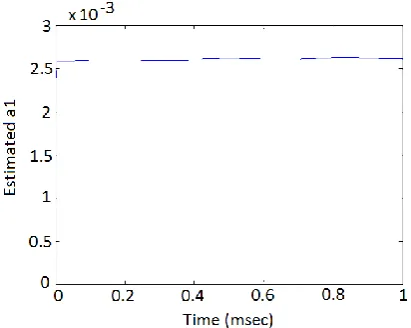
Figure 6 shows the estimation of a1 is inclined to constant value which the perfect tracking is performed whereas; the estimation of a2 has the ascending behavior in Figure 7.
0 0.2 0.4 0.6 0.8 1
x 10-3 0
0.2 0.4 0.6 0.8 1 1.2 1.4
time (sec)
E
le
ct
ro
d
e
D
isp
la
ce
m
e
n
t
(m
icr
o
m
e
te
[image:3.595.60.276.568.734.2]37
Fig 7: The estimated a2 with sinusoidal reference
4.2
The Adaptive Control with the
Ramped Reference Trajectory
In order to study behavior of the designed adaptive control with λ = 1.1×10⁶
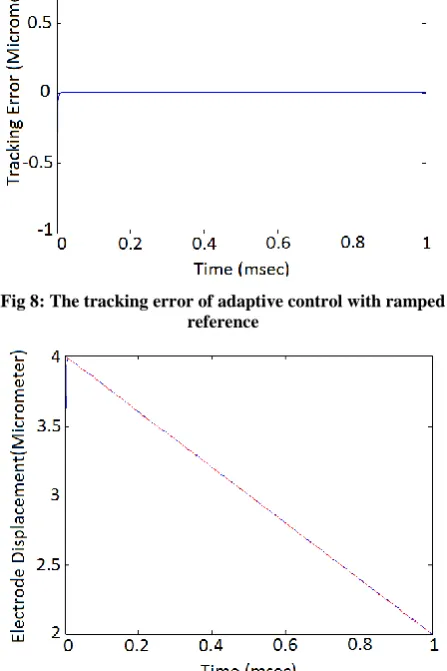
[image:4.595.322.535.110.277.2]and Г = 1×10⁴, a ramped reference trajectory is considered with a 0.002 slope.
Fig 8: The tracking error of adaptive control with ramped reference
Fig 9: The system output and the ramped reference of the electrode displacement
It is appeared from Figure 8 and Figure 9 that perfect tracking of designed adaptive control is achieved with λ = 1.1×10⁶
and Г = 1×10⁴
under ramped reference trajectory.
Fig 10: The control effort of adaptive control with ramped reference
Figure 10 shows except prior time, the maximum required input is 3volt that it is below the limitation of the electrostatic microactuator. In order to affect adaptive control by parameter varieties, the unknown parameters in the dynamical model of the electrostatic microactuator are assumed as
(20)
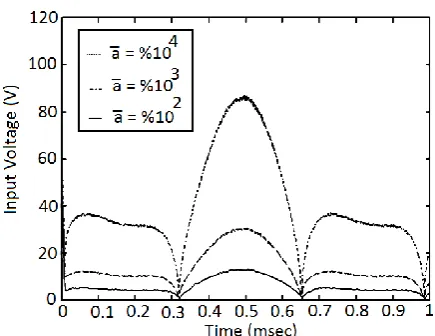
[image:4.595.55.279.360.696.2]Where j is 1 or 2, is the amount of parameter variety, and ai is the real amount of the parameter. Figure 11 and Figure 12 show the tracking errors and control efforts under the different varieties of the uncertain parameters.
Fig 11: The comparisons between the tracking errors under the different uncertainty
[image:4.595.317.540.436.603.2]38 Fig 12: The comparisons between the control efforts under
the different varieties of the uncertain parameters Figure 12 appears the required input of the adaptive control under different varieties of the uncertain parameters. It is obvious, if the percentage of parameter variety increase then the required input increase slower than. For example, the maximum input- control has 90 volt value if the parameter variety becomes 1000 times.
5.
CONCLUSION
The designed adaptive nonlinear controller in this paper is used to estimate unknown parameters of the electrostatic microactuator. The presented Lyapunov function satisfied the conditions of the Lyapunov stability criterion that the perfect tracking is achieved with parameter uncertainties.
In this paper, the controller gain and the adaptation constant are suggested λ = 1.1×10⁶
and Г = 1×10⁴, respectively. This controller has robustness against the parameter uncertainties and the variation parameters in the simulation tests how the required input keep in the normal rang of the electrostatic microactuators.
6.
REFERENCES
[1] Borovic B, Hong C, Liu AQ, Xie L, Lewis FL. Control of a MEMS optical switch. In: Proceeding of the 43rd IEEE conference on decision and control; 2004. p. 3039– 44.
[2] Borovic B, Liu AQ, Popa D, Cai H, Lewis FL. Open-loop versus closed-Open-loop control of MEMs devices: choices and issues. J Micromech Microeng 2005;15:1917–24.
[3] Bhansali S, Zhang AL, Zmood RB, Jones PE, Sood DK. Prototype feedbackcontrolled bidirectional actuation system for MEMS applications. J Microelectromech Syst 2000;9(2):245–51.
[4] Maithripala DHS, Berg JM, Dayawansa WP. Nonlinear dynamic output feedback stabilization of electrostatically actuated MEMS. In: Proceeding of the 42nd IEEE conference on decision and control, vol. 1; 2003a. p. 61– 6.
[5] Maithripala DHS, Berg JM, Dayawansa WP. Capacitive stabilization of an electrostatic actuator: an output feedback viewpoint. In: Proceedings of the 2003b American control conference. p. 4053–58.
[6] Maithripala DHS, Berg JM, Dayawansa WP. Control of an electrostatic microelectromechanical system using static and dynamic output feedback. ASME J Dyn Syst, Measure, Control 2005a;127(3):443–50.
[7] Maithripala DHS, Berg JM, Dayawansa WP. A general modeling and control framework for electrostatically actuated mechanical systems. Int J Robust Nonlinear Control 2005b;15:839–57.
[8] Marialena Vagia, George Nikolakopoulos, Anthony Tzes, “Design of a robust PID-control switching scheme for an electrostatic microactuator,” Journal of Control Engineering Practice, Volume 16, pp.1321– 1328, 2008.
[9] Owusu KO, Lewis FL. Solving the ‘‘Pull-in” instability problem of electrostatic microactuators using nonlinear control techniques. In: Proceedings of the second IEEE international conference on nano/micro engineered and molecular systems; 2007. p. 1190–95.
[10] Wenlei Li a,b, Peter X. Liu, “Robust adaptive tracking control of uncertain electrostatic micro-actuators with H-infinity performance,” Journal of Mechatronics, Volume 19, pp. 591–597, 2009.
[11] Zhu GC, Lévine J, Praly L. Improving the performance of an electrostatically actuated MEMS by nonlinear control: advances and comparison. In: Proceeding of the IEEE conference on decision and control 2005 and 2005 European control conference. p. 7534–39.
[12] Zhu GC, Lévine J, Praly L, Peter Y-A. Flatness-based control of electrostatically actuated MEMS with application to adaptive optics: a simulation study. J Microelectromech Syst 2006;15(5):1165–74.
[13] Zhu GC, Lévine J, Praly L. Stabilization of an electrostatic MEMS including uncontrollable linearization. In: Proceedings of the 46th IEEE conference on decision and control; 2007. p. 2433–38.
[14] Zhu GC, Penet J, Saydy L. Robust control of an electrostatically actuated MEMS in the presence of parasitics and parametric uncertainties. In: Proceedings of the 2006 American control conference. p. 1233–38.