Handwritten and Printed Devanagari Compound using
Multiclass SVM Classifier with Orthogonal moment
Feature
*1
K.V.Kale,
IEEE Senior Member,
2S.V.Chavan,
IEEE Student Member,
1
M.M.Kazi,
IEEE Student Member,
1Y.S.Rode,
IEEE Student Member1
Dept. of Computer Science & I.T., Dr. Babasaheb Ambedkar Marathwada Universitiy, Aurangabad (MS) - India
2Dept. of Computer Science & I.T. MSS’s Arts, Commerce & Science College, Ambad Dist. Jalna (MS) - India
ABSTRACT
Handwritten Devanagari character plays a vital role in the research area. Number of technique has been adopted in previous decades and still some new are arising to get good results from recognition system. In Devanagari, Compound character are complex in structure, they are written by combination two or more character. Due to complex structure in it, it gives a challenging task to the researchers. The occurrence of compound in the script is upto 8 to 10%. In this research paper, a recognition system for handwritten and printed Devanagari Compound Character is proposed bases on orthogonal moment i.e. Legendre and Zernike moment as a feature are used to recognize the Devanagari character. The character image is preprocessed and normalized to 30X30 pixel sizes, and used for structural classification where the character is classified into three classes. After classifying the character it is partitioned and from each zone moment feature are extracted. The proposed system is trained and tested on 27000 handwritten collected from writer of different profession, 10800 printed Devanagari basic and compound character database under APS Designer Software. For classification fivefold cross validation test is used with SVM to obtain average percentage of recognition accuracy. The RR for Printed is 98.42 % (basic) and 98.31% (compound) and for Handwritten is 98.51% (Basic) and 98.30% (Compound) by SVM. The total number of classes is 48 Basic character and 60 Compound + split character. The obtained results were compared with some related existing approaches. Owing to the proposed technique, the results obtained show higher efficiency regarding classifier accuracy.
Keywords
Devanagari Compound character; Legendre Moment; Zernike Moment; k-Fold; SVM.
1.
INTRODUCTION
Handwritten character recognition is an area of image processing and pattern recognition fields. This field of research is applicable to the application areas such as form filling, job application, banking and postal automation [1-3] etc, and also for identification of a person of a scanned handwritten script; it is useful for biometric modality with application in forensic and historic document analysis (HDA) and represents an excellent study area within the research field of biometrics. Handwritten character recognition in Indian script [4] is a challenging task specially, for several reasons because of complex structure of character with their modifiers and presence of compound character.
The research work on character recognition of Devanagari script was started in 1970, where Sinha and Mahabala [7] were presented a syntactic pattern analysis system for the recognition of Devanagari characters (DC).
First research report on handwritten Devanagari Characters (HDC) was published in 1977 by Sethi and Chatterjee [8], very few work were reported on OCR in the literature and later on in the next decade S. Kumar and et. al. contributed more in this domain [9]. An extensive research work on printed Devanagari Characters and Handwritten Characters was carried out by Bansal [10]– [12] and Reena et.al, [13], [14] respectively. Recognition of characters in different languages using Zernike Moments was reported in [9], [15]– [22]. Researchers have proposed Chain Code Histogram and directional information gradient based feature extraction in [22]–[24]. A significant contribution by Arora and et. al., proposed feature extraction techniques namely, intersection, shadow feature, chain code histogram and straight line fitting features in [25]–[28]. Deshpande and et. al. [29] has proposed fine classification and recognition of Devanagari characters. S. Kumar in [30] also extracted various features and performed comparison using SVM and MLP. Pal and et al. proposed SVM and MQDF based scheme for recognition of Devanagari Characters [31]. U. Pal and T. Wakabayashi [32] given a comparative study of different Devanagari Character recognizers which extracts features based on curvature and gradient information. Sushama Shelke and et. al. [33] presented a novel approach for recognition of unconstrained handwritten Marathi characters. Baheti M.J. and et al. [34] proposed a method based on Affine Invariant Moment (AIM) for Gujarati numerals using k-NN and PCA classifiers. Elastic matching (EM) technique based on an Eigen Deformation (ED) for recognition of handwritten Devanagari characters is proposed by V. Mane and et.al, [35]. Recognition of handwritten Bangla compound characters was attempted by U. Pal and et al. [36] using gradient features. S. Shelke and S. Apte have reported work on handwritten Marathi compound characters using multi-stage multi-feature classifier [5], [6]. The literature evidence shows that moment can be considered as potential features for recognition of characters and numerals, which motivate us to enrich the several orthogonal and discrete moment features and test the efficacy of the system for compound characters. While significant advances have been achieved in recognizing Roman-based scripts like English, ideographic characters Chinese, Japanese, Korean, and Arabic, only few works on some of the major Indian scripts like Devanagari, Bangla, Gurumukhi, Tamil, Telugu, are available in the literature [37]–[41].
2.
PROPERTIES OF DEVANAGARI
SCRIPT
Handwritten Devanagari character recognition is a challenging task especially because of complex structure of character with their modifiers and presence of compound character. Compound characters are those where one half of character is connected to full character to produce a special character. Thus there are large variations in shape of character as writing style, pen quality (thick/thin), strokes that substantial extent the recognition accuracy. Writing style in Devanagari script is from left to right. The concept of upper/lower case is absent in Devanagari script. Occurrence of compound character in the script is upto 8 to 10%. A consonant/vowel following a consonant sometimes takes a compound orthographic shape, which is called as compound character. Compound character is a combination of two and three consonants as well as consonant and vowels. There are about 280 compound characters in Devanagari. The compo-und characters are joined in various ways, by removing vertical line of the character and then join it to other character from left side like , or another way is join side by side or one above the other . The e.g. regarding to the compound is shown in Fig.(1). Split character is the half character of basic character which get connected to other character e.g. regarding split is given in Fig.(2).
Fig. (1) Example of Compound Character
Fig. (2) Example of Split of Compound Character To attain the recognition accuracy of join strategies of compound character the structural classification is required. There are two routes for recognition of compound character. One way by separation of the character and second is without separation. For first method two separate features are extracted and then recognition is done. For second method without separation the feature are extracted. At present no dataset on Devanagari handwritten compound characters is available. The data collection procedure is explained in the following section.
3.
DATABASE DESIGNING
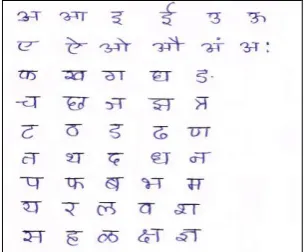
[image:2.595.340.515.66.509.2]The basic set of symbols of Devanagari script consists of 12 vowels (or swar), 36 consonants (or vyanjan) as shown in Fig. (3), which are used for this work, we have also used 45 compound character + 15 split component of compound character for proposed research which is presented in Fig. (4). A momentous contribution of present work is the pioneering development of large database for Handwritten Devanagari Basic and Compound Character was collected. Details of this database are provided. The printed datasets are created by using APS Designer 4.0 software’s. The printed dataset contains multi-font and size Devanagari (Basic & Compound) The collected dataset of printed basic and compound of character is shown in Fig (5) and (6).
[image:2.595.352.505.72.198.2]Fig.3-Sample dataset of handwritten Devanagari Character
[image:2.595.343.512.224.372.2]Fig.4-Sample dataset of handwritten Devanagari Compound and split Character
Fig.5 - Sample dataset of printed Devanagari Character with multi-font
[image:2.595.56.265.352.437.2] [image:2.595.344.514.407.520.2] [image:2.595.354.504.561.683.2].
)
,
(
)
(
)
(
4
)
1
2
)(
1
2
(
11 1
1
dxdy
y
x
f
y
P
x
P
m
n
L
nm
n m
3.1
Data Set
The Handwritten and Printed Devanagari (Basic & Compound) character databases consist of 27000 samples written by writer from different location, fields, profession etc and 10800 samples from APS Designer Software. The database is divided into respective training and testing set approximately into the ratio of 4:1. The details of this database are given below in Table 1.
Table 1 Dataset of handwritten and printed Devanagari Basic and Compound Character
Characte r Set
Basic Comp
-ound Split Char acter
Total
Devana gari Handw ritten Charact
er
Training
9600 9000 3000
27000 Testing 2400 2250 750
Total 12000 11250 3750
Devana gari Printed Charact
er
Training
3600 3375 1125
10800 Testing 1200 1125 375
Total 4800 4500 1500
3.2
Preprocessing
The preprocessing plays important role in handwritten character recognition as in pattern recognition task. Preprocessing is an important step by applying a number of procedures like smoothing, enhancing, filtering etc, for making a digital image usable by subsequent algorithm to improve their readability. The digital scanned image is first binarized, preprocess using various morphological operation opening, closing, spurs operations which connect discontinues.
3.3
Pre-classification
The pre-classification of character is based on two stages global features i.e. presence of vertical line, position of it in the character and enclosed region in the character and local features i.e. end points and junction in the character. On the basis of global feature, the character is classified into three major categories based on the presence of vertical bar, character with vertical bar at right VEB, character with vertical bar at middle VMB, and the character with absence of vertical bar NB.
Vertical bar on right are further classified into two categories based on whether the vertical bar and rest of the character are connected or not to the bar. These are show in the following Table 2.
Table 2: Classification of Devanagari Character
Sr. No
Pre-classification Character
1 Character connected with
vertical bar at right side
Ká, Iá, Ûî, pe,
Pá, $e, le, Le,
Oá, ve, He, ye,
Yá, cá, Ùe, ue,
Já, mî,<e, #î, %e
2 Character not connected withvertical bar at right side
iá, Ce, Má
3 Character with vertical bar atmiddle
Jáâ, heâ
4 Character with absence of
vertical bar
[.,Ú, š, ", [, {, o, j,
n, U
3.4
Local Structural Classification
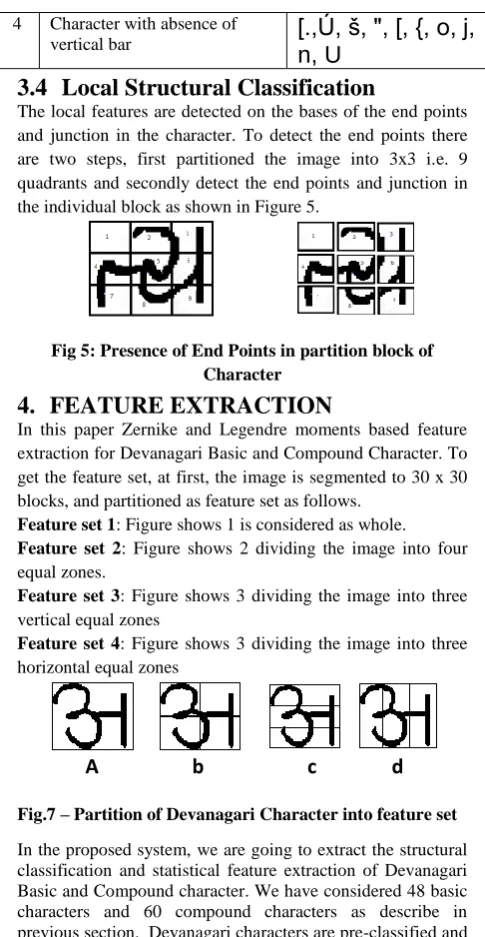
The local features are detected on the bases of the end points and junction in the character. To detect the end points there are two steps, first partitioned the image into 3x3 i.e. 9 quadrants and secondly detect the end points and junction in the individual block as shown in Figure 5.
Fig 5: Presence of End Points in partition block of Character
4.
FEATURE EXTRACTION
In this paper Zernike and Legendre moments based feature extraction for Devanagari Basic and Compound Character. To get the feature set, at first, the image is segmented to 30 x 30 blocks, and partitioned as feature set as follows.
Feature set 1: Figure shows 1 is considered as whole.
Feature set 2: Figure shows 2 dividing the image into four equal zones.
Feature set 3: Figure shows 3 dividing the image into three vertical equal zones
Feature set 4: Figure shows 3 dividing the image into three horizontal equal zones
[image:3.595.307.550.66.535.2]A
b
c
d
Fig.7 – Partition of Devanagari Character into feature set
In the proposed system, we are going to extract the structural classification and statistical feature extraction of Devanagari Basic and Compound character. We have considered 48 basic characters and 60 compound characters as describe in previous section. Devanagari characters are pre-classified and they are placed in proper class on the basis of global and local features in turn from it Zernike and Legendre moment features are extracted.
In pattern recognition, feature extraction stage for character recognition plays a major role in improving the recognition accuracy. Features are extracted from binary image/characters. Many characters are misclassified due to their similarity in shape or slight variation in writing style. So features which are selected should tackle these problems.
4.1
Legendre moments (LM)
The basis function for Legendre moment is Lnm(x, y) =
Pn(x)Pm(y) where Pp(x) denotes the pth order of Legendre polynomial. The (n+m)th order of Legendre moment, Lnm, is defined in Eq. 1 [43]
(1)
k n x k n k n k k n n k k n x n P 2 )! 2 ( )! ( ! )! 2 2 ( 2 / 0 ) 1 ( 2 1 ) (
(2)
The Legendre moment can be computed by Geometric moment as follows,[44]
n j m k jk mk njnm a a M
m n 0 0 4 ) 1 2 )( 1 2 (
(
3)
4.2
Zernike moments (ZM)
The Zernike moments are rotation invariant and can be use to construct to an arbitrary order. They are set of complex, orthogonal polynomials defined over the interior of unit circle x2 + y2 = 1. The general form is [45]
jmnm
nm r R r e
Z y x nm
Z ( , ) ( , ) ( )
(4)
Where x, y and r, correspond to Cartesian and polar coordinates, 0 |m| n, n - |m| is even
Rnm(r) is a radial polynomial given by,
k
n
r
m
k
n
m
k
n
k
k
n
m
n
k
k
r
nm
R
2
]!
2
/
|)
|
2
[(
]!
2
/
|)
|
2
[
!|
)!
(
2
/
|)
|
(
0
)
1
(
)
(
(5)
The Zernike moment of order n with repetition m for a digital image is given by [46]
* )] , ( )[ , ( 1
P x y v r
n nm Z nm x y
(6)
5.
Classification & Recognition
The classification stage is the assessment part of a recognition system and it uses the features that are extracted from the previous stage. We have used multiclass Support Vector Machine (SVM).
5.1
Support Vector Machines
The concept of (SVM) Support Vector Machine was introduced by Vapnik [47]. The objective of any Machine that is capable of learning is to achieve good generalization performance, given a finite amount of training data, by striking a balance between the goodness of fit attained on a given training dataset and the ability of the machine to achieve error- free recognition on other datasets. With this concept as the basis, support vector machines have proved to achieve good generalization performance with no prior knowledge of the data. The principle of an SVM is to map the input data onto a higher dimensional feature space nonlinearly related to the input space and determine a separating hyper plane with maximum margin between the two classes in the feature space. A support vector machine is a maximal margin hyper plane in feature space built by using a kernel function. This results in a nonlinear boundary in the input space. The optimal separating hyper plane can be determined without any computations in the higher dimensional feature space by using kernel functions in the input space [47]. The binary SVM classification problem can be converted to multi-class classification by building a number of 2-class SVM classifiers for different class pairs and then taking the final classification decision based on different strategies such as max-wins strategy, winner-takes-all strategy etc. Max-wins strategy is the majority-voting decision of all the 2-class SVM classifiers. In winner-takes-all strategy, the binary classifier
with highest output function takes the decision of classification. Common existing approaches [48-51] for multi-class multi-classification problem are against-one (OAO), one-against-all (OAA), binary tree of SVM and directed acyclic graph (DAG) etc. In this research, we have chosen OAO technique for multi-class classification.
Commonly used kernels include:- 1. Linear Kernel:
K(x, y) = x. y
2. Radial Basis Function (Gaussian) Kernel: K(x, y) = exp (-||x – y||2/22) 3. Polynomial Kernel:
K(x, y) = (x. y + 1) d
We use Support Vector Machine (SVM) as classifier in this study. The SVM produces a model (based on the training data) which predicts the target values of the test data given only the test data features. An SVM is defined for two-class classification. Given a training set of instance-label pairs (xi, yi), i = 1, 2 … l where xi Rnand y {1,-1}1, the SVM require the solution of the following optimization problem:
l i i T b wC
w
w
1 , ,2
1
min
Subject to yi (wt (xi)+b) 1 - i, i > 0
Here the training vectors xi are mapped into a higher dimensional space by the function . SVM finds the optimal hyper-plane which maximizes the distance, or more specifically the margin, between the nearest examples of both the classes. These nearest examples are called as support vectors (SVs). C > 0 is the penalty parameter of the error term.
Furthermore, K (xi xj) xi)Txj) is called the kernel function.
We used the radial basis function(RBF) kernel in our work given by
0
,
)
,
(
( || || ) 2
xixj
j
i
x
e
x
K
Now a search is applied to find the value of which is parameter of RBF as like the value of c that is cost parameter of SVM using cross-validation. The value of both variance parameter are selected in the range of (0,1) for gamma and (0 , 1000) for cost (c) and examines the recognition rate.
6.
Result & Discussion
Table 3: Moment Feature set for Devanagari
Zone set
Moment Feature Feature
Set
FS1 Legendre +Zernike Moment 15 FS2 Legendre +Zernike Moment 60 FS3 Legendre +Zernike Moment 45 FS4 Legendre +Zernike Moment 45 On the basis of above feature extraction technique, feature set are created. The feature set FS1, FS2, FS3, FS4 are formed as discuss above in the partitioned of the image. The feature set as specified in the table consist of moment based feature in combination and different feature set. From each zone LM and ZM feature are extracted.
The original training and testing set of Devanagari basic character are discussed in section III A; the data set is partitioned into training and testing set applying the k-fold crossing validation technique. First structural pre-classification is done as discuss in section III C and then moment based features are extracted from feature set as discuss in section IV.
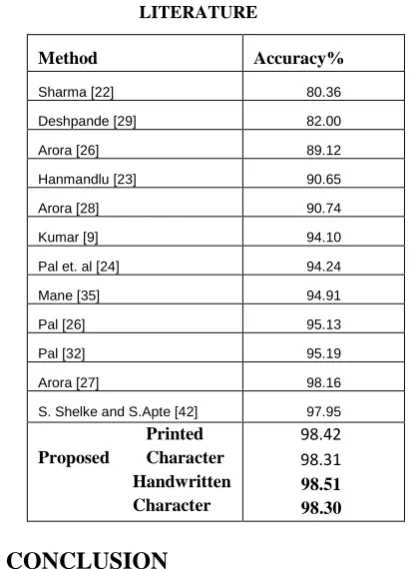
[image:5.595.329.536.92.377.2]After the pre-processing and pre-classification stage, we extracted a total feature as discuss in table 3, i.e. 15, 60, 45, 45 for each feature set for handwritten and printed Devanagari basic and compound character from the scanned documents. Data samples were divided into five fold cross validation for training and testing purpose. Accordingly, alphabets training data consisted of 9600 characters of handwritten and 3600 for printed Devanagari basic and 12000 for handwritten 4500 for printed Devanagari Compound character. Similarly for testing data consisted of 2400 characters of handwritten and 1200 for printed Devanagari basic and 3000 for handwritten 1500 for printed Devanagari Compound character. Feature vectors were extracted for the training data of handwritten and printed characters. One SVM model was trained for handwritten feature matrix of Devanagari Basic and Compound character and another was trained for printed feature matrix of Devanagari Basic and Compound character. SVM parameters on training data were fine-tuned using 5-fold cross-validation. Once the SVM models of handwritten character and printed character were trained, we checked performance of the recognition system on reserved testing data sets. The result is presented in Table 4 and 5 for Printed Devanagari results is 98.42% by SVM for basic and 98.31% by SVM for Compound Character. The performance of using SVM in Table 6 and 7 for Handwritten Devanagari Basic and Compound Character, Recognition result for Basic is 98.51% by SVM and Compound 98.30% by SVM. We have compared our results with those existing piece of work. Detail comparative result are given in Table 4
Table VIII. COMPARISON OF RESULTS OF PROPOSED METHOD WITH OTHER METHODS IN
LITERATURE
Method Accuracy%
Sharma [22] 80.36
Deshpande [29] 82.00
Arora [26] 89.12
Hanmandlu [23] 90.65
Arora [28] 90.74
Kumar [9] 94.10
Pal et. al [24] 94.24
Mane [35] 94.91
Pal [26] 95.13
Pal [32] 95.19
Arora [27] 98.16
S. Shelke and S.Apte [42] 97.95
Printed Proposed Character Handwritten Character
98.42 98.31 98.51
98.30
7.
CONCLUSION
In this paper we have proposed handwritten and printed Devanagari Basic and Compound character recognition system from which Legendre and Zernike moment based features are extracted and classifies through multiclass SVM classifier. We have obtained better result from the Legendre and Zernike moment based feature. Further we
8.
REFERENCES
[1] K. Roy, S. Vaidya, U. Pal, B. B. Chaudhuri, and A. Belaid, “A system for indian postal automation,” in Proc. 8th Int. Conf. Document Analysis and Recognition, Seoul, Korea, Aug. 31-Sep. 1, 2005, pp. 1060–1064. [2] U. Pal, R. K. Roy, and F. Kimura, “Indian multi script
full pin-code string recognition for postal automation,” in Proc. 10th Int. Conf. Document Analysis and Recognition, Barcelona, Spain, Jul. 26-29, 2009, pp. 456–460.
[3] B. B. Chaudhari, “Digital document processing - major directions and recent advances,” London:Springer, 2007. [4] U. Pal and B. B. Chaudhari, “Indian script character
recognition: a survey,” Pattern Recognition, vol. 37, pp. 1887–1899, 2004.
[5] S. Shelke, S. Apte, and et. al., “A novel multistage classification and wavelet based kernel generation for handwritten marathi compound character recognition,” in Proc. Int. Conf. Communications and Signal Processing, Kerala, India, 2011, pp. 193–197.
[7] R. K. Sinha and Mahabala, “Machine recognition of devnagari script,” IEEE Trans. System Man Cyber, pp. 435–441, 1979.
[8] I. K. Sethi and B. Chatterjee, “Machine recognition of constrained handprinted devnagari,” Pattern Recognition, vol. 9, pp. 69–75, 1977.
[9] S. Kumar and C. Singh, “A study of zernike moments and its use in devnagari handwritten character recognition,” in Proc. Intl. Conf. Cognition and Recognition, Mandya (India), 2005, pp. 514–520. [10]V. Bansal and et. al., Integrating Knowledge Sources in
Devanagari Text Recognition. IIT, Kharagpur: Ph.D. Thesis, 1999.
[11]V. Bansal and R. M. K. Sinha, “Partitioning and searching dictionary for correction of optically read devanagari character strings,” in Proc. 5th Int. Conf. Document Analysis and Recognition, Bangalore, India, Sept. 20-22, 1999, pp. 53–656.
[12]V. Bansal. and R. M. K. Sinha., “On how to describe shapes of devanagari characters and use them for recognition,” in Proc. 5th Int. Conf. Document Analysis and Recognition, Bangalore, India, Sept. 20- 22, 1999, pp. 410–413.
[13]R. Bajaj, L. Dey, and S. Chaudhury, “Devnagari numeral recognition by combining decision of multiple connectionist classifiers,” Sadhana, vol. 27, pp. 59–72, 2002.
[14]P. M. Patil and T. R. Sontakke, “Rotation, scale and translation invariant handwritten devanagari numeral character recognition using general fuzzy neural network,” Pattern Recognition, vol. 40, pp. 2110–2117, 2007.
[15]L. C. Barczak, M. J. Johnson, and C. H. Messom, “Revisiting momentinvariant: Rapid feature extraction and classification for handwritten digit,” in Proceeding of Image and Vision Computing, Hamilton, New Zealand, December, 2007, pp. 137–142.
[16] R. O. Duda, P. E. Hart, and D. G. Stork, Pattern Classification, Second ed. John Wiley and Sons, Inc. 14, 2001.
[17] H. R. Boveiri and et. al., “Persian printed numeral character recognition using geometrical central moments and fuzzy min max neural network,” International Journal of Signal Processing, pp. 226–232, 2009. [18] H. R. Boveiri., “Persian printed numeral classification
using extended moment invariants,” World Academy of Science, Engineering and Technology 63, pp. 167–174, 2010.
[19] S. Arora, D. Bhattacharjee, M. Nasipuri, D. K. Basu, and M. Kundu, “Application of statistical features in handwritten devanagari character recognition,” International Journal of Recent Trends in Engineering, vol. 2, pp. 40–42, 2009.
[20]R. S. Kunte and R. D. S. Samuel, “A simple and efficient optical character recognition system for basic symbols in printed kannada text,” Sadhana, vol. 32, pp. 21–533, 2007.
[21]S. N. Nawaz and et. al., “An approach to offline arabic character recognition using neural network,” in Proceeding of IEEE ICECS, 2003, pp. 1325–1331. [22]N. Sharma, U. Pal, F. Kimura, and S. Pal, “Recognition
of offline handwritten devnagari characters using quadratic classifier,” in Proc. Indian Conf. Computer Vision Graphics and Image Processing, Madurai (India), 2006, pp. 805–816.
[23]M. Hanmandlu, O. V. R. Murthy, and V. K. Madasu, “Fuzzy model based recognition of handwritten hindi characters,” in Proc. Ninth Biennial Conf. Australian Pattern Recognition Society on Digital Image Computing Techniques and Applications, Glenelg (Australia), 2007, pp. 454–461.
[24] U. Pal, N. Sharma, T. Wakabayashi, and F. Kimura, “Off-line handwritten character recognition of devnagari script,” in Proc. Ninth Intl. Conf. Document Analysis and Recognition, Curitiba (Brazil), 2007, pp. 496–500. [25]S. Arora, D. Bhattacharjee, M. Nasipuri, D. K. Basu, and
M. Kundu, “Combining multiple feature extraction techniques for handwritten devnagari character recognition,” in Proc. IEEE Region 10 Colloquium and Third Intl. Conf. Industrial and Information Systems, Kharagpur (India), 2008.
[26] S. Arora, D. Bhatcharjee, M. Nasipuri, and L. Malik, “A two stage classification approach for handwritten devanagari characters,” in Proc.Int. Conf. Comput. Intell. Multimedia Appl., 2007, pp. 399–403.
[27]S. Arora, D. Bhattacharjee, M. Nasipuri, D. K. Basu, M. Kundu, and L. Malik, “Study of different features on handwritten devnagari character,” in Proc. 2nd Emerging Trends Eng. Technol., 2009, pp. 929– 933.
[28] S. Arora, D. Bhattacharjee, M. Nasipuri, D. K. Basu, and M. Kundu, “Recognition of non-compound handwritten devnagari characters using a combination of mlp and minimum edit distance,” Int. J. Comput. Sci. Security, vol. 4, pp. 1–14, 2010.
[29] P. S. Deshpande, L. Malik, and S. Arora, “Fine classification and recognition of hand written devnagari characters with regular expressions and minimum edit distance method,” Journal of Computers, vol. 3, pp. 11– 17, 2008.
[30]S. Kumar, “Performance comparison of features on devanagari handprinted dataset,” Int. J. Recent Trends, vol. 1, pp. 33–37, 2009.
[31]U. Pal, S. Chanda, T. Wakabayashi, and F. Kimura, “Accuracy improvement of devnagari character recognition combining svm and mqdf,” in Proc. Eleventh Intl. Conf. Frontiers in Handwriting Recognition, Montreal (Canada), 2008, pp. 367–372.
[32] U. Pal, T. Wakabayashi, and F. Kimura, Comparative study of devnagari handwritten character recognition using different feature and classifiers,” in Proc. Tenth Intl. Conf. Document Analysis and Recognition, Barcelona (Spain), 2009, pp. 1111–1115.
[34] M. J. Baheti, K. V. Kale, and M. E. Jadhav, “Comparison of classifiers for gujarati numeral recognition,” International Journal of Machine Intelligence (IJMI), vol. 3, pp. 160–163, 2011.
[35]V. Mane and L. Ragha, “Handwritten character recognition using elastic matching and pca,” in Proc. Int. Conf. Adv. Comput., Commun. Control, 2009, pp. 410– 415.
[36]U. Pal, T. Wakabayashi, and F. Kimura, “Handwritten bangla compound character recognition using gradient feature,” in Proc. 10th Int. Conf. Information Technology, Orissa, India, 2007, pp. 208–213.
[37] B. B. Chaudhuri and U. Pal, “A complete printed bangla ocr system,” Pattern Recognition, vol. 31, pp. 531–549, 1998.
[38][38] K. Roy, T. Pal, U. Pal, and F. Kimura, “Oriya handwritten numeral recognition system,” in Proc. 8th Int. Conf. Document Analysis and Recognition, vol. 2, Seoul, Korea, Aug. 31-Sep. 1, 2005, pp. 770–774. [39]A. Pujari, C. D. Naidu, M. S. Rao, and B. C. Jinaga, “An
intelligent character recognizer for telugu scripts using multi resolution analysis and associative memory,” Image and Vision Computing, vol. 22, pp. 1221–1227, 2004.
[40]U. Bhattacharya, S. K. Ghosh, and S. K. Parui, “A two stage recognition scheme for handwritten tamil characters,” in Proc. 9th Int. Conf. Document Analysis and Recognition, Parana, Sept. 23-26, 2007, pp. 511– 515.
[41]M. Hasnat, S. M. Habib, and M. Khan, “A high performance domain specific ocr for bangla script,” in Novel Algorithms and Techniques In Telecommunications, Automation and Industrial Electronics. Springer Netherlands, 2008, pp. 174–178.
[42]S. Shelke and S. Apte, “Multistage handwritten marathi compound character recognition using neural networks,” Journal of Pattern Recognition Research 2 (JPPR), pp. 253–268, 2011.
[43]S.Saharia, P.K.Bora, and D.K.Saikia, “A comparative study on discrete orthogonal Chebyshev & Legendre moments for represe-ntationof printed characters”,in Proc.4thICVGIP,2004, pp.491.496.
[44]Prokop RJ, Reeves AP. A survey of moment-based techniques for unoccluded object representation and recognition. CVGIP: Graphical Models and Image Process. 1992;54(5):438–460.
[45]Teague MR. Image analysis via the general theory of moments. J Opt Soc Am. 1980; 70:920–930.
[46]Gheith Abandah and Nasser Anssari, “Novel Moment feature extraction for Recognizing Handwritten Arabic Letters”, Journal of Computer Science, Vol 5, pp. 226 – 232, 2009.
[47]Vapnik. V. 1995. The Nature of Statistical Learning Theory. Springer, N.Y. ISBN 0-387-94559-8.
[48]Chih Wei Hsu and Chih Jen Lin, “A comparison of methods for multi-class support vector machines”, IEEE Trans. On Neural Networks, Vol. 13, No. 2, March 2002. [49]B. Fei, J. Liu, “Binary tree of SVM: a new fast
multi-class training and multi-classification algorithm,” IEEE Transactions on Neural Networks, vol. 17, no. 3, May 2006.
[50]S. Cheong, S. H. Oh, and S. Y. Lee, “Support vector machines with binary tree architecture for multi-class classification,” Neural Info. Process. Lett., vol. 2, no. 3, Mar. 2004.