Removal of Noise in Medical Imaging Data using
Modified Decision based Adaptive Weight Algorithm
Nidhi Upadhyay Shruti Bhargava
Student researcher at TIT BHOPAL Asst. Professor at TIT BHOPAL
ABSTRACT
An effective filtering algorithmic program is planned for removing the salt and pepper noise at the various noise density position. Initial to discover the noise pixels, then completely different completely different} ways area unit practical to different noise densities. If noise density could be a smaller quantity than half-hour then, mean Filtering is applied to screeching image and if noise density is quite half-hour then, adaptive weight algorithmic program is applied to screeching image. Experimental results offer you a plan that this algorithmic program will suppress noise effectively. Changed call primarily based adaptive weight algorithmic program is developed for the removal of salt and pepper noise. It consists of 2 major steps, 1st to discover noise pixels in keeping with the correlations between image pixels, then use completely different ways supported the varied noise levels. For the low background level, neighborhood signal pixels mean methodology is adopted to get rid of noise and for the high background level, associate degree adaptive weight algorithmic program is employed. Experiments shows the planned algorithmic program has benefits over regularizing ways in terms of each edge preservation and noise removal, even for heavily infected image with background level as high as ninetieth. It still will get a big performance.
Terms — PSNR (Peak Signal to Noise Ratio), salt and pepper noise; adaptive weight algorithms; noisy image; mean filtering.
1.
INTRODUCTION
We trust heavily on our visual image to form logic of the globe around North American nation. we tend to not solely check up on effects to spot and categorise them, however we will scan for variations, and acquire associate degree taken as a full irregular “feeling” for a read with a fast peek. Humans have evolved terribly precise visual skills: we will determine a face in associate degree instant; we will differentiate colours; we will method an oversized quantity of visual data terribly quickly.However, the globe is in steady motion: stare at one thing for long enough and it'll modify in a way. Even an oversized solid structure, sort of a building or a peak, can amendment its look looking on the time of day (day or night); quantity of daylight (clear or cloudy), or numerous shadows Falling upon it. Snapshots, if you prefer, of a illustration vision
For our functions, image} may be a single picture that represents a bit. It may be person, or animals, or of an out of doors scene, or a microphotograph of associate degree electronic part, or the results of medical imaging. though the image isn't immediately acquainted, it'll not be simply a disorganized form.
2.
RELEATED WORK
During the transmission or generation of image, it were typically contaminated by varied noises. the foremost well-known version of noise in pictures is that the salt and pepper noise[1]. this kind of noise could seem in digital image attributable to contaminated impulse noise, that is caused by dead pixels in private sensors, faulty memory location in hardware or transmission in clamant
channel[2]. Salt(value 0) and pepper(value 255) noise scattered throughout the image in such how, pixels will take solely the most and minimum values in dynamic vary. The noise considerably reduces the visual effects of the image because it appears like sprinkles the white and black dots on the image. to enhance the image quality, it's vital to get rid of this noise.
Many varied algorithms were planned and researches has been conducted to get rid of the salt and pepper noise. along with these noise lessening techniques, majority splits the noise removal procedures into preliminarily detection of pixels corrupted by impulse noise followed by filtering the noise detected on the previous phase[3]. The common salt and pepper noise filtering algorithms includes: ancient Median(TM) filter algorithm; Extreme median(EM) filter algorithms; shift median (SM) filter algorithm[4]; adjustive median(AM) filter algorithms[5][6] etc. metallic element filter algorithmic rule is straightforward and speed, however it doesn't have ability of effectively removing salt and pepper noise and protection for edges and details in high noise density case[7]. EM, point and AM filter algorithms ar sensitive to totally different noise density. Their filtering properties go downhill with noise density increasing. In [8], call primarily based median filtering algorithmic rule ar used. These ways 1st determine clamant pixels and so replace them with applicable estimates victimization neighbor pixels, however clamant pixels aren't effective to observe. In [9], associate degree adjustive weight(AW) approach was proposed[10], within which the output may be a weighted total of the image and a de-noising issue, These weight coefficients depends on a state variable. The state variable is that the distinction between the present picture element and also the average of the remaining pixels within the close window. as a result of the constant ar varied, its troublesome to pick out associate degree applicable one.
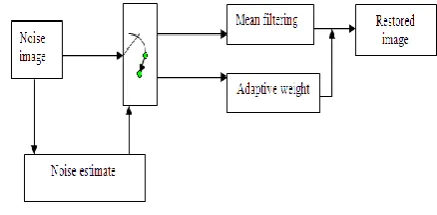
[image:1.595.322.541.572.679.2]By viewing these deficiencies and shortcomings, a switching decision based adaptive filtering algorithm is proposed. Its emphasis is an improving the de-noising ability.
Figure 2.1: A Modified Decision based adaptive weight filtering algorithm schematic
35 Only the noise pixels are processed, keeping the signal pixels
same. For filtering block, the different approaches were taken according to the noise density situations. In the low noise density case, neighborhood signal pixels mean method is adopted. In the highnoise density case, adaptive weight algorithm is used.
3. PROPOSED ALGORITHM
Firstly, i would like to debate a trifle regarding dataset that we tend to area unit planning to use for analysis motivation, we tend to in the main target medical resonance imaging knowledge for our denoising situation, we are going to conjointly take a look at our sculpt to totally different alternative medical pictures.
3.1.
Noise Detection-
Let I be the preprocessing image whose size is M x N , be the gray value of pixel at location (i, j), be the threshold used to decide whether the pending pixel belongs to noise pixels or not. be the values of the label matrix at pixel location (i, j) which is defined by:
(1)
It is known that the salt and pepper noise’s value is the max or min value in the image according to the characteristic of the noise sprinkling on images. If = 0, it means the pixel is a signal point, else it is noise pixel. Because the values of some signal pixels are absolutely around 0 or 255, it is needed to further decide whether the pixel is a noise one or not. After 40 images experiments, we find that it is advantage to use the temple window size 3 x 3 to the noise detection.
If (|s,t| 0) are not all zeros, it means that there are some signal pixels in the temple window centered at (i+s,j+t). Let T be the threshold and be the mean value of signal pixels but the center pixel itself in the temple window. Compare the D-value between and with T. If | -
, the pixel is regarded as a signal point, else it is a noise one.
(2)
If (|s,t| 0) are all zeros, it means that there are all probable noise pixels in the temple window. Let m and n be the number of salt and pepper noise in it separately. If belongs to the larger number of salt noise and pepper noise, the pixel is regarded as a signal point, else it is noise one.
(3)
3.2
Noise Filtering
The noise pixels are kept the same and only the noise pixels are corrected. Different filtering methods should be adopted for various noise densities. The specific steps as follow:
(1) Preliminarily estimate the noise density of the preprocessing image.
(4)
(2) When p is less than 30%, it is advantage to adopt the method of adjacent signal pixels mean value because of many signal pixels around the noise pixels. Let be the temple window of size centered at (i,j) and
be the mean value of all the signal pixels but the center pixel itself in . If is kept the same, else will be substituted by
(5)
(3) When p is more than 30%, if , is kept the same, else compute the signal pixels number marked as S3 in W3. If S3 = 0, it means that they are all noise pixels in W3, then move the window center to the next noise pixel. If , it means there are some signal pixels in W3. First compute the D-value between and Meani ,j, then compute their inverses marked as U a,b :
(6)
Because of the correlations between image pixels depending on their spatial location relationship, Generally, the closer the distance between two pixels are, the higher the correlations of them are. So it can make full use of spatial location relationship between the neighborhood pixels and the center pixel to determine the neighborhood pixels position weight marked as Va, b :
(7)
Let be the initial weight coefficients, be the normalization weight coefficient.
(8)
(9)
First Multiply of by the corresponding , then count up these figures. Their summation is :
(10)
will be substituted by and the pixel will be regarded as a signal point later.
(11)
(12)
4. RESULTS AND DISCUSSION
4.1 Peak Signal to Noise Ratio
To validate the advantage and effectiveness of our filtering algorithmic program, a gray-scale image whose size is 256×256 was selected . initial salt and pepper noise was supplementary to it; then our algorithmic program were accustomed restore the image corrupted by salt and pepper noise. Fig.2 is that the figure results comparison of various ways. The table one shows the various noise concentration applied to input image and obtained Peak Signal to Noise quantitative relation (PSNR) and Mean to Error.
The four algorithmic programs embody shows that: thulium algorithm is applicable for things of low noise density; With the noise density of the image increasing, EM algorithmic program is a lot of almost like thulium algorithmic program, Their filtering properties decline by means of the noise density increasing; though AW algorithmic program is best than thulium and EM algorithms in high density noise state of affairs, it still has some shortage either within the filtering result or in conserving the image details, compared with the planned algorithmic program. Supposing x_(i,j) and y_(i,j) area unit severally the gray-scale values of the initial image and also the output image at the component location(i,j). The image size is M×N, PSNR is that the image peak signal to noise quantitative relation.
PSNR=10×lg〖〖255〗^2/(1/(M×N)
∑_(i=1)^M▒∑_(j=1)^N▒〖(y_(i,j)-x_(i,j))〗^2 )〗 (13)
Compared with the filtering results of thulium, EM, AW and also the planned algorithmic program, we are able to see that the PSNR of the planned algorithmic program is greatest at totally different noise densities state of affairs. T shows that the improved results of the planned algorithmic program is finest. once the noise density is over hour, different algorithmic program PSNR drops off suddenly. With the noise density humanizing, the D-value connecting the planned algorithmic program and also the different 3 algorithms is best. notably once the noise density is up to ninetieth, their PSNR D-value is regarding ten dB. Experiment shows that the planned algorithmic program has improved de-noising and fortification detail capability.
4.2 Proposed Algorithm Simulation and
Output
[image:3.595.318.529.166.355.2]In the program, initial take the place in image and so convert that image into grayscale image mistreatment the MATLAB operate rgb2gray. The remodeled original image is appears like figure four.1. The figure four.1 may be a grayscale image of size 512 x 512, that is given to the planned algorithmic program as input image.
Figure 4.1: Original Image
[image:3.595.322.530.453.653.2]The salt and pepper noise is additional mistreatment the MATLAB operate imnoise(I, ‘salt & pepper’,01). the primary parameter to operate is that the input image, second parameter is noise kind (in our case it\'s salt & pepper) and third parameter is what proportion noise we would like to incorporate within the image. The on top of MATLAB operate can add salt and pepper noise with noise density zero.01 i.e. 100 percent within the input image and quantity created of this. operate is shown in figure 4.2.
Figure 4.2: image with salt and pepper noise added 0.01
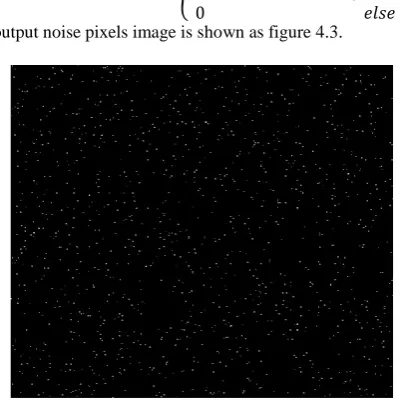
The figure 4.3 shows the noise pixels impassive from the noisy image figure 4.2. The threshold value is used to decide whether the pending pixel belonging to noise pixels or not. The figure 4.3 is the label matrix, whose value at pixel (i,j) is decided by the
subsequent functions,
, so
the output noise pixels image is shown as figure 4.3.
[image:3.595.56.264.595.720.2]37 Figure 4.4: Restored image with proposed algorithm
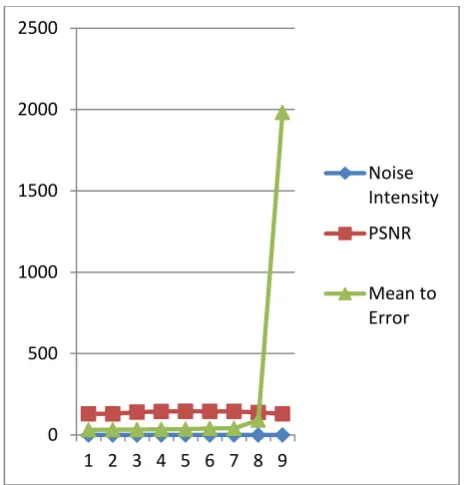
The table 1 shows the peak signal to noise ratio and mean to error when different noise intensities is functional to input image. The table shows that our proposed algorithm gives the high PSNR when the noise intensity is low and it is stable if we are increasing the noise intensity upto the 0.5. If we still increasing the noise intensity then at high noise intensity our filtering algorithm fails.
4.3 Tables & Graphs for Different noise
intensity based results-
Table No 1 Results based on different parameters for MEDICAL image
The figure 4.5 shows the chart of noise intensity versus PSNR and mean to error.
Table 1: dissimilar Noise intensities with PSNR and Mean to Error
Noise Intensity PSNR Mean to Error
0.01 130.0451 31.6125
0.02 129.9769 32.1125
0.03 140.8842 32.8050
0.05 144.5886 35.1159
0.07 145.5486 36.1592
0.09 145.0884 40.2014
0.1 145.0220 40.8205
0.2 138.5027 91.7937
[image:4.595.77.269.70.278.2]0.5 130.1591 1982.3
Figure 4.5 shows the chart of noise intensity versus PSNR and mean to error.
5. CONCLUSION
An effective filtering algorithmic program is planned for removing the salt and pepper noise at the various noise densities condition. initial to sight the noise pixels, then {different|totally totally different|completely different} ways area unit applied simply before different noise densities. If noise density is a smaller amount than half-hour then, Mean Filtering is applied to rackety image and if noise density is supplementary than half-hour then, adaptational weight algorithmic program is applied to rackety image. Experimental results show that this algorithmic program will contain noise effectively. particularly for Low noise density case, the planned algorithmic program has extra noticeable blessings compared to different algorithms. The performance of this algorithmic program is knowledgeable at low, medium and high densities on gray-scale pictures. At high noise density level, the planned algorithmic program offers improved ends up in comparison with different existing algorithms
.
6. REFERENCES-
[1] Deivalakshmi, S.; Sarath, S.; Palanisamy, P., “Detection and removal of Salt and Pepper noise in images by improved median filter”, Recent Advances in Intelligent Computational Systems (RAICS), 2011 IEEE.pp:363-368 [2] S. Huang and J.Zhu., “Removal of salt-and-pepper noise
based on compressed sensing”, IEEE Electronic Letters, Vol.46(17),pp.1198-1199,2010.
[3] Geoffrine Judith.M.C, and N. Kumarasabapathy., ”Study and analysis of impulse noise reduction filters”, Signal & Image Processing: An International Journal(SIPIJ), Vol.2(1),pp.82-92,2011.
[4] Wang and D. Zhang, “Progressive median filter for the removal of impulse noise from highly corrupted images”, IEEE Trans Circuits Syst II, Analog Digit Signal Process, 46(1):78-80, 1999.
0 500 1000 1500 2000 2500
1 2 3 4 5 6 7 8 9
Noise Intensity
PSNR
[5] S.J.Ko and Y.H. Lee, “Center weighted median filters and their applications to image enhancement”, Pattern Recognition Lett, 15(4):341-347, 1994.
[6] E.Abreu. M Lightstone, S.Mitra and K. Arakawa, “A new efficient approach for the removal of impulse noise from highly corrupted images”, IEEE Trans. Image Processing, 5(6):1012-1025, 1996.
[7] Shuqun Zhang and Mohammad A. Karim, “A new impulse detector for switching median filters,” IEEE Trans on Image Processing, 13(2):234-237, 2004.
[8] T. Kasparis, N. Tzannes and Q.Chen, “Detail-preserving adaptive conditional median filters,” Electron Imag.1(14):358-364, 1992.
[9] H. Hwang and R.A. Haddad, “Adaptive median filters: New algorithms and results”, IEEE Trans Image Process, 4(4):499-502.1995.
[10] K.Vasanth, S.karthik, Sindu Divakaran, “Removing of salt and pepper noise using unsymmetrical trimmed varient as
detector”, European Journal of scientific research, ISSN 1450-216X, Vol.70 No.3 (2012), pp. 468-478
[11] Aiswarya, K.; Jayaraj, V.; Ebenezer, D., “A New and Efficient Algorithm for the Removal of High Density Salt and Pepper Noise in Images and Videos” Computer Modeling and
7. AUTHORS BIBLOGRAPHY
1. Ms.Nidhi upadhyay-Ms .Nidhi Upadhyay received her Bachelor’s degree in Electronics and Communication Engineering in the year 2010 R.G.P.V Bhopal (M.P) India. Currently she is pursuing her Masters degree in Electronics and Communication from R.G.P.V, Bhopal (M.P) India. Her research interests are Image processing and electronics and Communication.
2. Mrs.Shruti Bhargava