http://dx.doi.org/10.4236/ojapps.2015.59051
How to cite this paper: Ntaganda, J.M., Haggar, M.S.D. and Mampassi, B. (2015) Fuzzy Logic Strategy for Solving an Optimal Control Problem of Therapeutic Hepatitis C Virus Dynamics. Open Journal of Applied Sciences, 5, 527-541.
http://dx.doi.org/10.4236/ojapps.2015.59051
Fuzzy Logic Strategy for Solving an Optimal
Control Problem of Therapeutic Hepatitis C
Virus Dynamics
Jean Marie Ntaganda
1, Mahamat Saleh Daoussa Haggar
2*, Benjamin Mampassi
3 1College of Science and Technology, School of Sciences, Department of Mathematics, University ofRwanda, Butare, Rwanda
2Department of Mathematics, Faculty of Exact and Applied Sciences, N’Djamena University, N’Djamena, Chad 3Department of Mathematics, Faculty of Sciences and Technology, Dakar University, Dakar, Senegal
Email: [email protected], [email protected], *[email protected], [email protected]
Received 27 July 2015; accepted 11 September 2015; published 14 September 2015
Copyright © 2015 by authors and Scientific Research Publishing Inc.
This work is licensed under the Creative Commons Attribution International License (CC BY).
http://creativecommons.org/licenses/by/4.0/
Abstract
This paper aims at the development of an approach integrating the fuzzy logic strategy for a the-rapeutic hepatitis C virus dynamics optimal control problem. To test the efficiency of this strategy, the authors propose a numerical comparison with the direct method by taking the values of de-terminant parameters of this disease for people administrating the drugs. The results are in good agreement with experimental data.
Keywords
Fuzzy Logic, Optimal Control, Membership Function, Membership Degree, Hepatitis C Virus, Uninfected Hepatocytes, Infected Hepatocytes, Numerical Simulation
1. Introduction
[2]; most genotypes have been divided into multiple subtypes (e.g., genotype 1 subtypes 1a and 1b). The chronic hepatitis C (CHC) causes cirrhosis and hepatocellular carcinoma and, without effective treatment interventions, significant increases in CHC associated morbidity, mortality, and health care costs are predicted [3].
HCV can be transmitted by transfusion of blood and blood products, transplantation of solid organs from in-fected donors, injection drug abuse, unsafe therapeutic injections, and occupational exposure to blood (primarily contaminated needles) [4]. Transfusion-associated HCV infection was an important source of infection before HCV testing of blood donors was introduced in the early 1990s. Since then, transfusion-associated HCV infec-tion has been virtually eliminated in those countries where routine HCV-testing has been implemented (Safe In-jection Global Network (SIGN, 2001)). HCV is less efficiently transmitted by occupational, perinatal and high- risk sexual exposures compared to those involving large or repeated percutaneous exposures to blood [4].
To date, an active or passive vaccination against HCV is not yet available. The main factor that hampers the development of an efficient vaccine is the considerable genetic heterogeneity of this positively-stranded RNA virus. However, better understanding of the natural immunity to HCV and the proof of vaccine efficacy in the chimpanzee challenge model allow some optimism about the development of an at least partly effective vaccine against this heterogeneous pathogen [5].
The ultimate goal of CHC treatment is to reduce the occurrence of end-stage liver disease and its complica-tions including decompensated cirrhosis, liver transplantation, and hepatocellular carcinoma (HCC). However, because progression of liver disease occurs over a long period of time, clinicians use sustained virologic re-sponse (SVR), defined as lack of detection of HCV RNA in blood several months after completing a course of treatment, to determine treatment success. SVR is considered a virologic cure [6]. Total duration of treatment and choice of regimen may depend on HCV genotype or subtype and host genotype. For many years, the stan-dard of care for treatment of CHC had been a combination of pegylated interferon alpha-2 (peg-IFN) and ribavi-rin (RBV) administered for 24 (genotypes 2 and 3) or 48 weeks (genotype 1 and others). There are three types of interferon: alfa (IFN-α), beta (IFN-β) and gamma (IFN-γ). Interferon alfa is used to treat viral hepatitis and some types of cancer. The type 1 IFNs [interferon alpha and beta (IFN-α/β)] comprise a family of distinct pro-teins [7] [Takaoka] that are produced by a wide variety of cells, including fibroblasts, epithelial cells, and hepa-tocytes [8], although plasmacytoid dendritic cells (DCs) are probably the major source in most viral infections. In contrast, type II IFN [interferon gamma (IFN-γ)] is a single gene cytokine unrelated in structure to IFN-α/β
doses of ribavirin administered for a longer duration of time versus HCV genotypes 2 and 3 patients who re-spond effectively to Peg-IFN with lower doses of ribavirin and shorter duration of therapy. Higher serum con-centrations of ribavirin are associated with higher response rates but also higher rates of hemolytic anemia which is a dose limiting side effect. Currently, several novel antiviral agents are being evaluated in individual studies, which are NS3-4A protease inhibitors, RNA-dependent RNA polymerase inhibitors, and different im-mune therapies [14].
Mathematical modelling and quantitative analysis of hepatitis C infections has been explored extensively over the last decade. Most of the modelling has been restricted to the short term dynamics of the model. One of the earliest models was proposed by Neumann et al.[15], who examine the dynamics of HCV in presence of Inter-feron-α (IFN-α) treatment. They find that the primary role of IFN is in blocking the production of virions from the infected hepatocytes. However, IFN has little impact when it comes to controlling the infection of the hepa-tocytes. Dixit et al.[16] improved upon [15] by including the effects of ribavirin, which in turn results in a frac-tion of the virions being rendered noninfectious. Their model is able to explain clinically observed biphasic de-cline patterns amongst patient population. Their study also shows that while IFN plays a pivotal role in the first phase decline of viral load, ribavirin has very little impact. However, in case of low IFN efficacy, ribavirin makes a significant contribution to the second phase of decline. The model could not successfully explain the triphasic decline patterns, as well as some cases of non-responders. Dahari et al. [17] in a subsequent and im-proved model, take into account the homeostatic mechanisms for the liver by incorporating a growth function. This model successfully explains the triphasic decline, as well as therapeutic failures.
Control theory has found wide ranging applications in biological and ecological problems [18]. In the case of HCV, Chakrabarty and Joshi [19] consider a model (motivated by [15]-[17] for HCV dynamics under combina-tion therapy of interferon and ribavirin. An objective funccombina-tional is formulated to minimize the viral load, as well as the drug side-effects and the optimal system is solved numerically to determine optimal efficacies of the drugs. Chakrabarty [20] extended the results in [19] by considering a clinically validated functional form for the interferon efficacy and hence determined the optimal efficacy of ribavirin. Martin et al. [21] in a recent paper examine a three compartment model for HCV, involving the susceptible, chronically infected and treated inject-ing drug users (IDUs). They determine an optimal treatment programme over a 10 year period takinject-ing into ac-count several biomedical and economic objectives. The objective of this paper is to find a new mathematical model of therapetic hepatitis C virus dynamics with treatment of two drugs, which is combination treatment with IFN and ribavirin.
In this paper we are interested in the role of drugs and how they play a crucial role in controlling HCV dis-eases through a bicompartmental model such that the controls are those drugs. Therefore, the formulation of op-timal control problem is done. There are the numerous methods that allow solving this kind of problem. We prefer to make a comparative study of direct method with another approach based on the fuzzy logic strategy.
This paper is organized as follows. Section 2 presents the model equations and optimal control problem. A short description of strategy approach by fuzzy logic for solving optimal control problems is discussed in this section. Section 3 is interested in presentation of the direct approach and the approach integrating the fuzzy logic for solving an optimal control problem of hepatitis C. The numerical simulation is presented in Section 4. Final-ly, we present concluding remarks in Section 5.
2. Methods
2.1. Setting of the Problem
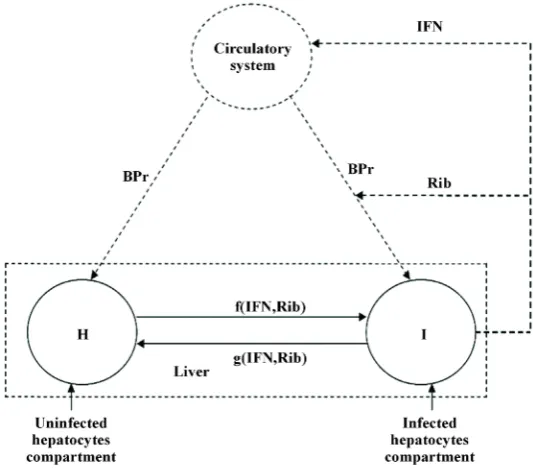
In terms of constraints of our problem, we consider a two compartmental mathematical model proposed in [22]. This mathematical model is formulated from a diagram given in Figure 1.
The model equations are as follows:
( )
( )
(
( )
( )
)
d ,
dtH t H t I f IFN t Rib t
α
= − + (1)
( )
( )
(
( )
( )
)
d ,
dtI t = −I t +H g IFN t Rib tβ (2)
where
0.0089 and 0.4678
Figure 1. A schematic diagram of two compartments for modeling human hepatitis C virus dynamics. PBr is blood pressure. IFN is interferon and Rib is ribavirin. H and I represent uninfected hepatocytes and infected hepatocytes respectively. The function f and g r represent the mechanism of control of hepatitis C virus. This mechanism is not direct and can be represented by outflow functions between uninfected hepatocytes and infected hepatocytes compartments that depend on interferon (IFN) and ribavirin (Rib) which flow in lever through circulatory system by blood pressure.These f and g must be identified.
(
,)
884.9682 sin(
)
350.8518 48.3569g IFN Rib ≈ × Rib IFN× + ×Rib+ ×IFN (4)
If X =
(
H I,)
T is a state vector, then the healthy improvement conditions for an uninfected human should look for reaching uninfected steady state Xe=(
H Ie, e)
T where He is the constant that must be found out. Since Ie =0, next the cost function (objective function) was formulated in the following way.Find IFN t∗
( )
and Rib t∗( )
solution of(
)
max(
)
2( )
2( )
20
, T H e IFN Rib
J IFN Rib =
∫
q H H− +q IFN t +q Rib t (5)subject to the system (1) - (2).
The positive scalar coefficients qH, qIFN and qRib determine how much weight is attached to each cost component term in the integrand whereas Tmax denotes the maximum time that the physical activity can take.
2.2. Description of Fuzzy Logic Strategy Approach
To describe fuzzy logic strategy approach, we consider a linear quadratic problem which can be formulated as follows. For two positive defined matrices L and Q find M
m
U ∈R , m=0, , M−1 that is minimizer of
(
)
1(
T T)
0 1 0
, , M M m m m m
m
J U U − − z Lz U QU
=
=
∑
+ (6)
subject to
(
)
1 , , 0, , 1.
,
m m m m
m m
m m
z f x U m N
z U
+
=
= −
∈ ∈
R R (7)
optimal solution for this mathematical method [23]. Although this method is used to solve the linear quadratic problem, the solution in some cases is not optimal because this method this method depends on the choice of the initial trajectory. Therefore, another method can be taken, we prefer for this reason, the method which integrates the fuzzy logic in order to determine quickly the optimal solution [24]. Fuzzy logic strategy approach is based on the linearization of state system. This approach had been developed by Takagi-Sugeno [25] [26]. It is from the mathematical model introduced in 1985 by Takagi-Sugeno that is used to get some fuzzy linearization re-gions in the state space [27]. These linearization regions are fuzzy regions where the operating points are taken. From the idea of Takagi-Sugeno, the nonlinear system decomposition in a structure multi models which are in-dependent linear models [28]. The mechanism of linearization using fazzy logic strategy for a nonlinear system (NL) can be described as follows.
If z ii, =1, , S is a operating point and
(
)
T 1, , S
z= z z denotes a state vector of operating points, the ap-proximation of a nonlinear term NL z
( )
is done using two following different fuzzy approximations:1) The approximation of order zero which satisfies:
( )
0( )
( )
i , 1, ,NL z ≈NL z =NL z i= S (8) 2) Taylor expansion series of first order verifying
( )
1( )
( )
( ) ( )
Td
, 1, , . d
i
i i
z NL z
NL z NL z NL z z z i S
z
≈ = + − =
(9)
To minimize the error between the non linear function and the fuzzy approximation, we introduce the factor of the consequence for fuzzy Takagi-Sugeno system that allows the improvement of approximation (8) or (9). Taking
ε
as this factor, from approximation (9) yields:( ) (
)
( )
( )
( )
( ) ( )
T0 1
1
d
, with 0 1.
d
i
i i
z
NL z NL z NL z
NL z
NL z z z
z
β ε
β β
≈ − +
≈ + − ≤ ≤
(10)
The following expression is obtained from the replacement of nonlinear term NL x
( )
in (7) by its approx-imated value using linearization around zi and it is system of m equations for each operating point i=1, , S:1 , , , , 1, , ; 0, , 1
m i m m i m m i m
z + =A z +B U +C i= S m= M− (11) where Ai m, and Bi m, are
(
M M×)
square matrices and Ci m, is(
M×1)
matrix.The outcome of approximation of nonlinear term
(
NL z( )
)
using fuzzy approximation is the transformation optimal control problem (6) - (7) in linear quadratic problem such that the feedback control is given by the fol-lowing expression [29] [30]:, , 1, , ; 0, , 1,
i m i m
U = −K z i= S m= M− (12) where
(
T)
1 T,
i i i i i i i
K = Q B E B+ − B E A (13)
is the feedback gain matrix and Ei discreet Riccati equation solution of the following form
(
)
1T T T T 0.
i i i i i i i i i i i i i
E Q A E A A E B L B E B− − + + − B E A = (14) From (12) S controls are determined and the defuzzyfication method [26] leads to only one system and only one control Um obtained by solving the iterated system
1 , 0, , 1,
m m m
x + =Ax +BU +C m= M− (15) , 0, , ,
m m
( )
( )
( )
( )
( )
( )
( )
( )
, , , ,1 1 1 1
1 1 1 1
, , and , 1, ,
S S S S
i i i m i i i m i i i m i i i m
i i i i
S S S S
i i i i i i i i
i i i i
z A z B z C z K
A B C K i S
z z z z
ω ω ω ω
ω ω ω ω
= = = =
= = = =
=
∑
=∑
=∑
=∑
=∑
∑
∑
∑
(17)and where ωi
( )
xi designates membership degree partner to the operating point zi.3. Numerical Approaches for Solving the Optimal Control Problem (5) Subject to
(1) - (2)
3.1. Using Fuzzy Logic Strategy
Since explicit Euler scheme is stable, it is used to approximate the optimal control problem (5) subject to (1) - (2). This method is an advantage to approach some ordinary differential equations. The following system is ob-tained from Taylor expansion around IFNe (Interferon of equilibrium) and Ribe (Ribarivin of equilibrium):
( )
( )(
)
( )
( )(
)
0.0089
1 2 3
0.4678
1 2 3
d d
d ,
d
f f f
g g g
H H I C IFN C Rib C t
I I H C IFN C Rib C t − − = − + + + = − + + + (18) where
(
)
(
)
(
)
(
)
(
)
(
)
1.0320 1 2.0320 2 2.0320 3 1 2 150.0734 996.5871 73.8850 1090.2213, 150.0734 996.5871
884.9682 cos 48.3569
884.9682 cos 350.8518
f e e
f e
f e e e e e
g e e e
g e e e
C IFN Rib
C IFN
C f IFN Rib IFN Rib Rib
C Rib IFN Rib
C IFN IFN Rib
C = × × + = × − = − × × − × = × × × + = × × × +
(
)
(
) (
)
3 , 1769.9364 cos
48.3569 350.8518 .
g e e e e e e
e e
g IFN Rib IFN Rib IFN Rib
IFN Rib
= − × × ×
− × − ×
Using the variable change
(
)
T(
)
T, and , ,
e e e e
X = H H I I− − U = IFN IFN Rib Rib− − (19) the system (18) becomes
(
)
( )(
(
)
(
)
)
(
)
( )(
(
)
(
)
)
0.0089 1
1 2 1 1 2 2 3
0.4678 2
2 1 1 1 2 2 3
d d
d .
d
e e f e f e f
e e g e g e g
X X H X I C U H C U IFN C
t
X X I X H C U H C U Rib C
t − − = − − + + + + + + = − − + + + + + + (20)
On the uniform grid and from the system (20) yields the following approximated system
(
)
(
)
( )(
)
( )(
)
(
)
(
)
( )(
)
( )(
)
0.0089
1, 1 1, 2, 1 1, 2 2,
0.0089
2, 1 2 3
0.4678
2, 1 2, 1, 1 1, 2 2,
0.4678
1, 1 2 3
1
1
,
m m m e f m f m
e m e f e f e f
m m m e g m g m
e m e g e g e g
X h X h X I C U C U
h H X I C H C Rib C
X h X h X H C U C U
h I X H C H C Rib C
where h Tmax
M
= and Xm =X t
( )
m .To determine the Takagi-Sugeno fuzzy system and using the form given by expression (8) or (9), now we fo-cus on linearization of two nonlinear factors of the system (21) that is
( )
(
)
( 0.0089)( )
(
)
( 0.4678)2 e and 1 e .
NL X = X +I − NL X = X +H −
This mechanism is done by taking the points Hi and I ii, =1,2,3, as for the first, second and third equation of the system this system respectively. In universe of discourse X set, these points take the corresponding values in the labels centers [24]. The simplification, we use only the Taylor expansion of first order around the operating points Hi and Ii. Hence we have three systems of the following form
(
)
(
)
( )(
)
( )(
)
(
)
(
)
( )(
)
( )(
)
0.0089
1, 1 1, 1 1, 2 2,
0.0089
1 2 3
0.4678
2, 1 2, 1 1, 2 2,
0.4678
1 2 3
1
1
.
m m i e f m f m
e i e f e f e f
m m i e g m g m
e i e g e g e g
X h X h I I C U C U
h H I I C H C Rib C
X h X h H H C U C U
h I H H C H C Rib C
− + − − + − = − + + × + × − + + + + = − + + + + − + + + + (22)
Let us note Xm=
(
X1,m,X2,m)
T and(
)
T 1, , 2, ,
m m m
U = U U for each number i of operating point, the system (22) becomes
1, , , , 1,2,3,
m i s m i i m i i
X + =A X +BU +C i= (23)
where
1 0
, 1,2,3
0 1 i h A i h − = = −
(24)
(
)
( )(
)
( )(
)
( )(
)
( ) 0.0089 0.0089 1 2 0.4678 0.4678 1 2, 1,2,3
i e f i e f
i
i e g i e g
I I C I I C
B h i
H H C H H C
− − − − + × + × = = + × + × (25)
(
)
( )(
)
(
)
( ) 0.00891 2 3
0.4678
1 2 3
, 1,2,3.
( )
e i e f e f e f
i
e i e g e g e g
H I I C IFN C Rib C
C h i
I H H C IFN C Rib C
− − − + + × × + × + = = − + + × × + × + (26)
Now we are interested in approximating the objective function of the problem (5). Hence, using rectangular method the following expression yields
(
)
1(
T T)
1 2
0
, N ,
N
m m m m
m
J X U − X R X U R U h
=
=
∑
+ (27)where matrices R1 and R2 are as follows
1 1 1 2 2 2 0 0 , 0 0 a b R R a b = =
such that the optimal control problem () subject to () - () can be formulated as follows. Find U∗ =
(
U0∗, ,UN∗−1)
T solution of(
)
1(
T T)
1 2
0
min , M m m m m
U J X U m X R X U R U h
−
=
=
∑
+ (28)1 , , , , 1,2,3.
m i m m i m m i m
X + =A X +B U +C i= (29) The problem (28) - (29) is a linear quadratic (LQ) such that for each i=1,2,3, the solution leads to feedback control that is
, 1,2,3
m i m
U = −K X i= (30) where Ki is a gain feedback.
3.2. Using Direct Approach
Firstly, the direct method focuses on approximation of the system (1) - (2) on uniform grid
max, 0, , ,
M tm mTM m M
Ω = = =
(31)
where we define a linear B-splines basis functions of the form
{
, 1, ,}
N M
j j M
ψ
= =
B (32)
such that we have the relation
( )
M
i tm im
ψ
=δ
,where δik is Kronecker symbol verifying
1 if 0 if im
i m i m
δ
= =≠
.
This approximation is done by introducing the vector space WM whose the basis is BM and satisfying two
following relation 1) dimWM =M 2) WM ⊂WM+1
Assuming 0
(
)
max
0,
W C= T and taking the interpolation operator :
M M
M
W W
φ
φ
Π →
Π
(33) satisfying
( )
( )
, 1, , ,M
k k
t t k M
φ φ
Π = = (34)
we are able to verify easily that
0 M
M
W W
φ φ →∞ φ
Π − → ∀ ∈ (35)
0
sup 1.
M
M W
W W φ φ
φ φ
≠ ∈
Π
Π = = (36)
Furthermore, the approximation of the system (1)-(2) can be formulated as follows. Find
(
H IM, M) ( )
∈ WM 2 solution of the system( )
( )
( )
(
( )
( )
)
d ,
d
M
M M M
H t H t I f IFM t Rib t t
α
= − + (37)
( )
( )
( )
(
( )
( )
)
d ,
d
M
M M M
I t I t H g IFM t Rib t t
β
( )
0 0 ,( )
0 0 ,M M M M
H =H I =I (39)
such that
0 0M N 0
H −H →→∞ (40)
0 0M N 0.
I −I →→∞ (41)
Secondly, the direct method deals with the discretization of the optimal problem (5) which becomes
( )
max(
( )
)
2 2(
( )
)
20 1
min M T M d
H e j j
Q J q H t H j q t t
λ∈ λ = λ
= − + ⋅
∑
∫
(42)where
(
)
T(
)
T, and IFN, Rib
IFN Rib q q q
λ = =
with
λ
j and qi respectively the jth component of the vectorsλ
and q respectively.Taking QM =
( )
WM 2 the approximation of solution of (42) is done by looking for(
)
1 , 2
M M M QM
λ = λ λ ∈ where the set such that
( )
, 0
, 1,2.
M
M M
j j m m m
m t j
λ λ ψ
=
=
∑
= (43)Using rectangular method such that the discretization is done on a regular grid ΩM the cost function (42) becomes
( )
(
)
2 2( )
2max ,
1 ( ) 1 , with .
M
M M M M
H k e j j m
m j
T
J q H t H q h h
M λ λ = = ≈ − + =
∑
∑
(44)Therefore, the discrete formulation of optimal problem (5) subject to (1) - (2) is written as follows.
( 1) ( 1)
( )
(
(
) ( )
)
T T
min
M M
M
M M M M
J h Y RY B
λ ∈R + ×R + λ ≈ + λ λ (45)
where
λ
M is a matrix(
M+ ×1 2)
with elements ,M j m
λ obtained from the function M j
λ
in the set BM andY denotes the matrix with
( )
i m, th component, M( )
m e
H t −H which is the first components of solution of the system (1) - (2) associated to λ λ= M, R and B are matrices of the form
0 0 , 0 0 IFN H Rib H q q R B q q = =
(46)
Taking the approximated objective function (45) and (37) - (38) satisfying (40) and (41) into account, the op-timal control problem (5) subject to (1) - (2) is a minimization problem with constraint such that discreet formu-lation of such problem can be formulated as follows.
Find
λ
∗,M ∈R(M+1)×R(N+1) solution of( 1) ( 1)
( )
(
(
) ( )
)
T T
min ,
M M
M
M M M M
J h Y RY B
λ ∈R + ×R + λ ≈ + λ λ (47)
subject to
( )
( )
( )
(
( )
( )
)
( )
( )
( )
(
( )
( )
)
d , d d , d MM M M
M
M M M
H t H t I f IFN t Rib t t
I t I t H g IFN t Rib t t α β = − + = − + (48)
where λM is a matrix
(
M+ ×1 2)
with elements ,M j m
λ obtained from function M j
λ
in BM andY is the matrix such that the
(
j m,)
th component is M( )
e,j m j
of (5) subject to (1) - (2) associated to λ λ= M and
(
)
T, e
e e
x = H I .
4. Numerical Simulation
Using the mechanism of linearization of the nonlinear terms of the system (21), we apply the fuzzy strategy and we consider the case of health person where we take He =He =1000 cells/dl of human blood and Ie=0.0001 cells/dl of human blood.
We consider a universe of discourse X which has two linguistic variables: uninfected hepatocytes (UH) and infected hepatocytes (IH). Taking account of the physiology of hepatitis in human body, we consider
[
200,1500]
H∈ and I∈
[
0,300]
. Therefore, the uninfected hepatocytes (respectively infected hepatocytes) is low if H<200 cells/dl (respectively I<0 cells/dl). If H (respectively I) is included between 200 and 1500 cells/dl (respectively 0 and 300 cells/dl), we suppose that the uninfected hepatocytes (respectively infected hepatocytes) is normal. While if h>1500 (respectively I>300) we say that the uninfected hepatocytes (re-spectively infected hepatocytes) is the highest. Then, LUH (Low uninfected hepatocytes), NUH (Normal unin-fected hepatocytes) and HUH (the highest uninunin-fected hepatocytes) constitute the terms (fazzy sets) of the lin-guistic variable UH. In an analogous way, LIH (Low infected hepatocytes), NIH (Normal infected hepatocytes) and HIH (the highest infected hepatocytes) are the terms of the variable linguistic IH.According the relation (19) and equilibrium values, we have X1∈ −
[
800,500]
and X2∈[
0,300]
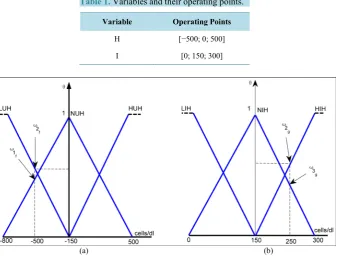
. For anuninfected Hepatitis C virus, uninfected hepatocytes and infected hepatocytes change such that we can consider a universe of discourse X where the labels are centered respectively at −800, 150 and 500; 0, 150 and 300. Then, we suppose that theses centers constitute the operating point’s values of the system (21). The operating points associated to those linguistic variables are given in Table 1; membership functions associated to this labeling are represented in Figure 2.
Let us set M =100 and Tmax =10, then the following results are found form (24), (25) and (26) respectively.
0.9 0
, 1,2,3 0 0.9
i
A = i=
[image:10.595.147.489.419.675.2]
Table 1. Variables and their operating points.
Variable Operating Points
H [−500; 0; 500]
I [0; 150; 300]
(a) (b)
1 2 3
105.9779 115.9350 95.3121 104.2671 94.7259 103.6259
, ,
0.4055 2.9424 0.2061 1.4953 0.1580 1.1464
B = − B = − B = −
1 2 3
83.7874 85.4191 85.5088
, , .
0.0001 0.0001 0.0001
C =− C =− C =−
− − −
It easy to note that the problem (28) - (29) is a linear quadratic (LQ). Since there are three linear state systems, the solution leads to three feedback controls of the form
, , 1,2,3;
k i k k
U = −K X i= (49) where Ki is a gain feedback.
The implementation can be made in several platforms. Here we use MATLAB package. Taking R1 and R2
of the relation (46) as identity matrices of size 2 respectively, we obtain from the relation (13) and (14) the fol-lowing matrices K ii, =1,2,3.
1 2 3
0.0068 0.2440 0.0065 0.3285 0.0061 0.3299
, , .
0.0015 0.2231 0.0027 0.3003 0.0031 0.3016
K = K = K =
− − −
The defuzzification transformation allows to obtain one system. Consequently, for the system (29) this tech-nique gives the following system
1 , 0, , 1,
k k k
X + = AX +BU +C k= N− (50) where A and B are 2 2× matrices and C a 2 1× matrix.
In the same way, from the matrixes K K1, 2 and K3 he defuzzication precess allows to have one matrix K.
We propose the following procedure.
The first (respectively second) line of matrixes A B Ci, , ,i i and Ki, i=1,2,3 is defuzzified using the de-gree of membership
ω
2f andω
3f (see Figure 2(a)) (respectivelyω
2g andω
3g (see Figure 2(b))). This manner of procedure is due to the two following reasons.i) We consider the degree of membership of the entry uninfected hepatocytes (respectively infected hepato-cytes). According to variable change (19), this value is 400 cells/dl (see Figure 2(a)) (respectively 120 cells/dl (see Figure 2(b)))). After calculations, we get
1f 0.4615,
ω
=ω
2f =0.5385 andω
3f =0(
θUH =(
0.4615;0.5385;0)
)
[resp.
ω
1g =0,ω
2g=0.6667 andω
3g =0.3333.(
θIH =(
0;0.6667;0.3333)
)
.ii) The nonlinear factor
( ) (
)
( 0.0089)( ) (
)
( 0.4678)2 e and 1 e ,
NL X X I − NL X X H −
= + = +
is used only in the first (respectively second) equation of the system (22). Considering these hypothesis, we have the following matrixes.
0.9 0 100.2344 109.6519
, ,
0 0.9 0.3391 2.4601
84.6661 0.0067 0.2895
, .
0.0001 0.0019 0.2488
A B
C K
−
= =
−
= =
− −
The solutions of the optimal control problem (28) - (29) and (47) - (48) can be determined in several platform. The implementation of these solutions is made using MATLAB packages.
To solve the problem (28) - (29) by fuzzy logic strategy only one program is enough. Using direct approach, the solutions of the problem (47) - (48) are given by a succession of programs based on MATLAB function used in optimization that is fmincon. This function is a MATLAB program which allows solving minimization prob-lem with constraints.
[image:11.595.76.520.82.152.2]Table 2. Minimal values of the objective function (Jopt) and the execution time (T) of main program for the resolution of the optimal control problem (28) - (29) by AHLF and (47) - (48) by ADIR.
AHLF ADIR
Jopt 0.0524 14.2379
T (second) 0.0149 51.08034
MATLAB program for AHLF, ADIR respectively. The results are obtained using a Processor Intel (R) core (TM) 2 Duo CPU, 2.20 GHZ.
Table 2 shows that the time execution of the main program to solve the problem (28) - (29) by AHLF is very small compared to one obtained by solving the problem (47) - (48) using ADIR . This argument justifies the ef-ficiency of the fuzzy logic strategy.
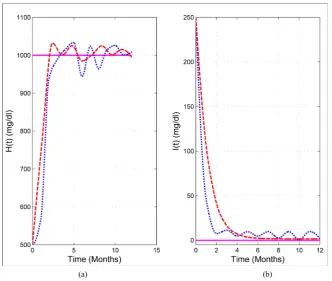
Considering a patient who is administrating the drugs during 12 months, the variations of the optimal para-meters is obtained using the hybrid approach integrating fuzzy logic strategy (AHLF) and the direct approach (ADIR). Numerical results of fuzzy logic strategy are obtained from the resolution of the problem (28) - (29) such that the controls are calculated using the relation (30). Solving the problem (47) - (48), we have the numer-ical results of direct approach.Figure 3 andFigure 4 illustrate comparison of the results of those two different methods.
Figure 3 illustrates both interferon (IFN) that is used to prevent the virus from infecting the cell (Figure 3(a)) and ribavirin (Rib) that allows the prevention of the infected cells from producing the new viruses (Figure 3(b)). Figure 4 presents the response of these chemotherapy to variation of the concentration of unin-fected hepatocytes (Figure 4(a)), inunin-fected hepatocytes (Figure 4(b)). For a patient who is administrating regu-larly the drugs, we see that interferon (IFN) and ribavirin (Rib) decrease and after 4months they reach the low-er value 0 (maximal use of thlow-erapy) before having its oscillation around this value (Figure 3(a) and Figure 3(b)). The solutions from AHLF and ADIR show that after 2.5 minutes of the starting time the optimal unin-fected hepatocytes (Figure 4(a)) increases to reach the wanted equilibrium value and inunin-fected hepatocytes (Figure 4(b)) decreases gradually to reach the value around the wanted value in 6 months before its oscillation around this value.
It is known that the main aim of treatment for chronic hepatitis C is to suppress HCV replication before there is irreversible liver damage. Furthermore, the role of drugs on chronic hepatitis C virus is to reduce the risk of liver disease and prevent the patient from passing the infection to others. The variation of controls given in Fig-ure 3 which shows the decrease from 1 (when and treatment is absent) of both interferon (IFN) and ribavirin (Rib) to be closer to the lower value 0 (maximal use of therapy). Figure 4(a) (respectively 4(b)) shows a in-crease (respectively dein-crease) of uninfected hepatocytes (respectively infected hepatocytes) to its higher (re-spectively lower) value during the six first months of the beginning of the process before oscillating around the wanted equilibrium value. This behaviour is due to action of therapeutic drugs. The results obtained in this work are rather satisfactory. In particular, the reaction of the disease to drugs can be modeled and they reduce the risk of it. Therefore the drugs play a crucial role such that any patient becomes healthy. Comparing the results using AHLF and ADIR, it is important to see in Figure 3 and Figure 4 that they are very closed.
5. Concluding Remarks
(a) (b)
Figure 3. Variation of drugs (controls) interferon, IFN (a) and ribavirin, Rib (b). The curves in dotted line represent the parameter for the the direct approach. The curve dashed line show the parameter for the approach integrating the fuzzy logic approach.
(a) (b)
[image:13.595.148.481.405.686.2]performance.
References
[1] Choo, Q.L., Kuo, G., Weiner, A.J., et al. (1989) Isolation of a cDNA Clone Derived from a Blood-Borne Non-A, Non-B Viral Hepatitis Genome. Science, 244, 359-362. http://dx.doi.org/10.1126/science.2523562
[2] Simmonds, P., Bukh, J., Combet, C., et al. (2005) Consensus Proposals for a Unified System of Nomenclature of He-patitis C Virus Genotypes. Hepatology, 42, 962-973. http://dx.doi.org/10.1002/hep.20819
[3] Kim, W.R. (2002) The Burden of Hepatitis C in the United States. Hepatology, 36, S30-S34.
[4] Alter, M.J. (2007) Epidemiology of Hepatitis C Virus Infection. World Journal of Gastroenterology, 13, 2436-2441.
http://dx.doi.org/10.3748/wjg.v13.i17.2436
[5] Houghton, M. and Abrignani, S. (2005) Prospects for a Vaccine against the Hepatitis C Virus. Nature, 436, 961-966.
http://dx.doi.org/10.1038/nature04081
[6] Shiratori, Y., Ito, Y., Yokosuka, O., Imazeki, F., Nakata, R., Tanaka, N., Arakawa, Y., Hashimoto, E., Hirota, K., Yo-shida, H., Ohashi, Y. and Omata, M., Tokyo-Chiba Hepatitis Research Group (2005) Antiviral Therapy for Cirrhotic Hepatitis C: Association with Reduced Hepatocellular Carcinoma Development and Improved Survival. Annals of In-ternal Medicine, 142, 105-114.
[7] Takaoka, A. and Yanai, H. (2006) Interferon Signalling Network in Innate Defence. Cellular Microbiology, 8, 907-922.
http://dx.doi.org/10.1111/j.1462-5822.2006.00716.x
[8] Li, K., Foy, E., Ferreon, J.C., Nakamura, M., Ferreon, A.C., Ikeda, M., et al. (2005) Immune Evasion by Hepatitis C Virus NS3/4A Protease-Mediated Cleavage of the Toll-Like Receptor 3 Adaptor Protein TRIF. Proceedings of the Na-tional Academy of Sciences of the United States of America, 102, 2992-2997.
http://dx.doi.org/10.1073/pnas.0408824102
[9] Honda, K., Takaoka, A. and Taniguchi, T. (2006) Type I Interferon [Corrected] Gene Induction by the Interferon Reg-ulatory Factor Family of Transcription Factors. Immunity, 25, 349-360.
http://dx.doi.org/10.1016/j.immuni.2006.08.009
[10] Lee, S.H., Miyagi, T. and Biron, C.A. (2007) Keeping NK Cells in Highly Regulated Antiviral Warfare. Trends in Immunology, 28, 252-259. http://dx.doi.org/10.1016/j.it.2007.04.001
[11] Young, H.A. and Ortaldo, J. (2006) Cytokines as Critical Co-Stimulatory Molecules in Modulating the Immune Re-sponse of Natural Killer Cells. Cell Research, 16, 20-24. http://dx.doi.org/10.1038/sj.cr.7310004
[12] Gil, M.P., Salomon, R., Louten, J. and Biron, C.A. (2006) Modulation of STAT1 Protein Levels: A Mechanism Shap-ing CD8 T-Cell Responses in Vivo. Blood, 107, 987-993. http://dx.doi.org/10.1182/blood-2005-07-2834
[13] Chen, J., Florian, J., Carter, W., Fleischer, R.D., Hammerstrom, T.S., Jadhav, P.R., Zeng, W., Murray, J. and Birnkrant, D. (2013) Earlier Sustained Virologic Response End Points for Regulatory Approval and Dose Selection of Hepatitis C Therapies. Gastroenterology, 144, 1450-1455.
[14] Manns, M.P., Foster, G.R., Rockstroh, J.K., Zeuzem, S., Zoulim, F. and Houghton, M. (2007) The Way forward in HCV Treatment—Finding the Right Path. Nature Reviews Drug Discovery, 6, 991-1000.
http://dx.doi.org/10.1038/nrd2411
[15] Neumann, A.U., Lam, N.P., Dahari, H., Gretch, D.R., Wiley, T.E., Layden, T.J. and Perelson, A.S. (1998) Hepatitis C Viral Dynamics in Vivo and the Antiviral Efficacy of Interferon-α Therapy. Science, 282, 103-107.
http://dx.doi.org/10.1126/science.282.5386.103
[16] Dixit, N.M., Layden-Almer, J.E., Layden, T.J. and Perelson, A.S. (2004) Modelling How Ribavirin Improves Interfe-ron Response Rates in Hepatitis C Virus Infection. Nature, 432, 922-924. http://dx.doi.org/10.1038/nature03153
[17] Dahari, H., Lo, A., Ribeiro, R.M. and Perelson, A.S. (2007) Modeling Hepatitis C Virus Dynamics: Liver Regeneration and Critical Drug Efficacy. Journal of Theoretical Biology, 247, 371-381. http://dx.doi.org/10.1016/j.jtbi.2007.03.006
[18] Lenhart, S. and Workman, J.T. (2007) Optimal Control Applied to Biological Methods.
[19] Chakrabarty, S.P. and Joshi, H.R. (2009) Optimally Controlled Treatment Strategy Using Interferon and Ribavirin for Hepatitis C. Journal of Biological Systems, 17, 97-110. http://dx.doi.org/10.1142/S0218339009002727
[20] Chakrabarty, S.P. (2009) Optimal Efficacy of Ribavirin in the Treatment of Hepatitis C. Optimal Control Applications and Methods, 30, 594-600. http://dx.doi.org/10.1002/oca.894
[21] Martin, N.K., Ashley, B., Pitcher, A.B., Vickerman, P., Vassal, A. and Hickman, M. (2011) Optimal Control of Hepa-titis C Antiviral Treatment Programme Delivery for Prevention amongst a Population of Injecting Drug Users. PLoS ONE, 6, e22309. http://dx.doi.org/10.1371/journal.pone.0022309
Innovative Mathematical Research (IJSIMR), 3, 1-10. (Online)
[23] Yakowitz, S.J. (1986) The Stagewise Kuhn-Tucker Condition and Differential Dynamic Programming. IEEE Transac-tions onAutomatic Control, 31, 25-30. http://dx.doi.org/10.1109/tac.1986.1104123
[24] Masmoudi, N.K. and Derbel, N. (2003) Optimal Control of Nonlinear Systems by Fuzzy Logic. ISCIII, Nabeul. [25] Sugeno, M. and Murakami, K. (1984) Fuzzy Parking Control of Model Car. 23rd IEEE Conference on Decision and
Control,Las Vegas,12-14 December 1984, 902-903. http://dx.doi.org/10.1109/CDC.1984.272144
[26] Takagi, T. and Sugeno, M. (1985) Fuzzy Identification of Systems and Its Applications to Modeling and Control. IEEE Transactions on Systems, Man and Cybernetics, 15, 116-132. http://dx.doi.org/10.1109/TSMC.1985.6313399
[27] Park, M.I., Kim, E., Ji, S. and Park, M. (1987) A New Approach to Fuzzy Modeling. IEEE Transactions on Fuzzy Sys-tems, 5, 328-337.
[28] Jacobson, D., Lele, D. and Speyer, J.L. (1971) New Necessary Conditions of Optimality for Control Problems with State-Variable Inequality Constraints. Journal of Mathematical Analysis and Applications, 35, 255-284.
http://dx.doi.org/10.1016/0022-247X(71)90219-8