Munich Personal RePEc Archive
Is the Jump-Diffusion Model a Good
Solution for Credit Risk Modeling? The
Case of Convertible Bonds
Xiao, Tim
CIBC
21 May 2013
Online at
https://mpra.ub.uni-muenchen.de/47366/
Is the Jump-Diffusion Model a Good Solution for
Credit Risk Modeling? The Case of Convertible Bonds
Tim Xiao
1Risk Quant, Capital Markets, CIBC, Toronto, Canada
ABSTRACT
This paper argues that the reduced-form jump diffusion model may not be appropriate for credit
risk modeling. To correctly value hybrid defaultable financial instruments, e.g., convertible bonds, we
present a new framework that relies on the probability distribution of a default jump rather than the
default jump itself, as the default jump is usually inaccessible. The model is quite accurate. A prevailing
belief in the market is that convertible arbitrage is mainly due to convertible underpricing. Empirically,
however, we do not find evidence supporting the underpricing hypothesis. Instead, we find that
convertibles have relatively large position gammas. As a typical convertible arbitrage strategy employs
delta-neutral hedging, a large positive gamma can make the portfolio high profitable, especially for a
large movement in the underlying stock price.
Key Words: jump diffusion model, hybrid financial instrument, convertible bond, convertible
underpricing, convertible arbitrage, default time approach, default probability (intensity) approach, asset
pricing,credit risk modeling.
1
The views expressed here are of the author alone and not necessarily of his host institution.
1.
Introduction
A company can raise capital in financial markets either by issuing equities, bonds, or hybrids
(such as convertible bonds).From an investor’s perspective, convertible bonds with embedded optionality
offer certain benefits of both equities and bonds – like the former, they have the potential for capital
appreciation and like the latter, they offer interest income and safety of principal. The convertible bond
market is of primary global importance.
There is a rich literature on the subject of convertible bonds. Arguably, the first widely adopted
model among practitioners is the one presented by Goldman Sachs (1994) and then formalized by
Tsiveriotis and Fernandes (1998). The Goldman Sachs’ solution is a simple one factor model with an
equity binomial tree to value convertible bonds. The model considers the probability of conversion at
every node. If the convertible is certain to remain a bond, it is then discounted by a risky discount rate that
reflects the credit risk of the issuer.If the convertible is certain to be converted, it is then discounted by
the risk-free interest rate that is equivalent to default free.
Tsiveriotis and Fernandes (1998) argue that in practice one is usually uncertain as to whether the
bond will be converted, and thus propose dividing convertible bonds into two components:a bond part
that is subject to credit risk and an equity part that is free of credit risk.A simple description of this model
and an easy numerical example in the context of a binomial tree can be found in Hull (2003).
Grimwood and Hodges (2002) indicate that the Goldman Sachs model is incoherent because it
assumes that bonds are susceptible to credit risk but equities are not. Ayache, Forsyth, and Vetzal (2003)
conclude that the Tsiveriotis-Fernandes model is inherently unsatisfactory due to its unrealistic
assumption of stock prices being unaffected by bankruptcy.To correct this weakness, Davis and Lischka
(1999), Andersen and Buffum (2004), Bloomberg (2009), and Carr and Linetsky (2006) etc., propose a
risk-neutral measure the expected rate of return on a defaultable stock must be equal to the risk-free interest
rate. The jump-diffusion model characterizes the default time/jump directly.
The jump-diffusion model was first introduced by Merton (1976) in the market risk context for
modeling asset price behavior that incorporates small day-to-day diffusive movements together with
larger randomly occurring jumps. Over the last decade, people attempt to propagate the model from the
market risk domain to the credit risk arena. At the heart of the jump-diffusion models lies the assumption
that the total expected rate of return to the stockholders is equal to the free interest rate under a
risk-neutral measure.
Although we agree that under a risk-neutral measure the market price of risk and risk preferences
are irrelevant to asset pricing (see Hull (2003))and thereby the expectation of a risk-free2 asset grows at the risk-free interest rate, we are not convinced that the expected rate of return on a defaultable asset must
be also equal to the risk-free rate. We argue that unlike market risk, credit risk actually has a significant
impact on asset prices. This is why regulators, such as International Accounting Standards Board (IASB),
Basel Committee on Banking Supervision (BCBS), etc. require financial institutions to report a credit
value adjustment (CVA) in addition to the risk-free mark-to-market (MTM) value to reflect credit risk
(see Xiao (2013b)). By definition, a CVA is the difference between the risk-free value and the risky value
of an asset/portfolio subject to credit risk. CVA implies that the risk-free value should not be equal to the
risky value in the presence of default risk. As a matter of fact,we will prove that the expected return of a
defaultable asset under a risk-neutral measure actually grows at a risky rate rather than the risk-free rate.
This conclusion is very important for risky valuation.
Because of their hybrid nature, convertible bonds attract different type of investors. Especially,
convertible arbitrage hedge funds play a dominant role in primary issues of convertible debt. In fact, it is
believed that hedge funds purchase 70% to 80% of the convertible debt offered in primary markets. A
prevailing belief in the market is that convertible arbitrage is mainly due to convertible underpricing
(Ammann, Kind and Wilde (2003), Calamos (2003), Choi, Getmansky and Tookes (2009), Loncarski,
Horst and Veld (2009), etc.), i.e., the model value is above the observed market price. However, Agarwal,
Fung, Loon and Naik (2007) and Batta, Chacko, and Dharan (2007) argue that the excess returns from
convertible arbitrage strategies are not mainly due to underpricing, but rather partly due to illiquid.
Calamos (2011) believes that arbitrageurs in general take advantage of volatility. A higher volatility in the
underlying equity translates into a higher value of the equity option and a lower conversion premium. In
fact, convertible arbitrage is far more complicated, involving taking positions in the convertible bond and
the underlying asset that hedges certain risks but leaves managers exposed to other risks for which they
reap a reward.
This article makes a theoretical and empirical contribution to the study of convertible bonds. In
contrast to the above mentioned literature, we present a model that is based on the probability distribution
(or intensity) of a default jump (or a default time) rather than the default jump itself, as the default jump is
usually inaccessible (see Duffie and Huang (1996), Jarrow and Protter (2004), etc).
We model both equities and bonds as defaultable in a consistent way. When a firm goes bankrupt,
the investors who take the least risk are paid first. Secured creditors have the best chances of seeing the
value of their initial investments come back to them. Bondholders have a greater potential for recovering
some their losses than stockholders who are last in line to be repaid and usually receive little, if anything.
The default proceedings provide a justification for our modeling assumptions: Different classes of
securities issued by the same company have the same default probability but different recovery rates.
Given this model, we are able to back out the market prices.
Valuation under our risky model can be solved by common numerical methods, such as, Monte
Carlo simulation, tree/lattice approaches, or partial differential equation (PDE) solutions. The PDE
algorithm is elaborated in this paper, but of course the methodology can be easily extended to tree/lattice
or Monte Carlo.
Using the model proposed, we conduct an empirical study of convertible bonds. We obtain a data
prices as well as associated interest rate curves, credit curves, stock prices, implied Black-Scholes
volatilities and recovery rates.
The most important input parameter to be determined is the volatility for valuation. A common
approach in the market is to use the at-the-money (ATM) implied Black-Scholes volatility to price
convertible bonds.However, most liquid stock options have relatively short maturates (rarely more than 8
years). As a result, some authors, such as Ammann, Kind and Wilde (2003), Loncarski, Horst and Veld
(2009), Zabolotnyuk, Jones, Veld (2010), have to make do with historical volatilities. Therefore, we
segment the sample into two sets according to the time to maturity: a short-maturity class (0 ~ 8 years)
and a long-maturity class (> 8 years). For the short-maturity class, we use the ATM implied
Black-Scholes volatilities for valuation, whereas for the long-maturity class, we calculate the historical volatility
as the annualized standard deviation of the daily log returns of the last 2 years and then price the
convertible bond based on this real-world volatility.
The empirical results show that the model prices fluctuate randomly around the market prices,
indicating the model is quite accurate. Our empirical evidence does not support a systematic underpricing
hypothesis. In fact, people in the market almost always calibrate their models to the observed market
prices using implied convertible volatilities. Therefore, underpricing may not be the main driver of
profitability in convertible arbitrage.
It is useful to examine the basics of the convertible arbitrage strategy. A typical convertible bond
arbitrage employs delta-neutral hedging, in which an arbitrageur buys a convertible bond and sells the
underlying equity at the current delta (see Choi, Getmansky and Tookes (2009), Loncarski, Horst and
Veld (2009), etc.). With delta neutral positions, the sign of Gamma is important. If Gamma is negative,
the portfolio profits so long as the underlying equity remains stable. If Gamma is positive, the portfolio
will profit from large movements in the stock in either direction (see Somanath (2011)).
We study the sensitivities of convertible bonds and find that convertible bonds have relatively
large positive gammas, implying that convertible arbitrage can make a profit on a large upside and
or small companies (while more established firms rely on other means of financing), the chance of a large
movement in either direction is very likely. Even for very small movements in the underlying stock price,
profits can still be generated from the yield of the convertible bond and the interest rebate for the short
position. Therefore, the large positive gammas of convertible contracts could be one of the main drivers in
convertible arbitrage.
The rest of this paper is organized as follows: The model is presented in Section 2. Section 3
elaborates the PDE approach; Section 4 discusses the empirical results.The conclusions are provided in
Section 5. Some numerical implementation details and a binomial tree approach are contained in the
appendices.
2
Model
Convertible bonds can be thought of as normal corporate bonds with embedded options, which
enable the holder to exchange the bond asset for the issuer’s stock.Despite their popularity and ubiquity,
convertible bonds still pose difficult modeling challenges, given their hybrid nature of containing both
debt and equity features. Further complications arise due to the frequent presence of complex contractual
clauses, such as, put, hard call, soft call, and other path-dependent trigger provisions. Contracts of such
complexity can only be solved by numerical methods, such as, Monte Carlo simulation, tree/lattice
approaches, or PDE solutions.
From a practitioner’s perspective, Monte Carlo is a “last resort” and “least preferred” method,
whereas lattice or PDE approaches suffer from the curse of dimensionality:The number of evaluations
and computational cost increase exponentially with the dimension of the problem, making it impractical
to use in more than two dimensions.
Three sources of randomness exist in a convertible bond: the stock price, the interest rate, and the
credit spread. As practitioners tend to eschew models with more than two factors, it is a legitimate
Hodges (2002) conduct a sensitivity study and find that accurately modeling the equity process appears
crucial. This is why all convertible bond models in the market capture, at a minimum, the dynamics of the
underlying equity.Since convertible bonds are issued mainly by start-up or small companies (while more
established firms rely on other means of financing), credit risk plays an important role in the valuation.
Grimwood and Hodges (2002) further note that the interest rate process is of second order importance.
Similarly, Brennan and Schwartz (1980) conclude that the effect of a stochastic interest rate on
convertible bond prices is so small that it can be neglected. Furthermore, Ammann, Kind, and Wilde
(2008) notice that the overall pricing benefit of incorporating stochastic interest rates would be very
limited and would not justify the additional computational costs. For these reasons, most practical
convertible models in the market do not take stochastic interest rate into account.
We consider a filtered probability space (,F ,
0
t
t
F , P ) satisfying the usual conditions,
where denotes a sample space, F denotes a -algebra, P denotes a probability measure, and
Ft t0 denotes a filtration.The risk-free stock price process can be described as
) ( ) ( )
( ) ( )
(t r t S t dt S t dW t
dS (1)
where S(t) denotes the stock price, r(t) denotes the risk-free interest rate, denotes the volatility,
) (t
W denotes a Wiener process.
The expectation of equation (1) is
dS t
r t S t dtE ( )Ft () ( ) (2)
where E
Ft is the expectation conditional on the Ft .Equation (2) tells us that in a risk-neutral world, the expected return on a risk-free stock is the
risk-free interest rate r(t), i.e., the discounted stock price under the risk neutral measure is a martingale
Next, we turn to a defaultable stock. The defaultable stock process proposed by Davis and
Lischka (1999), Andersen and Buffum (2004), and Bloomberg (2009), etc., is given by
( ) ( )
( ) ˆ ( ) ( ) ( ) ( ) )(t r t h t S t dt S t dW t S t dU t
dS (3)
where U(t) is an independent Poisson process with dU(t)1 with probability h(t)dt and 0 otherwise,
) (t
h is the hazard rate or the default intensity, S(t) is the stock price immediately before any jump at
time t. The expectation of dU(t) is E(dU(t) Ft)h(t)dt.
The expectation of equation (3) is given by
dS t
r t ht
S t dt S t h t dt r t S t dtE ( )Ft () ( ) ( ) () ( ) () () (4)
It is shown in equation (4) that the expected return of a defaultable stock grows at the risk-free
rate. Equation (3) is a simpler version of the Merton’s Jump-diffusion model where the number of jumps
is 1.
The jump-diffusion model was first proposed in the context of market risk, which naturally
exhibits high skewness and leptokurtosis levels and captures the so-called implied volatility smile or skew
effects. Ederington and Lee (1993) find that the markets tend to have overreaction and underreaction to
the outside news. The jump part of the model can be interpreted as the market response to outside news. If
there is not any outside news, the asset price changes according to a geometric Brownian motion. Since
the market price of risk and risk preferences are irrelevant to asset pricing within the market risk context,
the expected rate of return to the stockholders is equal to the risk-free rate under a risk-neutral measure.
However, we wonder whether it is appropriate to propagate the jump-diffusion model directly
from the market risk domain to the credit risk domain, as credit risk actually impacts the valuation of
assets. This is why financial institutions are required by regulators to report CVA. In fact, we will show in
the following derivation that the expected return of a defaultable asset under the risk-neutral measure is
actually equal to a risky rate instead of the risk-free interest rate. The conclusion is very important for
The world of credit modeling is divided into two main approaches: structural models and
reduced-form (or intensity) models. The structural models regard default as an endogenous event,
focusing on the capital structure of a firm. The reduced-form models do not explain the event of default
endogenously, but instead characterize it exogenously as a jump process. In general, structural models are
based on the information set available to the firm's management, such as the firm’s assets and liabilities;
while reduced-form models are based on the information set available to the market, such as the firm’s
bond prices or credit default swap (CDS) premia. Many practitioners in the credit trading arena have
tended to gravitate toward the from models given their mathematical tractability. The
reduced-form models can be made consistent with the risk-neutral probabilities of default backed out from
corporate bond prices or CDS spreads/premia.
In the reduced-form models, the stopping (or default) time of a firm is modeled as a Cox
arrival process (also known as a doubly stochastic Poisson process) whose first jump occurs at default and
is defined as,
t
th s s ds 0 ( , ): inf
(5)
where h(t) or h(t,t) denotes the stochastic hazard rate or arrival intensity dependent on an exogenous
common state t, and
is a unit exponential random variable independent of t.It is well-known that the survival probability from time t to s in this framework is defined by
sthu du
Z t s P s t
p(, ): ( | , ) exp ( ) (6)
The default probability for the period (t, s) in this framework is defined by
sthu du
s t p Z
t s P s t
q(, ): ( | , ) 1 ( , ) 1 exp ( ) (7)
We consider a defaultable asset that pays nothing between dates t and T. Let V(t) and V(T)
denote its values at t and T, respectively.Risky valuation can be generally classified into two categories:
The DTA involves the default time explicitly. If there has been no default before time T (i.e.,
T
), the value of the asset at T is V(T). If a default happens before T (i.e., t T), a recovery
payoff is made at the default time as a fraction of the market value3 given by V() where is the default recovery rate and V() is the market value at default.Under a risk-neutral measure, the value of
this defaultable asset is the discounted expectation of all the payoffs and is given by
D tT V T T D t V T t
E t
V() (, ) ( )1 (,) ()1 |F (8)
where
Y is an indicator function that is equal to one if Y is true and zero otherwise, and D(t,) denotesthe stochastic risk-free discount factor at t for the maturity given by
r u dut D
t
) exp ( ) ,
( (9)
Although the DTA is very intuitive, it has the disadvantage that it explicitly involves the default
time/jump. We are very unlikely to have complete information about a firm’s default point, which is often
inaccessible. Usually, valuation under the DTA is performed via Monte Carlo simulation.
The DPA relies on the probability distribution of the default time rather than the default time
itself.We divide the time period (t, T) into n very small time intervals (t) and assume that a default may
occur only at the end of each very small period. In our derivation, we use the approximation
y 1yexp for very small y. The survival and the default probabilities for the period (t, tt) are
given by
ht t
ht t tt t p t
pˆ(): (, )exp () 1 () (10)
h t t
ht t tt t q t
qˆ(): (, )1exp () () (11)
The binomial default rule considers only two possible states: default or survival. For the
one-period (t , tt ) economy, at time tt the asset either defaults with the default probability
) , (t t t
q or survives with the survival probability p(t,tt). The survival payoff is equal to the
3
market value V(tt) and the default payoff is a fraction of the market value: (tt)V(tt).Under
a risk-neutral measure, the value of the asset at t is the expectation of all the payoffs discounted at the
risk-free rate and is given by
r t t pt t qt V t t t
E
yt t
V t t t
E t
V() exp () ˆ( )()ˆ( ) ( )F exp ( ) ( )F (12)
where y(t)r(t)h(t)
1(t)
r(t)c(t) denotes the risky rate and c(t)h(t)
1(t)
is called the(short) credit spread.
Similarly, we have
y t t tV t t t t
E t t
V( ) exp ( ) ( 2)F (13)
Note that exp
y(t)t
is Ftt -measurable. By definition, an Ftt -measurable randomvariable is a random variable whose value is known at time tt . Based on the taking out what is
known and tower properties of conditional expectation, we have
i t
t t t t t t V t t i t y E t t V t t t y E t t y E t t V t t y E t V F F F F ) 2 ( ) ) ( exp ) 2 ( ) ( exp ) ( exp ) ( ) ( exp ) ( 1
0
(14)
By recursively deriving from t forward over T and taking the limit as
t
approaches zero, therisky value of the asset can be expressed as
tT
t yu duV T E
t
V() exp ( ) ( )F (15)
Using the DPA, we obtain a closed-form solution for pricing an asset subject to credit risk. Other
good examples of the DPA are the CDS model proposed by J.P. Morgan (1999) and a more generic risky
model presented by Xiao (2013a).
The derivation of equation (15) takes into account all credit characteristics: possibility of a jump
to default and recovery rate. It tells us that a defaultable asset under the risk-neutral measure grows at a
risky rate. The risky rate is equal to a risk-free interest rate plus a credit spread. If the asset is a bond, the
pricing risky bonds. The market bond model says that the value of a risky bond is obtained by discounting
the promised payoff using the risk-free interest rate plus the credit spread4.
Under a risk-neutral measure the market price of risk and risk preferences are irrelevant to asset
pricing (see Hull (2003)) and thereby the expectation of a risk-free asset grows at the risk-free interest
rate. However, credit risk actually has a significant impact on asset prices. This is the reason that
regulators, such as IASB and BCBS, require financial institutions to report a CVA in addition to the
risk-free MTM value to reflect credit risk.
In asset pricing theory,the fundamental no-arbitrage theorems do not require expected returns to
be equal to the risk free rate, but only that prices are martingales after discounting under the numeraire.
For risk-free valuation, people commonly use a risk-free bond as the numeraire, whereas for risky
valuation, they should choose an associated risky numeraire to reflect credit risk. The expected return is
that of the numeraire.
If a company files bankruptcy,both bonds and stocks go into a default status. In other words, the
default probabilities for both of them are the same (i.e., equal to the firm’s probability of default).But the
recovery rates are different because the stockholders are the lowest priority in the list of the stakeholders
in the company, whereas the bondholders have a higher priority to receive a higher percentage of invested
funds. The default proceedings provide a justification for our modeling assumptions: Different classes of
securities issued by the same company have the same default probability but different recovery rates.
According to equation (15), we propose a risky model that embeds the probability of the default
jump (or default intensity) rather than the default jump itself into the price dynamics of an asset. The
stochastic differential equation (SDE) of a defaultable stock is defined as
() ( )(1 ())
() () ( ) () ( ) () () )(t r t ht t S t dt S t dW t y t S t dt S t dW t
dS s (16)
where s is the recovery rate of the stock and y(t)r(t)h(t)
1s(t)
is the risky rate.For most practical problems, zero recovery at default (or jump to zero) is unrealistic.For example,
the stock of Lehman Brothers fell 94.3% on September 15, 2008 after the company filed for Chapter 11
bankruptcy. Similarly, the shares of General Motors (GM) plunged 32% on June 1, 2009 after the firm
initiated Chapter 11 bankruptcy. A good framework should flexibly allow people to incorporate different
recovery assumptions into risky valuation.
Equation (16) is the direct derivation of equation (15). The formula allows different assumptions
concerning recovery on default.In particular, s 0 represents the situation where the stock price jumps
to 0, and s 1 corresponds to the risk-free case. The expectation of equations (16) is
dS t
r t h t t
S t dtE ()Ft () ()(1s()) () (17)
Equation (17) says that the expected return of a stock subject to credit risk is equal to a risky rate
rather than the risk-free rate.The risky rate reflects the compensation investors receive for bearing credit
risk.
3.
PDE Algorithm
The numerical solution of our risky model can be obtained by either PDE methods, tree
approaches, or Monte Carlo simulation. In this paper,we introduce the PDE procedure, but of course the
methodology can be easily extended to the tree/lattice or Monte Carlo algorithms.
The defaultable stock price process is given by
() () ()(1 ())
() () () () () () ())
(t r t q t h t t S t dt S t dW t t S t dt S t dW t
dS s (18)
where q(t) is the dividend and (t)r(t)q(t)h(t)(1s(t))
.
The valuation of a convertible bond normally has a backward nature since there is no way of
knowing whether the convertible should be converted without knowledge of the future value. Only on the
maturity date, the value of an instrument and the decision strategy are clear. If the convertible is certain to
usually uncertain whether the continuation value should be treated as a bond or a stock, because in
backward induction the current value takes into account the results of all future decisions and some future
values may be dominated by the stock or by the bond or by both.Therefore, we arrange the valuation so
that the value of the convertible at each node is divided into two components:a component of bond and a
component of stock, i.e. L(S,t)G(S,t)B(S,t) where G(S,t) denotes the equity part of the
convertible bond and B(S,t) denotes the bond part of the convertible.
Suppose that G(S,t) is some function of S and t. Applying Ito Lemma, we have
dW S G S dt S G S t G S G S dG
2 2 22
2 1
(19)
Since the Wiener process underlying S and G are the same, we can construct the following
portfolio so that the Wiener process can be eliminated.
S G S G X (20)
Therefore, we have
dt S G S t G dS S G dG dX
2 2 2 2
2 1
(21)
In contrast to all previous studies, we believe that the defaultable equity should grow at the risky
rate including dividends, whereas the equity part of the convertible bond should earn the risky rate of
return excluding dividends, i.e.,
dtS G S t G dX Sdt S G Gdt h
r s
2 2 2 2
2 1 )
1
(
(22)So that the PDE of the equity component is given by
(
1
)
(
1
)
0
2
1
2 2 2
2
G
h
r
S
G
S
h
q
r
S
G
S
t
G
s s
(23)Similarly applying Ito Lemma to the bond part of the convertible B(S,t), we obtain
dW S B S dt S B S t B S B S dB
2 2 22
2 1
Let us construct a portfolio so that we can eliminate the Wiener process as follows S B S B Y
(25)
Thus, we have
dt S B S t B dS S B dB dY
2 2 22
2 1
(26)
The defaultable equity should grow at the risky rate including dividends, while the bond part of
the convertible bond grows at the risky rate of the bond. Consequently, we have
dtS B S t B dY Sdt S B h q r Bdt h
r b s
2 2 22
2 1 ) 1 ( ) 1
(
(27)The PDE of the bond component is
(
1
)
(
1
)
0
2
1
2 2 2
2
B
h
r
S
B
S
h
q
r
S
B
S
t
B
b s
(28)Equations (23) and (28) are coupled through appropriate final and boundary conditions reflecting
the terms of each individual convertible and need to be solved simultaneously. Convertible bonds often
incorporate various additional features, such as call and put provisions.
The final conditions at maturity T can be generalized as
otherwise
C
N
P
P
S
if
S
G
T T T c p,
0
,
max
,
min
,
(29)
otherwise
C
N
P
P
S
if
C
N
P
P
B
T c p T c p,
0
,
max
,
min
,
,
max
,
min
(30)where N denotes the bond principal, C denotes the coupon, Pc denotes the call price, Pp denotes the put
price and denotes the conversion ratio. The final conditions tell us that the convertible bond at the
maturity is either a debt or an equity.
The upside constraints at time
t
[
0
,
T
]
iswhere Lt Bt Gt
~ ~
~
is the continuation value of the convertible bond, Bt
~
is the continuation value of the
bond component and Gt
~
is the continuation value of the equity component. Equation (31) says that the
convertible is either in the continuation region or one of the three constraints (called, put or converted).
4.
Empirical results
This section presents the empirical results. We use two years of daily data from September 10,
2010 to September 10, 2012, i.e., a total of 522 observation days. This proprietary data are obtained from
an investment bank. They consist of convertible bond contracts, market observed convertible prices,
interest rate curves, credit curves, stock prices, implied Black-Scholes volatilities, and recovery rates.
We only consider the convertibles outstanding during the period and with sufficient pricing
information. As a result, we obtain a final sample of 164 convertible bonds and a total of 164 × 522 =
85,608 observations. None of the convertibles in this sample actually defaulted during the time window.
As of September 10, 2012, the sample represents a family of convertible bonds with a time to
maturity ranging from 2 months to 36.6 years, and has an average remaining maturity of 4.35 years. The
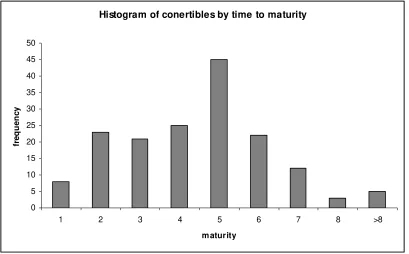
histogram of contracts on September 10, 2012 for various maturity classes is given in Figure 1.
Convertible bond prices observed in the market will be compared with theoretical prices under
different volatility assumptions. The sample is segmented into two sets according to the time to maturity:
a short-maturity class (0 ~ 8 years) and a long-maturity class (> 8 years). We first select a convertible
bond from each group: a 7-year (or 5-year outstanding) contract and a 20-year (or 17-year outstanding)
contract shown in Table 1.
Figure 1. Histogram of convertible bonds by time to maturity
This histogram divides the convertible bonds in our sample, as of September 10, 2012, into different bins
number of convertibles in each bins. A maturity bin of n covers contracts with a time to maturity ranging
from n-1 years to n years.
Histogram of conertibles by time to maturity
0 5 10 15 20 25 30 35 40 45 50
1 2 3 4 5 6 7 8 >8
m aturity
fr
e
q
u
e
n
c
[image:18.612.103.512.125.379.2]y
Table 1. Convertible Bonds
We hide the issuer names according to the security policy of the investment bank, but everything else is
authentic. In the market, either a conversion price or a conversion ratio is given for a convertible bond,
where conversion ratio = (face value of the convertible bond) / (conversion price).
Convertible bond Case 1 (a 7-year convertible) Case 2 (a 20-year convertible)
Issuer X company Y company
Notional of bond 100 100
Annual coupon rate 2.625 5.5
Payment frequency Semiannual Semiannual
Issuing date June 9, 2010 June 15, 2009
Maturity date June 15, 2017 June 15, 2029
Conversion price 30.288 13.9387
Currency USD USD
Business day convention Following Following
Put price - 100 at June 20, 2014
Let valuation date be September 10, 2012. An interest rate curve is the term structure of interest
rates, derived from observed market instruments that represent the most liquid and dominant interest rate
products for certain time horizons. Normally the curve is divided into three parts. The short end of the
term structure is determined using the London Interbank Offered Rates (LIBOR). The middle part of the
curve is constructed using Eurodollar futures that require convexity adjustments. The far end is derived
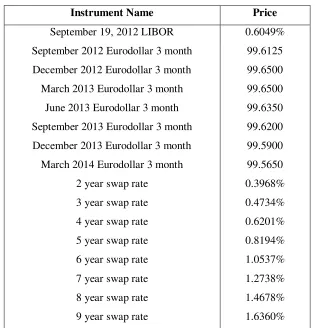
using mid swap rates.The LIBOR-future-swap curve is presented in Table 2. We bootstrap the curve and
[image:19.612.149.464.384.712.2]get the continuously compounded zero rates.
Table 2: USD LIBOR-Future-Swap Curve
This table displays the closing prices as of September 10, 2012.
Instrument Name Price
September 19, 2012 LIBOR 0.6049% September 2012 Eurodollar 3 month 99.6125 December 2012 Eurodollar 3 month 99.6500
March 2013 Eurodollar 3 month 99.6500 June 2013 Eurodollar 3 month 99.6350
September 2013 Eurodollar 3 month 99.6200 December 2013 Eurodollar 3 month 99.5900
March 2014 Eurodollar 3 month 99.5650
2 year swap rate 0.3968%
3 year swap rate 0.4734%
4 year swap rate 0.6201%
5 year swap rate 0.8194%
6 year swap rate 1.0537%
7 year swap rate 1.2738%
8 year swap rate 1.4678%
10 year swap rate 1.7825%
12 year swap rate 2.0334%
15 year swap rate 2.2783%
20 year swap rate 2.4782%
25 year swap rate 2.5790%
30 year swap rate 2.6422%
The equity information and recovery rates are provided in Table 3. To determine hazard rates,we
need to know the observed market prices of corporate bonds or CDS premia, as the market standard
practice is to fit the implied risk-neutral default intensities to these credit sensitive instruments. The
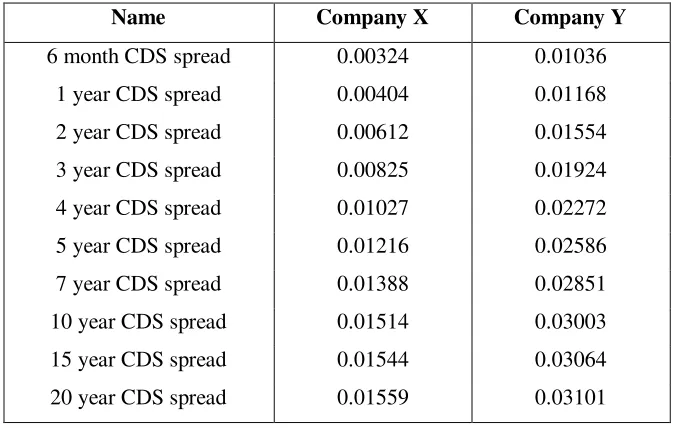
corporate bond prices are unfortunately not available for companies X and Y, but their CDS premia are
observable as shown in Table 4. Usually the CDS market leads the bond market, in particular during crisis
situation. Liquidity in the bond market is typically drying up during a financial crisis. Demand for
insurance against default risk, on the other hand, increases if the issuer is experiencing financial stress.
Consequently, prices and spreads derived from the CDS market tend to be more reliable. Said differently,
CDSs on reference entities are often more actively traded than bonds issued by the reference entities.
Unlike other studies that use bond spreads for pricing (see Tsiveriotis and Fernandes (1998),
Ammann, Kind and Wilde (2003), Zabolotnyuk, Jones, and Veld (2010), etc.), we perform risky valuation
based on credit information extracted from CDS spreads. Given the recovery rates and the CDS premia,
[image:20.612.152.461.69.191.2]we can compute the hazard rates via a standard calibration process (see J.P. Morgan (2001)).
Table 3. Equity and recovery information
This table displays the closing stock prices and dividend yields on September 10, 2012, as well as the
recovery rates
Company X Company Y
Stock price 34.63 23.38
Dividend yield 2.552% 3.95%
Equity recovery rate 2% 1%
Table 4. CDS premia
This table displays the closing CDS premia as of September 10, 2012.
Name Company X Company Y
6 month CDS spread 0.00324 0.01036 1 year CDS spread 0.00404 0.01168
2 year CDS spread 0.00612 0.01554 3 year CDS spread 0.00825 0.01924
4 year CDS spread 0.01027 0.02272 5 year CDS spread 0.01216 0.02586
7 year CDS spread 0.01388 0.02851 10 year CDS spread 0.01514 0.03003 15 year CDS spread 0.01544 0.03064
20 year CDS spread 0.01559 0.03101
The most important input parameter to be determined is the volatility for valuation. A common
approach in the market is to use the at-the-money (ATM) implied Black-Scholes volatility to price
convertible bonds. For the 5-year outstanding convertible bond (case 1 in Table 1), we find the ATM
implied Black-Scholes volatility is 31.87%, and then price the convertible bond accordingly. The results
are shown in Table 5.Our analysis actually indicates an overpricing of 0.42%.
For the 17-year outstanding convertible bond (case 2 in Table 1), however, most liquid stock
options have relatively short maturates (rarely more than 8 years). Therefore, some authors, such as
Ammann, Kind and Wilde (2003), Loncarski, Horst and Veld (2009), Zabolotnyuk, Jones, Veld (2010),
have to make do with historical volatilities. Similarly, we calculate the historical volatility as the
annualized standard deviation of the daily log returns of the last 2 years (from September 10, 2010 to
September 10, 2012),and then value the convertible bond based on this real-world volatility. The result
shown in Table 5 reports an underpricing of 1.07%. The test results demonstrate that the model prices are
Table 5. Model price vs. market price
This table shows the differences between the model prices and the market prices of the convertible bonds
under different volatility assumptions, where Difference = (Model price) / (Market observed price) – 1.
The convertible bonds are defined in Table 1.
Case 1 (a 7-year convertible) Case 2 (a 20-year convertible)
Type of volatility ATM implied Black-Scholes volatility Annualized historical volatility
Value of volatility 31.87% 18.07%
Model price 134.32 171.58
Market observed price 134.88 169.77
Difference -0.42% 1.07%
Any model can be used to calculate associated implied volatilities based on observed market
prices. Using the implied volatilities as inputs to the model, the model prices can exactly match the
market prices. The calibration can be done by choosing the implied convertible volatility that minimizes
the sum of the squared differences between the market prices and the model prices. The calibrated
convertible volatilities and the associated model prices are displayed in Table 6.
Table 6. Implied convertible volatilities
This table displays the implied convertible volatilities and the associated model prices, where Difference
= (Model price) / (Market observed price) – 1. The convertible bonds are defined in Table 1.
Case 1 (a 7-year convertible) Case 2 (a 20-year convertible)
Implied convertible volatility 32.55% 15.19%
Model price 134.88 169.77
Market observed price 134.88 169.77
[image:22.612.71.551.567.671.2]We repeat this exercise for all contracts on all observation days. For any short-maturity
convertible bond, we use the ATM implied Black-Scholes volatility for pricing, whereas for any
long-maturity convertible bond, we perform valuation via the historical volatility. The results are presented in
Tables 7.
Table 7. Statistics of underpricing for different maturity classes
An observation corresponds to a price snapshot of a convertible bond at a certain valuation date.
Underpricing is referred to as the model price minus the market price.
Maturity Observations Underpricing
Mean (%) Std (%) Max (%) Min (%)
≤ 8 years 82998 -0.13 1.37 0.79 -1.08
> 8 years 2610 1.67 2.03 2.24 0.58
Next, our sample is partitioned into subsamples according to the moneyness of convertibles.The
moneyness is measured by the ratio of the conversion value to the equivalent straight bond value or the
investment value.The underpricing of each daily observation with respect to the degree of moneyness is
shown in Table 8, where moneyness between 0 and 0.9 corresponds to out-of-the-money; moneyness
between 0.9 and 1.1 represents around-the-money; and moneyness higher than 1.1 is related to
[image:23.612.64.548.656.719.2]in-the-money.
Table 8. Statistics of underpricing for different moneyness classes
The moneyness is measured by dividing the conversion value through the associated straight bond value.
An observation corresponds to a snapshot of the market used to price a convertible bond at a certain
valuation date.
Moneyness Observations Underpricing
Mean (%) Std (%)
0.5 – 0.7 10595 -0.87 2.37
0.7 – 0.9 19850 0.51 1.64
0.9 – 1.1 14737 0.45 1.12
1.1 – 1.3 14379 -0.55 1.89
1.3 – 1.5 11631 -0.42 2.04
> 1.5 8622 -0.62 1.72
From Tables 8, it can be seen that the model prices fluctuate randomly around the market prices
(sometimes overpriced and sometimes underpriced), indicating the model is quite accurate. Empirically,
we do not find support for presence of a systematic underpricing as indicated in previous studies (see
Carayannopoulos and Kalimipalli (2003), Ammann, Kind and Wilde (2003), etc.). If there is no
underpricing, how has the arbitrage strategy been successful in the past? Maybe convertible arbitrage is
not solely based on underpricing
In a typical convertible bond arbitrage strategy, the arbitrageur entails purchasing a convertible
bond and selling the underlying stock to create a delta neutral position. The number of shares sold short
usually reflects a delta-neutral or market neutral ratio. It is well known that delta neutral hedging not only
removes small directional risks but it is also capable of making a profit on an explosive upside or
downside breakout if the position’s gamma is kept positive. As such, delta neutral hedging is great for
uncertain stocks that are expected to make huge breakouts in either direction. Since convertible bonds are
issued mainly by start-up or small companies, the chance of a large movement in either direction is very
likely. Even for very small movements in the underlying stock price, profits can still be generated from
the yield of the convertible bond and the interest rebate for the short position.
We calculate the delta and gamma values for the two deals described in table 1. The Greeks vs.
spot equity prices are plotted in Figures 2~ 5. It can be seen that the deltas increase with the underlying
prices in Figures 2 and 4. At low market levels,the convertibles behave like their straight bonds with very
convertibles are certain to be converted. In this case, the convertibles are similar to the underlying equities
and the deltas are equal to the number of shares (i.e., conversion ratios).
The gamma diagrams in Figures 3 and 5 have a frown shape. The gammas are the highest when
the convertibles are at-the-money. It is intuitive that when the stock prices rise or fall, profits increase
because of favorably changing deltas. For this reason, convertible bonds are very good candidates for
delta neutral hedging. Relatively large positive gammas of convertibles could be one of the main drivers
of profitability in convertible arbitrage.
Figure 2. Delta vs. underlying price for a 7-year convertible bond
This graph shows how the delta of the 7-year convertible bond (described in Table 1) changes as the
underlying stock price changes.
Delta of the 7-year convertible bond vs. underlying price
-0.5 0 0.5 1 1.5 2 2.5 3 3.5
1 11 21 31 41 51
equity price
d
elt
[image:25.612.115.500.347.579.2]a
Figure 3. Gamma vs. underlying price for a 7-year convertible bond
This graph shows how the gamma of the 7-year convertible bond (described in Table 1) changes as the
Gamma of the 7-year convertible vs. underlying price
-0.04 0 0.04 0.08 0.12 0.16
1 11 21 31 41 51
equity price
g
a
m
m
[image:26.612.117.500.70.300.2]a
Figure 4. Delta vs. underlying price for a 20-year convertible bond
This graph shows how the delta of the 20-year convertible bond (described in Table 1) changes as the
underlying stock price changes.
Delta of the 20-year convertible vs. underlying price
0 2 4 6 8
1 7 13 19 25 31 37
Equity price
d
e
lt
a
[image:26.612.116.498.417.645.2]This graph shows how the delta of the 20-year convertible bond (described in Table 1) changes as the
underlying stock price changes.
Gamma of the 20-year convertible vs. underlying price
0 0.2 0.4 0.6
1 11 21 31
equity price
g
a
m
m
a
5.
Conclusion
This paper aims to value hybrid financial instruments (e.g., convertible bonds) whose values may
simultaneously depend on different assets subject to credit risk in a proper and consistent way. The
motivation for our model is that if a company goes bankrupt, all the securities (including the equity) of
the company default. The recovery is realized in accordance with the priority established by the
Bankruptcy Code. In other words, different securities have the same probability of default, but different
recovery rates.
Our study shows that risky asset pricing is quite different from risk-free asset pricing. In fact, the
expectation of a defaultable asset actually grows at a risky rate rather than the risk-free rate. Therefore,
the reduced form jump diffusion model that assumes that the expected rate of return on a risky asset must
We propose a hybrid framework to value risky equities and debts in a unified way. The model
relies on the probability distribution of the default jump rather than the default jump itself, because the
default jump is normally inaccessible. The model is quite accurate for pricing convertible bonds.
Empirically, we do not find evidence supporting a systematic underpricing hypothesis. We also
find that convertible bonds have relatively large positive gammas, implying that convertible arbitrage can
make a profit on a large upside and downside movement of the underlying stock price.
Appendix
A. Numeric implementation for PDE
In this section, we describe the numerical method used to solve discrete forms of (23) and (28).
Let
0 ln S S
x t and define backward time as
t T
. The equations (23) and (28) can be rewritten as
(1 )
0 2 ) 1 ( 2 1 2 2 22
B h r x B h q r x B B b s
(A1)
(1 )
0 2 ) 1 ( 2 1 2 2 22
G h r x G h q r x G G s s
(A2)
The equations (A1) and (A2) can be approximated using Crank-Nicolson rule. We discretize the x
to be equally spaced as a grid of nodes 0 ~ M. At the maturity,
G
T andB
T are determined according to(29) and (30). At any time i+1, the boundary conditions are
0 ) )) 1 ( ( 5 . 0 1 ( ) ) 1 ( ( 5 . 0 1 ( ) )) 1 ( ( 5 . 0 1 ( ) ) 1 ( ( 5 . 0 1 ( 0 1 0 0 1 0 x when h q r G h q r G h r B h r B s i s i b i b i
(A3) x when S G B M i M i M
1 1 0 (A4)Then, we conduct the backward induction. The procedure is as follows.
// determine accrual interest and call/put prices
// determine boundary nodes
// use the PSOR (Projected Successive Over Relaxation) method to obtain the
continuation value of the bond component Bt
~
and the continuation value of the equity
component Gt
~
, applying the constraints (31).
EndFor
The value at node[0][y] is the convertible bond price where the equity price at node[0][y] is equal
to the market price.
A. Binomial tree algorithm
A binomial tree method is equivalent to an explicit difference scheme. Suppose that the stock
price S will either move up to the value uS with probability pu or down to the value dS with probability
u
d p
p 1 . As the binomial tree is a discrete approximation to the continuous distribution of equation
(16), the expectation and variance of the discrete distribution should be equal to those of the continuous
distribution.This method is commonly referred to as the moment matching technique.
To match the expectation, we have
S(t 1)/S(t )
p S(t )u (1 p )S(t )d S(t )exp(y t)E i i u i u i i s (A5)
or
) exp( )
1
( p d y t
u
pu u s (A6)
where
) 1
( s
s
s r q c r q h
y (A7)
where q is the dividend.
To match the variance, we get
S(t1)/S(t )
S2(t)
p u2(1 p )d2 exp
2y t
S2(t )exp(2y t)
exp( 2t)1
Var i i i u u s i s (A8)
) exp( ) 2 exp( ) 1
( 2 2
2 p d y t t
u
pu u s (A9)
Solving equations (A6) and (A9) according to the usual tree-symmetry condition: u = 1/d, we
obtain d u d t y pu s
exp( ) (A10)
) exp( 2 ) 2 exp( 4 1 ) exp( ) 2 exp( 1 ) exp( ) 2exp( 2 2 2
t y t y t t y t t y u s s s s
(A11)
) exp( 2 ) 2 exp( 4 1 ) exp( ) 2 exp( 1 ) exp( ) 2exp( 2 2 2
t y t y t t y t t y d s s s s
(A12)
There are many ways to approximate equations (A11) and (A12). The most well-known one is the
Cox, Ross, and Rubinstein (1979) type approximation that is up to order t accuracy and is given by
) exp( t
u (A13)
)
exp( t
d (A14)
Equations (A10), (A13) and (A14) specify the binomial risky tree parameters that are used to map
the continuous stock price dynamics into the lattice representation.
Suppose that there is a convertible bond.Let us construct a trading strategy H (,)to hold
units of the risky stock and units of the risky bond. At time ti the convertible bond value is
) ( ) ( )
(ti CB ti CS ti
C where CB(ti) is the bond component and CS(ti) is the stock component; the stock
value is S(ti); and the bond value is B(ti). At time ti1, the bond value becomes B(ti)exp(ybt) where
) 1
( b
b r h
y is the risky rate of the bond; the stock value becomes either uS(ti) or dS(ti);and the
convertible value has two possible outcomes: ( 1) ( 1) (i1)
u E i u B i u t C t C t