Volume 2012, Article ID 873078,10pages doi:10.1155/2012/873078
Research Article
Approximate Closed-Form Formulas for
the Zeros of the Bessel Polynomials
Rafael G. Campos and Marisol L. Calder ´on
Facultad de Ciencias F´ısico-Matem´aticas, Universidad Michoacana, 58060 Morelia, MN, Mexico
Correspondence should be addressed to Rafael G. Campos,[email protected]
Received 11 June 2012; Revised 10 September 2012; Accepted 23 September 2012
Academic Editor: Stefan Samko
Copyrightq2012 R. G. Campos and M. L. Calder ´on. This is an open access article distributed under the Creative Commons Attribution License, which permits unrestricted use, distribution, and reproduction in any medium, provided the original work is properly cited.
We find approximate expressionsxk, n, aandyk, n, afor the real and imaginary parts of thekth zerozkxkiykof the Bessel polynomialynx;a. To obtain these closed-form formulas we use the fact that the points of well-defined curves in the complex plane are limit points of the zeros of the normalized Bessel polynomials. Thus, these zeros are first computed numerically through an implementation of the electrostatic interpretation formulas and then, a fit to the real and imaginary parts as functions ofk, n and a is obtained. It is shown that the resulting complex number
xk, n, a iyk, n, aisO1/n2-convergent toz
kfor fixedk.
1. Introduction
The polynomial solutions of the differential equation
z2yz az2yz−nna−1yz 0, a >0, z∈C, 1.1
were studied systematically in 1 by the first time. They are namedgeneralized Bessel polynomials and are given explicitly by
ynz;a n
k0
n!na−1k n−k!k!
z
2
k
, 1.2
written in terms of the polynomial solutions of1.1. Also, this equation has application in
network and filter design, isotropic turbulence fields, and moresee the monograph2or 3–14and references therein for some other results. Among these, several results about the
important problem concerning the location of its zeros have been obtained 8–11 and in 12, explicit expressions for sum rules and for the homogeneous product sum symmetric
functions of zeros of these polynomials are given. On the other hand, the electrostatic interpretation of these zeros as the equilibrium configuration in the complex plane with a logarithmic electric potential and a dipole at the origin has been given in13, and in14
it is shown that this equilibrium configuration is not stable. Thus, these cases show that it is desirable to acquire new analytical knowledge about the location of the zeros of the Bessel polynomials.
In this paper we give approximate explicit formulas for both the real and imaginary parts of thekth zerozkxkiykofynz;aand show that the approximation order of these
new formulas to the exact zeros of the Bessel polynomials isO1/n2for fixedk.
The approach followed in this paper is simple and based on three items. The first is the electrostatic interpretation of the zeros of polynomials satisfying second-order differential equations15–17, the second is a simple curve fitting of numerical data, and the third is the
known fact that the points of well-defined curves in the complex plane are limit points of the zeros of the normalized Bessel polynomials8–11. The formulas yielded by the electrostatic
interpretation of the zeros of Bessel polynomials are used to find them numerically as it has been done previously with these and other sets of points 7–19. Several sets of zeros are
computed in this way and the sets of real and imaginary values are fitted by polynomials depending on the indexkwhose coefficients depend onnanda.
2. Asymptotic Expressions for the Zeros
Let zk xkiyk,k 1,2, . . . , n, be the zeros of the Bessel polynomial ynz;a, ordered
according to the imaginary part. Then, from1.1it follows thatA procedure for obtaining this kind of nonlinear equations for the zeros of a polynomial satisfying second and higher order differential equations is given in19.
n
k1
1
zj−zk
azj2
2z2 j
0, 2.1
where j 1,2, . . . , n, that is, the real and imaginary parts of the zeros should satisfy the electrostatic equations
n
k1
xj−xk
xj−xk2yj−yk2
ax
3
j2x2jaxjy2j −2yj2
2x2jy2j2
0,
n
k1
yj−yk
xj−xk2yj−yk2
yj
ax2
j4xjay2j
2x2
jy2j
2 0.
0 −1.5 −1 −0.5 ( z )
a=2
0
Re
200 300 400 500
k
a
0
Im
200 300 400 500
1
−0.5
−1
0 0.5
a=2
( z ) k b 0 −1 −0.6 −0.2 −0.4 −0.8 −1.2 −1.4 ( z )
a=40
0 100 200 300 400 500
k Re c 1 −0.5 −1 0 0.5 ( z )
a=40
0 100 200 300 400 500
k Im d 0 −1 −0.6 −0.2 −0.4 −0.8 −1.2 −1.4 ( z )
0 100 200 300 400 500
k
a=100
Re e 1 −0.5 −1 0 0.5 ( z )
0 100 200 300 400 500
k
a=100
Im
[image:3.600.134.467.96.489.2]f
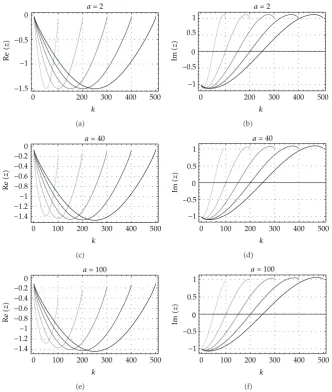
Figure 1: Real and imaginary parts of the zeros of the normalized Bessel polynomialsyn2z/2na−2;a
fora2,40,100. They are plotted as functions ofkforn100,200,300,400,500, in gray-level intensity, from lower to higher, according to the value ofn.
This set of nonlinear equations can be solved by standard methods. We have used a Newton method to solve them up ton500 anda100.
Letωkμkiνkbe thekth zero of the normalized Bessel polynomialsyn2z/2na−
2;a, that is,μk 2na−2xk/2 andνk 2na−2xk/2. As it is shown inFigure 1,
the piecewise linear interpolation of the real and imaginary parts of ωk can be fitted by
polynomials of the second and third degree in the indexk. Thus, we propose the following expressions
μk, n, a a2n, ak2a1n, aka0n, a,
νk, n, a b3n, ak3b2n, ak2b1n, akb0n,
0
−0.8
−0.6
−0.4
−0.2
0 100 200 300 400 500
n
∼
μ
(
1
,n
,a
)
a
0 100 200 300 400 500
n
−1.4
−1.5
−1.3
−1.2
−1.1
∼
μ
(
n/
2
,n
,a
)
[image:4.600.136.466.91.215.2]b
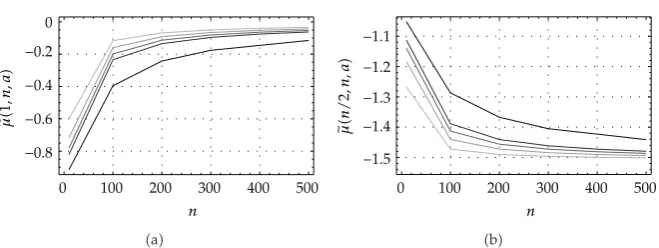
Figure 2: Dependence ofμ1, n, aandμn/2, n, aonnfora10,20,30,40,100. Plots are shown in gray-level intensity, from lower to higher, according to the value ofa.
for the approximate zeroωkμk, n, a iνk, n, ato fit our data. To find the dependence of the coefficients of these polynomials onnanda, we take into account the numerical behavior of the data at the middle and end points.
We begin by finding the coefficients of the second-order polynomial giving the real part by fitting the values of μk, n, a at k 1 and k n/2. In Figure 2 we show the dependence ofμ1, n, aandμn/2, n, aonnfor some values ofa.
A fit of these data to the models−A/nBand−A/nB−3/2 yields
μ1, n, a − 54a860
100n50a715, μ
n
2, n, a
−75n−2a400
50n11a220. 2.4
These conditions and the symmetry ofμk, n, awith respect to the middle point lead to the following coefficients:
a2n, a
p2n, a
rn, a, a1n, a
p1n, a
rn, a, a0n, a
p0n, a
rn, a, 2.5
where
p2n, a 4
7500n250625n850an−694a2−2770a96800,
p1n, a −4n1
7500n250625n850an−694a2−2770a96800,
p0n, a −100
130n2−993n−7656
−20135n2627n−1580a−2297n794a2,
rn, a 5nn−250n11a22020n10a143.
2.6
Now, to find the coefficients of the third-order polynomial giving the imaginary part we follow a similar procedure. The dependence of the real part of ν1, n, a and ∂νk, n, a/
0 100 200 300 400 500
−1
−0.9
−0.8
−0.7
−0.6
−0.5
(
1
,n
,a
)
n
∼
ν
a
0 0.05 0.1 0.15 0.2 0.25
k
(
n/
2
,n
,a
)
0 100 200 300 400 500
n
∼
ν
[image:5.600.138.466.96.215.2]b
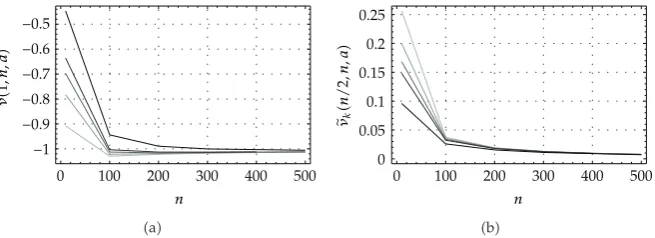
Figure 3: Dependence ofν1, n, aand∂νk, n, a/∂k|kn/2onnfora10,20,30,40,100. Plots are shown
in gray-level intensity, from lower to higher, according to the value ofa.
Again, a fit of these data to the modelsA/nB−1 andA/nyields
ν1, n, a −2525n−na−−150, ∂νk, n, a∂k
kn/2
96
na25. 2.7
In addition, we have that
νn
2, n,2
0, νn, n,2 −ν1, n,2, 2.8
therefore, the coefficients are given by
b3n, a
q3n, a
sn, a, b2n, a
q2n, a
sn, a,
b1n, a
q1n, a
sn, a, b0n, a
q0n, a
sn, a,
2.9
where
q3n, a −200
23n3−92n290n4200n3−5n28n−6a
−8n2−2n2a2,
q2n, a 100
69n4−255n3186n292n8
−1003n4−12n39n24n−12a43n3−3n24a2,
q1n, a 50
21n454n3−522n2748n−176
q0n, a −25
25n4−217n3618n2−660n184
−25n4−2n3−7n216n−12an3n2−4n4a2
sn, a 25n−12n−22a25.
2.10
Thus, the substitution of2.10,2.9,2.6, and2.5, respectively, in2.3yields the approxi-mate closed-form expressions
zkxk, n, a iyk, n, a 22μnk, n, aa−2i 22νnk, n, aa−2, 2.11
where k 1,2, . . . , n, for the zeros of the unnormalized Bessel polynomial ynz;a. The
expressions given in2.11converge to the zeros zkof these polynomials, as we will show
in the following.
3. Convergence
Following9, we define
Wz e
√
11/z2
z1 11/z2, 3.1
and denote byΓthe curve defined by
Γ z∈C:|Wz|1, argz≥ π 2
, 3.2
which contains the limit points ωk of the zeros of the normalized Bessel polynomial
yn2z/2na−2;a. Then, it has been proved in8that the zeroωkofyn2z/2na−2;a
approaches to orderO1/nthe limit valueωk, that is,
|ωk−ωk|O
1
n
, 3.3
asn → ∞.
Thus, if we show that|ωk−ωk|O1/n, we will have proved that
|ωk−ωk|O
1
n
, 3.4
and therefore, taking into account thatωk 2na−2zk/2, the explicit expression2.11
approaches to orderO1/n2the zeroz
To this purpose, we simply substitute the expression forωk μk, n, a iνk, n, a
given by2.3in3.1to obtain, after a lengthy calculation, that the expansion ofWωkin terms of 1/nis
Wωk 1
2a2−100a3k−2−5042k−67
25a25
25hak, a25cos2tk, a−sin2tk, a1
nO
1
n3/2
,
3.5
where
hk, a 25a213027a300k22a2−100a3k−2−5042k−672,
tk, a 25a13027a300k
41675−100aa2−1050k150ak.
3.6
This implies that
|Wωk|1O
1
n
, 3.7
for fixedkanda. Thus,ωkapproaches to orderO1/ntheΓcurve and3.4follows. From
here we have that
|zk−zk|O
1
n2
, 3.8
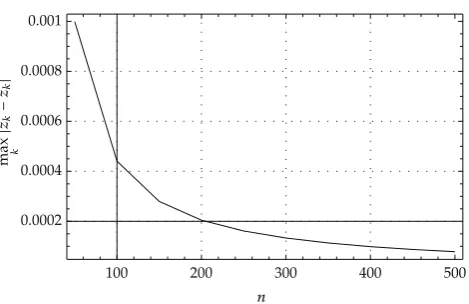
as n → ∞. Numerical calculations confirm and extend this result. Figure 4 shows the behavior of the maxima of|zk−zk|overkas they depend onnfor the particular case ofa2.
The numbers computed by2.2are taken as the exact zeroszk. A fit of these data gives 1/na witha1.7.
4. Some Few Tests
Just to give examples of the application of the approximate expression2.11, we consider the
following cases.
4.1. The Real Zero
A closed-form formula for the unique real zeroαnaof the Bessel polynomialynz;acan be obtained by the substitution ofk n1/2 in the real part of2.11,xk, n. This gives
αna −43n751 50−71a
−707a25900a35000
7500n O
1
n2
100 200 300 400 500 0.0002
0.0004 0.0006 0.0008 0.001
max k
n
|
zk
−
∼
zk
[image:8.600.184.419.92.244.2]|
Figure 4: Plot of the values of maxn
k1|zk−zk|againstnfor the case ofa2.
as our new result. In2,11very accurate expressions forαnaare given. Particularly, the following formula:
2
αna −1.325486838n−1.00628995a1.349836480O
1 2na−2
, 4.2
is given in11. Expanding 2/αnain powers ofnwe find that
2
αna −1.33333n−0.946667a0.666667, 4.3
indicating good relative agreement between the two results.
4.2. Power Sums
Here we carry out the corresponding multiplications and use some cases of Faulhaber’s formula. Then we compare our results with the exact ones.
1Sum of the Zeros. The simple sum ofzkcf.2.11gives a complicated expression
for the real part. However, expanding both the real and imaginary parts of this sum gives
s1n n
k1
zk−1
53a 100 −
71 30i
32
a25
1
nO
1
n2
. 4.4
The exact result iss1n −1, as can be seen from1.2.
2Sum of the Squares of the Zeros. In this case we take the particular case ofa1. For
this value we obtain
s2n n
k1
z2
k
3469 5915nO
1
n2
The exact sum
s2n
1 2n−1
1 2nO
1
n2
4.6
can be found elsewhere12.
The use of the approximate formula 2.11 for obtaining sums of higher powers of these zeros is not expected to give satisfactory results, since the powers and the sum magnify the total error.
5. Final Comment
The approximate formula forzkgiven above is far from being unique. There exist many other
functions to fit the zeros obtained through the electrostatic equations2.2, and there are other
conditions to impose at the extreme and middle points of the fitting interval. For instance, the imaginary partyk, ncan be fitted by a polynomial of degree 5, but this does not improve the rate of convergence and, on the other hand, the calculations become more complicated.
Acknowledgment
The authors thank Consejo Nacional de Ciencia y Tecnolog´ıa for the financial support given to this project.
References
1 H. L. Krall and O. Frink, “A new class of orthogonal polynomials: the Bessel polynomials,”
Trans-actions of the American Mathematical Society, vol. 65, pp. 100–115, 1949.
2 E. Grosswald, Bessel Polynomials, vol. 698 of Lecture Notes in Mathematics, Springer, Berlin, Germany, 1978.
3 H. M. Srivastava, “Some orthogonal polynomials representing the energy spectral functions for a family of isotropic turbulence fields,” Zeitschrift f ¨ur Angewandte Mathematik und Mechanik, vol. 64, no. 6, pp. 255–257, 1984.
4 J. L. L ´opez and N. M. Temme, “Large degree asymptotics of generalized Bessel polynomials,” Journal
of Mathematical Analysis and Applications, vol. 377, no. 1, pp. 30–42, 2011.
5 O. E ˘gecio ˘glu, “Bessel polynomials and the partial sums of the exponential series,” SIAM Journal on¨
Discrete Mathematics, vol. 24, no. 4, pp. 1753–1762, 2010.
6 C. Berg and C. Vignat, “Linearization coefficients of Bessel polynomials and properties of Student
t-distributions,” Constructive Approximation, vol. 27, no. 1, pp. 15–32, 2008.
7 L. Pasquini, “Accurate computation of the zeros of the generalized Bessel polynomials,” Numerische
Mathematik, vol. 86, no. 3, pp. 507–538, 2000.
8 A. J. Carpenter, “Asymptotics for the zeros of the generalized Bessel polynomials,” Numerische
Mathe-matik, vol. 62, no. 4, pp. 465–482, 1992.
9 F. W. J. Olver, “The asymptotic expansion of Bessel functions of large order,” Philosophical Transactions
of the Royal Society of London Series A, vol. 247, pp. 328–368, 1954.
10 H.-J. Runckel, “Zero-free parabolic regions for polynomials with complex coefficients,” Proceedings of
the American Mathematical Society, vol. 88, no. 2, pp. 299–304, 1983.
11 M. G. de Bruin, E. B. Saff, and R. S. Varga, “On the zeros of generalized Besselpolynomials I, II,”
Indagationes Mathematicae, vol. 84, pp. 1–25, 1981.
12 F. G´alvez and J. S. Dehesa, “Some open problems of generalised Bessel polynomials,” Journal of Physics
13 E. Hendriksen and H. van Rossum, “Electrostatic interpretation of zeros,” in Orthogonal Polynomials
and Their Applications, M. Alfaro, J. S. Dehesa, F. J. Marcellan, J. L. Rubio de Francia, and J. Vinuesa,
Eds., vol. 1329 of Lecture Notes in Mathematics, pp. 241–250, Springer, Berlin, Germany, 1988.
14 G. Valent and W. Van Assche, “The impact of Stieltjes’ work on continued fractions and orthogonal polynomials: additional material,” Journal of Computational and Applied Mathematics, vol. 65, no. 1–3, pp. 419–447, 1995.
15 G. Szeg˝o, Orthogonal Polynomials, Colloquium Publications, American Mathematical Society, Provi-dence, RI, USA, 1975.
16 F. Marcell´an, A. Mart´ınez-Finkelshtein, and P. Martinez-Gonzalez, “Electrostatic models for zeros of polynomials: old, new, and some open problems,” Journal of Computational and Applied Mathematics, vol. 207, pp. 258–272, 2007.
17 R. G. Campos, “Perturbed zeros of classical orthogonal polynomials,” Boletin de la Sociedad Matematica
Mexicana, vol. 5, no. 1, pp. 143–153, 1999.
18 R. G. Campos, “Solving singular nonlinear two-point boundary value problems,” Boletin de la Sociedad
Matematica Mexicana, vol. 3, no. 2, pp. 279–297, 1997.
Submit your manuscripts at
http://www.hindawi.com
Hindawi Publishing Corporation
http://www.hindawi.com Volume 2014
Mathematics
Journal ofHindawi Publishing Corporation
http://www.hindawi.com Volume 2014
Hindawi Publishing Corporation http://www.hindawi.com
Differential Equations
International Journal of
Volume 2014
Applied MathematicsJournal of
Hindawi Publishing Corporation
http://www.hindawi.com Volume 2014
Hindawi Publishing Corporation
http://www.hindawi.com Volume 2014
Hindawi Publishing Corporation
http://www.hindawi.com Volume 2014
Mathematical PhysicsAdvances in
Complex Analysis
Journal ofHindawi Publishing Corporation
http://www.hindawi.com Volume 2014
Optimization
Journal of Hindawi Publishing Corporationhttp://www.hindawi.com Volume 2014
Combinatorics
Hindawi Publishing Corporation
http://www.hindawi.com Volume 2014
International Journal of
Hindawi Publishing Corporation
http://www.hindawi.com Volume 2014
Journal of
Hindawi Publishing Corporation
http://www.hindawi.com Volume 2014
Function Spaces
Abstract and Applied Analysis
Hindawi Publishing Corporation
http://www.hindawi.com Volume 2014
International Journal of Mathematics and Mathematical Sciences
Hindawi Publishing Corporation http://www.hindawi.com Volume 2014
The Scientific
World Journal
Hindawi Publishing Corporation
http://www.hindawi.com Volume 2014
Hindawi Publishing Corporation
http://www.hindawi.com Volume 2014
Discrete Dynamics in Nature and Society
Hindawi Publishing Corporation
http://www.hindawi.com Volume 2014
Hindawi Publishing Corporation
http://www.hindawi.com Volume 2014
Discrete Mathematics
Journal ofHindawi Publishing Corporation
http://www.hindawi.com Volume 2014
Hindawi Publishing Corporation