THE STUDY OF RELATION OF ABSORBANCE WITH TIME AND
OPTIMIZATION OF MEASUREMENT CONDITIONS
Enkela Noçka1 , Ilva Gjika1 Ariola DEVOLLI2,
1
Polytechnic University of Tirana, General and Inorganic Chemistry Department 2
Department of Chemistry,Faculty of Food and Biotechnology, Agricultural University of Tirana, Albania.
ABSTRACT
The aim of our work is determination of the content of several tension-active substances in
polluted waters, having as prior object the AD. This method has high flexibility and accuracy. In
the following of our work in the session of the Analytical Chemistry we have made experiments
for the implementation of some simple and quick methods to determine AD in polluted waters. A
special attention was paid to the determination of total concentration of AD in marine waters,
because the main part of the water discharges end up in sea. The experiments performed
previously confirmed they have been made a better optimization of the measurement conditions
(ie EV concentration, time measurement, etc.) recommended from the literature, and that some
analytical parameters of the method could be improved (especially sensitivity of method). Prior
to showing the results of the experimental work we have present some data that have been used
in all of our experiments.
Materials and methods
a)apparatus used: Measurements turbidimetrik (photometric) are performed with UV-VIS
b) reactive and solvates
Anionic Detergents: Sodium dodecyl sulfate (SDS), 98% and Sodium signature
Dodecylbenzensulfonic acid sodium salt (Aldrich) were used. Basic water solution concentration 1000 mg/liter (or 500 mg/liter) are stored in the cold (refrigerator, 4 ° C), while the diluted solvates are prepared freshly (day use).
-Etiviolet (Cationic dyestuff) (EV) the Aldrich Company. The solution with concentration 10% is prepared by dissolving 0,050 g jet in 100 ml water, and is stored in cold.
- Polyvinyl alcohol (PVA) with molecular weight 13,000 to 23,000 of the Aldrich Company. Aqueous solution of 0.5% and 1% (m / v) are stored in cold.
-Buffer Phosphate, 1M, pH 6.4: 34 gram dissolved in 250ml water, added KOH solution to pH 6.4 (the pH-meter).
c) Cleaning of glass vessels:
A special care was devoted to glass containers cleaning. The glass containers that are going to be used for the AD determination should not be cleaned with powdered or liquid detergent. In our work we have followed this procedure to improve cleaning before we use these glass containers:
- water-washing
- washing with hypochlorite solution
-rinse out water and distilled water
-washing with HNO3
-rinse out distilled water
-sponge the mixture HCl + alcohol (ethyl or methyl) 1: 1
-rinse out distilled water.
d)The recommended method of measurement.
We add 10-20 ml distillated water, 1,0ml buffer phosphate (PH 6,4),V ml standard SDS solution
(newly prepared) in a 25 ml graduate balloon. After this we steered the content and is added t 3,0ml EV 10-3M and distillated water till to sigh of balloon (~1cm under the graduated line) ; and then is steered. After 5 minutes we add 0,5ml PVA solution 1% and distillated water till to graduated sign, it will well steered and is signed the time from the moment of addition of PVA. Measurement are performed after 30 minutes at Absorbance in λ=700nm, using glass container 1=1,0 cm. Volume V of SDS solution (and the concentration of this solution) are chosen
depending on the concentration of SDS in standard solution required standard to be prepared. perqendrimit te kerkuar te SDS ne tretediren standarte qe kerkohet te pergatitet.
When measurements are performed for solution of real samples, instead of distillated is added respective samples in graduated balloon of 25 ml. Any variation from the above methodology is mentioned in particular experiments.
1.2 Optimization of measurement conditions
Eksperiment 1: Optimal timing of measurements:
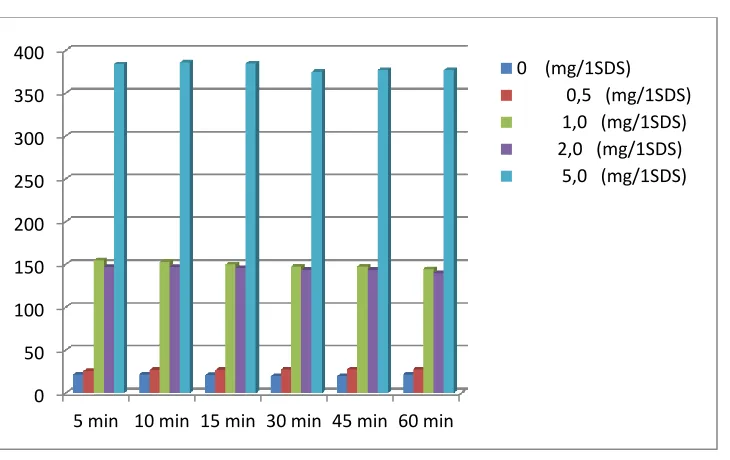
Results of absorbance measured at λ = 700nm for standard solution of SDS (0 to 0.5 mg / liter)
depending on the time till to 60 minutes are shown in table 1 and their graphic dependencies are given in Figure 1.
We noted that these results were obtained for the recommended methodology, but for
concentration of EV 1,2x M (3ml Ev M) and for concentration of PVA 0,02% m/v (0,5ml PVA 1%).
Table 1: Dependence of absorbance (Ax ) on measurement time.
Time
minutes
Concentrat DA (mg/1SDS) 0 0,5 1,0 2,0 5,0
10 22 27 153 147 386
15 21 27 150 146 385
30 20 28 148 144 375
45 20 28 148 144 377
[image:4.612.75.440.285.515.2]60 22 28 145 140 377
Figure 1: Dipedence of Absorbance from Time.
Conclusions
It is noted that measured Absorbance changes with time and this influence is more noticeable at high concentrations of SDS solution. The change of Absorbance with time scan be explained by changing the size of DA-EV associate; Absorbance values measured at λ=700nm responded radiation distribution of these associate. It may be accepted that measured absorbance varies a little in the range of 15(20)min to 45 minutes, for this reason we have choose as optimal measured time 30 minutes (from the moment of PVA addition).
0 50 100 150 200 250 300 350 400
5 min 10 min 15 min 30 min 45 min 60 min
LITERATURE
Allan W., Moore and Raymond A. Kolbesaon (1956) Determination of anionic detergents in
surface water, Vol 28(2), pp161-164
Chinnick, C.C.T., and Lincoln, P.A. (1954) Proceeding, 1 st world Conference on Surface Active Agents. Paris, France
Marron, T.V.and Scifferli, F.Ind.Eng.Chem,Anal.Ed. (1986) Standart Methods of Chemical Analysis. Volume II (A and B)