2019 2nd International Conference on Informatics, Control and Automation (ICA 2019) ISBN: 978-1-60595-637-4
Simulation Research on Liquid Level Cloud Model Control of
Double-Tank System
Jun-feng ZHANG, Chao LI
*and Peng QIANG
College of Navigation, Dalian Maritime University, Dalian 116026, China
*Corresponding author
Keywords: The double-tank system, PID control, Cloud model control, Simulink simulation.
Abstract. The double-tank system, representative in the research of process control system, is a typical time-delay object featured by large inertia, nonlinearity and strong coupling. In this paper, the control system of double-tank system in the process control laboratory is used as the research object, the mathematical model based on the combination of cloud model and PID is established and the simulation research of the double-tank system is carried out. The experimental results show that on the basis of PID, coupled with the cloud model control system, the response speed of the system can be accelerated, the overshoot is reduced, the adjustment time is greatly shortened, and the dynamic performance and steady state performance of the system can be improved.
Introduction
As a general parameter in the process of industrial control, liquid level is easily observed and measured and its time constant is usually small. Liquid level control plays an important role in many industrial applications such as liquid level change of firing glass kiln, industrial waste water treatment and chemical industries but there’s no method of liquid level control extremely suiting workers. The double-tank system is an usual controlled object in the industrial process control but its liquid level control system is characterized by large time delay and varying system parameters, which causes it often to be affected greatly by the external environment. Currently, the actual applied liquid level control system in the industrial process is controlled mainly by the traditional PID. The mathematical model of the relatively simple linear system is easy to be established and reach a satisfactory performance under the control of the traditional PID. However, in terms of the relatively complex system, people’s experience is something difficult to be accurately expressed in the actual control process, which leads to the fact that the mathematical model of the system is usually hard to be set up because semaphore is difficult to be accurately quantitatively expressed. And in this case, the limitation of PID controlling that it cannot efficiently switch between people’s qualitative cognition and quantitative expression of various precise signals will appear. Professor Li Deyi presented the concept of cloud model starting from uncertain expressions, combined probability theory and fuzzy mathematics and realized the switch between qualitative and quantitative signals in 1995. Fuzziness and randomness are no longer discussed separately in the cloud model, a new cognitive model, but well connected, which make it advantaged in the process of uncertain problems. And this theory exactly solves the limitations of PID controlling.
This paper deals with the liquid level control problem of the double-tank system, sets up the mathematical model based on the combination of the cloud model and PID, realized the adaptive control of the double-tank system by the value adjustment of PID scale, integration and differential in real time so that it can adjust controlling parameters by the change in situation in real time.
The Theory of Liquid Level Cloud Model Control System
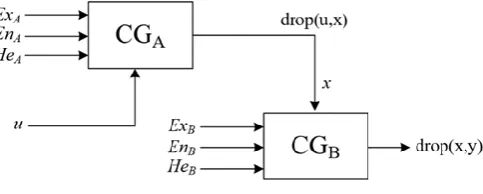
basic uncertainty; He is the measure of its Uncertainty. In this paper, the cloud model controlled double-tank system uses the single-formula and single-condition generator.(Figure 1)
Figure 1. Single-formula and single-condition generator.
After the effect errors of set value and feedback value enter the antecedent cloud generator, a gaussian random number with En of EnA and He of HeA is generated and then according to the formula:
x=exp(-0.5*((u-ExA)/L)^2 ). (1) the degree of certainty X can be determined. And a gaussian random number T is generated with En of EnB and He of HeB in the consequent cloud generator. Y can be determined by the degree of certainty
X and T according to the following formula:
y=ExB+T*sqrt(−2*ln(x)). (2) If the error is in the left of En, y is output according to the following formula:
y=ExB-T*sqrt(-2*ln(x)). (3) Then, a self-adjustment is generated by the combination with PID and the three PID values can be rearranged in real time to better control the tank with relatively ideal values all the time.
The Design Process of Cloud Model Control System
First step: Model a tank mathematically by Simulink of Matlab, establish a PID module and then simulate them;
Second step: Edit the principles of cloud model by S-function module of Matlab with the effect errors of set value and feedback value as input and output value y is generated by the before-mentioned cloud generator principles;
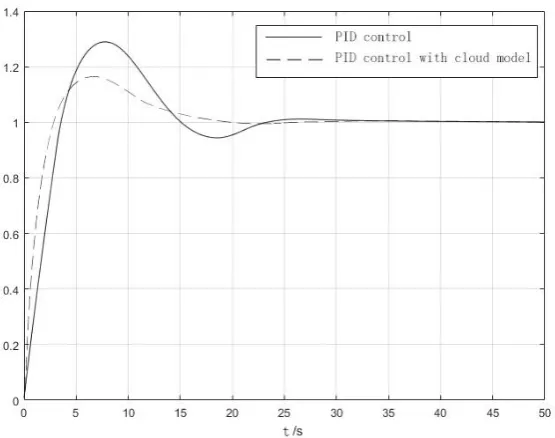
Finally, average weightily output value in each time leading to output values which are variations of the three PID parameters. The comparison figure of established PID control and the control combining cloud model and PID is showed in figure 2.
Figure 2. PID with cloud model and comparison with PID control.
Figure 3. Simulation chart for PID control with choud model and PID control.
Table 1. Comparison table of experimental result.
Rise time[s] Settling time[s] Percent overshoot
PID control 3.51 19.65 29.24%
PID control with cloud
model 2.82 10.71 17.12%
Summary
In this paper, a controlling method based on the combination of cloud model and PID of the double-tank system liquid level is presented to solve the problem that PID control over liquid level system is only by an array of PID values. The liquid level control of the double-tank system has been modeled and simulation experiments has been carried out to compare and analyze the PID controlling method and the controlling method combining cloud model and PID. The results of experiments shows the controlling method combining cloud model and PID presented by this paper solves that in terms of liquid level control of the double-tank system the problems cannot be corrected in real time only by PID control. Indexes such as rise time, setting time and overshoot are greatly advantaged and the dynamic performance and the steady-state performance of the system have a better performance. The practicality control cannot be studied in this paper because of the lack of experimental instruments. Therefore, the next step is completely out of the PID control, which means the three PID values will be replaced by the three values output exclusively by cloud model. And this will switch between qualitative and quantitative values better.
Acknowledgement
This research was financially supported by the National Science Foundation of China (61772102), the Fundamental Research Funds for the Central Universities (3132016322).
References
[1] Ning Weiwei, Du Xiaohua. Configuration and Debugging of Liquid Level Control System for Double Tank [J]. Modern Industrial Economy and Informationization, 2018, 8(18):23-24.
[2] Li Deyi, et al. Artificial intelligence with uncertainty second edition[M].Beijing:National defense industry press, 2005.
[3] Liu Honglin. Is Based on the PLC Level of PID Controls [J]. Equipment Manufacturing Technology, 2018(04):126-128.
[4] Zhang Lei, Li Ju. Liquid Level Controlling of Multi-effect Evaporation Processes Based on BPNN-based PID [J]. Instrument Technique and Sensor, 2018(03):98-101+107.
[5] Li Denghui. Research on fuzzy PID control strategy based on improved BBO algorithm [D].Southwest Jiaotong University Master Degree Thesis, 2018.
[6] Li Yaopeng. Application of multi-modal prediction in three-tank water level control system [D].Northeast electric power university, 2018.
[7] Sun Jinggao, Xue Rui, Yuan Wuyue. Application of nonlinear predictive control in three-tank liquid-level control system [J]. Journal of Nanjing University of Science and Technology, 2018, 42(04):439-444+452.
[8] Xue Qin, Xu Wenchao, Zhang Guohui, Zheng Changwei. Modeling Diversity Capability of Virtual Soldiers Based on Cloud Theory [J]. Journal of Ordnance Equipment Engineering, 2014, (11): 102-105
[9] Sun Jianmin, Liang Huanying, Ding Jianchao. Controller design of Tipper Semi-active Suspension using Adaptive Fuzzy-PID Control Theory, 2010 International Conference on Intelligent Computation Technology and Automation, 2010, 1050-1053