
2019 International Conference on Artificial Intelligence and Computing Science (ICAICS 2019) ISBN: 978-1-60595-615-2
Digital Twin-based Smart Building Management and Control Framework
Jian NIE, Wei-sheng XU
*, Da-zhang CHENG and You-ling YU
Tongji University, Shanghai 201804, China *Corresponding author
Keywords: Digital-twin, Intelligent building, Big data, Building management.
Abstract. Digital Twin is a digitalization technology that combines various technologies such as cloud computing, Internet of Things, and big data to implement interaction between physical and virtual spaces. This article describes the application of digital-Twin in the field of building and proposes a digital twin-based intelligent building management framework to achieve a more proactive, efficient, convenient and environment-friendly management control method throughout the life cycle. Finally, three application scenarios are listed under the digital twin-based smart building framework.
Introduction
Buildings are special industrial products whose value is reflected in the long-term operation process. Today, when information and communication technologies are fully infiltrated into society, there is an unprecedented breakthrough in the relationship between building, technology and people.
Liu Chang et al. [1] proposed the concept of smart building, that is, “buildings and people, network,
application, service system tightly coupled, complex system with integrated intelligence capabilities such as perception, memory, judgment and decision-making”, which highly summarizes future
imagination and expectation of building development.
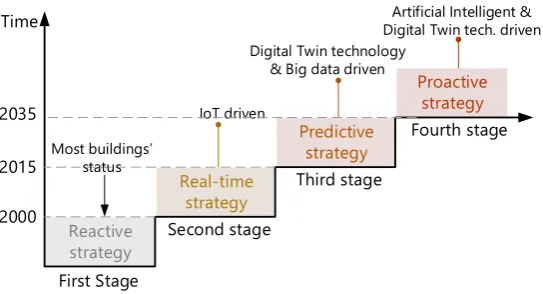
Referring to a new management model called “proactive manufacturing” based on the degree of big data utilization in manufacturing industry, the building evolution of life cycle management will also go through these four phases: passive, real-time, predictive and proactive (Figure 1), namely from a passively responds to householders’ demands and give corresponding feedback to predicting the behavior and state of facility and human resources proactively.
Real-time
strategy
Reactive strategy
First Stage
Second stage
Third stage
Fourth stage
IoT driven
Digital Twin technology & Big data driven
Artificial Intelligent & Digital Twin tech. driven
Predictive strategy
Proactive
strategy
Time
2000 2015 2035
Most buildings
[image:1.595.161.433.512.659.2]status
Figure 1. The evolution of Building Management and control strategies.
Digital Twin – A Data Model that Runs through all Phases of the Building's Life Cycle
The concept of Digital Twin was first introduced by Professor Grieves in 2003 [1]. Later, the US Department of Defense introduced the concept of digital twin into the maintenance of spacecraft and defined it as a multi-physical, multi-scale, multi-probability simulation process, based on the physical model of the aircraft to construct its complete mapping. Digital twin has the following characteristics [3]:
integrating various types of data of physical objects, is a faithful mapping of physical objects;
exists in the entire life cycle, evolving with it, and accumulating relevant knowledge;
can not only describe physical objects, but can be optimize them based on models.
Digital twin-related technology has been applied and validated in industrial fields. In 2011, Tuegel et al. [6] sought to establish an ultra-high fidelity digital twin simulation model to accurately predict the life and damage of a spacecraft structure. Grieves [7] studied methods of fault prediction and elimination in 2017 based on digital twin technology and then applied it in NASA related systems. In addition, companies such as PTC and Siemens have also proposed digital-twin related products and business solution.
The application of information technology in the housing and construction industry is Building
Information Modeling (BIM) which is a digital representation of physical and functional
characteristics of a facility [4]. Difference between BIM and Digital Twin is that, digital twin technology emphasizes the connection between virtual and reality, and the co-evolution with physical objects, while BIM is an information management platform which lack of the application in the Internet of Things. BIM is foundation of digital twin technology applied in building industry and make it easier to realize this concept.
[image:2.595.68.523.415.735.2]Framework of Digital-Twin Based Smart Building
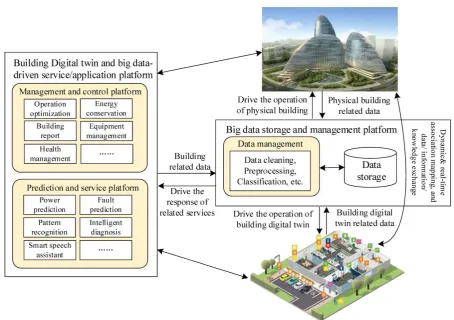
Digital twin technology is considered to be a key technology for implementing network physical systems (CPS). In this paper, we present a framework for digital-twin based smart building management and control methods. Four core components are detailed in the framework (shown in Figure 2) as follows:
Physical Building, Real-Time Obtaining, Organization, and Management of Data
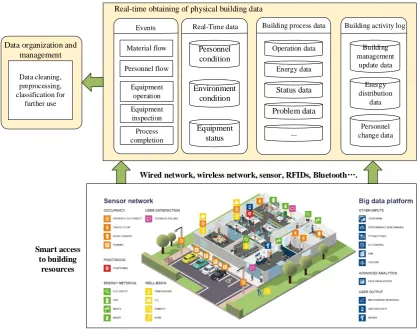
The building physical space is mainly responsible for accepting the tasks assigned by the digital-twin system and pre-defining the instructions according to the virtual building model to complete the relevant control actions. However, unlike the conventional buildings, the physical space under the digital-twin system needs to have real-time physical data, such as the indoor temperature of the temperature control system, the cooling water and the chilled water temperature, and real-time video monitoring data. IoT technology can be applied to multiple subsystems of the building to ensure the timeliness and accuracy of building data effectively.
In addition, the digital-twin concept provides a new solution for buildings’ data management. Buildings’ digital twins act as a single source of data throughout their life cycle. It enables suppliers to collaborate in facility selection, design planning, facility utility and maintenance.
Real-time obtaining of physical building data
Events
Material flow
Personnel flow
Equipment operation
Equipment inspection
Process completion
Real-Time data
Personnel condition
Environment condition
Equipment status
Building process data Building activity log
Operation data
Energy data
Status data
Problem data
...
Building management
update data
Energy distribution
data
Personnel change data
Wired network, wireless network, sensor, RFIDs, Bluetooth .
Data organization and management
Data cleaning, preprocessing, classification for
further use
Smart access to building
[image:3.595.92.513.302.632.2]resources
Figure 3. Smart Building data organization and management.
Virtual Building, Construction of Smart Building Digital Twin Model
models such as assessment, optimization, prediction, and traceability based on the numerous operational and evolution laws of the workshop. Edging algorithm methods such as data analysis, machine learning, and knowledge mining are indispensable.
Building Data Organization and Management
Building data presents the typical “3V” characteristics of big data [5], namely volume, variety and velocity. It is necessary to build a large-scale data storage and management platform to lay a solid foundation for digital twin. The data from building digital twin systems includes not only physical space data, but also data related to buildings in virtual spaces. The latter consists of model data and operations that compose data for digital twins, such as simulation data, prediction data, and evaluation data. The Big Data Storage and Management Platform serves as a single data source for data support for physical buildings, building digital twins, and building operations service platforms. It is the motivation and foundation for smart building management and control systems.
Smart Building Service Platform, Digital-Twin Based Smart Building Management and Services, and Big-Data Driven Prediction
The Building Operations Service platform as shown in Figure 4 refers to a collection of technologies that support the functional and target requirements of smart building management and control. It includes monitoring, forecasting and optimal control of building energy, internal resources and facility management. It consists of a predictive service platform and an operational management and control service platform. This Platform is a prerequisite for predictive management and control, providing forward-looking information for operational management and service platforms.
Big-data based applications realize proactive prediction instead of passive processing. It is possible and feasible to predict incoming interference at the beginning of the operational process. Staff can take the initiative to prevent or pre-solve possible interference. Using big data, the analytical model
Real-time data Real-time building
management and control
Building prediction and service
Real-time data
Simulation results
Initial control strategy
Physical building
Building digital twin
Building management and control service platform
Dynamic, real-time and visual monitoring The most optimal
Building control strategy
Dynamic& real-time association mapping, and data/ information/
knowledge exchange
Prediction service platform based on
big data (theoretical results)
Prediction service platform based on
digital twin (simulation results) Building prediction service platform
Comparation& evaluation
Verification& optimization
Prediction results
Big data-driven prediction process
Big data prediciton
model
Historical data
Experiences knowledge
Real-time data
Theoretical results
Real-time data Simulation results
[image:4.595.74.525.381.723.2]Drive the operation of building digital twin
of optimal decision-making is transformed from a causal relationship analysis model into a correlation analysis model. This provides a new approach to building environment optimization and operational decision making, especially for large-scale resource allocation and optimization issues.
Conclusion
Although the concept of smart building has long entered the sight of real estate developer operators, the current building informatization mainly focuses on data collection, comprehensive analysis and visualization, while ignoring Informatization and building management itself, and lacking the entire building simulation prediction of the whole life cycle. Through dynamic simulation and other technical methods, real-time online management based on digital twin technology concentrates on people and objects in the building and collecting data, and obtaining operational information that cannot be directly collected through simulation calculation from the collected data, which can be used for early prediction and automatic repair and operational services to enhance building intelligence, health and economic level. It realizes the digitalization of buildings, predicts construction problems, plans construction operation measures, and improves the life cycle of information solutions for building development.
Acknowledgements
The authors would like to express their sincere gratitude to Jiangsu Provincial Housing and Urban-Rural Construction Department - Program on the Next-Generation Intelligent Green Building and Research on Intelligent Control Algorithm of Super High-rise Complex Multi-Energy Air Conditioning System.
References
[1] J.K.W. Wong, H. Li, S.W. Wang. Intelligent building research: a review [J]. Automation in
Construction, 2004, 14(1).
[2] F. Tao and M. Zhang, “Digital Twin Shop-Floor: A New Shop-Floor Paradigm Towards Smart
Manufacturing,” in IEEE Access, vol. 5, pp. 20418-20427, 2017, 23(01): 1-9.
[3] Boschert S., Rosen R. (2016) Digital Twin—The Simulation Aspect. In: Hehenberger P., Bradley
D. (eds) Mechatronic Futures. Springer, Cham.
[4] Laiserin Jerry. Comparing pommes and naranjas[EB/OL].
http://www.laiserin.com/features/issue15/feature01.php, 2002-12-16.
[5] Chen, M., Mao, S. & Liu, Y. (2014) Big data: a survey. Mobile Networks and Application. 19:
171.
[6] Tuegel E.J., Ingraffea A.R., Eason T.G., Spottswood S.M. (2011) Reengineering aircraft
structural life prediction using a digital twin. Int J Aerospace Eng doi:
https://doi.org/10.1155/2011/154798.
[7] Grieves M., Vickers J. (2017) Digital twin: mitigating unpredictable, undesirable emergent
behavior in complex systems. Transdisciplinary perspectives on complex systems. Berlin: Springer-Verlag.
[8] Yao X.F., Zhou J.J., Zhang C.J., Liu M. (2017) Proactive manufacturing: a big-data based
emerging manufacturing paradigm. Comput Integr Manuf Syst 23(1): 172–185.
[9] Zhuang, C., Liu, J. & Xiong, H. Int J Adv Manuf Technol (2018) 96: 1149.
[10]Tao F., Cheng J., Qi Q., Zhang M., Zhang H., Sun S. (2017) Digital twin-based product design,
![Figure 4. Digital twin-based building management service and prediction framework [9]](https://thumb-us.123doks.com/thumbv2/123dok_us/250124.1024933/4.595.74.525.381.723/figure-digital-based-building-management-service-prediction-framework.webp)
