
© 2016, IRJET | Impact Factor value: 4.45 | ISO 9001:2008 Certified Journal | Page 2328
AMID BASED CROWD DENSITY ESTIMATION
Rupali Patil
1, Yuvaraj Patil
21
M.E student, Dept.of Electronics Engineering, KIT’s College of Engineering, Maharastra, India
2Professor Dept.of Electronics Engineering, KIT’s College of Engineering, Maharastra, India
---***---Abstract -
In the case of visual surveillance for a widearea a challenging problem is Crowd density estimation. So major problem is the safety of people in a crowd. Hence we proposed a video based crowd density analysis and
prediction system which is based on Accumulated Mosaic Image Difference (AMID) to estimate the number of people in a crowd. Our system can adequately estimate a specific number of persons and velocity of a crowd.
Key Words: crowd density estimation, AMID, prediction system , visual surveillance.
1.
INTRODUCTION
This system is used in surveillance systems using Closed Circuit Television where monitoring of the objects and their behavior can be done through a long period. A human observer might miss some information because monitoring crowds through CCTV are very high and cannot be performed at a time for all the cameras. Therefore, the use of automated techniques for monitoring crowds like estimating a crowd’s density, tracking a crowd’s movement and observing the crowd’s behavior, is necessary.
Crowd density estimation is one of the important applications in visual surveillance, and it plays a useful role in crowd monitoring and management. Specially for service providers in public places, crowd density estimation systems can provide the current state of waiting for customers and thus gives valuable reference to use the limited resources more efficiently. It has many advantages: curve fitting. Still, these methods may fail if background changes gradually over time.
Foreground based methods: In [2-3], first the foreground is extracted by removing background using a reference image, then considering function of the number of foreground pixels crowd density is computed. In [4], Optical Flow and Background Model is based on LK optical flow and GEM methods. This is computed for the complete image and used for crowd density estimation. This way overcomes the shortages of optical flow and background-subtract, such as sensitiveness of light changing and producing accumulate errors. But the modeling is time-consuming. In [5], Bayes decision rule is used for classification between background and foreground and the foreground of moving crowds is detected. The number of persons in a crowd is calculated as
a linear function of foreground pixels. In [6], The Changes in pixel value, are noted using an Markov Random Fields based approach. Then by minimizing a MRF-based objective function, the optimal foreground is obtained.
Feature-based methods: To detect human heads in crowds, Haar feature based head detection [7] and integral channel features [8] based head detection [9] are used. By analyzing the sizes and positions of detected heads the total number of people in a crowd is estimated, but this method may fail if the observed area is much crowded and only a few heads can be detected. In.[10], Input images are used to extract texture feature vectors. To solve the regression problem of calculating crowd density a Support Vector Machine is used. This method is inconvenient for real applications.
Group based methods: In Ref. [17], A group-based method is Proposed by authors to accurately estimate the number of people. This method deals with the entire area occupied by a group as a whole, rather than trying to detect individuals separately. In Ref. [18], A framework is proposed by authors, to segment high-density crowd flows and detect flow instabilities using Lagrangian particle dynamics. In this method, moving crowds are treated as periodic dynamical systems manifested by a time-dependent flow field. In[19] , Size of extracted crowd region is used as density measurement.
In this paper, optical flow approach is used for motion detection and estimation as a part of a preprocessing stage. The calculated dense optical flow of the frame is divided into blocks for block-based relative flow analysis. Later, the flow analysis in the region of a frame is performed, where density is needed to be estimated.
© 2016, IRJET | Impact Factor value: 4.45 | ISO 9001:2008 Certified Journal | Page 2329
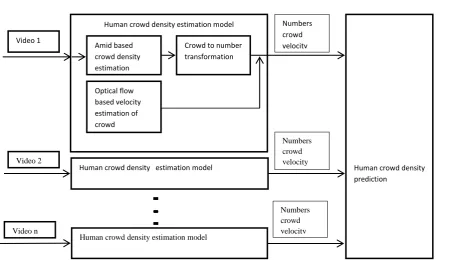
2. SYSTEM FRAMEWORK FOR WIDE AREA SURVEILLANCE
Human crowd density prediction
Human crowd density estimation model
Amid based crowd density estimation
Optical flow based velocity estimation of crowd
Crowd to number transformation
Human crowd density estimation model Video 1
Video 2
Human crowd density estimation model
Video n
Numbers crowd velocity
Numbers crowd velocity
[image:2.595.64.527.127.394.2]Numbers crowd velocity
Figure 1
Fig-1: System Framework For Wide Area Surveillance
Fig-2: Optical Flow Determination In Fig-1 Video is taken as input for processing. Then AMID
algorithm is used to detect local image changes. To predict crowd densities, the transformation from crowd density to a number of people should be known. Optical flow based velocity estimation of a crowd is used to find the velocity of crowd density. Multiple video processing is possible for estimation of a crowd from more videos.
2.1 Image Mosaicing Process
Includes three steps:First, registration of input images which is done by estimating the homography, in which pixels in one frame are related to their corresponding pixels in another frame.
Second, wrapping input frames, according to the estimated homography to align their overlapping regions.
Finally to build the result, paste the warped images and blend them on a common mosaicing surface.
1. Image Registration: Given a set of m images {I₁,I₂,…Im} with a partial overlap between at least two images, compute an image-to- image transformation that will map each image {I₂,I₃,…Im} into the coordinate system of I₁.
2. Image Warping: From the computed transformation,
warp each image,
3. Image Interpolation: resample the warped image. 4 Image Compositing: To create a single image on the reference coordinate system, blend images together
2.2 Optical Flow Determination
In Fig-2 Optical Flow determination is shown. Gaussian
Filter is Created(G)
Optical Flow is created
Elimination of Common Part Between 2 images
Convolution of smooth image with (G)to get im1 &im2
Common part between 2 images is calculated Smoothening of
[image:2.595.334.571.526.647.2]© 2016, IRJET | Impact Factor value: 4.45 | ISO 9001:2008 Certified Journal | Page 2330
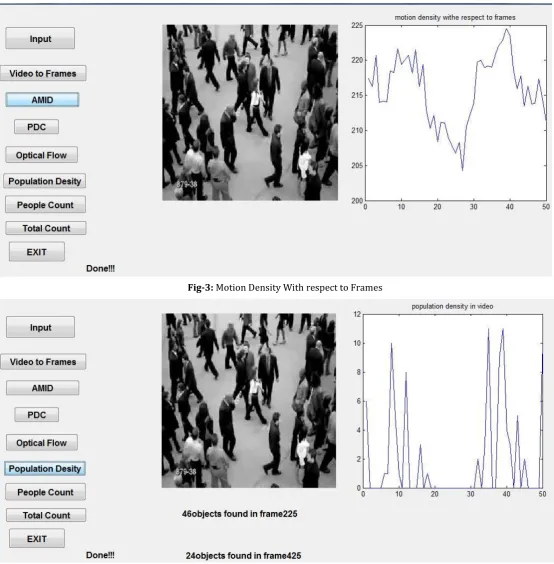
Fig-04: Population Density and Population count in videoInitially, a Gaussian Filter is created, which can be used for smoothening of image1 (im1) and image2 (im2).Then convolution operation is performed. Then common part between two images is calculated and eliminated. So finally we get the optical flow.
2.3 Processing of Videos
[image:3.595.23.578.159.724.2]In Fig-3 Motion density with respect to frame is shown. This figure is the plot, after performing AMID operation.
© 2016, IRJET | Impact Factor value: 4.45 | ISO 9001:2008 Certified Journal | Page 2331
Fig-05: Total Count in VideoIn fig 4. Population Density and population count are shown. Only the frames having the maximum count and the minimum count is shown here.
In fig 5 shows the total count of people in the video.
3. CONCLUSION
To estimate crowd density we have proposed AMID based approach.
The basic concept in this paper are as follow: First, the notion intra-crowd motions are proposed. Second, To represent the local intra-crowd motions the AMID series are proposed,
Then Population Density is calculated. So finally Population count is shown.
REFERENCES
[1] Zhan Beibei, Monekosso D N et al. “Crowd Analysis: Machine Vision and Applications”, A Survey[J],2008, 19(6):345-357.
[2] XU Liqun, Anjulan “Crowd Behaviors Analysis in Dynamic Visual Scenes of Complex Environment”, 15th IEEE International Conference on Image Processing, (ICIP), USA, 2008.
[3] GUO Jinnian, WU Xinyu, CAO Tian, et al. “Crowd Density Estimation Via Markov Random Field (MRF)”, World Congress on Intelligent Control and Automation(WCICA), 2010.
[4] MA Ruihua, LI Liyuan, HUANG Weimin, et al. “On Pixel Count Based Crowd Density Estimation for Visual Surveillance ”, IEEE Conference on Cybernetics and Intelligent Systems, Singapore,2004.
[5] Paragios N, Ramesh V. A “MRF-Based Approach for Real-Time Subway Monitoring”, IEEE Computer Society Conference on Computer Vision and Pattern Recognition, 2001.
[6] LIN S F, Chen J Y, Chao H X. “Estimation of Number of People in Crowded Scenes Using Perspective Transformation”, IEEE Transactions on Systems, Man, and Cybernetics Part 2001.
[7] Subburaman V B, Descamps A, Carincotte C. “ Counting People in the Crowd Using a Generic Head Detector”, IEEE 9th International Conference on Advanced Video and Signal Based Surveillance, Beijing, China,2012.
[8] WU Xinyu, Liang Guoyuan, LEE K K, et al. “Crowd Density Estimation Using Texture Analysis and Learning”, IEEE International Conference on Robotics and Biomimetics, (ROBIO), China, 2006.
[9] Dollar P, TU Zhuowen, PERONA P, et al. “IntegralChannel Features”, British Machine Vision Conference Rama Chellappa, UK, 2009.
[10] Brostow G J, Cipolla R. “Unsupervised Bayesian Detection of Independent Motion in Crowds”, IEEE Computer Society Conference on Computer Vision and Pattern Recognition (CVPR), New York, USA, 2006:
[11] Conte D, Foggia P, Percannella G, et al. “A Method for Counting People in Crowded Scenes”, IEEE International Conference on Advanced Video and Signal Based Surveillance (AVSS), Boston, MA, USA, 2010.
© 2016, IRJET | Impact Factor value: 4.45 | ISO 9001:2008 Certified Journal | Page 2332
Pursuing ME From KIT᾿S College of
Engineering, Kolhapur. She received BE Degree in Elecronics and Telecommunication from SGI,Atigre.
Professor at KIT᾿S College of Engineering, Kolhapur.He has received PHD Degree in Electronics Engineering.
[13] YANG Hua, SU Hang, ZHENG Shibao, et al. “ The Large-Scale Crowd Density Estimation Based on Sparse Spatiotemporal Local Binary Pattern”, IEEE International Conference on Multimedia and Expo (ICME), Barcelona, Spain, 2011.
[14] Rabaud V, Belongie S. “Counting Crowded Moving Object”, IEEE Computer Society Conference on Computer Vision and Pattern Recognition. New York, NY, USA, 2006. [15] Kilambi P, Ribnick E, Joshi A J, et al. “Estimating Pedestrian Counts in Groups”, Computer Vision and Image Understanding,2008.
[16] Zhang Zhaoxiang, LI Min. “Crowd Density Estimation Based on Statistical Analysis of Local Intra-crowd Motions for Public Area Surveillance”, Optical Engineering, 2012. [17] Ali S, Shah M. “ A Lagrangian Particle Dynamics Approach for Crowd Flow Segmentation and Stability Analysis”, IEEE Computer Society Conference on Computer Vision and Pattern Recognition, (CVPR), MN, USA, 2007. [18] Saxena S, Brémond F, Thonnat M, et al. “Crowd Behavior Recognition for Video Surveillance”, International Conference on Advanced Concepts for Intelligent Vision Systems (ACIS), France.2008.
[19] Sirmacek, B, Reinartz, P. “ Automatic Crowd Density and Motion Analysis in Airborne Image Sequences Based on a Probabilistic Framework”, IEEE International Conference on Computer Vision Workshops (ICCV), Barcelona, Spain, 2011.
BIOGRAPHIES
RUPALI PATIL
![基於鑑別式自編碼解碼器之錄音回放攻擊偵測系統 (A Replay Spoofing Detection System Based on Discriminative Autoencoders) [In Chinese]](data:image/gif;base64,R0lGODlhAQABAIAAAP///wAAACH5BAEAAAAALAAAAAABAAEAAAICRAEAOw==)