6
I
January 2018
Analysis and Seismic Response Reduction of 10, 15,
20 storey Building Using Base Isolation
Owais Kamran Shaikh1, Mrs. Gitadevi. B. Bhaskar
2
, Miss. Shalaka Sharma3
1
M-Tech Student(SE), Department of Civil Engineering, GHRAET, Nagpur
2
Assistant Professor, M-Tech Co-ordinator, Department of Civil Engineering, GHRAET, Nagpur
3
Asst. Professor, Department of Civil Engineering, GHRAET, Nagpur
Abstract: Earthquake never kills people but the defective structures do. The stability and stiffness of any structure is the major issue of concern in any high rise buildings. This study deals with a new type of base isolation application. The work includes design of 10, 15, 20-storey reinforced concrete symmetrical plan and unsymmetrical plan building in accordance with IS 1893:2002 provisions; one with fixed base and other is base isolated. By analyzing the fixed base buildings, we get maximum reactions under each column. For these maximum values lead-rubber bearings (LRBs) are designed in order to isolate the superstructure from substructure. Time history analysis is carried out by taking elcentro earthquake ground motion records. Modeling and analysis of fixed base and base isolated buildings by using E-TABS software and study the effects of earthquake ground motions on these models and study the effectiveness of lead rubber bearing used as base isolation system and carry out comparison between fixed base and base isolated building on the basis of their dynamic properties like maximum shear force, maximum bending moment, base shear, storey drift and storey acceleration. In this manner it could be possible to decide the effectiveness of this base isolation system, giving advices for future possible applications.
Keywords: Earthquake, Base Isolation, Lead-rubber bearings , E-TABS
I. INTRODUCTION
Conventional seismic design attempts to make buildings that do not collapse under strong earthquake shaking, but may sustain damage to non-structural elements and to some structural members in the building. Non-structural components may consist of furniture, equipment, partitions, curtain wall systems, piping, electrical equipment and many other items. There are mainly three main categories: architectural components, mechanical and electrical equipments, and building contents. This may render the building non-functional after the earthquake, which may be problematic in some structures, like hospitals, which need to remain functional during the earthquake. Non-structural components are sensitive to large floor accelerations, velocities, and displacements. When a building is subjected to an earthquake ground motion, the building induces motion, resulting in floor accelerations higher than the ground acceleration. Hence, it is present need and also a duty of civil engineers to innovate earthquake resisting design approach to reduce such type of structural damages. Special techniques are required to design buildings such that they remain practically undamaged even in a severe earthquake. There are two basic technologies used to protect buildings from damaging earthquake effects. These are base isolation devices and seismic dampers. The idea behind base isolationis to detach (isolate) the building from the ground in such a way that earthquake motions are not transmitted up through the building, or at least greatly reduced. Seismic dampers are special devices introduced in the building to absorb the energy provided by the ground motion to the building (much like the way shock absorbers in motor vehicles absorb the impacts due to undulations of the road).
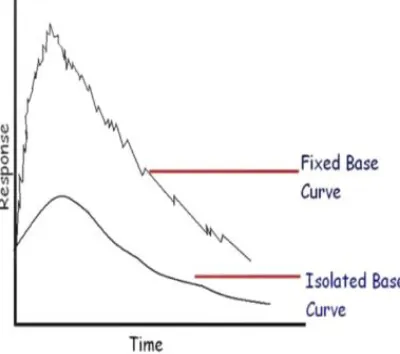
As an earthquake shakes the soil laterally, the foundation moves with the soil and the seismic waves are transferred throughout the structure over time. If the earthquake has natural frequencies with high energy that match the natural frequencies of the building, it will cause the building to oscillate violently in harmony with the earthquake frequency. The earthquake energy loses as it moves a structure, is proportional to the stiffness of the structure. Thus, in a nonisolated state, the building itself becomes an outlet for the energy of the earthquake because in all of its structural components it has to provide tremendous resistance (force) to the seismic motion. For the above equation of conservation of energy of a structure during seismic events, magnitude of energy component En is very high and is the primary reason for failure of structure. However, if the natural frequency of the building can be changed to a frequency that does not coincide with that of earthquakes, the building is less likely to fail. This is exactly what a base isolator does. The base isolator reduces the stiffness of the structure and thereby lowers its natural frequency. In this condition, the building's superstructure will respond to the vibrations as a rigid unit instead of resonating with the vibrations. Simply put, the building's foundation moves with the ground and the base isolator flexes to reduce the ground motion from affecting the superstructure. Lateral displacements caused are concentrated at isolation interface limiting the inter-storey drifts.
Fig 3. Isolated base system on earthquake.
Seismic isolation is characterized by flexibility and energy absorption capability. The flexibility alone is insufficient to defeat away a major portion of the earthquake energy so that inelastic action does not occur, i.e., En is minimized by means of energy dissipation in the isolation system and Ed is then useful in limiting the displacement response and in avoiding resonance. However, Structures are normally not isolated from vertical earthquake motions. Vertical ground motions are smaller in magnitude than horizontal motions. In addition structure is basically designed to resist static gravity loads they are inherently strong and stiff in vertical directions, making isolation in vertical direction of secondary importance.
[image:3.612.215.415.526.703.2]II. METHDOLOGY A. General
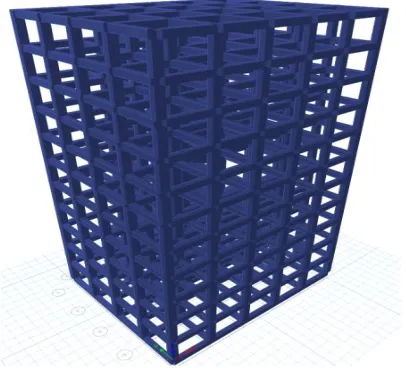
[image:4.612.209.412.151.335.2]This building has been modeled as 3D Space frame model with six degree of freedom at each node using ETAB 2016 software for stimulation of behaviour under gravity and seismic loading. The isometric 3D view and plan of the building model is shown as figure. The support condition is considered as fully fixed.
Fig 3D View of RCC regular plan building
B. Time History Analysis
A linear time history analysis overcomes all the disadvantages of modal response spectrum analysis, provided non-linear behavior is not involved. This method requires greater computational efforts for calculating the response at discreet time’s .One interesting advantage of such procedure is that the relative signs of response quantities are preserved in the response histories. This is important when interaction effects are considered in design among stress resultants. Although this is too simplistic to apply to a real structure, the Heaviside Step Function is a reasonable model for the application of many real loads, such as the sudden addition of a piece of furniture, or the removal of a prop to a newly cast concrete floor. However, in reality loads are never applied instantaneously - they build up over a period of time (this may be very short indeed). This time is called the rise time. As the number of degrees of freedom of a structure increases it very quickly becomes too difficult to calculate the time history manually - real structures are analyzed using non-linear finite element analysis software. Time-history analysis is increasingly used in design of new Structures and evaluation of existing ones .In the case of time-history analysis, seismic action is described by a suite of ground acceleration records.
III. CONCLUSIONS
A. It is seen that frequency has reduced due to insertion of base isolators in a building.
B. The time period were increased for the structure with base isolator compared to fixed base .
C. It is clear from the graph that spectral acceleration is lowest when building is isolated with rubber bearing.
D. It can seen that base shear has minimum value in case of regular plan building than irregular plan building when isolated with rubber bearing.
E. Displacement has decreased in case of base isolated building as compared to fixed base structure.
F. In base-isolated structures large reduction is observed in acceleration values, base shear forces and relative storey displacements with respect to conventional structures. Also it is reduced in case of regular plan building than irregular plan building. As a result of decreasing relative storey displacements, the accelerations acting on superstructure are damped at base level and the internal forces in superstructures are reduced.
G. The performance of base isolated building is better compared to the fixed base building.
H. There is 55% reduction in base shear when isolated with LRB as compared to the fixed base building in case of 10 storey. The
I. The storey drifts were decreased by 58% for 10,15,20 storey building in all seismic zones.
J. It has been observed that maximum shear force, bending moment, storey acceleration, base shear decreases; whereas increase in lateral displacements were observed for bottom storey then gradually decreases for top storey of base isolated building as compared with fixed base building model.
K. It is observed that time history plot of base shear, acceleration and displacement is reduced for LRB isolated base as compared to fixed base.
IV. ACKNOWLEDGMENT
I extend my sincerest gratitude to my parents, my friends, my Guides and my well wishers who had constantly encouraged me and helped me in all situations whenever needed during this project completion.
REFERENCES
[1] Raheem Faghaly"Optimum Design of Systems for Tall Buildings."International Journal of optimization in civil engineering, August 201
[2] Allen J. Clark "Multiple Passive base isolator For Reducing the Earthquake Induced Ground Motion." proceedings of ninth world conference on Earthquake engineering, august 2-9,1988
[3] Amr.W.Sadek "Non-Linear Response of Torsionally Coupled structures". World Earthquake Engineering conference 1980
[4] FahimSadek, BijanMohraj, Andrew W.taylor and Riley M.Chung"A method of estimating the parameters of tuned massJ.Ormondroyd and J.P. Den hartog ," the theory of dynamic vibration absorber",Trans. ASME APM-50- 7, 1928, pp. 9-22
[5] Jonathan Chambers and Trevor Kelly "Non-Linear Dynamic Analysis-the only option for irregular structures." 13th World Conference on Earthquake Engineering Vancouver, Canada. August 1-6, 2004. Paper No.1389
[6] K.S.Jagadish, B.K.R.Prasad and P.V.Rao,"The Inelastic Vibration Absorber Subjected To Earthquake GrounMotions."Earthquake engineering and Structural Dynamics. 7, 317-326 (1979)
[7] Kim Sd, Hong Wk, JuYk"A modified dynamic inelastic analysis of tall buildings considering changes of dynamicharacteristics" the structural design of tall Buildings 02/1999. Seismic Excitation of Low to High Rise RCC Structure wiLead Rubber Bearing Base Isolation http://www.iaeme.com/IJCIET/index.asp 481 [email protected]
[8] P.C.Tsopelas, S. Nagarajaiah, M. C. Constantinou and A. M. Reinhorn"Nonlinear Dynamic Analysis Of Multiple Building base isolated structures". Computers and Structures Vol.50, No.1,pp. 47-57,1994. Rahul Rana "Response control of structures by tuned mass dampers and their generalizations." paper no. 498 Eleventh world conference on Earthquake engineering.199
[9] Randall,S.E.Halsted, D.M. and Taylor,D.L.(1981)"Optimum vibration absorbers for linear damped systems".J.Mech. Design, ASME,103, 908-913.
[10] RomyMohan and C Prabha, "Dynamic analysis of RCC Buildings with shear wall."International Journal of Earth Sciences and Engineering ISSN 0974-5904, volume 04, October 2011,pp 659-662.
[11] R.Villavard,"Reduction in Seismic Response with Heavily Damped VibrationAbsorber."Earthquakeeng. structural dynamics 13,pp 33-4
[12] R.Villaverde ,"Seismic Control Of Structures With Damped Resonant Appendages. " First world conference on structuralcontrol,3-5 August, Los angeles , California USA,1994 ,pp
[13] S.M. Kalantari, H.Naderpour and S.R.HoseiniVaez"Nonlinear Dynamic Analysis of Multiple Building Base Isolated Structures by Investigation Of Base-Isolator Type Selection On Seismic Behavior Of Structures Including Storey Drifts And Plastic Hinge Formation."The 14th World Conference on Earthquake Engineering October 12-17, 2008, Beijing, China.
[14] G. Arya and Dr. Alice Mathai, Nonlinear Finite Element Analysis of High Damping Rubber Bearings for Base Isolation. International Journal of Civil Engineering and Technology (IJCIET), 5(9), 2014, pp.252–259.
[15] S.M.Wilkinson ,R.A.Hiley"A Non-Linear Response History Model For The Seismic Analysis Of High- Rise FramBuildings"september 2005,Computers and Structures
[16] S.N.Khante,B.P.Nirwan"Mitigation of response of Asymmetric Building Using Passive Tuned Mass Damper."International Journal of scientific & engineering research, volume-4,Issue 7,July 2013
[17] Thakur V.M. ,Pachpor P.D. "Seismic Analysis Of Multi-storey building with Tuned Mass Damper." International Journal of Engineering Research and Earthquake Applications (IJERA). Vol.2, Issue 1,Jan- Feb.2012, pp.319-326.