Technology (IJRASET)
E-commerce systems - A Survey
Bhavya H,Kashibai R T1,Mamtha Bai V2, Nirmala Kumari3 1,2,3
Dept. of Computer Science And Engineering, BMS College of Engineering Autonomous College Under VTU
Abstract-E-Commerce has advanced quickly in a very short span and is changing the face of business. It deals with carrying out business transactions with the aid of Internet through linked computer systems of host, buyer and the vendor. Due to its low time consumption and ease of usage, E-Commerce is gaining wide acceptance and popularity. There are many factors that govern the working of these systems. The aim of this paper is to know the major issues of e-commerce such as tools and techniques used in it, security issues and the algorithms on which an e-commerce works.
Keywords:Online shopping; Security;Data retrieval; Recommender system I. INTRODUCTION
Electronic commerce is trading in products or services using computer networks, such as the Internet. Electronic commerce draws on technologies such as mobile commerce, electronic funds transfer, supply chain management, Internet marketing, online transaction processing, electronic data interchange (EDI), inventory management systems, and automated data collection systems. E-commerce businesses may employ most of the following:
A. Online shopping web sites for retail sales directly to consumers B. Participating in online marketplaces, which process third-party C. Sales in both business to customer and customer to business. D. Buying and selling from one business to another
E. Using the demographic data through web contacts and social media F. electronic data interchange from one business to another
G. Establishing customers by e-mail or fax H. Engaging in launching new products and services
II. LITERATUREREVIEW
A. Online Shopping
Consumers shop online so that they can save money and time and they can get whatever they need easily. Today e-commerce has become very popular and there are many factors such as network infrastructure and technical components that have driven e-commerce in modern day business. Consumers shop online for convenience and accessibility, availability of information and selection.
Internet users shop online as it is convenient and a time-saving for them, but they do not like to share personal or credit card information over the internet. [1] Analysis that concerns about the safety of the online shopping environment were eased and if shoppers felt that online shopping saved them time and if they feel it is convenient for them then the number of online shoppers would be higher.
The research on what drives consumers to shop online has typically been fragmented as a large number of people shopping online and therefore this paper specifies a framework to increase researchers’ understanding of consumers’ attitudes toward online shopping and their intention to shop on the internet. The framework uses the method of the Technology Acceptance Model (TAM) as a basis that is extended by exogenous factors and can be applied to the online shopping content.[2]
1) Technical aspects: Network infrastructure: Network topology is the lower layer module in E-Commerce architecture. Examples include Hypertext Transfer Protocol (HTTP), Network protocols, network management issues like Quality of Service (QOS), Transmission Control Protocol/Internet Protocol (TCP/IP).
Technology (IJRASET)
development tools.Other examples of Internet technologies include the common object request broker architecture (COBRA), etc.[3]
2) What makes people to shop online and what keeps them coming back: Many business organizations have spent wisely on the internet to attract customers to their sites. It has become clear that the challenge was not simply to make the customers to use their site, but also to retain these customers for future purchases. A survey in [4] reveals that the survey and behavioral data collected from customers on the internet reflects that what was most important to them to use this site and what aspects makes them to stay longer. Since many people know, the internet is creating more perfect information for the buyer, the question arises that how effectively it will work during purchasing. [5] From this analysis, it clear that the aspects which attracts customer are not same in retaining customers on a long term basis. The purpose of this paper is to explore from the customers’ perspective, what attracts them to a specific site and which characteristics of a site keep them coming back.
B. Security in E-commerce
Cookies are the primary means for web applications to authenticate HTTP requests and to maintain client states. Many web applications such as e-commerce demand a secure cookie protocol. In order to provide security a protocol needs to provide the following four services:
Authentication
Confidentiality
Integrity and
Anti-replay
Author in [6] given that the secure cookie protocol is effective, efficient, and easy to deploy. In terms of effectiveness, this protocol provides all of the above four security services. In terms of efficiency, this protocol does not involve any database lookup or public key cryptography. In terms of deployability, a protocol can be easily deployed on an existing web server, and it does not require to make any changes to the Internet .
1) Security Tokens: For decades, the password has been the standard means for user authentication on computers. However, users are required to remember more, long and changing passwords, it is necessary to provide a secure solution for user
authentication. [7] Examines passwords and security tokens– which is collectively called as authenticators.
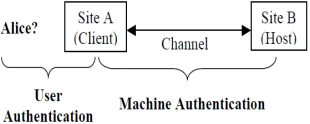
Authentication is the process of verifying the user and device identity or other entity in a computer system, oftenly acts as a prerequisite to allow to access resources in the system. The authenticating entity accomplishes positive verification by matching some short-form for identity indication such as a shared secret that has been pre-arranged during enrollment or registration only for authorized users for the purpose of performing trusted communications between parties for computing and telecommunications applications.
[image:3.612.217.372.528.590.2]Figure 1: Authentication comprises user authentication between machines.
Technology (IJRASET)
2) Types of Authenticators: Authentication factors are classified into these categories:a) Password b) Token.
A single password is an excellent authenticator. Its secrecy is a good defense against theft, it is convenient and inexpensive. The main problem is not with a single password, but with multiple passwords. Humans have difficulty remembering these. But a token can provide three major advantages when combined with a password. One thing is that it can store or generate multiple passwords. This change the task of remembering multiple, changing passwords to one of remembering only the single password needed to access the token, a single sign-on device. A second advantage is that it provides compromise detection since its absence is observable. The third advantage is that it provides added protection against denial of service attacks. For an account with only a password, an attacker can enter incorrect passwords for that user until the account locks out; whereas if combined with token, the attacker cannot just enter incorrect passwords because he has to steal the token first.
If you need to remember multiple passwords, a single sign-on approach is convenient. One option is a token that store or generates multiple pass codes in a secure manner and is accessed via a single password. The token must be secure and available when needed.
C. Data Retrieval
Retrieving data from a database is the challenging task. There are many techniques like content based image retrieval, feature extraction, the texture method which helps to extract data files and meanwhile managing load and time.
The content image based retrieval is a major problem due to maintenance of large database and difficulty in extraction of data, load management, large data files and overall retrieval time management [8] [11]. The Content based image retrieval which is a color feature uses image content to search and retrieve digital images stored in large databases. The main goal of CBIR is efficient image indexing and retrieval hence reducing the need for human intervention in the indexing process global image property based CBIR using a feed-forward back propagation neural network is proposed. The color histogram is considered as color descriptor.
A feed forward, back-propagation neural network (FFBP) [9] is used to achieve the proposed functionality. FFBP precedes both in forward and backward direction. Output computation is carried out in forward direction and error computation in backward direction.
A Content-based Image Retrieval System Based on Polar Raster Edge Sampling Signature using the proposed Polar Raster Edge Sampling Signature (PRESS) [10] algorithm the edge point count is stored in feature library. When a query is processed the similarity measure is performed between the query image features and the database image features based on Euclidian Distance similarity measure and the database images that are relevant to the given query image are retrieved.
Press algorithm as given below
BW edge(mask,’canny’); //Finding the edges of the image. [imx,imy]size(BW);
Bconv2(BW,msk); // smoothing the image [x,y] find(B==1);
P=[x,y];
[qr,qt]=polortransform(p); Get count of edge points; Store radius bin count in vector r;
// PRESS is used to extract shape features Store angle bin count in vector t;
Normalize for the sum of counts; Repeat for all images in the DB; Save item in feature DB;[10]
D. Recommender System
Technology (IJRASET)
typically produces a list of recommendations in one of two ways- through collaborative filtering or content based filtering.
The recommender system applies statically and knowledge discovery techniques to the problem of product recommendations during a live customer interaction and they are achieving widespread success in E-commerce nowadays.
1) A recommender system using K-means clustering:
Fig-3:Thesystem architecture of Recommendation System. [12]
The popular K-means algorithm can be used to implement the recommender system. It uses user’s browsing data, using n observations of browsing data it makes k clusters in which each observation belongs to the cluster with the nearest mean, which serves as the prototype of the cluster. These observation results in partitioning of the data space into Voronoi cells.
2) K-means clustering algorithm: The K-means method is a widely used clustering procedure hat searches for a nearly optimal partition with a fixed number of clusters. K-means clustering uses an iterative hill-climbing algorithm. The process of K-means clustering is as follows:
a) The initial seeds with the chosen number of clusters K, are selected and an initial partition is built by using the seeds as the centroids of the initial clusters.
b) Each record is assigned to the centroid that is nearest ,thus forming a cluster. c) Keeping the same number of clusters, the new centroid of each cluster is calculated. d) Iterate Step (2) and (3) until the clusters stop changing or stop conditions are satisfied[12]
3. A Graph Model: A two-layer graph model in which the two layers of nodes represent products and customers, respectively .Three types of links between nodes capture the input information: the product information, customer information, and transaction information. The link between the two products captures similarity between them. Different types of product information can be used to compute the similarity. For products like books and movies, the content of the product description can also be used to compute product similarity.
Technology (IJRASET)
E-commerce sites offer thousands of offers which will be difficult for a customer to choose among them. A Recommender system has emerged in response to this problem which recommends products to customer depending on their interests. A recommender system in e-commerce receives customer information on about products which he/she is interested in and recommends products which are likely to fit their needs.
One of the earliest and the successful recommender technique is ‘collaborative filtering’ [14].Collaborative Filtering system recommends product to the target customers depending on opinion of other customers. This system uses statistical method to find a set of customer who are called ‘neighbors’ once a neighborhood is formed this algorithm employs several techniques to produce recommendations.
III. CONCLUSION
This literature survey has covered some of the major factors like data mining, technical aspects, consumer behavior and the driving factors of E-commerce. We concluded that the token security system will be the best for E-commerce applications. Algorithms such as Color Histogram and K-means are efficient for data retrieval and recommendation systems respectively.
IV.ACKNOWLEDGMENT
The work reported in this paper is supported by the College through the Technical Education Quality Improvement Programme [TEQIP-II2] of the MHRD, Government of India.
REFERENCES
[1]http://www.pewinternet.org/Reports/2008/Online-Shopping.aspx
[2]Perea y Monsuwé, Toñita, Benedict GC Dellaert, and Ko De Ruyter. "What drives consumers to shop online? A literature review." International journal of service
industry management 15.1 (2004): 102-121.
[3]Vijaylaxmi, R. H. "A Review on the Factors that have Driven E-Commerce in Modern Day Business."
[4]Wolfinbarger, Mary, and Mary C. Gilly."Shopping online for freedom, control, and fun." California Management Review 43.2 (2001): 34-55.
[5] Reibstein, David J. "What attracts customers to online stores, and what keeps them coming back?." Journal of the academy of Marketing Science 30.4 (2002): 465-473.
[6]Liu, Alex X., et al. "A secure cookie protocol." Computer Communications and Networks, 2005.ICCCN 2005.Proceedings.14th International Conference
on.IEEE, 2005.
[7] O'Gorman, Lawrence. "Comparing passwords, tokens, and biometrics for user authentication." Proceedings of the IEEE 91.12 (2003): 2021-2040.
[8 ]Jain, Nitin, and S. S. Salankar."Color & Texture Feature Extraction for Content Based Image Retrieval."
[9]Mungara, ArvindNagathanManimozhiJitendranath. "Content-Based Image Retrieval System Using Feed-Forward Backpropagation Neural Network."IJCSNS 14.6
(2014): 70.
[10] Mathew, Santhosh P., et al. "A Content-based Image Retrieval System Based on Polar Raster Edge Sampling Signature." ActaPolytechnicaHungarica 11.3 (2014).
[11]Singha, Manimala, and K. Hemachandran. "Content based image retrieval using color and texture." Signal & Image Processing: An International Journal (SIPIJ) 3.1 (2012): 39-57.
[12]Kim, Kyoung-jae, and HyunchulAhn."A recommender system using GA K-means clustering in an online shopping market." Expert systems with
applications 34.2 (2008): 1200-1209.
[13] Huang, Zan, Wingyan Chung, and Hsinchun Chen. "A graph model for E‐commerce recommender systems." Journal of the American Society for information
science and technology 55.3 (2004): 259-274.
[14] Sarwar, Badrul, et al. "Analysis of recommendation algorithms for e-commerce." Proceedings of the 2nd ACM conference on Electronic commerce.ACM, 2000.
[15] Schafer, J. Ben, Joseph A. Konstan, and John Riedl. "E-commerce recommendation applications." Applications of Data Mining to Electronic
Commerce.Springer US, 2001.115-153.
[16]Von Reischach, Felix, et al. "A mobile product recommendation system interacting with tagged products." Pervasive Computing and Communications,
2009.PerCom 2009.IEEE International Conference on.IEEE, 2009.
[17]Agrawal, Rakesh, AmitSomani, and YirongXu. "Storage and querying of e-commerce data."VLDB.Vol. 1. 2001.
[18] Schafer, J. Ben, Joseph A. Konstan, and John Riedl. "E-commerce recommendation applications."Applications of Data Mining to Electronic Commerce.Springer US, 2001.115-153.
[19] Von Reischach, Felix, et al. "A mobile product recommendation system interacting with tagged products."Pervasive Computing and Communications, 2009.PerCom 2009.IEEE International Conference on.IEEE, 2009.