© 2017, IRJET | Impact Factor value: 5.181 | ISO 9001:2008 Certified Journal
| Page 1467
AUTOMATED ATTENDANCE SYSTEM USING FACE RECOGNITION
Akshara Jadhav, Akshay Jadhav
Tushar Ladhe, Krishna Yeolekar.
Dept. of Information Technology
University of Pune
NDMVP’s KBT COLLEGE OF ENGINEERING, NASHIK
---***---Abstract -
In modern times, face recognition has becomeone of the key aspects of computer vision. There are at least two reasons for this trend; the first is the commercial and law enforcement applications, and the second is the availability of feasible technologies after years of research. Due to the very nature of the problem, computer scientists, neuroscientists and psychologists all share a keen interest in this field. In plain words, it is a computer application for automatically identifying a person from a still image or video frame. In this paper we proposed an automated attendance management system. This system based on face detection and recognition algorithms, which automatically detects the student when he enter in the class room and marks the attendance by recognizing him. We used Viola-Jones Algorithm face detection which detect human face using cascade classifier and PCA algorithm for feature selection and SVM for classification. When compared to traditional attendance marking this system saves the time and also helps to monitor the students.
Keywords: Face Recognition, Face Detection, Machine Learning, PCA, SVM.
1. INTRODUCTION
Human beings can distinguish a particular face depending on a number of factors. One of the main objective of computer vision is to create such a face recognition system that can emulate and eventually surpass this capability of humans. In recent years we can see that researches in face recognition techniques have gained significant momentum. Partly due to the fact that among the available biometric methods, this is the most unobtrusive. Though it is much easier to install face recognition system in a large setting, the actual implementation is very challenging as it needs to account for all possible appearance variation caused by change in illumination, facial features, variations in pose, image resolution, sensor noise, viewing distance, occlusions, etc. Many face recognition algorithms have been developed and each has its own strengths. We do face recognition almost on a daily basis. Most of the time we look at a face and are able to recognize it instantaneously if we are already familiar with the face. This natural ability if possible imitated by machines can prove to be invaluable and may provide for very important in real life applications such as various access control, national and international security and defense etc. Presently available face detection methods mainly rely on two approaches. The first one is local face recognition system which uses facial features of a face e.g. nose, mouth, eyes etc. to associate the face with a person. The second approach or global face recognition system use
the whole face to identify a person. The above two approaches have been implemented one way or another by various algorithms. The recent development of artificial neural network and its possible applications in face recognition systems have attracted many researcher into this field. The intricacy of a face features originate from continuous changes in the facial features that take place over time. Regardless of these changes we are able to recognize a person very easily. Thus the idea of imitating this skill inherent in human beings by machines can be very rewarding. Though the idea of developing an intelligent and self-learning may require supply of sufficient information to the machine. Considering all the above mentioned points and their implications we have tried to gain some experience with some of the most commonly available face recognition algorithms and also compare and contrast the use of neural network in this field.
2. RELATED WORK
2.1. RFID (Radio Frequency Identification)-based
Attendance System
A number of works related to Radio Frequency Identification (RFID) based Attendance Systems exist in the literature. In [6] the authors have proposed RFID based system in which students carry a RFID tag type ID card and they need to place that on the card reader to record their attendance. RS232 is used to connect the system to the computer and save the recorded attendance from the database. This system may give rise to the problem of fraudulent access. Unauthorized person may make use of authorized ID card and enter into the organization.
2.2. Fingerprint based Attendance System
In [1] A portable fingerprint device has been developed which can be passed among the students to place their finger on the sensor during the lecture time without the instructor’s intervention. This system guarantees a fool-proof method for marking the attendance. The problem with this approach is that passing of the device during the lecture time may distract the attention of the students.
2.3. Iris-Recognition Based Attendance System
© 2017, IRJET | Impact Factor value: 5.181 | ISO 9001:2008 Certified Journal
| Page 1468
iris recognition management system that does capturing theimage of iris recognition, extraction, storing and matching. But the difficulty occurs to lay the transmission lines in the places where the topography is bad. In [3] authors have proposed a system based on real time face recognition which is reliable, secure and fast which needs improvement in different lighting conditions.
3. PROPOSED WORK
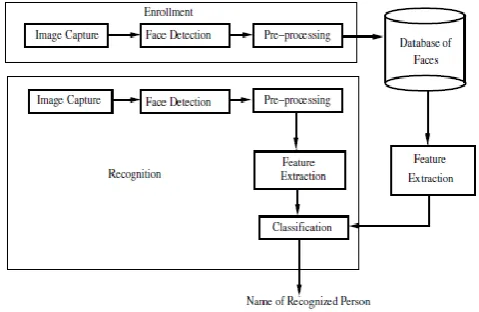
Systems design is the process of defining the architecture, components, modules, interfaces, and data for a system to satisfy specified requirements. Systems design could be seen as the application of systems theory to product development. The proposed automated attendance system can be divided into five main modules. The modules and their functions are defined in this section. The five modules into which the proposed system is divided are:
3.1. Image Capture
The Camera is mounted at a distance from the entrance to capture the frontal images of the students. And further process goes for face detection.
3.2. Face Detection
[image:2.595.42.282.483.639.2]A proper and efficient face detection algorithm always enhances the performance of face recognition systems. Various algorithms are proposed for face detection such as Face geometry based methods, Feature Invariant methods,
Figure 1: System Diagram
Machine learning based methods. Out of all these methods Viola and Jones proposed a framework which gives a high detection rate and is also fast. Viola-Jones detection algorithm is efficient for real time application as it is fast and robust. [9] Hence we chose Viola-Jones face detection algorithm which makes use of Integral Image and AdaBoost learning algorithm as classier. We observed that this algorithm gives better results in different lighting conditions and we combined multiple haar classifiers to achieve a better detection rates up to an angle of 30 degrees.
3.3. Pre-Processing
The detected face is extracted and subjected to preprocessing. This pre-processing step involves with histogram equalization of the extracted face image and is resized to 100x100. Histogram Equalization is the most common Histogram Normalization technique. This improves the contrast of the image as it stretches the range of the intensities in an image by making it more clear.
3.4. Database Development
As we chose biometric based system enrolment of every individual is required. This database development phase consists of image capture of every individual and extracting the bio-metric feature, in our case it is face, and later it is enhanced using pre-processing techniques and stored in the database.
3.5. Post-Processing
In the proposed system, after recognizing the faces of the students, the names are updated into an excel sheet. The excel sheet is generated by exporting mechanism present in the database system. The database also has the ability to generate monthly and weekly reports of students attendance records. These generated records can be sent to parents or guardians of students. At the end of the class a provision to announce the names of all students who are present in the class is also included. This ensures that students whose faces are not recognized correctly by the system have the chance to send a ticket to staff. And thus giving them the ability to correct the system and make it more stable and accurate. The announcement system is implemented using text to speech conversion. Many algorithms and applications are available that can convert text to lifelike speech. Amazon polly is one such service which includes 47 lifelike voices spread across 24 languages. Amazon Polly delivers the consistently fast response times required to support real-time, interactive dialog. API’s are provided which return the audio stream to the system. The system also has the ability to send notification emails to staff and erp operators. The email would be sent using one of the many Web API’s available like Amazon SES. The system would use email API’s to send daily reports to every authorized staff. Push notifications can also be implemented in the system, notifications can be sent to both staff and students. Push notifications are real-time and can help improve the accuracy of the proposed system.
3.6. Proposed Algorithm
1. Capture the Student’s Image
2. Apply Face detection algorithms to detect face
3. Extract the Region Of Interest in Rectangular Bounding Box
© 2017, IRJET | Impact Factor value: 5.181 | ISO 9001:2008 Certified Journal
| Page 1469
5. if Enrollment Phase thenStore in Database else
Apply PCA/LDA/LBPH (For feature Extraction) Apply Distance Classifier/SVM/Bayesian (for Classification)
end if
6. Post-processing
4. FEATURE SELECTION AND EXTRACTION
Throughout the past few decades there have been many face detection techniques proposed and implemented. Some of the common methods described by the researchers of the respective fields are :
4.1. Principal component analysis
In high-dimensional data, this method is designed to model linear variation. Its goal is to find a set of mutually orthogonal basis functions that capture the directions of maximum variance in the data and for which the coefficients are pairwise decorrelated [1]. For linearly embedded manifolds, PCA is guaranteed to discover the dimensionality of the manifold and produces a compact representation. PCA was used to describe face images in terms of a set of basis functions, or eigenfaces. Eigenfaces was introduced early [2] on as powerful use of principal components analysis (PCA) to solve problems in face recognition and detection. PCA is an unsupervised technique, so the method does not rely on class information. In our implementation of eigenfaces, we use the nearest neighbour (NN) approach to classify our test vectors using the Euclidean distance. Multilinear Principal Components Analysis One extension of PCA is that of applying PCA to tensors or multilinear arrays which results in a method known as multilinear principal components analysis (MPCA) [3]. Since a face image is most naturally a multilinear array, meaning that there are two dimensions describing the location of each pixel in a face image, the idea is to determine a multilinear projection for the image, instead of forming a one-dimensional (1D) vector from the face image and finding a linear projection for the vector. It is thought that the multilinear projection will better capture the correlation between neighborhood pixels that is otherwise lost in forming a 1D vector from the image [3].
4.2. Linear Discriminant Analysis
Fisherfaces is the direct use of (Fisher) linear discriminant analysis (LDA) to face recognition [4]. LDA searches for the projection axes on which the data points of different classes are far from each other while requiring data points of the same class to be close to each other. Unlike PCA which encodes information in an orthogonal linear space, LDA encodes discriminating information in a linearly separable space using bases that are not necessarily orthogonal. It is generally believed that algorithms based on LDA are superior
to those based on PCA. However, other work such as [5] showed that, when the training data set is small, PCA can outperform LDA, and also that PCA is less sensitive to different training data sets. When applying PCA to a set of face images, we are finding a set of basis vectors using lower order statistics of the relationships between the pixels. Specifically, we maximize the variance between pixels to separate linear dependencies between pixels. MPCA is a generalization of PCA in that it tries to identify high-order statistical relationships between pixels to form a better set of basis vectors where the pixels are treated as random variables and the face images as outcomes. In a similar fashion to PCA and LDA, once the new basis vectors are found, the training and test data are projected into the subspace and a method such as NN is used for classification.
4.3. Neural Networks
To model our way of recognizing faces is imitated somewhat by employing neural network. This is accomplished with the aim of developing detection systems that incorporates artificial intelligence for the sake of coming up with a system that is intelligent. The use of neural networks for face recognition has been shown by and we can see the suggestion of a semi-supervised learning method that uses support vector machines for face recognition. There have been many efforts in which in addition to the common techniques neural networks were implemented. For example in a system was proposed that uses a combination of eigenfaces and neural network. First The dimensionality of face image is reduced by the Principal component analysis (PCA) and later the recognition is done by the Back propagation Neural Network (BPNN).
5. RESULTS
[image:3.595.309.568.585.740.2]The attendance management system is simple and works efficiently. The project is based on web and needs browser to access the management system.
Figure 2: The home page of management portal.
© 2017, IRJET | Impact Factor value: 5.181 | ISO 9001:2008 Certified Journal
| Page 1470
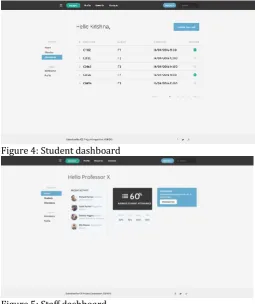
Figure 3: Sign up pageThe system has two roles student and staff. Both student and staff has two different dashboards through which users can control and view attendance records.
[image:4.595.35.291.315.620.2]Figure 4: Student dashboard
Figure 5: Staff dashboard
6. CONCLUSIONS
Automated Attendance Systems based on face recognition techniques thus proved to be time saving and secured. This system can also be used to identify an unknown person. In real time scenarios PCA outperforms other algorithms with better recognition rate and low false positive rate. The future work is to improve the recognition rate of algorithms when there are unintentional changes in a person like tonsuring head, using scarf, beard. The system developed only recognizes face up to 30 degrees angle variations which has to be improved further. Gait recognition can be fused with
face recognition systems in order to achieve better performance of the system. Poor lighting conditions may affect image quality which indirectly degrades system performance. Our system will perform well but it is not a perfect solution.
ACKNOWLEDGEMENT
With all respect and gratitude, we would like to thank all the people who have helped us directly or indirectly for the completion of the project "Automated Attendance System Using Face Recognition". We express our heartily gratitude towards Prof. N. S. Ujgare for guiding us to understand the work conceptually and also for her constant encouragement to complete the project. Our association with her as a student has been extremely inspiring. We would like to give our sincere thanks to Dr. H. V. Patil, Head of the Department of Information Technology for her technical support and constant encouragement. We would also like to extend our sincere thanks to our Principal Dr. K. S. Holkar for his help and support in all respects. We would also like to thank all our staff members and collogues who helped us directly or indirectly throughout our dissertation work.
REFERENCES
[1] B. K. Mohamed and C. Raghu - "Fingerprint attendance system for classroom needs", in India Conference (INDICON), 2012 Annual IEEE. IEEE, 2012, pp.433438.
[2] T. Lim, S. Sim, and M. Mansor - "Rd based attendance system", in Industrial Electronics Applications, 2009. ISIEA 2009. IEEE Symposium on, vol. 2. IEEE, 2009,pp. 778782 .
[3] S. Kadry and K. Smaili - "A design and implementation of a wireless iris recognition attendance management system", Information Technology and control, vol. 36, no.3, pp. 323329, 2007.
[4] T. A. P. K. K. L. P. M. L. M. P. A. W. G. D. P. J. G.. RoshanTharanga, S. M. S.C. Samarakoon - "Smart attendance using real time face recognition,", 2013.
[5] Xiaofei He; Shuicheng Yan; Yuxiao Hu; Niyogi, P.; Hong-Jiang Zhang, IEEE Transactions on Pattern Analysis and Machine Intelligence, pp. 328 340, 2005.
[6] M. Turk and A. Pentland, Eigenfaces for recognition, Journal of Cognitive Neuroscience, 3(1), pp. 7186, 1991.
[7] H. Lu, K. N. Plataniotis, and A. N. Venetsanopoulos, Mpca: Multilinear principal component analysis of tensor objects, IEEE Trans. on Neural Networks, 19(1):1839,2008.
© 2017, IRJET | Impact Factor value: 5.181 | ISO 9001:2008 Certified Journal
| Page 1471
Conference on Computer Vision and PatternRecognitionWorkshops, pp. 7-12, 2009.
[9] P. N. Belhumeur, J. P. Hespanha, and D. J. Kriegman, Eigenfaces vs. _sherfaces: Recognition using class speci_c linear projection, In ECCV 96: Proceedings of the 4th European Conference on Computer Vision-Volume I, pages 45 58, London, UK,Springer-Verlag 1996.
[10] Martinez, A.M. ; Kak, A.C. , IEEE Transactions on Pattern Analysis and Machine Intelligence, Volume : 23 , Issue:2, pp. 228 233, Feb 2001.
[11] Shireesha Chintalapati, M.V. Raghunadh , Automated Attendance Management System Based On Face Recognition Algorithms, 2013 IEEE International Conference on Computational Intelligence and Computing Research.