© 2018, IRJET | Impact Factor value: 6.171 | ISO 9001:2008 Certified Journal | Page 3033
ANALYSIS AND STUDY OF THE EFFECT OF GGBFS ON CONCRETE
STRUCTURES
Arnet Cleetus
1, Rubin Shibu
1, Sreehari PM
1, Vibin Kurian Paul
1, Boby Jacob
21UG Scholar, Civil Engineering Department, Mar Athanasius College of Engineering, Kerala, India 2Assistant professor, Civil Engineering Department, Mar Athanasius College of Engineering, Kerala, India
---***---Abstract -
Cement replacement materials are by-product used to produce concrete especially for High Performance Concrete (HPC), in this case, ground granulated blast furnace slag (GGBFS). GGBFS is a waste product in the manufacture of iron by blast furnace method. Efforts are urgently underway all over the world to develop environmentally friendly construction materials, which make minimum utility of fast dwindling natural resources and helps to reduce greenhouse gas emissions. The effects of combinations of mineral admixtures in concrete on the performance-related properties under different aspect ratio are compared to conventional concrete. The main objective of this project is to study the performance of GGBFS on plain and reinforced concrete structures. In the experimental work, the compressive strength, flexural strength, split tensile strength, workability, durability was conducted by addition of GGBFS in varying percentages of 0%, 20% and 40% by weight of cement.Key Words: Ground Granulated Blast Furnace Slag (GGBFS), OPC, Workability,Cement Concrete, Mechanical properties
1. INTRODUCTION
The demand for concrete as a material of construction will increase as the demand for infrastructure development increases, especially in countries such as China and India. In order to meet this demand, the production of Portland cement must increase. However, the contribution of greenhouse gas emission from the Portland cement production is about 1.35 billion tons annually or about 7% of the total greenhouse gas emissions to the earth’s atmosphere. Hence great effort is taken to reduce the cement consumption. It includes the use of supplementary cementitious materials like fly ash, GGBFS etc. and the use of alternate binders. The concrete using GGBFS was developed as a result of this.
The main components of blast furnace slag are Cao (30-50%), SiO2 (28-38%), Al2O3 (8-24%) and MgO (1-18%).The
major advantages of GGFBS are ensuring higher durability of structure, reducing the temperature rise and helping to avoid early-age thermal cracking and improved workability.
Thus, the development of a suitable concrete mix using OPC Cement and GGBFS would be beneficial ecologically by reducing the overall greenhouse gas emissions and providing an alternate use for the by-product of the steel manufacturing industry
2. MATERIALS AND MATERIAL TESTING
The constituents of conventional concrete are cement, coarse aggregate, fine aggregate and water. The common ingredients of GGFBS replaced concrete are GGFBS, fine aggregate, coarse aggregate, cement and water.
2.1 Ordinary Portland Cement
Ordinary Portland cement was used in this study. Special care was taken to ensure that the cement is from the latest batch of packing. The brand of cement used was JK Cements OPC.
2.1.1 Specific Gravity of Cement
Specific gravity is normally defined as the ratio between the weight of a given volume of material and weight of an equivalent volume of water. To determine the specific gravity of cement, kerosene which does not react with cement was used in a Le Chatelier’s flask. The specific gravity of cement was found to be 2.8.
2.2 Coarse Aggregate
Coarse aggregate give body to the concrete, reduce shrinkage and effect economy. Since coarse aggregates occupy more than 70% of the concrete, it contributes significantly to the strength, durability and volume stability.
2.2.1 Specific Gravity of Coarse aggregate
Specific gravity of an aggregate is made use of in design calculations of concrete mixes. The specific gravity of coarse aggregate was found using wire mesh suspended from a balance and is done accordingly to IS 2386 (part 3) – 1963. The specific gravity of coarse aggregate was found to be 2.68.
2.2.2 Sieve Analysis of Coarse aggregate
© 2018, IRJET | Impact Factor value: 6.171 | ISO 9001:2008 Certified Journal | Page 3034 Table-1: Sieve analysis of coarse aggregate
Sieve Size (mm)
Sieve opening
(microns) retained (g) Weight
% Weight retained (%)
Cumulative % weight retained Finer %
25 25000 0 0 0 100
20 20000 36 3.6 3.6 96.4
12.5 12500 898 89.8 93.4 6.6
10 10000 54 5.4 98.8 1.2
4.75 4750 12 1.2 100 0
2.3 Fine Aggregate
Manufacturer's sand was used as the fine aggregate. M-sand is the crushed aggregates produced from hard granite stone.
2.3.1 Specific Gravity of Fine aggregate
The specific gravity of fine aggregate was found using pycnometer test. The specific gravity of coarse aggregate was found to be 2.65.
2.3.2 Sieve Analysis of Fine aggregate
The sieve analysis for fine aggregate was done using sieve shaker. The sieve for fine aggregate was 4.75mm to 0.150mm. Sieve analysis test was done for fine aggregate and results are tabulated in table 2.
Table-2: Sieve analysis of fine aggregate
2.4 Water
Water is the most important ingredient of the concrete. The water, which is used for making concrete should be clean and fit for drinking should be used for making concrete.
2.5 Ground Granulated Blast Furnace Slag (GGBFS)
Ground granulated blast furnace slag (GGBFS) is obtained by quenching molten iron slag (a by-product of iron and steel making) from a blast furnace in water or steam, to produce a glassy, granular product that is then dried and ground into a fine powder.
2.5.1 Specific Gravity of GGBFS
The specific gravity of GGBFS was found using pycnometer test. The specific gravity of coarse aggregate was found to be 2.85.
3.CONCRETE MIX DESIGN
The proportioning of ingredients of concrete is governed by required the performance of concrete in two states, namely plastic and hardened states. If the plastic concrete is not workable, it cannot be properly placed and compacted. Here, in this project, we used IS method of mix design for normally vibrated concrete. In this method, design is based on the code (IS 10262: 2009, M-30 mix).
Table -3: Mix Proportioning For Conventional Concrete (0% GGBFS)
Cement 380 kg/m3
Fine Aggregate 554 kg/m3
Coarse Aggregate 1254 kg/m3
Water 180 L/m3
Table-4: Mix Proportioning For Concrete with GGBFS Replacement (20% GGFBS)
Cement 304 kg/m3
GGBFS 76 kg/m3
Fine Aggregate 554 kg/m3
Coarse Aggregate 1254 kg/m3
[image:2.595.336.530.518.591.2]Water 180 L/m3
Table-5: Mix Proportioning For Concrete with GGBFS Replacement (40% GGFBS)
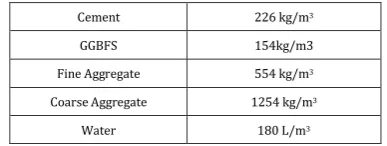
Cement 226 kg/m3
GGBFS 154kg/m3
Fine Aggregate 554 kg/m3
Coarse Aggregate 1254 kg/m3
Water 180 L/m3
4. PREPARATION OF TEST SPECIMENS
4.1 Casting
The Cement, GGBFS and the aggregates (coarse and fine) were first mixed together dry manually for about three minutes. The water was added to it to the required quantity. The fresh concrete prepared was casted in standard moulds (150mmx150mmx150mm) and was compacted using a needle vibrator.
Sieve opening Sieve (mm) Sieve opening (microns) Weight retained (g) % Weight retained (%) Cumulative % weight retained % Finer
480 4.75 4750 75 7.5 7.5 92.5
240 2.36 2360 210 28.5 28.5 71.5
120 1.18 1180 16 44.9 44.9 55.1
60 0.6 600 171 62 62 38
30 0.3 300 183 80.3 80.3 19.7
15 0.15 150 103 90.6 90.6 9.4
© 2018, IRJET | Impact Factor value: 6.171 | ISO 9001:2008 Certified Journal | Page 3035 Fig -1: Casted Specimens
4.2 CURING OF TEST SPECIMENS
In this study, the conventional method of curing itself was adopted and practiced. The specimens were demolded after 24 hours, then the specimens were placed in water tank filled with water with a temperature of 27+2o C or 27-2o C.
4.3 TESTING OF SPECIMENS
[image:3.595.373.494.132.265.2]In this study, the specimens were tested for compressive strength, flexural strength, tensile strength and modulus of elasticity. For these purposed the following number of cubes, beams and cylinders were casted to be checked for 7 days, 28 days.
Table -6: Specimen Table
GGBFS CONTENT
(%) 0% 20% 40% TOTAL NO
AGE AT TEST DAY 7 DAY 28 DAY 7 DAY 28 DAY 7 DAY 28 TOTAL NO
CUBES 3 3 3 3 3 3 18
CYLINDER 1 1 1 1 1 1 6
BEAM 1 0 1 0 1 0 3
5 TESTS CONDUCTED ON CONCRETE
5.1 Compressive Strength of Concrete Cubes
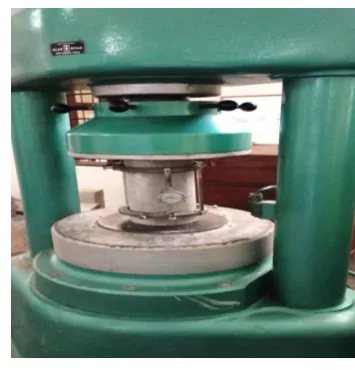
The compressive strength test was carried out on both 7th day and 28th day.
Fig -2: Compressive Strength Test
5.2 Flexural Strength
The Flexural strength test was carried out on the 28th day
[image:3.595.361.506.351.482.2]by two point loading.
Fig -3: Flexural Strength Test
5.3 Splitting Tensile Strength
[image:3.595.38.293.444.541.2]The Splitting tensile strength test was carried out on concrete cylinders.
Fig -4: Splitting Tensile Strength Test
5.4 Modulus of Elasticity
The test for modulus of elasticity was carried out on concrete cylinders as per Indian Standards.
[image:3.595.341.519.567.752.2] [image:3.595.79.263.626.754.2]© 2018, IRJET | Impact Factor value: 6.171 | ISO 9001:2008 Certified Journal | Page 3036 5.5 Workability
Tests were conducted for determining the workability for the three different proportionate concretes.
6. RESULTS AND DISCUSSIONS
6.1 Compressive Strength Test
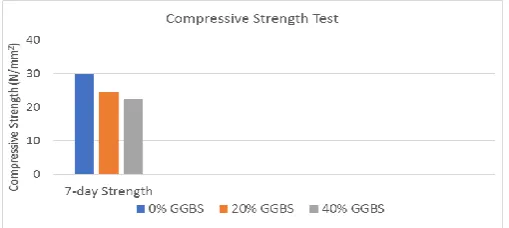
The compression test results are given in chart 1 and 2. The test was done for 7-day strength and 28-day strength test. From the chart 1, it was observed that the initial strength of GGBS infused concrete was less and from chart 2, it was observed that the strength of GGBS infused concrete increased more than that of conventional mix on the 28th day.
Chart -1: 7th day Compressive Strength
Chart -2: 28th day Compressive Strength
6.2 Workability
[image:4.595.35.290.260.374.2]The workability was found out using the slump test. The results are given in table 5. It was observed that the GGBS replaced concrete have high workability. The workability increases with the increase in the GGBS content. This may be attributed to the extended setting time property of GGBS. Thus, it remains workable for a longer period.
Table -7: Slump Values
MIXES GGBS CONTENT SLUMP (mm)
M1 0% 48
M2 20% 60
M3 40% 82
6.3 Split Tensile Strength
The split tensile strength test was carried out on the compression testing machine. The result obtained was compared to that of the conventional mix (0% GGBS mix). It was observed that the tensile strength of GGBS infused concrete was less than that of the conventional concrete mix. The results obtained are given in chart 3.
Chart -3: Splitting Tensile Strength
6.4 Flexural Strength
The extreme fiber stresses calculated at the failure of the specimen is called modulus of rupture or flexural. It was observed that the modulus of rupture was higher for a GGBS content of 20% and reduced further on. The results are given in chart 4.
Chart -4: Modulus of Rupture
6.5 Modulus of Elasticity
The test revealed that modulus of elasticity was higher for a GGBS content of 40% and reduced further on. The results are given in chart 5.
© 2018, IRJET | Impact Factor value: 6.171 | ISO 9001:2008 Certified Journal | Page 3037 6.5 Conclusion
The following conclusions were made based upon the experimental results:
1. The workability of GGBS infused concrete was more than when compared to the conventional concrete mix which also increases the initial setting time of the mix. The workability increases with increase in the GGBS content.
2. The initial compressive strength of concrete was found to be less than the conventional mix, however the 28-day compressive strength of concrete was found to be more than the conventional concrete.
3. Out of all the trial mixes prepared, the mix containing 40% GGBS was found to have the maximum compressive strength, similar to that of conventional M40 concrete mix.
4. The maximum compressive strength obtained was 42.47 N/mm2.
5. The split tensile strength of concrete when infused with GGBS was found to decrease as the content of GGBS was increased. Hence reinforcement fibers are recommended in mass-concreting situations where GGBS is used.
6. The elastic property of the concrete mix was improved on addition of GGBS. This property has an impact on concrete structures, making it less prone to the external loading by making it less vulnerable to undesirable deflection at critical points.
7. The optimum GGBS content was decided to be 40% by taking various factors into consideration after doing the tests and analyzing the results.
ACKNOWLEDGEMENT
The Authors wish to thank Miss. Boby Jacob for her collaboration in this work. We would also like express gratitude to other teaching faculties of Mar Athanasius College of Engineering, Kothamangalam who lend their hand in helping us finish this work in time.
REFERENCES
[1] D. Suresh and K. Nagaraju, “Ground Granulated Blast
Slag (GGBS) In Concrete – A Review,” IOSR-JMCE, Volume 12, Issue 4 Ver. VI (Jul. - Aug. 2015), PP 76-82.
[2] Suchita Hirde and Pravin Gorse, “Effect of Addition of
Ground Granulated Blast Furnace Slag (GGBS) on Mechanical Properties of Fiber Reinforced Concrete,” IJCET, Vol.5, No.3 (June 2015), PP 1677-1682.
[3] Arvind Nakum, Vishal Patel, and Vatsal Patel, “High
Strength Concrete Incorporating Ground Granulated Blast Furnace Slag and Steel Fibres: A Review,” IJSCR, Vol. 4, No. 2, May 2015, PP 195-200.
[4] Siddharth and Prof. Seetharam Munnur, “Experimental
Study on Strength Properties of Concrete using Steel Fibre and GGBS as Partial Replacement of Cement,” IJERT, Vol. 4 Issue 01,January-2015, PP 436-440.
[5] Kishan Lal Jain, “To effect on strength properties of