© 2017, IRJET | Impact Factor value: 5.181 | ISO 9001:2008 Certified Journal
| Page 326
An Efficient Secured And Inspection of Malicious Node Using Double
Encryption in-DTN
Karthick Raja.R
1, Niresh.S
2, Shailesh.I
3, Dr.V.Subedha
41
Karthick Raja.R , Dept. of Computer Science and Engineering ,Panimalar Institute Of
Technology,Tamilnadu, India.
2
Niresh.S , Dept. of Computer Science and Engineering , Panimalar Institute Of
Technology, Tamilnadu, India.
3
Shailesh.I , Dept. of Computer Science and Engineering ,Panimalar Institute Of
Technology,Tamilnadu, India .
4
.Dr.V.Subedha Phd ,Professor and Head Of Dept. of Computer Science and Engineering ,Panimalar Institute Of
Technology,Tamilnadu, India.
---***---
Abstract -
Delays Tolerant Networks (DTN) assumes that community nodes voluntary cooperate so as to paintings nicely. This cooperation is a cost-extensive interest and a few nodes can refuse to cooperate, main to an egocentric node behavior. commonly nodes are required to exchange their come upon records, wherein malicious nodes deliberately drop all or part of, therefore, so the general network overall performance will be critically affected. at the time of use, a watchdog is a well-known mechanism to hit upon egocentric nodes like that trusted authority, counting on nearby watchdogs on my own can result in poor performance whilst detecting egocentric nodes, in term of precision and pace. this is particularly essential on networks with sporadic contacts, including postponing tolerant networks (DTNs), where on occasion watchdogs loss of enough time or information to discover the egocentric nodes. accordingly, we recommend Statistical-based Detection of Blackhole and Greyhole attackers (SDBG) to cope with both individual and collusion assaults. To stumble on the character misbehavior nodes As shown within the paper, discover the attacker node on the time and increases the precision whilst detecting selfish nodes. large simulation indicates that our solution can paintings with diverse dropping chances and specific range of attackers consistent with collusion at excessive accuracy and coffee false fantastic.Key Words
:
Kiosk Net, Delays Tolerant Networks (DTN) , Statistical-based Detection of Black hole and Grey hole(SDBG), Max Pro Routing ,MUTON ,Drive-thru Network.1.INTRODUCTION
© 2017, IRJET | Impact Factor value: 5.181 | ISO 9001:2008 Certified Journal
| Page 327
attack, because attackers want to frequently create fakestumble upon information to boost the forwarding.
1.1
SYSTEM ANALYSIS
The existing system suffered from individual attack. The overcome of project is to detect the colluding of different attack to prevent data transfer. In contrast of existing system To detect the individual misbehavior nodes, fake negatives and malicious nodes. as an example, the approach most effective transmits positive detections. The man or woman attackers deliberately drop all packets. The losing misbehavior will increase the overall message shipping and waste the assets .The intermediate nodes which have carried and forwarded the dropped messages spread this incorrect facts right away on the community. Therefore, a method that includes the diffusion of bad detections as nicely becomes vital. every other problem is the impact of colluding or malicious nodes. although a recognition device, as the one presented, may be useful to mitigate the effect of malicious nodes. The proposing system uses Statistical-based Detection of Black hole and Grey hole attackers (SDBG) to deal with both character and collusion assaults to detect. A authority to reduce the time and improve the effectiveness of detecting egocentric nodes, reducing the harmful impact of false positives, and malicious nodes. while a touch occurs among or extra collaborative nodes. we are able to for that reason beautify the character detection accuracy by means of similarly gazing the quantity of self-sent messages every and every node up to date to pick out the authority.. so smooth to locate collusion and individual attack and we can produce high accuracy and low fake fine.
2. METHODODLOGY
2.1 Network Formation and Authority Creation:
First we have a tendency to will produce a trusty Authority then produce network node assume the communication vary of a node is finite. Thus a knowledge sender out of destination node’s communication vary will solely transmit packetized knowledge via a sequence of intermediate nodes in an exceedingly multi-hop manner. For the simplicity of presentation, we take a three-step knowledge forwarding method as associate example. Suppose that node A has packets, which can be delivered to node C. Now, if node A meets another node B that could facilitate to forward the packets to C, A will replicate and forward the packets to B. Thereafter, B will forward the packets to C once C arrives at the transmission vary of B. In this process, we outline 3 sorts of knowledge forwarding
[image:2.595.314.561.144.260.2]evidences. They are Delegation Task proof, Forwarding History proof and Contact History Evidence, Encounter Records, Message Records.
FIG – 1: AUTHORITY PROCESS
The authority creation is based totally on the idea of statical based method. It maintains the detail of every node, the information of (node identity, created time). The authority maintains on cross for on and off web site to check the mode of node operation. The value of popularity is maintained for each created node . Authority often exams for the attacker via which all nodes are operating based on the rule of thumb. The detection of the every node carried out via authority to make certain the safe switch. Every node will preserve the element of touch history , message record, shipping file ,undertaking proof ,ahead records and think about attacker .The contact history involves the time and name of every node. The message report holds the soucre and destination adress via with the records is transferred . The view attacker have the attacking node and time in which the attack is took place.
[image:2.595.315.560.550.718.2]© 2017, IRJET | Impact Factor value: 5.181 | ISO 9001:2008 Certified Journal
| Page 328
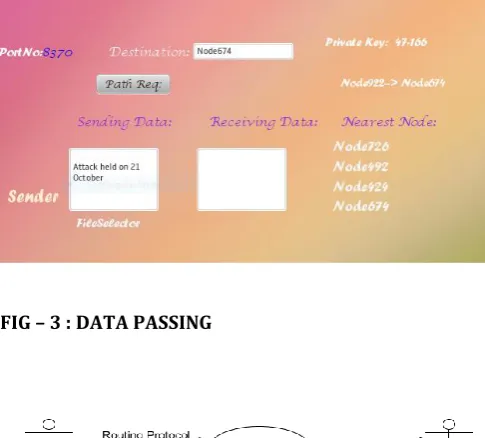
2.2 Route Finding and Data Forwarding: [image:3.595.36.279.342.561.2]A normal user can honestly follow the forwarding the messages as long as there area unit enough contacts. The requested message has been forwarded to the next hop, the chosen next hop nodes. We assume a trusty authority with the right to assign every node a novel symbol and a combine of public and personal keys. Nodes are assumed to recognize the general public keys of every alternative in order that they will certify messages signed by others. we model the general behaviors of nodes as follows. When 2 nodes encounter and exchange messages, each of them generates associate Encounter Record (ER) and stores it in its own storage. The ER includes the identities of two nodes, the ER sequence numbers assigned by them, the encounter timestamp and the lists of sent and received messages between the 2 parties and their signatures.
FIG – 3 : DATA PASSING
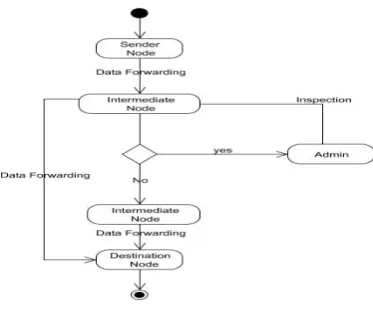
FIG - 4 : DATA FORWARDING
The node will hold the detail of mission evidence, message forwarding, view attacker. The message discipline holds the details of source and vacation spot address. the detail of forwarded message might be maintained in ahead records subject
2.3Detecting for colluding Attacks:
The two nodes square measure human action via intermediate node some time individual’s adversaries launch Associate in Nursing assailant initial receives messages from alternative nodes however later drops them with a particular chance. Black hole assailant drops all received messages (dropping chance = a hundred%) whereas grey hole attacker drops partly (dropping chance lower than 100 percent). The dropping occurs even if the assailant still has enough buffer to store messages , Introduces an SDBG, which might launch the trustworthy authority based mostly watchdog for the target node and decide it by collection the forwarding history proof from its upstream and downstream nodes. Each node maintains a native black list that lists malicious nodes that it detects as black hole or gray hole attackers If any node is detected as committing either misbehavior, authority will penalize it consequently and then trustworthy authority add blacklist and send malicious node name to any or all nodes. . To further improve the performance of the planned Statistical-based Detection on theme, we introduce a name system.
4.IMPLEMENTATION
© 2017, IRJET | Impact Factor value: 5.181 | ISO 9001:2008 Certified Journal
| Page 329
paintings, the information is transferred correctly [image:4.595.52.269.316.439.2]without any attack. as a result the double encryption gives greater reliable and well-secured mode of transmission. Whenever the mode of inspection is completed by means of authority and create the path between neighboring node, the collection of exclusive message is attached to the information and can be forwarded to cease sector of our vacation spot. once the node moves out of range, the subsequent neighbor node will preserve the technique and forward the statistics in time. the name of the game cannot be hazard or forwarded due to the fact the authority will preserve the contact records of each node, if any node involves in Attacking or stealing toward the facts, the authority will reject the node from the system of facts transfer. The facts can be any format, so the flexible over dependable procedure performed in SDBG method.
FIG – 5: ARCHITECTURE DIAGRAM
4. PERFORMANCE EVALUATION
4.1 Simulation Setup
The simulation is carried out in one simulator. The simulated community contains 40 nodes that may communicate in ad-hoc mode the use of Wi-fi in a transmission range of one hundred meters. They tour over an area of four,500 m three,400 m, at speeds of 10-50 km/h, the use of Shortest route Map based totally motion version that's to be had in one to simulate the movement of cars on the streets. The simulation time is 43,two hundred seconds (12 hours). Messages are generated on the price of 1 according to 25-30 seconds. The message size is inside the range of 50 kB-1 MB. This putting is applied to all the following experiments. For every test, the simulation runs for 10 times with random seeds and the common of the measured metrics are recorded and offered.
4.2 Evaluating the Detection Performance of SDBG
We investigate the detection performance of SDBG in components, detecting ER manipulation and detecting collusion losing. We use the following metrics for evaluation, Detection accuracy: percentage of malicious nodes that can be detected by means of normal nodes. The time taken for the misbehavior to be detected, Detection false high-quality charge: percent of everyday nodes which might be mistakenly judged as malicious by using different ordinary nodes. Nodes may be appropriately detected with the aid of all everyday nodes. Some measures of detection put off, (i) min postpone is the time taken for all malicious nodes to be detected at the least once by way of any ordinary node; (ii) average delay is the imply put off over all regular nodes that may hit upon the misbehavior; (iii) max delay is the time that everyone malicious nodes have been detected by using all of the regular nodes. The detection put off is constantly maximum at the manipulation percentage of 0.05 and lowest at the manipulation percent of zero.4. While the manipulation percent increases, the detection put off is reduced and detection rate is extended to 100 percent.
5. SEQUENCE FLOW
The sender node can forward records thru neighbor node while the admin will look in to the intermediate node that any assault happened, if any attack occur it will discard the node and manner thru subsequent neighbor node, forward history is maintained by admin.
[image:4.595.363.550.531.688.2]© 2017, IRJET | Impact Factor value: 5.181 | ISO 9001:2008 Certified Journal
| Page 330
6. CONCLUSION
Black hole and grey hole assaults are a critical chance to wire-much less networks, which include DTNs. current answers can guard in opposition to packet losing attacks in DTN but maximum of them fail to prevent the collusion of malicious nodes. We propose a method SDBG that could effectively save you now not simplest man or woman attackers but additionally cooperating attackers. The simulation consequences show that SDBG can stumble on colluding malicious nodes with high detection price and low fake fine rate when various the wide variety of colluding nodes and with a huge variety of packet-losing opportunity and exclusive routing protocols.
7. REFERENCES
[1] Dirk Kutscher “A Disconnection-Tolerant Transport for Drive-thru Internet Environments”/2005
[2] Zhaoyu Gaoy ,“PMDS: A Probabilistic Misbehavior Detection Scheme in DTN”/2005
[3] Qinghua Li , Student Member, IEEE,“Mitigating Routing Misbehavior in Disruption Tolerant Networks”/April,2012
[4] John Burgess, “MaxProp: Routing for Vehicle-Based Disruption-Tolerant Networks”/2005
[5 Yanzhi Ren, “MUTON: Detecting Malicious Nodes in Disruption-Tolerant Networks”/2003
[6] Kevin Fall, “A Delay-Tolerant Network Architecture for Challenged Internets”/2008
[7] Jorg Ott , Dirk Kutscher,“The “Drive-thru” Architecture: WLAN-based Internet Access on the Road”/2004
[8] S. Guo, M.H. Falaki, E.A. Oliver, S. Ur Rahman, A. Seth, M.A. Zaharia, and S. Keshav,
“Very Low-Cost Internet Access Using KioskNet”/2007 [9] Anders Lindgren, Avri Doria ,Olov Schel´en,“Probabilistic Routing in Intermittently Connected Networks”/2001
[10] Scott Burleigh, Adrian Hooke, and Leigh Torgerson,“Delay-Tolerant Networking: An Approach to Interplanetary Internet”/2003