© 2017, IRJET | Impact Factor value: 5.181 | ISO 9001:2008 Certified Journal
| Page 1108
Privacy Preserving In Authentication Protocol for Shared Authority
Based Cloud Computing
Thoke Virendra Dilip
1, Prof. Amol R. Dhakne
2.
1 .
Lecturer, Department of Computer Technology, AITP, Vita, Sangli, Maharashtra, India.
2.Assistant Professor, Department of Computer Engineering, F IT, Khopi, Pune, Maharashtra, India.
---***---
Abstract -
Distributed computing is developing as acommon information intuitive worldview to understand client's information remotely put away in an online cloud server. Cloud administrations give extraordinary comforts to the clients to appreciate the on-request cloud applications without considering the neighborhood foundation confinements. Amid the information getting to, various clients might be in a community oriented relationship, and consequently information sharing winds up noticeably critical to accomplish profitable advantages. Be that as it may, security and protection issues are getting to be noticeably enter worries in information sharing among the different clients in distributed storage. Keeping in mind the end goal to maintain a strategic distance from every one of these things, a framework is proposed in which a common specialist based protection saving confirmation convention (SecCloud) to explain protection and security issue for distributed storage and SecCloud+ is utilized for expelling information de-duplication.
Keywords: Cloud computing, privacy preservation, shared authority, AES Algorithm.
1.
INTRODUCTION
Cloud services provide great readiness for the users to enjoy the on-demand cloud applications without considering the local infrastructure limitations. During the data accessing, different users may be in a collaborative relationship, and thus data sharing becomes luminous to achieve productive benefits. The existing security solutions mainly focus on the authentication to realize that a user’s privative data cannot be unauthorized accessed, but neglect a subtle privacy issue during a user challenging the cloud server to request other users for data sharing. The challenged access request itself may reveal the user’s privacy no matter whether or not it can obtain the data access
permissions. Several schemes employing attribute-based
encryption (SecCloud) have been proposed for access control of outsourced data in cloud computing. It enables customers with limited computational resources to outsource their large computation workloads to the
cloud, and economically enjoy the massive
computational power, bandwidth, storage, and even appropriate software that can be shared in a pay-per-use
manner. Despite the tremendous benefits, security is the primary obstacle that prevents the wide adoption of this promising computing model, especially for customers when their confidential data are consumed and
produced during the computation. To combat against
unauthorized information leakage, sensitive data have to be encrypted before outsourcing so as to provide end to- end data confidentiality assurance in the cloud and beyond. However, ordinary data encryption techniques in essence prevent cloud from performing any meaningful operation of the underlying cipher text-policy, making the computation over encrypted data a very hard problem. The proposed scheme not only achieves scalability due to its hierarchical structure. As a result, there do exist various motivations for cloud server to behave unfaithfully and to return incorrect results, i.e., they may behave beyond the classical semi honest model.
2.
EXISTING SYSTEM
There are as of now surely understood existing security arrangements chiefly concentrate on the confirmation to understand that a client's privative information can't be unapproved gotten to, however disregard an unpretentious protection issue amid a client testing the cloud server to ask for different clients for information sharing. The tested get to ask for itself may uncover the clients security. The current frameworks characterize shared expert based protection safeguarding validation convention which permits security and security in the distributed storage. In this, common get to specialist is accomplished by unknown get to ask for coordinating component with security and protection contemplations. Quality based get to control is received to understand that the client can just get to its own particular information fields; intermediary re-encryption is connected by the cloud server to give information sharing among the various clients.
Hindrance of Existing System:
© 2017, IRJET | Impact Factor value: 5.181 | ISO 9001:2008 Certified Journal
| Page 1109
The different inspirations for cloud server to actunfaithfully and to return erroneous outcomes, i.e., they may carry on past the established semi sharpens show.
3.
PROPOSED SYSTEM
The proposed plan will have the capacity to ensure client's security against each single specialist with entire trait set is separated into N disjoint sets and controlled by every expert, accordingly every specialist knows about just piece of qualities. Subsequently the proposed plan will be tolerant against expert trade off, and bargaining of up to (N −2) specialists does not cut the entire framework down. We will give itemized examination on security and execution to indicate plausibility of the plan. Shoulder surfing is immediate perception strategies, for example, investigating somebody's shoulder, to get ace key and data. Shoulder surfing will be furnished inside the framework with SecCloud.
In the proposed plot, de-duplication will be included where the server will store just a solitary duplicate of each document, paying little respect to what number of clients made a request to store that record, contingent on the plate space of cloud servers.
Points of interest of Proposed System:
The outsourced calculation workloads regularly contain touchy data, for example, the business budgetary records, exclusive research information, or by and by identifiable wellbeing data can be secured utilizing private registering.
3.
LITERATURE REVIEW
Distributed computing is promising data innovation engineering for the two endeavors and people. It dispatches an alluring information stockpiling and intelligent worldview with evident focal points, including on request self-administrations, pervasive system get to, and area free asset pooling . Towards the distributed computing, normal administration engineering is anything as an administration (XaaS), in which foundations, stage, programming, and others are connected for omnipresent interconnections. Late investigations have been attempted to advance the distributed computing advance towards the web of administrations. Therefore, it winds up noticeably key worries with the expanding ubiquity of cloud
administrations. Traditional security approaches
primarily concentrate on the solid confirmation to understand that a client can remotely get to its own information in on-request mode. Alongside the assorted qualities of the application necessities, clients might need to get to and share each other's approved
information fields to accomplish beneficial advantages, which brings new security and protection challenges for the distributed storage. Existing System: The current security arrangements fundamentally concentrate on the confirmation to understand that a client's privative information can't be unapproved gotten to, yet disregard an unobtrusive protection issue amid a client testing the cloud server to ask for different clients for information sharing. The tested get to ask for itself may uncover the clients protection regardless of whether or not it can acquire the information get to consents.
Proposed System: Aim to honesty examining and secure de-duplication on cloud information which are accomplishing utilizing new secure framework as SecCloud and SecCloud+[1]. In that, expelling of respectability and de duplication done utilizing ABE calculation said by Jingwei Li,Jin Li,Dongqing Xie and Zhang Cai. Amol D Shelkar, Prof. Rucha R. Galgali [2], proposed Data Privacy issue can be proposed by Anony Control and Anony Control-F quality substance plot renouncement. In proposed conspire we add client repudiation in clients to empower enacting and deactivating clients to upgrade proficiency of framework and including greater practicality. Repudiated clients are kept up in the deny client list, will choose which client ought to may in distributed storage server to get to information or which will evacuate. The information get to benefit will be contingent on misconduct of client in cloud server.
Attribute Based Encryption (ABE) is dominatingly used to secure the distributed storage. Anony Control-F that can acquires from the essential client renouncement calculation. It likewise encourages document getting to consent like client allow, record creation, record cancellation and client denial in distributed computing. this worldview additionally delivers numerous new difficulties for information security and get to control when clients outsource touchy information for sharing on cloud servers, which are not inside an indistinguishable trusted space from information
owners.[3]. M. Satishkumar,B.
© 2017, IRJET | Impact Factor value: 5.181 | ISO 9001:2008 Certified Journal
| Page 1110
Get to control plans are not achievable in distributedcomputing as a result of their absence of adaptability, versatility, and fine-grained get to control. This paper widely reviews all ABE plots and makes an examination table for the key criteria for these plans in cloud applications which is demonstrated by Muhammad Yasir Shabir, Asif Iqbal, Zahid Mahammad, and Ataullah Ghafoor[5]. The methods of Two-to-One Recoding (TOR), and inspecting on grids, we propose another Key-Policy Attribute-Based Encryption (KP-ABE) plot for circuits of any self-assertive polynomial on cross sections, and demonstrate that the plan is secure against picked plaintext assault in the specific model under the Learning With Errors (LWE) suppositions appeared by Jain Zhao, Haiying Gao and Junqi Zhang[6]. S. Keelveedhi, M. Bellare, and T. Ristenpart, Dupless [7] give A design that gives secure deduplicated stockpiling opposing savage compel assaults, and acknowledge it in a framework called DupLESS. In DupLESS, customers scramble under message-based keys acquired from a key-server by means of an unmindful PRF convention
L. A. Dunning , R. Kresman[8], indicated procedure is utilized iteratively to appoint these hubs ID numbers going from 1 toN. The new calculations are based over a protected total information mining operation utilizing Newton's personalities and Sturm's hypothesis. A calculation for dispersed arrangement of specific polynomials over limited fields upgrades the versatility of the calculations. Markov fasten portrayals are utilized to discover insights on the quantity of cycles required, and PC polynomial math gives shut shape comes about for the finishing rates. S. Halevi, D. Harnik, B. Pinkas, and A. Shulman-Peleg[9] present the idea of evidences of proprietorship (PoWs), which lets a customer productively demonstrate to a server that that the customer holds a record, as opposed to only some short data about it. Merkle trees and particular encodings, and investigate their security. We executed one variation of the plan.
4.
SYSTEM ARCHITECTURE:-
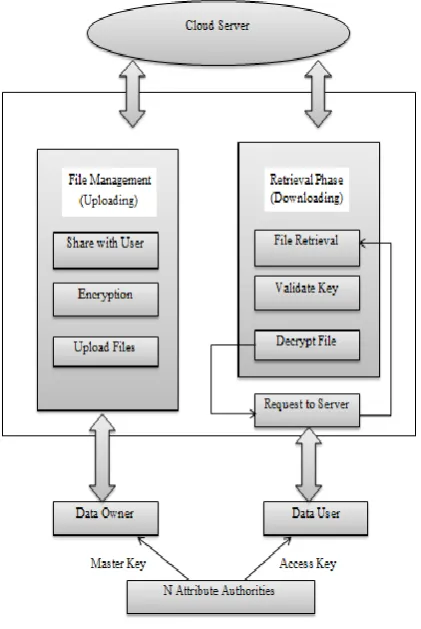
Figure shows the system architecture where the model of secure scheme is given. Authorities are assumed to have powerful computation abilities, and they are supervised by government offices because some attributes partially contain users’ personally identifiable information. The whole attribute set is divided into N disjoint sets and controlled by each authority, therefore each authority is aware of only part of attributes. A Data Owner is the entity who wishes to outsource encrypted data file to the Cloud Servers. The Cloud Server, who is assumed to have adequate storage capacity, does nothing but store them. Data users request access keys from all of the authorities, and they do not know which attributes are controlled by which authorities. When the
Data users request their access keys from the authorities, authorities jointly create corresponding access key and send it to them. All Data users are able to download any of the encrypted data files, but only those whose access keys satisfy the privilege tree can execute the operation. The server is delegated to execute an operation if and only if the user’s credentials are verified through the privilege tree.
[image:3.595.335.546.200.515.2]
Fig. 1 System Architecture
5.
SYSTEM ANALYSIS
© 2017, IRJET | Impact Factor value: 5.181 | ISO 9001:2008 Certified Journal
| Page 1111
sets and controlled by every specialist, in this mannerevery specialist knows about just piece of properties.
Thus the proposed plan will be tolerant against specialist trade off, and bargaining of up to (N2) experts does not cut the entire framework down. We will give point by point investigation on security and execution to indicate practicality of the plan. Shoulder surfing is immediate perception strategies, for example, investigating somebody's shoulder, to get data. Shoulder surfing will be furnished inside the framework with trait based encryption. In the proposed plot, de-duplication will be included where the server will store just a solitary duplicate of each record, paying little heed to what number of clients made a request to store that document, contingent on the circle space of cloud servers.
6.
MATHEMATICAL MODEL
Set Theory: 1 User Model:
Set of user entities U€{Do,Dc}
Do= {Do1, Do2, ……Don} Set of Data Owner Dc= {Dc1, Dc2, …….Dcn} Set of Data Consumer Each data owner and data consumer have attribute set A(Do) {Attr0, Attr1,……….,AttrN}
A(Dc) {Attr0, Attr1,……….,AttrN} 2 Authority Model:
Each user of type Do, Dc has to register with N attribute authorities.
Authorities Au = {A0, A1, A2………..AN} There are N authorities
Each authority Ai has to kept attribute of user U. User can upload multiple files F= {f1, f2 …fn} S={ O, U, MA, C, Pb, Pr}
S: System
O: {Set of owners O1, O2, ..., On, who requests public key , encrypt data and upload it on cloud}
U: {Set of users U1, U2, …,Un, who requests private key from MA then using that private key decrypts encrypted data downloaded from cloud}
MA: {multi authority server who generates keys for respective end users}
C: {All the data stored in cloud}
Pb: {Public key from multi authority server requested from owner}
Pr: {Private Key from multi authority server requested from user}
Fig. 7.1: Venn diagram
7.
AES ALGORITHM
© 2017, IRJET | Impact Factor value: 5.181 | ISO 9001:2008 Certified Journal
| Page 1112
8.
ABE ALGORITHM
ABE Algorithm
Quality based encryption is a kind of open key encryption in which the mystery key of a client and the figure content are reliant upon properties (e.g. the nation in which he lives, or the sort of membership he has). In such a framework, the decoding of a figure content is conceivable just if the arrangement of traits of the client key matches the qualities of the figure content. A urgent security part of Attribute-Based Encryption is plot resistance: A foe that holds numerous keys should just have the capacity to get to information if no less than one individual key stipends get to.
There are chiefly two sorts of Attribute-Based Encryption plans: Key-Policy Attribute-Based Encryption (KP-ABE) and Cipher content Policy Attribute-Based Encryption (CP-ABE).
In KP-ABE, clients' mystery keys are created in view of a get to tree that characterizes the benefits extent of the concerned client and information are encoded over an arrangement of characteristic. Nonetheless, CP-ABE utilizes get to trees to encode information and clients' mystery keys are produced over an arrangement of characteristic.
Property based encryption (ABE) can be utilized for log encryption. Rather than scrambling each piece of a log with the keys of all beneficiaries, it is conceivable to encode the log just with traits which coordinate beneficiaries' characteristics. This primitive can likewise be utilized for communicated encryption keeping in mind the end goal to diminish the quantity of keys utilized.
9.
CONCLUSION
• In our Approach, in the cloud computing to
achieve privacy-preserving access authority sharing by SAPA.
• Authentication is established to guarantee data confidentiality and data integrity with removing shoulder surfing.
• Data anonymity is achieved since the wrapped
values are exchanged during transmission.
• User privacy is enhanced by anonymous access
requests to privately inform the cloud server about the users access desires.
• Forward security is realized by the session
identifiers to prevent the session correlation
10.
REFERENCES
[1] Jingwei Li,Jin Li,Dongqing Xie and Zhang Cai “ Secure Auditing and Deduplicating Data in Cloud” DOI 10.1109/TC.2015.2389960, IEEE Transactions on Computers
[2] Amol D Shelkar, Prof. Rucha R. Galgali, “ Data Access Privilege With Attribute Based Encryption and User Revocation”, International Research Journal of Engineering and Technology (IRJET), Nov 2016.
[3] Praveen N.R and Renju Samuel,” Enhanced Efficient User Revocation Mechanism on Top of Anonymous Attribute Based Encryption” , International Journal of Emerging Technology in Computer Science Electronics, AUGUST 2016.
[4]M.Satishkumar,B.UdayKumar,Ch.ArunKumar,”Attribu te Based Data Sharing with At tribute Revocation to Control Cloud Data Access”, International Journal of Computational Science, Mathematics and Engineering, February-2016.
[5] Muhammad Yasir Shabir, Asif Iqbal, Zahid Mahammad, and Ataullah Ghafoor, “ Analysis of Classical Encryption Techniques in Cloud Computing” , ISSN 1007-0214 09/10 pp102-119 Vol. 21, Number1, February 2014
[6] Jain Zhao, Haiying Gao and Junqi Zhang,” Attribute-Based Encryption for Circuits on Lattices “, ISSN 1007-0214 05/13 pp463-469 Vol. 19, Number 5, October 2014.
[7] S. Keelveedhi, M. Bellare, and T. Ristenpart, Dupless:” Server aided encryption for de-duplicated storage”,in Proceedings of the 22Nd USENIXConference on Security, ser. SEC13. Washington, D.C.: USENIX Association, 2013, pp. 179194.
[8] L. A. Dunning and R. Kresman,” Privacy Preserving Data Sharing With Anonymous ID Assignment ” , IEEE Transactions on Information Forensics and Security, vol. 8, no. 2, pp. 402413, 2013.