International Journal of Emerging Technology and Advanced Engineering
Website: www.ijetae.com (ISSN 2250-2459, Volume 2, Issue 11, November 2012)673
A Review of Performance Evaluation of AODV Protocol in
Manet With and Without Black Hole Attack
Arunima Patel
1, Sharda Patel
2, Ashok Verma
31 M. Tech Student, 2Asst Professor, 3 Associate Professor, Department of Computer Science Engineering, Gyan Ganga Institute
of Science & Technology, Jabalpur, Madhya Pradesh, India
Abstract— Mobile Ad-Hoc Network is a collection of
mobile nodes that are dynamically and arbitrarily located in such a manner that the interconnections between nodes are capable of changing on continual basis. Due to security vulnerabilities of the routing protocols, wireless ad-hoc networks are unprotected to attacks of the malicious nodes. One of these attacks is the Black Hole Attack. In this paper, we focus on analyzing the performance of one of the popular routing protocols for MANET AODV with BlackholeAODV. Our aim is to simulate the AODV protocol with and without Black Hole Attack on various performance metric parameters.
Keywords— MANET, AODV, Black Hole Attack, Malicious
Node , NS2.
I. INTRODUCTION
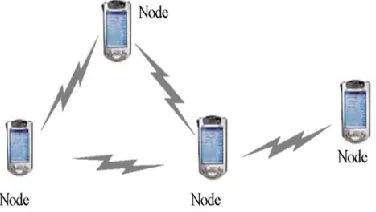
A mobile Ad hoc Network (MANET) [12] as its name implies, is a collection of mobile nodes that can communicate with each other without the use of predefined infrastructure or centralized administration. Mobile ad-hoc network have the attributes such as wireless connection, continuously changing topology, distributed operation and ease of deployment.
[image:1.612.340.543.284.402.2]Mobile ad hoc networks (MANETs) face different levels of challenges due to its varying mobile characteristics. The major goal of these networks is to bring the idea of mobility into real-life networks. These networks are known for their infrastructure less characteristics. The nodes are free to move anywhere and hence the communications links may be broken at any moment.
Figure I Mobile Ad hoc network (MANET)
[image:1.612.75.263.582.688.2]In MANET routing protocols are used for communicate. They are classified into different categories according to the methods used during the route discovery and route maintenance procedures.
Figure II Manet Routing Protocols
Proactive/Table-driven routing protocol needs to maintain up-to-date routing information from each node to every other node in the network. The familiar proactive
routing protocols are Destination-Sequenced Distance
Vector Routing Protocol (DSDV), Wireless Routing Protocol (WRP), and Global State Routing (GSR) etc.
Reactive routing protocol is also known as On Demand routing protocol. It creates routes only when desired by source. Cluster based Routing Protocols (CBRP), Ad-Hoc On-Demand Distance Vector Routing (AODV), Dynamic Source Routing Protocol (DSRP), Temporally Ordered Routing Algorithm (TORA), are On-Demand Routing protocols.
The hybrid routing protocol combines the advantages of proactive routing and reactive routing to overcome the defects of them. The familiar hybrid routing protocols is zone routing protocol (ZRP).
II. AODV
International Journal of Emerging Technology and Advanced Engineering
Website: www.ijetae.com (ISSN 2250-2459, Volume 2, Issue 11, November 2012)674
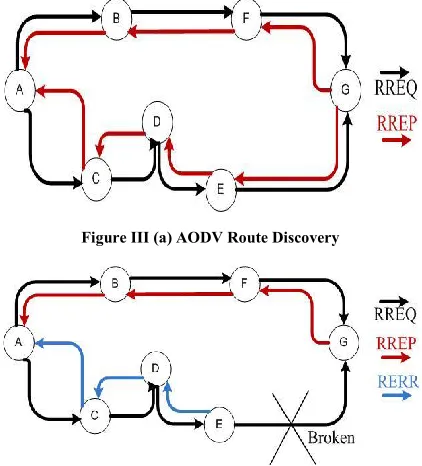
An important feature of AODV is the maintenance of time-based states in each node: a routing entry not recently used is expired. In case of a route is broken the neighbors can be notified. Route discovery is based on query and reply cycles, and route information is stored in all intermediate nodes along the route in the form of route table entries. The following control packets are used: routing request message (RREQ) is broadcasted by a node requiring a route to another node, routing reply message (RREP) is back to the source of RREQ, and route error message (RERR) is sent to notify other nodes of the loss of the link. HELLO messages are used for detecting and monitoring links to neighbors.Figure III (a) AODV Route Discovery
Figure III (b) Route Error Message in AODV
III. BLACK HOLE ATTACK
In a Black Hole attack, a malicious node sends fake routing information, claiming that it has an optimum route and causes other good nodes to route data packets through the malicious one.
When the malicious node receives an RREQ message, it immediately sends a false RREP message with a high sequence number and minimum hop count without checking its routing table to make an entry in the routing table of the source node, before other nodes replies to absorb transmitted data from source to that destination and drop them instead of forwarding [15].
IV. EXPERIMENTAL SETUP
The simulation is done with the help of NS-2 (v-2.34) network simulator. NS-2 provides faithful implementations of the different network protocols. There are number of simulation parameters which can be varied, are shown in below table.
Parameter Value
Simulator NS - 2.34
Simulation time 100 s
Number of nodes 10,20,30
Number of black hole
nodes 1,2,3
Terrain area 500m x 500m
Routing Protocol AODV
Packet size 512
[image:2.612.346.540.213.393.2]Traffic model CBR
Table I Simulation Parameters
V. RESULT AND ANALYSIS
Various network contexts are considered to measure the performance of a protocol. These contexts were created by varying the following parameters in the simulation.
Network Size
Number of Black Hole nodes
Traffic Load
A.For Single Black Hole Node
Figure IV (a)
0 10000 20000 30000 40000
10 20 30
Send
P
kt
s
[image:2.612.63.274.291.524.2]International Journal of Emerging Technology and Advanced Engineering
Website: www.ijetae.com (ISSN 2250-2459, Volume 2, Issue 11, November 2012)675
Figure IV (b)Figure IV (c)
Figure IV (d)
All the above four contexts are simulated and tested to see the effect of generated packet, received packet, routing packets, number of packets dropped in AODV and when there is a single Black Hole node.
B. For Two Black Hole Nodes
Figure V (a)
Figure V (b)
Figure V (c)
0 5000 10000 15000
10 20 30
Rec
v
P
kt
s
Number of Nodes
AODV BlackholeAODV
0 2000 4000 6000 8000
10 20 30
Ro
uting
P
kt
s
Number of Nodes
AODV BlackholeAODV
0 10000 20000 30000
10 20 30
N
u
m
b
e
r
o
f D
ata
Pkts
d
ro
p
p
e
d
Number of Nodes
AODV BlackholeAODV
0 10000 20000 30000 40000
10 20 30
Send
P
kt
s
Number of Nodes
0 5000 10000 15000
10 20 30
R
ec
v
P
kt
s
Number of Nodes
AODV BlackholeAODV
0 2000 4000 6000 8000
10 20 30
Ro
uting
P
kt
s
Number of Nodes
International Journal of Emerging Technology and Advanced Engineering
Website: www.ijetae.com (ISSN 2250-2459, Volume 2, Issue 11, November 2012)676
Figure V (d)All the above four contexts are simulated and tested to see the effect of generated packet, received packet, routing packets, number of packets dropped in AODV and when there are two Black Hole nodes.
C.For Three Black Hole Nodes
Figure VI (a)
Figure VI (b)
Figure VI (c)
Figure VI (d)
All the above four contexts are simulated and tested to see the effect of generated packet, received packet, routing packets, number of packets dropped in AODV and when there are three Black Hole nodes.
VI. CONCLUSION
Thus we have evaluated the performance of AODV protocol with and without Black Hole attack using different performance metrics and by varying the number of nodes as well as the number of black holes. It was observed in results that AODV always perform better in absence of Black Hole attack.
REFERENCES
[1 ] Fan-Hsun Tseng, Li-Der Chou1 and Han- Chieh Chao “A survey of black hole attacks in wireless mobile ad hoc networks”, Human-centric Computing and Information Sciences 2011.
[2 ] Harris Simaremare and Riri Fitri Sari “Performance Evaluation of AODV variants on DDOS, Blackhole and Malicious attacks”. In IJCSNS International Journal of Computer Science and Network Security, VOL.11 No.6, June 2011.
0 5000 10000 15000 20000 25000
10 20 30
Num
ber
of
Da
ta
P
kt
s
dro
pp
ed
Number of Nodes
AODV BlackholeAODV
0 10000 20000 30000 40000
10 20 30
Send
P
kt
s
Number of Nodes
AODV BlackholeAODV
0 5000 10000 15000
10 20 30
Rec
v
P
kt
s
Number of Nodes
AODV BlackholeAODV
0 2000 4000 6000 8000
10 20 30
Ro
uting
P
kt
s
Number of Nodes
AODV BlackholeAODV
0 5000 10000 15000 20000 25000
10 20 30
Num
ber
of
Da
ta
P
kt
s
dro
pp
ed
Number of Nodes
International Journal of Emerging Technology and Advanced Engineering
Website: www.ijetae.com (ISSN 2250-2459, Volume 2, Issue 11, November 2012)677
[3 ] Harsh Pratap Singh et al. “Guard against cooperative black holeattack in mobile adhoc network”, International Journal of Engineering Science and Technology (IJEST) Vol. 3 No. 7 July 2011.
[4 ] Lalit Himral, Vishal Vig & Nagesh Chand . “Preventing AODV Routing Protocol from Black Hole Attack” International Journal of Engineering Science and Technology (IJEST) Vol. 3 No. 5 May 2011.
[5 ] Monika Roopak , Dr Bvr Reddy “Performance Analysis of AODV Protocol under Black Hole Attack” International Journal of Scientific Engineering Research 2011.
[6 ] Nisarg Gandhewar, Rahila Patel “Performance Evaluation of AODV protocol in MANET using NS2 Simulator” International Journal of Computer Application 2011.
[7 ] Nital Mistry, Devesh C Jinwala, Mukesh Zaveri, “Improving AODV Protocol against Blackhole Attacks” Proceedings of the International Multiconference of Engineers and Computer Scientists 2010.
[8 ] K. Lakshmi, S.Manju Priya, A.Jeevarathinam K.Rama, K. Thilagam. International Journal of Engineering and Technology Vol.2 (6), 2010.
[9 ] Anu Bala , Raj Kumari, Jagpreet Singh “Investigation of Blackhole Attack on AODV in MANET” Journal of Emerging Technologies in Web Intelligence 2010.
[10 ]Payal N. Raj, Prashant B. Swadas. “DPRAODV: A Dyanamic Learning System Against Blackhole Attack In Bodv Based Manet.” In: International Journal of Computer Science Issues, Vol.2, 2009.
[11 ]Latha Tamilselvan, Dr V Sankaranarayanan, “ Prevenntion of Blackhole Attack in MANET”. 2nd International Conference on
Wireless Broadband and Ultra Wideband Communications India, 2007.
[12 ]C.R. Dow, P.J. Lin, S.C. Chen, J.H. Lin and S.F. Hwang, “A Study of Recent Research Trends and Experimental Guidelines in Mobile Ad- hoc Networks”, 19th International Conference on Advance
Information Networking and Applications, 2005.
[13 ]M. A. Shurman, S. M. Yoo, and S. Park, “Black hole attack in wireless ad hoc networks.” In: Proceedings of the ACM 42nd Southeast Conference (ACMSE’04), Apr. 2004.
[14 ]C.E. Perkins, E. Beilding-Royer. S. Das, Ad hoc on- demand distance vector (AODV) routing, IETF Internet Draft, MANET working group, 2004.
[15 ]M. Al-Shurman, S-M Yoo and S. Park, “ Black Hole Attack in Mobile Ad Hoc Networks”, ACM Southeast Regional Conf, 2004. [16 ]Hongmei Deng, Wei Li, and Dharma P. Agrawal, “Routing
Security in Wireless Ad Hoc Network,” IEEE Communications Magzine, vol. 40, no. 10, October 2002.
[17 ]H. Deng, W. Li, and D. P. Agrawal. “Routing Security in Adhoc Networks.” In: IEEE Communications Magazine, Vol. 40, No. 10, Oct. 2002.
[18 ]S. Marti, T. J. Giuli, K. Lai, and M. Baker, Mitigating Routing Misbehavior in Mobile Ad Hoc Networks. Proceedings of the 6th