manipulation of objects within a
collaborative virtual environment
Otto, O, Wolff, R and Roberts, DJ
http://dx.doi.org/10.1162/1054746041422280
Title
A study of event traffic during the shared manipulation of objects within a
collaborative virtual environment
Authors
Otto, O, Wolff, R and Roberts, DJ
Type
Article
URL
This version is available at: http://usir.salford.ac.uk/931/
Published Date
2004
USIR is a digital collection of the research output of the University of Salford. Where copyright
permits, full text material held in the repository is made freely available online and can be read,
downloaded and copied for noncommercial private study or research purposes. Please check the
manuscript for any further copyright restrictions.
Environments Business House University Road University of Salford Salford
Manchester M5 4WT United Kingdom
David J. Roberts [email protected] The Centre for Virtual Environments
Business House University Road University of Salford Salford
Manchester M5 4WT United Kingdom
Oliver Otto [email protected] The Centre for Virtual Environments
Business House University Road University of Salford Salford
Manchester M5 4WT United Kingdom
Presence,Vol. 13, No. 3, June 2004,251–262
©2004 by the Massachusetts Institute of Technology
Objects Within a Collaborative
Virtual Environment
Abstract
Event management must balance consistency and responsiveness above the require-ments of shared object interaction within a Collaborative Virtual Environment (CVE) system. An understanding of the event traffic during collaborative tasks helps in the design of all aspects of a CVE system. The application, user activity, the dis-play interface, and the network resources, all dis-play a part in determining the charac-teristics of event management.
Linked cubic displays lend themselves well to supporting natural social human com-munication between remote users. To allow users to communicate naturally and subconsciously, continuous and detailed tracking is necessary. This, however, is hard to balance with the real-time consistency constraints of general shared object inter-action.
This paper aims to explain these issues through a detailed examination of event traffic produced by a typical CVE, using both immersive and desktop displays, while supporting a variety of collaborative activities. We analyze event traffic during a highly collaborative task requiring various forms of shared object manipulation, in-cluding the concurrent manipulation of a shared object. Event sources are catego-rized and the influence of the form of object sharing as well as the display device interface are detailed. With the presented findings the paper wishes to aid the de-sign of future systems.
1 Introduction
Collaborative Virtual Environments (CVE) allow people to share experi-ence through a set of common virtual objects, regardless of geographical sepa-ration. Established applications include visualization, training, planning, and entertainment. Various forms of natural social human communication may be supported through avatars (virtual objects that represent a user), which may move around the environment, while users look at, point to, discuss, and ma-nipulate the common objects. The CVE system is responsible for supporting such forms of communication between remote users. The distribution of a vir-tual environment is typically done through a shared, networked database of objects. The network introduces latencies and consistency issues which must
be addressed by the CVE system. Systems adopt a vari-ety of distribution patterns. Centralized databases offer simple consistency control but are more affected by la-tency than are replicated databases, which allow users to interact with local copies of objects before communicat-ing state changes as events. Durcommunicat-ing event distribution and processing a number of mechanisms are needed for managing the balance of consistency and responsiveness. A detailed discussion would go beyond the scope of this paper and we refer the reader to Singhal and Zyda (1999) and Roberts (2004).
Interaction-rich applications may produce a scale of events that overwhelms the event management of a CVE system, reducing the quality of consistency and responsiveness. Users interface to the CVE through dis-play systems, the capabilities of which determine the kinds of human communication that can be supported. Cubic Immersive Projection Technology (IPT), such as a CAVE, lends itself well to social human communica-tion as the user’s own body is placed within the spatial social context. This encourages natural, subconscious, nonverbal communication. Although it is trivial to cap-ture such body movement using tracking systems, the resultant scale of event traffic can be hard to communi-cate across the CVE. Many teamwork tasks in the real world require the shared manipulation of objects, both sequentially and concurrently. Although many systems allow the manipulation of objects to be shared sequen-tially, few allow concurrent manipulation. This is be-cause doing so in a natural manner requires complex consistency balancing to address the problem of net-work latency. Designing such consistency control re-quires a thorough understanding of event traffic.
This paper aims to increase the understanding of the level and proportions of event frequency and the effect of both the method of object sharing and the display device. In contrast to related research, we focus on co-operative manipulation as a form of closely coupled col-laboration by supporting concurrent manipulation of shared objects via both the same and distinct attributes. We examine event traffic during collaboration through linked cubic IPT and desktop display devices while users share objects in a variety of ways. The main sources of
events are identified and the frequency of communi-cated events is measured.
1.1 Related Work
Much research has been dedicated to the develop-ment of CVE systems and toolkits, including the man-agement and optimization of network usage. Relevant examples are NPSNET (Macedonia, Zyda, Pratt, Bar-ham, & Zeswitz, 1994), PaRADE (Roberts, Sharkey, & Sandoz, 1995), DIVE (Fre´con & Stenius, 1998), MASSIVE (Greenhalgh, Purbrick, & Snowdon, 2000), CAVERNsoft (Leigh, Johnson, & DeFanti, 1997) and QUICK (Capps, 2000). Some studies have investigated the performance of communication infrastructures used to link training simulators (Wuerfel, 1998; d’Ausbourg, Bussenot, & Siron 2002), while other studies have in-vestigated the network traffic generated by both social gatherings and teamwork activities (Roberts, Richard-son, Sharkey, & Lake, 1998; Roberts, Strassner, Worth-ington, & Sharkey, 1999; Fre´con, Smith, Steed, Ste-nius, & Stahl, 2001; Greenhalgh, Bullock, Fre´con, Lloyd, & Steed, 2001; Leigh et al., 2001).
Although some research addresses issues of the coop-erative manipulation of shared objects and the impact of the network on user performance (e.g., Ryan & Shar-key, 1998; Margery, Arnaldi, & Plouzeau, 1999; Park & Kenyon, 1999; Broll, Meier, & Schardt, 2000; Mortensen et al., 2002; Pinho, Bowman, & Freitas, 2002; Linebarger, Janneck, & Kessler, 2003), little is known about the impact of shared object manipulation through various display devices on the characteristics of the network and event handling.
2 Experimentation
2.1 Display Devices
Our study is based on measurements of event traf-fic generated by two distinct display devices: an immer-sive cubic display and a nonimmerimmer-sive desktop display. An immersive cubic display uses IPT to surround the user with projection screens showing stereo images. Common setups consist of three walls and a floor, 3 by 3 meters each. Interaction within the virtual world is achieved by motion-tracking of a user’s head and hand movement. The important difference to other immer-sive displays, such as head-mounted displays (HMD), is that the user is still aware of his or her own body while completely immersed within computer graphics. This encourages subconscious, nonverbal social communica-tion and allows a natural interaccommunica-tion within virtual envi-ronments.
The most common nonimmersive display is a desktop workstation, as it is cheap and easily available. In our configuration, a desktop user interacted on a conven-tional PC through a mono screen using the keyboard and mouse. Both displays were equipped with an audio connection to support verbal communication during collaboration. Throughout the measurements, the dis-play devices were interconnected via an Ethernet LAN.
2.2 Application
Scenarios of shared object manipulation can be found in many application areas. In order to examine the event traffic during various distinct scenarios of shared object manipulation, we have designed a simple application that simulates a construction site. This ap-plication has already been a benchmark for related re-search, including social human communication, (Otto & Roberts, 2003; Roberts, Wolff, & Otto, 2003). The application situated remote users into a virtual construc-tion site surrounded by a selecconstruc-tion of building materials and tools. Their task was to build a predefined simple structure, requiring both systematic usage of tools and collaboration with remote users to gather and join ma-terials in a number of structured subtasks. The simula-tion of gravity within the virtual world enforced concur-rent object sharing and teamwork as in the real world.
For example, a material must be held in place while it is fixed, or two users must carry large materials together.
Throughout the experiment, a user’s task required both sequential and concurrent manipulation of shared objects to achieve the goal. Within the concurrent ma-nipulation of shared objects, we can identify two major scenarios: that of distinct object attributes, and that of the same object attribute. The concurrent manipulation of distinct attributes is, for example, involved when join-ing buildjoin-ing materials together. Here, one person con-trols the position attribute to hold a material in place, while another controls the “fixed” attribute that releases it from the effects of gravity. The concurrent manipula-tion of the same attribute is involved when users are carrying artificially heavy building materials, controlling the material’s position attribute together. Finally, a lim-ited number of tools in the virtual world enforced com-petition and sequential sharing.
2.3 Implementation
The application was implemented above a well-known CVE, DIVE (Fre´con & Stenius, 1998). This was chosen because it is an established testbed for experi-mentation of collaboration in virtual environments and, after three major revisions, remains an effective bench-mark (Fre´con et al., 2001; Greenhalgh et al., 2001; Schroeder et al., 2001; Steed, Mortensen, & Fre´con, 2001; Mortensen et al., 2002). DIVE version 3.3.5 was used for all display devices.
re-active and triggered by occurrences of specific events. DIVE supports several event types. These included ject transformations, such as movement or rotation; ob-ject interactions, such as grasp, release, or select; obob-ject collisions; and changes to object-specific properties and flags. Most functionality in our application was trig-gered by collisions of material and tool objects. For ex-ample, when a drill tool collided with a material object, the resulting collision event would trigger a procedure in the material’s behavior script to increase a specific counter attribute.
The distribution of events between remote sites was handled by DIVE’s distribution layer. The application can cope with the loss of certain event types. For exam-ple, users may repeat their action if an intended collision did not show the expected effect. Some specific events, however, are vital within the application. If, for exam-ple, an event that signals a change from an unfixed to a fixed state gets lost during distribution to remote sites, the object would become held in place at one site but not at the other. DIVE implements the replicated data-base approach above peer-to-peer communication. An event occurs first locally and is then distributed via mul-ticast to remote replicas. The DIVE system provides a loose level of consistency, where it is assumed that ob-jects are likely to be modified often, and therefore uses reliable multicast, relying on eventually converging states of replicas.
We have provided additional, tighter consistency management, implemented within the application-level object behavior scripts. To acknowledge the successful action of a tool, a flag is set to signal a definite state. A level of causal ordering and discarding of events was realized by constraining the order of manipulations through flags that can only be set in a certain order. For example, the flag to fix construction materials could only be set after the collision event from the drill tool and a screw occurred. If such a condition was not ful-filled the action would not be successful and the current event discarded, forcing the user to repeat the step. Al-lowing script procedures to set several distinct proper-ties concurrently has enabled concurrent object manipu-lation of distinct attributes, avoiding exclusive object ownership. For instance, a counter attribute of an object
could be set while its position was continuously up-dated. In contrast, concurrent manipulation of the same attribute was realized through intermediate procedures that gather and “combine” events before setting the actual attributes of the manipulated object. For exam-ple, carrying construction materials together with a re-mote user would be performed with the help of special tools used on each end of the material to attract a trans-formation. These tools send their current position to the carried object, which in turn attempts to find an average transform between them, and finally, communi-cates this opinion to the peer(s). One can see that this application-level consistency management adds addi-tional events to the common traffic. However, the lack of support for the consistent shared manipulation of objects, as in many CVE systems, makes this necessary.
2.4 Measurements
To make a clear assessment of the event traffic, we extended the DIVE distribution layer for synchronized, wall-clock timed event logging. Our extension logs oc-currences of outgoing event messages that have been sent over the network and maps them to a global time stamp through synchronized local clocks. The measured traffic shows the result of communicated events per sec-ond, which in turn are a result of local state changes at each site.
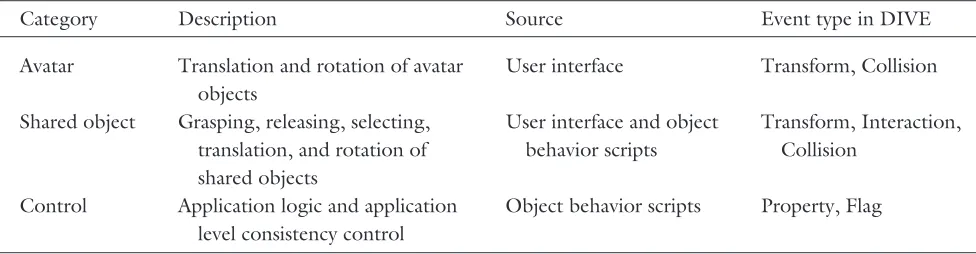
2.4.1 Event Types. Our measurements recorded only those events directly involved in the construction task. These included state changes of building materials, and tool and avatar objects caused by both the user and, indirectly, the object behavior scripts. Table 1 lists the various event types of DIVE that have been monitored.
avatar movement were transform events caused by ava-tar objects and the resulting collision events.
Object manipulation included events that showed a direct effect on the shared objects caused by both the user directly and the object behavior scripts indirectly. This included positioning the materials and tools, as well as simple interactions, such as picking and select-ing. Moving and rotating of shared objects generated transform events, whereas grasping, releasing, and se-lecting an object generated interaction events in DIVE. Again, collision events were generated when shared ob-jects collided during transformation.
There are a number of distinctions that must be noted here between the display types. An immersed user must physically reach for an object before grasping it, whereas a desktop user can pick up even a distant object through the pointer and keyboard. Grasping an object in the cubic display results in a hierarchy change in the scenegraph where the object becomes a child of the ava-tar’s hand. This means that manipulation does not change the relative transformation attribute of the ob-ject, as this is already mapped through hand movement events of the avatar. By default, selection in the desktop does not change the hierarchy and allows the user to directly affect the object’s relative transform attribute. Thus, object manipulation through the cubic display will be communicated primarily by events describing avatar movement, while object manipulation on the desktop will be communicated primarily by those events describing object transforms.
Control comprises the application logic and
application-level consistency management implemented in the ob-ject behavior scripts. Events generated by the behavior scripts included property and flag event types. Property events come from user-defined, object-specific infor-mation changes, such as counters, object references, or the level of sharing. Such events would also be gener-ated when an object’s behavior script accesses and mod-ifies attributes within other objects, such as setting the alignment position of the target object during concur-rent manipulation. Flag events were usually generated at the end of a manipulation action, signaling a definite state.
The system checks for collisions of moving objects and generates an event describing the result of a colli-sion for each affected object. Any object within the en-vironment, including the user’s avatar, may cause colli-sion events. As mentioned above, most functionality of our application was manged by collision triggers of cer-tain material and tool objects. The behavior scripts must listen to and process all occurring collision events to find out whether they are relevant or not. In order to assess the load of the scripts we monitored all collision event occurrences.
[image:6.630.70.558.118.245.2]In our application, vital events, such as grasping, fix-ing, and droppfix-ing, bound manipulation. Although these do not need to be tightly synchronized between the sites, a minimum level of causal ordering must be maintained. For example, a delayed transform event must not be allowed to affect a material once fixed. We were especially interested in the proportion of vital events to nonvital. Therefore, we monitored selected
Table 1. Summary of Monitored Event Types
Category Description Source Event type in DIVE
Avatar Translation and rotation of avatar objects
User interface Transform, Collision
Shared object Grasping, releasing, selecting, translation, and rotation of shared objects
User interface and object behavior scripts
Transform, Interaction, Collision
Control Application logic and application level consistency control
event types that have been identified as vital separately from the others. The set of vital events includes most flag events, as well as some property and collision events in DIVE.
2.4.2 Timing of Subtasks. During the measure-ments, two remote users performed the whole construc-tion task, structured into subtasks, for several test runs. The task included fetching tools and materials, carrying materials together, and holding materials in place while they are fixed. Within these subtasks, shared objects had to be manipulated sequentially as well as concurrently. Table 2 shows a summary of all subtasks that involved concurrent object manipulation. The table includes the approximate time stamp when a subtask was performed and how it was shared between the two users. Simple complexity of manipulation refers just to controlling the position attribute of a concurrently shared object during carrying or holding it in place, whereas comprehensive complexity refers to a number of separate manipulations of various tools and materials in a logical order to finally fix the object.
3 Results and Observations
Each test run completed construction in around four to five minutes. The process of the subtasks varied considerably over all test runs. This made a statistical analysis very difficult. However, both users always con-tributed with similar activity. Ten test runs were re-coded. In this section, we compare the results of one typical test run. We start with analyzing the frequency
of the typed event generated on each display. This is followed by a summary of the proportions of event types over the entire test run and then an overview of the influence of asymmetric displays. Throughout all tests, the average bandwidth used by the CVE system for two collaborating users within the test configuration was around 4 KBytes/s, with occasional peaks up to 20 Kbytes/s, exclusive audio streams.
3.1 Event Frequency
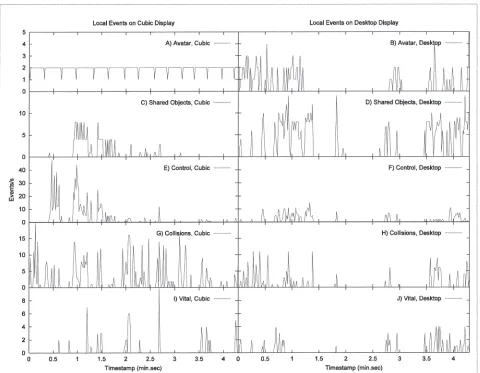
Figure 1 shows the measured frequency of events sent from each site. It shows graphs of events generated locally by the immersive cubic display and the nonim-mersive desktop display. The values are sorted by event types, similar to Table 1, and are mapped to a common time stamp illustrating the task progressing over time in minutes. As stated in Table 2, approximately the first third of the task included concurrent manipulation of the same attribute, whereas the middle and the last third involved concurrent manipulation of distinct attributes of shared objects. Sequential sharing took place in be-tween these subtasks.
[image:7.630.68.561.119.207.2]We now closely examine the results shown in Figure 1. Graphs A and B show transform event occurrences triggered by avatar movement, while Graphs C and D illustrate the frequency of transform and interaction events caused by direct object manipulations through the users or indirectly through the object’s behavior scripts. Graphs E and F display occurrences of events that were necessary for consistency control, managed by the object behavior scripts. Graphs G and H show all collision event occurrences, and finally, Graphs I and J
Table 2. Summary of Subtasks Involving Concurrent Object Manipulation
Subtask Description Time stamp
Manipulated attributes
Complexity of manipulation Cubic display Desktop
ST1 Carry obj1 0.5–1.5 Same Simple Simple
ST2 Fix obj1 1.5–3.0 Distinct Comprehensive Simple
show the frequency of events that have been vital to the application.
In the beginning phase, between time stamp 0 and 0.5, one can see avatar movement and collision event occurrences generated by both display devices. Graph A illustrates how the tracking system of the cubic display creates events by constantly sampling the location of the user’s head and hand. In our tests, the tracker update rate was configured with 500 ms, which was found to provide a reasonable compromise between accuracy and performance. All other graphs show bursts of events as a result of human interaction, similar to those found in Macedonia et al. (1994). Collisions occur when the
ava-tar approaches the tool and material objects. The dy-namic avatar of the user in immersive cubic display causes collisions in higher frequencies than the desktop user’s rigid avatar. At time stamp 0.1 and 0.25, the desktop user manipulated an object, as event occur-rences in graphs D, F, and J reveal. In this form, as se-quential object sharing, the behavior scripts generated few events on the desktop.
At time stamp 0.4, one can see an interaction event in Graph C as the immersive user picked up a tool for con-current manipulation and initiated subtask 1. Graph E shows frequent events with high peaks. These events are a result of the behavior scripts controlling the
[image:8.630.71.551.101.474.2]rent manipulation. However, an actual manipulation of the shared object has not been measured at this point in Graph C. Although both users interacted with distinct objects, no shared interaction occurred yet. The onset of concurrent manipulation of a shared object begins and is synchronized by vital events at time stamp 0.7. This is followed with a burst in nonvital events (Graphs C, D, E, and F), terminating with vital events at time stamp 1.5 when concurrent manipulation ends. Again high peaks are observed in the frequency of events for object behavior at the cubic display. One can clearly see a difference in the frequency of events for consistency management when comparing Graph E with F. The immersive display device causes the behavior scripts to generate events much more often than the desktop dis-play.
Remember that, through motion tracking in the cu-bic display, no events are generated from direct transfor-mations by the user, as these are mapped to hand move-ments from the dynamic avatar. What we see in Graph C is the result of transformations by the behavior scripts, whereas Graph D shows the sum of transforma-tions by the user and behavior scripts. Both graphs show occasional peaks, rather than a smooth update rate. The users who observed a jerky movement of the material object when carrying it could confirm this. This is a re-sult of event queuing caused by the preceding high event frequencies that must be processed by the behav-ior scripts before they can update the transformation of the manipulated object.
During the concurrent manipulation of distinct at-tributes in subtask 2 between time stamps 2.0 and 2.8, the graphs of the desktop display device show a long gap. This is because the desktop user can hold an object in the air from a distance, taking a share of the weight to allow the other user in the cubic display to manipu-late it. Thus, although the desktop user does not move the mouse, all the event traffic associated with moving the object is generated from the cubic display. After the occurrence of vital events that signalized a fixed-state change of the concurrently manipulated object at 2.7 in Graph I, one can see the response of the desktop user at time stamp 2.8. The frequent events in Graph D reveal that the shared object was still manipulated before the
avatar moved away, although the event for fixing should have taken effect. A delayed evaluation of vital events can lead to an erroneous application.
In the graphs of the desktop, one can see increased occurrences of events during more complex object ma-nipulations within subtask 3. Vital event occurrences are dense at this time. Closer inspection of the log files re-vealed that the desktop user generated a high number of interaction events. This can be attributed to the user trying to precisely position objects within the scene, which resulted in several grasps and releases of an ob-ject. The concurrent manipulation of distinct attributes produces clearly fewer events for consistency manage-ment than manipulating the same attribute, as the ob-ject behavior graphs show.
How-ever, these small movements can be useful for creating a feeling of copresence and in helping to demonstrate emotion.
Peaks of vital events sometimes occur when states are changed for several objects at the same time, such as setting the fixed state for all material objects that inter-sect with a screw object. Vital events always occur dur-ing or around bursts of object behavior scripts, object manipulation, or collision events. Such bursts in the load for the event management can lead to a delayed evaluation of vital events and to erroneous application.
3.2 Proportions
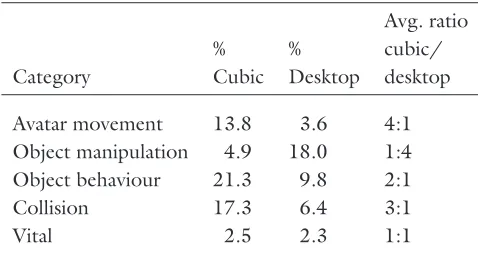
Table 3 summarizes the proportions of the various event occurrences that had to be sent over the network. The values, given as percentages, indicate the contribu-tion of the distinct display devices to the whole event traffic, averaged over all test runs. In summary, the im-mersive display device contributed 20% more to the to-tal amount of event occurrences compared to a desktop display. Comparing the sums and ratios of avatar move-ment and object manipulation proportions, one can see now how continuous motion-tracking in an immersive display compensates for additional object manipulation events caused by a desktop. However, an immersive dis-play causes considerably more collision events, as well as application-specific events for consistency control by the object behavior scripts, than the nonimmersive desktop display. The cubic display generated double the number of events than object behaviors and three times more
collisions were caused. The proportions of vital events were small compared to the rest. In our highly collabo-rative task, only 2.5% are vital events. No significant dif-ference in proportions of vital events can be seen be-tween the display types, as both users showed similar activity and contribution to the collaborative task.
3.3 Comparison
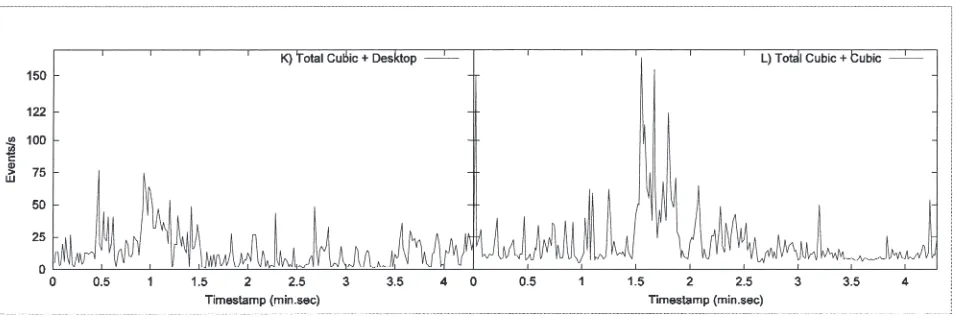
Finally, we look at the effect of asymmetric dis-plays on the total event traffic. In Figure 2, we compare the frequency of events communicated between an im-mersive cubic display connected to a desktop display, Graph K, and two connected cubic displays, Graph L. The former were tested across a local area network, whereas the latter were tested across the Internet, but we here assume this difference to have negligible effect on the traffic.
Comparing the frequency of event occurrences shown in the two graphs in Figure 2, one can see that in Graph L, the two immersive cubic displays together generated high peaks of up to 150 events per second, whereas in Graph K, the cubic and desktop combination showed peaks of around 60 events per second. Referring to find-ings of the previous results, the highest peaks occur dur-ing the concurrent manipulation of the same attribute of a shared object. During the concurrent manipulation of distinct attributes, both display configurations show similar peaks. However, the mean frequency of events, and thus the load for the CVE system, is about one third higher in Graph L than in Graph K.
4 Conclusion
[image:10.630.69.308.117.244.2]This paper aimed to add to the understanding of typical event traffic in a CVE through investigating the impact of various forms of object sharing across two distinct device types. This was approached by analyzing the event traffic during a highly collaborative task, in terms of both frequency and proportions of various event types. We have presented measurements of events sent across the network during a collaborative task re-quiring distinct forms of object manipulation as well as
Table 3. Event Proportions on Total Traffic
Category
% Cubic
% Desktop
Avg. ratio cubic/ desktop
Avatar movement 13.8 3.6 4:1 Object manipulation 4.9 18.0 1:4 Object behaviour 21.3 9.8 2:1
Collision 17.3 6.4 3:1
nonverbal communication. Unlike previous work, this has included measurements taken during the concurrent sharing of an object, both through the same and distinct attributes. The impact on the event traffic of the type of shared object manipulation and the display device used was compared. The presented results may be of value in the design of applications, infrastructure, and input de-vices. For example, recognizing characteristics in collab-orative actions and its resulting event traffic may lead to the development of advanced consistency control mech-anisms matching the characteristics and requirements of the actual method of shared object manipulation.
Within the confines of our application and implemen-tation, the primary findings of this work are:
1) Event bursts occur during shared object manipula-tion that often result in event queuing and thus the “jumping around” of the shared object. 2) The size of the burst depends on a combination of
interface and type of object sharing.
3) Tight, real-time, consistency management exacer-bates these bursts.
4) Erroneous results occur from the delay or loss of vital events.
5) Vital events are rare but tend to coincide or bound bursts of nonvital events.
We have shown that the interface, provided by a par-ticular display type, has significant impact on the
fre-quency of events. When linking several immersive displays for collaboration, the event traffic increases considerably. This should be considered when porting collaborative applications from desktop to tracked dis-play. Furthermore, we have shown that concurrent ob-ject manipulation can result in more traffic than sequen-tial manipulation, whereas concurrent manipulation of the same attribute has more impact than distinct at-tributes.
Generic support for collaboration requires both the support for various forms of object sharing and commu-nication of natural body movements. We have shown that supporting both is achievable but nontrivial. Our results show a specific need for filtering nonvital events while maintaining some level of causal ordering for all. Strategies such as sufficient causal ordering have ad-dressed this issue in the past (Roberts, 1995) but have not been rigorously tested with such high levels of mo-tion-tracked data. It remains to be seen if they could offer a generic solution for supporting social human communication.
5 Future Work
[image:11.630.73.551.101.260.2]We are currently developing a flexible consistency control module that supports a variety of time manage-ment strategies. Dedicated pipes distinguish between
vital and nonvital events. The time management strate-gies determine delivery, garbage collection, and order-ing criteria.
Acknowledgments
We would like to thank Anthony Steed, and the team from the University College London (UK) as well as Christoph An-thes, Dieter Kranzlmu¨ller, and the team from the Johannes Kepler Universita¨t in Linz (Austria) for collaborations during this research.
References
Broll, W., Meier, E., & Schardt, T. (2000). The virtual round table—A collaborative augmented multi-user environment.
Proceedings of CVE 2000(pp. 39 – 45). New York: ACM Press.
Capps, M. V. (2000). The QUICK framework for task-specific asset prioritization in Distributed Virtual Environments.
Proceedings of IEEE Virtual Reality 2000,143–150. d’Ausbourg, B., Bussenot, J.-L., & Siron, P. (2002).
PERFO-SIM: A performance evaluation tool for HLA distributed simulations.Proceedings of the Sixth IEEE International Workshop on Distributed Simulation and Real-Time Applica-tions (DS-RT’02),23–31.
Fre´con, E., Smith, G., Steed, A., Stenius, M., & Stahl, O. (2001). An overview of the COVEN platform.Presence: Teleoperators and Virtual Environments, 10(1), 109 –127. Fre´con, E., & Stenius, M. (1998). DIVE: A scalable network
architecture for distributed virtual environments. uted Systems Engineering Journal (special issue on Distrib-uted Virtual Environments), 5(3), 91–100.
Greenhalgh, C., Bullock, A., Fre´con, E., Lloyd, D., & Steed, A. (2001). Making networked virtual environments work.
Presence: Teleoperators and Virtual Environments, 10(2), 142–159.
Greenhalgh, C., Purbrick, J., & Snowdon, D. (2000). Inside MASSIVE-3: Flexible support for data consistency and world structuring.Proceedings of CVE 2000(pp. 119 –127). New York: ACM Press.
Leigh, J., Johnson, A. E., & DeFanti, T. A. (1997). CAV-ERN: A distributed architecture for supporting scalable
per-sistence and interoperability in collaborative virtual environ-ments.Journal of Virtual Reality Research, Development and Applications 2(2), 217–237.
Leigh, J., Yu, O., Schonfeld, D., Ansari, R., He, E., & Nayak, A. (2001). Adaptive networking for tele-immersion. Pro-ceedings of Immersive Projection Technology/Eurographics Virtual Environments Workshop (IPT/EGVE),199 –208. Linebarger, J. M., Janneck, C. D., & Kessler, G. D. (2003).
Shared simple Virtual Environment: An object-oriented framework for highly-interactive group collaboration. Pro-ceedings of the Seventh IEEE International Symposium on Distributed Simulation and Real-Time Applications (DS-RT’03),170 –180.
Macedonia, M. R., Zyda, M. J., Pratt, D. R., Barham, P. T., & Zeswitz, S. (1994). NPSNET: A network software archi-tecture for large-scale Virtual Environments.Presence: Tele-operators and Virtual Environments, 3(4), 265–287. Margery, D., Arnaldi, B., Plouzeau, N. (1999). A general
framework for cooperative manipulation in Virtual Environ-ments. In M. Gervautz, A. Hildebrand, and D. Schmalstieg (Eds.),Proceedings of Eurographics Workshop(Virtual Envi-ronments ’99) (pp. 169 –178). Vienna: Springer Verlag. Mortensen, J., Vinagayamoorthy, V., Slater, M., Steed, A.,
Lok, B., & Whitton, M. C. (2002, May).Collaboration in Tele-Immersive Environments.Paper presented at the Eighth Eurographics Workshop on Virtual Environments, Barce-lona, Spain.
Otto, O., & Roberts, D. (2003). Importance of communica-tion influences on a highly collaborative task.Proceedings of the Seventh IEEE International Symposium on Distributed Simulation and Real-Time Applications (DS-RT’03),195– 201.
Park, K., & Kenyon, R. (1999). Effects of network character-istics on human performance in a collaborative virtual envi-ronment.Proceedings of IEEEVirtual Reality 1999, 104 – 111.
Pinho, M. S., Bowman, D., & Freitas, C. (2002). Cooperative object manipulation in immersive Virtual Environments: Framework and techniques.Proceedings of ACM Symposium on Virtual Reality Software and Technology (VRST’02)(pp. 171–178).ACM SIGCHI & ACM SIGGRAPH.
Roberts, D. J., Richardson, A. T., Sharkey, P. M., & Lake, T. W. (1998). Optimising exchange of attribute ownership in the DMSO RTI.Proceedings of the Spring Simulation Interoperability Workshop, SISO,379 –386.
Roberts, D. J., Sharkey, P., & Sandoz, P. (1995). A real-time, predictive architecture for Distributed Virtual Reality. Pro-ceedings of the First ACM SIGGRAPH Workshop on Simula-tion & InteracSimula-tion in Virtual Environments,279 –288. Roberts, D. J., Strassner, J., Worthington, B. G., & Sharkey, P. (1999). Influence of the supporting protocol on the latencies induced by concurrency control within a large scale multi user distributed virtual reality system. Paper presented at the Interna-tional Conference on Virtual Worlds and Simulation (VWSIM), SCS Western Multi-conference ’99, San Francisco, CA, 70–75. Roberts, D. J., Wolff, R., & Otto, O. (2003). Constructing a
gazebo: Supporting teamwork in a tightly coupled, distrib-uted task in virtual reality.Presence: Teleoperators and Vir-tual Environments, 12(6), 644 – 660.
Ryan, M. D., & Sharkey, P. M. (1998). Distortion in
distrib-uted virtual reality. In J.-C. Heudin (Ed.),Proceedings of the First International Conference on Virtual Worlds (VW’98), Lecture Notes in Artificial Intelligence,Vol. 1434, 42– 48. London: Springer-Verlag.
Schroeder, R., Steed, A., Axelsson, A., Heldal, I., Abelin, A., Widestom, J., et al. (2001). Collaborating in networked immersive spaces: As good as being there together? Com-puters & Graphics 25(5), 781–788.
Singhal S., & Zyda M. (1999).Networked Virtual Environ-ments: Design and Implementation.SIGGRAPH Series, New York: ACM Press.
Steed, A., Mortensen, J., & Fre´con, E. (2001). Spelunking: Experiences using the DIVE System on CAVE-like plat-forms. In H.-J. Bullinger (Ed.),Immersive Projection Tech-nologies and Virtual Environments(pp. 153–164). Vienna: Springer-Verlag.