2017 2nd International Conference on Computer, Mechatronics and Electronic Engineering (CMEE 2017) ISBN: 978-1-60595-532-2
BPORS: Business Process Oriented Recommender System in Public
Service Network Platform
Xi CHEN
1, Shi-long MA
1, Jiang-hua LV
1and Bing-jie LI
2,*1
State Key Laboratory of Software Development Environment, Beihang University,Beijing, China
2
The 101 Research Institute of The Ministry of Civil Affairs, Beijing, China *Corresponding author
Keywords: Recommender system, Business process, System-Cold-Start problem.
Abstract. At present, the Public Service Network Platform (PSNP) in China generally carries a complex business system. When using such platforms, users often face the difficulty in finding target information caused by the inaccurate guidance information and inflexible feedback information in business process. To solve these problems, this paper introduced recommender system technology into PSNP and proposed the Business Process Oriented Recommender System (BPORS). We have designed an organizational structure for BPORS, and based on that, proposed the Business Process Oriented Recommendation Engine (BPORE) model. This model enables the recommended items at each event node of a business process to be dynamically updated based on users' feedback. For the inevitable system-cold-start problem, we adopted Thompson sampling algorithm combined with industry characteristics to solve it. BPORS has been applied to 101 National Funeral Public Service Network Platform for a period of time. It is proved that BPORS can better understand user and reduce user's time spent on searching content, which achieved the purpose of improving user experience.
Introduction
Nowadays, all the national Public Service Network Platforms (PSNP, such as the Chinese Government Procurement Platform, etc.) carry complicated business organization structures and confusing textual information. And many of the core services provided by PSNP are typically a set of business processes. Faced with the ever-changing industry terminology, users often face the difficulty in finding target information caused by the inaccurate guidance information and inflexible feedback information in business process.
Numerous studies show that continuously improved recommender system [1] technologies have been widely practiced in e-commerce, social network, personalized reading and other fields, and achieved varying degrees of good response. With the recommender system, user can more easily acquire personal needs information. However, its role and advantages have not yet been properly applied in many other traditional industries or fields.
BPORS will collect user's feedback information to analyze his preferences and needs, so as to further dynamically correct the recommended results at next event nodes.
In the rest of the paper, we mainly discuss three issues. First of all, design the organizational structure for BPORS, and define the data flow relationship among modules. Then, based on Thompson sampling [5] algorithm and industry characteristics of PSNP, propose a solution to the system-cold-start problem. After that, we propose the Business Process Oriented Recommendation Engine (BPORE) model. This model enables the recommended items at each event node of a business process to be dynamically updated based on users' feedback. Finally, introduce BPORS into 101 National Funeral Public Service Network Platform(101 NFPSNP) for performance evaluation.
Related Work
Recommender system technologies have been widely practiced in e-commerce, social network, personalized reading and other fields. Traditional recommendation engine is usually designed to combine Item Collaborative Filtering algorithm [6], Latent Factor Model [7], Latent Dirichlet Allocation Model [8] and other strategies in parallel or weighted hybrid model for a certain recommendation task. For the BPORE, it is a one-way relational model related to timing that the result of one recommendation strategy will be entered in the next one, which has not been studied before.
Liang Xiang et al. [9] summed up some universal solutions to system-cold-start problem:
a. Provide non-personalized recommendations, such as providing hot items, when the user data collected to a certain extent, and then switch to personalized recommendations.
b. Use the age, gender and other information provided by the user registration to do coarse-grained personalized recommendation.
c. Use the user's social network account to log in, import the user's friend information on the social networking site, and then recommend the favorite items of the friends to the user.
d. Users can be asked to feedback some sample items after registration, collect the user's interest in
these items, and then recommend those items similar to the samples.
Solution a and Solution b are applicable to all recommender systems, but the recommended results are coarse grained. Because of the particularity of the PSNP, user information will not be used together with the social network, solution c is not applicable in this scenario. Scheme d requires users to give addtional feedback actively many times, so its effect entirely depends on the cooperation degree of user. Therefore, it is necessary to give appropriate solutions to the problems and application scenarios in this paper.
Design and Implementation of BPORS
Organizational Structure
As shown in Fig. 1, the BPORS is mainly composed of “UI”, “Data Collection”, “Collation & Management” and “Recommender Engine” four modules.
Collation & Management
Recommender Engine
Data Collection
UI
User Feedback Data Data Classification
Item Attribute & User Behavior Data
Recommended Result
[image:2.612.121.483.611.670.2]User
Figure 1. The organizational structure of BPORS.
Data Collecton: This module is responsible for collecting data serving BPORS. The main sources include the data of users interaction with PSNP in log system and the constantly updated item data, industry basic specification data and industry business data in storage system;
Collation & Management: Collate data in different categories from “Data Collection” module and
format them for use by “Recommender Engine” module. Taking the user behavior data record as an
example, the format is unified as {OperationID, UserIP, UserID, OperationTime, OperationType, OperationObjectContent, ...};
Recommender Engine: The core module of BPORS, typically consists of multiple recommendation tasks or strategies, is mainly responsible for calculating the data from “Collation & Management”
module to get recommended results.
User Behavior Data
User Attribute Data
Behavior Feature Extraction Behavior Feature
Conversion User Feature Vector
Recommended Items List - Commodity Recommended Items
List - Service Recommended Items
List - Procedure
Feature-Item Related Recommendation
Candidate Items Set (Special Items or New
items)
Initial Recommendation
Result
Filter
Ranking
Recommendation Explanation
Final Recommendation
Result
Real-Time Calculation
Periodically Update
Multi-Category Related Items List of an Event Node
[image:3.612.82.532.203.382.2]
Figure 2. Data processing in a recommendation task.
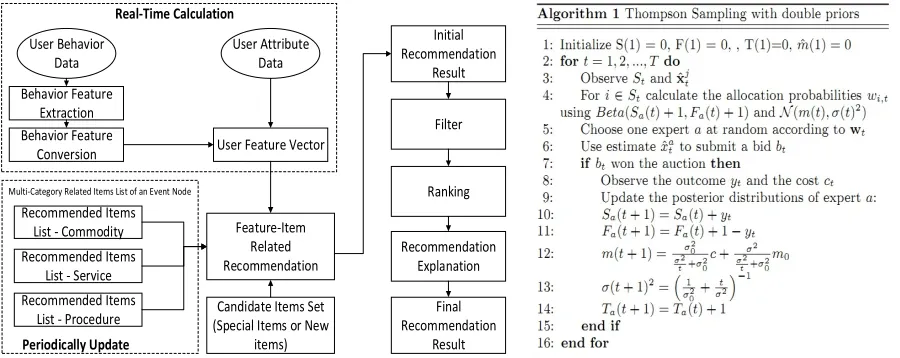
Fig. 2 shows the data processing within a recommendation task: Real-time calculation of user behavior data and user attribute data to construct user feature vectors; Update the recommended items list periodically; Construct user-item related matrix and get the initial recommended results; Merge and sort the initial result with a certain weight or priority, and then return final result.
System-Cold-Start Problem
Compared with the common e-commerce, news and other websites, PSNPs have some traits. We can start from these unique points to further consider the solution of system-cold-start problem:
a. The items provided by PSNP are usually applied to a specific field or industry and with strong professionalism. And the item correlation table can be rapidly established by introducing expert knowledge, industry basic specification information and business process specification information.
b. The establishment of PSNP is usually to meet the inevitable demand for the development of information construction, these industries already have long-term accumulation of resources. We can collect a large amount of high-quality data from the relevant institutions in the industry for analyzing user characteristics.
Specific steps are as follows:
Step 1: Collate long-term accumulated business data, extract the records of current user and analyze his identity attributes.
Step 2: Introduce into industry knowledge. For example, there is a one-to-many correspondence between the body part and the disease in the medical field. This mapping relationship is introduced as the initialization recommendation basis of the intelligent diagnosis process.
Step 4: Construct the initial user-item correlation matrix by integrating the user feature matrix obtained in the first three steps and the item feature matrix already calculated in the platform.
Step 5: Use the Thompson sampling in the bandit algorithm set to correct the user-item correlation matrix so as to improve the accuracy of the recommendation. The pseudo-code of the algorithm [5] is as Alrotithm 1 shows.
BPORE Model
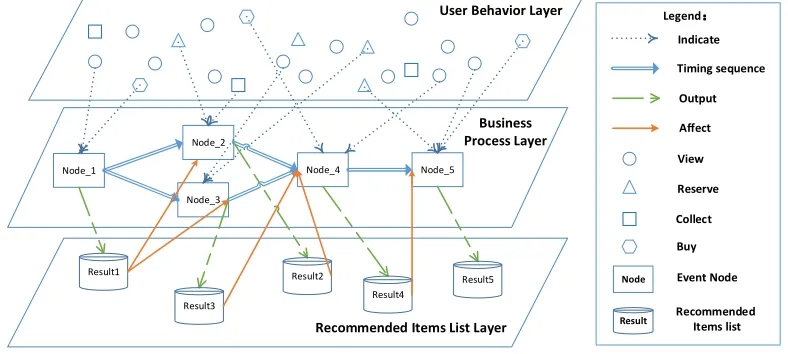
PSNP usually contains many business process lines, and the recommendations for these business process lines involve three main elements: “User Behavior”, “Event-Node” and “Recommended Items List”. “User Behavior” refers to the operation of user interaction with the system, including browsing, clicking, marking and other acts; “Event-Node” refers to each event in the business process line. What needs to be emphasized is that there is an insurmountable time sequence between two
event nodes; “Recommended Items List” is the recommended relevant items of one “Event-Node”,
and the user is in which node determined by the system.
Node_1
Node_2
Node_3
Node_4 Node_5
Business Process Layer User Behavior Layer
Recommended Items List Layer
Result1
Result3
Result2
Result4
Result5
Legend::::
Indicate
Timing sequence
Output
Affect
Node
View
Reserve
Collect
Buy
Event Node
Result Recommended
[image:4.612.108.502.257.434.2]Items list
Figure 3. BPORE model.
Fig. 3 shows the BPORE model in three layers: “User Behavior Layer”, “Business Process Layer”
and “Recommended Items List Layer”. In “User Behavior Layer”, we use different legends to represent different kinds of user behavior (including view, reserve, collect, buy, etc.); “Business Process Layer” describes the business process with a directed graph of event nodes; “Recommended Items List Layer” contains recommended results at all nodes which are dynamically changing.
Traditional recommendation engine is usually composed of different recommendation strategies in parallel or in weight-added. However, in BPORE model: because the relevant items need to be
recommended at each “Event-Node” of a business process, each node has an appropriate
recommendation strategy to support. In the context of business process, the relationship between these recommendation strategies is a one-way impact relationship corresponding to the inter-nodes’ timing relationship. That means, feedback on the recommended results at one node will be part of the next node’s recommendation strategy’s input. The interplay between the three layers includes the following:
“User Behavior Layer” to “Business Process Layer”:
(1) Each user behavior has its implicit meaning, and the accumulation of behaviors in a short term will lead to the occurrence of a certain “Event-Node”;
“Business Process Layer” to “Recommended Items List Layer”: Each “Event-Node” of a business process is supported by a corresponding recommendation strategy for calculating recommended results which are output to “Recommended Items List Layer”.
“Recommended Items List Layer” to “Business Process Layer”: The timing relationship of business process cannot be ignored. Users’ feedback to recommended result of a certain
“Event-Node”, whether adopted or refused, directly affects the recommended result at the follow-up nodes.
Application and Evaluation
Application Background
The construction of 101 National Funeral Public Service Network Platform (101 NFPSNP) is a concrete measure taken by the Ministry of Civil Affairs to implement the funeral reform proposals and promote the information technology project. According to the project requirements proposed by the Ministry of civil affairs 101, the platform provides one-stop service for users and relevant institutions of the funeral industry, consisting of five subsystems: “Portal”, “Funeral Policy and Culture”, “Science and Technology”, “News” and “Online-sacrifice”.
The current main task is to design the recommendation system for the main business scene in this platform, which can assist users to plan and process the whole “Funeral Process”.
The “Funeral Process” mainly includes the following key steps: issuing a death certificate, cancelling account, contacting funeral parlour, transporting body, cremation farewell, keeping corpse, body cosmetic surgery, ashes collection and burial, online-sacrifice. Each event node in this process switches the recommendation strategy to provide recommendations of organizations, products or services.
Solution to System-Cold-Start Problem
Due to the low purchasing frequency of funeral supplies and the poor correlation between items' attributes and users' attributes (user usually purchased for the deceased), the universal solutions are not applicable in this scenario. Therefore, a suitable system-cold-start solution should be formulated from the business scenario:
Step 1: Integrate “Death Population Data”. According to the data of the death population in the past decades compiled by the Ministry of civil affairs of each province,extract the “Undertaker of Funeral Business” to match the current user. Collect relevant records of the current user and extract the user identity characteristics therefrom.
Take the user whose user ID is “BRZ370284” as an example, to obtain the funeral business he has handled in Table 1:
Table 1. Handled business records of user (BRZ370284)
People ID Name ID Number Org Name Create Time
3702000007 Mi Chen 370223xxxxxxxx5136 Qingdao Jiaonan Funeral Parlour 2015-06-29 3702000026 Xun Guo 500224xxxxxxxx8251 Qingdao Jiaonan Funeral Parlour 2015-07-23
Table 2. User (BRZ370284)’s behaviors in “Funeral Policy and Culture” and “Online-sacrifice”
Op ID User ID Op Time Op Type Op-Con Type Op Con
5467885 BRZ370284 2017.05.22
12:34:45 view News
The implementation of funeral Huimin policy in Qingdao 5467898 BRZ370284 2017.05.22
12:37:22 view Book
Guiding Opinions on the Full Implementation of Huimin
Funeral Policy 5467913 BRZ370284 2017.05.22
12:41:06 view Memory Topic Remember Grandpa
Step 2: Introduce industry knowledge. As different regions and ethnic groups have different funeral culture, introduce region-custom label system to determine the user's tendency on funeral culture.
Step 3: Dealing with user behavior data which previously precipitated in other subsystems. As shown in Table 2, we found the user concerned more about the implementation of Huimin Policy. So the services and products launched by Huimin Policy should be listed in the top of the recommended result;
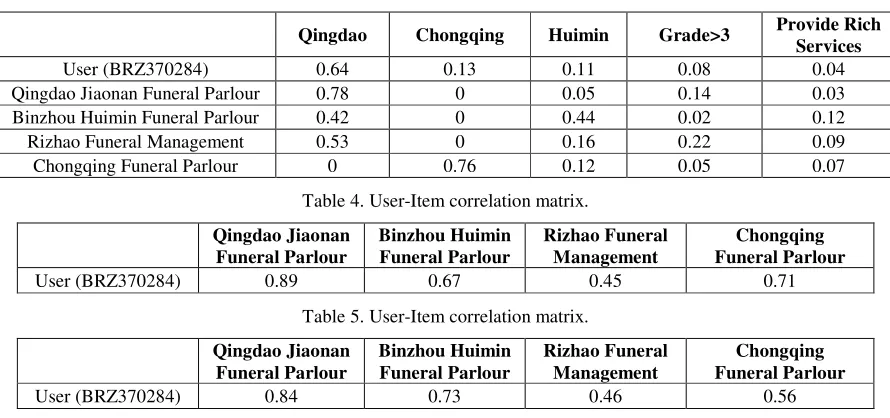
[image:6.612.83.528.336.545.2]Step 4: Construct the initial user-item correlation(≤1) matrix, take the example of recommending funeral parlours to the user, initial user-item correlation matrix’s construction in Table 3 and Table 4. Step 5: Use the Thompson sampling algorithm set to correct the user-item correlation matrix and the results are shown in Table 5.
Table 3. Label vectors of user and some items.
Qingdao Chongqing Huimin Grade>3 Provide Rich Services
User (BRZ370284) 0.64 0.13 0.11 0.08 0.04
Qingdao Jiaonan Funeral Parlour 0.78 0 0.05 0.14 0.03 Binzhou Huimin Funeral Parlour 0.42 0 0.44 0.02 0.12 Rizhao Funeral Management 0.53 0 0.16 0.22 0.09 Chongqing Funeral Parlour 0 0.76 0.12 0.05 0.07
Table 4. User-Item correlation matrix.
Qingdao Jiaonan Funeral Parlour
Binzhou Huimin Funeral Parlour
Rizhao Funeral Management
Chongqing Funeral Parlour
User (BRZ370284) 0.89 0.67 0.45 0.71
Table 5. User-Item correlation matrix.
Qingdao Jiaonan Funeral Parlour
Binzhou Huimin Funeral Parlour
Rizhao Funeral Management
Chongqing Funeral Parlour
User (BRZ370284) 0.84 0.73 0.46 0.56
Application of BPORE Model
Select “Contacting Funeral Parlour” and “Transporting Body” these two consecutive nodes in the
“Funeral Process” as the example to describe, the following is the design of two event nodes’ recommendation strategies.
The Recommendation Strategy of “Contacting Funeral Parlour”. Consider from the following
points of view:
a. Location. The principle of proximity: the recommended location should be close to the dead’s location or the hospital, in order to facilitate the memorial meeting participants (especially the old people).
The location is the most important factor. In order to obtain the candidate funeral parlors, we need to predict the location. We can consider this problem from the following aspects:
(4) Extract the location related info from the history of the user’s searching & browsing. b. The size of the funeral parlor and the richness of the services.
When working in cold start environment, we adopt the item content based recommendation algorithm to rating the candidates, and ranking them according to the rating level and the richness of the services as the result.
c. The credit level and the recommendation level of the funeral parlor.
We use the user behavior data and define the generalized user rating of the institutes (giving each behavior a different weight and recalculating). We continuously update the users-products related matrix, obtaining the recommendation result using the Top N of the itemKNN algorithm [7].
The Recommendation Strategy of “Transporting Body”. Consider from the following points of
view:
a. Location. The “Transporting Body” service has two types: transport to local and transport back home. To ensure the timeliness, we will consider local service a little bit more in both cases.
The “Transporting Body” services’ destination are usually funeral parlor. So the recommendation result mainly influenced by the user chose result in the last node.
b. Formal service. Avoid the “Illegal Car” reported by news.
We can choose Most-Popular algorithm to recommend high-score or popular services which in the same region with the funeral parlor to users.
Dynamically Changing Recommendations. Continue the case of the previous section,
recommend the following institutions for users at the “Contacting Funeral Parlour”: “Qingdao Jiaonan Funeral Parlour”, “Binzhou Huimin Funeral Parlour”, “Rizhao Funeral Management”, “Chongqing Funeral Parlour”; The list of services recommended for users at “Transporting Body” is consist of five services which closer to the above four funeral parlours respectively in each city.
When the user selects “Qingdao Jiaonan Funeral Parlour”, the service list at the “Transporting Body” node will update to those services provided by the funeral service institution of Qingdao city.
Evaluation of Application Effect
Since this BPORS is applied to the online public service platform, the evaluation of recommended results must proceed from the positioning of the platform itself and the business scenario. From the users’ point of view, we need to consider how to better understand them and reduce their frequency of searching content.
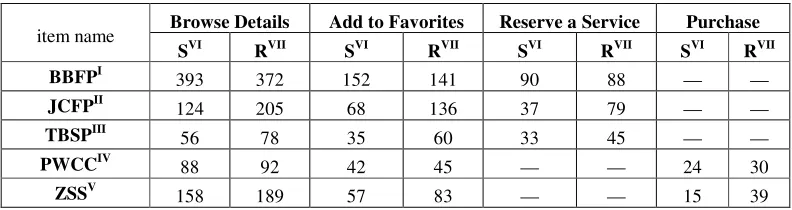
In the 101 NFPSNP, there are two main types of entry for users to view items (organizations, products or services): One is the from the directory page or search results page That is, users browse the directory page or actively type keywords to find content, when access to their demand list, select an item and click to its detail page to view. Another entry is in the “Funeral Process” page, the system provides the user with the recommended list of related items to select at each event node. So comparing the number of times that the same item is viewed from different entrances and the number of operations such as adding to favorites, reserving a service or purchasing a good, can more accurately measure the effect of the recommender system.
Table 6. Number of times of operations by different types and entries on items.
item name Browse Details Add to Favorites Reserve a Service Purchase
SVI RVII SVI RVII SVI RVII SVI RVII
BBFPI 393 372 152 141 90 88 — —
JCFPII 124 205 68 136 37 79 — —
TBSPIII 56 78 35 60 33 45 — —
PWCCIV 88 92 42 45 — — 24 30
ZSSV 158 189 57 83 — — 15 39
IBeijing Babaoshan Funeral Parlor; IIJinan Changqing Funeral Parlor; IIITransport Body Service from Castle Peak Funeral Service Provider; IVPeach Wooden Cinerary Casket; VZhongshan Style Shroud ( Brown ); VIUsers Actively Search; VIIUsers Are Recommended
As can be seen from the above table, for the three items JCFPII, TBSPIII and ZSSV, the number of their details viewed times which by clicking from the recommendation list is obviously more than that by clicking from the search result. In addition, the conversion rate of the collection, reservation and purchase operations by the recommended results is higher than the results obtained by the users’ active search. For BBFPI and PWCCIV, there is little difference between the two types of data sources, the possible reason is that this two items already have a certain reputation and influence. To sum up, the system achieves the purpose of understanding users, reducing the time and frequency of looking for content, and simultaneously improves the items’ conversion rates.
Summary
The main contributions of this paper include:
(1) Designed and built the organizational structure of the Business Process Oriented Recommender System (BPORS). After dividing modules, we defined the responsibilities of each module and the data flow relationship between modules that can ensure the stable operation of BPORS.
(2) Solved the system-cold-start problem. Utilizing the characteristics of the Public Service Network Platform (PSNP), we introduced professional knowledge, information standards and other data resources accumulated by the industry into BPORS to extract deeper features of users. Then, use Thompson sampling algorithm to correct the user-item correlation matrix so as to improve the recommendation accuracy.
(3) Proposed the Business Process Oriented Recommendation Engine (BPORE) model. This model enables the BPORS to recommend relevant items at each node of the business process and dynamically correct the recommended results of subsequent nodes according to users’ feedback on current node.
The BPORS has been applied to 101 National Funeral Public Service Network Platform (101 NFPSNP) , and realized providing public users with multiple types of relevant recommended items at each node in “Funeral Process”. It has been proved that BPORS can better understand user and reduce user's time spent on searching content, which achieved the purpose of improving user experience.
Reference
[1] Resnick P, Varian H R. Recommender systems [M]. ACM, 1997.
[2] Schafer J B, Konstan J, Riedl J. Recommender systems in e-commerce[C]// Proceedings of the 1st ACM conference on Electronic commerce. ACM, 1999:158-166.
[3] Phelan O, Mccarthy K, Smyth B. Using twitter to recommend real-time topical news[C]// ACM Conference on Recommender Systems. ACM, 2009:385-388.
[5] Dasdan A, Dasdan A, Dasdan A. Real-Time Bid Prediction using Thompson Sampling-Based Expert Selection[C]// ACM SIGKDD International Conference on Knowledge Discovery and Data Mining. ACM, 2015:1869-1878.
[6] Sarwar B, Karypis G, Konstan J, et al. Item-based collaborative filtering recommendation algorithms[C]//International Conference on World Wide Web. ACM, 2001:285-295.
[7] Jenatton R, Roux N L, Bordes A, et al. A latent factor model for highly multi-relational data[C]// International Conference on Neural Information Processing Systems. Curran Associates Inc. 2012:3167-3175.
[8] Blei D M, Ng A Y, Jordan M I. Latent dirichlet allocation[J]. Journal of Machine Learning Research, 2008, 3:993-1022.