2016 International Conference on Mathematical, Computational and Statistical Sciences and Engineering (MCSSE 2016) ISBN: 978-1-60595-396-0
The Modeling and Analysis for the Large-Scale Modular Energy Storage
Systems Based on Complex Network
Ji-zhong CHEN
1,*, Guo-liang WU
2, Ai-kui LI
3, Juan HU
1, Kun-yang WANG
1,
Na LIU
3and Xu-shen YAN
11
China Electric Power Research Institute, Haidian District 100192, Beijing China
2
Heilongjiang Electric Power Research Institute, Harbin 150036, Heilongjiang Province, China
3
Wuhan Nari Limited Liability Company of State Grid Electric Power Research Institute, Wuhan Hubei 430074, China
*Corresponding author
Keywords: Complex networks, Energy storage systems, Network-architecture model.
Abstract. The large-scale modular energy storage systems (MESS) technology is one of the key
technologies in relieving power contradictions and achieving the sustainable energy development. An accurate simulation model, which can capture the complicated and dynamic configuration characteristic of MESS, is very crucial for analyzing the performance of MESS with the architecture properties. In this paper, we have explored bipartite network method in complex networks to construct a network-architecture model of MESS. The coupling relationship between the electrical characteristics (voltage, current and power) and network characteristics (the network diameter, the degree of output terminals) was established. The structure coupling coefficient are presented to analysis the evolution and extension of MESS. Accordingly, the network-architecture model of MESS provides effective simulation analysis method for the plan and optimization of MESS.
Introduction
The large-scale modular energy storage systems (MESS) technology, that can be used to improve grid operation performance, efficiency and reliability, to increase asset utilization and renewable energy access and so on, is one of the key technologies in relieving power supply and demand contradictions and achieving the sustainable energy development [1,2].
While such large systems are able to provide powerful energy supply, they also introduce new challenges, among which, the performance of series-parallel-connected MESS is not so good as that of single battery. As an energy storage device, MESS meets the needs of electric power system in practical applications with enormous number of series-parallel cells. The performance of MESS not only depends on the performance of single cell battery, but also on the series-parallel connection mode of MESS topology. The temperature distributions and cooling capabilities of series cells directly result in the decline in the capacity of battery module [3,4]. The current imbalance of parallel cells get worse in the end of charge and discharge process [5,6]. Besides analyzing the influencing factors of MESS performance, there yet exists another open challenge in configuration flexibility, referred as the adaptive system reconfiguration, which is to optimally determine battery system configurations in accordance with real-time load requirements. The adaptive reconfiguration not only avoids the low efficiency issue of the traditional regulator-based approaches, but also increases the system robustness in that failed batteries can be by-passed without significantly degrading the system performance[7,8]. Motivated by this, an accurate simulation model, which can capture the complicated and dynamic configuration characteristic of MESS, is very crucial for analyzing, predicting and optimizing the performance of MESS with architecture properties.
be used to accurately characterize the complex electrical-chemical process by differential equations. However, physical models require intensive computations to solve the interdependent partial differential equations. Analytical models is used to characterize the battery performance with accurate and simple approximate equivalent mathematical formulas, but they ignore circuit features such as voltage and internal resistance, making them infeasible for multi-cell battery design and analysis as well as circuit simulation. In circuit-based models, battery nonlinear circuit behaviors can be emulated by using capacitors, voltage and current resources, and resistors from the circuit analysis point of view, which can be easily implemented in electronic design automation (EDA) tools. However, the above three simulation model are inappropriate for analyzing the performance of MESS with architecture properties.
This paper presents a network-architecture model to analyze the performance of MESS. The model takes cells and connection points into account. This model adopt the bipartite network method in complex networks, which is important since the existence of the isomorphism problem of the circuit. In addition, the proposed model builds a very useful "bridge" between architecture properties and electric parameters. Starting from this network-architecture model, we present a method for predicting the local evolution and system extension of the MESS under variable load conditions. The proposed model is provides an efficient means for reference to the assessment and optimization on performance of MESS from network-architecture aspect.
The paper is organized as follows. In Section II, the model of network-architecture MESS which is first promoted in this paper and network characteristics is described. The analysis of evolution and extension of MESS are presented in Section III. Finally, conclusions are given in Section IV.
Model Description
The objective of this paper is to construct a high-level model to analyze the influencing factors of MESS performance and configuration flexibility of MESS in terms of the series and parallel architecture of cells.
Modeling the Network-Architecture of MESS
We propose an abstracted graph model for MESS to facilitate in analyzing its performance. The bipartite network method of complex networks is taken to construct a network-architecture model in the way that:
i. the model defines two different types of Nodes : cells and connection points;
ii. the edge represents the configuration of the MESS, i.e., how the cells can be connected; iii. two connection points nodes n+ and n- are represented the two output terminals;
iv. the serial connection represents that the cell nodes and connection point nodes are linked in sequence;
v. the parallel connection represents that two edges of cell nodes are incident to the same pair of connection point nodes;
vi. the same kind of nodes do not exist edge.
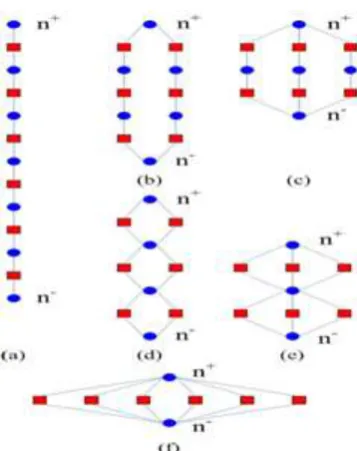
Figure 1 illustrates an example of the entire set of bipartite network graph model of six cell nodes.
mSnP represents a model with m cell nodes in series, and then n modules in parallel; nPmS
represents the model with n cell nodes in parallel, and then m modules in series[10]. For example, 3S2P represents 3 cells in series as a module, and then 2 modules in parallel as a MESS, as shown in Figure 1(b).
Figure 1. Bipartite network model of 6 nodes (a)6S1P, (b)3S2P, (c)2S3P, (d)2P3S, (e)3P2S, (f)6P1S
■cell node, ●connection node.
Network Characteristics of Model
The network characteristics of the bipartite network model are calculated with Pajek software, which is the basic quantities used to describe the architecture.
Network Diameter/Voltage. The shortest path lengths dij of a network is the length of the
geodesic from node i to node j. The maximum value of dij is called the diameter D of the network. The shortest path lengths between n+ and n- is the diameter D, as shown in Figure 1. The network diameter is corresponding to the voltage grade Vs of MESS.
Vs = D/2×Vcell (1) where Vcell is the voltage of cell.
Degree/Current. The degree (or connectivity) ki of a node i is the number of edges incident with
the node. The degree of output terminals kn is corresponding to the current grade Is of MESS.
Is = kn × Icell (2) where Icell is the current of cell.
Diameter and Degree/Power. So, the power rate Ps of MESS is:
Ps =(D×kn)/2×Icell×Vcell=(D×kn)/2×Pcell (3) where Pcell is the power rate of cell.
Analysis of MESS
Evolution Analysis
Series or parallel module as a set of physical connection, work together to complete a relatively independent function cell group, the node cell has single coupling way: series or parallel connection. The structure coupling coefficient of MESS is defined as the ratio of all degree of the series or parallel module to the degree of series-parallel module. Series structure coupling coefficient of mSnP is
ηs-c=Ns-c/Nsp (4) where Ns-c=kn(D-2), Nsp=kn(D+kn-3).
Parallel structure coupling coefficient of nPmS is
ηp-c=Np-c/Nsp (5) where Np-c= kn(kn-1)(D-2)/2, Nps=kn(kn-1)(D-2)=2+kn2(D-2).
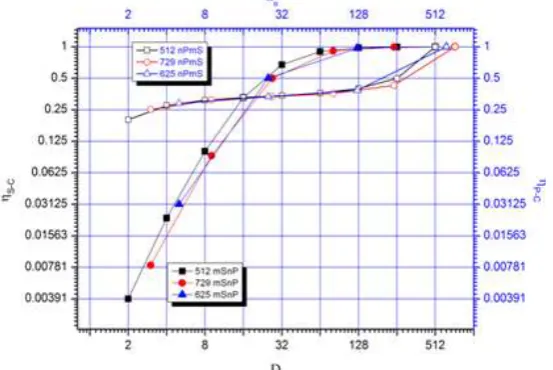
[image:4.595.160.437.350.535.2]The distribution of ηs-c and ηp-c of mSnP and nPmS with 512, 729 and 625 cells are shown in Figure 2. In mSnP, ηs-c with the diameter D increase significantly higher. That means the relative weights of series structure has risen dramatically. The temperature distributions and cooling capabilities of series cells increases the undesirable effects to the performance of MESS. In nPmS, ηp-c growth trend is relatively flat with the degree kn of output terminals, that is, the network of MESS remains relatively stable.
Figure 2. Distribution of the coupling coefficient of the modular ηs-c and ηp-c.
Extension Analysis
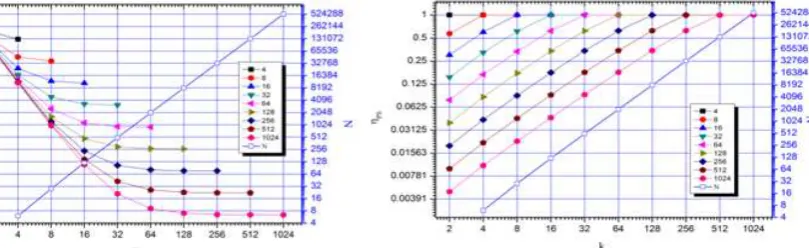
The system coupling coefficient of MESS is defined as the ratio of all degree of the system module to the degree of corresponding global coupled network. Series-parallel system coupling coefficient of mSnP is
ηsp=Nsp/N (6) Parallel-series system coupling coefficient of nPmS is
ηps=Nps/N (7) where N=kn(D-1)(kn(D-1)-1)/2.
Figure 3. Distribution of the coupling coefficient of the system ηsp.
Figure 4. Distribution of the coupling coefficient of the system ηps.
Conclusions
In this paper, we have explored bipartite network method in complex networks to construct a network-architecture model of MESS. The bipartite network model captures all the potential system configurations, and deal with the isomorphism problem of the circuit system. The coupling relationship between the electrical characteristics (voltage, current and power) and network characteristics (the network diameter, the degree of output terminals) was established. We present the structure coupling coefficient to analysis the evolution and extension of MESS. In evolution, ηp-c growth trend is relatively flat with the degree kn of output terminals, that is, the network of MESS remains relatively stable. In evolution, the network of nPmS have good connectivity and robustness. Accordingly, the network-architecture model of MESS provides effective simulation analysis method for the plan and optimization of MESS. In the future, we will investigate the weighted network model to study reliability of MESS.
Acknowledgement
This work was supported by the National Natural Science Foundation of China (51377149), and State Grid Corporation of science and technology projects (DG71-16-007), (WNZ161-0025).
References
[1] Rao Cheng-Cheng, Wang Hai-Yun, Wang Wei-qing, et al. Enhancement of the stable operation ability of large-scale wind power system based on the VSC-HVDC embedded in energy storage apparatus [J]. Power System Protection and Control, 2014, 42(4): 1-7.
[2] Yang Tian, Liu Xiaoming, Wu Qi, et al. Research on the Effect of Energy Storage Station on Assortative Mixing in the Power Grid [J]. Transactions of China Electrotechnical Society, 2015, 30(13):63-68.
[3] Zhang Weige, Shi Wei, Zhang Yanru, et al. Numerical Simulation Technique of Series-Parallel Power Lithium Ion Battery[J]. Power System Technology, 2012, 36(10): 70-75.
[4] Pinson M B, Bazant M Z. Theory of SEI formation in rechargeable batteries: capacity fade, accelerated aging and lifetime prediction[J]. Journal of the Electrochemical Society, 2013, 160(2): A243-A250.
[6] Miyatake S, Susuki Y, Hikihara T, et al. Discharge characteristics of multicell lithium-ion battery with nonuniform cells, Journal of Power Sources, 241:6 (2013),736-743.
[7] Steinhorst S, Shao Z, Chakraborty S, et al. Distributed reconfigurable Battery System Management Architectures, Asia and South Pacific Design Automation Conference, IEEE, (2016), 429-434.
[8] He L, Kong L, Lin S, et al. Reconfiguration-Assisted Charging in Large-Scale Lithium-Ion Battery Systems, International Conference on Cyber-Physical Systems, ACM/IEEE, (2014), 60-71.
[9] P. Rong and M. Pedram, An Analytical Model for Predicting the Remaining Battery Capacity of Lithium-Ion Batteries, IEEE Journal Very Large Scale Integrated, 14 (2006),441-451.
[10] Zhao Hai, Cai Wei, Wang Jinfa, et al. An Architecture Design and Topological Model of InterGrid, Transactions of China Electrotechnical Society, 30:6 (2015), 30-36.
[11] H.Tan, M.Peng. Minimization of ambiguity in parametric fault diagnosis of analog circuits Acomplex network approach, Applied Mathematics and Computation, 219:1 (2012),408-415.