Fast algorithm for Morphological Filters
This article has been downloaded from IOPscience. Please scroll down to see the full text article.
2011 J. Phys.: Conf. Ser. 311 012001
(http://iopscience.iop.org/1742-6596/311/1/012001)
Download details:
IP Address: 161.112.232.223
The article was downloaded on 24/08/2011 at 09:37
Please note that terms and conditions apply.
Fast algorithm for Morphological Filters
Shan Lou, Xiangqian Jiang, Paul J. Scott
Centre for Precision Technologies, University of Huddersfield, Huddersfield HD1 3DH, UK
E-mail: [email protected] (Xiangqian Jiang)
Abstract. In surface metrology, morphological filters, which evolved from the envelope filtering system (E-system) work well for functional prediction of surface finish in the analysis of surfaces in contact. The naive algorithms are time consuming, especially for areal data, and not generally adopted in real practice. A fast algorithm is proposed based on the alpha shape. The hull obtained by rolling the alpha ball is equivalent to the morphological opening/closing in theory. The algorithm depends on Delaunay triangulation with time complexity O(nlogn). In comparison to the naive algorithms it generates the opening and closing envelope without combining dilation and erosion. Edge distortion is corrected by reflective padding for open profiles/surfaces. Spikes in the sample data are detected and points interpolated to prevent singularities. The proposed algorithm works well both for morphological profile and area filters. Examples are presented to demonstrate the validity and superiority on efficiency of this algorithm over the naive algorithm.
1. Introduction
Surface metrology is the measurement of small scale geometrical features on surfaces. It has profound influences on manufacturing quality as it plays two important roles: on the hand it helps to control the manufacturing process; On the other hand it helps functional prediction. In surface metrology, the extraction and separation of multi-scale features mainly depend on filtering techniques. Among various filtering techniques, morphological filter is most suitable for functional prediction as its logic is more related with the geometrical properties of surfaces.
The envelope filtering system, called the E-System, is archived by rolling a ball (resp. disk) over the surface (resp. profile) [1]. By introducing morphological operations into the E-system [2], morphological filters emerged. They are carried out by performing morphological operations (dilation, erosion, opening, and closing) on the input profile/surface with the circular or flat structuring element, usually circular. Over the decade morphological filters have found many practical applications, for instance, the approximation of the conformable interface of two mating surface [3], the analysis of liner surface comprised of deep valleys and plateau roughness [4], etc. Although morphological filters could give better results in functional prediction and be regarded as the complement of mean-line filters, they are not generally adopted in real practice. One of the most important reasons is it is time consuming, especially for areal data. A naive algorithm was described in ISO 16610 [5]. It places the structuring element on each sample point and calculates the extreme points. The naive algorithm runs slow, especially for large surface and large structuring element. Meanwhile it combines the dilation and erosion to generate the opening and closing, doubling the processing time. In addition it is limited to the uniform sampled profile/surface. This paper sets out to develop a faster and more general
13th International Conference on Metrology and Properties of Engineering Surfaces IOP Publishing
algorithm for morphological filters. The algorithm employs the alpha shape as the basis of computation.
2. Introduction to Alpha Shape
The alpha shape was introduced by Edulsbrunner in the 1980’s [6]. The alpha hull is obtained by rolling the ball with radiusα over the point set. Straightening the round faces of the alpha hull by line segments for arcs and triangles for caps generates the alpha shape. The computation of the alpha shape is based on the Delaunay triangulation. For a point set S, the boundary of its alpha shape is equivalent to the boundary of the alpha complex Cα, which is the collection of the simplices in the Delaunay triangulation satisfying two properties: (i) the radius of the smallest circumsphere of the simplex is smaller than αand is empty; (ii) the simplex is a face of super simplex in the alpha complex.
Worrings and Smedulers [7] proved that the alpha hull is equivalent to the closing of the point set X
with a generalized ball of radius -1/α and that from the duality of the closing and the opening the alpha hull is the complement of the opening of Xc (complement of X) with the same ball as the structuring element. This crucial relationship provides a feasible method to compute morphological filters by the alpha hull.
3. Fast Algorithm for Morphological Filters
3.1. End Distortion Correction
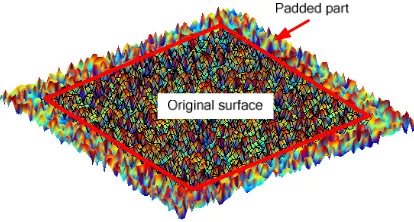
[image:3.595.196.403.481.592.2]End distortion is common for the filtration of open profiles/surfaces. Morphological filters are no exception. For mean-line filters, a common solution is to add sufficient zeros to the beginning and end of the profile/surface, referred as zero-padding. Zero-padding is not suitable for morphological filters because the padded part of the surface should not be geometrically viewed as a flat plane with zero height. Instead it should reflect the geometrical features of the surface edge. To achieve this, the padding of the surface is conducted by reflecting the counterpart area of the surface in the range of the ball radius starting from the surface margin. Figure 1 demonstrates the reflective padding of the surface.
Figure 1. Padding the surface by refection
3.2. Spikes Detection and Points Interpolation
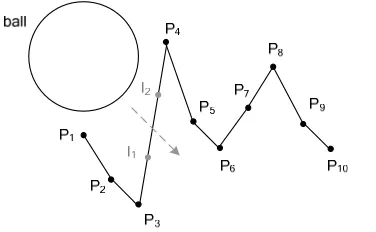
The sample data is a discrete representation of the measured surface. It may happen that sharp spikes exist in the sample data. Sometimes the space between the peak point and pit point is a lot larger than the rolling ball which will run into the interior of the surface. It is not allowed in reality because the real surface is physically continuous and won’t allow the ball to center. Therefore sharp spikes should be detected and more points linearly interpolated on the ridge of the spike to prevent the ball from passing through. Figure 2 illustrates the whole process. P1, P2, …, P10 are the sample points from the
original profile. P3P4P5form a local peak. P3 and P4 are spaced far from each other so that the ball will
roll into the interior. In this case additional points I1, I2 (and more if needed) are linearly interpolated
13th International Conference on Metrology and Properties of Engineering Surfaces IOP Publishing
Journal of Physics: Conference Series311(2011) 012001 doi:10.1088/1742-6596/311/1/012001
to reduce the gap between P3 and P4. For surfaces, they can degenerate to profiles if they are
considered as the composition of parallel profile sections. There is a trivial difference between the closing envelope and the opening envelope in their spike detection. For the closing envelope, it suffices to detect peak spikes only in that the closing envelope is only determined by peaks, and valleys can be ignored. As opposed for the opening envelopes it is enough to search valleys because it is only affected by valleys.
Figure 2. Spikes detection and points interpolation in sample data.
3.3. Boundary Extraction
Following the reflective padding, spikes detection and point interpolation, the next step is to triangulate the sample points by the Delaunay triangulation and subsequently extract the boundaries of the alpha shape ∂Sα, i.e. the boundaries of the alpha complex ∂Cα. The three-dimensional Delaunay triangulation results in a series of tetrahedrons, which could be categorized into two groups: tetrahedrons Tp whose circumscribe sphere radius is smaller than the radius of the rolling ball α, and
tetrahedrons Tnp whose circumscribe sphere radius is equal or larger than α. By the definition of the
alpha complex, Tp is contained in Cα.
Tp consists of the interior triangles σint and the triangles σregthat bound Tp. σreg, called the regular
boundaries, are a part of ∂Cα and they bound super simplices (i.e. tetrahedrons) in Cα. Tnp is comprised
of three components: the triangles σext that are out of Cα, part of σreg that are shared by both Tp and Tnp, and the triangles σsingthat are the other part of ∂Cα. σsing, called the singular boundaries, differ from σreg
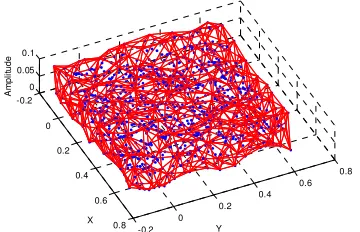
in that they do not bound super simplices in Cα. σsing satisfy two conditions: (i) the radius of its smallest circumsphere is smaller than α; (ii) its smallest circumsphere is empty. The regular boundaries σreg and the singular boundaries σsing make up all the boundaries of Cα. Figure 3 illustrates the boundary triangles of the alpha shape of sample points on a surface.
3.4. Envelope Calculation
The final step is to compute the envelope points. For each sample point, there is a corresponding point on the envelope locating at the same sample position. These points form a discrete representation of the envelope. To obtain the envelope point, an infinite vertical line is placed at the sample position to intersect with the covering boundary triangles (See figure 4). For the closing envelope, find the triangle with the highest intersection point. Then the envelope point can be obtained by intersecting the vertical line with the circumsphere of this triangle. The lower intersection point is the envelope point. Likewise, the envelope point for the opening envelope can be calculated in similar way.
13th International Conference on Metrology and Properties of Engineering Surfaces IOP Publishing
[image:4.595.201.389.213.329.2]-0.2
0
0.2
0.4
0.6
0.8 -0.2 0 0.2 0.4 0.6 0.8 0 0.05 0.1 Y X A m p li tu d e α
Figure 3. Boundary triangles of the alpha shape of measured.
Figure 4. Calculation of the envelope point
4. Examples
Examples of the closing envelope filter are shown in figure 5-8. Figure 5 presents a surface with 250*250 sample points. The total sampling area is 1.25*1.25 mm with sampling internal 5 µm. The structuring element is a 5 mm ball. Figure 6 illustrates the closing envelope superimposed over the surface. Figure 7 shows a sectional profile of this surface, its corresponding closing profile envelope is presented in figure 8. Experiment data shows the proposed algorithm is more efficient than the naive algorithm when processing with large areal data and large structuring elements.
Figure 5. Surface: 250*250 sample points.
Figure 6. Closing envelope superimposed over surface.
0 0.2 0.4 0.6 0.8 1 1.2 1.4
-4 -2 0 2 4 6x 10
-3 Distance (mm) A m p li tu d e ( m m )
0 0.2 0.4 0.6 0.8 1 1.2 1.4
-4 -2 0 2 4 6x 10
-3 Distance (mm) A m p li tu d e ( m m )
Figure 6. Profile: 250 sample points.
Figure 7. Closing envelope superimposed over profile.
5. Conclusion
The relationship that the alpha hull of the point set is theoretically identical to its closing/opening provides a feasible approach for computing morphological filters with the circular structuring elements. The proposed algorithm employs the alpha shape as the basis of computation. The algorithm depends on Delaunay triangulation with time complexity O(nlogn). It directly yields the closing/opening envelope without combining the dilation and erosion operations. Prior to calculating
13th International Conference on Metrology and Properties of Engineering Surfaces IOP Publishing
Journal of Physics: Conference Series311(2011) 012001 doi:10.1088/1742-6596/311/1/012001
[image:5.595.378.488.110.245.2] [image:5.595.95.275.123.239.2] [image:5.595.136.461.411.672.2]the alpha shape, special processes are conducted on the sample data to correct end distortion and justify the singularities caused by spikes. The proposed algorithm works well for both morphological profile and area filters. It is more efficient than the naive algorithm in processing speed for large areal data and large structuring element. Moreover, the proposed algorithm works for non-uniform sampled profile/surface, being more general than the naive algorithm. Another notable merit of the proposed algorithm is that the boundary triangulation data can be reused for multiple attempts of the ball radius. It could save a great deal of computing time considering in real practice a multitude of trails may be made for an appropriate ball radius.
Acknowledgements
The authors would like to thank the University of Huddersfield for providing the scholarship to support this work.
References
[1] Von Weingraber H 1956 Zur Definition der Oberflächenrauheit WerkstattstechnikMasch Bass
46
[2] Srinivasan V 1998 Discrete morphological filters for metrology, Proc. 6th ISMQC Symposium on Metrology for Quality Control in Production
[3] Malburg C M 2003 Surface Profile Analysis for Conformable Interfaces Transactions of ASME. 125 624-627
[4] Decenciere E and Jeulin D 2001 Morphological decomposition of the surface topography of an internal combustion engine cylinder to characterize wear Wear249 482-488
[5] ISO 16610-41 2005 Geometrical Product Specification (GPS)-Filtration Part 41: Morphological profile filters Disk and horizontal line-segment filters
[6] Edelsbrunner H and Mucke E P 1994 Three-dimensional alpha shapes ACM Trans. Graph.13 43-72
[7] Worring M and Smelders W M 1994 Shape of arbitrary finite point set in R2 Journal of
Mathematical Image and Vision4 151-170
13th International Conference on Metrology and Properties of Engineering Surfaces IOP Publishing