Citation:
Tipples, J (2018) Increased temporal sensitivity for threat:
A Bayesian generalized linear
mixed modeling approach.
Attention, Perception, & Psychophysics.
ISSN 1943-393X DOI:
https://doi.org/10.3758/s13414-018-01637-9
Link to Leeds Beckett Repository record:
http://eprints.leedsbeckett.ac.uk/5561/
Document Version:
Article
Creative Commons: Attribution 4.0
The aim of the Leeds Beckett Repository is to provide open access to our research, as required by
funder policies and permitted by publishers and copyright law.
The Leeds Beckett repository holds a wide range of publications, each of which has been
checked for copyright and the relevant embargo period has been applied by the Research Services
team.
We operate on a standard take-down policy.
If you are the author or publisher of an output
and you would like it removed from the repository, please
contact us
and we will investigate on a
case-by-case basis.
Increased temporal sensitivity for threat: A Bayesian generalized linear
mixed modeling approach
Jason Tipples1
#The Author(s) 2018
Abstract
People overestimate the duration of threat-related facial expressions, and this effect increases with self-reported fearfulness (Tipples inEmotion, 8,127–131,2008,Emotion, 11,74–80,2011). One explanation (Cheng, Tipples, Narayanan, & Meck in
Timing and Time Perception, 4,99–122,2016) for this effect is that emotion increases the rate at which temporal information accumulates. Here I tested whether increased overestimation for threat-related facial expressions in high fearfulness generalizes to pictures of threatening animals. A further goal was to illustrate the use of Bayesian generalized linear mixed modeling (GLMM) to gain more accurate estimates of temporal performance, including estimates of temporal sensitivity. Participants (N
= 53) completed a temporal bisection task in which they judged the presentation duration for pictures of threatening animals (poised to attack) and nonthreatening animals. People overestimated the duration of threatening animals, and the effect increased with self-reported fearfulness. In support of increased accumulation of pacemaker ticks due to threat, temporal sensitivity was higher for threat than for nonthreat images. Analyses indicated that temporal sensitivity effects may have been absent in previous research because of the method used to calculate the index of temporal sensitivity. The benefits of using Bayesian GLMM are highlighted, and researchers are encouraged to use this method as the first option for analyzing temporal bisection data.
Keywords Temporal processing . Bayesian modeling
When faced with danger, people frequently report changes in their perception of time. In support of such reports, studies have repeatedly shown that people overestimate the duration of emo-tionally arousing images, such as faces of people expressing fear or anger (for reviews, see Droit-Volet,2013; Lake, LaBar, & Meck,2016). In keeping with the idea that this effect is related to emotional experience, studies have shown that the overestimation for threat-related expressions is increased in in-dividuals with high levels of anxiety and self-reported fearful-ness (Bar-Haim, Kerem, Lamy, & Zakay,2010; Tipples,2008, 2011). The novel goal of the present research is to extend my previous research that used faces (Tipples,2008,2011) by es-tablishing whether individual differences in self-reported fear-fulness might also moderate the overestimation effect for threat-related images. Previous studies have examined time es-timation for threat-related images but have not tested for indi-vidual differences in fearfulness. Furthermore, I illustrate an
alternative approach to analyzing temporal bisection data— namely, Bayesian generalized linear mixed modeling (GLMM). A key benefit of this approach is that it uses infor-mation shared across individuals to improve estimates of time perception, including estimates of temporal sensitivity.
A clear role for individual differences in time estimates for fear-related events has been reported in several studies. In one study (Tipples, 2011) that used the temporal bisection task, participants learned to recognize short and long durations in an initial training phase. Then, in a second phase, they were asked to indicate whether angry, fearful, and neutral facial expressions were displayed for a duration that was more sim-ilar to either a standard short or a long duration that they had learned earlier. The Weber ratio and bisection point were cal-culated as indices of temporal performance. The bisection point is the comparison duration giving rise to 50% ofBlong^ responses. Relatively lower bisection point values indicate a perceived lengthening of time. The Weber ratio is an index of timing precision (or sensitivity) and is typically calculated by dividing the difference limen by the bisection point (e.g., Droit-Volet & Wearden, 2002; Ortega & López, 2008; Penney, Yim, & Ng,2014). The difference limen is one half * Jason Tipples
of the difference between the duration corresponding to ap -(Blong^) of 75% and the duration corresponding to a p -(Blong^) of 25%. The results showed that participants overestimated the duration of angry and fearful relative to neutral facial expressions—that is, the bisection point was reached sooner for the angry (M= 955 ms) and fearful (M= 951 ms) faces than for the neutral face (M = 1,021 ms). Moreover, this effect was modulated by individual differences in self-reported fearfulness. Specifically, fearfulness uniquely predicted increases in overestimation for both angry and fear-ful expressions. In keeping with other studies of emotion and time perception (e.g., Droit-Volet, Mermillod, Cocenas-Silva, & Gil,2010), differences in temporal sensitivity indexed by Weber ratio values were not significant.
One explanation for the effects of facial expressions on time perception reported by Tipples (2011) is that emotional arousal increases the rate of a pacemaker mechanism that re-sides within an internal clock. Internal clock models of timing (Gibbon,1977; Gibbon, Church, & Meck,1984; Treisman, 1963; Treisman, Faulkner, Naish, & Brogan,1990) include three key components: (1) a pacemaker that emits units of time (or pulses) at a specific rate, (2) an attention-controlled switch that controls the flow of the pulses, and (3) a counter through which perceived time is calculated on the basis of the total number of counted units. The switch closes when individuals attend to the to-be-stimulus and opens again when the stimu-lus offsets and timing finishes. A prediction of the internal clock model is that the effects of pacemaker speeding will multiply as duration increases—a multiplicative effect. In the temporal bisection task, a multiplicative pattern for emo-tion would be recorded if emoemo-tion leads to (1) a relative over-estimation of time and (2) an increase in the gradient of the slope for duration (Cheng, Tipples, Narayanan, & Meck, 2016). Although Tipples (2011) did report an overestimation effect, the differences in temporal sensitivity were not signif-icant, and more broadly, a multiplicative pattern has not been consistently found for emotionally arousing stimuli, including threat-related expressions (for a review, see Lake et al.,2016). The first goal of the present work was to extend the study by Tipples (2011) by establishing whether the association be-tween individual differences in fearfulness and overestimation of time for threat generalizes to pictures of threatening ani-mals. Other studies (Grommet et al.,2011) have reported an overestimation effect for fear-related animals but have not tested for individual differences in fearfulness. Here I specif-ically selected images that depict threat toward the observer (e.g., a shark with exposed fangs) in an attempt to produce a clear effect of threat on the time estimates.
The second goal of this research was to illustrate the ben-efits of the Bayesian GLMM approach for analyzing temporal bisection data, and in particular, the benefits of Bayesian GLMM for estimating differences in the psychometric slope for duration between threat and neutral conditions. Tutorials
and software for fitting non-Bayesian GLMMs to psycho-physical data can be found in several recent publications (e.g., Knoblauch & Maloney, 2012, chap. 9; Moscatelli, Mezzetti, & Lacquaniti,2012). GLMMs extend the more usu-al approach to modeling temporusu-al bisection data—a generusu-al- general-ized linear model with either a probit or logit link function—to include both information pooled across individuals and re-peated measures from the same individual. Pooling informa-tion across individuals is desirable because it permits shrink-age (Efron & Morris,1977; Stein,1956), whereby the distri-bution of individual parameters (the slope and intercept of the psychometric functions) are pulled toward the group mean relative to the standardBno-pooling^approach, in which in-formation is not shared across individuals.
Pooling information is likely to be particularly useful in stud-ies of emotion and time perception, in which the number of repetitions per cell of the design is typically low (< 10), and consequently, the data are particularly prone to complete separa-tion (i.e., all short durasepara-tions being classified as short and all long durations being classified as long). Without pooling, each psy-chometric function is weighted equally, and consequently, indi-vidual very steep or very shallow psychometric functions can exert undue influence on estimates of the average psychometric function. In support of the use of GLMMs for temporal bisection data specifically, a simulation study (Moscatelli et al., 2012) showed that GLMMs have higher statistical power than the more traditionalBno-pooling^approach (e.g., Tipples,2011), in which individual slopes and intercepts are calculated for everyone sep-arately and then used in a separate statistical analysis.
There are several reasons to use a Bayesian as compared to a non-Bayesian GLMM. First, a Bayesian approach can pro-vide researchers with answers to questions they typically want—the probabilities of specific hypotheses. For example, the conclusion that threat does not affect temporal sensitivity is based on nonsignificantpvalues. However, a nonsignificant
pvalue does not provide support for the null hypothesis, but rather for the probability of these, or more extreme, data under the null,p(D| H0). Bayesian methods are more suited to draw-ing the conclusion that a difference is practically equivalent to zero (or another value). A second benefit of using Bayesian GLMMs, specifically, is that maximum-likelihood estimates of the variance–covariance matrix estimated from frequentist GLMMs are sometimes drawn toward upper or lower bound-ary values (Bolker, n.d.)—in such situations, Bayesian methods avoid boundaries by providing a posterior distribu-tion of values rather than a point estimate (Chung, Rabe-Hesketh, Dorie, Gelman, & Liu,2013).
In summary, the goals were (1) to extend both Tipples (2011) and Grommet et al. (2011) by establishing whether the associa-tion between individual differences in fearfulness and overesti-mation of time for threat generalizes to pictures of threatening animals, and (2) to illustrate the benefits of the Bayesian GLMM approach for analyzing temporal bisection data.
Method
Sample size and power
In previous research (Tipples,2011), I recorded a relatively large zero-order correlation (r= .51) between an index of the overes-timation effect for threat faces (z-score-transformed proportion of
Blong^ responses for threat-related minusz-score-transformed proportion ofBlong^ responses for neutral faces) and reported fearfulness. In a frequentist setting, only 22 participants are need-ed to achieve 80% power (alpha = .05, one-tailneed-ed). Nonetheless, in previous research the correlation dropped tor= .38 after controlling for other covariates, and therefore I planned to sample as many participants as possible (within a single semester) on the condition that I sampled at least 44 participants—sufficient par-ticipants to achieve 80% power (alpha = .05, one-tailed) for an effect size as small asr= .38. The final sample size was 53 participants. The raw data, codebook, and code for the analyses can be found onlinehttps://osf.io/zyax5/.
Participants
Fifty-three undergraduate psychology students (29 female, mean age = 23.92 years,SD= 8.46; 24 male, mean age = 22.31 years,SD= 5.07) from the University of Hull partici-pated in return for a course credit. All had normal or corrected-to-normal vision.
Stimuli and apparatus
In the testing phase, 14 pictures from the IAPS (Lang, Bradley, & Cuthbert,2008) measuring 25.8 cm wide and 19.2 cm high were presented in the center of the computer monitor. Seven of the pictures were selected as dangerous animals, poised to attack (three snakes, one bear, two sharks, and one attacking dog), and seven as neutral animals (gannet, dog, hawk, butterfly, bird, coyote, and cow). The images were rated in separate research (Lang et al.,2008) on 9-point scales designed to measure their affective valence (ranging from
pleasanttounpleasant) and arousal (ranging fromcalmto
excited) experienced when viewing the images. The threat-related animals were rated as being more arousing (M = 6.58) and less pleasant (M= 3.74) than the neutral animals (arousalM= 4.00, valenceM= 6.33). All stimuli were pre-sented on a 17-in. computer monitor (1,280 × 1,080, 60 Hz) connected to a 1-GHz Pentium computer. Stimulus presenta-tion and data collecpresenta-tion were controlled by the E-Prime soft-ware (Schneider, Eschman, & Zuccolotto,2002).
Procedure
All participants completed learning and test phases. In the learning phase, participants were trained to discriminate short
(400-ms) from long (1,600-ms) stimulus durations. On the first eight trials, a pink oval appeared for either a short or a long duration in a fixed sequence (e.g., long–short–long– short–. . .). Participants were told to expect this sequence and to press theBz^orBm^key to indicate whether the oval appeared for a short or a long duration. The response mapping (e.g.,Bz^for short durations andBm^for long durations) was counterbalanced across participants. Following a response, participants were presented with visual feedback lasting 500 ms, for both correct (Byes^) and incorrect (Bno^) decisions. The feedback was followed by a fixed 1,000-ms intertrial interval. In the final stage of the learning phase, the pink oval was presented for a further eight trials in a new random order for each participant. Participants continued to indicate whether the oval appeared for a short or a long stimulus duration and received feedback.
During the test phase, the oval was replaced on each trial by one of the 14 different images, displayed for one of seven dura-tions. Participants were asked to (a) look at the picture and (b) indicate whether the picture appeared for a duration that was closer to either the short or the long duration that they had learned earlier. Feedback was not given during the main test phase. In the test phase, 14 possible trial types were derived from the factorial combination of Duration (7) × Picture Type (2; threat, neutral). Each of the 14 trial types was repeated seven times, leading to the creation of 98 trials for each person. Each trial began with a fixed 800-ms blank interval before the onset of a picture stimulus. A new randomized trial order was created for each participant. Finally, after the main test phase, participants completed the Emotionality, Activity and Sociability Temperament Survey for Adults (EAS; Buss & Plomin,1984) and the State–Trait Anxiety Inventory–Trait Form Trait subscale (Spielberger, Gorsuch, Lushene, Vagg, & Jacobs,1983).
Results
Traditional method
2002; Ortega & López,2008; Penney et al.,2014) and (2) by dividing the DL by the arithmetic mean of the short and long durations (Mioni et al., 2018). The mean Nagelkerke’s pseudo-R-squared values indicated overall satisfactory fits for both the neutral (M= .97,SD= .05) and threat (M= .98,
SD= .01) image conditions.
The mean BP and both WR indices for each participant were analyzed using pairedt tests. Following previous re-search (Grommet et al., 2011) that had also used threat-related images, the estimated BP was reached sooner for threat (BP mean = 954 ms,SD= 181) than for neutral (BP mean = 1,009 ms,SD= 181) images,t(51) =–2.71,p=.009 (95% CI [–95,–14]); that is, participants needed more temporal infor-mation in order to judge a neutral picture as long. For the WR calculated by dividing the DL by the BP, the results showed that for the difference between threat (WR mean = .168,SD= .08) and neutral (WR mean = .195,SD= .17), the effect was not significant,t(51) =–1.29,p=.20 (95% CrI [–0.06, 0.01]). However, analyses of the WR calculated by dividing the DL by the arithmetic mean of the short and long durations (1,000 ms) showed a significantly lower WR for threat (WR mean = .157,SD= .07) than for neutral (WR mean = .187,SD= .09) images,t(51) = -2.44,p = .01 (95% CI [– 0.05, –0.005]). Similarly, the DL was lower for threat (DL mean = 157,SD
= 76.9) than for neutral (DL mean = 187,SD= 98.5) images,
t(51) =–2.48,p=.01 (95% CI [54.14, 5.36]).
In summary, replicating previous research, there was a sig-nificant, large 55-ms leftward shift in the BP, indicating over-estimation for threat as compared to neutral images. Temporal sensitivity increased for threat as compared to neutral images, but only when the index of temporal sensitivity was calculated by dividing the DL by the arithmetic mean, and not when using the more typical method of dividing the DL by the BP. Following previous research, self-reported fearfulness was measured by scores on the Fearfulness subscale of the EAS (Buss & Plomin,1984), and trait anxiety was measured using the State–Trait Anxiety Inventory–Trait Form (STAI-T; Spielberger et al.,1983). Scores on each of the subscales of the EAS and STAI-T are presented in Table1. The mean fearfulness score for the sample (8.98,SD= 3.58) was similar to the mean score (9.28,SD = 3.68) reported in previous research (Tipples,2011). Independentttests with participant sex as the between-subjects variable and each measure shown in Table1as the dependent variable indicated that (1) mean fearfulness scores were higher for female (M= 9.86) than for male (M = 7.92) participants,t(51) = 2.01, p = .049 (95% CrI[0.002, 3.88]), and (2) all other differences were nonsig-nificant (alltvalues < 1.05, allpvalues > .3).
Bayesian GLMM
The data were modeled in a Bayesian GLMM in which the number ofBlong^ responses was modeled as a binomially
distributed random variable with a logistic link function. Modeling was carried out using the brms package (Bürkner, 2017) as an interface between Stan (Carpenter et al.,2017) and R (R Core Team,2018). In the Bayesian approach, plau-sible values of a model parameter—for instance, likely values of the slope representing increased sensitivity due to fear—are proportional to the likelihood of the data (conditioned on the model parameters) multiplied by priors for the parameters. The Bayesian modeling approach uses Markov chain Monte Carlo (MCMC) sampling to estimate a range of probable values for the model parameters. MCMC requires checks for chain convergence. To illustrate convergence, chain conver-gence diagnostics for the Duration × Image interaction effect (for Model 4 described below) can be found in the online supplementary material (https://osf.io/zyax5/). Also in the online supplementary material, I have included a graphical posterior predictive check to assess the adequacy of the main model, as well as the code for the analyses. The data set ("timeDF.csv") is also avaliable (https://osf.io/zyax5/). Weakly informative priors were selected for all model parameters.
Model specification
[image:5.595.306.545.121.256.2]I tested a single model that included the Image Type × Duration × Fearfulness interaction term. The model included varying by-subject intercepts and varying by-subject slopes (for image type and duration), as well as a correlation coeffi-cient between the varying by-subject intercepts and slopes. Variance by items (for each specific image) could not be esti-mated, due to a coding error. In the regression equation, image type (neutral, threat) was entered as a categorical (treatment-coded) input variable, with the neutral image condition serv-ing as the baseline (B0^) and threat serving as the treatment (B1^). The continuous variable duration was mean-centered— Table 1 Individual differences: Means and standard deviations of scores for male and female participants, separately, for each subscale of the Emotionality, Activity and Sociability (EAS) Temperament Survey for Adults (Anger, Distress, Fearfulness, Sociability, Activity), the State– Trait Anxiety Inventory–Trait Form, Trait subscale (STAI-T; Spielberger, Gorsuch, Lushene, Vagg, & Jacobs,1983), and age
Measure Males (N= 24) Females (N= 29)
M SD M SD
EAS–Activity 9.79 3.85 10.04 3.67 EAS–Anger 9.93 3.58 10.33 3.51 EAS–Distress 9.79 3.65 8.79 3.37 EAS–Fearfulness 7.92 3.55 9.86 3.35 EAS–Sociability 12.38 3.32 12.38 3.36
STAI-T 43.24 9.32 43.50 9.59
Age 22.31 5.07 23.92 8.46
that is, 1,000 ms was subtracted from each of the duration conditions—and fearfulness scores were both mean-centered and scaled to two standard deviations (Gelman,2008). Mean-centering facilitates the interpretation of regression coeffi-cients and also improves MCMC sampling efficiency.
As is shown in Fig.1, at mean levels of fearfulness, the estimated slope for duration was steeper for threat-related than for neutral animals,β(Threat × Duration) = 0.0008, 95% CrI [0.0001, 0.0016]. In other words, the model results agree with the analyses reported above (in which I calculated the WR by dividing the DL by the arithmetic mean): Temporal sensitivity increased for threat as compared to neutral images. There was a small decrease in the duration slope for threat images with increases in levels of fearfulness, although the 95% credible interval for this effect included zero,β(Duration × Threat × Fearfulness) =–0.0004 (95% CrI[–0.0016, 0.0008]).
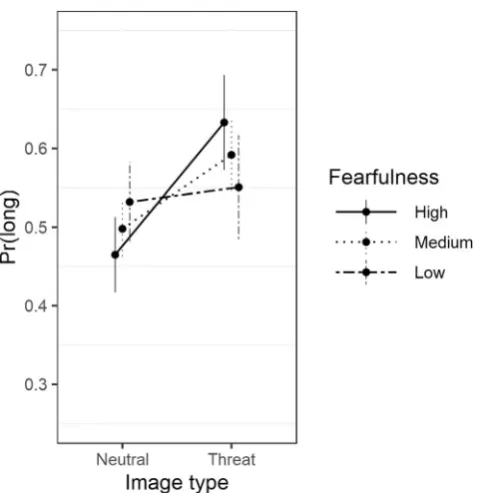
Other results corroborate the findings reported in previous research. RespondingBlong^increased for threat images rel-ative to neutral images,β(Threat) = 0.3898 (95% CrI[0.1495, 0.6368]), and moreover, this effect increased with self-reported fearfulness,β(Threat × Fearfulness) = 0.6213 (95% CrI[0.1522, 1.091]). The latter effect is shown in Fig.2, where it can be seen that at the average duration, the overestimation
effect for threat-related images increased with levels of fear-fulness from oneSDbelow the mean (low fearfulness) to one
SDabove the mean (high fearfulness). Taking the exponent of the log-odds and converting the odds to a probability [p/(1–
p)] helps us understand these results. At mean levels of fear-fulness, the mean of the posterior probability of responding
Blong^at the mean (1,000-ms) duration for the neutral image condition is .49 (BP = 1,001 ms). The 95% credible interval for the latter effect includes .50 [.42, .56], and therefore we can conclude that participants with medium levels of self-reported fearfulness were relatively accurate with respect to clock time. The mean posterior probability of responding Blong^ in-creased to .59 (BP = 946 ms) for threat images, and the latter effect increased further top= .62 (BP = 889 ms) for individ-uals with high levels of self-reported fearfulness. In short, the results support both relative and absolute (as compared to clock time) overestimations for threat-related images.
[image:6.595.307.547.49.296.2] [image:6.595.52.290.372.670.2]In addition to the main model, I estimated a final model that showed that the Fearfulness × Image Type interaction contin-ued to exclude zero,β(Threat × Fearfulness) = 0.80 (95% CrI [0.10, 1.49]), after controlling for the relationships between image (neutral, threat) differences and mean-centered scores for the remaining individual differences: β(Threat × Sociability) = 0.15 (95% CrI [– 0.35, 0.67]); β(Threat × Activity) = – 0.23 (95% CrI [– 0.78 , 0.29]); β(Threat × Anger) = – 0.08 (95% CrI [– 0.60, 0.41]); β(Threat × Distress) = 0.42 (95% CrI [–0.28 , 1.13]);β(Image × STAI) =–0.68 (95% CrI [–1.37, 0.007]).
Fig. 1 Multilevel logistic regression model of the proportions ofBlong^ responses, showing average model-predicted probabilities as a function of image (neutral, threat) and duration (mean-centered by subtracting 1,000 ms)
Fig. 2 Multilevel logistic regression model of the proportions ofBlong^ responses, showing average model-predicted probabilities of responding
Shrinkage
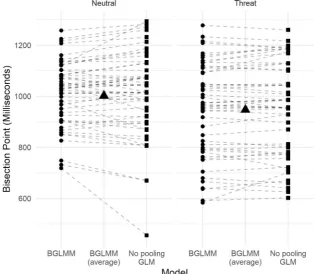
To illustrate shrinkage, whereby individual regression coeffi-cients are pulled toward the group mean, I have plotted (Fig. 3) the BPs for neutral and threat images for each individual separately, calculated from the Bayesian GLMM and the tra-ditional, no-pooling GLM. To allow for direct comparisons between the Bayesian GLMM and the no-pooling GLM esti-mates, I reestimated the Bayesian GLMM without fearfulness scores. The black triangle represents the group-average BP from the Bayesian GLMM. Perhaps the most striking aspect of this plot is the considerable heterogeneity in the BPs—there are very clear individual differences. Shrinkage can be seen most clearly for the neutral images, where three very low BPs are pulled toward the group average (represented by the trian-gle in the center of the left plot).
Exploratory analyses
I ran an exploratory analysis to test whether fearfulness was associated with time perception for threat in the high fearfulness-scoring female participant group. The regression model was identical to the main model described above but used the data for female participants only. For female partici-pants, respondingBlong^increased for threat images relative
to neutral images,β(Threat) = 0.61 (95% CrI[0.30, 0.94]), and moreover, this effect increased with self-reported fearfulness,
β(Threat × Fearfulness) = 0.61 (94% CrI[0.01, 1.2]). In other words, individual differences in fearfulness are associated with the overestimation effect for threat within the (high fearfulness-scoring) female participant group.
Discussion
This study extended the research by showing that the previ-ously reported overestimation effect for threatening facial ex-pressions in high-fearful individuals (Tipples,2011) general-izes to images of threatening animals poised to attack. The effects are not restricted to one class of stimuli. A new finding is that at medium levels of fearfulness, temporal sensitivity increased for threatening images. Increased temporal sensitiv-ity was evident in a steeper slope both for duration and, relat-edly, for the DL—the minimum observable difference in du-rations that produces a change in temporal judgments. This provides direct support for the pacemaker-speeding hypothe-sis (Cheng et al.,2016, p. 105) :BAll things being equal, a faster clock should be a more accurate clock, thereby leading to improved sensitivity to time and lower difference limens.^ The results also support the idea that threat-related stimuli
Fig. 3 Participant bisection points for neutral and threat animals estimated from a Bayesian GLMM and a no-pooling GLM (traditional approach). The black triangles represent the group-average bisection
[image:7.595.139.454.395.669.2]engage fear-specific processes (Tipples,2011), because the general overestimation effect for threatening images increased with self-reported levels of fearfulness, and the effect remained after controlling for the association between time estimates and other self-reported individual differences (in anxiety, sociability, distress, anger, and activity). The latter result extends those from a previous study (Tipples,2011) that had used threat-related facial expressions, by showing that the effect generalizes to time estimates for threatening animals (poised to attack).
Considering the differences in temporal sensitivity reported here, I reanalyzed data from my previous study (Tipples,2011), in which I examined time perception for angry, fearful, and neutral facial expressions. In that study I had reported nonsig-nificant differences in temporal sensitivity (indexed by the WR) between angry, fearful, and neutral facial expressions. Here I estimated a single Bayesian GLMM that included both the
β(Duration × Fearfulness) andβ(Duration × Anger) interaction terms, with the neutral face condition serving as a baseline (intercept) and duration as a mean-centered input variable. Convergence diagnostics and a table of the group-level poste-rior estimates can be found in the supplementary material (https://osf.io/zyax5/). In keeping with the present results for threat images, the estimated slope for duration was steeper for the fearful than for the neutral faces,β(Duration × Fearfulness) = 0.001, 95% CrI[0.0003, 0.001], and also steeper for the angry than for the neutral faces,β(Duration × Anger) = 0.0007, 95% CrI[0.00003, 0.001]. In sum, reanalyses of previous research (Tipples, 2011) corroborate the findings reported here—increased temporal sensitivity for threat.
A practical implication of this is that individual differences in fearfulness are consistently associated with an increase in the temporal overestimation effect for threat-related stimuli, and therefore, researchers may wish to include self-reported measures when modeling the effects of threat on time percep-tion. The Bayesian GLMM reported here is a particularly at-tractive method to model such differences, because individual difference scores can simply be added to the model as a con-tinuous covariate. Interaction effects in regression have a dif-ferent interpretation than interaction terms in standard (sum-coded) analysis of variance, and therefore researchers not fa-miliar with interpreting interaction terms in regression may wish to consult tutorials (e.g., Jaccard,2001) on this topic. As I have demonstrated for this dataset, there are other bene-fits of Bayesian GLMM—namely shrinkage, whereby ex-treme values are shrunk toward the group mean, and conse-quently such values do not exert an undue influence on esti-mates of the regression coefficients. To facilitate the continued use of this modeling technique, I have posted the code for the analyses here athttps://osf.io/zyax5/.
The findings do not support the conclusion (Droit-Volet, 2013) that threat does not affect temporal sensitivity. As these analyses illustrate, steeper slopes for threat-related stimuli
may have been absent in previous research because of the method used to calculate the Weber ratio as an index of gra-dient of psychometric slope. In the present study, slope differ-ences between threat and neutral images were not significant when the index of the gradient of the WR was calculated by dividing the difference limen by the bisection point. In con-trast, calculating the WR by dividing by the average of the durations (1,000 ms) produced a result consistent with (1) estimates of the slope and intercept from the Bayesian GLMM analyses (slopes for threatening as compared to neu-tral animals) and (2) differences in the DL. For future research, I recommend calculating the WR by dividing by the arithmet-ic or geometrarithmet-ic mean. In short, the results reported here are indicative of increased temporal sensitivity for threat, and therefore are consistent with the pacemaker-speeding account (Cheng et al.,2016).
A further reason that differences in temporal sensitivity might be absent in other studies of the effects of threat on time perception is that the psychometric functions calculated for temporal bisection data are subject to restriction-of-range ef-fects. For example, if participants start responding Blong^ sooner for threat-related stimuli, their intercept will be higher on the y-axis, and consequently they might reach an upper limit (ceiling) sooner. Indeed, this is the exact pattern reported in one study (see Fig.1in Droit-Volet et al.,2010), in which the authors reported an overestimation of the duration of a cue signaling an aversive sound as compared to a nonaversive cue, but no differences in temporal sensitivity. Here the estimated that the (mean-centered) intercept for participants at medium levels of fearfulness was close to the average duration, and therefore the slopes for these participants were not subject to restriction-of-range effects. As is illustrated in Fig.1, the esti-mated probability of respondingBlong^was close to zero for the shortest duration. For participants with high levels of self-reported fearfulness, the intercept was shifted upward, and in keeping with the restriction-of-range idea, there was a small decrease in the duration slope for threat images with increases in levels of fearfulness, albeit a difference that included zero. Therefore, modeling individual differences has a further benefit—it can highlight upward shifts in the intercept that might obscure the recording of differences in the gradient of psychometric functions.
disgust-related (Grondin, Laflamme, & Gontier,2014) or pleasant erot-ic (Angrilli, Cherubini, Pavese, & Mantredini,1997) images. Future research will be necessary to test this idea.
In summary, the results extend previous research by show-ing that the overestimation effect previously reported for threatening animals increases in magnitude in individuals who report high levels of fear. In addition, I have shown that increased temporal sensitivity due to threat may have been absent in previous research due to the method used to calcu-late an index of the slope of the psychometric function. Finally, I have demonstrated the usefulness of the Bayesian GLMM approach to modeling temporal bisection data, and in particular how modeling shrinkage by pooling information across individuals can improve estimates of the location and gradient of the psychometric function.
Open Access This article is distributed under the terms of the Creative C o m m o n s A t t r i b u t i o n 4 . 0 I n t e r n a t i o n a l L i c e n s e ( h t t p : / / creativecommons.org/licenses/by/4.0/), which permits unrestricted use, distribution, and reproduction in any medium, provided you give appro-priate credit to the original author(s) and the source, provide a link to the Creative Commons license, and indicate if changes were made.
Publisher’s Note Springer Nature remains neutral with regard to juris-dictional claims in published maps and institutional affiliations.
References
Angrilli, A., Cherubini, P., Pavese, A., & Mantredini, S. (1997). The influence of affective factors on time perception.Perception &
Psychophysics,59, 972–982.
Bar-Haim, Y., Kerem, A., Lamy, D., & Zakay, D. (2010). When time slows down: The influence of threat on time perception in anxiety.
Cognition and Emotion, 24, 255–263.https://doi.org/10.1080/
02699930903387603
Bolker, B. (n.d.). GLMM FAQ. Retrieved fromhttps://bbolker.github.io/ mixedmodels-misc/glmmFAQ.html
Bürkner, P.-C. (2017). brms: An R package for Bayesian multilevel models using Stan.Journal of Statistical Software,80(1), 1–28. https://doi.org/10.18637/jss.v080.i01
Buss, A. H., & Plomin, R. (1984).Temperament: Early developing per-sonality traits. Hillsdale, NJ: Erlbaum.
Carpenter, B., Gelman, A., Hoffman, M. D., Lee, D., Goodrich, B., Betancourt, M., ... Riddell, A. (2017). Stan: A probabilistic pro-gramming language.Journal of Statistical Software, 76(1). 10.18637/jss.v076.i01
Cheng, R.-K., Tipples, J., Narayanan, N. S., & Meck, W. H. (2016). Clock speed as a window into dopaminergic control of emotion and time perception.Timing and Time Perception, 4, 99–122. https://doi.org/10.1163/22134468-00002064
Chung, Y., Rabe-Hesketh, S., Dorie, V., Gelman, A., & Liu, J. (2013). A nondegenerate penalized likelihood estimator for variance parame-ters in multilevel models.Psychometrika,78, 685–709.https://doi. org/10.1007/s11336-013-9328-2
Droit-Volet, S. (2013). Time perception, emotions and mood disorders.
Journal of Physiology, 107, 255–264.https://doi.org/10.1016/j.
jphysparis.2013.03.005
Droit-Volet, S., Mermillod, M., Cocenas-Silva, R., & Gil, S. (2010). The effect of expectancy of a threatening event on time perception in human adults.Emotion,10, 908–914.https://doi.org/10.1037/ a0020258
Droit-Volet, S., & Wearden, J. (2002). Speeding up an internal clock in children? Effects of visual flicker on subjective duration.Quarterly
Journal of Experimental Psychology,55B, 193–211.https://doi.org/
10.1080/0272499014300025
Efron, B., & Morris, C. (1977). Stein’s paradox in statistics.Scientific American,236, 119–127.
Gelman, A. (2008). Scaling regression inputs by dividing by two standard deviations. Statistics in Medicine 27(15):2865–2873
Gibbon, J. (1977). Scalar expectancy theory and Weber’s law in animal timing.Psychological Review,84, 279–325.https://doi.org/10.1037/ 0033-295X.84.3.279
Gibbon, J., Church, R. M., & Meck, W. H. (1984). Scalar timing in memory.Annals of the New York Academy of Sciences,423, 52– 77.https://doi.org/10.1111/j.1749-6632.1984.tb23417.x
Grommet, E. K., Droit-Volet, S., Gil, S., Hemmes, N. S., Baker, A. H., & Brown, B. L. (2011). Time estimation of fear cues in human ob-servers.Behavioural Processes,86, 88–93.https://doi.org/10.1016/ j.beproc.2010.10.003
Grondin, S., Laflamme, V., & Gontier, É. (2014). Effect on perceived duration and sensitivity to time when observing disgusted faces and disgusting mutilation pictures.Attention, Perception, &
Psychophysics,76, 1522–1534.
https://doi.org/10.3758/s13414-014-0682-7
Jaccard, J. (2001).Interaction effects in logistic regression. Thousand Oaks, CA: Sage.
Knoblauch, K., & Maloney, L. T. (2012).Modeling psychophysical data in R. New York, NY: Springer. Retrieved fromhttps://www.springer. com/gb/book/9781461444749
Lake, J. I., LaBar, K. S., & Meck, W. H. (2016). Emotional modulation of interval timing and time perception.Neuroscience & Biobehavioral Reviews,64, 403–420.https://doi.org/10.1016/j.neubiorev.2016.03.003 Lang, P. J., Bradley, M. M., & Cuthbert, B. N. (2008).International Affective Picture System (IAPS): Affective ratings of pictures and
instruction manual (Technical Report A-8). Gainesville, FL:
University of Florida, NIMH Center.https://doi.org/10.1016/j.epsr. 2006.03.016
Mioni, G., Grondin, S., Meligrana, L., Perini, F., Bartolomei, L., & Stablum, F. (2018). Effects of happy and sad facial expressions on the perception of time in Parkinson’s disease patients with mild cognitive impairment.Journal of Clinical and Experimental
Neuropsychology,40, 123–138.https://doi.org/10.1080/13803395.
2017.1324021
Moscatelli, A., Mezzetti, M., & Lacquaniti, F. (2012). Modeling psychophys-ical data at the population-level: The generalized linear mixed model. Journal of Vision,12(11), 26.https://doi.org/10.1167/12.11.26 Ortega, L., & López, F. (2008). Effects of visual flicker on subjective time
in a temporal bisection task.Behavioural Processes,78, 380–386. https://doi.org/10.1016/j.beproc.2008.02.004
Penney, T. B., Yim, E. N. K., & Ng, K. K. (2014). Distractor expectancy effects on interval timing.Timing and Time Perception,2, 1–19. https://doi.org/10.1163/22134468-00002010
R Core Team. (2018). R: A language and environment for statistical computing. Vienna, Austria: R Foundation for Statistical Computing. Retrieved fromhttps://www.r-project.org/
Schneider, W., Eschman, A., & Zuccolotto, A. (2002). E-Prime (Version 1.1). Pittsburgh, PA: Psychology Software Tools.
Spielberger, C. D., Gorsuch, R. L., Lushene, P. R., Vagg, P. R., & Jacobs, A. G. (1983).Manual for the State–Trait Anxiety Inventory (Form Y).https://doi.org/10.1007/978-1-4419-9893-4
Probability(pp. 197–206). Berkeley, CA: University of California Press. Retrieved from http://projecteuclid.org/DPubS?service= UI&version=1.0&verb=Display&page=toc&handle=euclid.bsmsp/ 1200501640
Tipples, J. (2008). Negative emotionality influences the effects of emo-tion on time percepemo-tion.Emotion,8, 127–131.https://doi.org/10. 1037/1528-3542.8.1.127
Tipples, J. (2011). When time stands still: Fear-specific modulation of temporal bias due to threat.Emotion,11, 74–80.https://doi.org/10. 1037/a0022015
Treisman, M. (1963). Temporal discrimination and the indifference inter-val: Implications for a model of theBinternal clock.^Psychological
Monographs: General and Applied,77(13), 1–31.https://doi.org/
10.1037/h0093864
Treisman, M., Faulkner, A., Naish, P. L., & Brogan, D. (1990). The internal clock: Evidence for a temporal oscillator underlying time perception with some estimates of its characteristic frequency.