International Journal of Mathematics and Mathematical Sciences Volume 2011, Article ID 812680,8pages
doi:10.1155/2011/812680
Research Article
Spatial Numerical Range of Operators on
Weighted Hardy Spaces
Abdolaziz Abdollahi and Mohammad Taghi Heydari
Department of Mathematics, College of Sciences, Shiraz University, Shiraz 71454, Iran
Correspondence should be addressed to Abdolaziz Abdollahi,[email protected]
Received 2 November 2010; Revised 29 December 2010; Accepted 24 January 2011
Academic Editor: Alexander Rosa
Copyrightq2011 A. Abdollahi and M. T. Heydari. This is an open access article distributed under the Creative Commons Attribution License, which permits unrestricted use, distribution, and reproduction in any medium, provided the original work is properly cited.
We consider the spatial numerical range of operators on weighted Hardy spaces and give conditions for closedness of numerical range of compact operators. We also prove that the spatial numerical range of finite rank operators on weighted Hardy spaces is star shaped; though, in general, it does not need to be convex.
1. Introduction
For a bounded linear operatorTon a Hilbert spaceH, the numerical rangeWTis the image of the unit sphere ofHunder the quadratic formx → Tx, xassociated with the operator. More precisely,
WT {Tx, x:x∈ H, x1}. 1.1
LetX be a complex normed space with dual apaceX∗. The Banach algebra of all bounded linear operators is denoted byLX. For an operatorT ∈LX, the spatial numerical range
VTofT is defined by
VT {Tx, x∗:x∈X, x∗∈X∗, xx∗x, x∗1}. 1.2
numerical range is defined by
VLX, T FT:F∈LX∗, F1FId. 1.3
The notion of numerical range or the classical field of values was first introduced by O. Toeplitz in 1918 for matrices. This concept was independently extended by G. Lumer and F. Bauer in the sixties to a bounded linear operator on an arbitrary Banach space. In 1975, Lightbourne and Martin1extended this concept by employing a class of seminorms generated by a family of supplementary projections.
In 2, Gaur and Husain have studied the spatial numerical range of elements of Banach algebras without identity. Specifically, the relationship between spatial numerical ranges, numerical ranges, and spectra has been investigated. Among other results, it has been shown that the closure of the spatial numerical range of an element of a Banach algebra without identity but with regular norm is exactly its numerical range as an element of the unitized algebra.
A complete survey on numerical ranges of operators can be found in the books by Bonsall and Duncan3,4; we refer the reader to these books for general information and background.
InSection 2, after giving some background material, we give useful formula for the spatial numerical range of operators on weighted Hardy space. InSection 3, we show that the spatial numerical range of an operator needs not to be convex, and we also prove that the spatial numerical range of finite rank operators is star shaped. Finally, inSection 4, we give conditions for closedness of numerical range of compact operators.
2. Preliminaries
LetX be a complex normed space with dual spaceX∗. The mapping·,· : X×X → Cis called a semi-inner product onXif the following properties are satisfied:
i xy, z x, z y, zfor allx, y, z∈X,
ii λx, y λx, yfor allx, y∈Xandλ∈C,
iii x, x≥0 for allx∈X,
iv|x, y|2≤x, xy, yfor allx, y∈Xandλ∈C.
In5, Lumer defined the concept of a semi-inner product onXand showed that every normed linear spaceX, · has at least one semi-inner product·,·, such that
x, x x2 x∈X. 2.1
In terms of a semi-inner product satisfying 2.1, the definition of usual numerical range for Hilbert space operator at once generalizes to give the definition of the numerical rangeWTfor a linear operator onX,
WT {Tx, x:x1}. 2.2
semi-inner product satisfying2.1. In fact, Lumer showed thatcoWTdepends only on the norms of the operators.
The unit ball ofXis called smooth if for allx, withx1, there is a uniquex∗ ∈X∗, such thatx∗ 1 andx, x∗ 1. In this case, there is a unique semi-inner products onX
satisfying2.1, and thenVTcoincides with numerical rangeWTcorresponding to the unique semi-inner product satisfying2.1.
A principal result in spatial numerical range is a Theorem of Williams that givesσT⊆ VT, whereσTis the spectrum ofT. Also we havesee3
iWT⊆VT,
iicoWT coVT VLX, T,
iiisup{|λ|:λ∈WT}sup{|λ|:λ∈VT}.
It is of course trivial that every eigenvalue ofT is actually inVT.
Let 1 < p < ∞and {βn}n be a sequence of positive numbers with β0 1. The weighted Hardy space, which is denoted byHpβ, is the set of all formal power seriesfz
∞
n0fnznwith
fp
fp
Hpβ
∞
n0
fnp
βnp<∞. 2.3
LetμK n∈Kβnp, forK⊆N∪ {0}. Thenμis aσ-finite measure andHpβ Lpμ. So,
the spaceHpβis reflexive Banach space with the norm ·
Hpβ, and the dual ofHpβis
Hqβp/q, where 1/p1/q1 andβp/q {βnp/q}6.
In the casep 2, the weighted Hardy spaces with βn 1, βn n1−1/2, and βn n11/2 are classical Hardy space, Bergman space, and the Dirichlet space, respectively. The spaceH2βbecomes a Hilbert space with inner product
f, g
∞
n0
anbnβn2, 2.4
wherefz anznandgz bnznare the elements ofH2β 7.
The notationf, gis to stand forgf, wheref∈Hpβandg ∈Hpβ∗. Note that
f, g
∞
n0
fngnβnp. 2.5
Forf∈Hpβandg∈Hqβp/q, withfz a
nznandgz
bnzn, we definef∗
and∗gbyf∗z |an|p−1sgnanznand∗gz |bn|q−1sgnbnzn, respectively, where for
a nonzero complex numberw,sgnw w/|w|and sgn0 0. Clearly,
f∗qqf∗q
Hqβp/q
∞
n0
fnp
βnpfpp<∞,
∗gp
p
∞
n0
gnqβnpgqq<∞.
So,f∗ ∈ Hqβp/qand∗g ∈Hpβ. Obviously, one can see that∗f∗ f for allf ∈Hpβ
and ∗g∗ g for allg inHpβ∗. By a simple computation, we also have the following
consequences:
aifα≥0 andf∈Hpβ, thenαf∗αp−1f∗,
biff ∈Hpβ,f, f∗fp
p.
We define a semi-inner product onHpβby
g, f: g, Ff
, 2.7
wheref, g∈HpβandF
f :f2−pf∗. Obviously, we havef, f f2p.
Lemma 2.1. IfT is a bounded linear operator onHpβ, then
VT WT Tf, f∗:f∈Hpβ, f1
T∗g, g:g ∈Hqβp/q, g1,
2.8
whereWTis the numerical range ofT with respect to the semi-inner product defined by2.7.
Proof. Suppose thatf∈Hpβ,g∈Hpβ∗,fg1, andf, g1. Then
1 f, g≤fg1. 2.9
So, equality occurs in Holder inequality, and hence there are complex numbers α and η independent ofn, such that|fn|pβnp α|gn|qβnpand argfngn ηsee8.
Hence,|fn|pα|gn|q. But
1fpp fnpβnpα gnqβnpα, 2.10
and hence|fn|p|gn|q. On the other hand,
1fngnβnp
fngneiargfn gn βnp
eiηfnfnp/qβnpeiη.
2.11
Therefore, eiargfngn 1, or equivalently eiargfn eiarggn. Hence, gn
|fn|p/qeiargfn, org f∗. Then, the unit ball ofHpβis smooth, and so there is one and
only one semi-inner product onHpβwhich satisfy2.1. Then,VT WT 3. The last
3. Shape of the Spatial Numerical Range
The usual numerical range of a bounded linear operator on a Hilbert space is convex, and for every bounded linear operatorT on a normed spaceX, we know thatVLX, Tis convex. AlthoughVTneeds not to be convexsee3, B. E. Cain and H. Schneider proved that it is connected. Also in9, Kuliyev proved that the spatial numerical range of a given operator on a separable Banach space is pathwise connected.
Recall thatVTis star shaped with respect to zero if tz ∈ VTfor 0 ≤ t ≤ 1 and
z∈VT.
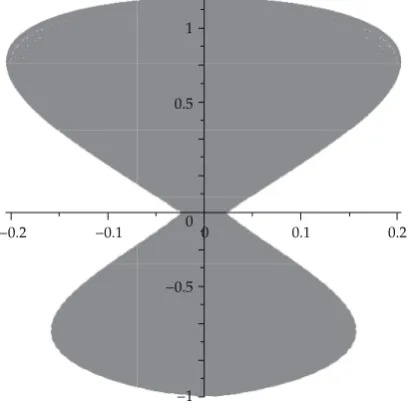
InTheorem 3.1, we give a necessary and sufficient condition for the numerical range of a bounded linear operator to be star shaped. In Example 3.2, we show that the spatial numerical range of linear operatorT onHpβneeds not to be convex, even ifT is compact
see also3. We also determine the shape ofVT, whenTis a finite rank operator. Finally, inTheorem 3.3, we prove that there is an operatorTonHpβthat may not be star shaped.
Theorem 3.1. LetT be a bounded linear operator onHpβ. Then
aVTis star shaped with respect to zero if and only if
VT Tf, f∗:f ∈Hpβ,fp≤1, 3.1
bifT is finite rank onHpβand 0∈VT, thenVTis star shaped with respect to zero.
Proof. The proof is trivial, asTkf,kf∗ kpTf, f∗, for each nonnegative real number
kandf ∈Hpβ.
Example 3.2. Letβ1 1 andT be the linear operator onHpβgiven by
Tfn
⎧ ⎪ ⎪ ⎪ ⎪ ⎪ ⎨ ⎪ ⎪ ⎪ ⎪ ⎪ ⎩
if0 f1 n0,
−f0 if1 n1,
0 n >1.
3.2
Therefore,
VT Tf, f∗:f1, f∈Hpβ
Tf0f0p/qe−iθ0Tf1f1p/qe−iθ1 :f1, f∈Hpβ,
3.3
whereθ0argf0andθ1argf1. By writing|f0|r,|f1|s, θθ1−θ0, we have
−0.2 −0.1 0 0.1 0.2 1
0.5
0
−0.5
[image:6.600.198.403.100.308.2]−1
Figure 1:VTforp3.
Now, let
αsup{Rez:z∈VT}suprsrp−2−sp−2:rpsp≤1,
βsup{VT∩R}
supcosθ·rsrp−2−sp−2:rpsp≤1, rp−sprsrp2sp2sinθ0.
3.5
We haveα > βunlessp2. If
zrsrp−2−sp−2cosθirp−sprsrp2sp2sinθ∈VT, 3.6
then the conjugate ofzis
zsrsp−2−rp−2cosπθ isp−rpsrsp2rp2sinπθ∈VT, 3.7
and soVT∗ VT. Thus,αwas attained at points above and below the real axis, and we have concluded thatVTis not convex unlessp2. InFigure 1, we draw the shape ofVT, forp3.
Theorem 3.3. There is an operatorTonHpβwith 0∈VT, such thatVTis not star shaped.
Proof. We proof this theorem by contradiction. Suppose that the spatial numerical range of
4. Compact Operators
SinceH2βis a Hilbert space, the numerical range of a compact operator onH2βis closed if and only if it contains the origin. Also the numerical range of a compact operator onHpβ
contains all nonzero extreme points of its closure, and sinceHpβis infinite dimensional,
there is a compact operatorT onHpβ, such thatVTis not closedsee10and page 103-109 of11. So, in general, the spatial numerical range of a compact operator needs not to be closed. In the following theorem, we give a closedness condition of such operators.
Theorem 4.1. LetTbe a compact operator onHpβ. IfVTis star shaped with respect to zero, then
it is closed.
Proof. SinceVTis star shaped with respect to zero, then byTheorem 3.1,
VT Tf, f∗:f ∈Hpβ,fp≤1. 4.1
For givenα∈VT, there is a sequencehnwithhnp1 andThn, h∗n → α. By
reflex-ivity ofHpβand Alaogul’s Theorem, there is a sequence{nk}∞k1, such thathnk → hin weak
topology andh∗nk → gin weak∗topology for someh∈ballHpβandg ∈ballHpβ∗.
Now, letm∈N. Define the bounded linear functionalsx,x∗by
xf∗:f∗m, x∗f:fm, 4.2
respectively, onHpβ∗andHpβ. Hence,
hnk, x∗ −→ h, x∗, h∗nk, x
−→ g, x, 4.3
ask → ∞. Then,
hnkm−→hm, h∗nkm−→gm, 4.4
as k → ∞. But by definition h∗nkm |hnkm|p/qeiarghn km. Therefore, gm
|hm|p/qeiarghmorgh∗. On the other hand,
Thnk, h∗nk
− Th, h∗≤ Thnk, h∗nk
− Th, h∗nk Th, h∗nk− Th, h∗ Thnk−h, h∗nk Th,
h∗nk−h∗
≤ Thnk−hh∗nk Th,
h∗nk−h∗.
4.5
SinceT is completely continuous andhnk → hweakly, thenThnk −h → 0, and hence
Thnk, h∗nk → Th, h∗. So,αTh, h∗, and the proof is complete by using4.1.
Since in infinite dimensional spaces 0 is allowed in spectrum of any compact operator, then we have the following corollary.
Corollary 4.2. LetTbe a compact operator onHpβ, such thatVTis convex. ThenVTis closed
Acknowledgments
The authors would like to thank Professor Alexander Rosa, the Editor-in-Chief of the International Journal of Mathematics and Mathematical Sciences, and the referee for useful and helpful comments and suggestions.
References
1 J. H. Lightbourne, III and R. H. Martin Jr., “Projection seminorms and the field of values of linear operators,” Numerische Mathematik, vol. 24, no. 2, pp. 151–161, 1975.
2 A. K. Gaur and T. Husain, “Spatial numerical ranges of elements of Banach algebras,” International
Journal of Mathematics and Mathematical Sciences, vol. 12, no. 4, pp. 633–640, 1989.
3 F. F. Bonsall and J. Duncan, Numerical Ranges of Operators on Normed Spaces and of Elements of
Normed Algebras, vol. 2 of London Mathematical Society Lecture Note Series, Cambridge University Press,
London, UK, 1971.
4 F. F. Bonsall and J. Duncan, Numerical Ranges. II, London Mathematical Society Lecture Notes Series, no. 1, Cambridge University Press, New York, NY, USA, 1973.
5 G. Lumer, “Semi-inner-product spaces,” Transactions of the American Mathematical Society, vol. 100, pp. 29–43, 1961.
6 K. Seddighi, K. Hedayatiyan, and B. Yousefi, “Operators acting on certain Banach spaces of analytic functions,” International Journal of Mathematics and Mathematical Sciences, vol. 18, no. 1, pp. 107–110, 1995.
7 A. L. Shields, “Weighted shift operators and analytic function theory,” in Topics in Operator Theory, Math. Surveys, no. 13, pp. 49–128, American Mathematical Society, Providence, RI, USA, 1974.
8 L. P. Kuptsov, “H ¨older inequality,” in Encyclopaedia of Mathematics, M. Hazewinkel, Ed., Kluwer Academic Publishers, Dordrecht, The Netherlands, 2001.
9 T. Y. Kuliyev, “Pathwise connectivity of the spatial numerical range,” Proceedings of the American
Mathematical Society, vol. 122, no. 4, pp. 1173–1174, 1994.
10 G. de Barra, J. R. Giles, and B. Sims, “On the numerical range of compact operators on Hilbert spaces,”
Journal of the London Mathematical Society, vol. 5, pp. 704–706, 1972.
Submit your manuscripts at
http://www.hindawi.com
Hindawi Publishing Corporation
http://www.hindawi.com Volume 2014
Mathematics
Journal ofHindawi Publishing Corporation
http://www.hindawi.com Volume 2014
in Engineering
Hindawi Publishing Corporation http://www.hindawi.com
Differential Equations International Journal of
Volume 2014
Applied MathematicsJournal of
Hindawi Publishing Corporation
http://www.hindawi.com Volume 2014
Probability and Statistics
Hindawi Publishing Corporation
http://www.hindawi.com Volume 2014
Journal of
Hindawi Publishing Corporation
http://www.hindawi.com Volume 2014
Mathematical PhysicsAdvances in
Complex Analysis
Journal ofHindawi Publishing Corporation
http://www.hindawi.com Volume 2014
Optimization
Journal ofHindawi Publishing Corporation
http://www.hindawi.com Volume 2014
Combinatorics
Hindawi Publishing Corporation
http://www.hindawi.com Volume 2014
International Journal of Hindawi Publishing Corporation
http://www.hindawi.com Volume 2014
Operations Research
Journal of
Hindawi Publishing Corporation
http://www.hindawi.com Volume 2014
Function Spaces
Abstract and Applied Analysis Hindawi Publishing Corporation
http://www.hindawi.com Volume 2014
International Journal of Mathematics and Mathematical Sciences
Hindawi Publishing Corporation http://www.hindawi.com Volume 2014
The Scientific
World Journal
Hindawi Publishing Corporation
http://www.hindawi.com Volume 2014
Hindawi Publishing Corporation
http://www.hindawi.com Volume 2014
Algebra
Discrete Dynamics in Nature and Society
Hindawi Publishing Corporation
http://www.hindawi.com Volume 2014
Hindawi Publishing Corporation
http://www.hindawi.com Volume 2014
Decision Sciences
Discrete Mathematics
Journal ofHindawi Publishing Corporation
http://www.hindawi.com Volume 2014
Hindawi Publishing Corporation
http://www.hindawi.com Volume 2014