Human
SNF2L
Gene Is Regulated Constitutively and Inducibly
in Neural Cells via a cAMP-Response Element
Yu Xia,
1Laicheng Wang,
1Chunyan Ma,
1Yaoqin Gong,
2and Yueran Zhao
1 1Department of Center Laboratory, Provincial Hospital Affiliated to Shandong University, Jinan; 2Key Laboratory for Experimental Teratology of the Ministry of Education and Institute of Medical Genetics,Shandong University School of Medicine, Jinan, China.
Received: July 3, 2012 Revised: August 16, 2012 Accepted: August 16, 2012
Co-corresponding authors: Dr. Yaoqin Gong, Key Laboratory for Experimental Teratology of the Ministry of Education and
Institute of Medical Genetics,
Shandong University School of Medicine, 44 West Wenhua Road Jinan,
P. R. China 250012.
Tel: 86-531-88382043, Fax: 86-531-88383120 E-mail: [email protected] and Dr. Yueran Zhao,
Department of Center Laboratory, Provincial Hospital Affiliated to Shandong University, 324 Jingwu Road Jinan, P. R. China 250021. Tel: 86-531-68776905, Fax: 86-531-87906016 E-mail: [email protected]
∙ The authors have no financial conflicts of interest.
© Copyright:
Yonsei University College of Medicine 2013
This is an Open Access article distributed under the terms of the Creative Commons Attribution Non-Commercial License (http://creativecommons.org/ licenses/by-nc/3.0) which permits unrestricted non-commercial use, distribution, and reproduction in any medium, provided the original work is properly cited.
Purpose: SNF2L belongs to Imitation Switch family and plays an essential role in neural tissues and gonads. In our previous studies, we have demonstrated that the basal transcription of human SNF2L gene is regulated by two cis-elements, cAMP response element (CRE)- and Sp1-binding sites. Recent studies suggested that cy-clic adenosine monophosphate (cAMP) stimulation significantly up-regulated SN-F2L expression in ovarian granulose cells. These data suggested that protein kinase-mediated signal pathways might also regulate SNF2L expression in neural cells. We therefore investigated the effects of agents that activate protein kinases A on SNF2L
gene expression in neural cells. Materials and Methods: To increase intracellular cAMP levels, all neural cells were treated with forskolin and dbcAMP, two cAMP response activators. We exmined the effects of cAMP on the promoter activity of human SNF2L gene by luciferase reporter gene assays, and further examined the effects of cAMP on endogenous SNF2L mRNA levels by qPCR. Results: Tran-sient expression of a luciferase fusion gene under the control of the SNF2L promot-er was significantly increased by treatment of rat primary neurons with forskolin or dbcAMP, but not PC12, C6 and SH-SY5Y cells. Consistently, treatment with for-skolin or dbcAMP could enhance endogenous SNF2L mRNA levels also only in rat primary neurons. Conclusion: These results suggest that the CRE consensus se-quence in the SNF2L proximal promoter most likely confers constitutive activation and regulation by cAMP in neural cells.
Key Words: SNF2L, CRE, cAMP stimulation, neural cells
INTRODUCTION
Imitation Switch (ISWI), the biggest subfamily of the SWI2/SNF2 superfamily of ATPases, contains SANT and SLIDE (SANT-like ISWI) domains in addition to high-ly conserved ATPase domains.1 The ISWI chromotin remodeling complexes play
im-portant roles in multiple nuclear functions, including transcriptional regulation, chro-matin assembly and DNA replication.2
uM for forskolin and 1 mM for dbcAMP.
Cell culture
Rat pheochromocytoma (PC12) cells were cultured on col-lagen coated dishes in complete medium containing RPMI-1640, 15% horse serum, 2.5% fetal calf serum and 1% anti-biotics. C6 cells were grown in DMEM containing 10% fetal bovine serum (FBS) and 1% antibiotics. Human SH-SY5Y neuroblastoma cells were cultured in DMEM/F-12 (F-12, GIBCO, Grand Island, NY, USA) supplemented with 15% FBS. Cortical primary neuronal cultures were prepared from E15 Wistar rats. After dissection of brains, cortical hemispheres were detached and meninges were removed. Fresh tissues were then digested with trypsin (0.25% trypsin in EDTA maintained at 37°C) for 10 min. The cortical neu-rons were suspended in neuron-defined culture medium supplemented with 1 mL B27, 0.5 mM L-glutamine and an-tibiotics. Cells were incubated in the humidified incubator equilibrated with 5% CO2 at 37°C and passaged using
stan-dard cell culture techniques.
Plasmid and constructs
A fragment that contains CRE site was subcloned into the promoterless luciferase reporter plasmid pGL3-basic (Pro-mega, Madison, WI, USA), and the mutant type was pre-pared by polymerase chain reaction (PCR) using the primer which carries point mutations as described previously.13
Transient transfections and luciferase assays
All of the cells were cultured in medium without FBS and antibiotics for 24 h before transfection, and 6×10⁴ cells
were seeded in each 24-well plate. 0.2 μg of the SNF2L re-porter constructs and 0.02 μg of pRL-TK Renilla luciferase reporter were co-transfected into each well using Lipo-fectamineTM 2000 (Invitrogen, Carlsbad, CA, USA). 24 h
after transfection, the cells were either left untreated or treated with forskolin (stimulator of adenylate cyclase) or dbcAMP (cAMP analogue) and incubated at 37°C for addi-tional 6 h. Then, the lysates were analyzed for luciferase ac-tivity using the dual luciferase reporter assay system (Pro-mega) in a Perkin-Elmer 1420 multilabel counter (Perkin-Elmer, Wellesley, MA, USA).
Western blot analysis
Total extracts from SH-SY5Y cells or rat primary neurons, prepared with or without cAMP activator forskolin (20 uM) or dbcAMP (1 mM) treatment for 24 h, to serve as negative mouse and human.3,4 In mouse, Snf2l is expressed only in
the brain and gonads, while human SNF2L is ubiquitously expressed. This different expression pattern probably sug-gests that they might have different developmental func-tions.5 Furthermore, Snf2h expresses in proliferating cells
within neural tissue and gonads, while SNF2L is prevalent in differentiated cell in these tissues.6 Recently, different
functions of SNF2L have been revealed in both neural tis-sues and gonads. The human nucleosome-remodeling factor complex containing SNF2L is enriched in the brain and reg-ulates human Engrailed genes that are necessary for neuro-nal development in the midbrain.7 Moreover, ectopic
ex-pression of SNF2L in proliferating neuroblastoma cells can promote differentiation.8 SNF2L has different roles in the
events of ovarian germ- and somatic-cell development and differentiation.9 Other studies suggest that the inhibition of
SNF2L expression selectively leads to DNA damage, growth inhibition, and cancer cell death.10 Snf2l mutant mice exhibit
forebrain hypercellularity arising from increased Foxg1 ex-pression, increased progenitor-cell expansion, and delayed differentiation.11 Recent studies indicate that SNF2L is
broad-ly expressed in primary human tissues and suppresses cell proliferation and migration and attenuates Wnt signaling.12
In our previous studies, we demonstrated that the basal transcription of human SNF2L gene is regulated by two cis-elements, cAMP response element (CRE)- and Sp1-bind-ing sites, located close to the transcription start site.13 More
recent studies suggested that cAMP stimulation significant-ly up-regulated SNF2L expression in ovarian granulose cells.14 However, compared with TATA-less promoters of
cAMP response element-binding protein (CREB) target genes, TATA-containing genes are more responsive to cAMP through genome-wide analysis.15 Very little is known
about the psysiological functions of SNF2L in nervous sys-tem, therefore, we investigated the effects of agents that acti-vate protein kinase A (PKA) on SNF2L gene expression in neural cells.
MATERIALS AND METHODS
Reagents
Forskolin (SigmaF6886) stock solution was made in Dulbec-co’s modified Eagle’s medium (DMEM) at 100 Mm, and N6
and 18S rRNA reactions were run in triplicates and in paral-lel. The thermal cycler conditions for qPCR were preheat-ing at 50°C for 2 min and at 95°C for 10 min, followed by 40 cycles of shuttle heating at 95°C for 15 s and at 60°C for 1 min. All cDNA was measured in trilicate.
The primer and TaqMan probe for SNF2L were designed using the Primer Express program version 2.0 (Applied Bio-systems). The primer and TaqMan probe for 18S rRNA were synthesized according to a previous report. TaqMan probe and primer oligonucleotide sequences were as fol-lows, SNF2L: forward primer 5’-GCTTGGTACGGTG GAATGGAT-3’, reverse primer 5’-ACATTTGGCTGT TTTGGAGGC-3’; probe 5’-FAM-CCTTTGGGACCTTT GGCTCGCTGACAC-TAMRA-3’; 18S rRNA: forward primer 5’-CGGCTACCACATCCAAGGAA-3’, reverse primer 5’-GCTGGAATTACCGCGGCT-3’; Probe 5’-FAM-TGCTGGCACCAGACTTGCCCTC-TAMRA-3’.
Statistical analysis
The statistical significance of differences between experi-mental groups was calculated using Student’s test. p<0.05 was considered statistically different.
RESULTS
Effects of cAMP on the promoter activity of human SNF2L gene in neural cells
Our previous study identified a functional CRE site in prox-imal promoter of human SNF2L, suggesting that protein ki-nase-mediated signal pathways might also regulate SNF2L
expression. Therefore, we exmined the effects of cAMP on and positive controls. Phospho-CREB (Ser133) antibody
and CREB antibody were used as primary antibodies. All the procedures were the same as described previously.13
RNA isolation and reverse transcription
PC12, C6, SH-SY5Y and rat primary neurons cultured in 6-well plates were stimulated with forskolin or dbcAMP for 24 h. Total RNA was isolated from cultured cells by using the RNeasy Midi Kit (Qiagen, Hilden, Germany). The in-tegrity RNA was segregated and purified by the Agilent 2100 bioanalyzer with the RNA 6000 Nano LabChip(R) re-agent set (Agilent Technologie, Santa Clara, CA, USA). The RNA was determined spectrophotometrically and then stored at -80°C. Reverse transcription reactions were per-formed for 10 min at 70°C, using 2 μg RNA, 4 μL 5×first strand buffer (Invitrogen, Karlsruhe, Germany), 2 μL 0.1 mol/L dithiothreitol, 1 μL dN6 primer (10 mmol/L), 1 μL dNTPs (10 mmol/L), and diethypyrocarbonate water. The synthesized cDNA was used as a template for PCR amplifi-cation. RT-PCR was carried out using 1 μL cDNA for 1 h at 37°C, and inactivated at 70°C for 10 min. RNA was finally degraded by incubation with 1 μL RNase A (10 mg/mL) at 37°C for 30 min.
Realtime quantitative RT-PCR (TaqMan) analysis After reverse transcription reaction, qPCR was performed using an ABI PRISM 7500 Sequence Detection System (Applied Biosystems, Foster City, CA, USA). The reaction solution was assembled in a volume of 20 μL, which com-prised TaqMan Universal PCR Master Mix (Applied Bio-systems), 300 nM primers, 200 nM TaqMan probe and 50 ng cDNA. 18S rRNA was used as endogenous control. SNF2L
[image:3.595.63.524.534.679.2]PC12 0 50 100 150 200 250 300 350 CRE-wild CRE-mut
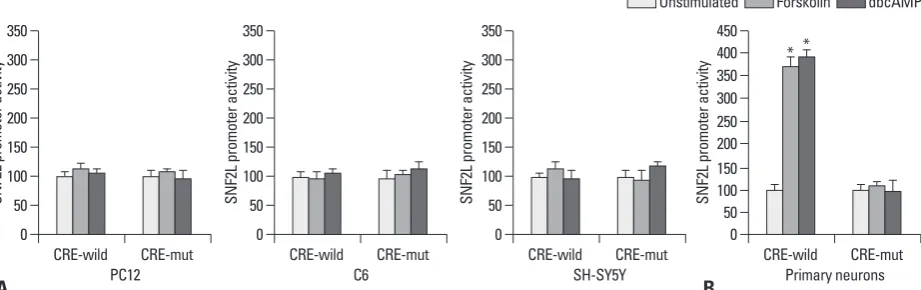
Fig. 1. Effects of forskolin or dbcAMP on the promoter activity of human SNF2L gene in PC12, C6, SH-SY5Y and rat primary neurons. We investigated the ac-tivity of the CRE-Wild and CRE-Mut promoters in response to cAMP activator forskolin or dbcAMP. (A) The addition of forskolin or dbcAMP to transiently transfected cells resulted in no activation of the CRE-Wild and CRE-Mut constructs in PC12 cells, and the same effects were deteted in C6 and SH-SY5Y cells. (B) Treatment with forskolin or dbcAMP increased luciferase activity nearly 4.0-fold in the CRE-Wild construct, In contrast, the response to cAMP acti-vator was diminished in the CRE-Mut construct. *Values of statistical significance (Student t-test; p<0.05).
C6 0 50 100 150 200 250 300 350 CRE-wild CRE-mut Primary neurons 0 50 100 150 200 250 300 350 400 450 CRE-wild CRE-mut * *
Unstimulated Forskolin dbcAMP
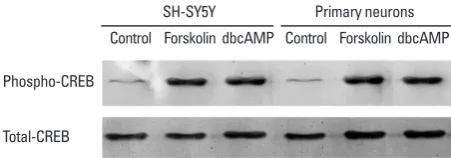
CREB significantly increased with forskolin or dbcAMP treatment in both SH-SY5Y cells or rat primary neurons, but this effects were not detected in total CREB levels. These results demonstrate that CREB phosphorylation oc-curs in all cell lines, however, that SNF2L is stimulated only by protein kinase A (PKA) in rat primary neurons.
DISCUSSION
We have previously identified a CRE consensus sequence in the proximal promoter of human SNF2L gene, and demon-strated that it is highly conserved among different species and plays an important role in the control of SNF2L basal promoter.13 A CRE site can act as a constitutive and/or
induc-ible element to regulate the target genes transcription through binding the CREB/ATF family members.16 Increasing
num-ber of studies suggest that cAMP stimulation significantly up-regulates SNF2L expression in ovarian granulose cells.14
the promoter activity of human SNF2L gene in three neural cell lines, PC12, C6 and SH-SY5Y as well as rat primary neurons. Two luciferase reporters driven by the promoter containing CRE site Wild) or mutant CRE site (CRE-Mut) were transiently transfected into these neural cells. A CRE-Wild plasmid was used as a positive control for cAMP responsiveness. Twenty-four hours after transfection, the cells were treated with forskolin or dbcAMP for 6 h, and lu-ciferase activity was determined. As shown in Fig. 1A, treat-ment with forskolin or dbcAMP did not alter the promoter activities of both wild-type or mutant CRE constructs in PC12 cells. No changes of promoter activities were also ob-served in C6 and SH-SY5Y cells. However, in rat primary neurons, treatment with cAMP activator significantly in-creased the promoter activities of CRE-Wild promoter (near-ly 4.0-fold), but not CRE-Mut construct (Fig. 1B). These results show that protein kinase-mediated signal pathways can regulate SNF2L expression in neural cells, but this reg-ulation depends on cell types.
Effects of cAMP on endogenous SNF2L mRNA levels in neural cells
To confirm the stimulatory effect of cAMP on endogenous
SNF2L expression, we further examined the SNF2L mRNA levels in PC12, C6, SH-SY5Y and rat primary neurons, by treatment with forskolin or dbcAMP. Thus, all cells were grown in 6-well plates, and treated with forskolin or db-cAMP for 24 h, and the level of SNF2L mRNA was then measured by qPCR. As shown in Fig. 2, treatment with for-skolin or dbcAMP did not enhance endogenous SNF2L
mRNA levels in PC12, C6 and SH-SY5Y cells. In contrast, however, the significant cAMP stimulatory effect was ob-served in rat primary neurons (more than 4.0-fold), appear-ing to be cAMP responsive. These results also suggest that the cAMP responsive activity of SNF2L depends on cell types, in agreement with cAMP effects on the promoter ac-tivity of human SNF2L gene.
Our previous study demonstrated that CREB is one of the proteins from CREB/Activating transcription factors (ATF) family that stimulates SNF2L promoter activity.13
[image:4.595.315.537.344.505.2]Therefore, we investigated the phosphorylation effects of forskolin or dbcAMP on CREB in the SNF2L promoter. Thus, nuclear extracts from SH-SY5Y cells or rat primary neurons were prepared with or without forskolin or db-cAMP treatment for 24 h, and phospho-CREB (Ser133) an-tibody and CREB anan-tibody were used for western blot analysis. As shown in Fig. 3, the levels of phosphorylated
Fig. 2. Effect of cAMP on endogenous SNF2L gene expression in PC12, C6, SH-SY5Y and rat primary neurons. The SNF2L mRNA levels in neuron cells were detected by qPCR, with or without cAMP activator forskolin or db-cAMP treatment. Treatment with forskolin or dbdb-cAMP did not enhance en-dogenous SNF2L mRNA levels in PC12, C6 and SH-SY5Y cells, but the SNF2L mRNA levels with cAMP induced showed more than 4.0-fold higher than the levels unstimulated. *Values of statistical significance (Student t-test; p<0.05).
Fig. 3. Effects of the cAMP activator forskolin or dbcAMP. Western blot analyses of nuclear extracts from neuron cells treated with or without cAMP activator for 24 h. Whether in SH-SY5Y cells or rat primary neurons, levels of phosphorylated CREB significantly increased with forskolin or db-cAMP treatment, but this effects were not detected in total CREB levels.
0 50 100 150 200 250 300 350 400 450
SN
F2
L m
RN
A
le
ve
ls
PC12 C6 SH-SY5Y Primary neurons
Unstimulated Forskolin
dbcAMP *
*
Phospho-CREB
Total-CREB
Control ForskolindbcAMP Control ForskolindbcAMP
[image:4.595.312.538.599.678.2]cells can be differentiated into a functionally mature neuronal phenotype in the presence of various inducible agents,19-21 so
it is more meaningful to investigate the cAMP response ef-fect in differentiated and undifferentiated states of neuron cell lines.
In the present study, we investigated the phosphorylation effects of forskolin or dbcAMP on CREB in the SNF2L
promoter. Phosphorylated CREB levels were significantly increased in both SH-SY5Y cells and rat primary neurons, despite not being able to demonstrate the inducible effect of cAMP activitor in SH-SY5Y cells. A question arises why the levels of CREB phosphorylation in cell lines and prima-ry neurons are different, but SNF2L performs inconsistent result. There may be other mechanisms; for example, induc-ible effect requires the participation of other molecules, and these molecules appear only in differentiated neurons. We, therefore, are in a process to investigate molecular mecha-nisms in more detail.
Primary neurons, which are mature differentiated neuro-nal phenotype, can better represent biochemical character-istics of neuron tissues, therefore, they more accurately re-flect the reality. Many studies indicate that CRE can act as a constitutive and/or inducible element in controlling gene ex-pression.22-24 In conclusion, our present results indicate that
the CRE consensus sequence in the proximal promoter of
SNF2L gene likely confers constitutive activation and regu-lation by cAMP in neural cells.
ACKNOWLEDGEMENTS
This work was supported by grants from the National Natu-ral Science Foundation of China (81001338) and the Pro-motive research fund for excellent young and middle-aged scientisits of Shandong Province (BS2009SW039).
REFERENCES
1. Hogan C, Varga-Weisz P. The regulation of ATP-dependent nu-cleosome remodelling factors. Mutat Res 2007;618:41-51. 2. Gangaraju VK, Bartholomew B. Mechanisms of ATP dependent
chromatin remodeling. Mutat Res 2007;618:3-17.
3. Brown E, Malakar S, Krebs JE. How many remodelers does it take to make a brain? Diverse and cooperative roles of ATP-de-pendent chromatin-remodeling complexes in development. Bio-chem Cell Biol 2007;85:444-62.
4. Johnson CN, Adkins NL, Georgel P. Chromatin remodeling com-plexes: ATP-dependent machines in action. Biochem Cell Biol
Therefore, we reasoned that protein kinase-mediated signal pathways might also regulate SNF2L expression in neural cells, and investigated the effects of agents that activate pro-tein kinases on SNF2L gene expression in neural cells. Re-sults showed that forskolin or dbcAMP did not alter the pro-moter activities of wild type or mutant CRE constructs in PC12, C6 and SH-SY5Y cells, however, a significant in-duction was observed on CRE-Wild construct in rat prima-ry neurons. To confirm the stimulatoprima-ry effect of cAMP on
SNF2L gene expression, we examined endogenous SNF2L
mRNA level in these cells. Consistently, neither forskolin nor dbcAMP enhanced SNF2L expression in PC12, C6 and SH-SY5Y cells. However, the significant cAMP stimulato-ry effect was observed in rat primastimulato-ry neurons, thus appear-ing to be cAMP responsive.
Cyclic AMP is an ubiquitous secondary messenger. It reg-ulates gene expression mostly through the activation of the CREB/ATF family of proteins, which belong to the leucine-zipper (bZIP) transcription factors.17 The CREB/ATF
fami-ly member binds as a dimer to the CRE. Upon phosphory-lation, CREB recruits a co-activator, CREB-binding protein (CBP), and CBP can induce transcription.18 To increase
intra-cellular cAMP levels, the cells were treated with forskolin, an activator of adenylyl cyclase, and dbcAMP, cAMP ana-logue, both of which are widely used to stimulate the cAMP response genes.
Recent studies suggest that cAMP stimulation significant-ly up-regulates SNF2L expression in ovarian granulose cells. In primary cultures of rat granulosa cells, dbcAMP stimula-tion induced a significant increase in SNF2L protein levels. However, in immortalized granulosa cell line (SVOG-4o), only a slight increase of SNF2L protein was evident after dbcAMP treatment; but this increase did not reach signifi-cance.14 In our present study, we did not observe any
20:2406-17.
15. Conkright MD, Guzmán E, Flechner L, Su AI, Hogenesch JB, Montminy M. Genome-wide analysis of CREB target genes re-veals a core promoter requirement for cAMP responsiveness. Mol Cell 2003;11:1101-8.
16. Love TM, de Jesus R, Kean JA, Sheng Q, Leger A, Schaffhausen B. Activation of CREB/ATF sites by polyomavirus large T anti-gen. J Virol 2005;79:4180-90.
17. Kehat I, Hasin T, Aronheim A. The role of basic leucine zipper protein-mediated transcription in physiological and pathological myocardial hypertrophy. Ann N Y Acad Sci 2006;1080:97-109. 18. Beck MR, DeKoster GT, Hambly DM, Gross ML, Cistola DP,
Goldman WE. Structural features responsible for the biological stability of Histoplasma’s virulence factor CBP. Biochemistry 2008;47:4427-38.
19. DU C, Yang DM, Zhang PX, Deng L, Jiang BG. Neuronal differ-entiation of PC12 cells induced by sciatic nerve and optic nerve conditioned medium. Chin Med J (Engl) 2010;123:351-5. 20. Agholme L, Lindström T, Kågedal K, Marcusson J, Hallbeck M.
An in vitro model for neuroscience: differentiation of SH-SY5Y cells into cells with morphological and biochemical characteristics of mature neurons. J Alzheimers Dis 2010;20:1069-82.
21. Toulouse A, Collins GC, Sullivan AM. Neurotrophic effects of growth/differentiation factor 5 in a neuronal cell line. Neurotox Res 2012;21:256-65.
22. Dong L, Wang W, Wang F, Stoner M, Reed JC, Harigai M, et al. Mechanisms of transcriptional activation of bcl-2 gene expression by 17beta-estradiol in breast cancer cells. J Biol Chem 1999;274: 32099-107.
23. Atlas E, Stramwasser M, Mueller CR. A CREB site in the BRCA1 proximal promoter acts as a constitutive transcriptional element. Oncogene 2001;20:7110-4.
24. Ogasawara K, Terada T, Asaka J, Katsura T, Inui K. Human or-ganic anion transporter 3 gene is regulated constitutively and in-ducibly via a cAMP-response element. J Pharmacol Exp Ther 2006;319:317-22.
2005;83:405-17.
5. Corona DF, Tamkun JW. Multiple roles for ISWI in transcription, chromosome organization and DNA replication. Biochim Biophys Acta 2004;1677:113-9.
6. Lazzaro MA, Picketts DJ. Cloning and characterization of the mu-rine Imitation Switch (ISWI) genes: differential expression pat-terns suggest distinct developmental roles for Snf2h and Snf2l. J Neurochem 2001;77:1145-56.
7. Barak O, Lazzaro MA, Lane WS, Speicher DW, Picketts DJ, Shiekhattar R. Isolation of human NURF: a regulator of Engrailed gene expression. EMBO J 2003;22:6089-100.
8. Badenhorst P, Xiao H, Cherbas L, Kwon SY, Voas M, Rebay I, et al. The Drosophila nucleosome remodeling factor NURF is re-quired for Ecdysteroid signaling and metamorphosis. Genes Dev 2005;19:2540-5.
9. Pépin D, Vanderhyden BC, Picketts DJ, Murphy BD. ISWI chro-matin remodeling in ovarian somatic and germ cells: revenge of the NURFs. Trends Endocrinol Metab 2007;18:215-24.
10. Ye Y, Xiao Y, Wang W, Wang Q, Yearsley K, Wani AA, et al. Inhi-bition of expression of the chromatin remodeling gene, SNF2L, selectively leads to DNA damage, growth inhibition, and cancer cell death. Mol Cancer Res 2009;7:1984-99.
11. Yip DJ, Corcoran CP, Alvarez-Saavedra M, DeMaria A, Rennick S, Mears AJ, et al. Snf2l regulates Foxg1-dependent progenitor cell expansion in the developing brain. Dev Cell 2012;22:871-8. 12. Eckey M, Kuphal S, Straub T, Rümmele P, Kremmer E,
Bosser-hoff AK, et al. Nucleosome remodeler SNF2L suppresses cell proliferation and migration and attenuates Wnt signaling. Mol Cell Biol 2012;32:2359-71.
13. Xia Y, Jiang B, Zou Y, Gao G, Shang L, Chen B, et al. Sp1 and CREB regulate basal transcription of the human SNF2L gene. Biochem Biophys Res Commun 2008;368:438-44.