Citation:
Zhu, FF and Poolton, JM and Maxwell, JP and Fan, JK and Leung, GK and Masters, RS (2014) Refining the continuous tracking paradigm to investigate implicit motor learning. Experimental psychology, 61 (3). 196 - 204. ISSN 1618-3169 DOI: https://doi.org/10.1027/1618-3169/a000239 Link to Leeds Beckett Repository record:
http://eprints.leedsbeckett.ac.uk/2440/
Document Version: Article
The aim of the Leeds Beckett Repository is to provide open access to our research, as required by funder policies and permitted by publishers and copyright law.
The Leeds Beckett repository holds a wide range of publications, each of which has been checked for copyright and the relevant embargo period has been applied by the Research Services team.
We operate on a standard take-down policy. If you are the author or publisher of an output and you would like it removed from the repository, please contact us and we will investigate on a case-by-case basis.
Running title: Implicit learning in continuous tracking
Refining the continuous tracking paradigm to investigate
implicit motor learning
1,2F. F. Zhu, 1 J. M. Poolton, 1 J. P. Maxwell, 2J. K. M. Fan, 2G. K. K. Leung,
& 1 R. S. W. Masters
1Institute of Human Performance & 2Department of Surgery,
The University of Hong Kong,
Hong Kong SAR, China
Corresponding author:
Dr. Frank Zhu
Institute of Human Performance & Department of Surgery The University of Hong Kong
3/F HKJC Bldg for Interdisciplinary Research 5 Sassoon Road, Hong Kong
Acknowledgments
Abstract
In two experiments we investigated factors that undermine conclusions about implicit
motor learning in the continuous tracking paradigm. In Experiment 1, we constructed
a practice phase in which all three segments of the waveform pattern were random, in
order to examine whether tracking performance decreased as a consequence of time
spent on task. Tracking error was lower in the first segment than in the middle
segment and lower in the middle segment than in the final segment, indicating that
tracking performance decreased as a function of increasing time-on-task. In
Experiment 2, the waveform pattern presented in the middle segment was identical in
each trial of practice. In a retention test, tracking performance on the repeated
segment was superior to tracking performance on the random segments of the
waveform. Furthermore, substitution of the repeated pattern with a random pattern (in
a transfer test) resulted in significantly increased tracking error. These findings imply
that characteristics of the repeated pattern were learned. Crucially, tests of pattern
recognition implied that participants were not explicitly aware of the presence of a
recurring segment of waveform. Recommendations for refining the continuous
tracking paradigm for implicit learning research are proposed.
Keywords: Implicit learning; Continuous tracking task; Complexity control;
Introduction
Implicit learning is defined as “the acquisition of knowledge that takes place largely
independently of conscious attempts to learn and largely in the absence of explicit
knowledge about what was acquired” (Reber, 1967, p.5). The continuous tracking task
paradigm has been used to investigate implicit learning of motor tasks (e.g., Pew,
1974; Wulf & Schmidt, 1997). In a typical continuous tracking task, participants use a
hand-driven device to track a target moving horizontally in a waveform pattern across
a computer screen. The target waveform in each trial consists of three segments of
equal duration generated by a sine-cosine series function. Participants are unaware
that while the coefficients of the function for the first and the third segments are
randomly generated and different in each tracking trial (random segments), the
coefficients of the function for the second (middle) segment remain constant
throughout practice (repeated segment). Increases in tracking performance with
practice are normally evident for all segments of the waveform pattern, suggesting
that generalized motor components of the tracking task are learned; however,
compared to performance on the random segments, tracking performance on the
repeated segment is improved, suggesting that characteristics of the waveform pattern
are learned. Typically, participants are unaware that a segment of the waveform
repeats and are unable to identify the repeated pattern when asked, causing
researchers to conclude that learning is implicit (e.g., Pew, 1974; Wulf & Schmidt,
1997).
have recently been questioned, however, on the grounds that improved tracking of the
repeated pattern may have occurred because the repeated segment was less complex
than the random segments. Chambaron, Ginhac, Ferrel-Chapus, and Perruchet (2006)
argued that the repeated segment originally used by Wulf and Schmidt (1997), and
subsequently by others (e.g., Boyd & Winstein, 2004; Shea, Wulf, Whitacre, & Park,
2001), may have been easier to track than the random segments. Wulf and Schmidt
(1997) tried to control for complexity by randomly selecting coefficients for their
waveform pattern from a sine-cosine series function within a specified value range.
They then ensured that the coefficients for the non-repeated random waveform
patterns were within the same value range. Participants demonstrated better tracking
performance for the repeated waveform pattern. However, Chambaron et al (2006)
computed the mean velocity and the mean acceleration of 10,000 randomly generated
segments using the constraints imposed by Wulf and Schmidt and showed that more
than 80% of the randomly generated segments were harder to track than the repeated
segment. Inadvertently, Wulf and Schmidt may have selected a repeated waveform
pattern that was easier to track than most randomly generated waveform patterns. To
substantiate whether learning a repeated waveform pattern could still occur when the
between-segment tracking complexity was controlled for, Chambaron et al. replicated
Wulf and Schmidt (1997), but had each participant track a different repeated
waveform pattern. They found that tracking of the repeated pattern was no more
accurate than for the random patterns (see also van Ooteghem, Frank, Allard,
Wulf and Schmidt’s original repeated waveform pattern that tracking performance
became superior. These findings led Chambaron et al. to question whether repeated
tracking of a waveform pattern results in implicit learning of that pattern. However,
Chambaron et al. did not examine whether tracking of the repeated pattern was more
accurate than tracking of the random patterns in a delayed retention test.
A second methodological issue associated with the continuous tracking task
paradigm was observed by Sekiya (2006), who found that participants consistently
displayed better tracking performance on the first random segment of the waveform
than on the second random segment. Sekiya postulated that degraded concentration
across a tracking trial might explain this finding. Pew (1974) also noted poorer
tracking of the second random segment, but could not fully account for the differences.
Since both Pew (1974) and Sekiya (2006) did not provide evidence that
between-segment tracking complexity was controlled in their studies, it is possible
that any performance difference between the two random segments was caused by
between-segment differences in tracking complexity.
In two experiments, we attempt to confirm and resolve methodological issues
associated with the continuous tracking task paradigm and evaluate the feasibility of
using the paradigm to investigate implicit learning.
EXPERIMENT 1
In the first experiment we sought to verify whether tracking performance declines
used, but a random segment was inserted in place of the repeated waveform pattern
(i.e., a different series of three random waveform patterns was followed on every
tracking trial). Furthermore, we implemented measures to control for
between-segment complexity of the waveform patterns. A stepwise decrease in
tracking performance on each segment would be consistent with previous findings
(Pew, 1974; Sekiya, 2006) and suggest that time-on-task warrants consideration when
employing the continuous tracking paradigm.
Method
Participants
Twenty-eight right-handed university students (M age = 21.1, SD = 1.94, 11 male and
17 female) with normal or corrected-to-normal vision volunteered to participate. No
participant had prior experience of the task. All participants provided their informed
consent and were paid an honorarium for participation (approximately US$10).
Additionally, in order to maintain motivation, participants received a bonus payment
(approximately US$15) for performances that ranked in the top 20%.
Task
Participants sat in front of a 17-in. LCD monitor with 1280 x 1024 pixel resolution at
a viewing distance of about 1 meter. In their right hand, participants held a pen that by
use of an Intuos3 pen tablet (Wacom, JP) controlled the position of a cross-haired
white cursor displayed on the monitor. The pen tablet was calibrated so that the ratio
of pen movement on the tablet to cursor movement on the monitor was exactly 1:1.
A custom Java program (Sun Microsystems, USA) was designed to generate the
waveform, control the segment complexity, present the target, and record both the
[image:8.595.89.504.221.426.2]target and cursor locations at a sampling rate of 32 Hz for analysis.
Figure 1
The target waveform consisted of three segments of equal duration generated
by a sine-cosine series of the general form:
αi = b0 + a1 sinθi + b1 cosθi + a2 sin2θi + b2 cos2θi + a3 sin3θi + b3 cos3θi
+ a4 sin4θi + b4 cos4θi + a5 sin5θi + b5 cos5θi + a6 sin6θi + b6 cos6θi
where θi = i * 2.14π / (time * freq), with time representing the segment duration (i.e.,
17.14 sec) and freq representing the sampling rate (i.e., 32 Hz). A smooth transition
between segments was created by transforming the first 15% and last 15% of each
segment so that each segment started and ended at ‘0’. Thus, waveform complexity
and tracking performance were evaluated on only the middle 70% of each segment
waveform pattern segments were randomly generated and different for every
participant on each trial, but followed two criteria in order to attempt to control for
complexity: (a) coefficients were numbers within the range of ± 5, and (b) there was
no more than 1% difference between the mean velocity of the waveform patterns of
the three segments when the coefficients were run through our experimental set-up1.
Procedure
Participants were informed that they would see a red dot (the target) moving
horizontally from left to right across the monitor and that their task was to track the
dot with the cursor using a tablet-pen. Participants were instructed to track the dot as
accurately as possible and were informed of the importance of task improvement. In
order to familiarize participants with the task, 4 warm-up trials were completed, in
which all three segments were random patterns. Practice consisted of 8 blocks of 4
trials (i.e., 32 trials). A 1 minute rest interval was provided between blocks.
Dependent measures
Participants’ ability to track the target waveform with the movement of the cursor was
calculated for each of the three segments as root mean square error (RMSE)in screen
pixels, which was averaged across trials per block as the dependent measure of
tracking performance. Two-way ANOVA with repeated measures was used in the
statistical analysis of dependent measures. Greenhouse-Geisser adjustments were
applied if Mauchley’s test showed that assumptions of sphericity failed. Bonferroni
1 Post-hoc analyses of mean segment velocity and of mean segment acceleration showed no significant
between-segment effects, suggesting that complexity among the three random segments was
adjustments were made to p values for multiple comparisons.
Results
Tracking performance (RMSE) during practice was assessed by computing a 3
(Segment) x 8 (Block) ANOVA with repeated measures. A main effect of Block was
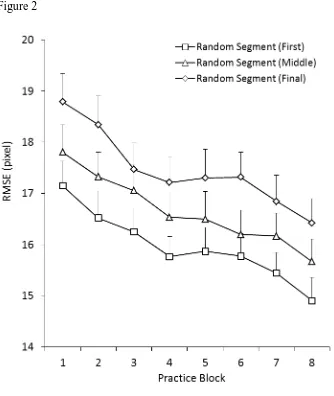
evident, F(3.70, 99.83) = 19.76, p < .001. As illustrated in Figure 2, RMSE in all three
segments decreased across the practice phase, suggesting a general improvement in
tracking with practice. A main effect of Segment was also evident, F(2, 54) = 54.50, p
< .001, with RMSE in Segment 1 significantly lower than in Segment 2 (p < .001),
and RMSE in Segment 2 significantly lower than in Segment 3 (p < .001). No
Figure 2
Observation of Figure 2 suggests that the time-on-task effect was roughly linear
(i.e., performance on the second segment is approximately halfway between the first
and final segments). To confirm this observation, we conducted an analysis to
compare tracking performance on the middle segment (M = 16.654, SE = .451) to a
computed average of tracking performance on the first and final segments (M =
16.709, SE = .444). A 2 (Segment) x 8 (Block) ANOVA with repeated measures of
performance during practice showed no significant effect of Segment, F(1, 27) = .30,
analysis suggests that the time-on-task effect is more or less linear.
Discussion
Previous findings have reported that tracking performance declines across a
continuous tracking task trial (Pew, 1974; Sekiya, 2006). This experiment provides
clear evidence to support this observation. Participants tracked a waveform pattern
comprised of 3 different (random) segments on every trial. A learning effect was
evident, suggesting that a general improvement in participants’ tracking capabilities
occurred. More significantly, tracking performance was consistently poorer on the
final segment of the waveform compared to the middle segment and in turn on the
middle segment compared to the first segment. This stepwise decrease in tracking
performance as the tracking trial progressed was evident from the very onset of
practice (see Figure 2).
The major implication of this finding is that between-segment comparisons to
verify learning of a repeated waveform pattern, commonly employed in the literature
(e.g., Chambaron et al., 2006; Wulf & Schmidt, 1997), may be confounded by a
time-on-task effect. Researchers must be careful, therefore, to design continuous
tracking paradigms that guard against such an effect. The standard method of
assessing learning of the repeated waveform pattern is to compare tracking
performance on the repeated segment (i.e., middle segment) with averaged tracking
performance of two random segments (i.e., first and final segments, e.g., Chambaron
et al., 2006; Wulf & Schmidt, 1997). Averaging tracking performance on the first and
assumes that this degradation is linearly related to time on task. The findings of
Experiment 1 add a degree of support to this assertion, and the use of this approach.
To be certain that the time-on-task effect is negated, however, one solution is to
construct a waveform pattern with just two segments, one repeated and one random,
and counterbalance the order of presentation of the segments across practice trials
(e.g., Vidoni & Boyd, 2008 & 2009; Vidoni, McCarley, Edwards, & Boyd, 2009).
Another solution is to verify learning not by conducting within-trial performance
comparisons, but by introducing a transfer test in which the repeated pattern
embedded in the middle segment of the waveform throughout practice is replaced by
a random pattern (such that the trial comprises three random segments) and
conducting between-trial performance comparisons. Poorer tracking performance on
the middle segment in the transfer test would provide evidence that characteristics of
the repeated waveform pattern have been learned. Since the repeated pattern tracked
throughout practice and the random pattern tracked only in the transfer test are
presented in the same time window of the trial (i.e., middle segment), this approach
overcomes the possible confound of a time-on-task effect. Such an approach is
analogous to that used in the serial reaction time task paradigm to assess (implicit)
learning of finger tapping sequences (e.g., Destrebecqz & Cleeremans, 2001; Reed &
Johnson, 1994; Shanks & Johnstone, 1999).
EXPERIMENT 2
waveform pattern can occur using the continuous tracking paradigm. Rather than all
participants tracking a common waveform pattern throughout practice, we selected 15
waveform patterns from the pool of 3108 random waveform patterns generated for
Experiment 12, and randomly assigned a different pattern to each participant. This approach guarded against the possibility of selecting a pattern for all participants to
learn, which contained a quirk that made more identifiable or easier to track.
Following practice, we introduced a test phase on a second day that comprised a
retention test, which included the repeated pattern, and a transfer test, which did not
(as we recommended in Experiment 1). Superior tracking performance in the retention
test of the repeated segment compared to the mean tracking performance on the first
and final random segments, and decreased tracking performance on the middle
(random) segment of the transfer test compared to the middle (repeated) segment of
the retention test, were both taken as evidence of learning. To indicate whether
learning of the repeated waveform pattern was implicit, awareness of the existence
and configuration of the repeated pattern was examined by a series of recognition
tests (see Wulf & Schmidt, 1997).
Method
Participants
Fifteen right-handed university students (M age = 22.73, SD = 3.67, 7 male and 8
female) with normal or corrected-to-normal vision volunteered to participate. No
2 Both the mean velocity and the mean acceleration of the 15 waveform patterns selected were within
0.1x standard deviations of both the averaged mean velocity and the averaged mean acceleration of the
participant had prior experience of the task. Payment and the manipulation to
maintain motivation were identical to Experiment 1. All participants provided
informed consent.
[image:15.595.92.498.248.461.2]Task, procedure, and dependent measures
Figure 3
The task and procedure were identical to Experiment 1 with three exceptions. First,
the middle segment of the waveform was a pattern that repeated on each trial of
practice and it differed for each participant3. Second, to guard against the performance degradation across a trial (as revealed in Experiment 1), we compared tracking
performance on the middle segment with averaged tracking performance on the first
and final segments. Third, tracking performance following practice was examined in
both a delayed retention test and a delayed transfer test on a second day, the order of
3 Again, post-hoc analyses of mean segment velocity and of mean segment acceleration showed no
significant between-segment effects, suggesting that complexity among the three random segments was
which was counterbalanced. In the transfer test, the repeated waveform pattern was
replaced by a previously unpracticed random waveform pattern, such that each
segment of the four transfer-test trials was random. Fourth, after the experiment,
participants completed a series of recognition tests to ascertain whether the repeated
segment had been detected and whether characteristics of the repeated waveform
could be identified. Participants were first asked if they had noticed anything in
particular about the tracking pattern and then if they had noticed repetition of any part
of the waveform pattern. Participants were informed that one third of the waveform
was in fact repeated on every trial and were asked to try to identify the pattern by
selecting a segment of waveform from a selection of six printed on a sheet of paper.
One segment represented the repeated pattern, whereas the other five segments were
generated randomly and had not appeared in previous trials. Finally, in a second
forced-choice recognition test, participants watched one trial of the tracking task. The
location of the repeated waveform (e.g., first, middle or final segment) was random
for each participant. Participants were asked to indicate the position of the repeated
waveform following the trial. Dependent measures were identical to Experiment 1.
Results
Performance
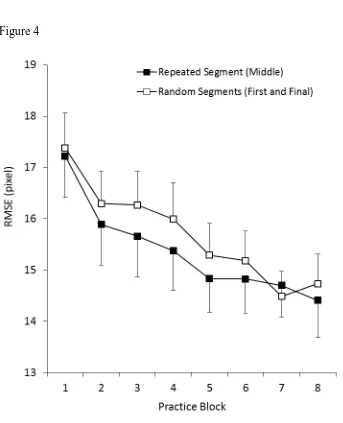
Tracking performance (RMSE) on the middle repeated segment and the averaged
tracking performance of the two random segments during practice were analyzed by a
2 (Segment) x 8 (Block) ANOVA with repeated measures. A main effect of Block was
repeated and random segments decreased across the practice phase, suggesting
general improvements in tracking. However, neither a main effect of Segment, F(1, 14)
= 1.97, p = .182, nor a Segment x Block interaction, F(7, 98) = 1.23, p = .291, was
[image:17.595.91.434.213.636.2]evident.
Figure 4
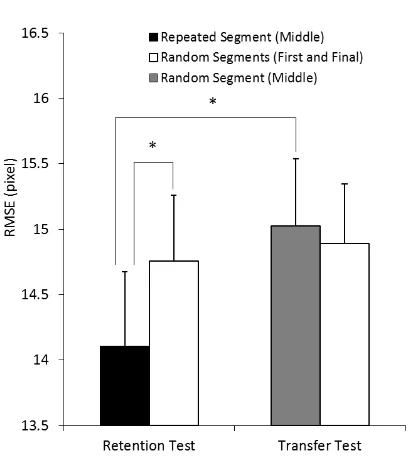
Tracking performance (RMSE) in the retention test and the transfer test for each
segment was analyzed by a 2 (Segment) x 2 (Test) ANOVA with repeated measures. A
Segment, F(1, 14) = 3.86, p = .07, approached significance. Crucially, a significant
Segment x Test interaction effect, F(1, 14) = 4.75, p < .05, was evident. Further
analysis confirmed that the increase in RMSE when the repeated waveform pattern in
the retention test was replaced by a random waveform pattern in the transfer-test (see
Figure 5) was significant (p < .01). In contrast, RMSE associated with the random
segments in the retention test and the (first and final) random segments in the transfer
test was not significantly different (p = .314). Furthermore, in the retention test the
RMSE of the repeated (middle) segment was significantly lower than the RMSE of the
random segments (p < .05), whereas, in the transfer test RMSE of the now random
middle segment was not significantly different from the mean RMSE of the other two
Figure 5
Recognition Tests
No participant commented on a particular aspect of the tracking pattern or reported
awareness of a repeated waveform pattern within a tracking trial. In the first
forced-choice recognition test, only 1 of the 15 participants correctly selected the
forced-choice recognition test, 5 of the 15 participants correctly identified the segment
position of the repeated waveform, consistent with chance level performance. None of
these five had correctly identified the repeated segment in the first forced-choice
recognition test.
Discussion
The continuous tracking task paradigm was investigated to determine whether
characteristics of a waveform pattern that, unbeknown to participants, repeated on
every trial of practice, could be learned and whether the learning was implicit. To
overcome the confounding step-wise influence of the time-on-task effect shown in
Experiment 1, tracking performance on the first and final segments of the waveform
was averaged for comparison to the repeated middle segment of the waveform and a
transfer test was introduced, in which a previously unseen segment of waveform was
inserted in place of the repeated waveform. In the retention test, tracking performance
on the repeated segment was superior to tracking performance on the random
segments. Furthermore, substitution of the repeated pattern with a random pattern in
the transfer test increased tracking error on the middle segment. These findings imply
that characteristics of the reported pattern were learned. Analysis of both the mean
velocity and the mean acceleration of the waveforms suggested that between-segment
complexity was appropriately controlled for.
In keeping with notions that sleep consolidates motor learning (Siengsukon &
Boyd, 2009a; Siengsukon & Boyd, 2009b), trends towards superior tracking
significant until the delayed retention test on a second day. This highlights the
methodological importance of delayed retention tests to quantify the true extent of
motor learning. Finally, tests of pattern recognition suggested that participants were
not consciously aware of the presence of a repeated waveform pattern and could not
reliably identify characteristics of the pattern.
GENERAL DISCUSSION
In two experiments, we examined the validity of the continuous tracking task
paradigm for investigating implicit learning. The reliability of findings from previous
work that has used the paradigm have been questioned due to uncertainties about the
control of complexity across the repeated waveform pattern and the random patterns
with which tracking performance is compared (Chambaron et al., 2006). In this study,
the generation of waveform patterns was controlled by stipulating a tighter range of
coefficient values and of mean velocity, which in turn controlled for acceleration.
Furthermore, in Experiment 2 each participant was assigned a different, strictly
controlled, waveform pattern to guard against the possibility of participants learning a
pattern with idiosyncrasies that made it easier (or harder) to track, or more
recognizable.
A second issue associated with the paradigm is that tracking performance
decreases as a function of time on task (e.g., Pew, 1974; Sekiya, 2006), which may
provides clear evidence of a time-on-task effect. Two possible explanations for the
effect are mental fatigue or boredom; however, one would expect these factors to have
a cumulative effect that results in larger between-segment discrepancies towards the
end of apractice session. This was not the case. An alternative explanation, proposed
by Sekiya (2006), is that concentration degrades as each trial progresses. It is beyond
the scope of the current study to verify whether concentration or attention changes as
a consequence of time-on-task. Electroencephalography (EEG) methodology has
identified theta power at the frontal cortex region as a marker of attention control and
has increasingly been used as a means to evaluate temporal changes in cortical
activity in motor control tasks (e.g., Baumeister, Reinecke, Schubert, Schade, & Weiss,
2012; Doppelmayr, Finkenzeller, & Sauseng, 2008; Zhu, Maxwell, Hu et al., 2010).
Zhu, Poolton, Wilson, Hu, Maxwell, and Masters (2011a) employed EEG
methodology in a three segment continuous tracking task, but unfortunately did not
specifically analyze theta power at the frontal region. Future use of EEG may help
unpick the cortical activity changes that underlie the time-on-task effect. A different
explanation for the time-on-task effect is that blink rate increased across a trial,
causing participants to miss information that was necessary for accurate tracking. In
this experiment, participants were required to track the target for 51 seconds in each
trial. Blinking may have become more frequent in the second and third parts of each
trail as a consequence of drying of the ocular surface (e.g., Acosta, Gallar, &
Belmonte, 1999). If this was the case, a simple measure of blink rate should positively
Although the underlying cause of the time-on-task effect is unclear, it should be
considered when designing experiments using the continuous tracking task paradigm.
Experiment 1 suggested that the time-on-task effect was linear across segments, so in
Experiment 2 we adopted the method of averaging the tracking performance of the
first and final (random) segments (see Chambaron et al., 2006; Wulf & Schmidt, 1997)
to control for performance degradation across a trial. The ensuing comparison of
tracking performance on the repeated segment with that on the random segments in
the retention test showed superior tracking performance on the repeated segment;
suggesting that elements of the repeated waveform had been learned. To further
control for the time-on-task effect, we took the additional step of including a transfer
test alongside the retention test, in which the repeated segment was replaced by a
previously unseen (random) segment of waveform. This manipulation resulted in
lower tracking performance, providing further support for the notion that the
continuous tracking paradigm allows specific characteristics of a repeated waveform
pattern to be learned.
As a gauge of participants’ explicit knowledge about the repeated waveform, a
protocol of generic questioning and forced-choice recognition tests was included, in
keeping with previous work (e.g., Wulf & Schmidt, 1997). Overall, there was minimal
explicit awareness of the existence of a repeated waveform or of the configuration of
the pattern. There has been much debate about the credibility of such recognition tests
when evaluating the implicit or explicit make-up of the knowledge supporting
2003; Shanks & Johnstone, 1999). Informed identification of the repeated pattern may
require explicit knowledge of the entire segment of waveform (Perruchet et al., 2003);
however, increased tracking performance may only require explicit knowledge of
distinct characteristics or certain chunks of the waveform pattern. Whether explicit
knowledge of these characteristics was available to participants cannot be ascertained
fully from the recognition tests that were used. Future work using the continuous
tracking task paradigm should find alternative means by which to verify the processes
that underlie learning of waveform characteristics.
The measure of cortical activity by EEG methodology may provide insight in
this regard. As an informative index of the involvement of explicit processes in motor
control and learning, Hatfield and his colleagues recommend an analysis of the degree
of linear relatedness or ‘co-activation’ between the left temporal brain region (T3),
associated with verbal-analytical activity (Haufler, Spalding, Santa Maria, & Hatfield,
2000; Kerick, McDowell, Hung, Santa Maria, Spalding, & Hatfiled, 2001), and the
frontal midline region (Fz), associated with motor planning, in the alpha frequency
bandwidth. Low T3-Fz coherence is thought to reflect less dependence on explicit
processes for motor performance (see Deeny, Hillman, Janelle, & Hatfield, 2003; Zhu,
Poolton, Wilson, Maxwell, & Masters, 2011b). As such, expert marksmen displayed
lower EEG T3-Fz coherence than less skilled shooters (Deeny et al., 2003) and novice
golfers who used an implicit motor learning paradigm (Masters, 1992; Maxwell,
Masters, Kerr, & Weedon, 2001) displayed lower EEG T3-Fz coherence than more
tracking task paradigm for laparoscopic surgical skills training, T3-Fz alpha power
coherence was greater when participants were made aware of the repeated waveform
pattern compared to when participants were not, suggesting that T3-Fz alpha power
coherence reflects the use of explicit knowledge of characteristics of the pattern to
support tracking performance (Zhu et al., 2011a). In the current study, higher T3-Fz
coherence in the repeated middle segment compared to previously unseen random
segments would be expected if explicit knowledge about the pattern of the waveform
was used.
This study of the continuous tracking task for implicit learning research leads
to a number of recommendations for the appropriate use of the paradigm. First,
measures should be taken to control between-segment waveform complexity,
particularly segment velocity and acceleration. Having each participant track a
different repeated waveform pattern, as suggested by Chambaron et al. (2006), can
further reduce the chance that the repeated segment is less complex than random
segments due to some idiosyncratic characteristic of the selected pattern. Second, the
time-on-task effect should be taken into account when searching for evidence of
learning. One solution is to compare the tracking performance on the repeated
segment with the averaged tracking performance of the two random segments.
Another is to include a transfer test in which the repeated segment is replaced by a
random segment. Third, the retention test should be conducted on a second day to
allow offline consolidation of learning to occur. Last, better ways of evaluating the
need to be implemented. Neurophysiological measures may provide objective insight
in this regard. Adherence to these recommendations should increase the reliability of
findings from the continuous tracking task paradigm and will enhance confidence in
the paradigm’s use as a tool with which to investigate implicit learning.
References
Acosta, M. C., Gallar, J., & Belmonte, C. (1999). The influence of eye solutions on
blinking and ocular comfort at rest and during work at video display terminals.
Experimental Eye Research, 68, 663-669
Baumeister, J., Reinecke, K., Schubert, M., Schade, J., & Weiss, M. (2012). Effects of
induced fatigue on brain activity during sensorimotor control. European
Journal of Applied Physiology, 112,2475-2482
Boyd, L. A., & Winstein, C. J. (2004). Providing explicit information disrupts implicit
motor learning after basal ganglia stroke. Learning and Memory,11, 388-396.
Chambaron, S., Ginhac, D., Ferrel-Chapus, C., & Perruchet, P. (2006). Implicit
learning of a repeated segment in continuous tracking: A reappraisal.
Quarterly Journal of Experimental Psychology, 59, 845-854.
Deeny, S. P., Hillman, C. H., Janelle, C. M., & Hatfield, B. D. (2003). Cortico-cortical
communication and superior performance in skilled marksmen: An EEG
coherence analysis. Journal of Sport and Exercise Psychology, 25, 188-204.
Destrebecqz, A., & Cleeremans, A. (2001). Can sequence learning be implicit? New
Review, 8, 343-350.
Doppelmayr, M., Finkenzeller, T., & Sauseng, P. (2008). Frontal midline theta in the
pre-shot phase of rifle shooting: Differences between experts and novices.
Neuropsychologia, 46, 1463-1467.
Haufler, A. J., Spalding, T. W., Santa Maria, D. L., & Hatfield, B. D. (2000).
Neuro-cognitive activity during a self-paced visuospatial task: Comparative
EEG profiles in marksmen and novice shooters. Biological Psychology, 53,
131-160.
Kerick, S. E., McDowell, K., Hung, T.-M., Santa Maria, D. L., Spalding, T. W., &
Hatfield, B. D. (2001). The role of the left temporal region under the cognitive
motor demands of shooting in skilled marksmen. Biological Psychology, 58,
263-277.
Masters, R.S.W. (1992). Knowledge, knerves and know-how: The role of explicit
versus implicit knowledge in the breakdown of a complex motor skill under
pressure. British Journal of Psychology, 83, 343-358.
Maxwell, J. P., Masters, R. S. W., Kerr, E., & Weedon, E. (2001). The implicit benefit
of learning without errors. Quarterly Journal of Experimental Psychology
Section A: Human Experimental Psychology, 54, 1049-1068.
van Ooteghem, K., Frank, J. S., Allard, F., Buchanan, J. J., Oates, A. R., & Horak, F.
B. (2008). Compensatory postural adaptations during continuous, variable
amplitude perturbations reveal generalized rather than sequence-specific
Perruchet, P., Chambaron, S., & Ferrel-Chapus, C. (2003). Learning from implicit
learning literature: Comment on Shea, Wulf, Whitacre, and Park (2001).
Quarterly Journal of Experimental Psychology Section A: Human
Experimental Psychology, 56, 769-778.
Pew, R. W. (1974). Levels of analysis in motor control. Brain Research, 71, 393-400.
Reber, A. S. (1967). Implicit learning and Tacit knowledge. New York: Oxford
University Press.
Reed, J., & Johnson, P. (1994). Assessing Implicit Learning With Indirect Tests:
Determining What Is Learned About Sequence Structure. Journal of
Experimental Psychology: Learning, Memory, and Cognition, 20, 585-594.
Sekiya, H. (2006). Contextual interference in implicit and explicit motor learning.
Perceptual and Motor Skills, 103, 333-343.
Shanks, D. R., & Johnstone, T. (1999). Evaluating the Relationship between Explicit
and Implicit Knowledge in a Sequential Reaction Time Task. Journal of
Experimental Psychology: Learning Memory and Cognition, 25, 1435-1451.
Shea, C. H., Wulf, G., Whitacre, C. A., & Park, J. H. (2001). Surfing the implicit wave.
Quarterly Journal of Experimental Psychology Section A: Human
Experimental Psychology, 54, 841-862.
Siengsukon, C. F., & Boyd, L. A. (2009a). Sleep to learn after stroke: Implicit and
explicit off-line motor learning. Neuroscience Letters, 451, 1-5.
Siengsukon, C. F., & Boyd, L. A. (2009b). Does sleep promote motor learning?
Vidoni, E. D., & Boyd, L. A. (2008). Motor sequence learning occurs despite
disrupted visual and proprioceptive feedback. Behavioral and Brain Functions,
4, 32.
Vidoni, E. D., & Boyd, L. A. (2009). Preserved motor learning after stroke is related
to the degree of proprioceptive deficit. Behavioral and Brain Functions, 5, 36.
Vidoni, E. D., McCarley, J. S., Edwards, J. D., & Boyd, L. A. (2009). Manual and
oculomotor performance develop contemporaneously but independently
during continuous tracking. Experimental Brain Research, 195, 611-620.Wulf,
G., & Schmidt, R. A. (1997). Variability of practice and implicit motor
learning. Journal of Experimental Psychology: Learning Memory and
Cognition, 23, 987-1006.
Zhu, F. F., Maxwell, J. P., Hu, Y., Zhang, Z. G., Lam, W. K., Poolton, J. M., et al.
(2010). EEG activity during the verbal-cognitive stage of motor skill
acquisition. Biological Psychology, 84, 221-227.
Zhu, F. F., Poolton, J. M., Wilson, M. R., Hu, Y., Maxwell, J. P., & Masters, R. S. W.
(2011a). Implicit motor learning promotes neural efficiency during
laparoscopy. Surgical Endoscopy, 25, 2950-2955.
Zhu, F. F., Poolton, J. M., Wilson, M. R., Maxwell, J. P., & Masters, R. S. W. (2011b).
Neural co-activation as a yardstick of implicit motor learning and the
propensity for conscious control of movement. Biological Psychology, 87,
List of Figures
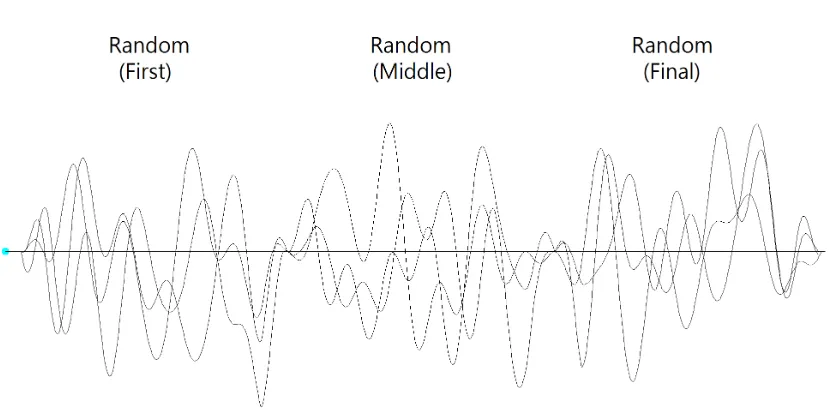
Figure 1. Examples of tracking waveform patterns used in Experiment 1.
Figure 2. Mean tracking performance (RMSE) across practice for each of the three
random segments.
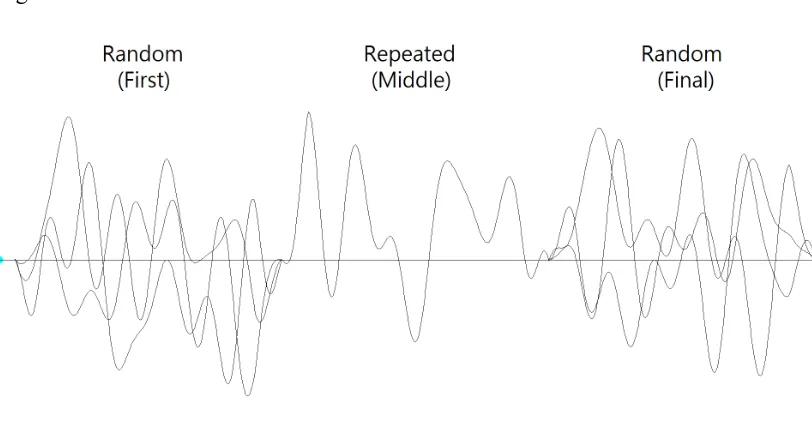
Figure 3. Examples of tracking waveform patterns used in Experiment 2.
Figure 4. Mean tracking performance (RMSE) across practice for the repeated
segment and the random segments in Experiment 2.
Figure 5. Mean tracking performance (RMSE) in the retention test and in the transfer