GST- Indirect Tax Reform
Preeti Chandra1, Shradha Panwar2
1
Research Scholar, Dept. of Economics, Radhe Hari Govt.(PG) College Kashipur (Kumaun University, Nainital), Uttarakhand
2
Research Scholar, Dept. of Commerce, H.N.B. Garhwal University (Srinagar), Uttarakhand
Abstract: With effect from 01 Jul 2017, Indirect Tax reform in the form of GST has been rolled out by the government of India after a long discussion held to reach at consensus in several round of meets between representative of Centre and States. The objective of this paper is to study the concept of GST and its impact on business and household. An attempt is being done through this paper to study concept and broad impact of this transformation of Indirect tax. It is apparent, that the GST is destination based tax hence the end customer has to bear the complete value addition and tax on the goods and services as liability shifts to end user. Further, there is uniformity in GST rates at national level and its digitalization would make it more transparent and business friendly. It is well known that India is fast growing economy in the world and now due to inflow for various foreign direct investment and ease to business policy of the present Government has further enhanced growth rate. The policy ‘One Tax, One Market, One Nation’ will speed up the wheel of growth of Indian economy. With the inception of GST, inflation will come down, tax avoidance will be difficult, generate extra resources to boost welfare, pro-poor and weaker section programmes. This study being descriptive, secondary data will be taken into consideration to support the conclusion. The GST is at beginning stage, its broad impact on business and general people will be a limitation imposing factor on the study due to time constraints.
Keywords: VAT, GST, Economic Growth, Ease to Business, End User.
I. INTRODUCTION
The taxation was born and shaped with civilization. The structure and complexity of the tax system have been developed along with the development of civil society. The sovereign authority of the government to extract tax is the life of taxation, Government’s need for resources is its bargaining power and human instinct of reluctance to sacrifice money is the reason for its mandatory imposition. The taxation policy in ancient India was highly logical and based on the principles of economic theory and equity in comparison with the current taxation policies of the government. The tax system of our ancients was quite reasonable, rational, convenient, elastic, appealing and based on the principles of maximum welfare with some exceptions. Over the centuries system of taxation has been shaped and reshaped to make it acceptable, effective and efficient. The journey of restructuring the tax system has been going on to make it more and more meaningful. While the innovations and development in information and communication technology have made the tax system more objective, transparent and effective, the innovations and developments in finance and business models, globalization and liberalization policies, emergence of MNEs (Multinational Enterprises) as lead players and increase in the international trade have contributed in making the tax system a complex one.
Tax is order of the day and one of the important components of cost of a product or service. The cost of product or service influences, directly or indirectly, profitability of the organization. Hence, the tax aspects play a crucial role in business decisions. In developing countries, positive tax parameters like an efficient and long term fiscal policy, simplified tax structure, reduced tax rates etc. are the key players in attracting the foreign direct investment too. India’s economy has been among the fastest growing economies in recent years. This growth has been supported by several factors like market reforms, large inflow of foreign direct investment, raising foreign exchange reserves, a blooming information technology and real estate sector and flourishing capital market.
In recent years India has been viewed as an attractive and dynamic investment destination, and has witnessed an increased presence of multination enterprises (MNEs) and a consequential increase in cross border trade. This has created many opportunities to the Government for improving tax system of the country. In India, since the inception of New Economic Policy (NEP) in 1991, many economic reforms have been announced and introduced. One major reform undertaken is “Taxation Reforms”. The effect of taxation reforms on business community, in making the Indian Products and services competitive at global level.
improving the tax collection as it will disrupt all the tax barriers between states and integrate country via single tax rate. GST was first introduced by France in 1954 and now it is followed by 160 countries. Most of the countries followed unified GST while some countries like Brazil, Canada follow a dual GST system where tax is imposed by central and state both. In India also dual system of GST is proposed including CGST and SGST.
A. Supplementary Bills of GST in Lok Sabha
At the last, the Lok sabha cleared the much-anticipated bills after lasting 8 hours long debate to ensure to layout road map for smooth GST. In the earliest session lasted 7 hours it was assured that the goods may become slightly cheaper on implementation of the GST as a lot of entry taxes prevailed currently will automatically be removed. The finance Minister Arun Jaitly made the sensitized statement in media that “Lok Sabha having approved all 4 laws that Centre is supposed to legislate through Parliament, I think significant step forward has been taken. We are virtually seeing history in the making because we are now going to be transforming into a new system of indirect taxation.” The minister added that “India remained a different economic entity. Trucks could be seen waiting outside state border, there was no free flow of goods.” The goods and service tax is highly clarified tax regime and has the potential to take the GDP of the country to a plus 2 after its roll out. The following four supplementary bills to roll out the GST were taken in the Lok Sabha:-
1) Central Goods and Service Tax
2) Compensation GST bill
3) Integrated GST bill
4) UTGST
II. OBJECTIVE OF STUDY
A. The study has following objectives:
1) To study the concept of Goods and Services Tax (GST)
2) To study the impact of GST on businesses
3) To study the impact of Goods and Services Tax (GST) transparency to tax burden
III. LITERATURE REVIEWS
Garg (2014) mentioned in his study that GST is the only indirect tax that directly affects all sectors and sections of our economy. The goods and services tax (GST) is aimed at creating a single, unified market that will benefit both corporate and the economy. Shaik, Sameera and Firoz (2015) mentioned in their study the implementation of GST would help to maintain simplicity and transparency by treating all the goods and services as equal. GST would possibly be a collective gain for industry, trade, agriculture and common households as well as for the Central and the State Government.
Sehrawat and Dhanda(2015) evaluated the advantages and challenges of GST. The study concluded that apart from establishing an effective and transparent tax administration and removing the cascading effects of taxes, GST has advantages like single base computing system; export will be zero rate, simple tax structure.
Dani(2016) studied the impact of Goods and Service Tax on Indian Economy. The conclusion drawn was that there are certain loopholes in the proposed GST. If there is general agreement over issues like threshold limit, revenue rate, electricity and liquor etc, GST would simplify the existing tax system.
Kawle, and Aher (2017) studied the impact of GST on Indian Economy. The study concluded that as GST is single tax system, it would record a significant economic development and economic growth of the country by removing the biggest hurdle like multiple tax and complex taxation system from the economy.
Lourduna than and Xavier(2017) studied the implementation of Goods and Service Tax(GST in INDIA). The study concluded that by including all the several taxes together will provide relief to producers and the end consumer.
IV. RESEARCH METHODOLOGY
Basically, the study focuses on extensive study of secondary data, collated from various books, newspapers, respective Govt. portal, news articles through internet has been put into use being an explanatory nature.
Fig.1. Filtering of all indirect tax into one tax (GST)
By Introduction of GST on 1st July,2017 all indirect taxes are subsumed in GST. Total 17 different taxes and 22cess are abolished by introduction of single tax GST (Goods and Service Tax). Taxes removed by introduction of GST are Central Excise Duty, Service Tax, Value Added Tax, Countervailing duty, Custom Duty, Entertainment Tax, Luxury Tax, Lottery Tax, State Surcharge, Sales Tax, Antidumping duty, Swachchh Bharat Cess, Krishi Kalyan Cess, Infrastructure Cess & Education Cess.
Goods & Services Tax Law in India: Goods & Services Tax Law in India is a comprehensive, multi-stage, destination-based tax that will be levied on every value addition. In simple words, GST is an indirect tax levied on the supply of goods and services. GST Law has replaced many indirect tax laws that previously existed in India. So, before GST, the pattern of tax levy was as follows:
Buying raw materials Manufacture
VAT VAT- Excise
Sale to Wholesaler/ Warehousing
VAT
Final sale to consumer Sale to retailer
VAT
Flow Chart 1- Pattern of Tax Levy (Before GST)
Under the GST regime, tax will be levied at every point of sale. Now, “GST is a comprehensive, multi-stage tax that will be levied on every value addition.”
There are multiple change-of-hands an item goes through along its supply chain: from manufacture to final sale to consumers.
Buying raw materials Manufacture
Sale to Wholesaler / Warehousing
Final sale to consumer Sale to retailer
Flow Chart 2- Supply Chain (Final Sale to Consumer)
GST
CESSES INDIRECT
TAXES
Sale to the end consumer Goods and Services Tax will be levied on eachof these stages, which makes it a multi-stage tax.
A. Value Addition
The manufacturer who makes shirts buys yarn. The value of yarn gets increased when the yarn is woven into a shirt. The manufacturer then sells the shirt to the warehousing agent who attaches labels and tags to each shirt. That is another addition of value after which the warehouse sells it to the retailer. The retailer packages each shirt separately and invests in the marketing of the shirt thus increasing its value. GST will be levied on these value additions i.e. the monetary worth added at each stage to achieve the final sale to the end customer.
B. Components of GST
Under the theory one nation one tax, The Goods and Service Tax (GST) is a comprehensive value added Tax on the supply of Goods and Services. GST replaced all the indirect taxes (like Excise duty, VAT, CST etc.) levied on goods and services by Government on its implementation. The main motive of GST is to reduce the cascading effect of tax on the cost of goods and services and create a common, cooperative and undivided Indian market to make economy stronger and powerful. So the GST system has combined Central excise duty, additional excise duty, service tax, State VAT entertainment tax etc. under one banner. It will impact tax structure, tax incidence, tax computation, credit utilization and reporting, leading to a complete overhaul of the current indirect tax system. This is one of the biggest taxation reforms that took place in India on its officially passing by the Government. Many countries across the world have single unified GST system but due to non-consensus between central and state government of India, India adopted a Dual GST model, meaning that the GST would be administered both by the Central and the State Governments. A Dual GST will be levied on the taxable value of every transaction of supply of goods and services.
1) State Goods and Services Tax (SGST), collected by the state government
2) Central Goods and Services Tax (CGST), collected by the central government
3) Integrated Goods and Service Tax (IGST), collected by the central government on inter-State supply of goods and services.
4)
C. Model (Explanation)
1) Centre GST: Under CGST, a single National Tax is levied on goods and services exchanged and revenue so generated is shared by the state and central govt. In this model of taxation, the Centre collects total tax revenue leaving little for state government.
2) State GST: Under this model of taxation, the State levy GST and the Centre withdraws from the field of GST or VAT completely. Thus the revenue collection of the state increased and dependence on the centre is lesser. The compensation of revenue to the center is done by reduction in fiscal transfer to the states.
C. Dual GST Model
1) Concurrent Duel GST-Under this system, GST is levied both Governments concurrently whereas under existing system centre can levy tax on goods and services such excise duty on manufacture of goods and services and state has no power to levy tax on manufactured goods. The Central GST is administered by the Central Government and State GST is administered by State Governments. Kelkar Committee in 2002, recommended this type of model.
2) Advantages
a) Cascading effect of tax removed
b) A single and unified taxation will be beneficial for corporate and economy in country.
c) Make in India brand will be benefited.
d) No big changes need in existing structure of taxation.
e) Maintains balance fiscal autonomy between centre and state.
3) Disadvantages
a) Maintaining uniform rate of taxation on goods and services among the state will be challenging.
b) Non-concurrent Dual GST
will allow an input credit for the tax on goods levied by the States. This model has not been accepted either by Centre or State. The Govt. has already rolled out the concurrent Dual GST on goods and services to take place in interstate trade.
D. Significance of GST
GOODS AND SERVICE TAX
Positive Impact on GDP Simplicity Transparency
Flow Chart 3-Significance of GST
Goods & Service Tax (GST) or VAT serves the purpose to impose a broad-based tax on final consumption by households. Hence, GST is a comprehensive tax levy on supply of goods and services.
1) Both Government and Industry are keen to implement GST
2) Governments are looking at increasing the tax base and tax collections (i.e. increase revenue buoyancy) through GST
3) State is looking at GST as a window for taxing services
4) Centre is looking at GST to go beyond the point of manufacture
5) Industry wants GST to eliminate the cascading effect of taxes
GST would also address issues of development through greater interaction between VAT/GST systems, along with growing risks of double taxation and unintended non-taxation in the absence of international VAT/GST coordination. Basic principles of VAT/GST are generally same across the tax jurisdictions in so far as they are designed to tax final consumption in the jurisdiction where it occurs according to the destination principle. The fundamental proposition is that GST/VAT is a tax on final consumption and hence the burden should not rest on the business.
VI. IMPACT OF GST ON BUSINESSES
GST is purported to bring in the ‘one nation one tax’ system, but its effect on various industries will be slightly different. The first level of differentiation will come in depending on whether the industry deals with manufacturing, distributing and retailing or is providing a service.
1) Ease of Beginning a New Business: Any new business needs a VAT registration from State’s sales tax department. GST will achieve a consistency in procedure and centralized registration that will help to start business and its expansion in various States without any hassle.
2) Exemption for New Startups and Small Businesses: GST will increase the limit, upto Rs 10 lakhs and further, organizations with turnover between Rs 10 and 50 lakhs will pay tax at a lower rate. This will bring relief from taxation rates to recently settled business.
3) Easy Taxation System: With the introduction of GST, the complexity of the procedure will be reduced by incorporating all the expenses and by making the taxpaying way less difficult
4) Relief for Business in Both Sales and Services: GST won’t make difference between services and sales, and in this way the expense computation will be done on aggregate amount
5) Decrease in Transportation Cost across the Country: GST will cut down expenses related to keeping high stocks, as there will now be no disorder in the movement of goods across states. According to a CRISIL investigation, GST can decrease logistics
Increase in
economicactivity lead to
increase in development
activities
-Certainly
-Common Law
-Cost Reduction
- Uniformity
-Ease of compliance
-Saving to industry/govt.
and consumer
-Total tax element for
consumer is reflected on
the invoice
expenses of organizations delivering non-mass products (including all goods like steel, nourishment grains, manures, transported by railroads) by as much as 20 %.
6) Impact of GST on Manufacturers, Distributor and Retailers: Multiple indirect taxes have increased the administrative costs for manufacturers and distributors and it is being hoped that with GST in place, the compliance burden will ease and this sector will grow more strongly.
VII. ANALYSIS AND DISCUSSION
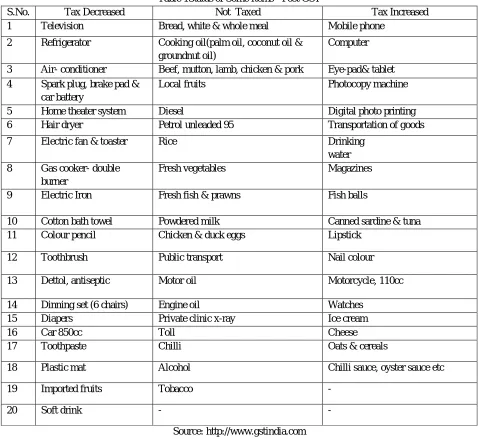
[image:7.612.67.545.240.679.2]Table 1 presents the impact of GST after completion, which shows the changes in rate of goods increasing and decreasing and also presents some goods on which there is no tax after implementation of GST. According to table 1, the first row presents the goods whose rates has been decreased and third row presents increasing rates of goods after GST. But there are some of the items in which GST is not implemented, second row shows.
Table 1Status of Some Items - Post GST
S.No. Tax Decreased Not Taxed Tax Increased
1 Television Bread, white & whole meal Mobile phone
2 Refrigerator Cooking oil(palm oil, coconut oil &
groundnut oil)
Computer
3 Air- conditioner Beef, mutton, lamb, chicken & pork Eye-pad& tablet
4 Spark plug, brake pad &
car battery
Local fruits Photocopy machine
5 Home theater system Diesel Digital photo printing
6 Hair dryer Petrol unleaded 95 Transportation of goods
7 Electric fan & toaster Rice Drinking
water
8 Gas cooker- double
burner
Fresh vegetables Magazines
9 Electric Iron Fresh fish & prawns Fish balls
10 Cotton bath towel Powdered milk Canned sardine & tuna
11 Colour pencil Chicken & duck eggs Lipstick
12 Toothbrush Public transport Nail colour
13 Dettol, antiseptic Motor oil Motorcycle, 110cc
14 Dinning set (6 chairs) Engine oil Watches
15 Diapers Private clinic x-ray Ice cream
16 Car 850cc Toll Cheese
17 Toothpaste Chilli Oats & cereals
18 Plastic mat Alcohol Chilli sauce, oyster sauce etc
19 Imported fruits Tobacco -
20 Soft drink - -
Source: http://www.gstindia.com
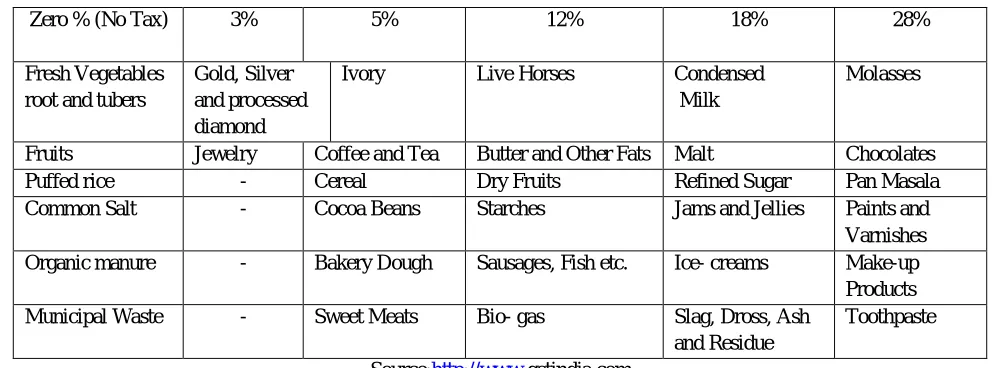
Table Six-Slab Tax Rate Structure Adopted for the GST
Source:http://www.gstindia.com
A. GST- ‘Destination-based’ instead of ‘Origin-based’
There is a common saying that GST in India is a 'destination-based consumption tax'. To justify the features and related advantages of destination based consumption tax, we shall have to understand the 'origin-based GST' and its relevance in comparison.
DESTINATION BASED– GST ORIGIN-BASED GST
It is imposed on the value added of all taxable
products that are consumed domestically.
Location of Production
Imports are not taxed but Exports are taxed under
origin principle in an open economy
It is imposed on the value added of all taxable products that are produced domestically
Location of Consumption
Exports are not taxes but imports are taxed under
destination principle in an open economy
Note: In closed economy, both are same; the question of taxation of either imports or exports does not arise at all.
OECD VAT guidelines support the adoption of the "Destination Principle" for supplies of services and intangibles. This guideline support the universal adoption of the 'destination principle' as a means of reducing both potential double taxation (i.e. supplies being taxed in both the source and destination) and potential under taxation (i.e. supplies not being taxed in either the source or the destination).
B. Illustration
AnX manufactures goods. He bought goods for Rs. 1, 40,000 and incurred expenses of Rs. 10,000. These manufactured goods were sold for Rs. 1, 65,000. Say, CGST rate 10% & SGST rate 10%. Compute Sale Price.
Intra-state sale Inter-state sale
Particulars Amount (Rs.) Particulars Amount(Rs.)
Cost of Goods 1,40,000 Cost of Goods 1,40,000
Add: Expenses 10,000 Add: Expenses 10,000
Add: Profit ( = SP - TC) 15,000 Add: Profit ( = SP - TC) 15,000
Sales 1,65,000 Sales 1,65,000
SGST @ 10% 16,500 IGST @ 20% 33,000
CGST @ 10% 16,500 Additional Tax @ 1% 1,650
Sales Price 1,98,000 Sales Price 1,99,650
Zero % (No Tax) 3% 5% 12% 18% 28%
Fresh Vegetables root and tubers
Gold, Silver and processed diamond
Ivory Live Horses Condensed
Milk
Molasses
Fruits Jewelry Coffee and Tea Butter and Other Fats Malt Chocolates
Puffed rice - Cereal Dry Fruits Refined Sugar Pan Masala
Common Salt - Cocoa Beans Starches Jams and Jellies Paints and
Varnishes
Organic manure - Bakery Dough Sausages, Fish etc. Ice- creams Make-up
Products
Municipal Waste - Sweet Meats Bio- gas Slag, Dross, Ash
and Residue
C. Tax Burden
Total 17 Taxes and 22 Cesses has been brought into one tax (GST) by subsuming centre and state imposed taxes from the midnight of Jun 30, 2017 This was felt as burden of having so much of taxes and cess thereon.
1) Transparency - The GST is expected to bring down the rates of products by eliminating cascading tax. Now with the inception
of GST, the end user is able to know the rate of Tax he has paid for the utilized goods and services. The consumer very occasionally gets invoice of the goods which he intends to purchase where mention of taxes charged are never mentioned except VAT. There was complete lack of transparency in the system.
2) Realistic tax burden-The rates of GST has been kept realistic keeping in view the old rate of tax and these rates are being discussed where needed by the GST Council.
3) Business friendly-The faster growth in business and trade is result of efficient taxation and its procedure, which the country is going to see in near future. The reform in taxation is revolutionary in the current tax structure with uniformity, simplification and transparency in processes. It is paving the path for business friendly nation in the world. Reduction in tax burden, logistics and inventory costs, and hassle free movement of goods have a positive and lasting impact on business activity of companies. The reform impacts will be seen on all sections of the business society ranging from small time businessmen to huge conglomerates and from a developing to developed state in India.
4) Hard Pricing : Companies has to pass on the effective reduced tax burden to the consumer failing which anti profiteering body may catch defaulters.
5) Hassle free Movement of Goods: The GST helpeda hassle-free movement of goods and increased profit margins of companies by boosting supply chain in logistic sector. Country’s logistics supply has been transformed with inception of GST, cost has reduced significantly and Inter-state transportation of goods has become more efficient and faster.
6) Increased revenue collection :The GST is likely to increase the government tax revenue 'over time' believes the Niti Aayog. In its three year action plan (2017-18 to20), the government think-tank believes due to a efficient tax system post-GST, tax revenue of the government is expected to grow (in a baseline scenario) to Rs 26.48 lakh crore by 2019-20 from Rs 17.03 lakh crore in 2016-17. The indirect tax to GDP ratio is likely to rise to 5.7 per cent, 5.8 per cent and 5.9 per cent in 2017-18, 2018-19 and 2019-20, respectively, compared to in 2016-17 is 5.6 per cent. Tax buoyancy is ratio of growth rate in tax collection to growth rate in the Gross Value Addition (GVA). A tax buoyancy of greater than 1 means that the tax revenues increase at a faster rate than the nominal GVA.
D. GST (India VS Other Countries)
Table 3 presents a comparison state among countries where GST prevails in various forms showing Tax slabs, name, Threshold exemption Limit, Liability arises on, Returns and payments, Reverse charge Mechanism, Exempt services :-
Table1 3: Comparison Table -GST S.
N
Particulars India Canada UK Singapore Malaysia
1 Name of
GST in the country
Goods and Service tax
Federal Goods and Service Tax & Harmonized Sales Tax
Value Added Tax
Goods and Service Tax
Goods And Services Tax
2 Standard
Rate
0% (for food
staples)3%, 5%, 12%, 18% and 28%(+cess for luxury items)
GST 5% and HST varies from 0% to 15%
20 %
Reduced rates- 5 %, exempt, zero rated
7% Reduced rates- Zero rated, exempt
6%
3 Threshold
exemption Limit
20 lakhs (10 lakhs for NE states)
Canadian $ 30,000 (Approx Rs. 15.6 lakhs in INR)
£ 73,000 (Approx Rs. 61.32 lakhs)
Singapore $ 1 million
(Approx Rs. 4.8 crore)
MYR 500,000 (Approx Rs. 75 lakhs)
4 Liability
arises on
Accrual basis: Issue of invoice OR Receipt of payment
Accrual basis: The date of issue of invoice OR the date of receipt
Accrual Basis: Invoice OR Payment
Accrual Basis: Issue of invoice OR Receipt of payment
-earlier of payment- earlier. OR Supply -earliest Cash basis (T/O upto 1.35mn): Payment
OR Supply - earliest Cash basis:(T/O upto SGD$1mn):
Payment
of invoice OR Receipt of payment
5 Returns and
payments
Monthly and 1 annual return
Monthly, quarterly or annually based on turnover Usually quarterly. Small business option- annual Usually quarterly Business option- Monthly returns. Large organsations- Monthly
6 Reverse
charge Mechanism
Apply on goods (new) as well as services (currently under Service tax)
Reverse charge applies to importation of services and
intangible properties.
Applicable Reverse charge
applies to supply of services
Reverse charge applies to imported services
7 Exempt
services
Manufacture of exempted goods or Provision of
exempted services (to be notified)
Real estate, Financial Services, Rent (Residence), Charities, Health, Education Medical, Education, Finance, Insurance, Postal services Real estate, Financial services, Residential rental Basic food,Health Transportation, Residential property, Agricultural land Source: https://cleartax.in/s/gst-india-and-other-countries-comparison
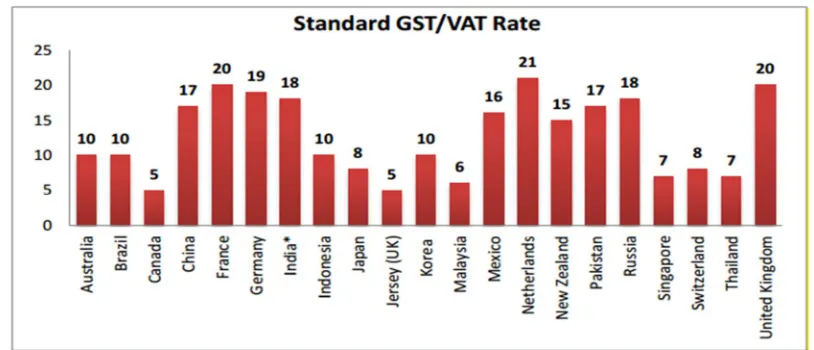
[image:10.612.97.504.531.706.2]Besides the countries tabulated above, there are some other countries which can be referred to while study of imposition of tax is done. In New Zealand, there is no GST on financial services and rental income. Business can recover the amount of tax through input tax. In China, there are 0% 5% and 9%Tax slabs against India’s 0% 5% 12% 18% and 28% GST slabs. While in Indonesia, exporting goods, restaurants and hotel business are exempted from tax. In USA tax are collected at federal level, state level and at local government level at the rate of 10% and 39%. Tax is not imposed on medical equipment and medicine and its export. In India, for efficient tax collection, corruption free taxation, easy movement of goods from one state of other state the GST has been so structured. In our country dues system of GST is imposed which differentiate from other countries. Some countries have VAT system while some has GST system.
VIII. CONCLUSION
GST is a unified indirect tax system which has eliminated cascading effect of taxes thus finally reduced end cost of the product. The main advantage of GST is reduction in manufacturing cost and simultaneously generating higher revenue by curbing tax evasion for the development and boost economy. GST has facilitated trading by replacing17 indirect taxes and 22 cess like VAT, CST, Service tax, Excise tax, educes etc. This unified tax regime will lead to a corruption free trade practices directly and will affect the common men indirectly by passing on the benefits of GST to the end consumers. In detailed study, it is also concluded that GST alone does not determine the final price of goods; there are other factor like the producer/sellers/Traders/consumers and Profit Margin which determines final price of goods. The GST will also be a factor promoting make in India brand as the cost of Indian origin product will be lesser then that of imported article due GST impact. In the long run GSTwill play a crucial and dynamic role in deciding economic growth of the nation and common man/ business decisions. Indeed the simplicity and transparency and uniformity in taxation will generate higher revenue and move the trade towards digitations, a step forward.
REFERENCES
[1] Dani, Shefali. (2016). A Research Paper on an Impact of Goods and Service Tax (GST) on Indian Economy. Business and Economics Journal, 7(4).
[2] Garg, Girish. (2014). Basic Concepts and Features of Good and Service Tax In India. International Journal of scientific research and management (IJSRM), 2(2). 542-549.
[3] Kawle, Pooja, S., & Aher, Yogesh, L. (2017). GST: An economic overview: Challenges and Impact ahead. International Research Journal of Engineering and Technology, 4(4), 2760-2763.
[4] Lourdunathan, F., & Xavier, P. (2017). A study on implementation of Goods and Service Tax(GST) in India: Prospects and Challenges. International Journal of Applied Research, 3(1), 626-629.
[5] Sehrawat, Monika., & Dhanda, Upasana. (2015). GST in INDIA: A Key Tax Reform. International Journal of Research- Granthaalayah, 3(12), 133-141. [6] Shaik, Shakir., Sameera, S, A., & Firoz, SK, C. (2015). Does Goods and Service Tax (GST) leads to Indian Economic Development. Journal of Business and
Management, 17(12), 1-5.
B. Blogs / Website
1) Https://blog.saginfotech.com/impact-gst-bill-different-sectors-india
2) Https://blog.saginfotech.com/supplementary-gst-bills-passed-in-lok-sabha
3) Https://www.quora.com/What-is-the-impact-of-GST-on-building-materials-like-cement-TMT-bars-steel-bricks-paint-etc
4) Https://www.lawyered.in/legal-disrupt/articles/gst-goods-services-tax-everything-you-need-know
5) Http://www.gstindia.com
6) Http://www.hindustantimes.com/india-news/transparency-to-tax-burden-10-ways-in-which-gst-will-impact-people-businesses
7) Https://cleartax.in/s/gst-india-and-other-countries-comparison
8) Http://www.zeebiz.com/india/news-gst-in-india-versus-gst-in-the-other-countries-what-differentiates-india-16838
AUTHORS' BIOGRAPHY
Preeti Chandra has received M.A. degree and pursuing Ph.D. as a Research Scholar, Dept. of Economics, Radhe Hari Govt. (PG) College Kashipur ,USN (Kumaun State University,Nainital), Uttarakhand.
E-mail: [email protected]
Shradha Panwarhas received M.Com. degree and pursuing Ph.D. as a Research Scholar, Dept. of Commerce, H.N.B. Garhwal Central University (Srinagar), Uttarakhand.