Optimal Efficiency Controller of AC Drive System
Rateb H. Issa
Mechatronics Engineering Department Faculty of Engineering Technology
Al- Balqa Applied University
ABSTRACT
This paper has presented a mathematical-based scheme for induction motor drive system leading to efficiency optimization. The proposed scheme uses information on torque of the squirrel cage motor to generate the appropriate voltage amplitude that maximizes the motor efficiency. A constantV/f efficiency controller model has been configured and built depending on a set of experimental data, based on the motor equivalent circuit, using Matlab computer program. The model was validated by simulation using a typical induction motor drive model implemented with Matlab/Simulink.
The aim of this paper is the drive system performance improvement by designing optimal efficiency controller; this will supply stator of the motor with proper voltage and frequency under different loading conditions using appropriate algorithm.
General Terms
Algorithms, Performance, Experimentation.
Keywords
Squirrel CageMotor, Efficiency, Drive System, Optimization, Modeling, Simulation.
1.
INTRODUCTION
The importance of energy saving techniques implementation in industry can be pointed out from two points of view: 1- It is well known that more than 60 % of total generated electrical energy is consumed by electric motors in industry. Therefore, motor energy saving solutions by increasing its efficiency has received considerable attention during the last three decades due to the increase in energy cost [1] & [2]. 2- Three-phase asynchronous motors, especially the squirrel cage type are widely used in industrial electric drives and are responsible for most of energy consumed by electric motors in industry [3]& [4].
Energy saving can be achieved by following means of electric drive system loss reduction:
A- Electric motor selection and design. B- Improvement of power supply parameters. C- Utilizing a suitable optimal control technique. Motor operation under rated conditions is highly efficient [5], however, in many applications, when induction motor works at variable speed it has more losses and less efficiency, so it operates far from the rated point[6].
Under these circumstances, it is not possible to improve the motor efficiency by motor design or by supply waveform shaping technique. Therefore, a suitable control algorithm that minimizes the motor losses will rather take place [7]-[9].
The need of efficient drive system could be achieved by special controllers that not only modify the losses and efficiency, but also searching for the optimal efficiency to reduce the power consumption from the source [10]-[13]. In this paper will be designed an optimal efficiency Controller, which will minimize the motor losses under different loading conditions, by varying stator voltage and frequency as a function of motor load torque, depending on industrial machinery type.
2.
AC Drive System Components
[image:1.595.319.539.406.515.2]The block diagram of voltage source inverter-three-phase squirrel cage induction motor drive system is presented in Figure 1. It consists of three-phase squirrel cage induction motor, IGBT-voltage source inverter-based AC-to-AC converter, and optimal controller [10]. In order to analyze the system performance, all of these components should be modeled [14] & [15].
Fig 1: Block diagram of an inverter-three-phase squirrel cage induction motor drive system
2.1 Squirrel Cage Induction Motor
AC drive systems are used worldwide in many residential, commercial, industrial, and utility applications. Electric motors transform electrical energy into mechanical energy. An AC motor may be part of pump or fan, or connected to some other form of mechanical equipment such as a winder, conveyor, or mixer.
2.1.1 Per-Phase Equivalent Circuit of Induction
Motor
Theper-phaseequivalent circuit of induction motor is shown on figure 2 [16].
Where:
1
R
: Stator resistance. R\o o
S
Fig 2: Per-phase equivalent circuit of induction motor
m
R
: Magnetizing resistance. X1: Stator reactance.X\2:Rotor reactance referred to stator circuit.
m
X
: Magnetizing reactance. I1: Stator current.I\2: Rotor current referred to stator circuit.
m
I
: Magnetizing current.1
V
: Applied phase voltage.S
: Slip of the motor Slip is defined by: (1)Where:
o
: Synchronous speed [red/sec].
: Rotor speed [red/sec].(2) Where:
f
: Three phase source's frequency [Hz].P
: Number of poles.2.1.2 Power Flow Diagram of Induction Motor
The Power flow diagram of induction motor is shown on figure 3[17].
Fig 3: Power flow diagram of induction motor
The power flow diagram components are: Input power is given by:
1 1 1 in
3
V
I
cos
P
(3)Stator copper losses are given by: 1
2 1 1
e
3
I
R
P
(4) Magnetic losses are given by:m 2 m
mag
3
I
R
P
(5)Rotor copper losses are given by: em 2 2 ' 2 2
e
3
I
R
S
P
P
(6)Electromagnetic (air gap) power is given by:
T
P
em (7) Mechanical and additional losses are given by:out rot
0
.
015
P
P
(8)Output power is given by:
T
P
out (9) The torque- speed characteristic of the induction motor isdescribed by:
2SC
2 \ 2 1 \ 2 2 1 X S S 3 T
R
R
R
V
(10)2.1.3 Parameters of Induction Motor
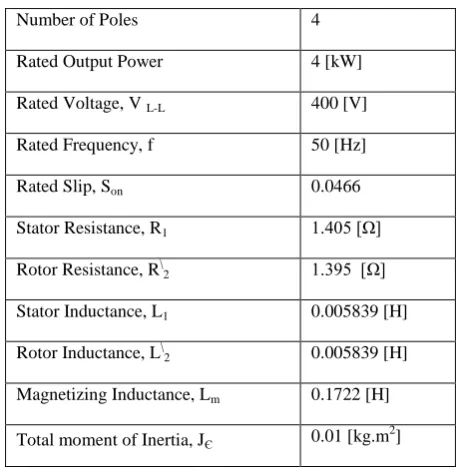
The rated values and parameters for 3-phase induction motor squirrel cage type are given in table 1.
Table1. Parameters of three- phase squirrel cage induction motor
Number of Poles 4
Rated Output Power 4 [kW]
Rated Voltage, V L-L 400 [V]
Rated Frequency, f 50 [Hz]
Rated Slip, Son 0.0466
Stator Resistance, R1 1.405 [Ω]
Rotor Resistance, R\2 1.395 [Ω]
Stator Inductance, L1 0.005839 [H]
Rotor Inductance, L\2 0.005839 [H]
Magnetizing Inductance, Lm 0.1722 [H]
Total moment of Inertia, JЄ 0.01 [kg.m 2
]
2.2 Optimal Controller
The optimal control system is a closed loop system, used to drive or control processes and keep the variables in these processes at optimal values in spite of the influences that affect it. The optimal control system is also a programmed controller and has the ability to adaptive searching for the optimal values of the variables when the changes affect the process.
There are several optimal control techniques, used to optimize AC drive system, some of these techniques are [18]& [19]:
1- Minimum stator current. 2- Minimum total losses.
3- Maximum Efficiency. 4- Maximum power factor.
[image:2.595.313.542.314.550.2]3.
Squirrel Cage Induction Motor
Efficiency Optimization
In general, there are three different approaches to improve the induction motor efficiency especially under light load conditions [20] namely loss model controller (LMC), search controller (SC), and lookup table scheme. This paper considers the loss model controller.
The electric motor efficiency represents the machine behavior during the electric power conversion into mechanical power, and defined as [21]:
(11)
The total losses (
P
)comprises of copper losses in stator and rotor, iron losses due to eddy current and hysteresis, stray losses arise on the copper and iron of the motor, friction losses and finally converter loses due to the resistance offered by the solid state switches. Power output is the product of shaft load and its speed.3.1.
Modeling of AC Drive System Using
Matlab Simulink Toolbox
3.1.1Modeling of Optimal Controller
The inverter-based AC-to-AC Converter is considered an ideal system, where the DC voltage at the input of the inverter has no AC component, and the output voltage of the filter at the output of the inverter has no harmonics (just the fundamental wave is considered).
The ratio of the amplitude of the sinusoidal waveform to the amplitude of the triangular waveform is called the modulation index (Ma). The modulation index is in the range of (0 to 1). The relationship between the modulation index and the RMS value of the phase voltage waveform is [14]:
in a
V
M
V
(12)Where:
V
: The RMS value of phase output voltage of the converter.in
V
: The RMS value of phase base voltage of the converter.Notice that
V
in is equal to the nominal voltageV
N, so equation (12) can be written as:N a
V
M
V
(13)So changing the modulation index and the sinusoidal waveform frequency will change the RMS value of the output voltage and frequency, respectively.
Equation (12) gives the static voltage model. The Steady-State frequency model is:
in
f
f
(14) Where:f
: Frequency of the output voltage of the converter. in [image:3.595.325.541.80.165.2]f
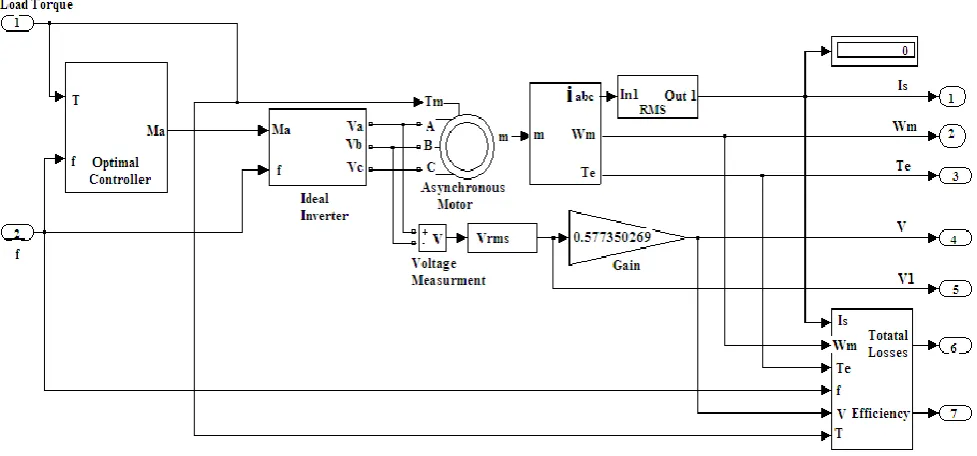
: Frequency of the sinusoidal waveform. Figure 4 shows the model of constant V/f controller.Fig 4: The model of V/f controller
3.1.2 Modeling of Induction Motor Total Losses
The induction motor total losses (
P
) can be calculated
by:
rot 2 e mag 1e
P
P
P
P
P
(
15)
Substituting equations (4), (5), (6), (7) and (8)in Eq. (15):
out o 5 . 0 N 1 1 2 N 1 1 magN 1 2 1
P
015
.
0
S
T
)
f
f
(
)
V
V
(
P
R
I
3
P
(
16)
Where:
magN
P
-
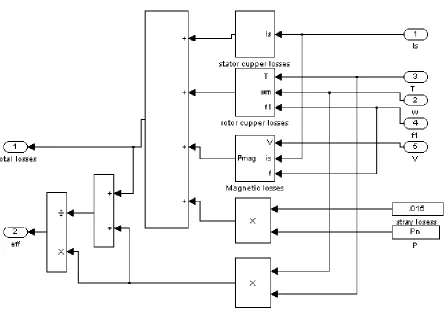
Magnetizing nominal losses.The induction motor total losses model is shown on figure 5.
3.2.
Optimal
Efficiency
Controller
at
Different Frequencies Design
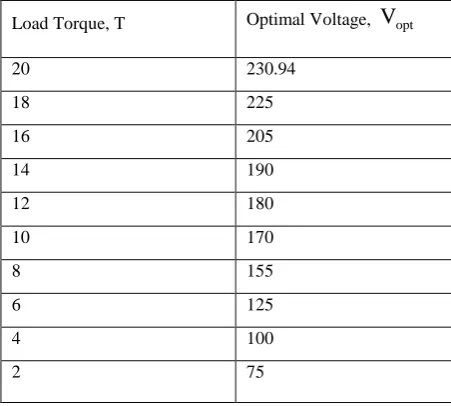
[image:3.595.314.540.539.742.2]Curve Fitting method is used to build the optimal efficiency controller’s equation that computes the modulation index. The modulation index controls the value of applied stator voltage to satisfy maximum efficiency at any value of load torque. By using Curve Fitting Toolbox, controller’s equation was derived from the following data set, given in table 2, which represent values of variant loads with the optimal voltage’s values;these values satisfythe maximum efficiency.
Table 2 Optimal voltage’s values of variant load at (f=50 Hz)
Load Torque, T Optimal Voltage,
V
opt20 230.94
18 225
16 205
14 190
12 180
10 170
8 155
6 125
4 100
2 75
Fig 5: Induction motor total losses model
Optimal efficiency controller’s equation at f=50 Hz derived using the following steps:
1- The above data set must be loaded in the MATLAB workspace.
2- Import data into the Curve Fitting Tool.
3.After fitting the previous data, we got the fitting curve. 4. From the fitting editor we got equation coefficients.
5. The resultant controller’s equation at nominal frequency is:
8 7 2 6 3 5
4 4 5 3 6 2 7 1 opt
a
T
a
T
a
T
a
T
a
T
a
T
a
T
a
V
(17) Where:
38.95
a
16.12,
a
1.229,
a
.4122,
0
a
.04077,
0
a
.001913,
0
a
e
4.292
a
,
e
3.698
a
constants
are
a
,...,
a
,
a
8 7
6
5 4
3
5 -2
7 -1
8 2 1
Following the above mentioned steps different controllers could be built; each of them can control the drive system at certain frequency. Automatic switch can select proper controller, which apply the optimal voltage at desired frequency.
Automatic switch has five input ports, one port for each controller. The automatic switch uses control signal (CS) to determine proper input port (suitable controller). The control signal computed by the following equation:
6
f
1
.
0
CS
(18)Figure 6 shows the optimal efficiency controller model at different frequencies using automaticswitch.
4.
Optimized AC Drive System Model
The optimized drive system model consists of the following blocks:
1- AC squirrel cage induction motor model. 2- Inverter model.
3- Optimal efficiency controller model at different frequencies using automatic switch.
4- Induction motor total losses model
Fig 6: Optimal efficiency controller model at different frequencies using automatic switch
[image:5.595.61.550.468.696.2]5.
Simulation Results
Using the model of AC drive system with constant V/f optimal efficiency controller, we have the following simulation results:
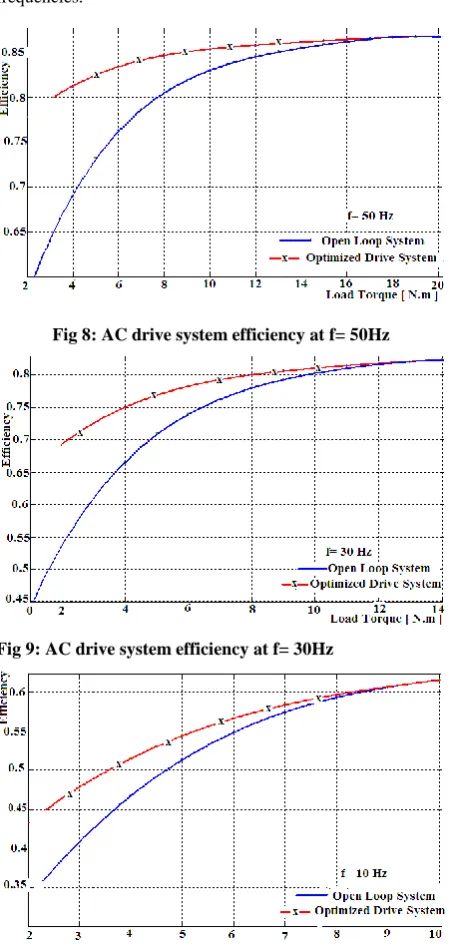
1- Figures (8, 9 and 10) represent efficiency relationship versus load torque for both open loop and optimized AC drive systems at different frequencies ( f = 50Hz,30Hz and 10Hz). 2- Figures (11, 12 and 13) represent real time steady-state efficiency relationship under different load torques for both open loop and optimized ac drive systems at different frequencies ( f = 50Hz,30Hz and 10Hz).
[image:6.595.312.540.65.787.2]3- Figure 14 represents real time steady-state efficiency relationship under constant load torque at different frequencies.
Fig 8: AC drive system efficiency at f= 50Hz
Fig 9: AC drive system efficiency at f= 30Hz
[image:6.595.316.540.71.213.2]Fig 10: AC drive system efficiency at f= 10Hz
[image:6.595.317.539.81.333.2]Fig 11: Real time AC drive system efficiency at f= 50Hz
[image:6.595.56.282.219.694.2]Fig 12: Real time AC drive system efficiency at f= 30Hz
Fig 13: Real time AC drive system efficiency at f= 10Hz
[image:6.595.317.542.380.739.2]6.
Discussions and Conclusions
The proposed technique can be implemented on AC drive systems equipped with load torque sensor and for which the steady state speed- torque characteristics are known.
The advantages that can be gained with the proposed efficiency optimization algorithm are tremendous, and energy savings can be achieved with a high percentage.
Studying and analyzing the above shown figures of simulation results, we can conclude that:
1- Implementation of constant V/f optimal efficiency has improved the efficiency of optimized drive system, in comparison with the efficiency of open loop drive system working at different frequencies and load torques.
2- Tangible improvement of drive system efficiency is noticed at light load torques.
3- Efficiency improvement range becomes less, when decreasing applied frequency.
7.
REFERENCES
[1] Millie Pant, Radha Thangarajn and Singh V.P. Efficiency Optimization of Electric Motors: a Comparative Study of Stochastic Algorithms, World Journal of Modeling and Simulation, 2008, Vol. 4, No. 2, pp. 140-148.
[2] Vaez-Zadhe, S. and Hendi, F. A.Continuous Efficiency Controller for Induction Motor Drives, Energy Conversion and Management, 2005, 46, pp.701–713. [3] Garcia, G. and Luis, J. An Efficient Controller for an
Adjustable Speed Induction Motor Drive. IEEE Trans. Ind. Elec., 1994, 31(5), pp. 533–539.
[4] Thanga Raj,C., Srivastava, S.P. and Pramod agarwal.Differential Evolution Based Optimal Control ofInduction Motor Serving to Textile Industry, IAENGInternational Journal of Computer Science, 2008,35:2,pp. 1-8.
[5] Palit, B.B. Energy Saving Operation in Induction Motorsby Voltage Reduction at No- and Low Partial Load, inProc. IEEE Ind. Appl. Annual Meeting, 1989, pp.147-151.
[6] Muravlev, O. and Vekhter, E. Energetic Parameters ofInduction Motors as the Basis of Energy Saving in aVariable Speed Drive, Electric Power Quality andUtilization, 2005, Vol.IX, N.2.
[7] Lim,S. Nam, k. Loss-Minimizing Control Scheme forInduction Motors, IEEE Proc. -Electr. Power Appl.,July 2004, Vol.151, No. 4,
[8] Feng-Chien Lin, Shing-Ming Yang, On-Line Tuning of an Efficiency- Optimized Vector Controlled Induction Motors Drives, Tamkang Journal of Science and Engineering, 2003, Vol. 6, No. 2.
[9] Rateb H. Issa, Energy Saving in Electric Elevators with Random Loading Diagram, Journal of Engineering Studies & Research, Baghdad, 1997,Vol.4, No.2. [10]Rateb Issa. Three-Phase Induction Motor Stator Current
Optimization, IJCA Special Issue on’ Evolutionary Computation for Optimization Techniques” ECOT, 2010, pp.41-50.
[11]Alfredo M.G, Thomas A.L and Donald W.N, A New Induction Motor V/f Control Method Capable on Industry Applications, vol. 34, No. 4, July- August, 1998, pp. 813-820.
[12]Rasmus K. Ursem, Models for evolutionary Algorithms and Their Applications in System Identification and Control Optimization, BRICS, 2003.
[13]Minh Ta-Cao, Yoichi Hori, Convergence Improvement of Efficiency Optimization Control of Induction Motor Drive, Industrial Applications Conference,2000, Conference record of IEEE, Vol. 3, pp. 1662-1669. [14]Hussein Sarhan and Rateb Issa, Modeling, Simulation
and Test of Inverter Induction Motor Drive System with Improved Performance, Journal of Engineering Sciences,Asuit Univerisity,2005,Vol.33,No.5.
[15]Krishna, R. Electric Motors Drives Modeling, Analysis, and Control, Prentice Hall, 2001.
[16]Dubey , G. K. Fundamentals of Electric Drives , Narose Publishing House, second edition,2002
[17]Rateb Issa ,Zeid Hijazin,Electric Motors Drive, Al-Mujtama’ Al-Arabi Publisher,Amman,Jordan, 2007. [18]Hussein Sarhan, Rateb Issa and Mohammad Alia,
Optimal Power Factor Control of Three-Phase Induction Motor Drives Using PIC-Microcontroller, International Review of Automatic Control,2012, Vol.5,N.3, pp.349-353.
[19]Rateb Issa, Hussein Sarhan and Ijreid Al-Khawaldeh, Modeling and Simulation of Flux- Optimized Induction Motor Drive, Research Journal of Applied sciences, Engineering and Technology,2010, Vol.2,N.6,pp. 603-613.
[20]Hamid, R and Amin, A.M.A. New Technique for Maximum Efficiency of Induction Motors Based on PSO, IEEE conference proceedings, 2006, pp.2176– 2181.