http://dx.doi.org/10.4236/jqis.2014.43015
Josephson Fourier Spectrometer Based
on HTSP: Construction and Quantum
Computer Realization Problem
Dresvyannikov Maxim, Zherikhina Larisa, Murzin Vladimir, Tskhovrebov Andrey The Lebedev Physical Institute of the Russian Academy of Sciences, Moscow, Russia
Email: [email protected]
Received 17 June 2014; revised 19 July 2014; accepted 5 August 2014
Copyright © 2014 by authors and Scientific Research Publishing Inc.
This work is licensed under the Creative Commons Attribution International License (CC BY). http://creativecommons.org/licenses/by/4.0/
Abstract
The possibility of creating a spectrometer of THz range, which is based on non-stationary Joseph-son effect in HTSP is considered. Simple design of JosephJoseph-son junction adjustable at cryogenic con-ditions is proposed. Using of such device for solving the problem of factorization of high value numbers, which in fact is the only motivation for creating a quantum computer, is discussed.
Keywords
High-Temperature Superconductors, Josephson Effect, Quantum Computer
1. Introduction: Non-Stationary Josephson Effect in HTSC Systems and Its
Applications
Previously we have investigated non-stationary Josephson effect via dot junction, which was performed by crossing of edges of two prisms of Y1Ba2Cu3O7−δ. Josephson effect [1] is a phenomenon, where it is possible to observe persistent and phase-dependent current in tunnel structures (weak link):
sin
J c
I =I ϕ (1)
2πe 2
c
T
I th
R kT
∆ ∆
=
(2)
2e
V t
φ ∂ =
con-D. Maxim et al.
134
ductance. In our case junction is exposed to radiation, thus we have: V t
( )
=V0+vcos( )
ωt which gives us the next equation for Josephson current:0 0
2e 2e
sin n
j c n
n
v
I I J nω V t φ
ω =+∞ =−∞ =
∑
+ + .From this equation, it follows that under irradiation of Josephson junction it is possible to observe steps on a
current-voltage characteristic with
0 c n nv j J V
amplitude. The experiment conditions corresponded to so-called inverse non-stationary Josephson effect with external electromagnetic microwave radiation (in our case fext ≈ 140 THz). We observed Shapiro steps on the curve of the current-voltage characteristic that pointed on an ap-pearance of Josephson effect [1] [2], and enabled drawing a conclusion about high microwave radiation sensitiv-ity of the contact (Figure 1). Also it’s worth mentioning that our junction is cheap and easy to produce; that’s very important in case of breakdown. So it is viable to construct a fast spectrum analyzer with the high micro-wave radiation sensitivity based on HTSP Josephson junction [3]. Such a device could record THz radiation, as
2πfext <Δ, and Y1Ba2Cu3O7−δpossesses a wider superconductivity gap Δ in comparison with traditional su-perconductors. The action of the analyzer comes to recording current-voltage characteristic, recognition of Sha-piro steps, and restoration of signal spectrum based on them.
2. Method of Analogy Simulating of the Quantum Computer with the Help of the
Single Josephson Contact: Discussion of the Scheme of the Device
One of the most interesting modern problems, which demand quick production of Fourier transform, is the rea-lization of quantum computer [4]. At present, there are a lot of research centers, which try to find ways of reali-zation of quantum computer. Yet, there is the only applied problem for such a devise. It is the problem of facto-rization of multidigit numbers, which provides the framework for code-breaking of the high defensive codes in cryptography [5]. The method of factorization is based on the classical Euclid algorithm [6]. For factorization of an integer number N on prime factors it is necessary to find periods of the function f x
( )
=axmodN, wheremod
A B is the residue of division A by B, x―natural number. Then one takes the lowest period r, and
defines the proper divisor gcd 2 1, r
N− a N
, where gcd
(
A B,)
is the greatest common divisor of A and B.This simple algorithm for solving the problem of factorization of numbers could be realized with the help of quantum computer. As the period of function f x
( )
corresponds to the maximum of its Fourier-spectrum, it is enough to find appropriate coordinates of the extremum. The quantum computer permits to do such operation for a few measurements of X register. Registers X and Y form entangled state, when all combinations ofq-bites, which correspond to domain of x definition, are present at the X , due to quantum fluctuation and appropriate values of y= f x
( )
are in register Y. We propose alternative approach for finding an effective substitution of the non-polynominal algorithm, which is based on the use of a spectrum analyzer with Josephson HTSP junction. In our case the role of quantum parallelism is substituted by the modeling of function( )
xmod( )
t mod( )
( )
N N
f x =a N ⇒aτ N = f t . Indeed, as a periodic function fN
( )
t contains the whole super-position (not quantum) of Fourier harmonics, which form this function supposing time t is fixed, when it is multiple of the period τ. In some way this is an analog of the quantum parallelism, when register X of a quantum computer contains in the form of superposition all possible values of x due to indefinite states of allq-bits. The block scheme of such device, which includes Josephson junction and is intended for factorization of numbers on prime factors, is presented on Figure 2. Here, voltage U is applied to M1, thus the output of inte-grator is U t
( )
= ∗U t. Further, in accordance with Richardson formula we observe current( )
(
e)
0 e 1
Ut kT
I t =I − on diode D, and by zero shifting of integrator M2 we can compensate term I0 in order
to receive
( )
0 eeUt kT t
V t =I R =a on M3 input (we assume for convenient that I R0 =1, thus e eU kT
a= ). Next
we compare V t
( )
with the analog signal N (it is generated via M7) on comparator M4. If V t( )
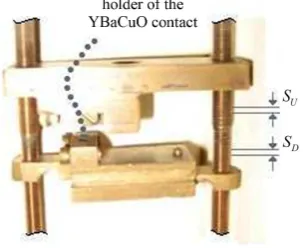
exceedsFigure 1. Right- and left-hand bolts are identical constructively. They have different thread pitch between higher and lower parts, that allows to displace electrodes of HTSP toward/outward by
50 cm
u d
[image:3.595.237.389.90.214.2]S −S = m per one turn. Junction is shifted out of center for additional accuracy of adjust-ment of contact, that permit to use principle of lever.
Figure 2.The block scheme demonstrates the realization of process of factorization on prime factors
via Fourier spectrum analyzer, which is based on HTSP Josephson junction. Left-hand out of the ca-pacity C (M1 - M8)—block of formation of
( )
t mod( )
N
f t =aτ N . Right-hand out of C (M9 - M11)—Jo-
sephson spectrum analyzer. M1—integrator with a constant voltage at the entrance; M2—integrator of currents; M3—wide band differential operational amplifier; M4—comparator; M5—digital analog mul-tiplier; M6—stepped integrator; M7—digital-to-analog converter; M8—tact generator; M9—strobe sto-rage memory; cross-Josephson junction; M10—digital-to-analog converter; M11—analog-to-digital converter.
which is needed for prime numbers factorization. From M3 residue is applied to M8, and after discretization it is applied to Josephson junction, where Fourier conversion is occurred.
3. Conclusion
Of course, during development, analog computing systems yielded to digital one in produced calculations. However, in our opinion in the field of quantum computers that moment will not come very soon.
Acknowledgements
This work was supported by the program “Strongly Correlated Electrons in Semiconductors, Metals, Supercon-ductors and Magnetic Materials” of the Department of Physical Sciences of the Russian Academy of Sciences (project No. II-3).
References
[image:3.595.132.501.275.420.2]D. Maxim et al.
136
[2] Shapiro, S., Janus, A.R. and Holly, S. (1964) Effect of Microwaves on Josephson Currents in Superconducting Tunne-ling. Reviews of Modern Physics, 36, 223.http://dx.doi.org/10.1103/RevModPhys.36.223
[3] Larkin, S. (1999) Measuring the Frequency of Monochromatic Microwave Field on the Basis of the Non-Stationary Josephson Effect. Research and Production Concern “Nauka”, National Research Center “Phonon”, Naukova Dumka, 271.
[4] Feinman, R.P. (1986) Quantum Mechanical Computer. Foundations of Physics, 16, 507. http://dx.doi.org/10.1007/BF01886518
[5] Vasilenko, O.N. (2003) Theoretic Algorithms in Cryptography. Moscow Center for Continuous Mathematical Educa-tion, Moscow.