Multipath Routing Protocol using Cross-layer based QoS
Metrics for IEEE 802.11e WLAN
Shaik Madhar Saheb
Caledonian College of Engineering PO BOX 2322
CPO Seeb 111, Oman
A. K. Bhattacharjee
Department of Electronics and Communication Engineering, NIT,
Durgapur, India
Dharmasa
Caledonian College of Engineering PO BOX 2322
CPO Seeb 111, Oman
ABSTRACT
To achieve Quality of Service (QoS) support for multimedia traffic, IEEE 802.11e specifies Hybrid Coordination Function (HCF) Controlled Channel Access (HCCA) technique. When it is applied in multi-hop networks, the performance results, however, reveal that there is significant degradation of throughput with high delay at high load conditions. This is due to the fact that routing is responsible for the successful packet delivery and QoS Support. In a single path routing protocol, although multiple paths are discovered by the source during the process of discovering a route, the path with the shortest delay is chosen as the best path while discarding the rest. An increased efficiency can be achieved in terms of QoS metrics, balancing the load and tolerance to faults by the use of multipath routing. Apart from using multipath routing, cross-layer based approach is also necessary for the enhancement of QoS in IEEE 802.11e networks. This paper proposes a multipath routing protocol using cross-layer based metrics for improving the QoS of multimedia traffic in IEEE 802.11e networks. Initially a combined cost metric is formed based on traffic contention time, average transmission delay and signal fading values. The path with minimum combined cost is chosen as the primary path from the multiple disjoint paths discovered. In case of failed data transmission, the traffic is re-routed through an alternate path with next minimum cost. Simulated Performance evaluation substantiates the reliability of the proposed protocol in achieving higher delivery ratio and throughput and reducing the delay.
General Terms
Average Transmission Delay, Multipath Route Discovery Process, Signal Fading Value, Traffic Contention Time.
Keywords
Access Point, Basic Service Set, Combined Cost, Cross-Layer, Multipath Routing, Traffic Class.
1.
INTRODUCTION
Wireless Local Area Network (WLAN) designed by IEEE 802.11 has Basic Service Sets (BSS) containing wireless stations (STA). IEEE 802.11 WLAN stipulates a Distributed Coordination Function (DCF) and a Point Coordination Function (PCF). It possesses an autonomous BSS along with an infrastructure network. This network containing an access point (AP) and its associated STA’s can be formed as ad hoc network. In a BSS, the coordination functions control the channel access of the STA [1]. These technologies are widely deployed as the most preferred wireless access technology in the recent past. There are natural limitations of wireless
Most routing schemes do not provide distinct QoS support as they attempt to get the shortest possible path. An efficient distributed admission control can be designed only when there is a QoS routing support which is required to discover routes with less interference [11]. The Media Access Control (MAC) layer and routing protocols are mutually affected by each other. A virtual network is triggered by the paths taken by the routing protocols when at a particular node the MAC protocols are stimulated. The initiation of new route queries and updates to the routing table, however, leads to contention at the MAC layer [12]. In single path routing protocol such as Ad hoc On-Demand Distance Vector (AODV), although multiple paths are discovered by the source in the discovery process, only the route with the shortest possible delay is chosen while discarding the rest. This leads to recurrent route breaks as there is no alternate path to destination and hence packets are dropped by the intermediate nodes. Multi-path routing has definite advantage over single path routing protocols in that the traffic is distributed among all several available good paths rather than only the best path available. In doing so there is a significant improvement in the network utilization and by diverting traffic to unused network resources, proper load balancing is provided, thereby reducing congestion in hot spots. Multi-path routing helps to reduce performance issues and excessive variance in congested links by providing steady and smooth data streams through fault tolerance, load balancing, bandwidth aggregation, and improvement in QoS metrics such as delay [13]. However, the IEEE 802.11e and multi-path routing protocols interaction is further to be researched. The cross-layer design approach uses multilayer parameters from Open Systems Interconnection (OSI) stack in order to enhance the performance of multi-hop wireless networks such as Wireless Sensor Networks (WSN), Mobile Ad Hoc Networks (MANET), WLAN as well as Wireless Mesh Networks (WMN) [14]. In the design of a WLANs protocol, criteria such as physical layer adjustment to the rapid changes in link characteristics, minimizing collision, ensuring fairness in the access of MAC layer and a routing decision to effectively deliver data to the destination, have to be met by the network layer. However, the layered protocol design methodology does not always provide optimum solution for dynamic environment. With layered protocols energy cannot be regained from WLAN routing protocol. It is also not possible to fetch location information or to calculate routes from the underlying data link and physical layers. Hence, a cross-layer protocol design is indispensable to enhance the WLANs performance. The organization of the paper is as follows: Section 2 discusses related work. Section 3 describes proposed solution. In section 4 simulation results and discussions are presented and finally conclusions are presented in the section 5.
2.
RELATED WORK
All Lamia Romdhani et. al. [10] proposed a routing protocol based on Cross Layer metrics, CLAE, for finding out the best possible path including the parameters such as transmission delay, network bandwidth, and stability of route and so on. CLAE is developed based on the communication properties of On-Demand AODV and IEEE 802.11e MAC (EDCA). Their focus was mainly on establishing the path with lesser delay and without loss of generality. Their buffer management scheme developed for audio class service aims to reduce undesirable network behavior (resulting from the setup of new channels of communication and node mobility), and to distinguish audio packets based on their tolerated end-to-end transfer delay and current experienced delay. Ron Banner et. al. [13] have adopted a meticulous approach to investigate the
multipath routing and established the considerable benefit of multipath routing in providing best possible solutions. Noureddine Kettaf et. al. [15] have suggested a cross-layer routing protocol for mobile ad hoc networks based on the interaction between Admission Control enabled On-demand Routing (ACOR) protocol and QoS-based IEEE 802.11e MAC layer. The aim of their protocol is to find a viable route in line with the application QoS requirements. Víctor Carrascal Frias et. al. [16] have put forward a QoS-aware multipath Dynamic Source Routing (DSR-based) routing protocol to enhance the connection reliability while load balancing and reducing the end-to-end delay. Carlos T. Calafate et. al. [17] have extensively studied the results of the interaction between reactive routing protocols for MANETs and the IEEE 802.11e standards and found that considerable enhancements in throughput and normalized routing overhead can be achieved due to the increase in the responsiveness of routing. Multipath Routing Protocol (CMRP) based on Cross-layer design for mobile ad hoc networks propounded by Hang Shen et. al. [18] uses the means of the node energy signal from the physical layer. This protocol aims to optimize routing decision and quality of path.
3.
PROPOSED PROTOCOL
3.1
Overview
The protocol proposed here at first calculates multiple disjoint paths and then estimates the Combined Cost (CC) metric based on the metrics such as: Traffic Contention Time (TCT), Average Transmission Delay (ADelay) and Signal Fading Value (SFV). Finally, the path with minimum cost (i.e., with minimum CC) is chosen as the best path from the multiple disjoint paths and the data is sent through.
3.2
Estimation of Traffic Contention Time
Metric
In the beginning, A MAC layer throughput model which provides an upper bound for shared wireless network with nodes having varied rates of transmission is defined in accordance with the IEEE 802.11 standard. Extensions to IEEE 802.11e HCCA MAC protocol are defined when nodes gain access to the channel in their transmission opportunity (TXOP) and are permitted to keep it for a specified interval of time. Finally, the Traffic Contention Time (TCT) metric is defined. The transmission throughput upper bound for the basic Carrier Sense Multiple Access with Collision Avoidance (CSMA/CA) and the Request to Send / Clear to Send (RTS/CTS) mechanism is given as,
N
j j
j k
R
PL
PL
AT
1
(1)
where,
AT – the Average Throughput, PLk – the Packet Length for
node k, Rk – Rate.
inversely proportional to minimum value of the contention window.
Thus, if Wi is weight of the node i, then equation (1) in the
case of 802.11e HCCA can be given as,
N
j j
j j
k k
R
PL
W
PL
W
AT
1
(2)
The time estimate for a packet to be transmitted through link l is PLl/ATl, where ATl will be as (2). Therefore, the TCT metric
of a weighted service differentiation can now be given as,
l
N
j j
j j
l l
R
PL
W
W
TCT
1
(3)3.3
Estimation of Delay Metric
The performance of an application is impacted by the MAC layer as is evident from various research works. The proposed scheme saves the time at which the unicast packet arrives when it is received from the routing layer by the MAC layer which will then be forwarded to the next hop. Similarly, it calculates the delay in the transmission when the acknowledgment (ACK) is received. This can be given as,
Tdelay = Tack – Trec
where Tack is the time at which the ACK is received by the
MAC layer and Trec is the time at which a packet is received
from the routing layer.
For all the transmitted packets, Tdelay is calculated for a
tunable period T. In case of less or no traffic the transmission delay is taken as it is. Taking the average delay in transmission at the end of every period T, the node updates the respective priority. In addition, the average time of transmission is estimated only when the packets are successfully sent in intermediate nodes. The ratio of the packet delay calculated at step j initially is noted by Djcurr. To
minimize transient delay bias, an estimator of Exponentially Weighted Moving Average (EWMA) is used to smooth the values estimated. Assuming that for each period of update T at step j, the average delay AjDelay is computed iteratively as
given below,
1
)
1
(
jDelay j
curr j
Delay
D
D
A
(4)where j is the jth period updated T, Djcurr the current delay,
and λ the leveling value which determines the size of memory used in calculating the averages.
3.4
Estimation of Signal Fading Value
Metric
Wireless communication is characterized by severe signal fading (SFV). SFV helps in predicting the mobility of the node. The bigger the SFV, the higher is the distance and hence the higher the probability of link interruption. Hence, the path with low SFV is considered stable as it is energy efficient which in turn can reduce signal attenuation for packets sending and therefore, data packets can be transmitted through this path.
In equation (5) SFV, transmitted by routing message, of the node is defined. This indicates the amount of stability between two serial nodes relative to the entire path,
i i i i
CE
CE
RE
SFV
(5)where REi is the remaining node energy for the node i, CEithe
fixed energy consumption for node i of every efficient data packet sending.
3.5
Multipath Route Discovery Process
3.5.1
Route Request (RREQ)
Using the equations (3), (4) and (5), the TCT, ADelay and SFV
can be estimated for each node respectively. The combined cost then is determined as,
* *
( )
*
Delay
a TCT b A
CC
c SFV
(6)
where a, b, and c are normalization or smoothing constants. Let us suppose a source S needs to send data to the destination node D through the intermediate nodes R1, R2 and R3. To initiate discovery of QoS-aware route, an RREQ is sent by the source S. When the RREQ packet is received by R1, it estimates the metrics mentioned earlier.
Firstly, the host R1 calculates its cost CCR1 using equation (6).
CCR1
RREQR1 ======= R2
Secondly, R2 calculates its cost CCR2 and adds it to the cost of R1. Then R2 forwards the RREQ including the added cost.
CCR1+ CCR2
RREQR2 ============= R3
Lastly, when it reaches the destination node D, the RREQ will contain all the combined costs of the nodes.
CCR1+ CCR2 + CCR3
RREQR3 =================== D
3.5.2
Route Reply (RREP)
The RREP packet with the combined costs of node, is sent by the destination node D to the nearest upstream node R3.
CCR1+ CCR2 + CCR3
RREP ================ R3
R3 computes its Combined Cost CC from RREP which can be given as,
CC = (CCR1+ CCR2 +CCR3) - (CCR1+ CCR2)
Similarly, all the intermediate hosts calculate their costs. The route with least cost value is selected by the source from the total RREP it receives. In case of failure or breakage in any route in the transmitted path, it selects the next available best path from the multiple disjoint paths and reroutes the data through that path.
4.
RESULTS AND DISCUSSION
4.1
The Parameters of the Simulated
Model
a constant value of 11Mbps. In the simulation time of 50 seconds, 10 Quality of Service aware Stations (QSTAs) and a base station (BS) are installed in a 1000 x 1000 metre region. Each node has a 250 metre transmission range. TCP upload traffics are sent from wireless stations. The proposed Multipath Routing protocol with Cross-layer Based QoS metrics (MRCBQ) is compared with CLAE [10] protocol.
Table 1. Gives a summary of the simulation settings and parameters
Area Size 1000 X 1000
Mac 802.11e
Radio Range 250m
Simulation Time 100 sec
Scheduler EHAS
Traffic Source CBR
Packet Size 512
MSDU 2132
Transmission Rate 250Kb
No. of QSTAs 5,10,15,20 and 25 No. of sessions 1,2,3,4 and 5
4.2
Performance Metrics
The performance is mainly evaluated according to: a) Average Ratio of Packet Delivery: It is the proportion of the total packets received to the total packets transmitted. b) Throughput: The average throughput received measured in Mb/sec, and c) Average End-to-End Delay: The average surviving data packets from source to destination.
4.3
Results
4.3.1
Effect of Node Increase
In the first simulation, the nodes are varied with an increment of 5 as 5, 10, 15, 20 and 25.
Figure 1 illustrates the decrease in end-to-end delay when the MRCBQ protocol is used unlike the CLAE protocol, in the case of increased nodes. This is because of less traffic contention in case of MRCBQ.
MRCBQ achieves a good throughput and delivery ratio as it selects path with least signal fading and less traffic contention and there is a reduction in the average packet drop. Figure 2 illustrates this with the comparison of the average packet delivery ratio of MRCBQ and CLAE protocols.
Figure 3 demonstrates the increase in the throughput in the case of MRCBQ in comparison with CLAE when the nodes are increased.
Nodes Vs Delay
0 0.5 1 1.5 2 2.5 3 3.5 4
5 10 15 20 25
Nodes
D
e
la
y
(s
)
MRCBQ CLAE
Fig 1: Nodes Vs Delay
Nodes Vs Delivery Ratio
0 0.2 0.4 0.6 0.8 1 1.2
5 10 15 20 25
Node s
D
e
lR
a
ti
o
MRCBQ CLAE
Fig2: Nodes Vs Delivery Ratio
Nodes Vs Throughput
0 1 2 3 4 5
5 10 15 20 25
Node s
M
b
/s CLAE
MRCBQ
Fig 3: Nodes Vs Throughput
4.3.2
Effect of varying Flows
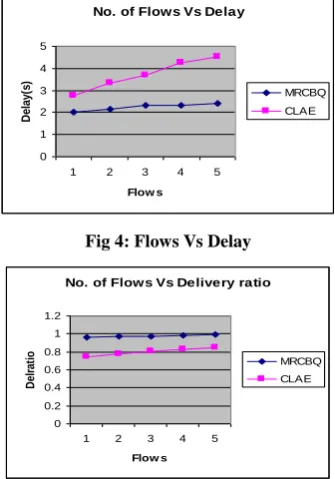
In the second experiment, the flows are varied as 1, 2, 3, 4 and 5.
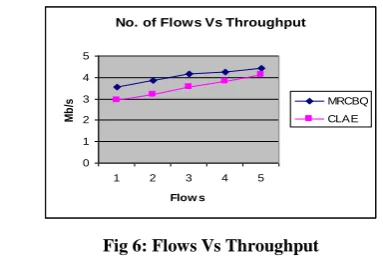
Figure 4 indicates a decrease in end-to-end delay of flows when the MRCBQ protocol is used unlike the CLAE protocol, as MRCBQ selects the path with less traffic contention. Figure 5 indicates the better delivery ratio achieved by MRCBQ compared to CLAE protocol while figure 6 represents the increase in the throughput in the case of MRCBQ when compared to CLAE when there is an increase in the number of flows.
No. of Flows Vs Delay
0 1 2 3 4 5
1 2 3 4 5
Flow s
D
e
la
y
(s
)
[image:4.595.344.512.476.716.2]MRCBQ CLAE
Fig 4: Flows Vs Delay
No. of Flows Vs Delivery ratio
0 0.2 0.4 0.6 0.8 1 1.2
1 2 3 4 5
Flow s
D
el
ra
ti
o
MRCBQ CLAE
[image:4.595.86.249.598.711.2]No. of Flows Vs Throughput
0 1 2 3 4 5
1 2 3 4 5
Flow s
M
b
/s MRCBQ
[image:5.595.61.253.71.202.2]CLAE
Fig 6: Flows Vs Throughput
5.
CONCLUSION
A cross-layer based multipath routing protocol for IEEE 802.11e WLAN is suggested by the authors. Initially, multiple disjoint paths are determined followed by the estimation of a combined cost metric based on the Traffic Contention Time, Average Transmission Delay and Signal Fading Value. An RREQ is sent by the source S to initiate the discovery of QoS-aware route. The moment RREQ packet is received by R1, all metrics previously mentioned are computed and the combined cost CCR1 is calculated. R2 calculates its combined cost CCR2 by adding the cost of R1 and forwards the RREQ packet including the added cost. The RREQ will have all combined costs of all nodes by the time it arrives at the destination node D. The destination node D sends RREP, which includes all the node costs, to the source node S via the intermediate nodes. On receiving the RREP from all the paths, the path with minimum combined cost is selected as the best path by the source S and the data is transmitted through this path. The simulation results demonstrate that the proposed Multi-path routing protocol helps in achieving better delivery ratio and throughput with reduced delay.
6.
ACKNOWLEDGMENT
This work is part of the first author’s PhD work, which is supported under the Staff Development Program of Caledonian College of Engineering, Oman and National Institute of Technology Durgapur, India.
7.
REFERENCES
[1] Shou-Chih Lo and W. T. Chen, "An Efficient Scheduling Mechanism for IEEE 802.11E MAC Enhancements," IEEE Wireless Communications and Networking Conference (WCNC), March 2004
[2] Muhammad Akber Farooqui, “Protocol Design Issues in WLAN”, Journal of Lecture Notes in Engineering and Computer, VOL 2176, Issue 1, pages 279-282 (2009). [3] Conroy Smith and Neco Ventura, "A
Measurement-Aided Model-Based Admission Control Scheme for IEEE 802.11e EDCA Wireless LANs," In Proceedings IFIP Symposium on Wireless Communications and Information Technology in Developing Countries ( WCITD), Oct. 2008.
[4] P. Ansel, Q. Ni, and T. Turletti, “An Efficient Scheduling Scheme for IEEE 802.11e," In Proceeding of Modeling and Optimization in Mobile, Ad Hoc and Wireless Networks, 2004.
[5] Y. Higuchi, A. Foronda, C. Ohta, M. Yoshimoto, and Y. Okada, “Delay guarantee and service interval optimization for HCCA in IEEE 802.11e WLANs,” In Proceeding of IEEE Wireless Communications & Networking Conference (WCNC 2007), 2007.
[6] Inanc.I, Keceli.F and Ayanoglu.E, “An Adaptive Multimedia QoS Scheduler for 802.11e Wireless LANs”,
In Proceedings of the IEEE International Conference on communications, ICC-2006.
[7] Alan Marshall, “Quality of Service (QoS) for Wireless Networks”, In the Proceeding of International Telecommunication union, October 2007.
[8] HCCA, from
http://en.wikipedia.org/wiki/IEEE_802.11e-2005 [9] Bo Han, Lusheng Ji, Seungjoon Lee, Robert R. Miller
and Bobby Bhattacharjee, “Channel access throttling for improving WLAN QoS ”, In Proceedings of the 6th Annual IEEE communications society conference on Sensor, Mesh and Ad Hoc Communications and Networks, 2009.
[10]Lamia Romdhani and Christian Bonnet, “A Cross-Layer On-Demand Routing Protocol for Delay-Sensitive Applications”, 16th IEEE International Symposium on Personal Indoor and Mobile Radio Communications, 2005
[11]Xiaolin Cheng, Prasant Mohapatra, Sung-Ju Lee and Sujata Banerjee, “MARIA: Interference-Aware Admission Control and QoS Routing in Wireless Mesh Networks”, IEEE ICC, 2008.
[12]Chris Barrett, Martin Drozda, Achla Marathe and Madhav V. Marathe, “Characterizing the Interaction between Routing and MAC Protocols in Adhoc Networks”, Proceedings of the 3rd ACM international symposium on Mobile ad hoc networking & computing, 2002.
[13]Ron Banner and Ariel Orda, “Multipath Routing Algorithms for Congestion Minimization”, IEEE/ACM Transactions on Networking, 2007.
[14]Shafiullah Khan, Kok Keong Loo and Zia Ud Din, “Cross Layer Design for Routing and Security in Multi-hop Wireless Networks”, Journal of Information Assurance and Security, 2009.
[15]Noureddine Kettaf, Hafid Abouaissa, Thang Vuduong and Pascal Lorenz, “A Cross layer Admission Control On-demand Routing Protocol for QoS Applications”, IJCSNS International Journal of Computer Science and Network Security, 2006.
[16]Víctor Carrascal Frías, Guillermo Diaz Delgado and Monica Aguilar Igartua, “Multipath Routing for video-streaming services over IEEE 802.11e Ad hoc Networks”, International Conference on Software in Telecommunications and Computer Networks, 2006. SoftCOM 2006.
[17]Carlos T. Calafate, Pietro Manzoni, and Manuel P. Malumbres, “On the interaction between IEEE 802.11e and routing protocols in Mobile Ad-hoc Networks”, 13th IEEE Euromicro Conference on Parallel, Distributed and Network-Based Processing, 2005
[18]Hang Shen, Guangwei Bai, Junyuan Wang, Yong Jin and Jinjing Tao, “Performance Study of a Cross-Layer Based Multipath Routing Protocol for IEEE 802.11e Mobile Ad Hoc Networks”, I. J. Communications, Network and System Sciences, 2008.
[19]Shaik Madhar Saheb, A. K. Bhattacharjee and A. Vallavaraj, “An Enhanced HCCA Based Adaptive Scheduler for Multimedia Traffic in IEEE 802.11e Wireless LAN”, In: Proceedings of WORLDCOMP 10, ICWN 10, VOL 2, pages 446-453 (2010).