Comparison of Different Saturation Pulse Types in a
Series of Saturation Transfer Difference NMR
Experiment Based on Cox-1 Enzyme and
Ibuprofen Interaction
Nil E. Binbay
1,*,
Berrin Ziyadanoğulları
21Department of Electronics, Vocational School, Dicle University, Turkey 2Faculty of Science, Dicle University, Turkey
Copyright©2017 by authors, all rights reserved. Authors agree that this article remains permanently open access under the terms of the Creative Commons Attribution License 4.0 International License
Abstract
Here we report, comparison of two different saturation pulse types with different shapes, Gaussian pulse and Reburp pulse. Pulses are comparatively used in a series of STD-NMR experiments for determine which one is more effective for saturation and also saturation transfer for ibuprofen and COX1 mixture. Both pulses have been comparatively studied, and they are applied to identical samples in identical experimental conditions to see the difference. Also they are examined over different pulse parameters, like lengths and powers. Finally it is shown that, re-burp pulse gives more intensive STD-NMR signals than Gaussian pulse shape under same conditions and same samples. That means Reburp pulse shape causes more effective saturation than Gaussian pulse shape for COX enzyme and ibuprofen. Results are in accordance with literature.Keywords
STD-NMR, Cyclooxygenase Enzyme, Ibuprofen, Gaussian Pulse, Reburp Pulse1. Introduction
Ibuprofen is a well-known and widely used member of NSAID’s (Non-Steroidal Anti-Inflammatory Drugs). The main mechanism of ibuprofen is suppressing synthesis of Prostaglandin by inhibition COX (Cyclooxygenase) enzymes. [1] Ibuprofen inhibits COX enzymes by binding them. [1] Binding interaction between ibuprofen and COX enzymes is fast and reversible. [1, 2, 4] Therefore mixture of them is suitable for STD-NMR (Saturation Transfer Difference Nuclear Magnetic Resonance) experiments.
As it is discovered earlier, COX enzyme has two isoforms; COX-1 and COX-2.[2-6] It is known that, Ibuprofen binds
both of COX isoforms, COX-1 and COX-2, almost equally [2-5]. There is no selectivity either any of COX enzymes for ibuprofen. So when it is used as an anti-inflammatory drug in humans, it inevitably inhibits both of COX enzyme isoforms simultaneously. However these two isoforms possess different functions in human body, such as; COX-1 mainly responsible from protection of gastric mucosa, while COX-2 mainly responsible from inflammation. [2-5] Therefore, like other typical NSAID’s, ibuprofen causes serious gastrointestinal side effects, especially in long term use. In short terms, while it is treating inflammation by binding to COX-2, it causes major side effects by binding COX-1. [2,3] To overcome this problem, research groups have been trying to find some COX-2 selective novel anti-inflammatory drugs for a while, and it is still represents a major challenge for drug designers.
Universal Journal of Public Health 5(6): 320-329, 2017 321
technique emerges as a novel technique which has unique benefits to study with target big molecules and novel small ligands. It is highly useful for such drug design studies. It could be being revealed that with STD -NMR, which compound binds to macro molecule, and therefore shows more activity as a novel drug candidate. If the ligand binds, technique also can give some information about which proton groups of Ligand play more effective role in binding process. This information known as epitope mapping. [7]
STD-NMR based on selectively saturation of macro molecule and then observing only ligand’s peaks to determine whether it binds or not. Therefore it does not necessary to be deal with complex NMR spectra of macro molecule. This fact is one of the major benefits of STD-NMR.STD-NMR technique also has some unique advantages over the others, such as observing enzymes and ligands in a solution and near-natural conditions, or requiring as little enzyme as nano-molar levels etc. Usage of this technique increases rapidly due to these advantages. [7, 8]
In STD-NMR, determining and calibrating of saturation pulse parameters (shape, duration, power etc.) for each experiment is one of the very important steps in experimental process and could cause dramatic effect on success of the experiment. For example using not optimised saturation pulse power could easily cause false results. If saturation pulse power being applied higher than necessary, you may excite ligands peaks so you get false positive STD signals. On the other hand, if you set the saturation pulse power very low then you may could not saturate enzymes peaks effectively, and you get false negatives. So optimising saturation pulse parameters is necessary for STD-NMR experiments. And once you could not see the macro molecule’s peaks directly, it is very hard to be sure if macro molecule is saturated or not. Every effort which contributes to find correct set of these parameters, is also contributes success of experiments and indirectly contributes to novel drug design processes, whose uses this technique.
The main aim of this work is to determine which pulse
type is more effective in such a STD experiment including COX enzyme and ibuprofen. And also to analyse effects of pulse parameters and to find optimum parameter set to get improved STD-NMR signals.
2. Experimental
The COX-1 isoform from ram seminal vesicles and ibuprofen were purchased from Sigma-Aldrich. Ibuprofen was supplied as dry powder and 20 mM ibuprofen stock solutions were prepared with solving ibuprofen in DMSO-d6. COX-1 isoform from ram seminal vesicles were supplied in 80 mM pH 8.0 Tris-HCl, 0.1% Polysorbate 20, and 300 μM diethyldithiocarbamate (DDC), and used as such. Then 400 μL of ibuprofen stock solution, COX-1 Enzyme solution and 100 μL of Tris-HCl (pH 8.0) as buffer were mixed in a 5mm NMR tube. And then STD-NMR experiments are carried out in BRUKER AVANCE III 400 MHz spectrometer. Off resonance and on resonance frequencies are selected as 36 kHz and -200 Hz (90 ppm, -0,5 ppm). “Stddiffgp19.2” pulse program was used from Bruker’s pulse program library for all experiments. All spectra were recorded with 1024 scans.
3. Results
3.1. Gaussian Saturation Pulse Shape with Different Pulse Powers
Figure 1. (a)1D proton NMR spectrum of ibuprofen; (b) STD-NMR spectrum of ibuprofen and COX1 mixture with Gaussian pulse shape, with 30 dB pulse power and 50 ms pulse length; (c) STD-NMR spectrum of ibuprofen and COX1 mixture with Gaussian pulse shape, with 40 dB pulse power and 50 ms pulse length; (d) STD-NMR spectrum of ibuprofen and COX1 mixture with Gaussian pulse shape, with 50 dB pulse power and 50 ms pulse length; (e) STD-NMR spectrum of ibuprofen and COX1 mixture with Gaussian pulse shape, with 80 dB pulse power and 50 ms pulse length.
[image:3.595.111.496.423.688.2]Universal Journal of Public Health 5(6): 320-329, 2017 323
3.2. Different Pulse Powers for Gaussian Pulse with 10 ms Pulse Duration
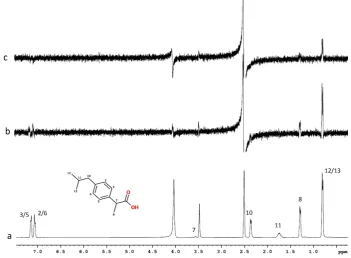
Gaussian shaped saturation pulses were applied as 10 ms pulse trains for 4 seconds along the saturation time to the ibuprofen and COX1 mixture. Off resonance and on resonance frequencies are selected as 36 kHz and -200 Hz (90 ppm, -0,5 ppm). “Stddiffgp19.2” pulse program routine was used from Bruker’s pulse program library for STD-NMR experiment. Pulse power was varied between 70 dB and 80 dB. Spectra were recorded with 1024 scans (with 64 dummy scans). Results are shown in figure-3 and figure-4 and figure-5.
[image:4.595.122.473.163.419.2]Figure 3. (a)1D proton NMR spectrum of ibuprofen; (b) STD-NMR spectrum of ibuprofen and COX1 mixture with Gaussian pulse shape, with 70 dB pulse power and 10 ms pulse length; (c) STD-NMR spectrum of ibuprofen and COX1 mixture with Gaussian pulse shape, with 80 dB pulse power and 10 ms pulse length.
Figure 4. (a)1D proton NMR spectrum of ibuprofen (high field region of spectrum); (b) STD-NMR spectrum of ibuprofen and COX1 mixture with
[image:4.595.125.472.559.718.2]Figure 5. (a)1D proton NMR spectrum of ibuprofen (low field region of spectrum); (b) STD-NMR spectrum of ibuprofen and COX1 mixture with Gaussian pulse shape, with 70 dB pulse power and 10 ms pulse length (low field region of spectrum); (c) STD-NMR spectrum of ibuprofen and COX1 mixture with Gaussian pulse shape, with 80 dB pulse power and 10 ms pulse length (low field region of spectrum).
3.3. Reburp Saturation Pulse Shape with Different Pulse Powers
[image:5.595.124.476.454.712.2]Reburp shaped saturation pulses were applied as 10 ms pulse trains for 4 seconds along the saturation time. Pulse power applied as 70 dB and 80 dB. Spectra were recorded with 1024 scans (with 64 dummy scans). Results are shown in figure-6, figure-7, and figure-8.
Universal Journal of Public Health 5(6): 320-329, 2017 325
Figure 7. (a)1D proton NMR spectrum of ibuprofen (high field region of spectrum); (b) STD-NMR spectrum of ibuprofen and COX1 mixture with Reburp pulse shape, with 70 dB pulse power and 10 ms pulse length (high field region of spectrum); (c) STD-NMR spectrum of ibuprofen and COX1 mixture with Reburp pulse shape, with 80 dB pulse power and 10 ms pulse length (high field region of spectrum).
Figure 8. (a)1D proton NMR spectrum of ibuprofen (low field region of spectrum); (b) STD-NMR spectrum of ibuprofen and COX1 mixture with
Gaussian pulse shape, with 70 dB pulse power and 10 ms pulse length (low field region of spectrum); (c) STD-NMR spectrum of ibuprofen and COX1 mixture with Gaussian pulse shape, with 80 dB pulse power and 10 ms pulse length (low field region of spectrum).
3.4. Comparison of Gaussian and Reburp Pulses at 70 db with 10 ms Pulse Duration
[image:6.595.96.506.78.343.2] [image:6.595.105.500.532.634.2]Figure 9. (a)1D proton NMR spectrum of ibuprofen; (b) STD-NMR spectrum of ibuprofen and COX1 mixture with Reburp pulse shape, with 70 dB pulse power and 10 ms pulse length; (c) STD-NMR spectrum of ibuprofen and COX1 mixture with Gaussian pulse shape, with 70 dB pulse power and 10 ms pulse length.
Figure 10. (a)1D proton NMR spectrum of ibuprofen (high field region of spectrum); (b) STD-NMR spectrum of ibuprofen and COX1 mixture with
[image:7.595.92.506.416.708.2]Universal Journal of Public Health 5(6): 320-329, 2017 327
Figure 11. (a)1D proton NMR spectrum of ibuprofen (low field region of spectrum); (b) STD-NMR spectrum of ibuprofen and COX1 mixture with
Reburp pulse shape, with 70 dB pulse power and 10 ms pulse length (low field region of spectrum); (c) STD-NMR spectrum of ibuprofen and COX1 mixture with Gaussian pulse shape, with 70 dB pulse power and 10 ms pulse length (low field region of spectrum).
4. Discussion
There are five spectra can be seen in figure-1: (a)1D proton NMR spectrum of ibuprofen, which is used as reference spectrum for observing STD spectra; (b) STD-NMR spectrum of ibuprofen and COX1 mixture with Gaussian saturation pulse shape applied, with 30 dB pulse power and 50 ms pulse length; (c) STD-NMR spectrum of ibuprofen and COX1 mixture with Gaussian saturation pulse shape applied, with 40 dB pulse power and 50 ms pulse length; (d) STD-NMR spectrum of ibuprofen and COX1 mixture with Gaussian saturation pulse shape applied, with 50 dB pulse power and 50 ms pulse length; (e) STD-NMR spectrum of ibuprofen and COX1 mixture with Gaussian pulse shape, with 80 dB pulse power and 50 ms pulse length.
It is clearly seen in the spectra, while saturation pulse power decreasing from 30 dB to 80 dB, ((b) represents highest power at 30 dB and (e) represents lowest power at 80 dB, (c) and (d) are 40 dB and 50 dB respectively), STD signals decreasing in accordance also. At lowest power, 80 dB, there is almost no saturation remains to be observed as STD signal. It is revealed that, the correct adjustment of saturation pulse power is an important step for such a STD-NMR experiment. If it is not adjusted correctly, then saturation signals probably being loosed at all, and the experiment probably gives false negative results.
Another noticeable fact in spectra is that, the solvent (DMSO-d6) peak at around 2,5 ppm, always being saturated, nearly independent about how powerful saturation pulse being applied, as it is expected.
There are five spectra can be seen in figure-2, and (a), (b), (c), (d) and (e) are same as figure-1, but focused only low field region (aromatic region) of spectra. As it is seen in
spectra, aromatic ring protons were not saturated as much as the methyl protons at around 0,8 ppm; that means these proton groups do not play active role in binding process to COX enzyme as other groups do. But STD signal of aromatic protons still depends on saturation pulse power as others, decreases accordingly with decreasing power.
There are three spectra can be seen in figure-3: (a)1D proton NMR spectrum of ibuprofen, which is used as reference spectrum for observing STD spectra; (b) STD-NMR spectrum of ibuprofen and COX1 mixture with Gaussian saturation pulse shape applied, with 70 dB pulse power and 10 ms pulse length; (c) STD-NMR spectrum of ibuprofen and COX1 mixture with Gaussian saturation pulse shape applied, with 80 dB pulse power and 10 ms pulse length.
As it is seen in figure-3, while saturation pulse power decreases from 70 dB to 80 dB, STD signals also decreases, just like figure-1 and figure-2. But when figure-3 and figure-1 compared, it is seen that, saturation pulse duration is also effective on resulted STD signals. Shorter saturation pulse duration ( =10 ms, in figure-3, spectra (b) and (c) ), saturates wider bandwidth in frequency area, so affects more of enzyme protons, therefore one get more intensive STD signals, than longer saturation pulse duration ( =50 ms, in figure-1 and figure-2, spectra (d) and (e) ).
There are three spectra can be seen in figure-4, and (a), (b), and (c) are same as figure-3, but focused only high field region of spectra. It is seen that stronger saturation pulse power at 70 dB in (b) causes more intense STD signals, than weaker saturation pulse at 80 dB in (c).
power at 70 dB in (b) causes more intense STD signals, than weaker saturation pulse at 80 dB in (c).
There are three spectra can be seen in figure-6: (a)1D proton NMR spectrum of ibuprofen, which is used as reference spectrum for observing STD spectra; (b) STD-NMR spectrum of ibuprofen and COX1 mixture with Reburp saturation pulse shape applied, with 70 dB pulse power and 10 ms pulse length; (c) STD-NMR spectrum of ibuprofen and COX1 mixture with Reburp saturation pulse shape applied, with 80 dB pulse power and 10 ms pulse length.
As it is seen in figure-6, dependence of STD signals on applied saturation pulse powers is still preserved in Reburp pulse shape as same as Gaussian pulse shape was; increasing saturation pulse power (from 80 dB (spectrum (c)); to 70 dB (spectrum (b)) gives more intense STD signals, just as expected. But if figure-6 and figure-3 compared, it is seen that, Reburp pulse shape, with same pulse length, gives more intense STD signals, than Gaussian pulse shape does.
There are three spectra can be seen in figure-7, and (a), (b), and (c) are same as figure-6, but focused only high field region of spectra. It is seen that stronger saturation pulse power at 70 dB in (b) gives more intense STD signals, than weaker saturation pulse at 80 dB in (c).
There are three spectra can be seen in figure-8, and (a), (b), and (c) are same as figure-6, but focused only low field region of spectra. It is seen that stronger saturation pulse power at 70 dB in (b) gives more intense STD signals, than weaker saturation pulse at 80 dB in (c).
There are three spectra can be seen in figure-9: (a) 1D proton NMR spectrum of ibuprofen, which is used as reference spectrum for observing STD spectra; (b) STD-NMR spectrum of ibuprofen and COX1 mixture with Reburp saturation pulse shape applied, with 70 dB pulse power and 10 ms pulse length; (c) STD-NMR spectrum of ibuprofen and COX1 mixture with Gaussian saturation pulse shape applied, with 70 dB pulse power and 10 ms pulse length. It is clearly seen in figure-9 that, Reburp shaped saturation pulse (spectrum (b)) gives more intense STD signals, than Gaussian shaped saturation pulses with exactly same conditions for COX1 enzyme and ibuprofen mixture, in such a STD-NMR experiment.
There are three spectra can be seen in figure-10, and (a), (b), and (c) are same as figure-9, but focused only low field region of spectra. It is seen that, STD signal of ibuprofen’s peak-10 at around 2,37 ppm can only be seen by Reburp saturation pulse being applied (spectrum (b)), and it is not visible with Gaussian saturation pulse (spectrum (c)).
There are three spectra can be seen in figure-11, and (a), (b), and (c) are same as figure-9, but focused only high field region of spectra. It is seen that, STD signal of ibuprofen’s aromatic peaks at around 7,2 ppm can only be seen by Reburp saturation pulse being applied (spectrum (b)), and it is not visible with Gaussian saturation pulse (spectrum (c)).
Although the exact interaction mechanism between ibuprofen and the COX enzymes does not being understood
fully and still represents a major subject of some researches, it is commonly agreed that, ibuprofen binds to COX enzymes. [9, 10] Every spectrum in this work supports this fact, since STD signals, by definition, can only be being obtained if ligand (ibuprofen) binds to macromolecule (COX1 enzyme); otherwise there would be no STD signal at all, to be being observed. It is obviously seen that there are STD signals almost in every spectra. Existence of these signals are the experimental proof of the fact that ibuprofen binds to COX1.
5. Conclusions
Here we report a comparative study on differently shaped saturation pulses in a series of STD-NMR experiments, based on COX enzyme and ibuprofen binding interaction. These experiments are carried on with Gaussian and Reburp saturation pulse shapes applied to solution with different pulse powers, and different pulse lengths. Every single experiment takes approximately 10 hours of spectrometer time.
Finally it is concluded that, the Reburp pulse shape is gives more intense STD-NMR signals, therefore saturates more enzyme protons more effectively than Gaussian shaped saturation pulse in same experimental conditions, same pulse power and same pulse length for such a STD-NMR experiment includes COX enzyme and ibuprofen.
Funding Sources
This study is funded by DUBAP (Dicle University Scientific Research Projects Coordinatorship) under the Project No. 14-MYO-120.
Acknowledgements
Our special thanks go to DUBAP for funding this Project under the Project No: 14-MYO-120.
REFERENCES
[1] J. R. Vane., R. M. Botting. Anti-inflammatory drugs and their mechanism of action, Inflammation Res., Vol.47, Suppl.2,
78−87, 1998.
[2] L.A. Garcia Rodriguez, H. Jick. Risk of Upper Gastrointestinal Bleeding and Perforation Associated With Individual Non-Steroidal Anti-Inflammatory Drugs, Lancet, Vol.343, 769-772, 1994.
[3] M.M. Wolfe, D.R. Lichtenstein, G. Singh. Gastrointestinal Toxicity of Non-Steroidal Anti-Inflammatory Drugs, N. Engl. J. Med., Vol.340, 1888-1899, 1999.
Universal Journal of Public Health 5(6): 320-329, 2017 329
NSAID Therapy, Semin. Arthritis Rheum., Vol.17, 17-22, 1988.
[5] D. Kleinknecht, P. Landais, B. Goldfarb. Analgesic and Non-Steroidal Anti-Inflammatory Drug-Associated Acute Renal Failure: A Prospective Collaborative Study, Clin. Nephrol., Vol.25, 275-281, 1986.
[6] J.R. Vane, Y. S. Bakhle, M.R. Botting. Cyclooxygenases 1 and 2., Annu. Rev. Pharmacol Toxicol., Vol.38, 97-120, 1998. [7] A.Viegas, J. Manso, F. L. Nobrega, E. J Cabrita.
Saturation-Transfer Difference (STD) NMR: A Simple and Fast Method for Ligand Screening and Characterization of Protein Binding, J. Chem. Educ., Vol.88, 990−994, 2011.
[8] C. A. Lepre, J. M. Moore, J. W. Peng. Theory and Applications of NMR Based Screening in Pharmaceutical Research, Chem. Rev. Vol.104, 3641-3675, 2004.
[9] J. J. Prusakiewicz, K. C. Duggan, C. A. Rouzer, L. J. Marnett. Differential Sensitivity and Mechanism of Inhibition of COX-2 Oxygenation of Arachidonic Acid and 2-Arachidonoylglycerol by Ibuprofen and Mefenamic Acid,
Biochemistry, Vol.48, No.31, 7353-7355, 2009.
[10]V. Limongelli, M. Bonomi, L. Marinelli, F. L. Gervasio, A. Cavalli, E. Novellino, M. Parrinello. Molecular Basis of Cyclooxygenase Enzymes (COXs) Selective Inhibition,