FUZZY RANDOM CHANCE-CONSTRAINED
PROGRAMMING BASED APPROACH TO
ACTIVE-POWER-OUTPUT CALCULATION FOR WIND POWER FARMS
NING CHEN
Assoc. Prof., School of Mechanical and Automotive Engineering, Zhejiang University of Science and Technology, HANGZHOU 310023, P.R.China
E-mail: [email protected]
ABSTRACT
Based on the fuzzy random chance-constrained programming(FRC) theory, the paper presents a method to calculate active-power-output of large-scale wind power farms connected to power grid. The calculation of active-power-output can be turned into a FRC programming problem which constrained conditions. This paper put forward a mathematical model of calculate active power in wind power integrated system based on FRC programming form. These include ramp constrains of the generating units, output restricted zone, line transmission capacity, reserved capacity constraints, the balance of load, and so on. The question is solved by particle swarm optimization based fuzzy simulations. The results on IEEE30 system demonstrate the advantages of the proposed approach.
Keywords: Particle Swarm Optimization; Fuzzy Random Chance-Constrained Programming;
Active-Power-Output; Large-Scale Wind Power Farms; Power Grid
1. INTRODUCTION
Wind energy resources are clean renewable energy, Renewable energy has been increasingly embraced due to dwindling fuel reserves, and wind power generation is one of the most prospective new energy. Because of the fluctuation and intermittent of wind power generation, this fluctuant power will affect the power quality of the imbedded grid, such as voltage fluctuation and flicker. The active power output time-varying values of distributed wind turbines are important to supply and demand balance, generation ability and transmission ability.
The terrain and the different wind power installed capacity determine the position of wind turbine in large scale wind farm. The active power output varied with the fluctuation of wind speed, the wind speed-active power output data impact on the power grid[1]-[2].Now, the active power output calculation method based on Genetic Algorithm and hybrid intelligent algorithm has certain time lag characteristic, which is inaccurate to power dispatching and power quality management.
Based on the stochastic programming theory, the literature present a method to calculate maximum injection power of large-scale wind farms connected to power grid[3]. The literature
introduces a new method for calculating wind power penetration limits in power system utilizing chance constrained programming[4]. A fuzzy random chance-constrained programming based hybrid intelligent algorithm for quantifying the transmission reliability margin (TRM) is presented in literature[5].The literature put forward a mathematical model of economic dispatch in wind power integrated system based chance constrained programming (CCP) and describes the related constrained conditions in probability form [6].
ISSN: 1992-8645 www.jatit.org E-ISSN: 1817-3195
2. THE ACTIVE POWER OUTPUT
MATHEMATICAL MODEL INCLUDING WIND FARMS
The random variation of active power output in wind farms depends mainly on the fluctuation of wind speed and wind direction.the wind speed on axial fan hub must be obtained firstly if we want to calculate the active power output of wind farms. The wind speed on axial fan hub of wind turbines are different because of the wind wake effect and geographic location [7].
The arbitrary wind turbine may be occlused by upwind turbines in different extent.While calculating the input wind speed of wind turbine in wind farm, the interaction between different wind turbines must be considered.according to the law of conservation of momentum,the wind speed on axial fan hub can be described as:
2 2 2
0 0 1
( )
( )
(
, )
( )
j nj k w k kj j
k k j
v t
v
t
β
v
−x t
v
t
= ≠
=
+
∑
−
(1)where,
v
j(
t
)
is the wind speed of arbitrary windturbine;
v
w−k(
x
kj)
is the wind wake speed of NO.j
wind turbine on the effect of NO.k
wind turbine;0 j
v
is the wind speed of NO.j
wind turbine without the effect of tower shadow;/
k
A
shad jkA
rot jβ
=
− − is ratio of the No. kwind turbine projected area on NO.j
wind turbine andthe NO.
j
wind turbine area;n
is total wind turbine number in wind farm.The rated output power value of wind farm is equal to active power output, which is the output upper limit of wind farm. The active power output of wind turbine can be described as:
3 3
3 3 3 3
0
(
or
)
(
)
CI CO
CI R
ki R CI R
R CI R CI
R R
v v
v v
v
P
P
v
P
v
v v
v
v
v
v
v v
P
≤
≥
=
−
≤ ≤
−
−
≥
(
)
(2)Where,
P
Ris rated output power of wind turbine;v
is wind speed on axial fan hub;v
CIis cut-in wind speed; the automatic device incorporated wind turbine into power grid when the wind speed valuehigher than
v
CI;v
CO is the wind cut-out speed, thewind turbine stop generation and detach from power system when the wind speed value higher
than
v
CO ;v
R is rated wind speed .The active power output of wind farm can be described as:
∑
==
N i ki kP
P
1 (3)3. FUZZY CHANCE- CONSTRAINED
PROGRAMMING MATHEMATICAL MODEL
Chance-constrained programming is the important branch of stochastic programming, which is used in solving optimization problems of the uncertain factors in given confidence interval [8].
Supposing
x
is decision vector,ξ
is fuzzyrandom vector,
f x
( , )
ξ
is objective function,( , )
g x
ξ
is constraint function,j
=
1 2
, ,
,
m
, hance- constrained conditions as follows:{
( , )
0
,
1 2
, ,
,
}
( )
h j
C
g x
ξ
≤
j
=
m
α
≥
β
(4)where,
α
,β
is confidence level.Standard chance-constrained programming mathematical model as follows:
{
}
{
}
max
. .
( , )
( )
( , )
0 ( )
h
h j j
f
s t
C
f x
f
C
g x
ξ
γ
δ
ξ
α
β
≥
≥
≤
≥
(5)
where,
γ δ α β
, , ,
is given confidence interval;1 2
, ,
,
j
=
m
.{
}
{
}
max
0
. .
( , )
( , )
jf
s t
prob f x
f
prob g x
ξ
δ
ξ
β
≥
≥
≤
≥
(6)
where,
prob
express the credibility measure ofelements in set;
j
=
1 2
, ,
,
m
.3.1 Objective Function
Taking the maximum installed capacity as optimization objective:
{ }
max 1max
g N k kf
prob P
=
=
∑
(7)3.2 Constraint Conditions
Since the output power do not followed with velocity increase. When attach certain wind speed, the active power output of wind farm attain limited value on the effect of constraint condition which includes confidence level. The constraint conditions are composed of the power balance constraint of system, the rotating reserve constraint of system, the grade ability per minute constraint of system, the active power output constraint of transmission line, the output power constraint of conventional wind turbine.
System power balance constraint :
∑
∑
∑
= =
=
=
+
w lg N k N j l j w k N i g
i
P
P
P
1 1
1
(8)
System rotating reserve constraint:
max 1 1 1 g g N N g g i i i i L
prob
P
P
R
R
P
β
η
= =
−
≥
≥
=
∑
∑
(9)System gradeability per minute constraint:
max
2
1 1
g W
N N
up g w
I i k k
i K
prob
R P
δ
P
β
= =
≥
≥
∑
∑
(10)Transmission line active power output constraint:
prob P
llmin≤ ≤
P
lP
llmax≥
β
3 (11)The output power constraint of conventional wind turbine: max min g i g i g
i
P
P
P
≤
≤
(12)where,
N
wis number of wind turbine in grid;w k
P
is random variable, the active power output ofwind turbine;
N
l is the number of bus whichaccess load;
P
jlis the power supply of bus;β
1and2
β
andβ
3are given confidence interval;P
igmaxandmin g i
P
are the upper and lower limit ofconventional wind turbine;
R
is the rotating reserve active power output of system;η
is the systemreserved rate;
P
l is total load;r
iup is the activepower output maximum allowed grade ability per
minute of conventional wind turbine;
δ
k is thepossible maximum output power of wind turbine;
max l l
P
andP
llmin are the upper and lower limitactive power output of transmission line
l
.4. PARTICLE SWARM OPTIMIZATION
BASED ON FUZZY CHANCE-CONSTRAINED PROGRAMMING
4.1 Particle Swarm Optimization
Particle swarm optimization originated from the research of birds swarm behavior[3]-[6], Application shows that compared with the genetic algorithm, the particle swarm optimization has the advantages of quick convergence and high forecast accuracy. the main characteristics of particle swarm optimization is:
1) Each individual is endowed with one random value which can flow in question space;
2) Individuals have memory function;
3) Individuals' evolution realize by cooperation and competition between individuals.
4.2 Stochastic Simulation Technique
Stochastic simulation technique provides a new and effective way to verify constraint condition, the realization process as follows:
Considering constraint conditions:
{
( , )
0
,
1 2
, ,
,
}
prob g x
ξ
≤
j
=
k
≥
α
(13)ISSN: 1992-8645 www.jatit.org E-ISSN: 1817-3195
x
,letN
1=
0
, the probability density functiongenerate
N
random variables, substitutedξ
andx
to(13).If
g x
j( , )
ξ
≤
0,
j
=
1 2
, ,
,
k
,then added1 to
N
1 ,according to law of large numbers whenN
is sufficiently large, if(13) is tenable, and only if isN
1/
N
≥
α
tenable. IfN
1/
N
≥
α
is not tenable, which shows that the particles generated by particle swarm optimization inconsistent with the probability level of (13), such particle should be forsaken, generating new particle until all particles meetN
1/
N
≥
α
.4.3 Solving Process
According to the mathematical model in this paper, the work flow of particle swarm optimization is as follows:
1) Input the wind turbine numbers, wind turbine operation parameters, wind random distribution parameters.
2) Input the basic parameters of conventional power unit, such as: output limit , grade ability rate, reserve level ,etc.
3) Set the confidence level of constraint condition including random variable; input the basic parameters of particle swarm optimization, such as: iteration number, population size.
4) Calculate the active power output of wind farm according to the wind speed data of wind turbines measured. Testing the particles meet constraint condition including confidence level or not by using stochastic simulation technique, forming the initial positions and values of initial particle group which accord with population size.
5) Calculate the adapt value of each particle.
6) From(2),compared the adapt value of each particle with individual extremum, renewal current
individual extremum is i best
P
if the result is better.7) From(2),compared the adapt value of each particle with global extremum, renewal current
individual extremum is
G
best if the result is better.8) Renewal position and velocity of each particle.
9) Repeat steps(5)~(8), till the data fitted the stop conditions.
10) Take the most suitable particle as optimal solution which is the active power output of wind power farm seeking.
5. ANALYSIS OF EXAMPLES
Taking IEEE 30-node system for example [7], supposing the wind farm access in system at node 16.there are sixty wind turbines in wind farm, the cut-in wind speed, cut-out wind speed, rated wind speed is respectively 4, 25, 15m/s. Supposing the wind turbine on node 11 and 13 are opened units, the output power of which is 0.2 pu, the wind turbine on node 1 is balance unit. the wind turbine on node 2,5,8 can automatic adjustment within limits of permit output power. The total active load is 3.561pu.
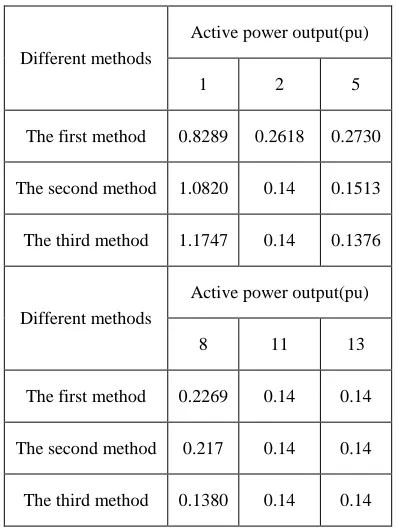
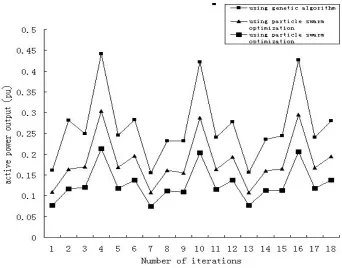
In order to verify the effectiveness of the algorithm, the active power output mathematical model is respectively solved by particle swarm optimization and genetic algorithm. Calculation results are list in graph1, the value of spinning reserve level is the 15 percent of system load, the maximum output power variation is the 30 percent of nominal capacity. Wind speed obeys Weibull distribution. Related parameters of wind turbines are list in Table1.
Table1 Units Parameters of IEEE30 Buses System
Wind turbine Upper limit outpower(pu)
Lower limit outpower(pu)
1 1.39 1.30
2 0.58 0.32
13 0.25 0.20
27 0.17 0.10
The first method:using genetic algorithm.
β
1and
β
2andβ
3 are 0.95, expect the maximum activepower output.
The second method:using particle swarm
optimization.
β
1 andβ
2andβ
3 are 0.95, expectthe maximum active power output.
The third method : using particle swarm
optimization.
β
1 andβ
2andβ
3 are 0.90, expect [image:5.612.99.298.270.535.2]the maximum active power output.
Table 2 Optimization Solution of Two Optimizations
Different methods
Active power output(pu)
1 2 5
The first method 0.8289 0.2618 0.2730
The second method 1.0820 0.14 0.1513
The third method 1.1747 0.14 0.1376
Different methods
Active power output(pu)
8 11 13
The first method 0.2269 0.14 0.14
The second method 0.217 0.14 0.14
The third method 0.1380 0.14 0.14
From Table 2, when the confidence level is changed(change 0.95 to 0.90) ,the active power output improved obviously, and vice versa.
6. CONCLUSION
Based on the randomness of wind farm, this paper put forward a mathematical model of calculate active power in wind power integrated system based on FRC programming. The question is solved by particle swarm optimization based fuzzy simulations, At last, an analyzation result about IEEE-30 system is given, The following conclusions can be drawn from the study.
Using the fuzzy chance-constrained programmi-ng mathematical model, the active power output can meet the constrained conditions.
Under the same convergence condition, the time of genetic algorithm is twice than particle swarm optimization, which shows that the efficiency in search for searching speed of particle swarm optimization, the performance of particle swarm optimization is better than genetic algorithm.
So, the particle swarm optimization is suitable for the active power output short-term forecast.
ACKNOWLEDGMENT
This work is partially supported by National Natural Science Foundation of China (Grant No.61273240), and Key Project of Chinese Ministry of Education (Grant No.211070), and Zhejiang Provincial Natural Science Foundation of China (Grant No. LY12F03024).
Thanks for the suggestions from Miss Bingjing Xiang.
REFRENCES:
[1] LEI Yazhou, WANG Weisheng, YIN Yong-hua, and DAI Huizhu, “Wind Power Penetration Limit Calculation Based On Chance Constrained Programming”, Proceedings of the CSEE, Vol.22, No.5, 2007, pp.32-35.
[2] WU Jiekang, WU Qiang, CHEN Guotong, and LIANG Ying, “ Fuzzy Random Chance-constrained Programming for Quantifying the Transmission Reliability Margin”, Automation of Electric Power Systems, Vol.31, No.5, 2007, pp. 23-28.
[3] WU Jun,LI Guojie, and SUN Yuan-zhang, “Maximum Injection Power Calculation of Wind Farms Connected to Power Systems Based on Stochastic Programming”, Power System Technology, Vol.31, No.14, 2011, pp.15-19.
[4] Zaininger H W, “Potential dynamic impacts of wind turbines on utility systems”, IEEE Transactions on Power Apparatus and Systems,Vol.100, No.12, 2011, pp.4821-4829.
ISSN: 1992-8645 www.jatit.org E-ISSN: 1817-3195 [6] JIANG Yuewen, CHEN Chong, and WEN
Buyin, “Economic dispatch based on particle swarm optimization of stochastisimulation in wind power integrated system”, Advanced Technology of Electrical Engineering and Energ, Vol. 26, No.3, 2007, pp. 37-41.
[image:6.612.137.479.341.609.2][7] CAO Na, ZHAO Hai-xiang, REN Pu-chun, and DAI Hui-zhu, “Establish and Application of Wind Speed Model in Wind Farm Dynamic Analysis”, Proceedings of the CSEE, Vol.22, No.9, 2007, pp.68-72