Journal of Chemical and Pharmaceutical Research, 2013, 5(11):617-625
Research Article
CODEN(USA) : JCPRC5
ISSN : 0975-7384
Effect of different excipients on formulation of immediate release
artemether/lumefantrine tablets
Mahmoud Alburyhi, Maged Alwan and Ashwaq Ahmed Aboghanem*
Department of Pharmaceutics, Faculty of Pharmacy, Sana'a University, Yemen
_____________________________________________________________________________________________
ABSTRACT
Different formulae were used to prepare Artemether/Lumefantrinetablets using direct compression and wet granulation methods of preparation. Tablets of Lumefantrine and Artemether were prepared in different concentrations with: Microcrystalline cellulose (as diluent), HPMC and Polyvinylpyrrolidone (as binder), Croscarmellose sodium, Crospovidone and starch 1500 (as disintegrant), Colloidal Silicon dioxide (as glident), Polysorbate 80 (as surfactant), PEG (as dissolution enhancer), Magnesium stearate and sodium stearylfumarate (as lubricant).The different formulations of Artemether and lumefantrine tablets were evaluated for: weight variation, uniformity of tablets thickness and diameter, friability, hardness, disintegration and dissolution for Artemether and Lumefantrine.
Keywords: Lumefantrine; Artemether; Formulation, Excipients.
_____________________________________________________________________________________________
INTRODUCTION
Artemether/Lumefantrine is a new and very well tolerated oral antimalarial drug effective even against multidrug-resistance falciparum malaria. Many studies have shown that it is the most effective of the antimalarial compound in shortening the fever and parasite clearancetimes [2,3]. Artemether is chemically, (3R, 5aS, -6R, 8aS, 9R, 10S, 12R, 12aR)-Decahydro-10-methoxy-3, 6, 9-trimethyl-3, 12-epoxy-12H-pyrano[4,3-j]-1, 2-benzodioxepin. Artemether (ART), also called dihydroartemisinin methyl ether, is a synthetic derivative of artemisinin[3,4]. Lumefantrine Also known as benflumetol and CGP 56695 during development) is chemically, 2, 7-Dichloro-9-[(4-chloro phenyl) methylene]-α-[(dibutylamino) methyl]-9H-fluorene-4-methanol and is used in the treatment of uncomplicated falciparum malaria[4].
In the case of conventional (immediate-release) solid oral drug products, the release properties are mainly influenced by disintegration of the solid dosage form and dissolution of drug from the disintegrated particles[1,10,11,13,14,15].
EXPERIMENTAL SECTION
2.1. Materials: 2.1.1. Apparatus
2.1.2. Materials and Reagents
Lumefantrine (Calyx chemicals& pharmaceuticals limited Thailand Batch no LF/20091107) kindly supplied by Pharma Yemen, Artemether (Microorgo-chem India Batch no Mo/ARM/0807) kindly supplied by Shiba-Pharma Yemen. Microcrystalline cellulose (Microcell 101®) Blanver Brazil, Hydroxypropyl methylcellulose (HPMC, Hypromellose) (Methocel®) Colorcon U.K, Polyvinylpyrrolidone (Povidone K®) ISP Switzerland, Croscarmellose sodium (AC-Di-Sol) (Explocel®) Blanver Brazil, Crospovidone XL-10(Crosslinked povidone) ( ISP Switzerland), Starch 1500(Pregelatinized starch) (Colorcon U.K), Colloidal Silicon dioxide(Cab-O-Sil) (Aerosil®200) Evonik Germany, Polysorbate 80 (Polyoxyethylene 20 sorbitan monooleate) Croda U.K, Polyethylene glycol 6000 (PEG) Macrogol 6000 (Clariant U.K), Magnesium stearate (Merk Germany), Sodium stearyl Fumarate (Lubripharm®) SPI Pharma.
2.2. Methods:
2.2.1. Preparation of Immediate Release Lumefantrine/Artemether Tablets
Immediate release Tablets of Artemether/Lumefantrine (20mg/120mg)were prepared in different concentrations with: Microcrystalline cellulose (as diluent), HPMC and Polyvinylpyrrolidone ( as binder), Croscarmellose sodium, Crospovidone and starch 1500 (as disintegrant), Colloidal Silicon dioxide (as glident), Polysorbate 80 (as surfactant), PEG (as dissolution enhancer), Magnesium stearate and sodium stearylfumarate (as lubricant)[5,9,10,12] as shown in The table (1).Each formula Contains: 120 mg Lumefantrine and 20 mg Artemether. All Formulations were prepared by wet granulation method except F1was prepared by Direct compression.
2.2.2. Weight Variation Test:
Ten tablets were separately weighed and their average weighed and standard deviation were calculated.
2.2.3. Uniformity of Tablets Thickness and Diameter:
The diameter and thickness of ten tablets were measured and the average of the ten tablets was calculated.
2.2.4. Friability:
Friability test was carried out as following: Ten tablets from each formula were accurately weighed and then placed in the drum of the friabilator. The drum rotated at 25 rotation per minute for 4 minutes. The tablets were weighed again and the present loss in weight was calculated.
2.2.5. Hardness:
The hardness (breaking strength in KP) of ten tablets from each formula was measured using hardness tester, and then the average of the ten tablets was calculated.
2.2.6. Hardness/Friability Ratio (H.F.R):
The H.F.R. was calculated for each formula by dividing the average hardness by its friability. H.F.R. is a good criterion for the mechanical strength.
2.2.7. Disintegration Test:
One tablet was placed in each of the six cells of the disintegration apparatus. Water was used as immersed solution maintained at 37+ 0.5°C then the apparatus was operated until no residue of the tablets aggregates remaining on the basket mesh, at this point the time of disintegrating was recorded.
2.2.8. Dissolution of Lumefantrin from Its Tablet Formulations:
The dissolution of Lumefantrin was determined using USP dissolution apparatus where medium was 0.1 N hydrochloric acid containing 1% of benzalkonium chloride; 1000 ml maintained at 37+ 0.5°C. The paddle was used to rotate 100 rpm. After 45 minutes passed, portion of the medium was withdrawn and filtered through 0.5µ m filter and diluted to a concentration of 24µg/ml with the medium then analyzed for Lumefantrin content by measuring the absorbance at λmax 342 nm using 0.1 N hydrochloric acid containing 1% of benzalkonium chloride as blank[2,6,7,8,14].
2.2.9. Dissolution of Artemether from Its Tablet Formulations:
2.2.10. Chromatographic conditions:
The mobile phase was a mixture of Acetonitrile, 1-propanol, trifluoroacetic acid, and water (500:100:1:400). The mixture was filtered through 0.45 µm membrane filter and degassed by means of vacuum pump. The mobile phase was delivered into the HPLC apparatus at a flow rate of 2ml/min, the detection was conducted at 210 nm, Column-C18(ODS) 5µ m (150x4.6mm) was used[6].
2.2.11. Preparation of Stock Solution and Working standard:
Artemether Stock Solution: 200 µg/ml was prepared by accurately Weighing of 40 mg of Artemether powder, transferring into a 200 ml volumetric flask and dissolving with Diluent (Acetonitrile and water(1:1))
Artemether Standard solution : 20 µg/ml was prepared by accurately transferring of 10 ml of the stock solution into a 100 ml volumetric flask and diluting with The medium[6].
RESULTS AND DISCUSSION
When the powder of the formula 1 and 2 were compressed, no tablets could be obtained as the compressibility of the powder was very low. During the compression process of the Formula 3 good tablets with nearly acceptable hardness could be obtained but a very high sticking of the powder on surfaces of the punches and dies system appeared.
When the weight of the unit tablets was increased from 180 to 250 mg in formula 4 by increasing the percentage of the diluent (Microcrystalline cellulose) from 10 % to 31.6%, the sticking problem which appeared in formula 3 was noticeably decreased. Sticking problem was completely disappeared in formulae 9.
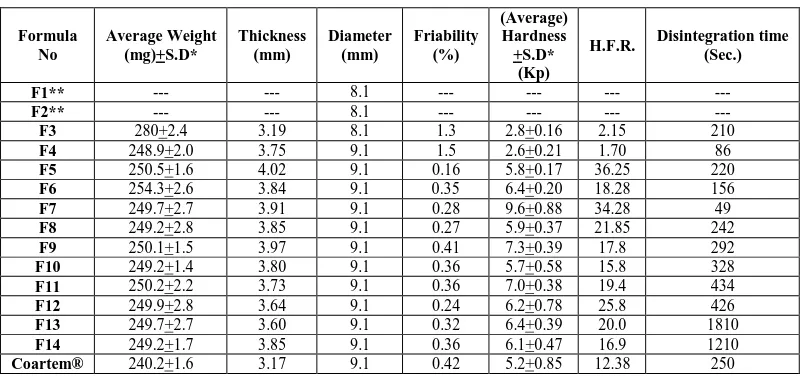
Table (2) illustrates the results of different quality control tests which were carried out to evaluate the prepared formulae.
All Prepared formulae showed weight variation with standard deviation less than 3%.
The Results of thickness and diameter indicated uniformity in the prepared tablets. In Formulae 4-15 the Range of thickness was (3.6 - 4.02 mm) while the diameter was 9.1. Formulae 1,2 and 3 the diameter was 8.1 mm as the panchs &die system used in these formulae was 8.00 mm.
The results of friability of formulae from 5 - 14 were acceptable (less than 0.5 %). The result of Formulae 3 and 4 were more than 1%.
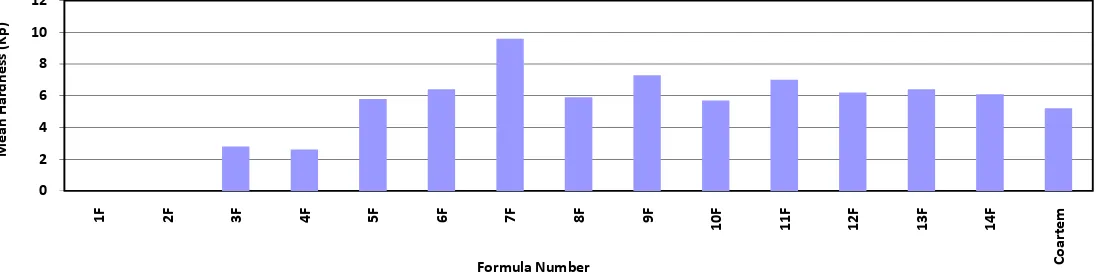
Formulae from 5-14 give acceptable hardness with a range 5-9 kp while formulae 3 and 4 gave low hardness which were less than 3kp.
The Results in table (2) Show the formulae with high concentration of Colloidal silicon dioxide have better mechanical strength than others.
The results of disintegration time show that all formulae have disintegration time less than 10 minutes except formulae 13 and 14 where the disintegration time was above 15 minutes that considers not acceptable.
Dissolution of Lumefantrine from Its Tablet Formulations:
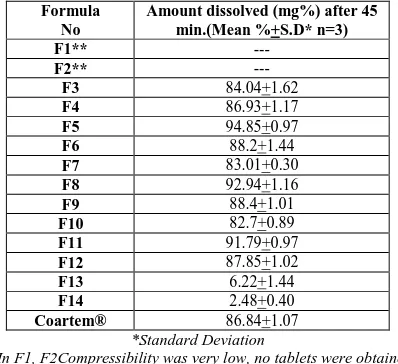
Results of the dissolution test of lumefantrine are shown in table (3). It is clearly that the dissolution results from nearly all formulae were more than 80% which consider very acceptable comparing to the brand (coartem) which was 86.84%, while the dissolution obtained from formulae 13 and 14 were less than 10% which considers not acceptable.
Dissolution of Artemether from Its Tablet Formulations:
Table (1): Formulation of Immediate Release Artemether/Lumefantrine Tablets Formula No. Microcry-stalline cellulose HPMC Polyvinyl-pyrrolidone Croscarmellose sodium Crospov-idone Starch 1500 Colloidal silicon dioxide Polysorbate 80 PEG 6000 Mg-stearate Sodium stearylfumarate Total weight (mg) F1
10.2% 4% --- 4% --- --- 0.5% 3% --- 0.5% --- 180
F2 13.3% 2% --- 3% --- --- 0.5% 3% --- 0.5% --- 180
F3 10.2% 4% --- 4% --- --- 0.5% 3% --- 0.5% --- 180
F4 31.6% 2 % --- 4% --- --- 0.5% 3% --- 0.5% --- 250
F5 31% 6% --- 5% --- --- 1.5% 3% --- 0.5% --- 250
F6 30.8% 6% --- 5% --- --- 1.5% 0.2% --- 0.5% --- 250
F7 33.8% --- 3% 5% --- --- 1.5% 0.2% --- 0.5% --- 250
F8 27.3% 6% --- 5% --- --- 1.5% 0.2% --- 0.5% 2% 250
F9 26.3% 6% --- 5% --- --- 1.5% 0.5% --- 3% 2% 250
F10 28.3% 6% --- 5% --- --- 1.5% 0.2% --- 3% --- 250
F11 26.5% 6% --- --- 5% --- 1.5% 3% --- 2% --- 250
F12 26.5% 6% --- 5% --- --- 1.5% 3% --- --- 2% 250
F13 21.5% 6% --- --- --- 10% 1.5% 3% --- 2% --- 250
F14 26.5% 6% --- 5% --- --- 1.5% --- 3% 2% --- 250
*Standard Deviation**In F1, F2Compressibility was very low, no tablets were obtained.
Table (2): Quality Control Test for Different Formulations of Artemether/Lumefantrine Immediate Release Tablets
Formula No Average Weight S.D* + mg) ( Thickness (mm) Diameter (mm) Friability (%) (Average) Hardness S.D* + (Kp)
H.F.R. Disintegration time (Sec.)
F1** --- --- 8.1 --- --- ---
---F2** --- --- 8.1 --- --- ---
---F3 280+2.4 3.19 8.1 1.3 2.8+0.16 2.15 210
F4 248.9+2.0 3.75 9.1 1.5 2.6+0.21 1.70 86
F5 250.5+1.6 4.02 9.1 0.16 5.8+0.17 36.25 220
F6 254.3+2.6 3.84 9.1 0.35 6.4+0.20 18.28 156
F7 249.7+2.7 3.91 9.1 0.28 9.6+0.88 34.28 49
F8 249.2+2.8 3.85 9.1 0.27 5.9+0.37 21.85 242
F9 250.1+1.5 3.97 9.1 0.41 7.3+0.39 17.8 292
F10 249.2+1.4 3.80 9.1 0.36 5.7+0.58 15.8 328
F11 250.2+2.2 3.73 9.1 0.36 7.0+0.38 19.4 434
F12 249.9+2.8 3.64 9.1 0.24 6.2+0.78 25.8 426
F13 249.7+2.7 3.60 9.1 0.32 6.4+0.39 20.0 1810
F14 249.2+1.7 3.85 9.1 0.36 6.1+0.47 16.9 1210
Coartem®
240.2+1.6 3.17 9.1 0.42 5.2+0.85 12.38 250
*Standard Deviation**In F1, F2Compressibility was very low, no tablets were obtained.
[image:4.595.221.624.281.469.2]Table (3): Dissolution of Lumefantrin from Its Freshly Prepared Tablet Formulations in 0.1N HCl Containing 1% Benzalkonium Chloride
Formula No
Amount dissolved (mg%) after 45 S.D* n=3) +
min.(Mean %
F1**
---F2**
---F3 84.04+1.62
F4 86.93+1.17
F5 94.85+0.97
F6 88.2+1.44
F7 83.01+0.30
F8 92.94+1.16
F9 88.4+1.01
F10 82.7+0.89
F11 91.79+0.97
F12 87.85+1.02
F13
6.22+1.44
F14 2.48+0.40
Coartem®
86.84+1.07
*Standard Deviation
**In F1, F2Compressibility was very low, no tablets were obtained.
Table (4): Dissolution of Artemether from Its Freshly Prepared Tablet Formulations in Water
Formula No.
Amount dissolved (mg%) after S.D* n=3) +
1 hr. (Mean %
Amount dissolved (mg%) after S.D* n=3) + 3 hr. (Mean %
F1** ---
---F2** ---
---F3
60.23 + 2.0 78.56 +0.84
F4 57.97 +1.16 79.64 +0.66
F5 64.23 +1.84 88.47 +0.65
F6 65.24+0.87 90.08+1.02
F7 74.11 +1.60 91.77 +1.50
F8 62.1 +0.82 92.71 +2.01
F9 76.68 +0.69 90.06 +0.68
F10 75.08+0.78 89.04+0.75
F11 75.31 +2.69 91.18 +1.28
F12 69.2 +1.10 80.23 +2.22
F13 42.3 +1.60 85.53 +0.85
F14 35.5+2.02 87.6 +0.70
Coartem® 59.84+0.49 86.17+0.87 *Standard Deviation
[image:5.595.322.521.90.272.2] [image:5.595.277.567.303.474.2]
Figure (1): Average Hardness of Artemether/Lumefantrine Tablets
Figure (2): Average Friability of Artemether/Lumefantrine Tablets 0
2 4 6 8 10 12
F
1 F2 F3 F4 F5 6 F F7 F8 F9 F10 F
1
1 F
1
2 F
1
3 F
1
4
C
o
a
rt
e
m
M
e
a
n
H
a
rd
n
e
ss
(
K
p
)
Formula Number
0 0.2 0.4 0.6 0.8 1 1.2 1.4 1.6
F
ri
a
b
il
it
y
(
%
)
[image:6.595.146.695.95.232.2]Figure (3): Average Disintegration Time of Artemether/Lumefantrine Tablets
Figure (4): Average Dissolution of Lumefantrine from Artemether/Lumefantrine Tablets
0 200 400 600 800 1000 1200 1400 1600 1800 2000
M
e
a
n
D
is
in
te
g
ra
ti
o
n
t
im
e
(
S
e
c.
)
Formula Number
0 10 20 30 40 50 60 70 80 90 100
A
m
o
u
n
t
d
is
so
lu
te
d
(
%
)
[image:7.595.113.728.100.256.2] [image:7.595.102.734.316.472.2]Figure (5): Average Dissolution of Artemether from Artemether/Lumefantrine Tablets
0 10 20 30 40 50 60 70 80 90 100
A
m
o
u
n
t
d
is
so
lu
te
d
(
%
)
Formula Number
After 1 hour
[image:8.595.123.725.88.226.2]CONCLUSION
Based on formula 1 which was prepared by direct compression since no tablets with acceptable hardness could be obtained during compression, it can be concluded that Artemether / Lumefantrine tablets (20mg/120mg) couldn’t prepared by direct compression. The compressibility of the active materials especially the Lumefantrine (which constitutes the highest percentage per tablet) is very low. It was found that increasing the net weight of the tablet from 180 mg to 250 mg decreases the sticking effect which appeared during compression. The reason of that is the Lumefantrine which has sticking nature so when the percentage of this material decreased per tablet, its sticking effect noticeably decreased. In addition to this, using two types of lubricants (magnesium stearate and sodium stearyl Fumarate, 3%,2%) was the good choice to terminate the sticking problem completely as in Formula 9. Increasing the percentage of the colloidal silicon dioxide to 1.5% participates in increasing the hardness of the tablets as shown in the formulae 5-14.
Based on the Disintegration and dissolution results, starch 1500 is not acceptable to be used as disintegrating agent in Artemether / Lumefantrine (20mg/120mg) immediate release tablets formulations. In addition, PEG is not acceptable to be used in Artemether / Lumefantrine (20mg/120mg) immediate release tablets formulations. Also it was concluded that Crospovidone 5% and croscarmellose sodium 5% are acceptable to be used as disintegrants in Artemether / Lumefantrine (20mg/120mg) immediate release tablets formulations.
Polyvinyl pyrrolidone 3% and HPMC 6% as binder in wet granulation method give the optimum results in Artemether / Lumefantrine (20mg/120mg) immediate release tablets formulations. Based on the quality control tests Formulae 5-12 are the most satisfied formulae.
REFERENCES
[1] Dressman Jennifer, Krämer Johann ; Historical pharmaceutical dissolution testing (2005), 3
[2] P Umapathi; J Ayyappan; S Darlin Quine, Tropical Journal of Pharmaceutical Research, October 2011; 10 (5): 643-653.
[3] Pratap Y. Pawar; Manisha P. Chavan; Geetanjali K. Ghanwat; Manish A. Raskar; Harshada P. Bhosale, Der Pharma Chemica, 2011, 3(3): 135-139.
[4] R. Arun1; A. Anton Smith , Int J Pharm Biomed Res 2011, 2(3), 201-205
[5] Row Raymond C, Shesky Paul and Owen Sian C, Hand book of Pharmaceutical Excipients, Fifth Edition,
(2006), 546,132, 346, 611, 211, 214, 731, 188, 545, 430, 705
[6] Authorized USP SALMOUS Standard Version 1. (2009), the United States Pharmacopeial Convention, pp.1,2,3 available at
http://www.usp.org/sites/default/files/usp_pdf/EN/nonUSStandards/lumefantrineArtemetherTablets.pdf
[7] Sagar Narayankar; Manisha Phadke; Dattatray Patil; R. K. Jadhav; Ramesh S. Yamgar, Der Pharma Chemica,
2010, 2(5):494-499
[8] Hanson Royal, Gray Vivian , Handbook of Dissolution Testing,3rd edition, (2004),130,134
[9] Chukwuemeka P. C. Azubuike; Augustine O. Okhamafe; Abiodun Falodun, J. Chem. Pharm. Res., 2011, 3(3):481-488.
[10] M. M. Ghorab; Mayada Elhadi Babiker, J. Chem. Pharm. Res., 2012, 4(5):2817-2831.
[11] Sachin V. Wankhede; M. Krishnaprasad; SY Manjunath, Subal Debnath, J. Chem. Pharm. Res., 2010, 2(5): 548-554.
[12] Swati C. Jagdale; Nisha C. Fernandes; Bhanudas S. Kuchekar; Tejas P.Shah; Anuruddha R. Chabukswar, J. Chem. Pharm. Res., 2010, 2(2): 65-72.
[13] A.Patel; A.lodha; J.chaudhuri; P.Jadia; T.Joshi; J.Dalal , J Pharm Bioallied Sci. 2012 March; 4(Suppl 1): S98– S100.