Development and validation of a dissolution method for Raloxifene
hydrochloride in pharmaceutical dosage forms using RP-HPLC
Sandeep Kalepu
a*, Vijaykumar Nekkanti
b, Mohanvarma Manthina
aand
Veerabhadraswamy Padavala
aa
Department of Pharmaceutical Technology, Shri Vishnu College of Pharmacy, Bhimavaram,
Andhra Pradesh, India
b
CPS Formulations, Dr. Reddy’s Laboratories Ltd., Hyderabad, Andhra Pradesh, India
_____________________________________________________________________________________________
ABSTRACT
The aim of this study was to develop and validate a dissolution test for Raloxifene hydrochloride (RLX) in pharmaceutical dosage forms using a reverse phase high performance liquid chromatographic (RP-HPLC) method. Efficient chromatographic separation was achieved using a ZodiacSil C4 column (150x 4.6 mm, 5µ), with simple mobile phase combination delivered in an isocratic mode and quantitation was by ultraviolet detection at a wavelength of 287 nm. The mobile phase consisted of buffer and acetonitrile (64:36% v/v) delivered at a flow rate of
0.7 ml min-1. Buffer consisted of 50 mM potassium di-hydrogen ortho phosphate monohydrate, pH adjusted to 3.0
using ortho-phosphoric acid. The calibration curve was linear (R2 > 0.999) over the concentration range of 2.5 – 15
µg mL-1 of the analyte. The optimized dissolution conditions include the USP apparatus II at a paddle rotation rate
of 50 rpm and 900 mL of 0.001 N HCl (pH 3.0) as dissolution medium at 37 ± 0.5°C. The present method was validated with respect to linearity, specificity, precision, accuracy and robustness. The system suitability parameters, such as theoretical plates, tailing factor and relative standard deviation (RSD) between five standard replicates were well within the limits. The stable nature of drug in the prescribed dissolution medium could be inferred from the stability studies. The developed dissolution test was adequate for its purpose and can be applied for the quality control of RLX in pharmaceutical dosage forms.
Keywords: Raloxifene hydrochloride, dissolution, RP-HPLC, validation.
_____________________________________________________________________________________________
INTRODUCTION
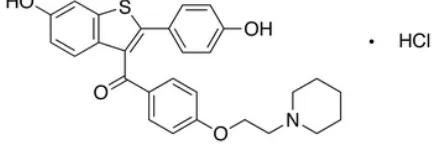
Fig. 1: Structure of Raloxifene HCl
A high interindividual and intraindividual variability (30%) of most pharmacokinetic parameters is exhibited by RLX and which makes it attractive for further disposition and metabolism studies [1]. The drug has beneficial actions on lipoprotein metabolism, reducing both total cholesterol and LDL; however, HDL is not increased unlike with estrogen-replacement therapy. After oral administration RLX is absorbed rapidly and has an absolute bioavailability of about 2%. The drug has a half-life of about 28 hrs and is eliminated primarily in the faeces after hepatic glucuronidation [1,2].
Drug release from pharmaceutical dosage forms can be evaluated using a dissolution test. In order to check the batch to batch consistency in drug release and detect the manufacturing deviations, the in vitro dissolution tests are important in quality control, while a predictive estimate of drug release correlating to in vivo performance of the drug product is provided by R&D. However, a dissolution test should be sensitive and reliable for predicting the in vivo performance of drug product [6]. Thus in order to develop and optimize a drug formulation and correlate it’s in vitro and in vivo release, the dissolution profiles could be considered important [7,8]. A few HPLC methods with UV detection have been previously reported for the determination of RLX in Pharmaceuticals [9-14]. The present work describes the development and validation of an accurate and reliable RP-HPLC method for the estimation of release of RLX in solid dosage forms, considering various factors like media volume, pH and sinks conditions. The RP-HPLC method reported in this study was validated in accordance with the International Conference on Harmonization (ICH) guidelines [15,16]. It is assumed that this dissolution test meets the required conditions that will dissolve a large fraction of the dose in a reasonable amount of time and will be used for quality control studies.
EXPERIMENTAL SECTION
2.1. Chemicals and Reagents
Raloxifene HCl was procured from Dr. Reddy’s Laboratories Ltd., Hyderabad. Acetonitrile, Methanol, Ortho-phosphoric acid were obtained from Rankem, India. Hydrochloric acid was obtained from SD fine Chem., India. Potassium Hydrogen Pthalate, Sodium Hydroxide and Glacial Acetic acid were obtained from Merck (India) Ltd. Potassium di-hydrogen ortho-phosphate was obtained from Fischer Scientifics, USA. High purity water was prepared by a Millipore Milli-Q plus water purification system. All other reagents used were of analytical grade.
2.2. Instrumentation
The drug dissolution profiles were studied using USP type II rotating paddle apparatus (LabIndia, Disso 2000). The liquid chromatographic system used for method development and validation was Waters 2695 binary pump plus auto sampler and a 2998 photo diode array detector (Waters Corporation, MA, USA). The pH of all solutions was determined by Thermo orion (Orion 420 A+) pH-analyzer.
2.3. Chromatography
Chromatographic separation was achieved on a ZodiacSil C4 column, with 150 mm X 4.6 mm ID and 5µ particles. The mobile phase consisted of a mixture of buffer and acetonitrile (640:360 v/v), which was degassed by using vacuum pump and sonication for 15 min prior to use. Buffer consisted of 50 mM potassium di-hydrogen ortho phosphate monohydrate, pH adjusted to 3.0 using ortho-phosphoric acid. The flow rate of mobile phase was 0.7 mL min-1and the injection volume was 50 µL. The column temperature was maintained at 37°C ± 0.5°C and the detection was monitored at a wavelength of 287 nm. Mobile phase was used as diluent.
3.1. Optimization of dissolution test conditions
presence of any degradation products and any changes in the peak area.
3.2. Method validation
RP-HPLC method was used to analyze the RLX samples in selected dissolution medium. The present method was validated with respect to linearity, specificity, precision, accuracy and robustness according to International Conference on Harmonization [15,16] and United States Food and Drugs Administration (USFDA) guidelines [17,18].
RESULTS AND DISCUSSION
4.1. Optimization of dissolution test conditions
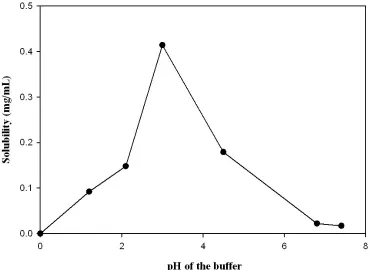
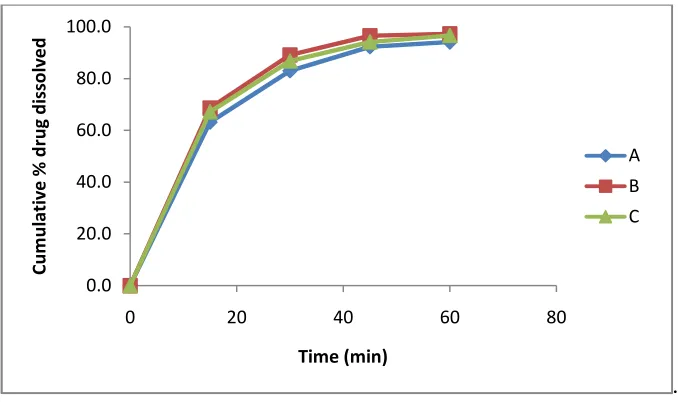
[image:3.595.110.480.399.669.2]The important parameters to be considered during the development of a dissolution method are solubility and solution stability of the drug sample. Buffers ranging from pH 1.2 – 7.4 were used as media. Considering the solubility and release profiles of the formulation as depicted in figure 2 & 3 respectively, greater solubility and highest drug dissolution was observed with 0.001 N HCl (pH 3.0) as medium. Three reproducible batches of the formulation containing 60 mg of RLX were performed with the developed method and the results showed no significant differences among the batches. The percent drug release for all the three batches were greater than 85% in 30 min as depicted in figure 4, which were well within the suggested acceptance criteria of not less than 80% in 30 min.
Fig. 3: Comparative dissolution profiles across pH buffers
Hence, based on the solubility and screening studies, 0.001 N HCl (pH 3.0) provided or ensured excellent sink conditions with greater stability for drug release. So 0.001 N HCl was selected as the optimized dissolution medium for dissolution of RLX in pharmaceutical dosage forms.
.
Fig. 4: Release profiles of three reproducible batches of RLX formulations
During the evaluation of solution stability of RLX in the selected dissolution medium (0.001 N HCl), chromatograms were obtained. The results showed that the solutions remained stable and no peaks related to degradation products were observed. According to literature (USP, 2007) [19], the acceptable range for solution
0.0 20.0 40.0 60.0 80.0 100.0
0 20 40 60 80
C
u
m
u
la
ti
v
e
%
d
ru
g
d
is
so
lv
e
d
Time (min)
A
B
[image:4.595.137.476.444.645.2]not more than (NMT) 2.0. As indicated in Table 1 relative standard deviation (RSD) for the area and retention time of five replicates showed adherence to limits. For all the chromatograms, theoretical plates were above 2500 and the tailing factor was less than 2.0. RSD results from five replicates showed adherence to the limits. The above results indicate the validity of the above developed method and suggested its use for routine lab analysis.
Table 1: System suitability criteria and results
Parameter Criteria Results
Blank No interference No interference
Tailing Factor NMT 2 1.2
Theoretical Plates NLT 2500 3500
% RSD for the area of 5 replicate injections of the standard solution NMT 2.0% 0.48 % RSD for the retention time of 5 replicate injections of the standard solution NMT 0.2% 0.04
4.2.1. Linearity
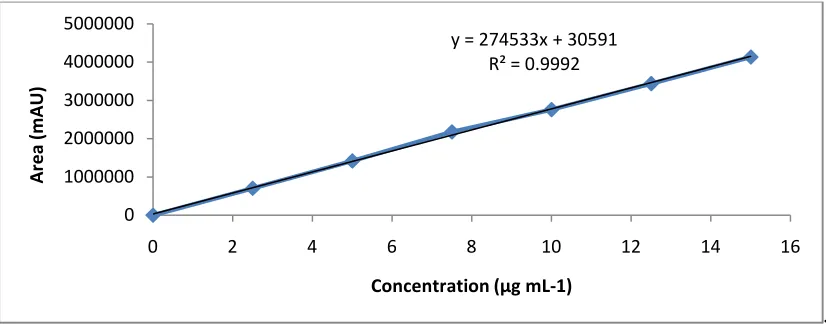
To establish linearity of the above method, calibration solutions were prepared from stock solution at six concentration levels from 10 to 150% of the assay analyte concentration (2.5, 5.0, 7.5, 10.0, 12.5 and 15 µg mL-1). Each solution was injected and the chromatograms were obtained. A calibration curve was prepared by plotting concentration (µg mL-1) against area response (mAU) and is depicted in Figure 5. The corresponding linearity data of RLX is shown in Table 2.
.
Fig. 5: Linearity curve for Raloxifene HCl
Table 2: Linearity data of Raloxifene HCl
4.2.2. Specificity
The ability to unequivocally determine the analyte in presence of additional components such as excipients, degradation products and impurities is called as specificity of an analytical method. It is evaluated comparing the chromatograms of placebo solution and RLX solution obtained from dosage form. No peaks were observed in the resultant chromatogram of placebo. The dosage form showed a single peak corresponding to RLX but no other
y = 274533x + 30591 R² = 0.9992
0 1000000 2000000 3000000 4000000 5000000
0 2 4 6 8 10 12 14 16
A
re
a
(
m
A
U
)
Concentration (µg mL-1)
Percent of API Concentration (µg/mL) Area (mAU)
25 % 2.5 701135
50 % 5 1417795
75 % 7.5 2176475 100 % 10 2759206 125 % 12.5 3439330 150 % 15 4133161
Slope 274533
y-intercept 30591
[image:5.595.204.410.584.683.2]peaks of the formulation (i.e. excipients) were observed as depicted in Figure 6. These results confirm the specificity of the method for RLX.
Fig. 6: Chromatogram corresponding to test sample
4.2.3. Precision
[image:6.595.210.403.446.547.2]The precision of the method was investigated with respect to repeatability and intermediate precision. Repeatability is a measure of the precision under the same operating conditions over a short interval of time and is also known as intra-assay precision. This was evaluated by assaying six replicate injections of RLX at 100% of the test concentration (10 µg mL-1) on the same day. Analyzing the samples on two different days by two different analysts using different columns (of same make), different chromatographic and dissolution systems gives the intermediate precision (inter-day precision) and was evaluated by assaying six replicate injections of RLX at 100% of the test concentration. The peak area based RSD for inter-day and intra-day precision are tabulated in Table 3. The results indicated that all the RSD values were within the accepted criteria of NMT 2.0%.
Table 3: Precision (repeatability) of Raloxifene HCl
Replicates Intra-day (area) Inter-day(area)
Day 1 Day 2
1 2759037 2777989 2781368 2 2729380 2756100 3768510 3 2720992 2729098 2724679 4 2770871 2776001 2788753 5 2771800 2739009 2720457 6 2740191 2798987 2766885 Average 2748712 2762864 2758422 % RSD 0.79 0.95 1.05
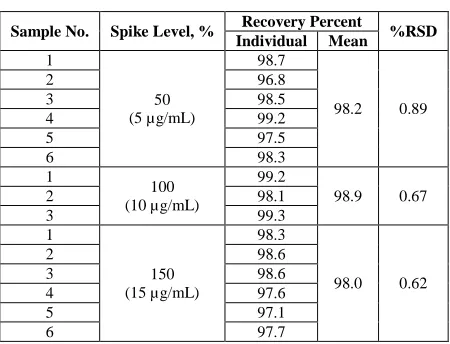
Table 4: Accuracy (recovery) of Raloxifene HCl
Sample No. Spike Level, % Recovery Percent %RSD
Individual Mean
1
50 (5 µg/mL)
98.7
98.2 0.89
2 96.8
3 98.5
4 99.2
5 97.5
6 98.3
1
100 (10 µg/mL)
99.2
98.9 0.67
2 98.1
3 99.3
1 98.3
2 98.6
R A L O X IF E N E 4 .0 1 1 A U 0.00 0.05 0.10 0.15 0.20 0.25 0.30 0.35 0.40 Minutes
[image:6.595.194.419.569.741.2]amounts of RLX added and the amounts found.
4.2.5. Robustness
Robustness of the method was evaluated by altering the experimental conditions such as flow rate and pH of the mobile phase. The flow rate was varied by ± 0.2 (0.5 and 0.9 ml min-1) and the pH of the mobile phase was varied by ± 0.1 units (2.9 and 3.1 pH units). The results revealed that deliberate variations of the method conditions had no significant effect of the retention time and peak area (for a given RLX concentration), indicating the robustness of the above chromatographic method.
CONCLUSION
An isocratic RP-HPLC method was developed for the estimation of percent drug release of RLX in pharmaceutical dosage forms. The method overcame the solubility and stability issues and was validated as per ICH guidelines. The optimized dissolution conditions included a 900 mL of medium (0.001 N HCl, pH 3.0) and the paddle speed at 50 rpm. A rapid quantification of many samples in routine analysis could be achieved using this chromatographic method, since the run time was relatively short (6 min). The method showed satisfactory results for all the method validation parameters tested and indicated that, the developed method is linear, specific, precise, accurate and robust. Therefore, this method can be recommended for the quality control studies of RLX in pharmaceutical dosage forms, concomitantly assuming the therapeutic efficacy of the drug.
Acknowledgement
Authors are thankful to Dr. Reddy’s Laboratories Ltd., India and Shri Vishnu college of Pharmacy, India for providing all the facilities during the study.
REFERENCES
[1]D Hochner-Celnikier. Eur. J. Obstet. Gynecol. Reprod. Biol., 1999, 85(1), 23 - 29. [2]M Heringa. Int. J. clin. Pharmacol. Ther., 2003, 41 (8), 331 – 345.
[3]The Merck Index. 14th ed., Merck White House station, 2006, p.1394.
[4]Evista®. Accessed april (2005) http://www.drugresourcecenter.com/evista/evista.htm. [5]J S Teeter; RD Meyerhoff. Environ. Toxicol. Chem., 2002, 21 (4), 729 - 736.
[6]S Azarmi; W Roa; R Lobenberg. Int. J. Pharm., 2007, 328, 12–21.
[7]GL Amidon; H Lennernas; VP Shah; JR Crison. Pharm. Res., 1995, 12, 413 – 420.
[8]E Galia; E Nicolaides; D Horter; R Lobenberg; C Reppas; JB Dressman. Pharm. Res., 1998, 15, 698 - 705. doi:
10.1023/A:1011910801212.
[9]J Trontelj; T Vovk; M Bogataj; A Mrhar. Pharm. Res., 2005, 52, 334–339. doi: 10.1010/j.phrs.2005.05.007.
[10]Q Wang; H Zhang; Z Yu; SYD Xuebao. 2002, 19, 105–108; ref. Chem. Abstr. 2002; 137: 68307h.
[11]P Nandini; W Jayant. Indian Drugs, 2001, 38, 591–592.
[12]P Venkata Reddy; B Indha Ravi; G Srinibabu; JVNL Sehagiri Rao. E-Journal Chem, 2006, 6, 60–64.
[13]B Kalyanaramu; K Raghubabu. J. Chem. Pharm. Res., 2011, 3(1), 122-127.
[14]B Vijay kumar; K Pratap kumar; K Suresh; Saheena Apsar; P Srikanth; Y Suneetha. J. Chem. Pharm. Res., 2011, 3(3):784-791.
[15]ICH (Q2R1). Guidelines on validation of analytical procedures: text and methodology. In: Proceedings of the International Conference on Harmonization, Geneva.2007.
[16]ICH. Draft guidance on specifications: test procedures and acceptance criteria for new drug substances and products: chemical substances. Federal Register (Notices) 2000, 251, 83041-83063.
[17]FDA. Analytical procedures and methods validation: chemistry, manufacturing, and controls. Federal Register
(Notices), 2000, 65 (169), 52776–52777.
[18]FDA. Guidance for industry: dissolution testing of immediate release solid oral dosage forms. US Department
of Health and Human Services, Centre for Drug Evaluation and Research (CEDER), 1997.