ISSN: 1992-8645 www.jatit.org E-ISSN: 1817-3195
345
A PERSONALIZED SEARCH ENGINE BASED ON
CORRELATION CLUSTERING METHOD
1
BOURAIR ALATTAR , 2 NORITA MD. NORWAWI
Faculty of Science and Technology, Universiti Sains Islam Malaysia E-mail: [email protected]
ABSTRACT
Nowadays, search engines tend to use latest technologies in enhancing the personalization of web searches, which leads to better understanding of user requirements. This paper aims to address the problem of enhancing the efficiency of search system by mining data logs. Search logs are associated with all the interactions that have been done between the user and the search engine including the query, the resulted pages and the selection. The paper also aims minimize the ambiguity within the query whilst the partitioning-based clustering aims to reduce the search space by dividing the data into groups that contain similar objects. To do so, this paper conduct several experiments to evaluate correlation clustering method. The method of this paper includes a pre-processing phase, which in turn involves tokenization, stop-words removal, and stemming. In addition, we evaluates the impact of the two similarity/distance measures (Cosine similarity and Jaccard coefficient) on the results of the correlation clustering method. Experimental results obtained are quite satisfactory in terms of the Precision, Recall and F-score. .
Keywords: Personalized Search Engine, Correlation Clustering algorithm, similarity/distance measures.
1. INTRODUCTION
Personalization in search engine aims to use data logs to observe and store the user’s transactions[1-10]. Such logs contain heterogeneous information that can be represented by various aspects such as information that is related to the user’s preferences, language, location and interests. Moreover, it also contains information related to the user’s behaviour such as his own queries, frequent terms and criteria of results selection. In another aspect, these data logs contain information about the search engine itself including its response and the mechanism of ranking documents. Therefore, these logs tend to be large-scale repository which can significantly influence the effectiveness and efficiency of the search system.
The huge and continually increasing amount of information on the web creates many challenges for the researchers of web search [10-15]. One of the problems of search engines is that when queries are issued by different users, most of them return the same results to the users without considering who have submitted the query. Thus, all users get the same result for the same query, even if they have widely different interests, needs and backgrounds. Current web search engines like Google, Yahoo and many more are built to serve all users, independent of the special needs of any individual user. Majority of the search engines on the web deliver a list of
results for the user’s query. It has been seen that most of the times the exact search context or interest of the user is ignored. For example, a biologist and a programmer may use the same query “mouse” with different search context, but the search systems would return same results. In addition, it has been seen that most of the times search results present such a big list of outcomes that they have to be categorized into different result pages. There are individual differences with respect to synonymy, polysemy and information needs which create problems for the users. The user might have to browse multiple yet irrelevant results before reaching the expected information. So to fill the gap between the user interest and retrieved search results, personalized web search needs to be evolved[16]. Nevertheless , few of these issues can be alleviated when the users make use of personalization methods while searching [17].
ISSN: 1992-8645 www.jatit.org E-ISSN: 1817-3195
346 log data are quite noisy. Unlike traditional text, queries tend to be shorter and yield high degree of ambiguity with possibility to have noisy data such as typos. Furthermore, the meaning of queries may change over time. There is a need to mine data logs in order to enhance the effectiveness (the quality of matching results) and the efficiency (the time and memory) of the search engine. The effectiveness of the personalization of web search based on grouped web usage data depends on the quality of clusters[20]. So efficient clustering algorithm is desired to enhance the effectiveness and efficiency of the Personalization of Web Search [3, 5, 8, 10, 21, 22]. Clustering technique is a method that seeks to organize data into different classes that share identical characteristics. In this technique, intra-class similarities are maximized or minimized. In the clustering technique, it is not common for labels to be attached to data in advance. This research used in this paper presents the results of an experimental study of the correlation clustering method on personalized search engine . The method of this paper includes a pre-processing phase, which in turn involves tokenization, stop-words removal, and stemming. In addition, we evaluates the impact of the two similarity/distance measures (Cosine similarity and Jaccard coefficient) on the results of the correlation clustering method.
This paper is split into four main sections: In Section two, we discussed related works on personalized web search engine document. Then in Section three, we described the How do we implementation out our review. And Section four will be on the experimental findings, and finally, Section five and will be conclusion our work..
2. RELATED WORK
Many methods and approaches have been proposed in terms of web search personalization. For instance, Speretta and Gauch [7] explores the use of a less-invasive means of to gather user
information for personalized web search.
Particularly build user profiles based on activity at the search site and study the use of these profiles to provide personalized search results. User profiles are created by classifying the collected information into concepts in a reference concept hierarchy and then these profiles are used to re-rank the search results and the rank-order of the user-examined results before and after re-ranking, are compared. Their personalized re-ranking results in a 34% improvement in the rank order of the user selected results.
Lai and Soh [23] compared User profile results and personalized search results. The large amount of information is available on web. When user searches anything, in some cases it provides same results for different type of queries. Therefore, it is difficult for user to get relevant and desirable results because it does not consider user preferences as well as interest. Evaluation of users’ specified query search and browsing activities are depends on searching query inputted and clicking rate (i.e. no of the times various user click that link) of each link in the response of query and the amount of time they used particular site. Solution to this is to construct user searching profile and method for document profile construction. The discussion is taken place that conclude how to use this model to combine document and user searching profile to provide desired personalized search results to user.
Kim and Cho [24]implemented a personalized Web search engine by using fuzzy concept network with link structure. Many search engines uses link structure to find out precision. Output of link based search engine is having high quality than text based search engine but they are complex. Personalization is one of the best way to obtain more effective and desirable results. Fuzzy concept with network with link structure is useful to find user query’s subjective interest. The proposed approach is used to make results personalized by using link based search techniques. The experimental results shows that the results returns to user are based on user interest and preferences, also appropriate.
Matthijs and Radlinski [11] collect web usage data that is URL of page, duration of page visit, page session date and time ,length of the source HTML using Firefox add on.
Liang [25] proposes effective way to construct user profiles based on user interest and preferences. To construct user profiles three approaches are proposed Support Vector Machines method Rocchio method, k-Nearest Neighbors method and. Experimental results taken from a constructed dataset conclude that the k-nearest method is effective than other.
ISSN: 1992-8645 www.jatit.org E-ISSN: 1817-3195
347 improves the precision significantly as compared to the baseline.
Palleti, et al. [27], by using probabilistic query expansion author developed personalized web search. In this approach, the authors developed a personalized Web search system applied at proxy, which changes to user interests perfectly by generating user profile with the use of collaborative filtering. A user profile consists of probabilistic correlations among query terms and document terms, which are utilized for providing personalized search results. Experimental outcomes prove that this proposed personalized Web search system is very effective and efficient. Smyth [3] introduced community-based approach to provide effective personalizing Web search. At community level, knowledge reflect within search communities by collecting user search query and result chosen by user. All collected data is used to prepare a
relevance model that provides promotive
community relevant results for all web search. Collaborative web search approach is used here that suggest valuable and sharable knowledge.
With the growth in the number of Web users, the problem of personalization of web search engine has become very critical and popular [18]. It is highly needed to personalized Web Search effectively as it is an open problem in the information retrieval community [5] .Mining the user logos and search results is considered as one of major approaches toward personalization. Mining data logs is a challenging task regarding to several obstacles. The size of search and browse log data at a search engine is usually very large and log data are quite noisy. Unlike traditional text, queries tend to be shorter and yield high degree of ambiguity with possibility to have noisy data such as typos. Furthermore, the meaning of queries may change over time.
Few researches are performed on mining data logs aim for enhancing the quality of matching results and the time and memory that would be consumed [19]. There is a need to mine data logs in order to enhance the effectiveness (the quality of matching results) and the efficiency (the time and memory) of the search engine. The effectiveness of the personalization of web search based on grouped web usage data depends on the quality of clusters([20]). So efficient clustering algorithm is desired to enhance the effectiveness and efficiency of the Personalization of Web Search[3, 5, 8, 10, 21, 22]. Thus it brings interesting
clustering challenges in the personalized search
framework. Clustering results should change
dynamically to detect the changes in user’s interest and to reflect the personalized ranking of search results.
3. PROPOSED METHOD
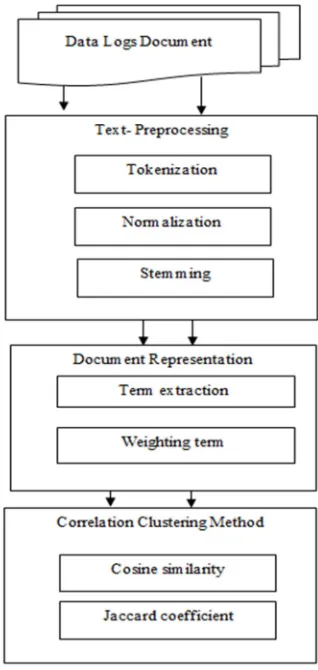
[image:3.612.330.489.292.627.2]In this study framework includes all the stages of implementing the proposed method. Such stages determine the process of collecting the dataset, preprocessing tasks, feature extraction and the clustering method. The comparative Analysis and evaluation of clustering is carried out by using precision, recall and overall F-measure. Figure 1 shows the framework of the crime document clustering.
Figure 1: Research Methodology.
3.1 Preprocessing
ISSN: 1992-8645 www.jatit.org E-ISSN: 1817-3195
348 recognizing named entities. The following sub-sections illustrates those steps.
a) Normalization
This step aims to clean the data by removing noisy or unwanted data such as, digits, stop-words and special characters. Such data has been explained as follows:
b) Remove special characters
There are tremendous of special characters which hinders the process of analyzing text. Table 1 shows a sample of such special characters.
Table 1 Sample of special characters Special characters
! - ~ @ * ^ # & + $ % =
c) Remove stop-words
Generally, documents usually found to contain a lot of unnecessary words in English, such as, pronouns, prepositions, conjunctions and others, which are usually used by authors for the purpose of linguistically enhancing the structures, and in particular, focusing on the syntactic or grammatical function of the language, rather than strengthening the semantic function or the meaning of the content. Therefore, in this particular regard, the process of word removal is very common and of considerable importance to be involved in Document Clustering. This is because, by carrying out word removal. The dimensionality of the terms space will be drastically reduced. stop word as a list of 571 Stop words, and are called so, these are generally regarded stop words because they tend to convey syntactic functions, rather than conveying more than they convey semantic functions, such as, carrying further meaning, which can enhance and strengthen the communicative or informational aspects of the document content.
d) Tokenization
The first step of morphological analyses is the tokenization. The aim of the tokenization is the exploration of the words in a sentence. Textual data is only a block of characters at the beginning. All following processes in information retrieval require the words of the data set. Tokenization is the task of dividing words from text into clusters of consecutive morphemes, one of which typically corresponds to the word stem.
e) Stemming
Stemming aims to eliminate all the derivational inflections form the words. The stemmer that have been used in this research is based on the Buckwalter system which includes three distinct lexicon files (dictionary) listing all prefixes, suffixes, and stems. The algorithm works by dividing a given input word into prefix, stem and suffix and then match those segments with the corresponding lexicons.
3.2 Text Representation
Directly In applying most learning algorithms to text information, in a direct way without representing, it has been proved to be impossible, due to the complex nature of the text information. Therefore, before applying the text using to a machine learning method, it is essential to converting the content of a textual document to a compact representation is necessary. They are Document representation has been found to be efficiently used as a language-independent method, since they are it is independent of the meaning of the language, and perform well in case of noisy text. Term Frequency × Inverse Document Frequency (TF×IDF) weighting is also recognized as a simple method for term weighting.
.
Term Frequency × Inverse Document Frequency (TF×IDF) weighting is seen as the most popular method used for term weighting, since it considers this property. By using this approach, assigning the weight of term i in document d to the number of times the term appears in the document is proportional, and it is in inverse proportion to the number of documents in the corpus, in which the term appears.
.
3.3 Similarity And Dissimilarity Measures
ISSN: 1992-8645 www.jatit.org E-ISSN: 1817-3195
349 closeness between a pair of objects, in terms of either the pair wise similarity or distance. This research will focus on well-known measures of distance between patterns. In this regard, this paper focuses on the cosine similarity and Jaccard coefficient as similarity or distance measures.
Cosine
Cosine similarity is one of the most well-known similarity measure which is applied to text documents such as in numerous information retrieval applications and clustering . In measuring
the given two documents. and , their cosine
similarity is:
, . . | | ∗ | |
Jaccard
The Jaccard coefficient, which is another similarity measure, also known as the Tanimoto coefficient, is used to measure the similarity in the intersection divided by the union of the objects. For text document, the use of Jaccard coefficient is to make a comparison of the sum weight of shared terms and the sum weight of terms presented in either of the two documents but in condition that they are not the shared terms. The formal definition is as follows:
, . .
| | ∗ | | . .
3.4 Clustering Techniques
Correlation clustering
Correlation clustering does not require a bound of the number of clusters that the data is partitioned into; rather it aims to partition the data into the optimal number of clusters based on the similarity between the data points [2]. Basically, it aims to maximize the agreements by maximizing the similarity and minimizing dissimilarity within the same cluster, and minimizing the disagreements by
minimizing the similarity and maximizing
dissimilarity between clusters. Assume G V, E
be a graph on a vertices with edge weightsc$% 0.
Let e u, v ∈{+, -} be the label of the edge (u, v).
The positive neighborhood of u is N+(u) = {u} ∪
{v: e (u, v) = +} and the negative neighborhood of
u is N, u -u.∪ -v: e u, v .. Let OPT
represent the optimal clustering, and for a clustering C, we let C (v) be the set of vertices that are in the same cluster as v. Consider a clustering C -12, 13, … , 15.. A negative labeled edge inside a cluster is considered a negative mistake and a positive labeled edge between
clusters is considered a positive mistake [2]. If our goal is to minimize disagreements, we minimize the weight of positive edges between clusters and absolute valued weight of negative edges inside clusters. When maximizing agreements we wish to maximize the weight of positive edges inside clusters plus the absolute valued weights of negative edges between clusters.
4. EVALUATION METRICS
Now, in order to evaluate clustering methods, the common information retrieval metrics precision, recall and f-measure will be used. Precision aims to evaluate the cluster based on the number of correct retrieved candidates out of the total number of retrieved candidates. Hence, we can calculate precision and recall. Precision aims to evaluate the cluster based on the number of correct retrieved candidates out of the total number of retrieved candidates. It can be calculated as follows:
6789:;:<= 9>?;@87 :
# <B 9<7789@ :=;@C=98 := 9>?;@87 : @<@C> # <B 9>?;@87 : :=;@C=98;
Whereas, recall aims to evaluate the cluster based on the number of correct retrieved candidates out of the total number of correct instances in the dataset. It can be computed as follows:
789C>> 9>?;@87 :
# <B 9<7789@ :=;@C=98 9>?;@87 : @<@C> # <B 9<7789@ :=;@C=98; := @D8 EC@C;8@
Now it can be possible to calculate the f-measure as follows:
B F8;C?78 2 H 6789:;:<= H I89C>> 6789:;:<= J I89C>>
5. EXPERIMENTAL RESULTS
ISSN: 1992-8645 www.jatit.org E-ISSN: 1817-3195
[image:6.612.92.295.118.304.2]350
Table 2 Results of correlation clustering with three clusters
Correlation clustering
Precision Recall Fmeasure
C
o
si
n
e
0.3 80% 76% 78%
0.4 82% 80% 81%
0.5 86% 83% 84%
J
a
cc
a
rd
0.3 78% 75% 76%
0.4 80% 78% 79%
0.5 84% 80% 82%
[image:6.612.315.519.218.406.2]Second experiments aims to evaluate the correlation clustering with Cosine similarity measure and Jaccard similarity measure in terms of the ability to identify clustering of data log’s queries with four clusters . The results of precision, recall and f-measure will be stated with three values of threshold which are 0.3, 0.4 and 0.5. Table 3 shows these results of this phase.
Table 3 Results of correlation clustering with four clusters
Correlation clustering
Precision Recall Fmeasure
C
o
si
n
e
0.3 81% 75% 77%
0.4 85% 78% 82%
0.5 88% 83% 85%
J
a
cc
a
rd
0.3 82% 78% 79%
0.4 85% 81% 82%
0.5 89% 84% 86%
As shown in Table 3, the precision, recall and f-measure have been calculated for each threshold values. In fact, the greatest values of precision, recall and f-measure have been obtained by using 0.5 of threshold. Morever, the results obtained using correlation clustering with cosine simailarity is worse than that obtained using correlation clustering with Jaccard simailarity on four clusters.
Second experiments aims to evaluate the correlation clustering with Cosine similarity measure and Jaccard similarity measure in terms of the ability to identify clustering of data log’s queries with four clusters . The results of precision, recall and f-measure will be stated with three values of threshold which are 0.3, 0.4 and 0.5. Table 4 shows these results of this phase.
Table 4 Results of correlation clustering with five clusters
Correlation clustering
Precision Recall Fmeasure
C
o
si
n
e
0.3 84% 80% 82%
0.4 87% 82% 84%
0.5 90% 85% 87%
J
a
cc
a
rd
0.3 84% 79% 81%
0.4 87% 82% 84%
0.5 91% 85% 87%
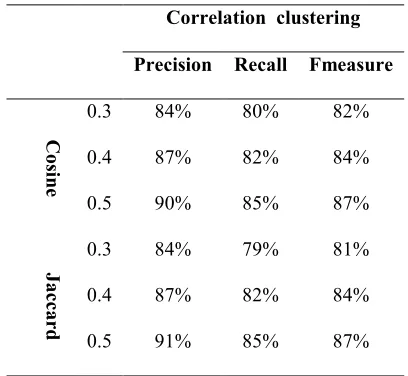
As shown in Table 4, the precision, recall and f-measure have been calculated for each threshold values. In fact, the greatest values of precision, recall and f-measure have been obtained by using 0.5 of threshold. Morever, the results obtained using correlation clustering with cosine simailarity is almost the same as that obtined using correlation clustering method with Jaccard simailarity on five clusters In general, the two similarity measures have obtained their best results when the number of clusters were 5 where Cosine has achieved 90%, 85% and 87% of precision, recall and f-measure respectively. Whereas, Dice has achieved 91%, 85% and 87% of precision, recall and f-measure respectively. Efficient clustering algorithm is developed to enhance the effectiveness and efficiency of the Personalization of Web Search. Clustering results change dynamically to detect the changes in user’s interest and to reflect the personalized ranking of search results
6. CONCLUSION
[image:6.612.82.303.439.626.2]ISSN: 1992-8645 www.jatit.org E-ISSN: 1817-3195
351 (Cosine similarity and Jaccard coefficient) on the results of the correlation clustering algorithms. the results obtained using correlation clustering with cosine simailarity is almost the same as that obtined using correlation clustering method with Jaccard simailarity on five clusters In general, the two similarity measures have obtained their best results when the number of clusters were 5 where Cosine has achieved 90%, 85% and 87% of precision, recall and f-measure respectively. Whereas, Dice has achieved 91%, 85% and 87% of precision, recall and f-measure respectively. Efficient clustering algorithm is developed in this research to enhance the effectiveness and efficiency of the Personalization of Web Search. In the future work, we paln to extend this work to
include other clustering methods such as
hierarchical clustering and other similarity
measures. To enhance the clustering methods for personalized web search engine , we plan to combine clustering algorithms with meta-heurstic search algorithm.
REFERENCES
[1] P. Brusilovski, A. Kobsa, and W. Nejdl,
The adaptive web: methods and strategies
of web personalization vol. 4321: Springer
Science & Business Media, 2007.
[2] B. Smyth and E. Balfe, "Anonymous
personalization in collaborative web search," Information retrieval, vol. 9, pp. 165-190, 2006.
[3] H. C. Lee and A. Borodin, "Cluster based
personalized Search," in International
Workshop on Algorithms and Models for
the Web-Graph, 2009, pp. 167-183.
[4] B. Smyth, "A community-based approach
to personalizing web search," Computer,
vol. 40, pp. 42-50, 2007.
[5] A. B. Rajmane, P. M. Patil, and P. J.
Kulkarni, "Personalization of Web Search Using Web Page Clustering Technique,"
World Academy of Science, Engineering and Technology, International Journal of Computer, Electrical, Automation, Control
and Information Engineering, vol. 9, pp.
2171-2176, 2016.
[6] K. W.-T. Leung, W. Ng, and D. L. Lee,
"Personalized concept-based clustering of
search engine queries," IEEE Transactions
on knowledge and data engineering, vol.
20, pp. 1505-1518, 2008.
[7] M. Speretta and S. Gauch, "Personalized
search based on user search histories," in
The 2005 IEEE/WIC/ACM International
Conference on Web Intelligence (WI'05),
2005, pp. 622-628.
[8] P. Ferragina and A. Gulli, "A personalized
search engine based on Web‐snippet
hierarchical clustering," Software:
Practice and Experience, vol. 38, pp.
189-225, 2008.
[9] N. Ramesh and J. Andrews, "Personalized
search engine using social networking
activity," Indian Journal of Science and
Technology, vol. 8, p. 301, 2015.
[10] A. Kumar and M. Ashraf, "Personalized
web search engine using dynamic user profile and clustering techniques," in
Computing for Sustainable Global
Development (INDIACom), 2015 2nd
International Conference on, 2015, pp.
2105-2108.
[11] M. I. Jalgaon, "AN EFFICIENT AND
NOVEL APPROACH FOR WEB
SEARCH PERSONALIZATION USING
WEB USAGE MINING," Journal of
Theoretical and Applied Information
Technology, vol. 73, 2015.
[12] M. Sah and V. Wade, "Evaluation of
Personalized Concept-Based Search and Ranked Lists over Linked Open Data," in
UMAP Workshops, 2014.
[13] M. Sah and V. Wade, "Personalized
concept-based search and exploration on
the web of data using results
categorization," in Extended Semantic Web
Conference, 2013, pp. 532-547.
[14] K. W.-T. Leung, D. L. Lee, and W.-C.
Lee, "Pmse: A personalized mobile search
engine," IEEE transactions on knowledge
and data engineering, vol. 25, pp.
820-834, 2013.
[15] D. Sontag, K. Collins-Thompson, P. N.
Bennett, R. W. White, S. Dumais, and B. Billerbeck, "Probabilistic models for
personalizing web search," in Proceedings
of the fifth ACM international conference
on Web search and data mining, 2012, pp.
433-442.
[16] P. Jay, P. Shah, K. Makvana, and P. Shah,
"Review on web search personalization
through semantic data," in Electrical,
Computer and Communication
Technologies (ICECCT), 2015 IEEE
International Conference on, 2015, pp.
ISSN: 1992-8645 www.jatit.org E-ISSN: 1817-3195
352
[17] G. Bordogna, A. Campi, G. Psaila, and S.
Ronchi, "Disambiguated query
suggestions and personalized content-similarity and novelty ranking of clustered
results to optimize web searches,"
Information Processing & Management,
vol. 48, pp. 419-437, 2012.
[18] P. Kumar, R. S. Bapi, and P. R. Krishna,
"SeqPAM: a sequence clustering
algorithm for Web personalization,"
International Journal of Data
Warehousing and Mining, vol. 3, p. 29,
2007.
[19] D. Jiang, J. Pei, and H. Li, "Mining search
and browse logs for web search: A
survey," ACM Transactions on Intelligent
Systems and Technology (TIST), vol. 4, p.
57, 2013.
[20] K. Vijayalakshmi and S. Jena, "Web
Usage Classification and Clustering
Approach for Web Search
Personalization," in Proceedings of the
Sixth International Conference on
Computer and Communication
Technology 2015, 2015, pp. 376-383.
[21] Y. Inoue, T. Imada, S. Doi, L. Chen, T.
Utsuro, and Y. Kawada, "Clustering Search Engine Suggests by Modeling Topics of Web Pages collected with
Suggests," in Proceedings of the 10th
International Conference on Ubiquitous
Information Management and
Communication, 2016, p. 50.
[22] J. G. Moreno, G. Dias, and G. Cleuziou,
"Query log driven web search results
clustering," in Proceedings of the 37th
international ACM SIGIR conference on Research & development in information
retrieval, 2014, pp. 777-786.
[23] J. Lai and B. Soh, "Personalized Web
search results with profile comparisons,"
in Third International Conference on
Information Technology and Applications
(ICITA'05), 2005, pp. 573-576.
[24] K.-J. Kim and S.-B. Cho, "A personalized
web search engine using fuzzy concept
network with link structure," in IFSA
World Congress and 20th NAFIPS
International Conference, 2001. Joint 9th,
2001, pp. 81-86.
[25] C. Liang, "User profile for personalized
web search," in Fuzzy Systems and
Knowledge Discovery (FSKD), 2011
Eighth International Conference on, 2011,
pp. 1847-1850.
[26] K. W.-T. Leung, D. L. Lee, and W.-C.
Lee, "Personalized web search with
location preferences," in 2010 IEEE 26th
International Conference on Data
Engineering (ICDE 2010), 2010, pp.
701-712.
[27] P. Palleti, H. Karnick, and P. Mitra,
"Personalized web search using
probabilistic query expansion," in
Proceedings of the 2007 IEEE/WIC/ACM
International Conferences on Web
Intelligence and Intelligent Agent