1000
A NEW METHOD OF FUZZY PN SYSTEM TO MODEL OF
AIRCRAFT FLIGHTS THROUGH DIFFERENT TERRAIN
RAED I. HAMED
College of Science and Technology, University of Human Development, Department of IT,
Sulaymaniyah, KRG, Iraq, E-Mail: [email protected]
ABSTRACT
A novel approach of fuzzy Petri net (FPN) is presented to aircraft terrain following (TF) through aircraft flights. The FPN controller system as presented in this paper determine where the aircraft needs to modification its altitude. Depending on the concepts of real-time system applications the decision-maker (i.e. Terrain-Following Radar (TFR)) will be promising notwithstanding for hard terrains in expression of shape and features. The implementation process for terrain following collaborative design is fuzzily dedicated by the algorithm of FPN. The FPN approach employs special connections among existing Slope, Height, and Spacing of the terrain with aircraft flights velocity overhead the ground to construct appropriate FPN rules. Settling on knowledge implies a basic decision making over passing across or over
a terrain. Slope angle of terrain (Sl1 and Sl2), spacing is the ratio of the largest and smallest peak-to-peak terrain (Sp1
and Sp2) and height of vehicle (He1 and He2), and the main system is the velocity (Sl, He and Sp) is output all the inputs and outputs are linguistic variables. The case study of aircraft flights show the effectiveness of the FPN approach as compared to other existing approaches. Based on the FPN approach the results illustrate a perfect chasing while using four models with a number of fuzzy rules equal to 200 rules will causes an optimal results. While a suitable height of an aircraft flights above the ground is substantial this given us good motivation to develop a new approach in maintaining the height of aircraft. Finally, the presented method is applied with low-level flight to be authenticity be applied for such applications.
Keywords: Aircraft Terrain Following Flights, Fuzzy System, Terrain Following, Fuzzy Petri Net, Decision Making.
1. INTRODUCTION
Terrain-referenced navigation (TRN) frameworks at this moment used as a piece of some ethereal vehicles gives accurate position enrollment in regard to a specified terrain following by indicating the vehicle position inside a mechanized scene plot [1,2,3]. Through virtue of the virtual map and learning the automobile position, it could outfit the pilot with notification of approaching tangles and flags for possible evading movement too. Inside the case of a flying plane, the warnings will be of impending managed flight into terrain and signs for low-level region TF flight. Then again, TRN structures typically use an appropriate combination for input together with plane self-limitation navigation data, top above ground stage, elevations above suggest sea stage and eventually terrain heights from the stored map information to offer high precision flow-loose navigation [4,5,6]. The contemporary method regarding to CFIT warnings, gives circumstantial attention terrain show and TF cues.
Our model combined FPN with Matlab fuzzy logic tool is prospective to give an good role in the this part of our studding to support and guidance in terminal stages of flight; particularly for airports existing in protoplasmic areas [7,8,9,10]. There is, notwithstanding, a requirement for a quick algorithm and mechanical assembly to fly an aircraft, it can be viably help pilot or go about as an integral mode for the autopilot [11,12,13]. FPN is the key concept here, we are well recognized that the process of decision making is quick and generally precise for basic circumstances, for example, flying in the region of ground where snappy estimated calculations are more imperative as restrict to moderate exact ones.
issues of demonstrating and modeling for collaborative design process.
There is, be that as it may, a requirement for a quick TF calculation and mechanical assembly to aircraft, which can viably help pilot or go about as a reciprocal mode for the autopilot. FPT as a graphical and mathematical fuzzy mode is the key idea here, as it is outstanding that decision making basic leadership is quick and moderately precise for basic circumstances, for example, flying in the region of the ground where fast algorithms are more indispensable as restrict to moderate exact ones [16,17].
The analysis of this problem was done by using this model regarding with the collection of the data and build suitable design according to the problem requirements. This model has been designed using the Matlab tool. The data which are the three input attributes in our fuzzy model that are Slope, Height, and Spacing of the TF of the first most likely candidate of our problem, and the attributes which are the Slope, Height, and Spacing of the second most likely candidate, these three features can be calculated in FPN subsystems by the collecting the information from the TF, then use it in the main FPN system in order to determine the final value for TF. By constructing the fuzzy membership function in a broader design for each variable to access the accuracy of the values obtained, and success to accessed the outcomes in high performance and efficiency.
The rest of this paper is set out as follows. Section 2 depicts the use of fuzzy theory based on fuzzy petri net and terrain following. Foundation of a FPN approach to modeling aircraft terrain following fuzzy with reasoning algorithm are introduced in section 3. Experimental and simulation FPN results is introduced in section 4. Reenactment comes about and their examination is introduced in section 5.
2. FUZZY THEORY OF FPN AND TERRAIN FOLLOWING
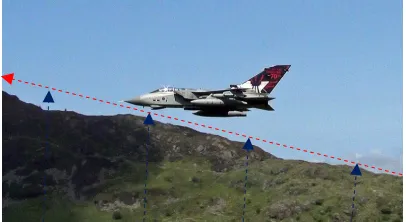
FPN approaches to TF have been discovered to some extent. Although the application of FPN is not widely used with aircraft terrain following started to gain popularity. The motivating force for utilizing a FPN as a new model with aircraft terrain following is we can exploit the linguistic variables a component characteristic in the fuzzy logic [18,19,20]. The bends could have straightforward structures in longitudinal and horizontal of directional planes associated with some transitional bends as shown in Fig. 1. Fundamentally, such direction arranging is utilized
as a part of this examination keeping in mind the end goal to create particular rules to be utilized as a part of FPN decision-making controller as Fig. 2 shows.
[image:2.612.317.520.244.355.2]Here, the model for creating a fuzzy set theory for aircraft terrain following was proposed, is made to measure the terrain following value for aircraft by obtaining the three features in terrain following in the three subsystems Slope, Height, and Spacing for more information than using it in the main system to predict the terrain following value for each case.
Figure 1: Terrain Following Flight Of Longitudinal And Horizontal Directional
Mamdani system [21] which is based on a concept of maximum and minimum operations it is correspondence exactly to FPN method depending on fuzzy sets and fuzzy rules, is used for computing the final result of maintaining the height of aircraft (i.e. velocity Ve) effect of the MF on the slope, height, and spacing of the terrain variables or linguistic concerned and pigmenting a final crisp output. FPN method can be implemented by four steps of processes through the Matlab tool, and the main structure of the main system is explicated in Fig. 2.
Step1 Fuzzification process of input Sl, He, and Sp
variables. Select pertinent input variables of the sub-systems and for main system as well as the UoD for each variable.
Step 2 FPN model is adopted to descript FL and
knowledge base system showing in the cooperating design system.
Step 3 the Mamdani system is used for the purpose
of inference. The FPN approach is a perfect chasing while using four models with a number of fuzzy rules equal to 200 rules will causes an optimal results. These fuzzy rules got them we got them all correctly from knowledge from experts.
Step 4 the final step is defuzzification of the
1002 Inference
[image:3.612.90.294.71.221.2]System FPN
Figure 2: The Structure of Fuzzy System Corporation with FPN.
This research describes and progresses the results of the FPN as a new method based on the aircraft terrain following of decision-making controller. FPN method can be used to put a value to evaluate the accuracy of our problem using a FPN with Matlab tool. Our model used the effects in the concept of if-then rules. The fuzzy system includes the three subsystems that are classified to Fuzzy Slope with two inputs (Sl1 and Sl2) and one output Sl, Spacing with two inputs (Sp1 and Sp2) and one output He, and Height with two inputs (He1 and He2) and one output Sp, and the main system is the velocity with three inputs (Sl, He and Sp) and one output Ve will represent a aircraft terrain following of decision-making which is determined by the results from the three subsystems as showed in Fig. 3.
Figure 3: FPN Model an Overview of Main System
To apply the FPN model with Matlab tool in an implementation, the inputs must be fuzzified, that even, their value is in the range 0 to 1 for He and Sp, -1 to 1 for Sp and 0 to 2 for output Ve , after that the rules defined by the application are applied, and then, the results derived from different rules are combined using an aggregation function. Then, the results that are aggregated are defuzzified through the use of an inference function.
The ratings of the FPN transactions and the combination of the results of the individual
transactions accomplished using fuzzy set operations [10,14,15]. We developed an improved method that worked on the three features of aircraft terrain following of decision-making controller, to predict the value for each subsystem. This method utilizes the information that is collected at the aircraft terrain following. In our system build an optimized model of FPN, this model included one main fuzzy system with three fuzzy sub-systems, was developed as showed in Fig. 4. These have been appointed as Slope, Height, and Spacing sub-systems. Each fuzzy variable has the fuzzy sets depend on intuition. The fuzzy MF for each variable are divided into 5 regions as shown in Fig. 4. And there are 25 transactions (i.e. rules) for each of the three subsystems.
3. FPN APPROACH TO MODELING
AIRCRAFT TERRAIN FOLLOWING
In the suggested FPN model to harmonize such rules, we intend to locate an arrangement of principles which could ensure a protected low-level flight in such regions. Fig. 4 demonstrates a basic algorithm of decision-making which commands the airplane in light of the current terrain profile together with velocity of the airplane, its situation. The basic idea is the created FPN transections (i.e. rules). The inference FPN rules, in any case, must be effective in a general sense however there could be as many as 125 FPN transactions, see fig. 4 block diagram of fuzzy inference reasoning structure. A terrain is perceived in view of FPN model so the little changes in territory are taken for calculation. The aircraft ought to play out a terrain following maneuver in vertical plane, however in light of a few conditions the vehicle can play out a terrain following maneuver in horizontal plane naturally. Settling on knowledge implies a basic decision making through passing across or over a territory. Slope angle of terrain (Sl1 and Sl2), spacing ratio is the ratio of the largest and smallest peak-to-peak terrain (Sp1 and Sp2) and height of vehicle (He1 and He2), and the main system is the velocity (Sl, He and Sp) is output all the inputs and outputs are linguistic variables.
[image:3.612.92.294.457.562.2]Figure 4: Block Diagram of Fuzzy Petri Net Inference Reasoning Structure of Slope, Spacing and Height, and
Velocity
Figure 5: Trapezoidal MFS for Slope, Height, Spacing and the Output Velocity
[image:4.612.95.307.71.269.2]In the FPN slope angle subsystem Sl each variable is divided into 5 regions, is based (Sl1 and Sl2), which is defined as very flat (VF), flat (F), medium (M), sharp (S) and very sharp (VS). Table 1 provides the fuzzy rules for the FPN slope angle subsystem Sl with FPN model. For example, if Sl1 is VF and Sl2 is VS, then slope angle Sl is very sharp (VS). Fig. 6 Instances of modeling fuzzy Petri net fuzzy production rules of slope angle of terrain (Sl1 and Sl2) subsystem.
Table 1: Fuzzy If-Then Rules for FPN Slope Angle Subsystem Sl.
Figure 6: Instances of Modeling Fuzzy Petri Net Fuzzy Production Rules of Slope Angle of Terrain (Sl1 and Sl2) Subsystem
VF F M S VS
VF F VF VF VF VF
F F VF VF VF VF
M VS S M F VF
S S S S M M
VS VS VS S M M
VS S M L VL
Input Variable “Height - He”
VF F M S VS
Input Variable “Slope-Sl”
VL L M H VH
Input Variable “Spacing - Sp”
[image:4.612.91.274.324.725.2] [image:4.612.314.522.397.670.2]1004 And so, in the FPN height of vehicle subsystem He each variable is divided into 5 regions, is based (He1 and He2), which is defined as very low (VL), low (L), medium (M), high (H) and very high (VH). Table 2 provides the fuzzy rules for the FPN height of vehicle subsystem He with FPN model. For example, if He1 is M and He2 is H, then height of vehicle He is low (L). Fig. 7 Instances of modeling fuzzy Petri net fuzzy production rules of height of vehicle of terrain (He1 and He2) subsystem.
Table 2: Fuzzy If-Then Rules For FPN Height Of Vehicle Subsystem He.
Figure 7: Instances of Modeling Fuzzy Petri Net Fuzzy Production Rules of Height of Vehicle of Terrain (He1 And He2) Subsystem.
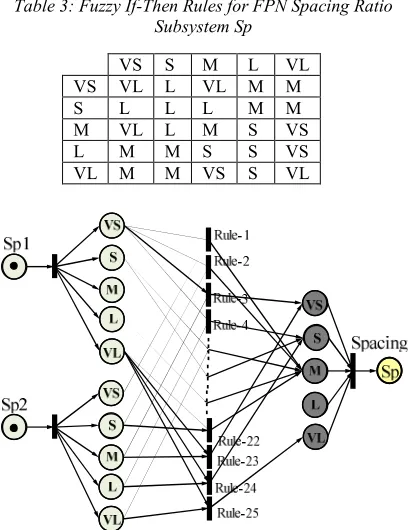
And Similar in the FPN spacing ratio (Sp1 and Sp2) subsystem, each variable is divided into 5 regions, is based on (Sp1 and Sp2), which is defined as very small (VS), small (S), medium (M), Large (L) and very large (VL). Table 3 provides the fuzzy rules for the spacing ratio subsystem. For example, if Sp1 is small (S) and Sp2 is medium (M), then spacing ratio Sp is large (L). Fig. 8 Instances of modeling fuzzy Petri net fuzzy production rules of FPN spacing ratio (Sp1 and Sp2) subsystem.
Table 3: Fuzzy If-Then Rules for FPN Spacing Ratio Subsystem Sp
Figure 8: Instances of Modeling Fuzzy Petri Net Fuzzy Production Rules of FPN Spacing Ratio (Sp1 and Sp2) Subsystem.
Here, we obtained the three input variables (Sl, He and Sp) to use it in the main system the FPN final result of the velocity (Ve) is the output are linguistic variables. The FPN system takes the Sl, He and Sp values as linguistic variables inputs provided by the three subsystems and calculates the overall value of the velocity (Ve). Table 4 provides the fuzzy rules for the velocity (Ve) main system. For example, if Sl is VF and He is VL and Sp is VS then the Ve is VL. Fig. 4 FPN velocity (Ve) main system.
Table 4: Main System Fuzzy If-Then Rules Of Sl, He And Sp As Inputs And Ve As Output.
VL L M H VH
VL L VL VL VL VL
L L VL VL VL VL
M M L VL VL VL
H H M L VL VL
VH VH VH H L VL
VS S M L VL
VS VL L VL M M
S L L L M M
M VL L M S VS
L M M S S VS
VL M M VS S VL
Input Output
Rule No. Sl He Sp Ve
1 VF VL VS VL
2 VF VL S VL
3 VF VL M VL
4 VF VL L VL
5 VF VL VL VL
…… …. … …. …..
121 VS VH VS VH
122 VS VH S VH
123 VS VH M VH
124 VS VH L VH
[image:5.612.93.296.253.519.2]The fuzzy linguistic variables in the velocity (Ve) main system are very low (VL), low (L), medium (M), high (H) and very high (VH), there could be as many as 125 transaction rules.
4. EXPERIMENTAL AND SIMULATION
FPN RESULTS
Our FPN velocity-Ve model was applied using FPN and Matlab tool, we determined the outputs from the collected data, we used the data from the Slope angle of terrain (Sl1 and Sl2), spacing ratio is the ratio of the largest and smallest peak-to-peak terrain (Sp1 and Sp2) and height of vehicle (He1 and He2), that dealt with existing variables (Slope-Sl, Height-He and Spacing-Sp). The FPN velocity-Ve model used the effects of if-then rules to get the crisp output of the aggregate of all the results. In order to determine the main system value of the FPN velocity-Ve, the system uses the numeric data of the Slope-Sl, Height-He and Spacing-Sp and use it as the input in the three FPN subsystems Slope angle (Sl1 and Sl2), spacing ratio (Sp1 and Sp2) and height of vehicle (He1 and He2) to obtain the three subsystems values as shown in the table 5, and uses theses values to the main FPN velocity-Ve model to calculate value of aircraft terrain following as shown in table 6.
Then, the defuzzification of Slope-Sl, Height-He and Spacing-Sp is calculated as Sl1=0.998 and Sl2=-0.361 then the final value of Slope-Sl= 0.0, He1=0.889 and He2=0.566 then the final value of Height-He = 0.5, and Sp1=0.305 and Sp2=0.298 finally Spacing-Sp =1.0 by the centroid of gravity method theses values represent the final results of MF in the each FPNs system.
These Slope-Sl, Height-He and Spacing-Sp values are then sent to the next step of antecedent propositions rules of FPN main model to calculate the FPN velocity-Ve Fig. 9 together with the result of FL model [17]. The fuzzy transactions of FPN model of main model are aggregated to have a crisp value of FPN velocity-Ve value = 1.1. By determining the centroid method, which indicates the winning rule -- FR65 (IF Slope-Sl is medium) and (Height-He is medium) and (Spacing-Sp is very-large) THEN (Velocity-Ve is medium) is the winner rule out of 125 rules.
To illustrate our FPN model we assumed a set of data for both FPN and fuzzy logic models as shown in Fig. 10.
[image:6.612.319.526.97.537.2]Figure 9: Final Decision Of A) FPN Model And B) FL Model [17].
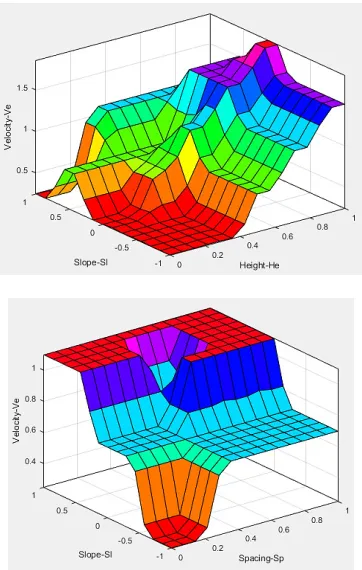
[image:6.612.315.528.573.675.2]1006 The rule surfaces of four systems, which describe the decision-making for aircraft terrain following are shown in Fig. 11. The three Slope-Sl, Height-He and Spacing-Sp values obtained from subsystem models, and the main model value obtain from the main system FPN velocity-Ve model.
Figure 11: The Rule Surfaces of Four Systems Of Slope-Sl, Height-He, Spacing-Sp And Velocity-Ve
5. CONCLUSION
The paper proposes a FPN methodology that could be utilized for aircraft terrain following (TF) through aircraft flights. The configuration process is depicted as a FPN of four models show by fuzzy reasoning learning base in view of transactions or rules. The FPN approach employs special relationships among existing Slope, Height, and Spacing of the terrain together with aircraft flights speed above the ground to the main FPN velocity-Ve model to calculate value of aircraft terrain following. Settling on knowledge implies a basic decision making through passing across or over a terrain. So the execution stream of configured model is chosen. Slope angle of terrain (Sl1 and Sl2), spacing is the ratio of the largest and
smallest peak-to-peak terrain (Sp1 and Sp2) and height of vehicle (He1 and He2), and the main system is the velocity (Sl, He and Sp) is output all the inputs and outputs are linguistic variables.
The process the FPN rules in the subsystem and main system design to determine the aircraft terrain following value, by using the numeric data for each model, we obtained the result with high ratio of the accuracy and high performance by building broader MF. Compared our FPN model with existing fuzzy logic method to a crisp values, our method can make a decision with more confidence.
REFRENCES:
[1] Malaek, S.M. and Kosari, A.R., “Novel minimum time trajectory planning in terrain following flight”, IEEE Transactions on Aerospace and Electrical System, Vol. 43, pp. 2-12, 2007.
[2] Malaek, S.M. and Kosari, A.R., “Dynamic based cost functions for TF/TA flight”, paper presented at the IEEE Transactions on Aerospace and Electronic Systems, Guidance and Control, 2010.
[3] Shioiri, H. and Ueno, S., “Three-dimensional collision avoidance control law for aircraft using risk function and fuzzy logic”, Trans. Japan Soc. Aero. Space Sci., Vol. 46 No. 154, pp. 253-61, 2004.
[4] Rahim, M. and Malaek, S.M., “Fuzzy terrain following flight: a new approach”, First Inter. Symp. on Systems and Control in Aerospace and Astronautics (ISSCAA), pp. 510-3, IEEE Cat. No. 06EX1168C, Harbin, 2006a.
[5] Rahim, M. and Malaek, S.M., Intelligent Based Trajectory Planning in Terrain Following Flight, ICAS, Hamburg, September, 2006b.
[6] Rahim, M. and Malaek, S.M., “Intelligent operation using terrain following flight in unmanned aerial vehicles”, IEEE Aerospace and Electrical System Conference, Big Sky, MT.2007.
[7] Liu, H. C., You, J. X., & Tian, G., “Determining Truth Degrees of Input Places in Fuzzy Petri Nets”, IEEE Transactions on Systems, Man, and Cybernetics: Systems, PP(99), 1-7, 2016.
operators”, IEEE Transactions on Cybernetics, 46(8), 1839-1850, 2016.
[9] Raed I. H, S. I. Ahson, and R. Parveen., “Designing Genetic Regulatory Networks Using Fuzzy Petri Nets Approach”, (IJAC), Springer, Vol. 7(3), pp. 403-412, 2010. [10]Liu, H. C., You, J. X., You, X. Y., & Su, Q.,
“Linguistic reasoning Petri nets for knowledge representation and reasoning”, IEEE Transactions on Systems, Man, and Cybernetics: Systems, 46(4), 499-511, 2016. [11]Asseo, S.J., “Terrain following/terrain
avoidance path optimization using the method of steepest descent”, Proceedings of the IEEE National Aerospace and Electronics Conference, Inst. of Electrical and Electronics Engineers, New York, NY, USA, Vol. 3, pp. 1128-36, 1988.
[12]Innocenti, M., Pollini, L. and Turra, D., “A fuzzy approach to the guidance of unmanned air vehicles tracking moving targets”, IEEE Transactions on Control Systems Technology, Vol. 16 No. 6, pp. 1125-37, 2008.
[13]Malaek, S.M. and Kosari, A.R., “Novel minimum time trajectory planning in terrain following flight”, IEEE Transactions on Aerospace and Electrical System, Vol. 43, pp. 2-12, 2007.
[14]Raed, I.H., Ahson, S.I., “Confidence value prediction of DNA sequencing with Petri net model ", Journal of King Saud University – Computer and Information Sciences (2011) 23, 79–89, 2011.
[15]Raed I. Hamed, “Expert Systems of Adaptive Fuzzy Reasoning-Based Implementation for Velocity Estimation of Servo Motor System”, International Journal of Computer Science and Control Systems (JCSCS). Vol. 7, No. 1, pp. 4-14, May 2014.
[16]Wu, P., Clothier, R. and Campbell, D., “Fuzzy multi-objective mission flight planning in unmanned aerial systems”, Proceedings of IEEE Symposium on Computational Intelligence in Multi criteria Decision, Honolulu, Hawaii, USA, pp. 1-5, 2007. [17]M. Rahim and S. Móhammad-Bagher,
"Aircraft terrain following flights based on fuzzy logic", aircraft engineering and aerospace technology. Vol. 83 (2), pp. 94 – 104, 2011.
[18]Z. Suraj, “A new class of fuzzy Petri nets for knowledge representation and reasoning,” Fund. Informat., vol. 128, nos. 1–2, pp. 193– 207, Jan. 2013.
[19]MENG Xian-gang, YAN Hong-sen. Purchase forecasting in knowledgeable manufacturing systems based on self-learning fuzzy Petri nets. Control and Decision, 243):371-377,
2009.
[20]Yin-zhang GUO, Jian-chao ZENG. Decision-making and controlling for products collaborative design implement process based on fuzzy Petri net. Procedia Engineering, 15, 3032 – 3040, 2011.


![Figure 10: Comparing FPN model and fuzzy logic model [17]](https://thumb-us.123doks.com/thumbv2/123dok_us/8907468.957502/6.612.319.526.97.537/figure-comparing-fpn-model-and-fuzzy-logic-model.webp)