3555
A C2C E-COMMERCE TRUST MODEL BASED ON
REPUTATION
ZHANG YILONG, JIANG HUIFANG, ZHANG SHUOSHUO,WANG XIAORUI, REN YUAN
School of Computer Science and Technology, China University of Mining and Technology,Jiangsu, Xuzhou 221116, China
E-mail: [email protected]
ABSTRACT
The reputation of the nodes come from the evaluation information in C2C e-commerce. The trust model in actual application is generally cumulative or mean model, this model is too simple to effectively resist malicious attacks because of the false evaluation, it is difficult to guarantee the accuracy of reputation calculation. A new trust model is proposed in the paper, in which the seller’s reputation and buyer’s credit are designed respectively. The model also considers the new factors, such as the default reputation of the system, the number of failed transactions, the credibility of the transaction and so on. In order to calculate the buyer’s confidence in the seller, it increased the buyer’s confidence in the goods. The experimental results show that the model is effective and anti attack, and it is more accurate than the existing trust model. It can be effectively applied to C2C e-commerce system.
Keywords: Reputation, Trust Model, False Evaluation, E-commerce, Node
1. INTRODUCTION
E-commerce is giving convenience to consumers, at the same time, its revealed credit problems also affect the consumer's confidence. The virtual nature of the network makes it difficult for consumers to discern the authenticity of merchant information and product information. The C2C e-commerce is an anonymous discontinuous transaction between individuals, so the authenticity of the evaluation information is more difficult to guarantee [1]. Existing research shows that trust is an effective way to solve the credit problems.
Gambetta and Abul-Rahman give the concept of trust: The trust that individual A for individual B is the subjective possibility that individual A expects individual B to be A's service[2]. Most current C2C e-commerce sites are using reputation mechanism, The Well-known C2C e-commerce sites, such as eBay, Taobao are using this feedback mechanism, this mechanism is simple and intuitive, but in practice there are many drawbacks, such as credit speculation, malicious slander [3].
In this regard, scholars at home and abroad put forward a variety of reputation-based trust model. Literature[4] proposed global reputation and local reputation. Literature [5] considered a number of factors that affect the value of trust, including transaction evaluation, number of transactions
between nodes, credibility of evaluation nodes, transaction context and community context and many more and so on. On the basis of the literature [4], Jiang Shou-xu et put forward a method of determining the confidence factor and designed the evaluation quality model [6]. In the literature[7-8], Jiang Shou-xu's model is improved, which introduced the degree of dispersion of rewards and punishments and feedback information. Literature [9] uses a specific analysis of similar and misleading goods to set the trust model in e-commerce. Literature [10] enhances the trust model's security by adopting a variety of methods, including the introduction of competence evaluation, service expectation, historical trust in P2P networks, and the analysis of node feedback value, recommendation evaluation and global trust to enhance the trust model. Literature [11] studied the influence of communication agent's reputation and message frame on trust model, and it proved the effective role of trust model in VANETs through theoretical analysis and experimental verification.
3556 punishment system; 3)Some models ignore the calculation of evaluation credibility or the calculation is too simple, it is difficult to deal with malicious attacks and the model's accuracy is low. In this regard, this paper presents a new trust model based on the trust of merchants and the trustworthiness of goods, namely the SPT model(Trust Model Based on Sellers Trust and Products Trust), improving the existing trust model, more suitable for C2C e-commerce.
2. SPT TRUST MODEL
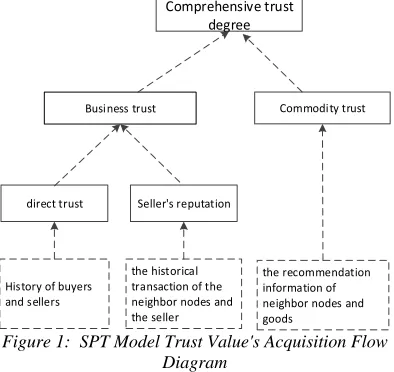
The SPT model calculates the buyer's trust in the transaction and helps the buyer make the purchase decision. Model trust value acquisition process diagram shown in the Figure 1. The buyer's comprehensive trust in the transaction comes from the business trust and product trust. Business trust is the buyer's trust in the seller. The trustworthiness of the goods refers to the buyer's trust in the goods to be purchased,which is obtained by the recommendation of other buyers who have purchased the goods.
Business trust Commodity trust
Comprehensive trust degree
History of buyers and sellers
the historical transaction of the neighbor nodes and the seller
Seller's reputation direct trust
[image:2.612.97.294.365.551.2]the recommendation information of neighbor nodes and goods
Figure 1: SPT Model Trust Value's Acquisition Flow Diagram
2.1 Business reputation calculation
The buyer's direct trust to the seller derived from the level of trust gained through the historical records and ratings of both, derived from the direct trading experience between the two. The model takes into account the trading hours, the trading evaluation and the transaction amount, and explicitly expresses the impact of the number of transactions on the direct trust.
Let the trust value calculate the initial time as
t
0 and the current time ast
c . After timet
0, buyeri
and sellerj
haven
times transactions, of which the number of successful transactions iss
n
and the number of failed transactions isn
f .[1, ]
sk
n
,V i j k
( , , )
andm
k represent the evaluation and transaction amount of buyeri
to sellerj
after thek
successful transaction respectively. The direct trust DTij of buyeri
to sellerj
is calculated as shown in formula (1):1
1
( , )
( , , )
( , , )
( , , )
ns f k
k
ij n
k k
n n
s i j k
m
V i j k
DT
s i j k
m
(1)s( , , )i j k is the time factor, which represents the weight of the rating given by the buyer
i
in thek
transaction with the sellerj
in the direct trust, the shorter the transaction time is from the time of calculating the trust value, the more bigger of the proportion of the evaluation. The calculation of s( , , )i j k is as shown in formula (2):0
0 1
s( , , )=
(
)
k n
i i
t
t
i j k
t
t
(2)( ,
n n
s f)
is the transaction number adjustment function, calculated as shown in formula (3):( ,
n n
s f)
s( )
n
s f( ,
n n
s f)
(3)( )
s
n
s
is the number of successful transaction adjustment function, the more successful transactions, the more accurate of the direct trust that the buyer to seller, take ( ) 1 nss ns e
.( ,
n n
s f)
is the transaction failure adjustment function, when the transaction failure rate increases,( ,
)
fn n
s f
decreases, takings
( )
( , ) (2 )nf nf n
f n ns f e
. 2.2 Buyer trust calculation3557 refers to whether the buyer's performance in the process of trading is credible, such as whether the buyer's attitude is reasonable. The evaluation credibility refers to the credibility of the buyers' evaluation, considering whether the buyers actively submit the evaluation and whether the evaluation is true. In practice, when buyers are unwilling to take the initiative or forget the score, the system acquiesce in the default. Some sellers will use the cash rebate to improve their reputation (e.g., five star reviews), so that the buyer will give the favorable comment on purpose. When calculating the credit rating of the buyer, the default evaluation and false evaluation should be considered.
Supposed that from the initial moment of trust value, the initial moment
t
0 to the current timet
c , buyeri
has donen
transactions.C
irepresents the credit degree of buyer
i
aftern
transactions, and its calculation is shown in formula (4): 0 1
( ( , )
( ))
1
n k ip i k
g
f
C
C
n
(4)(1) C0 is the initial value assigned by the system to the buyer, which makes it 3.
(2) p i k( , ) is the result of buyer
i
's successfultransaction
k
times,p i k
( , ) [0,5]
.(3)
g
is the test factor to determine whether the score is default good evalution in the system. The calculation is as shown in formula (5):1, Non-systematic score
0 System rating
g
,
(5)(4)
is the dispersion degree of the evaluation, comparing the dispersion degree of the buyer's score and the average score to determine whether the buyer is true or not. The calculation is as shown in formula (6):1
( , , )
=
( , , )
jj
V i j k
U
V i j k
U
,
0
,
(6)( , , )
V i j k is the buyer
i
's rating on the goodj
purchased in
k
transactions, while Uj is the average score of the commodityj
.
is the minimum, set it to:2 1
1
=
n( ( , )
l j)
lV i j
U
n
(7)n
is the number of neighbor nodes of commodityj
,V i j
( , )
l represents the evaluation of the neighbor nodei
l of commodityj
.(5) f( )
is the reward and penalty function, which is calculated as shown in formula (8):1
1
( )
(1
)
2
m
m
f
e
e
(8)Among them, 1m
e
is the acceleration factor andm
is the transaction value of thek
transaction.
is the reward adjustment factor that prevents the reward from overflow. The calculation is as shown in formula (9):0
( , ) 5
=
( , )
( , ) 5
5
p i k
p i k
p i k
,
,
(9)( , )
p i k
is the result of buyeri
'sk
successful transaction,p i k( , ) [0,5] 。2.3 Seller trust calculation
Seller's reputation is based on the seller's historical behavior observation or evaluation of information derived from the seller's future behavior expectations. The reputation of the seller is calculated from historical transaction evaluation information obtained by the seller. In order to reduce the calculation time and storage load, this paper introduces a time window. First define a time window
T
, its length is setted according to the specific application of e-commerce platform。Time windowT
will be divided into a number of time periods from the initial trading timet
0 to the current time oft
c , which are marked as1
, , ,...,
2 3 nT T T
T
according to the distance from the current time , simply store the transaction record of the current time windowT
n.Suppose in the time period
T
n, the seller successfully traded n times. The seller's current reputation valueR
(jcur) within the time periodT
nmay be expressed as shown in formula (10):
( ) 1
1
( , )
( , )
( , )
n k cur k j n k kC
F k j
V k j
R
C
F k j
3558 In it,
V k j
( , )
is the evaluation obtained by the sellerj
after thek
transaction,C
k is the buyer's credit rating in thek
trading,F k j
( , )
is the familiarity that buyer to the seller operating type in thek
trading. The number of times the buyer buys the same type of goods indicates the familiarity of the buyerk
to the sellerj
's merchandise category. If the system hasl
categories of goods, the seller's corresponding management matrix[type
1
]
MS
,
t ype2,
,
t ype
l
, marking the type of seller's merchandise as 1, others set to 0.The buyer's purchasing matrix
1 2
,
[b ,
l]
MB
n bn
,
bn
, wherebn
k represents the number ofk
type of goods purchased. The familiarityF k j
( , )
of buyerk
to sellerj
isexpressed as
( , )
TF k j
MB MS
.Further, the accuracy and validity of sellers reputation calculations can be considered by synthesizing historical transaction records. This section will give an iterative calculation. Suppose the seller's reputation at
TS
n1 isR
nj1, and thecurrent seller's reputation
R
nj is calculated as shown in formula (11):1
(1
)
( )n n cur
j j j
R
R
R
(11) where ,
is the historical weight factor. Considering the influence of the time factor, the longer the current time, the smaller the weight of the current partial trust calculation, that is, the influence of the historical trust data in the partial trust calculation should be gradually weakened. At this time, the historical weight factor
can be calculated according to the formula (12):=
1+
(12)Let
be the time attenuation factor. If
=1
, then the historical data will not be weakened. The historical data has the same weight as the current trust data. If
=0
, the influence of historical data is not considered at all, and0.7
0.95
.n j
R
is the seller's reputation based on the evaluation of the neighbor nodes ofj
, and then revises the expectation to obtain the reputation according to the number of transactions and the total amount of the transaction. The reputationR
jof seller
j
is defined as shown in equation (13):= ( ,
)
nj j j
R
N M
R
(13) Where
(
N
,
M
j)
is the adjustment function,N
is the total number of transactions of sellerj
, and Mj is the seller's cumulative sales amount. The more the total number of transactions and the total turnover, the closer the seller's reputation to the true value, take(
)
1/NMjj
N
M
e
,
.2.4 Business reputation calculation
Business reputation is the seller's reputation or expected to the seller's behavior,which is obtained through observations for seller's historical behavior or evaluation information. The historical transaction evaluation information the seller obtained is used to calculate the seller's reputation. In order to reduce the computing time and storage load, this paper introduces a time window. First define a time window
T
, accordingto the specific application of e-commerce platform to set its length. The time window
T
is used todivide the time period from the initial transaction time
t
0 to the current timet
c into a plurality of time segments, which are marked as1
, , ,...,
2 3 nT T T
T
according to the distance from the current moment, and only store Transaction records in the current time windowT
n.Suppose in the time period
T
n, the seller successfully traded n times. The seller's current reputation valueR
(jcur) within the time periodT
nmay be expressed as shown in formula (14):
( ) 1
1
( , )
( , )
( , )
nk cur k
j n
k k
C
F k j
V k j
R
C
F k j
(14)( , )
V k j
is the evaluation obtained by the sellerj
after the
k
th transaction,C
k is the buyer's credit rating of thek
transaction buyer,F k j
( , )
is thek
th transaction buyer's familiarity with the seller's operation type. The number of times the buyer purchases the same type of commodity represents the familiarity of the buyerk
with the type of sellerj
's merchandise. If the system hasl
categories of goods, the seller corresponds to the
3559
[
1,
2,... type ]
MS
type type
,
l
, the seller of goods belonging to the type marked as 1, the other set to 0. The buyer's purchasing matrix1 2
,
[b ,
l]
MB
n bn
,
bn
, where thebn
krepresents the number of
k
types of goods purchased. The familiarityF k j
( , )
of buyerk
with seller
j
is denoted by( , )
TF k j
MB MS
.Further, synthesizing historical transaction records can be used to improve the accuracy and validity of sellers reputation calculations. This section will give an iterative calculation. Let
1
n
TS
time seller reputation asR
nj1, the currentseller reputation
R
nj calculated as shown in formula (15):1
(1
)
( )n n cur
j j j
R
R
R
(15)In it,
is a historical weighting factor. Considering the influence of the time factor, the longer the current time, the smaller the weight of the current partial trust calculation, that is, the influence of the historical trust data in the partial trust calculation should be gradually weakened. At this time, the historical weight factor
can be calculated according to the formula (16) method:=
1+
(16)Let
be the time attenuation factor. If
=1
, then the historical data will not be weakened, and the historical data will have the same weight as the current trust data; If
=0
, the influence of historical data is not considered at all, and it is usually desirable that0.7
0.95
.n j
R
is based on the neighbor nodes of sellerj
to make an evaluation of the seller's reputation to calculate expectation of sellerj
, Then gain a reputation by correcting the expectations based on the number of transactions and the total amount of the transaction. The reputationR
j of sellerj
is defined as shown in equation (17):= ( ,
)
nj j j
R
N M
R
(17)In it,
(
N
,
M
j)
is the adjustment function,N
is the total number of transactions by seller
j
,j
M is the seller's cumulative sales amount. The more the total number of trades and the total amount of transactions, the closer the seller reputation to the true value, take
1/
(
)
NMjj
N
M
e
,
.2.5 Product trust calculation
In the e-commerce environment, the trustworthiness of the product
TP
refers to the credibility of the product obtained by the consumer based on the evaluation of other buyers who have purchased the product. The trustworthiness of the goods is based on the recommendation income of its neighbor nodes (buyer nodes who have purchased the goods). This paper calculates the degree of product trust, taking into account the following factors:1)The number of neighbor nodes. The more the number of neighbor nodes, the more accurate the product trust.
2)The product's neighbor node recommends the product.
3)Recommended trust of neighbor nodes.
Suppose that after time
t
0, buyeri
has purchasedn
productsj
.
k
[1, ]
n
,( , , )
v i j k
and s( , , )i j k respectively represent thek
times buyersi
evaluation of goodsj
and time factor. The degree of recommendationRD
ij of the buyeri
to the commodityj
is as shown in formula (18):1
( , , )
( , , )
nij k
RD
s i j k
v i j k
(18) When the product recommendation is used to calculate the product trust, it needs to consider whether the last evaluation time calculated by the product recommendation is too far from the current calculation time. If it is too far, you need decay time to the degree of recommendation of goods. Let
the last time of trade
t
t
, the calculation of the3560
,
( , )
(1
)
,
l
l
j j c l
j j c
RD
t
t
RD j j
s RD
t
t
(19)In it
is the valid time window, letting0
c
t
t
t
, the time attenuation factors
is calculated as shown in equation (20):1
(
n i)
i
s
t
t
t
(20)The Recommendation Credibility refers to the degree of trust consumers evaluate the information of other buyers, reflecting the conditional delivery of trust. Suppose that the
purchase matrix of buyer
i
is1 1
[ , ,..., ]
i l
MB
a a
a
and the purchase matrix of buyerk
isMB
k
[ , ,..., ]
b b
1 1b
l . If the purchase matrix of buyerk
and buyeri
more similar, the two tend of spending is also more similar. If the two had bought the same product and the greater the number of same goods, reflects both consumption habits increasingly similar. In this paper, we consider the similarity between two buyers' purchase matrix and the same number of goods to calculate the recommendation credibility of buyerk
relative to buyeri
. The recommended reliabilityRC
ik is calculated as shown in Equation (21):( , )
(1
sim i k)
ikRC
e
sp
(21) In it,2
1
( , )
l(
j j)
j
sim i k
a
b
represents the purchasing experience similarity of two buyer nodes. And
sp
is the same number of goods.To sum up, we give the formula
TP
for calculating the trust value of the commodityj
, as shown in formula (22):1 1
( , )
( )
N ik k N ik kRC
RD k j
TP
N
RC
(22) ( )N
is the adjustment function, N is the number of neighbors of commodityj
. The more the number of neighbor nodes, the closer the trustvalue approach the true value of the product, taking 1/
( )
NN
e
.2.6 Comprehensive trust calculation
The degree of trust
T
of buyeri
on the sellerj
on the productp
is use of weight factors and business trust and product trust to calculate. The definition of degreeT
of trust is shown in formula (23):1 2
T
TS
TP
(23) Among it,
1,
2 are weight,w1 indicates the importance of consumer trust to the business trust in this transaction, w2 indicates the importance of consumer trust to the product trust in this transaction. Let
1+ =1
2 , among id0
1,
2
1
. This paper argues that the two reflect the trust value from different views and both have the same weight, taking
1=0.5
,
2=0.5
.When conducting small transactions, the transaction risk is low, you can properly increase the trust value to facilitate transactions to improve the seller's reputation. The trust value
T
calculated by the SPT model can be combined with the current transaction amount for risk control to make the model more flexible. The final integrated trustTrust
is shown in equation (24):(
)
5
F amount
T
Trust
(24)Amont it,
-(
)
amount
F amount
e
is the risk control function .
is the maximum amount of risk that the user can bear,amount
is the current transaction amount. Ifamount
, thenF amount
(
)
1, the value of trust is increased relative to the previous value. Conversely, ifamount
, that is, the transaction value exceeds the maximum amount that the user can bear, the trust value will be reduced and the transaction risk will be reduced.3. SIMULATION EXPERIMENT AND ANALYSIS
3561 to distribute high-quality or inferior goods. According to the quality of the seller's merchandise, the seller can be divided into honest service sellers, dishonest service sellers, random service sellers and oscillation service sellers. The buyers can be divided into credit evaluation buyers, random evaluation of buyers, the default evaluation buyers, exaggerated evaluation of buyers and slander evaluation buyers.
Suppose the product quality parameter is r, then the evaluation of the buy's evaluation to the seller is r, the random evaluation of the buyer to the seller takes a random integer between 1-5. Default rating buyer rated the seller as 5. Exaggerated evaluation of the exaggerated buyer to
the seller is
*
2.5 ,5
[image:7.612.314.523.75.208.2]max r
exaggerator
r
,exaggerator
is an exaggerated factor. Slander evaluation of the slander buyer to the seller ismin r
,5
r
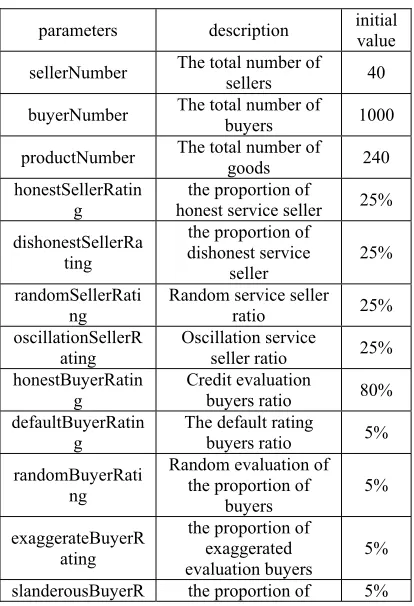
. In reality, as long as the buyer has no obvious malicious purchase behavior, the seller usually gives praise to the buyer. The experiment for the seller to the buyer's rating is set to 4 or 5. The main parameters of the experiment are shown in Table 1.Table 1: The Main Parameters of The Simulation Experiment.
parameters description initial value
sellerNumber The total number of sellers 40
buyerNumber The total number of buyers 1000
productNumber The total number of goods 240 honestSellerRatin
g
the proportion of
honest service seller 25% dishonestSellerRa
ting
the proportion of dishonest service
seller 25%
randomSellerRati ng
Random service seller
ratio 25%
oscillationSellerR ating
Oscillation service
seller ratio 25%
honestBuyerRatin g
Credit evaluation
buyers ratio 80%
defaultBuyerRatin
g The default rating buyers ratio 5% randomBuyerRati
ng
Random evaluation of the proportion of
buyers
5%
exaggerateBuyerR ating
the proportion of exaggerated evaluation buyers
5%
slanderousBuyerR the proportion of 5%
ating swear evaluation
buyers
Trade_number Total transactions 20000 t0 Trust calculates the initial time 0
r Product quality 4
oscillation Oscillation factor 4 exaggerator Exaggerated factor 0.5
Time attenuationfactor 0.75
For the sake of discussion, random evaluation of buyers, the default evaluation buyers, exaggerated evaluation buyers and slander evaluation buyers are called malicious evaluation buyers. The proportion of malicious evaluation buyers reflects the degree of attack strength, the experiment defines the following four types of attacks: Mild attack, Moderate attack, Severe attack and Extreme attack. The proportion set of various malicious attack nodes Shown in Table 2.
Table 2: The Main Parameters of The Simulation Experiment. Atta ck type The propor tion of the defaul t rating buyers The propor tion of the rando m rating buyers The propor tion of the exagg erate rating buyers The propor tion of the slande r rating buyers The proporti on of maliciou s nodes Mild attac k
5% 5% 5% 5% 20%
Mod erate attac
k
10% 10% 10% 10% 40%
Seve re attac
k
15% 15% 15% 15% 60%
Extr eme attac k
20% 20% 20% 20% 80%
3.1 Direct trust analysis
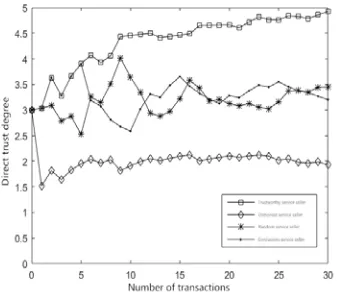
[image:7.612.90.297.434.737.2]3562 malicious buyers is set to 0. The results of the experiment are shown in Figure 2. The direct trust of the sellers of good faith gradually rises and tends to be stable, and the direct trust degree of the dishonest service sellers is obviously lower than the other three sellers. The oscillating service seller and the random service seller show different trends, and show different trends according to their trading characteristics. The direct trust degree calculation method can distinguish the direct trust degree that evaluation of buyers directly to sellers of different quality of service, which shows that the calculation method is effective. When verifying the SPT model 's method of calculating the direct trustworthiness against the seller' s large amount of integrity and fraud, the experiment set the seller to conduct several small good faith transactions to enhance trust and then conduct large amount of fraudulent transactions. The mean model (labeled as AVG) is compared with the SPT model. The experimental results are shown in Figure 3. The direct trust calculated by SPT model grows slowly when the seller deals in the early stages of small trustworthiness and increases to a higher value after many good faith transactions. It declined rapidly when sellers were massively fraudulent and declined significantly more than the increase in small-value, honest transactions. However, AVG calculated the direct trust to deal with large-scale fraud decreased less, did not play a penalty effect, and the ability of the SPT model to counter the large-scale monster fraud is significantly better than the AVG model.
[image:8.612.108.277.481.627.2]Figure 2: Direct trust degree
Figure 3: Comparison of direct trust degree
3.2 Buyer creditability analysis
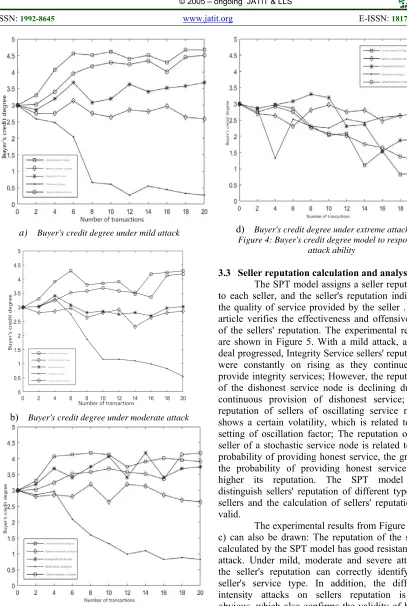
3563 a) Buyer's credit degree under mild attack
b) Buyer's credit degree under moderate attack
c) Buyer's credit degree under severe attack
[image:9.612.95.502.60.666.2]d) Buyer's credit degree under extreme attack Figure 4: Buyer's credit degree model to respond to
attack ability
3.3 Seller reputation calculation and analysis
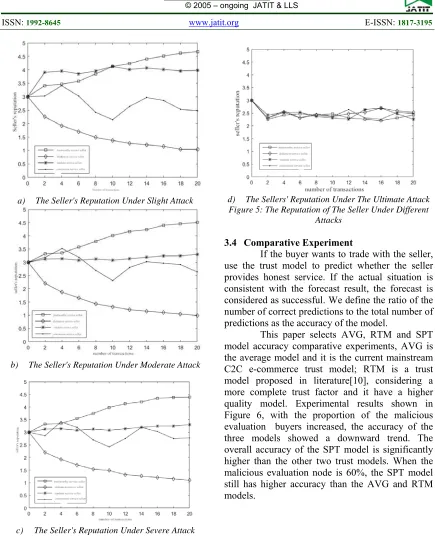
The SPT model assigns a seller reputation to each seller, and the seller's reputation indicates the quality of service provided by the seller . This article verifies the effectiveness and offensiveness of the sellers' reputation. The experimental results are shown in Figure 5. With a mild attack, as the deal progressed, Integrity Service sellers' reputation were constantly on rising as they continued to provide integrity services; However, the reputation of the dishonest service node is declining due to continuous provision of dishonest service; The reputation of sellers of oscillating service nodes shows a certain volatility, which is related to the setting of oscillation factor; The reputation of the seller of a stochastic service node is related to the probability of providing honest service, the greater the probability of providing honest service, the higher its reputation. The SPT model can distinguish sellers' reputation of different types of sellers and the calculation of sellers' reputation is valid.
3564
a) The Seller's Reputation Under Slight Attack
b) The Seller's Reputation Under Moderate Attack
c) The Seller's Reputation Under Severe Attack
[image:10.612.89.524.56.610.2]d) The Sellers' Reputation Under The Ultimate Attack Figure 5: The Reputation of The Seller Under Different
Attacks
3.4 Comparative Experiment
If the buyer wants to trade with the seller, use the trust model to predict whether the seller provides honest service. If the actual situation is consistent with the forecast result, the forecast is considered as successful. We define the ratio of the number of correct predictions to the total number of predictions as the accuracy of the model.
[image:10.612.96.303.76.585.2]3565
Figure 6: Comparison of The Accuracy of Different Models
The SPT model uses a time window to calculate the sellers' reputation and only needs to calculate the transaction records in the current time window, which greatly reduces the computational workload. This article compares the SPT, AVG and RTM three models' running time, the results shown in Figure 7. The SPT model time is higher than the AVG model that have simple calculation, but the difference is small. Compared with the RTM, the SPT model’s time is still less than the RTM model in the case of higher accuracy than the RTM model. Experiments show that the SPT model has higher computational efficiency.
Figure 7: Comparison of Run Time
4. CONCLUSION
The SPT trust model proposed in this paper improves the reputation of sellers based on the existing trust models. The SPT model added to the system default praise and the number of transactions failed to improve the accuracy of direct trust. The SPT model calculates the seller's reputation and computes the trustworthiness of the
goods. The simulation results show that the model can accurately reflect the node trust and reduce the time cost, to a certain extent, improve the resistance to attack. However, due to the lack of researches on e-commerce trust model at home and abroad, the complexity of the network and the abstraction of trust, the model still needs to be improved continuously. In the follow-up study, we should focus on the improvement of the model and the factors of network complexity, so as to improve the practical value of the model.
List and number all bibliographical references in 10-point Times New Roman, single-spaced, at the end of your paper. For example, [1] is for a journal paper, [2] is for a book and [3] is for a conference(symposium) paper.
REFRENCES:
[1] GAN Zao-Bin, ZENG Can, MA Yao, LU Hong-Wei, "C2C E-Commerce Trust Algorithm Based on Trust Network", Journal of Software, vol. 26, no. 8, 2015, pp.1946-1959.
[2] Abdul-Rahman Alfarez, Stephen Hailes. "Supporting trust in virtual communities", Proc.of the 33rd Hawaii Int’l Conf.on System Sciences,USA, vol. 1,2000, pp. 9-pp.
[3] LI Dao-quan, LIANG Yong-quan, ZHANG Wei, "Survey on trust management for e-commerce systems", Application Research Of Computers,vol.4,2010,pp.1207-1211+1226. [4] Resnick Paul, Richard Zeckhauser, "Trust
among strangers in Internet transactions: empirical analysis of eBay's reputa-tion system"//Proc of Economics of Internet and e-Commerce, 2002 pp.127-157.
[5] XIONG Li, LIU Ling, "PeerTrust: supporting reputa-tion-based trust for peer-to-peer electronic communi-ties", IEEE Transactions on Knowledge and Data Engi-neering, vol.16, no.7,2004, pp.843-857.
[6] JIANG Shou-Xu, LI Jian-Zhong, "A Reputation-Based Trust Mechanism for P2P E-Commerce Systems", Journal of Software, vol.18, no.10,2007,pp.2551-2563.
[7] WANG Liang, GUO Ya-jun, "Trust Modeling and Evaluation in E-commerce System", Computer Engineering, vol.35, no.32910,2009, pp.129-131.
[8] LI Dao-quan, "E-commerce trust management modeland methodological research", Shandong University of Science and Technology,2011 [9] LONG Yin, LIU Hong-Yan, HE Jun, HU He,
[image:11.612.91.296.445.601.2]3566 Product Description in E-Commerce Website", Journal of Software,vol.25, no.S2,2014, pp.127-135.
[10] ZHU Jie, "Research on Trust Model in P2P Network", Nanjing University Of Posts And Telecommunications,2016
[11] Giuseppe Primiero, Franco Raimondi, Taolue Chen, Rajagopal Nagarajan, "A Proof-Theoretic Trust and Reputation Model for VANET", IEEE,2017,pp.146-152.
[12] Ebrahim Bagheri,Ali A. Ghorbani. “Behavior analysis through reputation propagation in a multi-context environment”,ACM,2006. [13] Judd Antin, Elizabeth F. Churchill, Bee-Chung